About this episode
Get every episode summarized
Each time Bright Side Universe publishes, we email you a written briefing from the transcript — the topics, who appeared, and any specific claims, with the ad reads skipped.
Email me new episodesFree for 3 shows. No card needed.
Hosts & guests

Transcript ready
104 searchable segments. Every word is indexed and playable.
Full transcript
Bright Side Universe — This Planet Is Moving Toward Its Doom. Machine-transcribed; use the interactive transcript above to jump the player to any line.
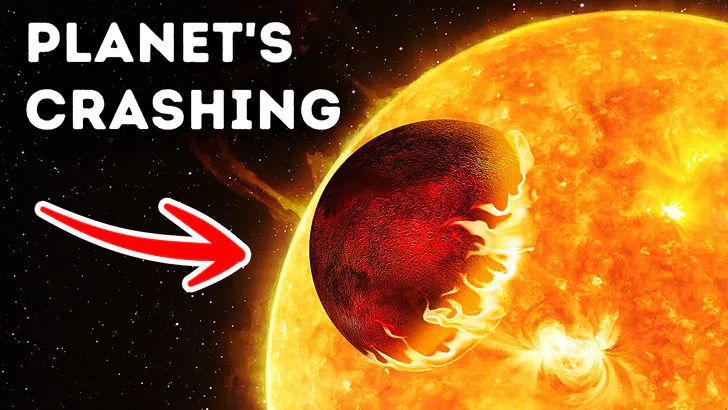
in a star system far far away. To be more precise, 2600 light years away. There's an exoplanet called Kepler 1658B. It's a gas giant that resembles our Jupiter, but what differentiates it from Jupiter is that this poor planet is doomed. It's spiraling toward its parent star, which will eventually end in a fiery collision. But the most interesting thing? Astronomers would have remained totally ignorant of this fact. If not for a tiny clue. It was a really minuscule change in the planet's orbit. It wouldn't have been noticed if astronomers hadn't compared more than a decade of data received by different telescopes. More precisely, scientists have been watching the exo-Jupiter pass between our planet and its parent star once every two weeks for the last 13 years. And they've noticed that the orbit of the planet is getting smaller and smaller. Every year, Kepler 1658B needs 131 milliseconds less to complete a lap around its star.
If this tendency continues, the planet is bound to collide with its star in 2.5 million years. Even before this discovery, computer models predicted that some planets could meet their end by crashing into their stars. But this is the first time when astronomers have some real proof of such an outcome by measuring almost imperceptible changes in a planet's orbit. They now know for sure what happens when a planet is going to crash into its star, even though we probably won't be around to witness it. But let me tell you a bit more about the doomed planet. It was discovered by NASA's now retired Kepler Space Telescope. It was launched in 2009 and its mission was to find planets orbiting other stars, aka exoplanets. And the very first exoplanet the telescope spotted was the very gas giant we've been talking about. But it took astronomers about a decade to confirm that this space object was indeed an exoplanet. This world is like a dense version of Jupiter.
I mean, take six Jupiter's worth of material, roll it into a ball about 1.1 times as wide, and voila, the planet is tidally locked to its parent star, which means that it makes one complete turn every time it finishes a lap around the star. As a result, the same side of the gas giant is always facing the star. It's the same as what happens to the moon. Our natural satellite is tidally locked to Earth. That's why we only see half its surface. Now what is making the exo-Jupiter fall into its star? The same process that is pushing the moon away from Earth. When a moon orbits a planet or a planet orbits a star, their gravity forces interact and tug on the other's mass. That's what causes tides on Earth. This tugging releases some energy. It can make an object speed up and slow down. In the first case, a space body will move higher. In the second, it will start moving lower, and this is exactly what's happening to the gas giant. Its parent star is 1.5 times the
mass of the sun, so no wonder its tidal forces are gradually slowing down the planet's movement, making it fall inward. This all sounds kind of tragic, but this potential collision is by far not the weirdest thing happening in space. Let's look at some others. For example, Beetlejuice, a red giant in the Orion constellation, started to dim in 2019. This confused astronomers. By that time, the star had already swollen to enormous proportions. If it was to replace our sun, its outer surface would spread far beyond Jupiter's orbit. And then Beetlejuice became dimmer in the fall of 2019. This process continued through February 2020. The changes could be seen with the unated eye. No wonder, the star's brightness had dipped by two thirds. At that time, astronomers were sure Beetlejuice was about to explode into a supernova. They continued to observe the star, but unexpectedly, it returned to its regular brightness.
Thanks to the Hubble Space Telescope, scientists figured out that the star had ejected some of its material, and this partially blocked its light. How about cotton candy exoplanets? Those are particular planets outside of our solar system. Also called superpuffs, they have the lowest density ever discovered. This gives them an airy, fluffy appearance, but despite looking like the most popular amusement park treat, such planets are enormous. Come to think of it, scientists often discover strange things in space. Some of them look like blurry blobs, but there's one type of these blobs that doesn't look like any other known space body. The odd radio circles are only visible in radio telescopes. They might be the remains of supernovae, but some astronomers go as far as to claim that they might be the throats of wormholes. Those are hypothetical tunnels between two very distant points in space.
The Juno mission noticed something weird in the upper atmosphere of Jupiter. The unusual phenomenon was blue sprites and elves twirling above the planet's surface. These are two kinds of bright flashes of light that appear for short periods of time, mere milliseconds. They extend up and down toward the surface of the planet. On Earth, such flashes usually happen at the height of 60 miles above massive thunderstorms. Rogue planets don't orbit their stars, maybe because they don't have any. These free-floating space bodies travel across the universe and can end up literally anywhere. They're also pretty hard to find. Rogue planets produce only weak emissions. The world moves fast. You work day, even faster. Pitching products, drafting reports, analyzing data. Microsoft 365 co-pilot is your AI assistant for work. Built into word, excel, PowerPoint, and other Microsoft 365 apps you use, helping you quickly write,
analyze, create, and summarize. So you can cut through clutter and clear path to your best work. Learn more at Microsoft.com slash M365 co-pilot. But not so long ago, astronomers spotted the smallest rogue planet in the Milky Way. It's smaller than Earth, but a bit bigger than Mars. Fast radio bursts are blindingly bright bursts of radio waves. They pack as much energy as our sun produces in days, but last mere milliseconds. Most of these fast radio bursts come from far, far beyond the Milky Way. But recently, astronomers have detected some originating in our home galaxy, and their source is a magnetar, just 30,000 light years away from our planet. If it does exist, nuclear pasta is the strongest material in the entire universe. Formed from the leftovers of extinguished stars, this substance gets squeezed into spaghetti-like tangles of material. It can break, but only if you
apply 10 billion times the pressure needed to shatter steel. Not so long ago, scientists discovered that one of the most massive stars in the neighborhood had just disappeared. It was a star 75 million light years away from Earth. Normally, it'd be too far away for astronomers to clearly see individual stars, but only unless they're huge. And the star we're talking about was enormous. It was shining 2.5 million times brighter than the Sun. For the last time, astronomers saw the star in 2011. They decided to examine it more closely several years later, but it was already too late. The star had vanished. Such massive stars usually go out and extremely bright supernovae, but astronomers noticed nothing like that in this case. There's a theory that the star collapsed into a black hole without triggering a supernova first. It does occur among stars approaching the end of their lives, but very, very rarely. There are black holes, and there might be
mini-black holes, even though their existence hasn't been proven yet. Unlike their massive siblings, hypothetical mini-black holes could be really tiny, not bigger than an atom. Their mass can vary, but just one minuscule thing might have the mass of a thousand sedans. One theory claims that tons of micro-black holes could have been created right after the big bang and the beginning of the universe. Some scientists even go as far as to say that a couple of mini-black holes pass through our planet every day. More than 7,000 light years away from Earth, there is the Eagle Nebula, a young cluster of stars just 5.5 million years old. The Hubble Space Telescope managed to take an image of several dark silhouettes near the Nebula Center. Those are the so-called Pillars of Creation, an active star-forming region. Look, how cool is that?
This episode is brought to you by Athletic Brewing Company. No matter how you do game day, on the couch, in the crowd, or manning the snack table, Athletic Brewing fits right in. With a full lineup of non-alcoholic beer styles, you can enjoy bold flavors all game-long. No hangovers, no buzz, no subbing out for water in the second half. Stuck the fridge for tip-off, with a variety of non-alcoholic craft styles, available at your local grocery store or online at AthleticBrewing.com. Near beer, fit for all times. President Barack Obama Virginia, we are counting on you. Republicans want to steal enough seats in Congress to raid the next election and wield unchecked power for two more years. But you can stop them by voting yes by April 21st. Help put our elections back on a level playing field and let voters decide not politicians. Vote yes by April 21st. Paid for by Virginians for fair elections.
More episodes
More from Bright Side Universe

Solar Eclipses That Changed Human History Forever
Bright Side Universe
Our Solar System Is Doomed Because of This Star
Bright Side Universe
7 Ancient Sites Some People Believe Were Built by ALIENS
Bright Side Universe
What Changed the Moon Forever? The Incredible Event That Shaped It
Bright Side Universe