0:00
Tyler Reddick here from 2311 Racing.
0:02
Another checkered flag for the books.
0:04
Time to celebrate with Chamba.
0:06
Jump in at chambacacino.com.
0:09
No purchase necessary, VTW Group.
0:11
Boy, we're prohibited by mom, CCNC, 21 Plus.
0:13
Sponsored by ChambaCacino.
0:16
Before you begin your road trip, ask yourself,
0:19
do you really need five full suitcases?
0:22
With the 2026 Kia Sportage X Pro's class leading cargo space,
0:26
you'll have room for what you need.
0:28
Find out more at your local Kia dealer today.
0:31
Keep the adventure going.
0:32
Kia, movement that inspires.
0:34
Call 800-333-4 Kia for details.
0:36
Always drive safely and obey all traffic laws.
0:38
Comparisons based on second-row legroom and cargo space
0:40
behind second-row seats in the subcompact SUV class
0:42
according to Kia's segmentation as of October 2025.
0:45
Hello and welcome to Astronomy Daily, your daily dose
0:49
of what's happening out there in the cosmos.
0:53
It is Thursday, the 12th of March, 2026.
0:57
And today's show is a packed one.
0:59
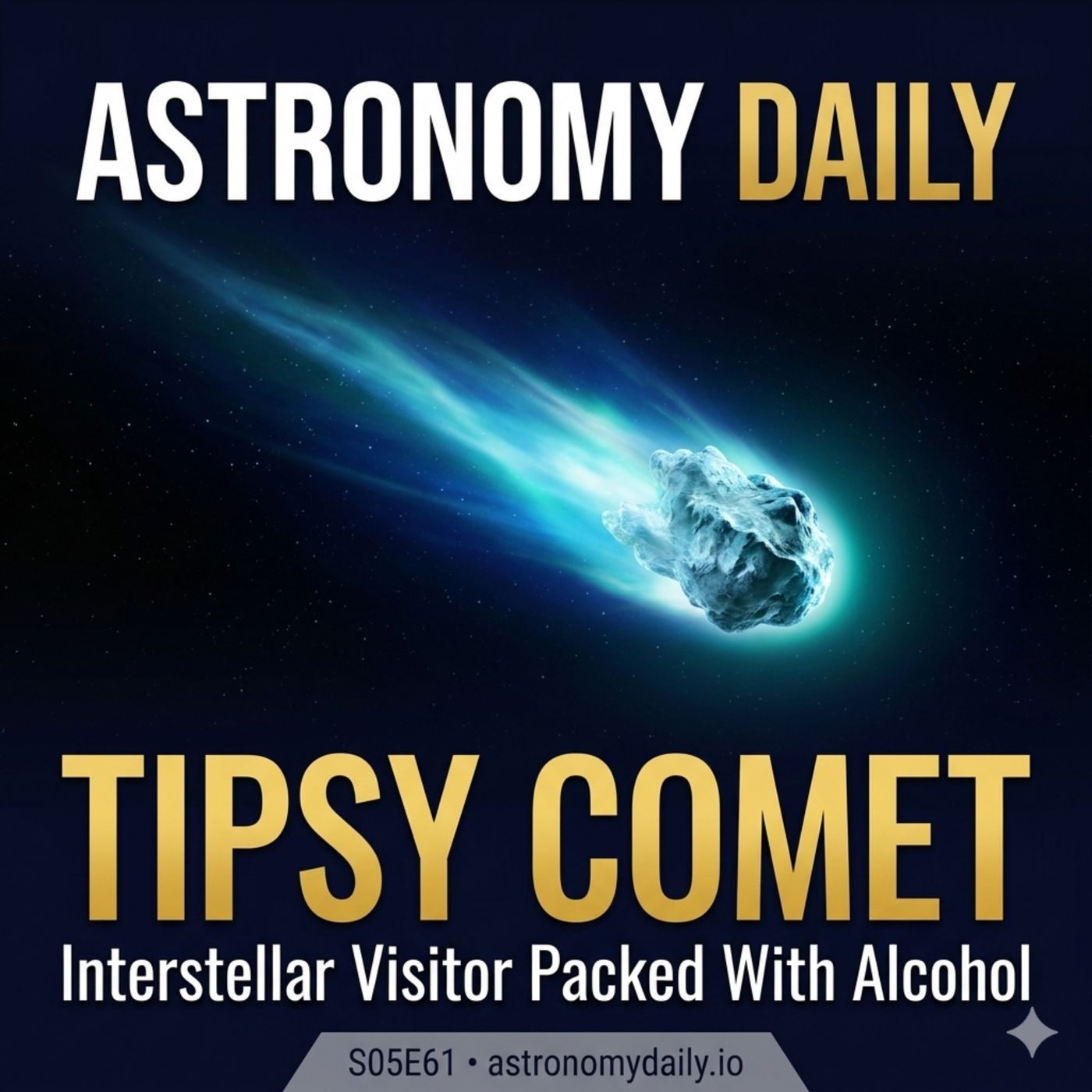
We've got an interstellar comet that's absolutely loaded
1:03
with alcohol, a rocket that bounced back
1:06
from an explosive year to nail its seventh flight,
1:09
and the biggest NASA briefing in months.
1:11
The Artemis II flight readiness review
1:14
is happening right now as we record.
1:16
We've also got some beautiful science
1:18
from deep inside the sun, a satellite that came home early
1:21
thanks to the solar cycle, and a brand new gas cloud
1:24
discovered swirling around the black hole
1:26
at the heart of our Milky Way.
1:28
Dick's stories, let's get into it.
1:30
Our first story is one of my favorites in a while
1:33
because it involves an interstellar comet that's, frankly,
1:38
You're going to milk that headline all episode, aren't you?
1:43
So three I ATLS, if you've been listening to us
1:46
over the past several months, you'll remember
1:48
this is only the third confirmed interstellar object
1:51
ever detected passing through our solar system.
1:54
It came from somewhere out there
1:56
from a completely different planetary system,
1:59
and it's been one of the most intensely observed objects
2:03
And now astronomers using ALMA,
2:05
the adicama large millimeter sub millimeter array in Chile,
2:10
have published new findings about its chemical makeup,
2:13
and what they found is genuinely surprising.
2:15
Using ALMA's adicama compact array,
2:18
researchers studied the coma,
2:20
that glowing halo of gas and dust around the comet's core,
2:23
as three I ATLS was warming up on its approach towards a sun
2:29
They focused on the fingerprints of two molecules,
2:32
methanol, which is a type of alcohol, and hydrogen cyanide.
2:36
And the results were extraordinary.
2:39
In most solar system comets,
2:41
those two molecules show up in roughly comparable amounts.
2:45
But in three I ATLS, the ratio of methanol
2:48
to hydrogen cyanide was between 70 and 120 to one.
2:53
That's not just unusual.
2:55
It places it among the most methanol-rich comets
2:58
ever studied, period.
3:00
Nathan Roth, the lead researcher
3:01
from American University, put it really beautifully.
3:04
He said, observing three I ATLS
3:07
is like taking a fingerprint from another solar system.
3:10
The details reveal what it's made of,
3:12
and it's bursting with methanol
3:14
in a way we just don't usually see in comets
3:16
from our own solar system.
3:18
There's another fascinating detail here, too.
3:21
In most comets, hydrogen cyanide flows out
3:23
from the nucleus, the central core.
3:26
Methanol usually does the same.
3:28
But in three I ATLS, the methanol is coming from two places,
3:33
the nucleus, and from tiny icy grains
3:36
drifting in the coma around the comet.
3:38
Those grains are essentially acting
3:40
like miniature comets of their own,
3:42
releasing methanol as they warm up in sunlight.
3:45
It's a level of structural complexity.
3:47
We haven't seen traced
3:49
in an interstellar object before.
3:51
What does all this methanol tell us?
3:53
It points to a comet that formed
3:55
in an extremely cold environment,
3:57
possibly a dark molecular cloud
3:59
packed with carbon monoxide ice,
4:01
and that its icy material was incorporated
4:03
into the comet's nucleus with very little alteration.
4:07
Essentially, this thing is a chemical time capsule
4:09
from a distant planetary system,
4:12
and it's older than our own sun.
4:13
And here's a fun watch this space moment.
4:16
Three I ATLS is currently
4:19
about 3.8 astronomical units from the sun,
4:22
roughly the distance between Mars and Jupiter,
4:25
and heading outward at around 28 kilometers per second.
4:29
On March 16th, just four days from now,
4:32
it makes its closest approach to Jupiter,
4:34
passing within about 0.36 AU.
4:38
It's one of the last major milestones
4:40
before this visitor disappears
4:42
into interstellar space for good.
4:44
It's been one of the most scientifically productive
4:46
interstellar visitors we've ever had the luck to catch.
4:50
Every observation has taught us something new
4:52
about how planetary systems,
4:54
not ours, form and evolve.
4:56
Story 2 is a proper comeback story,
5:00
and those are always fun to tell.
5:02
Firefly Aerospace successfully launched its Alpha Rocket
5:06
last night, Wednesday 11th,
5:08
from Vandenberg Space Force Base in California.
5:12
And it was a mission called Stairway to 7, Flight 7.
5:16
And it absolutely nailed it.
5:19
For context, Firefly had a rough 2025.
5:23
Two major mishaps, a failed launch in April,
5:26
and then an explosive ground test in September
5:28
that destroyed a first stage.
5:31
The rocket had been grounded for nearly 11 months,
5:34
so this was a significant moment for them.
5:36
The mission lifted off at 5.50 PM Pacific time,
5:40
completed nominal stage separation,
5:43
achieved orbital insertion,
5:45
and delivered a demonstrator payload for Lockheed Martin.
5:48
The second stage engine even performed a relight,
5:52
a bonus milestone for validating new systems.
5:55
And this wasn't just any flight.
5:57
Stairway to 7 was the last flight
6:00
of Alpha's Block 1 configuration.
6:02
Firefly is now transitioning to Block 2,
6:05
which is an upgraded version of the rocket.
6:07
Longer, more capable,
6:09
with a new in-house avionics suite
6:11
and improved thermal protection.
6:13
Those systems were tested in shadow mode on this flight
6:16
and confirmed working.
6:18
FEO Jason Kim said the mission was, quote,
6:21
flawlessly executed.
6:23
And while Alpha has now had full mission success
6:26
just three times in seven attempts,
6:29
the trajectory is clearly improving.
6:32
And Firefly's lunar landing success with BlueGhost
6:34
last year showed they can absolutely get the job done.
6:39
The first Block 2 flight will carry a US Space Force mission
6:42
called Victus Hades Jackal,
6:44
scheduled for no earlier than the second quarter of this year.
6:48
Firefly also has plans to expand Alpha operations
6:51
to Wallops Island in Virginia
6:53
and the S-Range Space Center in Sweden.
6:56
Good times ahead for this team.
6:57
All right, story three.
6:59
And this one is literally happening as we speak.
7:03
NASA held its Artemis II flight readiness review today,
7:08
at Kennedy Space Center in Florida,
7:10
with a press conference at 3 p.m. Eastern
7:13
featuring NASA Administrator Jared Isaacman.
7:17
A flight readiness review is a critical milestone.
7:20
It's the formal process where all the key mission stakeholders
7:23
come together and evaluate whether every system,
7:26
every procedure, and every person is ready to fly.
7:29
It's one of the last major gates
7:31
before a launch date gets set.
7:33
To recap where we are,
7:35
Artemis II is the first crewed mission of the Artemis program.
7:39
Four astronauts flying around the moon
7:42
and back inside the Orion spacecraft,
7:44
farther from Earth than any humans have ever traveled.
7:48
The crew is Reed Wiseman, Victor Glover,
7:52
and Canadian Space Agency astronaut Jeremy Hansen.
7:56
The mission hit a snag in late February
7:58
when a helium flow issue was found in the upper stage
8:01
of the space launch system rocket.
8:03
After a wet dress rehearsal,
8:05
the stack had to be rolled back
8:07
into the vehicle assembly building for repairs.
8:10
NASA has since identified and fixed
8:12
to seal obstruction in the quick disconnect causing the problem
8:15
and technicians have been validating the repairs.
8:18
The rocket is currently targeting a second rollout
8:21
to the launch pad later this month
8:23
with an April launch window on the table.
8:26
We'll have the outcome of today's press conference
8:29
This story is moving fast
8:31
and we'll be covering every step of it as we get closer.
8:35
It has been over 50 years since humans flew beyond
8:40
Artemis II is going to change that
8:42
and we are so close.
8:44
Well, we certainly hope so.
8:47
Story four is a beautiful piece of long game science.
8:50
Researchers from the University of Birmingham
8:52
and Yale University have published a study
8:55
in the monthly notices of the Royal Astronomical Society
8:59
that reveals something fundamental
9:01
and surprising about our star.
9:03
The Sun's internal structure shifts
9:05
measurably from one solar cycle to the next.
9:08
This might sound like it should be obvious.
9:10
Of course, the Sun changes, but here's the thing.
9:14
During solar minimum, the Sun is supposed to be
9:18
Fewer sun spots, weaker magnetic fields,
9:21
a quieter, more uniform surface.
9:24
The assumption had always been that these quiet periods
9:27
were basically the same each time around.
9:31
The team used a network of six ground-based telescopes
9:34
called the Birmingham Solar Oscillations Network, Bison,
9:38
which has been listening to the Sun hum
9:42
They analyzed tiny vibrations inside the Sun,
9:45
essentially sound waves trapped inside the star
9:47
to infer what was happening beneath the surface.
9:50
This field is called Heliosysmology
9:53
and it's essentially the same principle
9:55
as using seismic waves to map the interior of the Earth.
9:59
They looked at four successive solar minima,
10:02
the quiet periods between solar cycles 21 and 25,
10:07
and found that the minimum between cycles 23 and 24,
10:11
which fell in 2008 to 2009,
10:14
was structurally different from the other three.
10:17
That minimum was already known
10:19
to be one of the quietest and longest on record,
10:22
but now they've shown it left a measurable internal fingerprint.
10:27
Specifically, a sound wave glitch caused by helium ionization
10:31
just below the Sun's surface was significantly stronger
10:34
than in the other three minima,
10:36
and the speed of sound in the outer layers was slightly higher,
10:40
suggesting subtly different gas pressures, temperatures,
10:43
and magnetic field strengths deep inside the Sun.
10:46
Why does this matter?
10:48
Because how the Sun behaves during its quiet periods
10:51
has a strong bearing on how active the next cycle will be.
10:55
Better understanding solar minima
10:57
means better space weather forecasting,
10:59
and space weather affects satellites, GPS, power grids,
11:03
and communications infrastructure here on Earth.
11:07
Professor Bill Chaplin from Birmingham summed it up perfectly.
11:10
For the first time, they've been able to clearly quantify
11:13
how the Sun's internal structure shifts
11:16
between one cycle minimum and the next,
11:18
and the techniques used here
11:20
could eventually be applied to other Sun-like stars
11:23
using ESA's upcoming Plato mission.
11:26
The Sun isn't just our star,
11:28
it's our best laboratory for understanding stars everywhere.
11:32
Following up on a story we brought you a couple of days ago,
11:35
you could say story five has a certain poetic quality to it.
11:39
Yesterday morning, Wednesday the 11th,
11:42
NASA's Van Allen Probe A re-entered Earth's atmosphere
11:46
and burned up over the Eastern Pacific Ocean,
11:49
ending a mission that launched back in August 2012,
11:52
nearly 14 years in space.
11:55
The Van Allen Probes, there were two of them, A and B,
11:59
were built to study Earth's radiation belts.
12:02
Those are the two massive donut-shaped zones
12:05
of high-energy charge particles
12:07
trapped by our planet's magnetic field.
12:10
They're named for physicist James Van Allen,
12:13
who discovered them in the late 1950s.
12:16
Understanding these belts is critical
12:19
because they shield Earth from cosmic radiation and solar wind,
12:23
but they can also be brutal on satellites
12:26
and spacecraft passing through them.
12:28
The Probes were originally designed for a two-year mission.
12:31
They ran for nearly seven.
12:33
During that time, they made a series of landmark discoveries,
12:37
including the first confirmed observation
12:40
of a transient third radiation belt,
12:42
which conformed during periods of intense solar activity.
12:46
The spacecraft ran out of fuel in 2019
12:48
and have been drifting in orbit ever since.
12:51
Here's what made yesterday's reentry newsworthy
12:54
beyond the usual satellite farewell.
12:56
NASA had originally calculated that probe A
12:59
wouldn't re-enter until 2034, eight years later than it actually did.
13:04
The culprit, the current solar cycle.
13:07
We're in a particularly active phase right now,
13:09
an increased solar activity heats and expands Earth's upper atmosphere,
13:14
which creates more drag on satellites in low-to-medium orbit,
13:17
holding them down faster than expected.
13:20
The 600 kg spacecraft mostly burned up on reentry, as expected,
13:25
with a 1 in 4,200 chance of any surviving debris
13:30
causing harm to anyone on the ground.
13:33
The US Space Force confirmed reentry at 637 AM Eastern time
13:39
over the Eastern Pacific.
13:40
No injuries or debris impact reported.
13:44
But Probe is still up there,
13:46
and its reentry isn't expected before 2030.
13:50
Though given what just happened,
13:51
we might want to keep an eye on that estimate, too.
13:54
The sun has a way of accelerating things.
13:57
And our final story brings us right to the heart of our own galaxy
14:01
and the super-massive black holes sitting there.
14:05
Astronomers at the Max Planck Institute
14:07
for extraterrestrial physics have discovered
14:10
a new gas cloud orbiting Sagittarius A star.
14:14
The 4 million solar mass black hole
14:16
at the center of the Milky Way, about 27,000 light years
14:22
The new cloud is called G2T.
14:24
And it was found using the Eurus Instrument,
14:26
the enhanced resolution imager and spectrograph,
14:29
mounted on the European Southern Observatories
14:32
very large telescope in Chile.
14:34
Two previous clouds, known as G1 and G2,
14:37
had been observed orbiting Sagittarius A star for years.
14:41
But their true nature was still hotly debated,
14:44
were they pure gas clouds or were they hiding stars inside them?
14:48
The discovery of G2T turns out to be the key
14:52
that helps answer that question,
14:54
because the three clouds don't just
14:56
share the same general neighborhood.
14:58
Their 3D orbits are almost identical,
15:02
just rotated slightly with respect to each other.
15:05
And here's why that's a big deal.
15:07
If G1, G2, and G2T each contain
15:11
a hidden star at their core, you'd expect
15:13
those stars to have very different orbital histories.
15:16
The odds of three independent stars
15:18
settling into nearly identical orbits
15:21
around the supermassive black hole are extraordinarily slim.
15:24
So the matching orbits strongly rule out
15:27
the hidden star hypothesis.
15:29
Instead, the astronomers believe all three clouds
15:32
likely share a common origin, a massive binary star
15:36
system called IRS-16 SW, which is in that region
15:41
and is known to be expelling enormous amounts of gas.
15:45
The three clouds may have been shed from that pair of stars
15:49
at different times, drifting into similar orbits
15:52
as they interact with the extreme gravitational environment
15:56
near Sagittarius A star.
15:58
The Galactic Center is one of the most
16:00
extreme environments in the universe.
16:02
Stars and gas clouds hurtling around the black hole
16:05
at tremendous speeds.
16:07
And yet, we're still finding brand new objects there
16:09
after decades of observation.
16:12
It's a reminder that our own cosmic backyard
16:14
still holds secrets, extraordinary ones.
16:17
That's all six stories for today.
16:20
What a show, a tipsy interstellar comet,
16:23
a triumphant rocket come back,
16:25
the imminent moon mission update,
16:28
the Sun's inner life, a satellite's fiery farewell,
16:32
and a new discovery at the very heart of our galaxy.
16:35
If you enjoyed today's episode, please subscribe,
16:38
leave us a review, and share us with someone who loves space.
16:43
You can find us at astronomydaily.io
16:46
and on all the major platforms at at AstroDailyPod.
16:51
And keep watching the skies.
16:53
Jupiter's about to get a very unusual close visitor
16:56
in just four days, three eye atlas,
16:59
making its last big swing before heading back to the stars.
17:05
thanks for listening to AstronomyDaily.
17:07
We'll see you tomorrow.
17:09
In the meantime, keep looking up.
17:11
The astronomy day, the star is the toe.
17:22
The star is the toe.
17:30
The star is the toe.
17:34
Tyler Reddick here from 2311 Racing.
17:38
Yeah, it's even better with Chamba by my side.
17:41
Race to chambacasino.com.
17:44
No purchase necessary, VTW Group,
17:46
void work prohibited by law, CTSC's, 21 plus,
17:48
sponsored by Chamba Casino.
17:50
Dear McDonald's, your breakfast menu, fire.
17:54
Tens across the board.
17:56
I could be happy with anything.
17:58
Even though I ordered the same thing every time.
18:02
Thanks for not judging me.
18:03
I'll try something new next time.
18:08
Score a two for five dollar deal
18:09
in a sausage McMuffin with egg and more.
18:12
Limited time only price and participation
18:14
may vary cannot be combined with any other offer
18:16
single item at regular price.