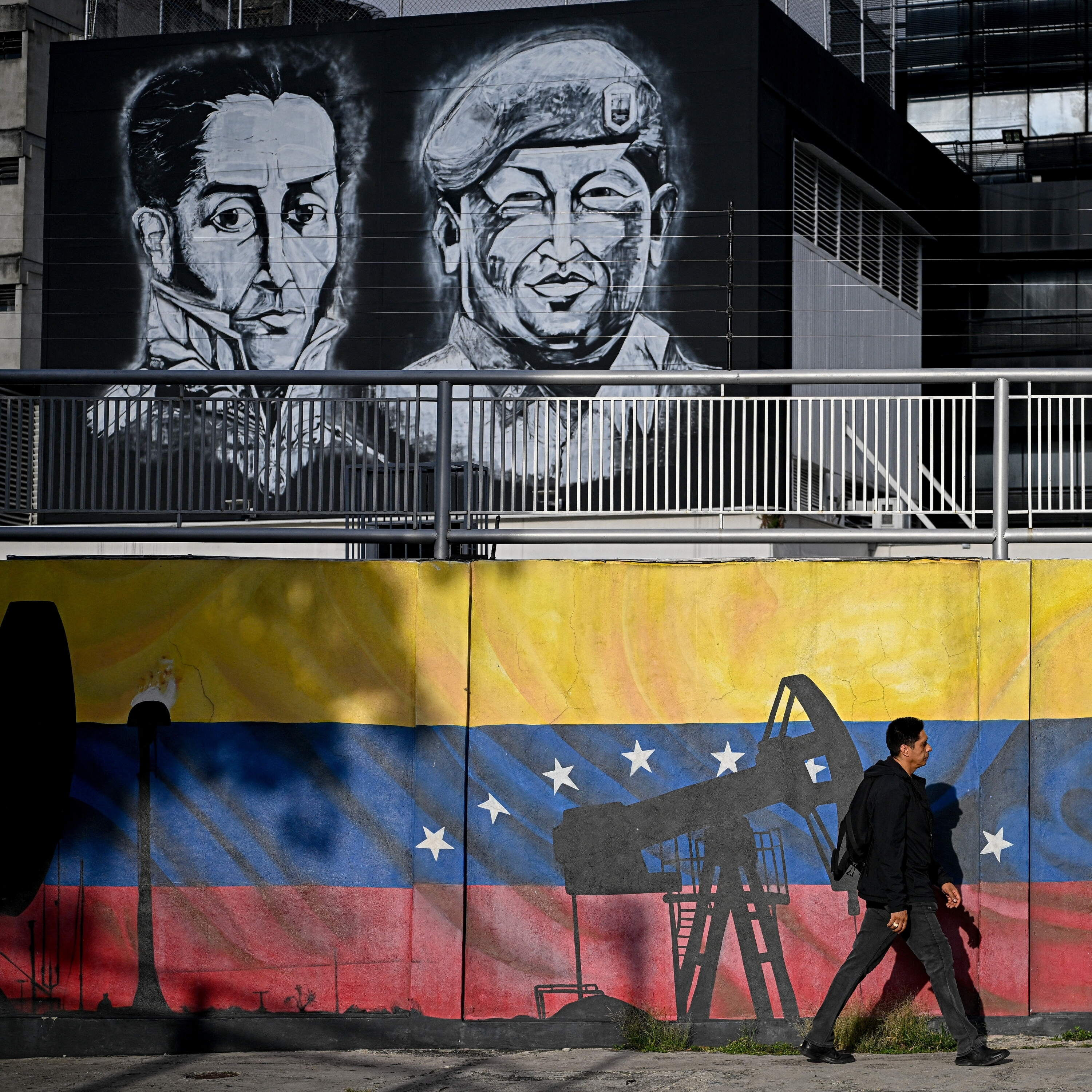
About this episode
Planet Money is made possible by:
The exact nature of this deal has been … obscure, to say the least. But today, we wanted to know, from someone who’s been through this before, what does this mean for Venezuela?
José Ángel Pereira Ruimwyk is both optimistic … and wary. He’s a longtime Venezuelan oil insider. When Venezuela invited in foreigners, decades ago, he was there to greet them. And when Venezuela wanted them out? Well, that’s how he ended up in a jail cell.
On today’s show, we’re going to hear from one third-generation Venezuelan oilman who has seen everything … up until this, of course.
Check out our other episodes about Venezuela:
- Chevron, Venezuela and the Paradox of Plenty
- How Venezuela imploded
Read:
- Our book: Planet Money: A Guide to the Economic Forces That Shape Your Life
- Our weekly longform Planet Money newsletter
- Our weekly Indicator round-up newsletter
Follow:
- TikTok
- YouTube
Support public media with NPR+ and enjoy perks for over 25 podcasts like this one. This show’s perks include bonus episodes and sponsor-free listening. Learn more at plus.npr.org.
This episode was hosted by Nick Fountain and Erika Beras and produced by Emma Peaslee with help from Sam Yellowhorse Kesler. It was edited by Marianne McCune. It was fact checked by Emma Peaslee with help from Sierra Juarez. It was engineered by Josephine Nyounai with help from Jimmy Keeley. Alex Goldmark is Planet Money’s executive producer.
See pcm.adswizz.com for information about our collection and use of personal data for sponsorship and to manage your podcast sponsorship preferences.
NPR Privacy Policy
Get every episode summarized
Each time Planet Money publishes, we email you a written briefing from the transcript — the topics, who appeared, and any specific claims, with the ad reads skipped.
Email me new episodesFree for 3 shows. No card needed.
Hosts & guests

Transcript ready
274 searchable segments. Every word is indexed and playable.
Full transcript
Planet Money — Trump drinks Venezuela’s milkshake. Machine-transcribed; use the interactive transcript above to jump the player to any line.
This message comes from Mint Mobile. If you're tired of spending hundreds on big wireless bills, bogus fees and free perks, Mint Mobile is for you. Shop plans at MintMobile.com slash switch. Taxes and fees extra. See Mint Mobile for details. This is Planet Money from NPR. It's been one week since President Trump got on Truth Social and announced that the United States of America had just entered into an agreement with the country of Venezuela on the biggest oil deal in world history. All caps. This announcement was a little vague on the details, but more have come out since. According to the White House, the US government, through the Pentagon, might be buying a stake in a Venezuelan oil company. The Venezuelan government is going to give that company the exclusive right for 100 years to extract oil from 17 of its oil fields.
And the US will get a bunch of that oil for cheap. So yeah, eight months after Trump ordered the capture of the leader of Venezuela and told oil execs, we're going to be extracting numbers in terms of oil like few people have seen. The US government is apparently in the oil biz. We didn't know what to make of this. Venezuela, as we've talked about on the show before, has been blessed with one of the biggest reserves of oil in the world. Despite that, it is a poor country. And its oil industry is just barely sputtering along right now. Part of that has to do with politics, from American meddling to corrupt leadership. And part of it has to do with an idea we've covered before. The paradox of plenty. What happens when a country's whole economy is based on riches from one resource. But part of it, the part we're going to focus on today because it's relevant to Trump's announcement has to do with foreigners who gets to tap into the country's
massive oil reserves. Because for the last century, Venezuela has been wrestling with this other paradox. We're going to call it the can't live with them, can't live without them paradox. You know how sometimes you need help, but you don't like it when you get it? That has been the story of Venezuela's oil industry and outsiders. They have this long history of opening up to foreign investment and then shutting down again, opening up and shutting down again. Earlier this week, I called up a guy who witnessed this back and forth from the inside. Hello. Hi. His name, Jose Angel Pereira Remvec. His oil pedigree, strong. I am the third generation. His grandparents worked in Venezuela's oil industry at its founding, when foreigners all but ran the show. His parents were part of its nationalization. Jose himself found his true love because of Venezuela's oil. He and his wife, Mervis, were in a chorus run by the state oil company. And we met there, young kids. You met in the state oil
company's chorus. Yes. Yes. Give me a song. Give me a few notes. And as Jose has been following the news out of Venezuela this week, he has been thinking about the lessons he and his family have learned. As they've watched Venezuela open its fast reserves of oil to foreigners and then decide to shut them out. In particular, Jose himself had a front row seat to one moment in the 90s. When just like now, Venezuela's oil industry was faltering. And just like now, they opened up their previously nationalized oil industry to foreigners. It was called, well, I'm going to need some help. Apertura Petrera. Opening. Apertura like the aperture of a camera. Apertura is opening. Yes. Jose kind of led the charge of the Apertura. The last time Venezuela opened its doors to foreign investment in their oil sector. Me and my wife, you and your wife worked for
the first project of the Apertura. That very first project. Yes. So you're the perfect person to talk to about this. I was the guy that started all of this. A long work to play money. I'm Nick fountain. And I'm Erica Barris. There's been a lot of coverage of this evolving deal between the US and Venezuela. Some great stuff from our colleagues here at NPR about what the US hopes to get from this and whether it'll work. The climate impacts today on the show. What does this mean for Venezuela? We're going to hear one take. The take of a Venezuelan oil man who's been through all this before. Everybody saying this deal is probably terrible for the Venezuelan people. Do you agree with that? No, let me tell you. I'm an oil and gas guy that knows the industry inside. Yeah. Jose, he's both optimistic and wary. Because he's seen it all. When Venezuela invited foreigners in, he was there to greet them. And when Venezuela wanted them out, well, that's how we
ended up in a jail cell. This message comes from Odu. If your business runs on five different apps, 12 browser tabs and one spreadsheet that everyone's afraid to touch, it's probably time for Odu. Odu is an all in one business management software platform. Instead of wasting time switching between systems, your business works together in real time. Odu gives you one flexible platform built to grow with you. Try for free today at odu.com slash planet money. That's odou.com slash planet money. This message comes from Mint Mobile. If you're tired of spending hundreds on big wireless bills, bogus fees and free perks, Mint Mobile is for you. Shop plans at MintMobile.com slash switch taxes and fees extra. See Mint Mobile for details. All right. So what does Jose think about this news coming out of Venezuela? In a bit, we're going to hear his take why he thinks this deal between the US, this private
Venezuelan company and the Venezuelan government could help a lot of people. And where he thinks this all might go wrong based on his experiences, his generational experiences. Remember, he's a third generation Venezuelan oil man. And from each of those generations, you can get these picture perfect little snapshots of the long drama filled history of Venezuela's oil from a time when foreigners reigned to the nationalization and back and forth again. Snapshot number one, a century his grandparents meet cute. His grandpa, a Dutch drilling engineer, part of the original wave of foreign investment in and exploitation of Venezuela's oil. His grandma, a Venezuelan nurse in a hospital run by an oil company. How they met is that he got an accident and they put him in the ER and she saw out. You know what, blonde blue eye guys, very cute. And they got connected.
This, of course, was the first era of Venezuelan oil for in control, which eventually, Venezuelans got tired of because too little money from their labor and their resources were going to them. Right, which brings us to snapshot number two. Now it's 1967. And this photo is of Jose's parents, both oil workers with suitcases. They're moving to Tulsa, Oklahoma with cute little five-year-old Jose as two sisters as part of a bigger plan. Before Venezuela could nationalize their oil industry, they needed trains up Venezuelan oil engineers. So he says, Venezuela's oil minister sent Jose's family and a bunch of others to train at the University of Tulsa to study at their world-class petroleum engineering program. Ten Venezuelan families in the 60s in the US was very, very uncommon. Let me tell you, my best friend was in America where we played Kyle Bowie, saying Indians and can you imagine who played the Indians? Seven years later, snapshot
number three. It's Jose and his family again. But he's a teenager now. It's the late 70s and they're back in Venezuela. His parents are working for a new nationalized oil company. Actually, everyone is. Venezuela has taken control of the oil and eventually creates one state-run company to own everything. But totally else, the Venezuela or Bedevesa. Though there are still tons of American workers around. In fact, Jose and his family are living in this weird company town that looks like Texas. Picture it. It's Texas, but in the middle of nowhere. An oil field in Venezuela. That was like a copy-based of the US. We have gold course, we have bowling, we have pools, theaters. We celebrated four of July. We celebrated Thanksgiving. We did hallowing. We did many American things. A decade later, Jose and that Meso-Soprano he married from the youth chorus, they're grown. They have their own jobs with a
nationalized oil company. And for them, everything is great. Except after years of high oil prices and ballooning budgets and payrolls, the price of oil has dropped. Venezuela is starting to neglect its oil fields. Yeah, so maybe another snapshot, idle drilling rigs and pump jacks. Jose says he was there to see it. And from it, he took a very important lesson. The oil and gas industry, where you always have to be investing, always be investing. ABI. If you don't, he says your oil field stopped being as productive. Any oil field can have around 10 to 11% yearly that they decline. So if you don't do nothing in 10 years, you're producing a zero. So Venezuela didn't have money to do that. And that's what the genius guys of that time created the Pertura because they said, okay, let's do something. Let's bring international players so they can bring money. And that's
how the Pertura came. This is the moment we wanted to talk with Jose about the most, the Pertura, the opening. Because if you squint at least, it is analogous to what's happening now. A rusty heap of an oil industry and an opening for foreigners to plow money into the economy. Jose, if you couldn't tell from his genius comment, is a fan of that earlier Apple Dura. He says he saw firsthand how letting in both money and expertise from outside of the country could benefit Venezuelans. Yes, we mentioned before, he says he worked for the very first project of the Pertura way back in 1992. He got himself hired by one of those foreign investors, a Japanese company, which was exciting. Has you ever met a Japanese person before? I had to buy a book how to deal with Japanese. They sent him to Tokyo for months to get trained. And Singol Pereira got schooled in Japanese business culture. Well, for example, I became Pereira son. Hey, Pereira son.
Pereira son. Yeah, yeah, yeah. He picked up new business principles like the one where you try to get some consensus before making big changes. And it can be crazy. But is you ever having a team of 20 people? Do you need that? All that 20 people are in consensus. It takes time to post that. Is that how the oil industry usually works? No, I came with the American culture that is like this. You know, and if you're the boss, you'd make a decision. He worked for a few years for the Japanese company building up oil field infrastructure and then jumped over to an American company, majority owned by Conaco and Chevron, also part of the Apple Tura. Jose says those two companies brought new technology that Venezuela had needed for years. For example, a lot of Venezuela's reserves of oil are this kind of sticky, eki tar like stuff. Bad stuff. So we needed to have a way to produce that Venezuela didn't have that technology. And these companies had figured out how
to deal with the sticky, eki stuff. Essentially, they diluted it, made a smoothie of it so it could be transported in a pipeline. That was a technology that was brought by Chevron, by Conaco, these companies. Yeah, they brought tons of new technology and also tons of money, just enormous amounts of investment. So do you think that the Apple Tura worked? The first years, the first they can work very good. Yeah, Jose says for the industry and for many, though not all Venezuelans, it worked very well. Foreign companies brought new oil fields online, fixed up the old ones, oil production nearly doubled. And all that investment meant lots of jobs for Venezuelans. So Jose says he's been thinking a lot about the Apple Tura as he's seen the news trickle out of Venezuela about this new deal with the United States. This is going to be like a Pertura 2.0. So that the thing in the 90s. Yes, it's going to be like a Pertura 2.0. Yes.
The White House said the company they're doing business with is going to invest $100 billion in new oil production. And this week, Chevron said they're going to spend more than $7 billion over the next five years. Yeah, lots of cash. And remember the bottom always be investing. Jose says that investment, you don't put it in Mars, you put it in Venezuela because you have to drill the well. Sure. So to drill the well, you have to have that truck driver, you need a chauffeur, you need that in Panada, lady that prepared that breakfast. You know, she's very important. She might be the most important person. Yeah, so I'm not kidding, you wouldn't need everything. So the people can have a better life. But when Jose looks at the Apple Thura, he helps spearhead back in the 90s. He says it also includes a cautionary tale, which is when you open up Venezuela to foreign investment and the foreigners seem to have the upper hand, things can go sour. Right, because
here is how the Apple Thura 1.0 ended. As foreigners started reaping the benefits of their investments, a brash red beret wearing populace named Hugo Chavez, El Comundante, was gaining popularity. In 1998, he'd run for president and win partially on the promise of sharing the oil wealth, lifting people out of poverty and dethroning the oil elite. Chavez criticized Betébessa, the state oil company, calling it a state within a state. And Jose says on that point, he wasn't exactly wrong. The product that was happening with Betébessa, those guys that began to work with my dad, this guy became like, they were like kings. They were intouchable. They became very, you know, it was like a teocracy, you know? Yeah, theocracy, an oligopoly. And they weren't just going to let Chavez take their power. These guys didn't like Chavez and they did kind of a plot to take Chavez and
that created the national strike. In late 2002, oil workers, their management walked off the job. It was a standoff between Chavez and the oil elite. There was violence in the street. Oil production dropped too close to zero. Venezuela was starved of its oil money. They were thinking that if they do that national strike and they squeezed Chavez, he will resign. That was their idea. That's what they thought. And look what Chavez did. He fired 20,000 people. Whoa. 20,000. Including everyone you knew. Oh, everyone I knew. Yes. Not him. He was in the private sector by then. Can you imagine all my former colleagues being fired? I have neighbors. Neighbors that lived beside my house that were fired. In the mid 2000s, Chavez made good on his promise to try to redistribute the oil wealth. He tore up the contracts the foreign companies had with Betoevisa, said they weren't fair. He was a little bit right, but you see the things in
what happened after he took a bad decision for Jose. Everything worked out okay because all those formally foreign owned companies. I became the manager of all those companies. You became the manager of all the nationalized oil companies. 44 companies. Yes. Wow. 44 companies, which means Jose had a front row seat as foreigners made their slower treat out of the country. The only major American oil company to stay was Chevron under a new contract that gave majority control to Betoevisa. Meanwhile, Betoevisa was taken over by Chavez loyalists, some of whom couldn't tell a pump jack from a nodding donkey. Just kidding. That's the same thing. It took years, but at the end, they destroyed it. It lost two thirds of the production capacity. But at the same time, Betoevisa became bloated. They hired an enormous number of employees. Like five times where we had in the past,
they are only been paid because it's like a political party. So that is the cautionary tale of the apple dura. If you let foreign investors in, it can be good. It can revitalize the oil sector. A lot of people can reap the rewards. But beware because things can change. If Venezuelans get the sense that they're being taken advantage of, they might take everything back. Now this new Venezuelan oil deal just announced by Trump, it's a, it's a weird one. Even though the Venezuelan constitution says that oil deposits are owned by the Venezuelan people and can't be transferred to a private company or country, this deal gives the rights to 17 oil fields in Venezuela to a private company, which might be partially owned by the US. Of course, it's not the best deal. I would never negotiate that. But, of course, they didn't have chance to negotiate. That was imposed. Yeah. Remember the US military bomb Venezuela removed its former president, put him on an airplane
and is holding him at a jail in New York. The current US backed president seems basically at the back in call of the White House, not exactly an negotiation. But despite all that, and despite the climate impacts and how the oil wealth might not be shared equitably, Jose thinks anything to jumpstart Venezuela's oil economy has the potential to be good for Venezuela's. He's not out. Wow. Are you going to come out of retirement to do this? I can be advising back from getting from the US. I'm not planning to go back to Venezuela. Oh, yeah. Because there is one more thing that happened to Jose and Venezuela that we haven't told you about yet. Yeah. It might be the most cautionary epilogue to this cautionary tale, especially for any oil execs trying to get in on this deal. Here's a little image, a preview. Can you imagine 20 eyes with skeleton masks and rifles? That's after the break.
This message comes from Odo running a business shouldn't feel like surviving a software group project. Start managing your business with one unified system. Odo is the all-in-one business management software. Try for free today at odu.com slash planet money. This message comes from better help. Imagine carrying a backpack every day. Inside it, every conversation, every mistake, every expectation. It is easy not to notice how heavy it is until someone asks if you want to put it down. Sometimes feeling better starts exactly like that. Better isn't one size fits all. Better is personal. It's therapy tailored to the individual to help lighten what you carry. Match with a therapist who truly understands. Visit betterhelp.com slash NPR. This message comes from Midi Health. Most women never get real answers about their
hormone health. Midi is changing that. Built by women, for women, Midi connects you with clinicians who specialize in hormone health with virtual care covered by most major insurance plans. Getting started is easy. Sign up with Midi and book your first visit with a clinician right away. Understand your hormones. Visit joinmiddi.com to book your first visit. That's join m-i-d-i.com. I don't really think that any oil exec who is thinking to go into business in Venezuela right now has the time to listen to the show. But if you are, you're going to want to hear this part. This story is about just how bad things can get when an oil exec gets caught in a geopolitical struggle. In the 2010s, Jose Pereira got a pretty sweet job. He became president and CEO of SICCO, which is an oil company owned by Venezuela and selling Venezuela in oil. But based in the United States. So he moved up to Houston, was living the oil executives life. We have all that toys. I flew in helicopters all over. I have a plane that I could travel all over. But it was a tough
situation politically. Jose was a Venezuelan kind of raised in Oklahoma running a Venezuelan oil company in Texas. Yeah. The American thought he was just a chevista and the Venezuelans. Well, eventually they didn't trust him either. And that got worse in 2017 when president Trump and the successor to Chavez, Nicolas Maduro really started going at it. Sanctions from Trump harsh words for Maduro. Jose says being stuck in the middle was exhausting. He was ready to call it quits, getting ready to retire. And then just before Thanksgiving, he was at the movies with his wife, Justice League, when he got a call. It was Venezuela's petroleum minister. They wanted him to come to Caracas to give an update about a refinery project. So I was like a short notice. Come tomorrow. Come tomorrow. Tomorrow. Yes. So I quit the movie. I told my wife. We see the movie when I come back. Next morning, he and five other executives fly to Caracas. They give their presentation. It goes well.
I had the plane waiting for me in the airport. And when I was going to go to the airport, they opened the doors and it came like 20 guards with masks, skeleton mask. Can you imagine 20 eyes with skeleton masks and rifles? He says they were from Maduro's counterintelligence unit, the folks who rounded up Maduro's political prisoners. One of them approached him and said, who is Josepareta here? So I said, I'm I'm Josepareta. Okay, you had to come with me. And then they we went to a small room. It came inside a general and he announced that we were accused to be American spies, had committed treason to the country. And we're going to go to jail. They put us handcuffed. And the next time I went out to see the sky was 10 months after. So I stayed in solitary confinement for the next 10 months. 10 months in solitary accused of treason,
corruption and embezzlement, all of which he says he didn't do. The US government agreed. They said he was wrongfully detained. But he was stuck. This is the last snapshot of our story. Jose, alone in a cell, the starkest of contrast with the expense account life he'd been living before. He lost 100 pounds. 400 pounds. Yes. Yes. You've lost 100 pounds? 100 pounds in one year. Yeah. So no diet star me. Oh, yeah. Eventually he got out of solitary. His family figured out how to get him food. And he was reunited with his sick go colleagues. Oh, wow, my friend. We hug all of us. We begin to cry. He says they kind of saved each other in detention. They became workout buddies, Bible study buddies, dominoes buddies. It was like when he worked for the Japanese company. Every decision they made, they made together and discussed at great length. Well, let me tell you, we create like a boardroom. No, no, no, no, no, literally we did like a boardroom. We weren't
that six in a round table. A taken decision how we will survive. Eventually, after nearly five years of imprisonment, two cases of scabies, two of COVID, a case of bronchitis and a heart attack. Jose, the rest of his sick go colleagues and two other prisoners were swapped for two Venezuelans nephews of then president Maduro. What's a good deal? What's a good deal? So that explains why he doesn't want to go back and why his son who also works in oil for generations says no way. And it might also explain why kickstarting foreign investment in Venezuela has been so hard for president Trump. Why most of the big oil companies haven't jumped back into Venezuela so far. Apertura 2.0, it is not exactly happening on the best of terms. It is one country that US pretty much dictating the terms with gun boats and helicopters. Jose and a lot of other people do not want to be
in the middle of that. A quick word before we go. We are working on a new bonus episode about a topic we've been asked to tackle a bunch of times over the years. The economics of podcasting. We are pulling back the curtain on NPR plus these sponsor messages you hear or maybe don't hear the dollars and sense of it all. If you're curious about how any of that works and have a question drop us an email planet money at mpr.org. This episode of Planet Money was produced by Emma Peasley and Samuel Harris Kessler. It was edited by Marian McEwan. It was fact-checked by Emma and Sierre Warris. It was engineered by Josephine Neonai with help from Jimmy Gilley. Outscore Mark is Planet Money's executive producer. Special thanks to longtime planet money producer Willa Rubin who is currently covering energy for NPR. You got to check out her coverage. It's really great.
I'm Nick fountain. I'm Erica Varys. This is NPR. Thanks for listening. This message comes from Bombus. Bombus compression socks help keep legs fresh on travel days, work days, like days and more. That's all day relief with everyday style. Go to Bombus.com slash NPR. This message comes from Mint Mobile. If you're tired of spending hundreds on big wireless bills, bogus fees and free perks, Mint Mobile is for you. Shop plans at MintMobile.com slash switch. Taxes and fees extra. See Mint Mobile for details. This message comes from Niddy Health. Most women never get real answers about their hormone health. Mitty is changing that. Built by women, four women, Mitty connects you with clinicians who specialize in hormone health
with virtual care covered by most major insurance plans. Getting started is easy. Sign up with Mitty and book your first visit with a clinician right away. Understand your hormones. Visit joinmitty.com to book your first visit. That's joinmiddy.com.
More episodes
More from Planet Money

The loan at the heart of a new foreclosure crisis
Planet Money

Cost-cutting, quiet guilt and the inflation generation
Planet Money

Love in the time of Palantir
Planet Money

Dolly Parton’s “9 to 5,” the true story behind the anthem (bonus)
Planet Money