Loading...
newssocietyculture
Trump’s warped war logic – If you start more, you can end more!
About this Episode
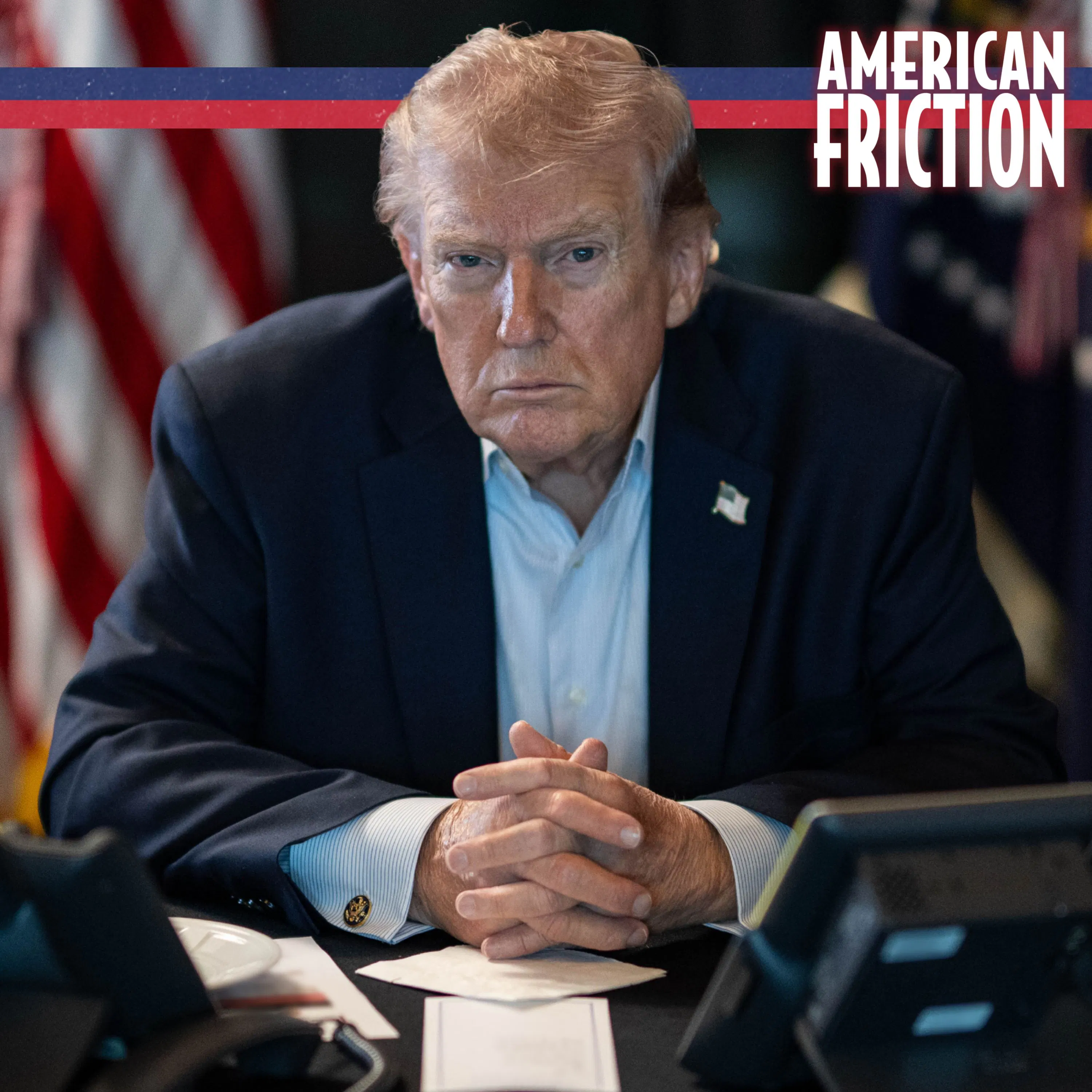
Trump loves ending wars so much that he just keeps starting more that he can then eventually end. Or something like that… The latest began with strikes on Iran – why is he doing this? And why now? Politico's senior foreign affairs correspondent Nahal Toosi joins Jacob Jarvis to discuss.
Back us on Patreon – we need your help to keep going. Get ad free episodes, extra bits and merch
We’re now on Youtube
Follow us on social media:
BlueSky
Instagram
TikTok
Written and presented by Jacob Jarvis. Video and audio editor: Chris Jones. Group Editor: Andrew Harrison. Managing Editor: Jacob Jarvis Executive producer: Martin Bojtos. Artwork by James Parrett. Music: Orange Factory Music. AMERICAN FRICTION is a Podmasters Production. www.podmasters.co.uk
Learn more about your ad choices. Visit podcastchoices.com/adchoices
Hosts & Guests
Transcript
Hello and welcome to American Friction.
On Saturday morning, I decided I was going to take the dog out for a walk and just ignore
the news and listen to an audio book.
When I got back, I checked my phone and christened message me and said, well, this is terrifying
and that's why I opened social media to a raft of World War III posts alongside the
news that America had launched strikes on Iran.
This has long been rumored, but now it's a reality.
So why now?
What does Trump actually want from this and what will the reaction in America be?
The situation only appears to be getting worse.
How bad can it get?
To discuss all of this, I'm joined by Nahal Tussi, senior Foreign Affairs correspondent
for Politico.
Nahal, thanks for joining me.
Hey, it's great to be here.
So nahal, Trump promised no more walls.
How is he justifying breaking this promise?
I mean, is this technically a war or is it just major combat operations?
Is it just military strikes?
Is it just a campaign to deal with a potential preemptive post-emptive?
I don't even know if that's a word.
Yeah.
Attack.
I mean, we're hearing so many different versions of this that it's really
really messy.
And so how is he justifying it?
Well, he and his people have laid out an array of reasons, potential alleged reasons, that
they consider doing this.
And they are really all over the map.
A main thing I just want to ask, there seems to be the big question over here that, you
know, our Prime Minister is asking and has been getting a barrage of insults for doing.
So is there any legality to this, whatever, where you're trying to square it?
Is there any way they've even tried to actually justify it in a legal manner?
International law experts say, no, this is illegal.
I mean, I'm sure there's, you can find one or two out there who say that it's fine.
The administration seems to be at times trying to make the argument that the President had
to act because there was an imminent threat from Iran.
Now, the idea is that the President does have the right to move quickly against imminent
threats, that that doesn't require congressional approval, and that otherwise, you would have
to go to Congress.
And Congress is the one in our constitution that has a power to declare war.
Now the question is, what is an imminent threat?
And the Trump administration has said all sorts of things about, oh, well, the Iranians
were building out their ballistic missile program.
They were planning to come after us.
Marco Rubio, the Secretary of State, was kind of, said the most astonishing thing, which
was he basically said that Israel was going to attack Iran anyway.
And we knew that if they did that and when they did that, the Iranians would attack us.
And therefore, we had to attack first to prevent them from attacking us after Israel was
going to attack them anyway.
So I have not heard a lot on the side that says, yeah, here's some very, very clear reasons
that this was completely legal and the President could do it without Congress as approval.
It seems like the administration is still trying to figure out an actual argument that can
fly for that.
When it comes to the idea of congressional approval, anyone sane who seems to be talking about
the situation says, you know, Congress should be approving war actions and they are the
arm of government that has the power to do that.
But has that idea been proven to be for the birds, just I can't remember the last time
it seems like something like this was started and there was congressional approval.
Well, I mean, we've had, you know, Congress vote on things, for example, related to the
Iraq War that effectively authorized the U.S. to take military action in Iraq that authorized
the U.S. take military action after we were attacked on 9-11 in places that harbored al-Qaeda.
There is this one argument that Iran has in the past harbored some al-Qaeda fighters and
that maybe we could use that legal rationale as a reason to do what we just did.
I don't think a lot of people are going to buy that.
But if you're asking me whether Congress has this great track record of really being on
top of this and, you know, exercising their power, no, the answer is no.
I mean, for years and years, Congress has been seeding its power to the president.
Whenever they have been given, not whenever, but at times, such as in the case of Syria,
when Barack Obama went to Congress and said, hey, give me permission to go and strike
Syria over the chemical weapons, I want you to play your role in this, they wouldn't
do it.
Right?
And so we have this very partisan polarized Congress where Republicans are pretty much going
to do whatever the president wants and Democrats don't have any power to stop them.
And they cannot seem to find compromises on hardly anything.
I mean, maybe they can, you know, name a post office now and then.
This is just not a Congress that can really function on any level.
So I mean, I can understand why a president would say I really don't want to deal with those guys
on Capitol Hill, but do you still go launch a massive war in the Middle East?
That's a different thing.
Even though in Congress, as you say, it just appears that the Democrats are powerless
and the Republicans will do whatever, whatever he says privately.
What do they, what their feelings seem to be?
Because I just don't see how anyone can be, can be happy with this.
Even if you are a complete lapdog, you must be quite frustrated looking on at this situation.
Plenty of people in Congress don't like the Iranian regime.
I really can't think of any who do, right?
This is a tyrannical regime that has been anti-American for more than almost 50 years.
It's been a thorn in our side.
So you're not going to get a lot of members of Congress shedding any tears
over the death of the Iatola or anything like that.
So I think privately, there's a sense of, well, at least,
you know, we'd struck a blow.
But the fallout that's happened since, the question of the legality, the question of,
for instance, right now, when a huge erupting issue is the question of the safety of American
citizens in the region, which this administration apparently did very little to prepare for.
So, you know, there's a lot of unhappiness with the process and there's a lot of unhappiness
with the rationale.
And there's a lot of questions about the end game and how long this is going to last,
how much is going to cost, and what kind of a Middle East are we going to leave behind?
I mean, we don't know what's going to replace this regime.
The president does not know.
So it's a real mess.
It was not really, it's not really well found out.
When it comes to that, I mean, clearly, Trump and allies don't see there being a moral
responsibility to make around stable.
They don't seem to see that sort of due to care for maybe the people of Iran in that way.
But should they not just see a self-interest in making around be stable?
Because to me, it seems like just the country being a complete power vacuum and potentially
breeding ground for masses of anti-American sentiment just doesn't seem to make any sense to me,
even if you don't care about the people there on much of a human level.
So one of the questions right now is, are we going to have potentially what people call
regime collapse?
And so that is this idea that the government effectively falls into a million pieces in Iran,
and you have different factions grabbing different bits of power, perhaps different territory,
perhaps even leading to skirmishes, civil wars, ethnic malicious mobilizing, things like that.
Yeah, Iran becoming a broken-up failed state, kind of like Libya, right?
And so there is this concern among definitely the Gulf Arab states and a number of other countries,
many US allies in Europe, and of course, people in the United States who will at some point,
whether they're lawmakers or not, have to deal with the fallout from this.
But there's also this other way to look at this, which is Iran's regime has been such a danger
to other countries in the region through its proxy militias, through its efforts to get a nuclear
program or nuclear weapons alleged. They say they don't want nuclear weapons.
And it's growing ballistic missile programs, which Israel in particular saw as a threat.
So some might argue that a failed Iran is less of a threat to, for instance, Israel,
and perhaps even some of its neighbors. I am not convinced of that. I think it could
become a terrorist playground. A lot of bad things can emanate when you have a place that large
with that many people in such chaos. So yeah, people need to be concerned. And I think one of the
goals of the Trump administration is to have some sort of a stable government remain there, even if it
means dealing with the remnants of the regime. You wrote about a regime change, but also this idea
of behavior change. You've been potentially what they're trying to push there. And that
came, that phrase came from a source you were speaking to within the Trump administration. Could
you kind of describe to me what you think they they meant by that? What the difference is there
from regime change to behavior change? As I've been looking into this, I've heard like a wide array
of terms, regime change, regime transformation, regime collapse. I kind of regime modification,
regime adjustment, right? And when you look at Venezuela, for instance, that that's kind of a
model of, you know, it was a first I was like, this is regime change. And then I realized, oh,
it's kind of just partial regime change. The difference though, when you look at behavior change
versus regime changes, you can have most possibly all, but probably most or at least some of a regime
is institutions, even its personnel, even its process and its allocation of power remain the same
as long as when it comes to the United States, the regime acts differently toward the United
States. So if you are say Iran, and Trump might be perfectly happy with leaving the same people
in place, the same system, not real elections, the opposite, whatever, as long as they can in a
verifiable way show that they're not going to be a threat to the U.S. and its allies. They can
completely mothball their nuclear program, cut back or end their ballistic missile program,
and also just, you know, cut the funding and support for proxamilicious. I mean, if they really
take steps that the U.S. is happy with, then I think he would say, well, this is a total behavior
change. You could even argue, in many ways, if you change its behavior enough, it's a different
regime, right? Now, there are plenty of critics of this idea, right? I mean, for a long time,
in particular in the Iranian diaspora, you know, used to be that people thought we could reform
the regime. But over time, there grew to be, has grown to be this belief inside the Iranian diaspora
that there's no way to reform this regime. You have to pull it out by every root, every branch,
every stem. It has to completely go, this is not a reformable crowd. They're not going to change
their behavior. And I think in particular among Israelis as well, there is this belief that
this group of people, this system is just designed in a way that it is inherently untrustworthy.
And you have to change it to such an extraordinary degree that is basically unrecognizable.
They don't really buy the behavior change idea. The Israelis don't. But I think the Trump
administration, seeing what it's done in Venezuela, seeing what it hopes to do in Cuba, still thinks
that it's possible with Iran. With Israel, Mark Eribe airport forward, as you say, the kind of
preemptive, preemptive strike theory that they had to go to war for Iran because Israel might
launch a preemptive strike on Iran, which would then get America. It just seems it's a really
you have to travel. It's a lot of sort of mental gymnastics you have to make there. But let's say,
okay, that is the reasoning for it. What does that mean for the US and Israel relationship?
Because to me, it just seems like I'm struggling to see how that isn't becoming much more
strained than it is. I think that Trump, having seen what happened in Venezuela, the kind of
way that the operation worked and succeeded, felt emboldened. And I think that he
agreed with Benjamin Netanyahu, the Prime Minister of Israel, that the Iranian regime is
unusually vulnerable right now. And so if we were going to strike, we might as well do it now
when they are so weak. I think in a sense, this was going to happen no matter what. But there was
definitely a sense of, well, the Israelis have to be involved. They want us to be involved.
And they have to put some skin in the game too. And we just need to all do this together. We
reported that there was some talk that maybe they would have preferred the Israelis to
stage out the first strike so that the Iran would respond so that the US could right back.
Now, I will also say, Rubio has sort of been trying to walk back what he said a little bit
today, trying to muddy the question of whether he even mentioned Israel, even though we have the
transcript. But in terms of the future, I think it's about how far Israel wants to go in terms
of the bombing and this regime change idea and how much patience the US has on that front. So far,
it's Israel that's been doing most of the actual assassinations. We've been basically, the US has
basically been striking facilities and capabilities, things like that. And as this operation goes on,
is it possible that Israel may want to go further than the US, especially when it comes to
destroying the regime? Israel has largely been the one that's been carrying out the assassinations,
whereas we have been striking the facilities and the capabilities of the Iranian system.
And so the Israelis may say, look, we want to just kill more and more people in this system.
We want to go for the police chiefs. We want to go for the besiege leaders. We want to get absolutely
everyone that we can. And in the meantime, the US might be seeing mounting American casualties.
We've already had at least six troops die, not to mention growing political discontent in America.
I mean, Trump at some point may feel the political pain and we've got a midterm election just a few
months away. And so the question might be, will they at some point split with the Israelis saying,
no, no, we got to keep going and Trump saying, no, it has to stop. And believe me, everyone is
watching for that potential split down the line.
That's the good stuff right there. So if your business is in it to win it, win with Shopify.
Start your free trial today at Shopify.com slash win.
This is the new Weight Watchers. Built for real life and real results, no matter what
Mojure in. Maddie went all in for her big day and lost 33 pounds. Emily lost 85 pounds and
hit her goal while still living her life. Weight Watchers gave me the tools and I feel amazing.
Join the millions of members and lose weight with the number one doctor recommended Weight
Loss Program. Lose more at WeightWatchers.com. At six months participants in a clinical trial of
Weight Watchers Program lost an average of 12 pounds.
This is possibly one of many sort of million dollar questions here now. But why
why is it that it would have to get to a point where America and Israel, there would be,
there would be a kind of split there as opposed to America is in what seems to be an uneven
relationship when it comes to terms of power, just saying you have to stop. I don't really understand
why there isn't more of that. And Trump seems so prepared to leverage his power against certain
people. But then it would appear particularly with Benjamin Netanyahu, he does not seem to have
that sort of that gravitas to do so. This is a very sensitive question. And answering it is
you have to be very nuanced because it's a very complicated issue. It goes back decades Netanyahu
has been the prime minister for so long that it's largely been about him and the relationship with
American presidents that he has had. Look, I think the US who is a major provider of aid,
military assistance to Israel has definite, I mean, we're the superpower. And I think that the
Israelis know that. But I also think the Israeli prime minister also knows he can make a very good
argument. Like the argument that this regime is unusually weak right now and we need to strike
is a legitimate argument. And the argument, for instance, last June that look, you might as well
go and strike their nuclear targets now because they're so weak after we just bombed them for 11
whatever days. That's something that that Trump agreed with. So I don't think this is something
where it's a question of like who's the more powerful one and who's not. I think the US
is a more powerful one. But I think sometimes Netanyahu who often has also played the partisanship
game in the United States by very much leaning on the Republicans has just managed to make pretty
solid arguments. And let's not forget that if there is one president that can put leverage and
power over Netanyahu is Donald Trump. Remember what he did when I came to Gaza and he basically
pulled together that that peace agreement the 20.1 and he basically made Benjamin Netanyahu
call the countries and apologize to them for staging a strike in Qatar. And not a lot of American
presidents have been willing, frankly, to do something like that to someone they consider a
really important ally in the Middle East. And President Trump very much can stand up to Netanyahu
when he chooses to. But he also gets some of the arguments that Netanyahu makes.
On the on the timing of this operation, if we're calling it that,
does it and I know we're dealing with real world logic and then Trump logic? Does it seem like
logical the timing of it or is there some sort of logic within Trump's logical frame as to why
now, why he chose now to be the time to go forward with this?
I mean, you know, he he wanted to strike earlier. He wanted to strike in January when
there were protesters in Iran hitting the streets and the Iranian government was cracking down on
them. And he was told, look, we don't have the assets in place. So weeks and weeks later,
after all of the there's two carrier strike groups and other assets are in the region,
the biggest build up of US military force in the region since 2003, the US invasion of Iraq.
He had them there. He tried the diplomatic route as well. You know, everybody's bringing up that
check out the play where like the check off's gun, right? It's like if there's a gun in the first
scene, it's going to be used by the 13. And that kind of was how it felt when you had all of these
military assets in place. You go like, okay, he's going to use this, right? And I think the only
question was, was it going to be like a small approach, a medium approach, or an all-out approach?
And it was Donald Trump. So of course, he went for the all-out approach.
So, so Trump referenced when he was criticizing Geist Army reference, Winston Churchill. And he
talks as though he does have these reference for these great men of history. Do you think he cares
about how he looks and how he will stack up at some point in that sort of way?
I think he really does like the idea of being seen as someone who liberates a group of people.
Like he does like thinking that he can help the Iranian people or the Venezuelan people or the
Cuban people. It's, you know, it's strange because people have this belief that Trump just doesn't
care about humanity or whatever. And I think though that, you know, he has this thing where
maybe he doesn't actually care about the people, but he likes being seen as a liberator of people.
So it's more about him, right? So I guess, you know, if that's what it takes to liberate people,
it's to satisfy Ziko then okay. So so Trump, Pete Hegsiff and Marco Rubio who you would expect to be
the sort of free most important players on the American side on this. Don't completely don't have
their stories straight. Don't seem to agree on why they did it. Don't seem to know exactly
what the the reasoning was there. To me, that seems to indicate maybe they either they're just,
if they're not on the same page and that that's one thing or there are other characters that play.
Who else in this story should should we be looking out for, you know, if there is Jared Kushner
important person to look for is Steve Whitkoff an important person to look at like who are the
who are the power brokers beyond the the obvious figureheads. I think you named some of them. I
would say the chairman of the joint chiefs, Dan Kane is also an important player. He he tries,
you know, he does his job in the sense that he gives the president an option. He tries not too much
to voice opinions. That's not really the role per se, but he he does say look, he has said
we we could face a lot of casualties. It's not going to be simple. But when he when he is asked
to come up with a plan as we saw in Venezuela, he comes up with one and it's and President Trump
really seems to to trust him. I think the CIA chief John Ratcliffe also probably played
a more important role than people know. And also, oh man, the kind of influencer types and Lindsey
Graham as well. Senator Lindsey Graham, a big player in this, some of the conservative talk show
type hosts and look ultimately Netanyahu played a really big role from in the conversations.
But this all always comes down to Trump and kind of his instincts and what he wants to do.
And I think he just felt like he has the the bandwidth and he doesn't have to worry about
reelection. He's not he just he wants to change the world. I mean, look at what he did with
tariffs, right? He is willing to throw aside any constraints. And so he's like, let's just do it
in for a diamond for a dollar. Yeah, I always think Lindsey Graham is a good person to look out for
because whenever he's in the news, I know something really stupid is happening. So this can make me
incredibly, incredibly angry with how this is this is spreading at the moment. Obviously,
it's really hard to predict and it's hard to to know what's going on. And what do we what can we
can we say when it terms to when it comes to game plan that out, but also more importantly,
I suppose at this moment, what do we have to acknowledge that we we simply don't know what are
the what are the known unknowns going on? I mean, how the Iranian government is going to try to
maintain itself? Who's going to who's really going to rule the country? Is it going to be the
clerics or is it going to be the military, the IRGC in particular? How long this is going to last?
That is definitely an open question right now. And how far this conflict is going to spread? I mean,
the Iranians are launching missiles across the region. You've had Dubai get hit. You've had
Qatar and Bahrain. I mean, and if those countries decide they have to react and that they have
to hit Iran just to show their populations. Yes, we can do this to them. We're not going to just
sit here and take it. Then we could be talking about a broader regional war at some point. This
really does have the possibility, the potential to really get out of control.
With Trump, if it's his personal interests, what are the main things to look out for then? Are
the Gulf countries something we really should be focusing on? Because his own personal enrichment,
which seems to be one of his main driving forces behind being president, does seem to be very
tied to the Gulf states. So if nothing else is going to make him want to put on the brakes,
perhaps his bank balance might. So are they an area to look out for?
I think absolutely, but I also think if you're looking for President Trump to be logically consistent,
then you're just wasting your time. He says he's trying to free the Iranian people
and yet he's barred Iranians from coming to the United States. I gave up a long time ago trying
to find logic or consistency. There's only so much bandwidth it feels like any of us can have,
and I imagine yours as a foreign correspondent that's be incredibly full at the moment with the
amount of conflicts going on. What do you think this means for other conflicts? Is it going to
draw focus, resource away from them? What do they mean for all the other wars that are going
on around the world and all the other places that Trump just seems to be bombing at will?
I mean, I think you know, Ukraine might not get the attention that it deserves. Not to mention
there's potential munitions shortages that we're going to be suffering as a result of this war,
which means that we might not be able to sell as many to our partners such as Ukraine who are
facing conflicts. And Afghanistan and Pakistan right now are fighting each other and it's
barely making the headlines at all because this other war has gotten all of the attention.
And yeah, I mean, look, it's so funny. I feel sometimes I become very forgetful lately. I've been,
I just can't seem to keep anything in my mind. I just have like such a bad memory and I'm just
realizing, oh, it's because, you know, I have only so much bandwidth and there's so many different
things going on. And my brain is like, you know what? You're just going to have to forget about
that thing you saw the other day. You're just going to have to forget it because I don't have room
for that. I have to think about Iran. Just a final question on Trump. Do you think he's,
he's likely to start more wars and stop more wars over the next few, few months?
I mean, are we counting, ending the worst that he starts?
Yeah, that's probably a difficult one, isn't it? Let's say they don't count.
I mean, all I'm going to say is like, you know, it's just joke that it's been,
people have been saying it's, um, it's like the fief of peace prize just doesn't mean anything anymore.
Yeah. Yeah, it really is, it's not worth the, the gold it's printed on. Is that the phrase
with you? Who knows? But, uh, no, thank you. Thanks so much for joining me.
Thanks for having me. And thank you to all of you for listening to American friction.
Remember, if you enjoy what we do, you can support us on Patreon to get episodes
ad-free and early search American friction podcast Patreon or by the link in the show notes.
And if you can't do that, please do make sure you rate review and subscribe wherever you're listening
to the show. I'm Jacob Jarvis. Thank you for listening to American friction.
Rinse snows that greatness takes time, but soda's laundry. So rinse will take your laundry and
hand-deliver it to your door, expertly cleaned. And you can take the time pursuing your passions.
Time one spent sorting and waiting, folding and queuing, now spent challenging and
innovating and pushing your way to greatness. So pick up the Irish flute or those calligraphy
pens or that daunting beef Wellington recipe card and leave the laundry to us. Rinse, it's time to be great.


