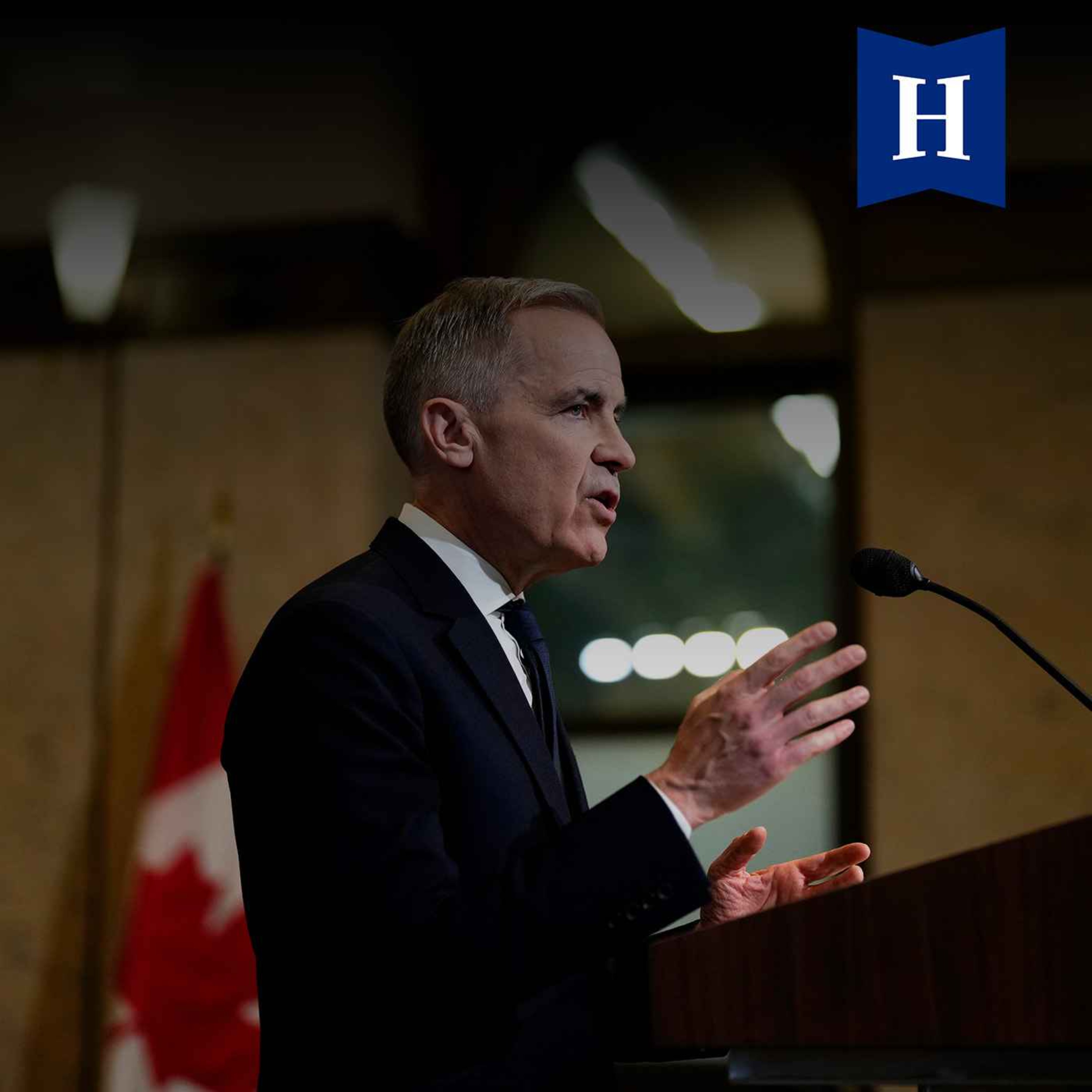
About this episode
Ian Lee, associate professor at Carleton University's Sprott School of Business, argues Canada's retaliatory tariff strategy against the United States is fundamentally flawed. He contends that Canada's vastly smaller economy and heavy trade dependence on American trade make it far more vulnerable in a prolonged trade war. Lee advocates for returning to negotiations with the Trump administration, while simultaneously pursuing domestic structural reforms including eliminating interprovincial trade barriers, developing natural resources, and reducing corporate tax rates to strengthen Canada's economic position. He warns that Trump could cancel CUSMA in its entirety.
The Hub is Canada’s fastest growing independent digital news outlet.
Subscribe to The Hub’s podcast feed to get our best content when you are on the go:
https://tinyurl.com/3a7zpd7e (Apple)
https://tinyurl.com/y8akmfn7 (Spotify)
Follow The Hub on X: https://x.com/thehubcanada?lang=en
CREDITS:
Daphne Liang - Producer and Editor
Harrison Lowman - Host
Justin Tang/The Canadian Press - Photo Credit
Hosted on Acast. See acast.com/privacy for more information.
Get every episode summarized
Each time Hub Podcasts publishes, we email you a written briefing from the transcript — the topics, who appeared, and any specific claims, with the ad reads skipped.
Email me new episodesFree for 3 shows. No card needed.
Transcript ready
143 searchable segments. Every word is indexed and playable.
Full transcript
Hub Podcasts — Trump trade war: Is Canada destined to lose?. Machine-transcribed; use the interactive transcript above to jump the player to any line.
Welcome to HubHit. I'm Harrison Lelman, managing editor of the hub. Well, it's coming up on four weeks of not being at the negotiating table with the Americans during this ongoing, yes, ongoing trade war, is Canada taking the right approach. Ian Lee is an associate professor at the Sprawd School of Business at Carlton University, my alma mater. And he's going to tell us more. Ian, how are you doing today? I'm doing very well. Thank you for inviting me. You're very welcome. You're very welcome. Welcome. Welcome back. Okay, so these latest Trump counter-tariffs that will come into effect end of September, blocking the import of Canadian motorcycles, most out-call, some dairy, mattresses, motor boats, 50% tariffs on those. Those are being added to the list. How serious is this counter blow from where you sit in? If one and a lot of pundits are looking at particular tariff on a particular product and a particular understanding and say, hey, look, it's not that big deal. We can we can we can accept it. We can sustain that.
Okay. I think our approach by the government, the Canadian government, the premieres by pundits as missed the boat. And I know it sounds very arrogant. So bear me out. Hear me out. The impact is a cumulative and be it is destroying business confidence in the country. So when someone says, well, are you really saying that that one tariff on that one set of hockey sticks is going to bring down the can economy? Of course I'm not. I've never said such a thing. What I'm saying is that it's going to fall. We're going to get hit much harder because we are one 13th the size of the US. We are 2.2 trillion GDP expressed in US dollars and they're 32 trillion. So they are vastly larger. They have vastly greater resilience. They are vastly less dependent on tariffs. I'll get to your question of what I just want to put a couple of big picture numbers out there. I mean, I've heard Kenan say we can bring America to its knees. I think premier Ford said that. Canada, the totality of Canada's tariffs are 400 billion to the United States. That's 1.5% of US GDP. I don't know anyone who suggested 1.5% of the Canadian economy if some runs into trouble.
It's just as preposterous. When you start looking at these numbers and get away from the absolute values because people say, look at 400 billion. It's such a large amount of money. How can you dare say that that's not going to have an impact if we did go after all of it? The answer is because people aren't normalizing the data into percentages. The United States is so humongously huge and this is proving the point. Our total exports are 1.5% of American GDP. Let me give you a second big, big, big number for your listeners and your viewers. The US has the smallest percentage of import exports of all the OECD countries. 85% of American GDP is generated inside the United States only 15% with the rest of the world. We're about a third of our GDP. The Scandinavian countries are north of 50%. In other words, let me put that into plain English for everybody. 85% of American GDP, if that's 32 trillion, is American companies in California trading with American companies in Illinois trading with American companies in Texas, with Florida and all the other 50 states.
So their dependency or exposure to the world is 15%. It's very small, smaller than any other OECD country. That means they're less vulnerable just on that number alone. Then you can go into looking at things like their dynamism and R&D and all that stuff. We won't even go there. Now coming back to Canada, we are much, much more dependent because we're a small country. We're an open country. One third of our GDP is dependent on trade with the world and 71% of that is with the US. So any trade war where we get into retaliatory, any kind of tariffs, whether from the American side or our side, is going to hurt us far more badly than it's going to hurt the United States. That's the first point. And so this, and the second large point, big picture point I want to take, is that this is not sustainable because what's going to happen when those tariffs, as we see the effect kicking in, is we're going to see an awful lot of small businesses losing their market share.
What are they going to do? They're going to lay off the employees and the small business sector, SME sector accounts for about 70%, 72% of all the private sector jobs in Canada. So again, you're going to see layoffs and small business failures. We're going to get hit far harder than the US. So this is why I have argued we should be getting back to the bargaining table and trying to get to a deal. And then I've got some other things I can talk about, medium and longer term, that we should be doing that I've addressed. We have addressed in the book, Larry O'Brien and I have written, we hope it comes up mid-October and it's Canada's options in this age of Trump. And it's more about structural reform of the weaknesses in the Canadian economy. We can talk about that hopefully if we have enough time. You said that we're playing a dangerous game here. Are you hearing from small businesses, medium-sized businesses in this country in terms of what could actually happen when these tariffs come into effect? Yes, yes I am. Because I'm one of the low-end voices in the media, I'm getting a lot of email and it's fascinating. It really is fascinating. Not only the fact they're just terrified. I'm getting emails from people saying, my business, my market's going to drive up, I'm going to lose my business.
But when I step back and look at the people who are cheerleading for go after Trump, more tariff war, yeah, retaliatory tariffs, I find a large number of them are in the public sector where they're protected. Okay, public sector meaning, you know, you can't, you know, professors are in the public. I'm in the public sector by the way. Okay, I am. I'm ten year old. Okay. And so the people who are most terrified of this tariff war are the people in the markets. These are people in the business committee. The Chamber of Commerce is saying this is a terrible thing. So is the Confederation of Intervent and Business. So is the Business Council. So you look at the people who got skin in the game as opposed to us, the armchair analysts in the public sector. Okay, we're not saying, oh, this is a jolly fun war coming up. This reminds me of Barbara Tukman's The Guns of August, you know, and how they fell into it through folly and ignorance and and rarer. They were all cheering. We're going to go up and have a nice jolly little war and it'll be over by Christmas and everything will be wonderful. And it turned out to be the most catastrophic war in human history. I'm not suggesting this is going to turn into a shooting war. I'm not suggesting that.
What I'm saying is people are radically underestimating the impact of this war on the Canadian business sector. And that's why I am speaking out so strongly. These retaliatory tariffs are the worst possible thing we could be possibly be doing in this country. And you know, you're gaining the reputation from some of, you know, being sympathetic to the administration, right? That's the reputation that people get on the other side that are saying we should be back at the negotiating table. For those that say what should we just, are you telling us to just roll over Ian in the face of a, you know, American shadow that just is cast over top of us, you know, shrouding us in darkness. How are we supposed to act strategically when we are so small and so reliant? Does it not just mean that we're forced to roll over and make concession after concession? And I'll add, are the negotiations irrelevant if it means that concessions to continue to be continued to be made after the fact that they might not be worth the paper that are written on? So I get that question all the time both in the media and of course from individuals or anybody who's supposed to lie down and roll over, of course not.
In the book we've written, which will be published we hope with Amazon publishing that's our plan. We're not doing for the money. We're doing to influence people like you, you know, journalists and politicians. And so we have a, we've analyzed Canada for the last 60 years and said we made a series of very major strategic structural mistakes. Number one, the list, interprovincial trade bears, they were not imposed by little green men from Mars on us. The provincial premiums, all ten of them and their predecessors imposed tariffs that dwarfed anything that Donald Trump has done. And so we should be eliminating them tomorrow morning. You don't hear a peep from the premier saying we are part of the problem. They are. I believe we believe that our premieres are part of a major problem. They've imposed 200 billion dollars of drag on the economy, 9% of GDP according to IMF. Stefan Marry on the chief economist, the national bank had to say we're way underestimating the impact of these interprovincial barriers. He suggests they can be as high as 20%.
So number one, tomorrow morning, Mr. Carney threatened the premieres, working to withhold all of your hundred billion dollars in equalization until you eliminate every last interprovincial trade barrier in this country. What do you actually do that in? Could you actually see that? They talk a big talk. Yes. You're asking me what am I advocating? I can't make Trump. I can't. Carney, do it. I'm you're saying what can we do? Number two, we made a huge mistake in the last 60 years and I was debating this for the last 12 since I became a professor in the 80s. We've been demonizing resources writ large. They're bad. They're dirty. They're low tech. We're going to become a third world country if we ended up exploiting our resources. So what did we do? We passed no pipeline bills. We passed tanker ban bills. We passed all kinds of restrictions on development and natural resources. Even though Europe and Asia Pacific leaders, prime ministers and chancellors have come to this country on the front lawn and said we want your resources. We don't want your F-150 trucks.
We don't want your manufacturer goods. We want your resources. And so then we put all kinds of roadblocks. We don't have a pipeline to these go. So number two is we've got a turn on the jets. I hope that Mr. Carney stands up and says no, no, no, we're not going to have everybody beg for the Calgary major project's office. I'm going to right now announce that every last project, capital project, this has gone already through the regulatory hopes to make sure that they're compliant with the labor laws and the environment laws. You're all approved as of today. Come on in. Start building tomorrow morning. And we can we can I get work with you. Seriously to get rid of any art to not get rid of to block or remove any roadblocks of any group that tries to stop you. Can I guess what your third can I guess what your third point is? Go ahead over reliance on the US at you know 71% of our exported goods goes to that country. Am I right? We are 71 exactly and I got that from stats can we argue that we engineered in this country and over reliance in not out of malice.
We did it because we're going to stop that we're going to demonize the resources not export them. Well that's the only thing the world wants from us. So what did that do? It effectively forced us back into the arms of the United States and Donald Trump not because anybody was doing it with malice or some strategic design. When you the moment you say we're going to really do everything we can to really suppress the trillions of dollars of resources in this country and we're not going to build pipelines and we're going to make it very difficult to ship it through ports and to go to tidewater. Then you are effectively forcing us to rely on exclude overwhelmingly on the United States. So that was our third one developed the resources number four. And these things are going to be popular but if you go on it's all evidence based it's all based on stats candidate or OECD. We have the highest corporate income tax rates in the OECD and so what are we doing and I say this to my students and they look at me in shock. I said we've got a great big ad on ourselves in Canada to the corporate world to the business world.
Go to the United States the rates are cheaper don't stay in Canada that's our subliminal message. No I don't say that they're saying that explicitly but if you're charging a lot more in Canada and a lot less in the States we are unwittingly encouraging capital flight. So there's all those things they can do but let me get back and people say that's going to take time yes it is. I argue that we decide and Carney has said so and I agree with him that a trade agreement is absolutely essential for this country. Well then we have to decide what are we willing to give up to get that trade agreement. I believe there's things we can give up and then we have to be really hard-nosed and say do we really believe that supply management which is I've characterized it as the most immoral act of parliament in the last 70 years. Why? Because it increases I did a paper on supply management because it increases the price of milk goods dairy and those products and guess who pays the highest by who is hit the most low income people. So supply management isn't a full-out assault and discrimination against low income people and all our parties every one of them have said we're going to die on the hill for 8000 multi-millionaire dairy farmers.
And yes I looked up stats can and they are multi-millionaire because of their land holdings. So and this is their number one American and we're willing to sabotage a trade agreement because we want to defend the most immoral law in our country called supply management and it's for 8000 dairy farmers so we can exploit 40 million Canadians with higher dairy and milk prices. This is madness. There's one thing we can give up in a compromise negotiation and then we have to decide what are we willing to give up? What's essential? Of course we're not going to give up sovereignty. Of course we're not going to you know the ban French right I'm very skeptical because Greer Greer said categorically multiple times no we never asked you and there's no record in Washington if you do a Google search. There's no record of anybody in the American government ever telling Canada they got to give up French labeling. So I'm skeptical that that they made that demand. So what we have to do is decide what are we willing to give up? Compromise on because that's what negotiations are and I've been involved in negotiations. You know you all give up this and you give up that.
And for those who say you cannot do a deal and record and say you cannot do a deal with Mr. Trump. Well I because I am evidence based I went and looked up just this morning how many and there's some 16 or 18 trade agreements. So I included Japan signed by the government of the United States so you cannot empirically state that you cannot do a trade deal with Trump. The fallback argument used by the critics is well he will rip it up it's written in pencil. He hasn't abrogated or changed or altered one of those 18 agreements. I'm not here to defend Trump. I don't agree with. I hit at all. I have supported every free trade agreement since 1988 which is the antithesis of tariffs free trade agreements remove tariffs. They don't put them on. Take them off. So if you are a free trader as I am and you believe in free trade then by definition you're against our Trump I am. And so we should be getting back to the negotiating table. We absolutely must have that but simultaneously and this is the sort of the paradox of my argument.
We need to integrate more with the states while simultaneously we must diversify like mad diversifying resources to Asia Pacific and the Europe to reduce the percentage of dependency from 71% to 50, 60. There's a ceiling to all of that right. You know what geography is fake but but tell me this. Something's got to give but as you've seen often happens in politics people aren't willing to give. The politicians don't seem willing to push and get rid of all the interprovencial trade barriers. People don't seem to be you know they want the wartime footing. They want to push back. They want to stop negotiations but they're not willing to take the hit when it comes to cost of living. What else am I missing? Your politicians are not willing to take wartime footing. You know if we're actually to worry your heart can back to the world where two days the government seized farms to make airfields that doesn't seem to be happening.
We have the emotional energy the symbolism etc but but there's not a willingness on the part of of citizens as well as the politicians that represent them to do much of anything that is you know major so what where we're left to it. Here's a lot of response. If I'm setting up an if then proposition if we don't go back to the negotiating table and if we don't end these terrorists in other words they stay on for an indefinite period of time. So in other words they're not just there for a week or two if they stay on I am predicting that you're going to see a very very large increase in unemployment as small businesses lose their market share and they lay out their way. Can I ask Ian just within that how long does it take a tariff to filter down to the public. I assume it's quite a lengthy process all these have deadlines but but how does it how long does it take for it to actually be implemented and take effect. I assume you talk about bureaucracy you can only imagine how much bureaucracy is about to be introduced in this country. But sorry go ahead. Flip not flip it but quickly fast moving consumer goods that turn over very quickly they flow through very more quickly because you can send them more quickly.
Slow moving capital goods take longer so it's going to you're going to see some right of what's on the impact some of it right away and some of it later. My answer though I'm giving you a more I'm trying to give you a more broad answer what's going to break the log gem that's what you're asking me. I am saying if the price and we ended up with a pretty serious recession because the tear of staying effect then and we have you know 12 or 15% unemployment and it looks like it's going to go on indefinitely with no end game in sight. I think the needle may start to change on public opinion saying wait a minute I didn't sign up for permanent unemployment rates of 15% and businesses going down like 10 bins in the small business sector. So now that's conditional on the fact that they're that we do not come to an agreement by the way the fear and all of this that I haven't expressed and everybody nobody's talking about this. If we continue to have this impasse and it gets uglier and uglier has anybody thought about the fact I have what if the man with the orange hair wakes up one morning and says I am abrogating.
Cosmo bye bye have a nice day if we he abrogates and cancels kuzmo this will be catastrophic and again for those in their studies I've seen some of the study saying it survived you know the the few tear of increases that's not what's going to kill us what's going to kill us are the the capital flight because many many many many businesses in this country will say I've just lost my access to my biggest market that determines the survival of my business I cannot stay in canada. Everyone's focused on the tariffs it's not the tariffs everybody it's the impact of the capitalist who own the business who say I can't stay in canada anymore because the tariffs are going to take away my access to the market that allows me to be successful. So what I'm worried about is capital flight of businesses saying look the KPMG study said 42% of businesses were actively studying moving their business the I stays and people said I'm you know so what this is going to be deadly. If we lose kuzmo you're going to see capital flight that I believe it's going to be unprecedented and you're going to see very large increases in unemployment and unemployment and you're going to see a very significant decline in our standard of living.
Okay let's end on this Ian I want to you mentioned Andrew coin this is someone who said just yesterday that we're not in the midst of a trade negotiation he points to things like product bands you know the renaming of lakes who knows in the next few days we could see Trump saying okay I'm sorry. So I'm saying okay each Canadian plays a travel visa when they come over the border now at what point and should we ever conclude that this is not like a conventional trade dispute renegotiations etc and that it's more of like American economic coercion or is everything on the table now if things get to this point you know we should expect and it's you know within. We should expect and Americans you know you're able to go beyond economics to to fight back. I just want to say because I don't want anyone to think I'm trusting Andrew coin I've read Andrew coin I think every column since he started as a journalist in the early 1990s at the National Post okay I have been one of his strongest admirers and I still am I just have a normous respect for Andrew coin. On these columns that he's written in the past two three months about the whole and past with Trump I just categorically completely and comprehensively disagree with what he's saying.
I think he's making assumptions so I'm trying to be very analytical I respect him enormously incredibly gifted intelligent man so we can say that now I think he has made some assumptions that he has convinced himself and many Canadians have convinced themselves that are fact and they're not they're just allegations or suspicions. Donald Trump's completely irrational well that's just an allegation I don't think he is completely rational I think he's Machiavellian beyond all belief I think he's vicious. I think he's very rational in the same sense a hitman's rational I don't advocate people signing contracts to kill people but nobody can say a hitman is irrational they they know I got to get a gun I got to get bullets I got to stop the guy and figure out where he is I mean that's rational within a very immoral under they you're not painting a good picture here you know about the future. What I'm trying to say is a lot of the complaint like you know Andrew Coins said you cannot negotiate with Donald Trump he said that in writing well Trump has negotiated his claim to the president so you can't say that factually he said things because of his anger and many many Canadians which I fully understand have made very strong assumptions and about Trump that I don't believe are true is he a bad man yes is he nasty yes is he vicious yes is he Machiavellian yes does he break the law yes does that mean you therefore which they have concluded that's it can't do a thing with him you can't as a government I know prime minister
prime minister Trudeau Geertro said the govern is to choose you can't just say oh my god I'm throwing up my hands the guy I'm dealing with in the other countries and idiot is a moron I can't deal with him I quit you gotta keep on going you have to keep negotiating you can't give up and recording at in his arguments are really saying everybody just give up that's what he's really saying at the bottom of the bottom of the bottom wait if you say well I can't do anything I can't negotiate I can't do this I can't do this again to that then what you say is just give up and I don't believe anybody should ever give up you gotta keep going you gotta keep fighting you gotta keep negotiating you gotta keep developing reforms as we'll be talking about and you don't give up and Trump is going to be gone in less than two roughly two years and then it's going to be a different I'm not saying it's gonna go back to the status quo anti I'm not saying it's gonna be the good old days there'll be someone I believe Donald Trump is so unique he was one in two hundred and fifty years and they will not do another Donald Trump for another two hundred and fifty years at least if ever
so the next president is gonna come back to the middle I didn't say that we're gonna love the next president but all this craziness of the past is gonna be gone and so we have to we're investing in the future not only for ourselves but in the future relationship but the future president and the people there saying Canada didn't give up on America even when they were facing this terrible awful man called Donald Trump so we gotta be at the negotiating table not only for ourselves but to as a if you will a down payment on the relationship that's going to come after Donald Trump leaves office okay that is in Lee he's not gonna give up telling us that we need to change course as a country here in Canada he is Associate Professor at the spread school of business at Carlton University and we thank him so much for joining us today on the hub thank you so much Ian
More episodes
More from Hub Podcasts

9/11, Europe, and the fight over immigration
Hub Podcasts

How much slack is left in the global oil market?
Hub Podcasts

Canada’s low-quality trade war debate
Hub Podcasts

Andrew Coyne says we are at war, but is that true?
Hub Podcasts