Loading...
About this Episode
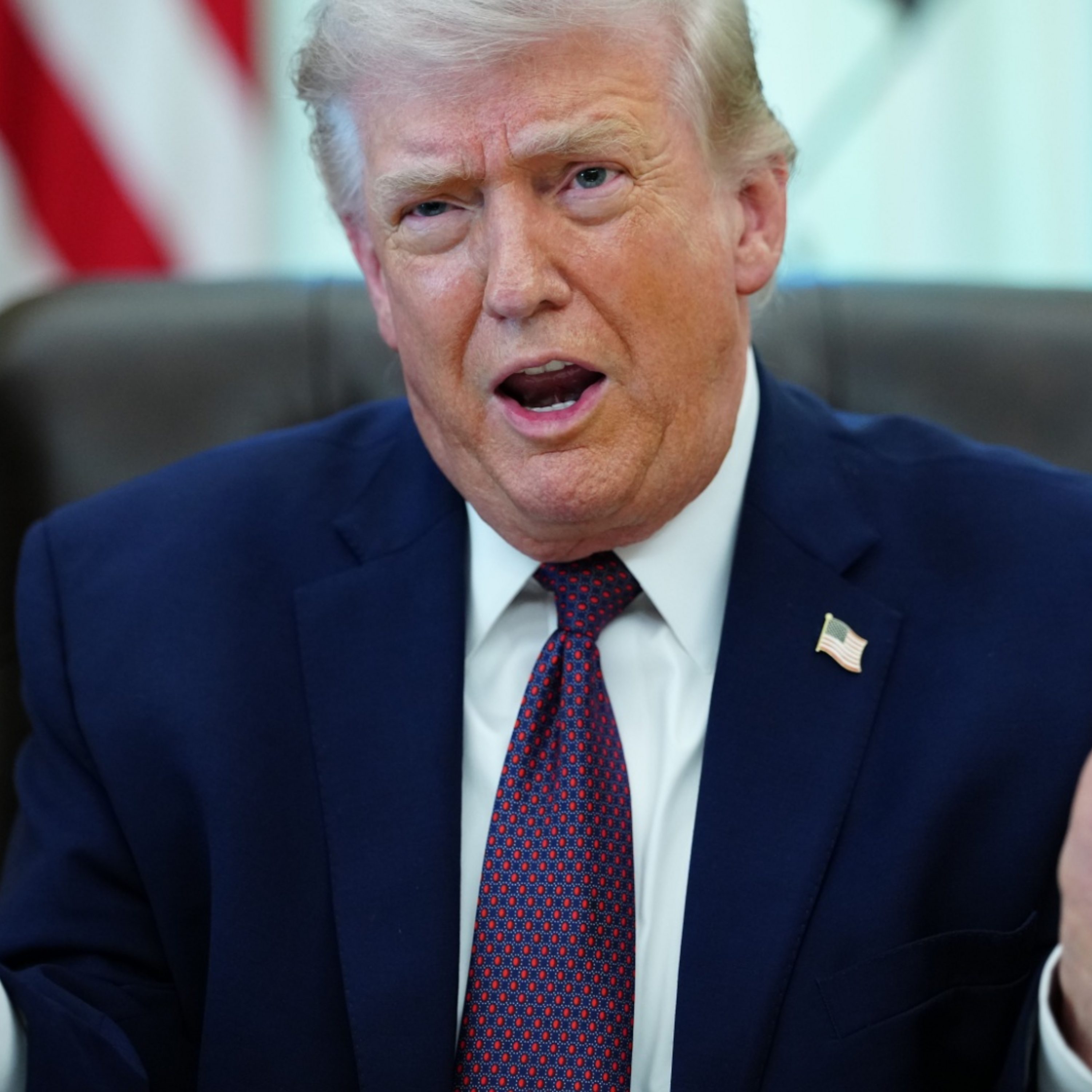
President Trump says the US will end its war against Iran in the next "2 or 3 weeks" - but it will be up to other countries to secure the vital Strait of Hormuz. We'll look at how Australia is dealing with rising fuel costs, and whether it's a good idea for Britain's King Charles to visit Washington at this moment. Also: Donald Trump's White House ballroom project is halted; a special report from the North Sea on a plan to capture carbon dioxide; shocking news for families who had fertility treatment in Northern Cyprus; and we check in with our reporter at Cape Canaveral ahead of NASA's first Moon mission in five decades.
Hosts & Guests

Transcript
This BBC podcast is supported by ads outside the UK.
Momentum doesn't appear overnight.
It's built, refined, repeated.
Puerto Rico has been building it for decades
as a U.S. jurisdiction operating under U.S. federal law,
regulatory standards and market protections.
Here, global companies manufacture life-saving medicines,
advanced technologies and critical products at scale,
and with competitive tax incentives designed to support investment
and expansion, companies don't just start here.
They grow here.
Not culture or business.
Culture and business.
Puerto Rico.
It's not what's next.
It's where.
Visit investpr.org forward slash business.
When Kohler, global design leader and luxurious
kitchen and bath products asked me to be their ambassador
for timeless, elegant, durable cast iron,
I said, I'm in.
Soon after I was in their Kohler Wisconsin foundry,
watching molten iron poured,
enamel applied by hand,
and the beautiful finished pieces ready to ship.
Since 1883 Kohler cast iron has been crafted by incredible artisans,
and seeing it firsthand,
gave me a whole new appreciation for their craftsmanship.
Now, I'm proud to lend my staff of approval to my favorite
Kohler cast iron products for their durability,
beauty, and enduring style.
Shot my curated picks at Kohler.com.
As the Kohler cast iron ambassador, I say long live cast iron.
This is the Global News Podcast from the BBC World Service.
Hi, Alex Ritson, and in the early hours of Wednesday,
the 1st of April, these are our main stories.
Iran says it will end the war with the US,
but only in return for security guarantees.
Donald Trump says it will be over in two to three weeks.
Mixed reactions as Britain confirms King Charles will make a state visit to America.
And Borum Blues for President Trump as a judge stops work on the White House extension.
Also in this podcast, the depleted North Sea oil and gas fields being turned into huge
offshore carbon dioxide storage sites.
And as the team is preparing, I think everybody's pretty excited and understands
a significance of this launch.
This first chapter on our way back to the moon.
The final preparations for the first manned moon mission for more than 50 years.
There's been some optimism after Iranian state media reported,
President Masood Psezhkyyan saying his country is willing to end the war with the US and Israel
in return for security guarantees.
And Donald Trump has also said the war will end in two to three weeks,
but there are conflicting accounts on the status of peace talks and few tangible signs of progress.
Speaking in the Oval Office, President Trump said the end to US operations in Iran
is not dependent on reaching a deal with Tehran,
but rather meeting Washington's war goals.
He also reiterated his call for countries struggling with fuel shortages
to go get their own oil from the state of Hormuz.
We'll be leaving very soon.
And if France or some other country wants to get oil or gas,
they'll go up through the strait.
They'll be able to fend for themselves.
I think it'll be very safe actually.
But we have nothing to do with that because we hit them hard.
We got rid of a lot of the radicalized lunatics along the strait.
We have had regime change.
Now, regime change was not one of the things I had as a goal.
I had one goal.
They will have no nuclear weapon.
And that goal has been attained.
They will not have nuclear weapons.
But we're finishing the job within maybe two weeks, maybe a couple of days longer.
The comments come after a day of heavy strikes on Iran
and follow a warning from the powerful Islamic Revolutionary Guard Corps
that it would retaliate against US tech giants if more Iranian leaders are killed.
And in the past few hours,
it's understood a tanker has been hit by an unknown projectile off the coast of Qatar.
The crew are reported to be safe.
Our North America correspondent Gary O'Donohue gave me this assessment of President Trump's strategy.
I mean, it does really depend what day it is.
What the war aims are for Donald Trump.
He's talked about bombing until Iran has no longer the capacity for nuclear weapons,
which obviously doesn't have any way at the moment.
He's also said that the war is coming to an end.
And I think a lot of people will find that quite surprising,
because we're in a situation where the strait of war moves are still effectively closed.
All this nuclear material is still buried under the ground inside Iran.
And the Islamic Republic remains in place.
And so for, you know, in terms of war aims, one might wonder,
can that really be what victory looks like?
Can he just walk away and leave the rest of the world to sort out the strait of war moves?
Well, I think they believe they can.
They insist always that he has accepted this today.
That America isn't dependent on that oil, etc., etc.
Although that's always belied by the fact that gasoline has just gone over
an average of $4 a gallon here for the first time since August 2022.
You know, the market means that it is still subject to what's going on elsewhere.
So the rhetoric is along those lines, but it's not clear that that can really be
something they believe.
And of course, can they walk away without achieving the goal of retrieving the nuclear material?
440 kilos of 60% enriched uranium?
Can they walk away with the regime in tax even if they, as they say,
they have removed the top few echelons?
The interesting thing is that in the last few days Donald Trump has said we've achieved
regime change. So you can see the beginnings, I think, of a narrative that says,
whether or not anyone believes it or not, that says we've achieved what we set out to do.
How's all this going down with ordinary Americans?
This is a very partisan war. The numbers are really quite striking.
You've got around three quarters of Republicans who support this war.
You've got around one in ten Democrats who support this war.
Amongst Donald Trump's most loyal supporters, as we call them, the MAGA base,
that support is up to 90%. It drops away with more moderate Republicans,
but it's still approaching six out of ten.
I was down in Alabama, over the weekend, talking to some farmers, talking to some people
at a baseball game, talking to people in a church, and you get a real sense that there's a lot
of loyalty to this president down there. As farmers said to me that his diesel was up 50%
that his fertilizer was up $400, $500 a ton, and I said, well, does that question your support
for the president? No, no. That's fine. I'll take the pain to try and stop Iran getting a
nuclear weapon sending over here. Now, you can argue about whether that's likely whether this,
the homeland is under threat, but many Republicans do buy the argument. On the other hand,
a priest I spoke to down there, he said to me, yeah, there's broad support for the president
in this community, but don't forget, you know, these things can change. People can be fickle.
There was support for Vietnam, there was support for Iraq, and things changed. Gary O'Donohu
in Washington. President Trump has again lashed out at countries which he says haven't helped
with his war in Iran. As we've heard, he said the UK, France, and other countries could get their
own oil from the now blocked, straightforward moves. Earlier, Mr. Trump's defense secretary,
Pete Hegseth, appeared to make fun of Britain's Royal Navy. In what was perhaps an unfortunate
coincidence of timing, on the same day, Royal officials in Britain confirmed that King Charles
will make a state visit to the US later this month. It raised the question of whether the King
ought to visit a country whose leaders have been rude about Britain. It's an issue that has divided
opinion. David Dimbleby, a veteran BBC broadcaster who's commented on many royal occasions,
strongly opposes the idea of a state visit at the moment. I think it's in a cute embarrassment.
No, I don't think it's a good idea. I mean, I've pitted the King. I mean, he's at the mercy of
the government. The government says, go, he goes. And sitting down to a state dinner with a man who
has insulted the British troops in Afghanistan and said they weren't particularly important and weren't
needed, goes out of his way to be rude about Britain and about NATO, and who's a narcissist and
a bully. And the wage stand up to bullies is not to take it, but it seems that that's not the
government's view. It appears to endorse what the president is standing for. It appears to
endorse the narcissism. I think the British people, for whom, you know, the King speaks,
would actually have liked to see a slight distance made, a postponement because while the
president is involved in this very important war and they would see it in Iran, it would be
inappropriate. That's why I think it could have been used cautiously as a actually president
Trump. You're not going to win everyone in this in this game. You're not going to win over.
You know, we're not going to send our monarch to sort of shmuz with you in Washington. I mean,
the King is, after all, Commander-in-Chief of the Armed Forces in Britain and Trump has
insulted them when we've been on such a rocky road with this presidency. I would have thought
not canceling it. That would be too much of a rebuke, but there would be a diplomatic way of
finding a pause. But not everyone agrees. Robert Hartman is the author of an upcoming biography
of the late Queen Elizabeth. He thinks Mr. Trump will be on his best behavior as he was when he
visited Britain last year. These things are never perfect and clearly there could be a better time.
I mean, if you look back at the president's speech at the state banquet at Windsor last September,
I mean, I can't recall in decades of state visitors having quite such warm words to say about
Britain generally. I mean, let's sort of forget this is a president who is half British.
There is a really deep rooted love and respect for the monarchy. That runs completely on a separate
axis, if you'd like, from his views on the British government. I would argue for the foreign
office of British foreign policy for the prime minister. I mean, this is a useful way of resetting
the dial. When you look back at the track record of Donald Trump in the presence of royalty,
I mean, I was there in 2018 when he came to see the Queen for the first time and then he had his
first day visit the following year 2019 and then he obviously came last year on his day visit.
Every time he's with the royal family, he's on his best behavior. I mean, he during all his
visits with the late Queen, there was no tweeting. So there is not going to be any sort of
over-office to curling embarrassing moment, I don't think. I think he will be very conscious that
this has got to work. Robert Hardman. As fuel prices rise around the world because of the war in Iran,
countries have begun to implement measures to conserve as much as possible and to offer help
to those paying inflated prices. In Australia, the federal government has halved fuel tax.
In some states, they've even started offering free public transport.
Prime Minister Anthony Albanese has reassured Australians that the country's fuel supply
remains secure after panic buying and petrol stations running dry. Our correspondent Simon
Adkinson, who's in Kens in Queensland, told me how much people would save.
The exercise duty has been halved, which means it's going down by about 26 and a bit Australian
cents. That's around 18 U.S. cents per liter for petrol and diesel. So it should say drivers
between ten Aussie dollars, about seven U.S. dollars and twenty dollars, depending how big
they're vehicles. It's a bit of a saving. I've been past a few service stations here this morning,
and it's clear that while some of them have already started to cut their prices by pretty much
exactly the same amount as that duty reduction, a lot still haven't. And what the companies are saying
and the government is that this is fair enough because they've got to sell the stock first that
they bought at the higher price. Will it help curb the economic impact of the war? I mean,
speak to people here and they say it's better than nothing. Even with this tax cut,
their fuel is still going to be way, way more expensive than it was before the U.S. in Israel.
A tax around, if I can give you an example, just before the war began, I feel my car here,
with these, it cost a touch over a hundred Australian dollars. It's about 70 U.S. dollars.
A couple of days ago, that same tank of fuel was a hundred and ninety dollars,
so close to double. And so the savings on this duty are only going to offset that. And of course,
there are other flow on costs as well. Everything in Australia needs to be transported,
huge distances, so prices of everything are going up. So, you know, this might help a little bit,
but overall the picture is pretty grim here in terms of cost of living.
I'm free public transport in some places. Yeah, that's right. So for the next month,
people in the states of Tasmania and Victoria won't have to pay to use public transport.
And this is basically authorities there saying, come on, leave your car at home, save some fuel,
and a bit of an incentive, you'll save some money to get on the bus, get on the train, get on the
tram, and it won't cost you a penny. And it's proven to be quite popular. I'm in Queensland
today where public transport, it's not free, but it's had a flat rate of 50 Australian
cents for coming up for a couple of years now, something that became so popular that
no politician dares cancel it. And that's led to a real jump in public transport use.
So, hopefully the governments of Tasmania and Victoria will be hoping for a similar uptake.
Of course, there's a big country for a lot of people, public transport just isn't a practical
way to get around, so it's going to take more than that to lure people away from their vehicles.
Simon Atkinson
Still to come in this podcast. You can't just say someone's this and then they're not.
It's who you are as a person really. The shocking news for some families who've used
fertility treatment in northern Cyprus.
Hey there, it's Ryan Seacrest for Safeway. It's stock up savings time. Now,
through April 2nd, spring in for store-wide deals and earn four times at points. Look for
in-store tags to earn on eligible items from Hunts, nerds, Pillsbury, Lowry's,
Briars Quaker and Culture Pop. Then, clip the offer in the app for automatic event-long
savings. Stack up those rewards to save even more. Enjoy savings on top of savings when you shop
in store or online for easy drive up and go, pick up or delivery. Restrictions apply. See website
for full-terms and conditions. Nicole host Easter every year. That's why she shops at B.J.'s
wholesale club, stocking up on spiral ham, baked goods, fresh flowers, candy, and five dozen eggs.
I've got a lot of baskets to fill. Nicole's not worried because she know she can save big
and get it all done in one trip. It's like winning the Easter egg hunt. When you save
everyone wins. Get a $15 digital coupon when you spend $150 in one transaction. Now,
through April 5th, visit bj's.com slash easter coupon for details. Bj's your Easter destination.
One ice coffee. 99 cents please. For real? No way.
One ice coffee. 99 cents please. For real? No way.
What a deal. Your new morning groove. Ice coffee from McDonald's, any size for just 99 cents
till 11 a.m. Pricing participation may vary. Cannot be combined with any other offer.
Bada bada bada.
This is the Global News Podcast. Now to another matter that's been on President Trump's mind
over recent months, the new ballroom he's having built as part of an extension to the White House.
Work has already started, but a judge has now ruled that construction has to stop,
because Mr. Trump doesn't have the authority to build it without approval from Congress.
I heard more about what the judge said from our Washington correspondent. I only wells.
Well, he said that while Donald Trump is the steward of the White House at the moment,
he isn't the owner and so he doesn't have the authority to approve funding or large-scale
iterations to federal property without the permission and approval of Congress. Essentially,
he was saying that the preservation group, the National Trust for Historic Preservation,
that have brought this lawsuit against the ballroom project are likely to succeed
in their lawsuit. That is effectively the judgment here by this federal judge.
And now he said that Donald Trump essentially has 14 days to try and appeal this decision.
Otherwise, construction will be halted in two weeks. So I think in less Donald Trump,
successfully manages to appeal this decision in the next 14 days, it is likely that construction
is going to be paused on this. What does the president actually want to do with the ballroom?
Why are his plans so controversial? Well, he sees this as a chance to massively expand
essentially the hosting space of the White House at the moment. Sometimes when large-scale events
are put on, they have to erect marquees or tents or, for example, outside. And this is a way of
increasing the capacity for posting balls, big-state dinners, for example. Although Trump has actually
said recently that the ballroom is just in his words a shed for what's underneath and that there
will also be this big military complex underneath it. So he has huge ambition, I think, for this
project, which is part of his wider plans, to make his mark on Washington and make various
changes to the city while he's in office. Why it's controversial is the White House, of course,
is one of the most symbolic buildings in the US. And I think there is a sense that critics,
when they saw diggers going in and essentially deconstructing the East Wing, tearing it down and
starting to construct a new building on it, that they were pretty horrified that there were these
huge changes being made to the White House without much input from the public or federal lawmakers.
Has there been any reaction from the White House? What's this going to mean for the
President's plans? Is he going to have to go to Congress? Well, Donald Trump has reacted
himself, posting on Truth Social, attacking the National Trust for Historic Preservation,
who brought this lawsuit against the project, accusing them of being a radical left group of
lunatics, who he accused of essentially overlooking projects elsewhere in the US that he described
as over budget. But now opposing a ballroom, which he said was under budget ahead of schedule,
didn't cost the taxpayer and, in his words, is one of the finest buildings of its kind anywhere
in the world. So he's clearly, as expected, not happy at all with this decision. In terms of
options going forward, the judge had said that it's not too late for him to go to Congress and seek
approval. So if he did get that approval, then perhaps that would give him that authority to go
ahead. Or he could potentially try to launch a legal appeal in the next two weeks. It is a
short timeline, though, for him to successfully get that appeal approved in time to allow construction
to continue. To Denmark now, where an ambitious carbon capture plan will soon be underway,
with human activities emitting record levels of carbon dioxide, carbon capture allows
thousands of tons of CO2 that's being released from power stations and other industrial processes
to be captured and then stored in depleted oil and gas fields in the North Sea. This could make
a real difference in limiting the long-term warming of the planet. Green Sun's future, which is
led by British chemicals giant Ineos, will become the EU's first large-scale offshore CO2 storage
site. Our reporter, Adrian Murray, travelled from the Danish port town Esber, and out into the North Sea.
Our helicopter had flown 250 kilometres from Denmark's west coast when it circled
a solitary oil rig rising up from the choppy waters of the North Sea. Here an almost depleted
oilfield is about to get a second life as the site of a massive carbon storage project
called Green Sun Future. Where CO2 emissions captured from industry will be buried 1800 meters
below the seabed. At a landing at the large Mother Platform nearby, Merd Scala, CEO of Ineos Energy,
showed me to the wellhead. Instead of moving the oil and gas up the ground, we're going to
inject the CO2 into the ground instead. When commercial operations get underway in the next few months,
this will be the EU's first large-scale offshore storage site. We think it's one of the best
answers to CO2 emissions and Denmark has the potential to actually store more than
several hundred years of our own emissions. Globally, hundreds of carbon storage initiatives
are in development. In Europe, the North Sea is emerging as a hub with several large-scale
projects advancing in Norway, the Netherlands, Denmark and the UK. And at a decades of exploration,
the region's geology is also well understood. At a large warehouse on the outskirts of Copenhagen,
cases of rock samples are stacked floor to ceiling. Neil Skomspon, a senior researcher at the
Geological Survey of Greenland and Denmark, showed me a grainy green slab drilled from the seafloor.
We call it green sand because it is actually green. If you feel it, it's a little rough.
He says the North Sea's poorest bedrock is well suited for CO2 storage.
We want a large volume of poor small cavities in the rock that can actually store the CO2,
and then we want lotstones that can seal off the reservoir. We know that over geological time,
that this cap rock has been capable of withholding oil and gas below, and that is the same ceiling
mechanism that we use for CO2 storage. Both the UN's top climate science body say that carbon
capture is a necessary tool to help limit global warming. However, the technology is not with
that critics. If we want to go net zero and even net negative, we will need these technologies.
Helena Hegel is head of climate and environmental policy at Greenpeace Denmark.
But if our generation use the seabed for storing carbon now, that we shouldn't have emitted in
the first place, then the generations coming after us won't be able to use the seabed to store their
emissions. Back on the Siri rig out of the North Sea, maintenance manager Peter Pierre tells me
that carbon storage offers new opportunities. Seeing a future building up here to the green
transitions is just amazing. And soon that climate warming CO2 will be shipped out here in the North
Sea and knocked away for good. Adrienne Murray
Going through fertility treatment can be a difficult experience for many couples,
and for those traveling abroad and using sperm or egg donors, there are a different set of
challenges. Northern Cypress is a popular destination for those seeking more affordable IVF,
but there's no independent fertility regulator. The BBC has spoken to parents who used clinics
there and now believe their chosen donors were not used, and are Collinson reports.
Siblings Kate and James are looking through a photo album with their parents.
So I was a father baby compared to Jane.
There are two mums, Beth and Laura, each underwent IVF to have their children.
The same sex couple needed a sperm donor. They selected an anonymous Danish man known as Finn
from a sperm bank. They're showing me his profile.
Right, witty, creative, optimistic, strong, physically and mentally.
Are you a smoker? No, never smoke.
It was really important that they had some sense of who he is.
Because that's half of them. It's half their genetics, their DNA,
shapes their identity, their sense of self, who they are.
As Beth and Laura would each be a biological mother to one child, they wanted donor
Finn to be used in all IVF procedures to ensure their children were biologically related.
They paid their fertility clinic in northern Cyprus to import Finn's sperm.
When did you start thinking? Not everything is adding up here.
So when James was born, we expected him to have blue eyes, and he didn't,
so that kind of rang a bit of an alarm bell.
The family decided to do a series of DNA tests.
They're meeting with a leading genetics expert to find out their results.
Beth and Laura, I've got your results here in these envelopes.
After a few minutes of quiet reading, Beth tells us the findings.
So it says that Kate's and James are unrelated.
Is there any possibility whatsoever in your mind that they might be related?
Professor Denise Sinderkampkort has analysed all of the family's DNA tests.
She says not only are the children from different sperm donors,
she thinks it's unlikely either are from donor Finn.
Beth and Laura have gone from knowing a lot about their children's donor
to knowing nothing at all. What screening have they done for the donor
in terms of health checks and also how many donations have they done?
Beth and Laura's IVF treatment was in northern Cyprus, one of the most popular destinations
for British people seeking fertility treatment abroad.
Clinics there promise high success rates, low costs and even a sunny holiday.
Many patients say they have positive experiences there,
but our investigation has uncovered a more disturbing side.
The families of seven children have told me they believe they were given the wrong sperm or
egg donors at clinics in northern Cyprus. Most of them have now done DNA tests.
That's an absolutely appalling position to be in. That that should never ever happen.
Dr Ippocrates Saris from the British Fertility Society has viewed our findings.
It's important to say that there's nothing inherently wrong with what's called
cross-border medicine and it happens quite a lot. However, the moment you exit the shores of this
country, you rely on the local regulation of wherever you're having treatment.
Northern Cyprus is only legally recognised by Turkey and has its own fertility laws.
Unlike the UK, it does not have an independent regulator monitoring its clinics.
Bethelora's doctor denies any wrongdoing and the clinic where they had their treatment
has not responded to our questions. Back on a beach in southwest England is a family coming to terms
with what they've discovered, particularly James. How did you feel when you saw your DNA results?
Upset because like you can't just say someone's this and then they're not. Identity is the
main thing. It's who you are as a person really. James ending that report by Anna Collinson.
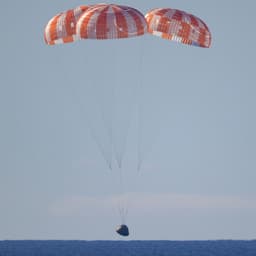
Final preparations are underway for America's first manned mission into deep space since 1972.
The Artemis II rocket will take four astronauts on a 10-day journey around the moon. If all goes
well, the launch could take place later today. Senior NASA test director Jeff Spording gave
this update. There was a lot of smiles today, so I felt really good about that. As the team is
preparing, I think everybody's pretty excited and understands the significance of this launch.
This first chapter on our way back to the moon. But there is a chance the launch could be delayed
because of the weather. The rocket might not take off if it's too cloudy or if there's rain.
Mark Berger is the launch's weather officer. Still maintaining a 20% chance of a no-go condition
during the launch window. So the optimistic side of me says that means 80% chance of go here.
Again, isolated showers are wandering around but a lot of real estate between those showers
and all likelihood. So we should be able to shoot the gap between those showers and none of these
look particularly vigorous. Our science editor Rebecca Morrell is at Cape Canaveral for the launch.
In Florida, the crowds will gather on the beaches to watch four astronauts begin their
journey to the moon. I'm pretty excited about it. I came out here to see it and I heard it's going
to be a great show. A lot of people are going to be here. People going up to the moon is kind of
like cool stuff because when the booster comes down it likes a big ol' noise. I love space. It's
amazing. It's the greatest unknown out there. The huge countdown clock which sits on the lawn at
the Kennedy Space Center has started ticking down. The Artemis 2 mission team says the rocket is
ready to launch. The crew has been spending time with their families having dinner at the
astronaut beach house like the Apollo astronauts did with their families more than 50 years ago.
These astronauts won't be landing on the moon during their 10-day long mission they'll be
travelling around its far side the side we never see from Earth. Their journey will start on the
most powerful rockets that has ever built with the astronauts strapped into a capsule right at
the top. Randy Bresnick, a former commander of the International Space Station, says the Artemis
crew will be in for quite a ride. We try not to allow yourself to get too excited and then when
you finally hear the 10, 9, 8 with the liquid engines light off at six seconds they test it out
and they're all looking good. 3, 2, 1 you know once the sun is light there's no turning them off
so they're going to space and they're definitely ready for that. Former astronaut Randy Bresnick
ending that report from Rebecca Morrell. And that's all from us for now. If you want to get
in touch you can email us at globalpodcast at BBC.co.uk. You can also find us on X at BBC World
Service use the hashtag globalnewspod. And don't forget our sister podcast the global story
which goes in-depth and beyond the headlines on one big story. This edition of the Global News
podcast was mixed by Holly Smith. The editor is Karen Martin. I'm Alex Richardson until next time.
Goodbye.