Loading...
religionspirituality
Truth For Life Daily Program - The Prayer of Jesus (Part 2 of 2)
About this Episode
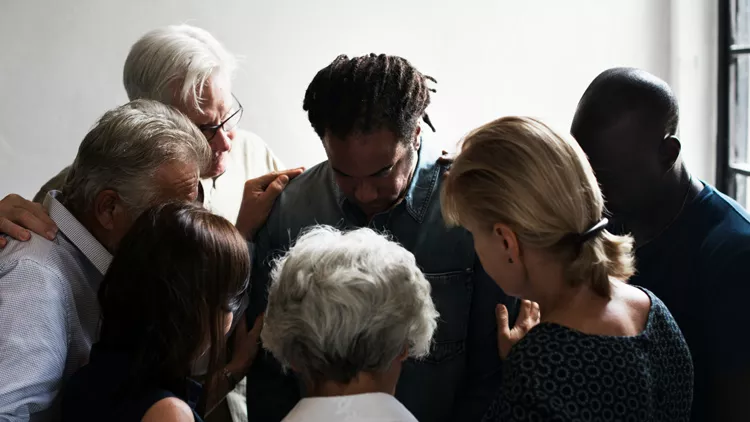 Prayer requests often include things like healing from illness or success with endeavors. While these aren’t bad things to pray about, you won’t find them in Jesus’ High Priestly Prayer. So what was His focus? Find out on Truth For Life with Alistair Begg.
-----------------------------------------
• Click here and look for "FROM THE SERMON" to stream or read the full message.
• This program is part of the series‘The High Priestly Prayer’
• Learn more about our current resource, request your copy with a donation of any amount.
Helpful Resources
- Learn about God's salvation plan
- Read our most recent articles
- Subscribe to our daily devotional
Follow Us
YouTube | Instagram | Facebook | Twitter
This listener-funded program features the clear, relevant Bible teaching of Alistair Begg. Today’s program and nearly 3,000 messages can be streamed and shared for free at tfl.org thanks to the generous giving from monthly donors called Truthpartners. Learn more about this Gospel-sharing team or become one today. Thanks for listening to Truth For Life!
Hosts & Guests
Transcript
Often when people share prayer requests, we hear about the need for healing from illness
or injury or success in various endeavors. And while it's not wrong to pray for these things,
we don't find this in Jesus' high priestly prayer. So what was his focus in this sacred prayer?
We'll find out today on Truth for Life. Alistair Begg is teaching from chapter 17 of John's gospel.
The Father is personally distinct from the Son, even as the Son and the Father are distinct
from the Holy Spirit. So we're confronted by the fact that from all of eternity, within the
Godhead, there was love and there was communication. Verse 24 reinforces this, Father, I desire that
they also whom you have given me may be with me where I am to see my glory that you have given me.
Listen, because you loved me before the foundation of the world. It's a profound mystery.
It's a profound truth. But we'll leave mystery and go on to security, to security. I just picked
these, you could have chosen maybe another five words, but you'll notice how the disciples are
described in verse 6. I have manifested your name to the people whom you gave me out of the world.
Yours they were and you gave them to me and they have kept your word. Now hopefully there's at
least one person who's saying to himself, well we dealt with that back in chapter 6. It's probably
a lady. They usually pay more attention, but it's 6.37. This is 6.36. But I said to you that you have
seen me and yet you do not believe all that the Father gives me will come to me and whoever comes to
me I will never cast out. And this is the will of him who sent me that I should lose nothing of all
that he has given me, but raise it up on the last day. For this is the will of my Father that
everyone who looks on the sun and believes in him should have eternal life and I will raise him
up on the last day. And after he had said these things in the hearing of the disciples who would
remember that he had said this, he now says what he says in prayer to his Father. I'm praying for
them, he says in verse 9 the security of the prayers of Jesus for his own in verse 11. I'm no longer
in the world, but they are in the world and I'm coming to you, Holy Father, keep them in your name.
By verse 14 he says they are hated, the world has hated them because they're not of the world.
But notice in verse 13 I'm coming to you and these things that I speak in the world that they
may have my joy fulfilled in themselves. Filled with the joy that comes by the means of the work
of the Holy Spirit within the life of the child of God and at the same time hated by the world.
You shouldn't be surprised that people don't like you. You shouldn't be surprised when you say
that Jesus is the second person of the Trinity. You shouldn't be surprised when in addressing your
Muslim friends you point out that this is a radically different perspective. That the idea that
all roads lead to heaven like they lead to Timberto cannot be substantiated from the Bible.
And when that becomes the prevailing notion of a Western culture as it increasingly is,
then the person who's prepared to stand out and say no, Jesus said I am the way that truth
and the life and no one comes to the Father except through Him. Don't expect people to stand and
applaud. They hate that. It challenges core convictions that have become increasingly embedded
in our culture. But blessed are you when you are persecuted for righteousness sake. When people
say all manner of evil against you fall asleep for my sake rejoice and be glad. A security that
doesn't mean we are just navigating our way through the through the universe in a sort of tranquil
state. No, we're involved in opposition to the things that we hold dear, opposition to the one
whom we hold dear. And yet our joy is fulfilled. We've been reading through the Psalms for a while now
and back in Psalm 11, the Psalm begins about praising God. And the Psalmist says,
why do you say to me, flee like a bird to your mountain, flee like a bird to your mountain?
The Psalmist says, you know, if we could only get out of here, which of course goes all the way
back to the sixties and to Eric Burden, we got to get out of this place. It is the last thing
we ever do, right? Now, if I listen carefully to some of you speaking and you tell me you watch the
news a great deal, I feel so bad for you. As you fall asleep at night singing, we got to get out
of this place. It is the last thing we ever do, but there's nowhere to go. Why do you say, flee like a
bird to your mountain? Where would you go? Where would you ever want to go? Save in the arms
of Jesus in the Lord, I take refuge. Why do you say to me, flee like a bird to the mountain?
Security. Thirdly, sanctity, sanctity.
There's 17, can be our starting point here.
Sanctify them in the truth. Your word is truth preceded by verse 16. They are not of the world,
just as I am not of the world. Because once we are united to Christ and Christ is not of the world,
then we are not of the world. If your reading makes shame, you're working away through
due to ouronomy as part of the readings. And this morning, it was very, very clear, God is speaking
to His people. And He's sent to them, I have chosen you as a people for my very own possession.
You're not like anybody else. You're not like the surrounding nations. You are radically different.
Now, Jesus is making the same point. Sanctify them. How then is sanctification to take place?
Well, He tells us that the means of sanctification, how is a man or a woman separated from the sin
that is so appealing to me? How is it that my life may become dedicated to righteousness,
which often seems like a far harder way to go through your day? How does that happen?
Well, the answer is it happens by means of the Word of God.
I have given them the words that you gave me. I have given them the words that you gave me.
Go all the way back through this gospel. And that's what he's referring to. John chapter 8,
for example, again, Jesus spoke to them saying, I am the light of the world. Whoever follows me will
not walk in darkness, but will have the light of life. Notice that both our security and our sanctity
are by means of the Word of God, by means of the Word of God,
that God's Word is a lamp to our feet, it is a light to our path, it causes up short,
it stabilizes us when we're shaky, it encourages us when we're faltering,
and all to the end that we might be seen to be the very children of God.
I hope you read your Bible. I hope you read it. Make the book live to me, O Lord,
morning prayer. Show me yourself within your Word. Show me myself. Show me my Savior.
Make the book live to me. Now I have to go to the office. Now I have to go to the school.
Now I have to deal with her. I've got to deal with that. Your Word sanctified them. Jesus
prays to the Father for his followers that we might be what he deserves for us to be,
and the means for attaining to this is through the Word of God. I suffer a while and thought about
a man that I only heard briefly when I came here in the early 80s. Some of you will have remembered
him for a longer. He's born in 1901 in the Carolinas, and he died on the 12th of August 1986.
I heard him in the three years that I had before he died. He was a wonderfully endearing
teacher of the Bible, and he said memorable things. The one I want to mention to you, I'll mention
in a moment, but here is another one. In it fits, if you are a Christian, you're not a citizen of
the world trying to get to heaven. You are a citizen of heaven making your way through the world.
That's good. So in the morning, I say, I am a citizen of heaven making my way through the world.
This world is not my home. Just passing through. But here's the quote that I went looking for.
I wish I could do it in his accent, but I won't. Sin will keep us from this book,
or this book will keep us from sin. And it is not the word hidden in the head, but in the heart
that keeps us from sin. You can have a head full of Scripture and a heart full of sin. You can
backslide with a Bible under your arm. I say that makes the point. And to this end,
Lotus in verse 19, and here is a mystery as well. Jesus says, I consecrate myself. I consecrate
myself to this end. For their sake, I consecrate myself that they also may be sanctified in the truth.
When Paul fastened on this, writing to the Corinthians, 2 Corinthians 5, 15, he says,
and he died for all that those who live should no longer live for themselves, but for him who
died for them and was raised again. Mystery, security, sanctity, unity, just briefly our time passes.
But it's only a trailer. Verse 11, what is he praying that they may be one even as we are one,
that they all may be one. Notice, verse 21, just as you, Father, are in me and I in you,
that they also may be in us so that the world may believe that you have sent me. 23, I end them,
you and me, that they may become perfectly one. Now we'll come back to this in detail,
obviously, as we work our way through the entire chapter, just two things to point out.
Number one, this unity is supernatural. It is supernatural. Jesus is not asking for us to create
this. He's explaining that it is a supernatural reality. And that's why we can pray this morning
in the awareness of the fact that Tepele, who comes from South Africa and our brothers and
sisters in North Africa, and the folks that I left behind in the Balkan Peninsula two weeks ago,
we are one in Christ Jesus. It's a supernatural reality. You walk into a world that you've never
known, meaning people that you've never seen, speaking a language that you don't understand,
and you call them brother, you call them sister, and you mean it. It's not affectation,
it's a reality, something stirs in your heart. You're singing the same songs in Dutch,
and you're going, this is true. This is absolutely true. What is this unity? Supernatural,
secondly, evangelical, evangelical. In other words, it is doctrinal. The reality of the unity
about which Jesus speaks is not a structural thing. It is not an organizational thing. It is an
evangelical reality. It is grounded in the truth, sanctify them in the truth. What is the truth?
It is the truth of who Jesus is, why Jesus came, what it means that Christ has dealt with sin,
and so on. In other words, it's not a unity on the basis of the lowest common denominator,
whereby we will sacrifice deep convictions in order to make it look like we all really like one
another. I have, as you know, good Roman Catholic friends, and so do you. There are many things
that were agreed on, but in fundamental places, there are matters of great distinction.
No, this of course demands more of our attention, and we will give it. But look at verse 8,
for I have given them the words that you gave me. I gave them the words you gave me. They have
received them. They've come to know in truth that I came from you, and they have believed that
you sent me. And so the basis of our unity is the apostolic gospel. It is that which is laid out
for us in the Scriptures. Last word, the word glory, verse 24, Father, I desire that they also,
whom you have given me, may be with me where I am to see my glory that you have given me.
Now again, hopefully somebody says, well, we dealt with that glory back in chapter 12,
and you're absolutely right. It was in the context of one of our truly true leases.
12, 23, in Jesus' answer, them, the hour has come for the Son of Man to be glorified. You'll
notice incidentally, that's exactly how chapter 17 begins, that's how the prayer begins.
And after he had spoken these words, he lifted up to his eyes to heaven, and he said,
Father, the hour has come. The hour that we considered way back in chapter 2 in the miracle
in Canaan of Galilee, where Mary says to Jesus, we don't have a wine, and Jesus
inagmetically responds to her, Mom, the hour has not yet come. Now it's the hour when he will be
glorified, how will he be glorified? He will be glorified just as a way a grain of wheat falls
into the earth and dies, but dies and bears much fruit. And I think perhaps here in verse 24,
you have perhaps one of the things of Jesus that leads us farthest into the divine depths.
Father, I desire that they also whom you have given me may be with me where I am,
to see my glory that you have given me because you loved me before the foundation of the world.
Oh, Jesus, I have promised, as the hymn writer, to serve thee to the end.
Oh, Jesus, you have promised to all who follow thee, that where thou art in glory,
thou shalt your servant be. John's gospel begins, John 114, we have seen his glory.
The glory is of the only begotten of the Father, full of grace and truth in the person of Christ.
The Christian recognizes that we are being transformed from one degree of glory into another,
but we recognize too that there is still a day to come when the glory which Christ had with the
Father is going to be unveiled before our eyes. The revelation of the entirety of who and what
God is, the immensity of his love and so on. Samuel Rutherford, Scottish minister and theologian
born in 1600, lived for 61 years, was one of the commissioners from Scotland at the Westminster
Assembly where the Westminster Confession of Faith was written and placed before the United
Kingdom Parliament for its understanding and ratification, what a very different world.
Rutherford left behind, of course, many of his letters and many of his writings.
In them, he writes to one of his friends, your errand, he says, in this life, is to make sure
an eternity of glory for you to see. That's your purpose. Of course, the Scottish Catechism gives us
that. What is the chief end of man to glorify God and to enjoy him forever? There's nothing else
that can satisfy. You may be here this morning and most of what I've said, you sounds like gobbledygook,
but understand this, you were made by God. By nature, you turn away from God, we all do.
But his love is so great that he pursues even the people that are not even looking for him.
And why does he do so? For his own glory. In order that on that day, the glory might be seen
to belong entirely to him. In the 19th century, a lady called Anne Cussens took some of
Rutherford's writings and wrote a 19 verse poem. And a few of those verses were then
exerted and turned into a hymn, which some of you will have sung in your past, but it goes
along these lines, the sands of time are sinking. She's true, the dawn of heaven breaks.
The summer mourn I have sighed for, the fair sweet mourn awakes. Dark, dark has been the midnight,
but day spring is at hand, and glory, glory to earth. In Emanuel's land, I won't go through
all him, the king there in his beauty, without a veil is seen. This is a wonderful poem. It's not
sentiment. O Christ, he is the fountain, the deep sweet well of love. And then masterfully, the bride
has not her garment, but her dear bridegroom's face. I will not gaze at glory, but on my king of grace,
not on the crown he giveeth, but on his pierced hands, because the lamb is all the glory
in Emanuel's land. I pray, Father, that they may see my glory, the glory that I had with you
in the pre-incarnate reality of eternity. Mystery, security, sanctity, unity, glory. Welcome to John
17th, a brief prayer. And when I think that God his son not sparing sent him to die,
I scarce can take it in that on the cross my burden gladly bearing, he bled and died to take away
my sin, then sings my soul. Lord, may it be out of the fullness of your gracious work in us,
that we might live in the light of the truth that we discover in such a way that it brings glory to
you, the only true and living God, and we pray in Christ's name. Amen.
You're listening to Truth for Life with Alistair Begg.
If you're enjoying this study of Jesus high-precly prayer found in John's Gospel,
Alistair's teaching on this series comes with companion study guide, and you can download it for
free at truthforlife.org slash study guides. And in addition to reflecting on Jesus' prayer as
you prepare for Easter, you can sign up to receive Alistair's newly released seven-day reading plan,
titled The King on the Cross. Over the course of seven days, you'll receive a series of
brief emails that trace the rise and fall of Israel's kings all in anticipation of the perfect
who would sit on the throne forever. In this seven-day reading plan, Alistair unpacks the Old
Testament expectation of a ruler who would come one day. It's an enriching way to center your
thoughts on God's plan for our salvation as we look forward to celebrating Resurrection Sunday.
You can sign up for free, go to truthforlife.org slash reading plans.
You know, we never know how God will use this program to change a life, but we trust that by
the spirits in powering, God uses his word to save and transform lives. That's why our mission
of truth for life is to teach the Bible clearly every day in such a way that you could apply it
to your daily life. We're glad you studied along with us today. Tomorrow we'll consider how in
God's economy, death on a cross became a symbol of power, triumph, and glory rather than the
ultimate signal of defeat. The Bible teaching of Alistair Begg is furnished by truth for life
where the learning is for living.


