About this episode
Get every episode summarized
Each time Clark County Today News publishes, we email you a written briefing from the transcript — the topics, who appeared, and any specific claims, with the ad reads skipped.
Email me new episodesFree for 3 shows. No card needed.
Hosts & guests
Transcript ready
86 searchable segments. Every word is indexed and playable.
Full transcript
Clark County Today News — Two Bridges, One Growing Bill for Clark County. Machine-transcribed; use the interactive transcript above to jump the player to any line.
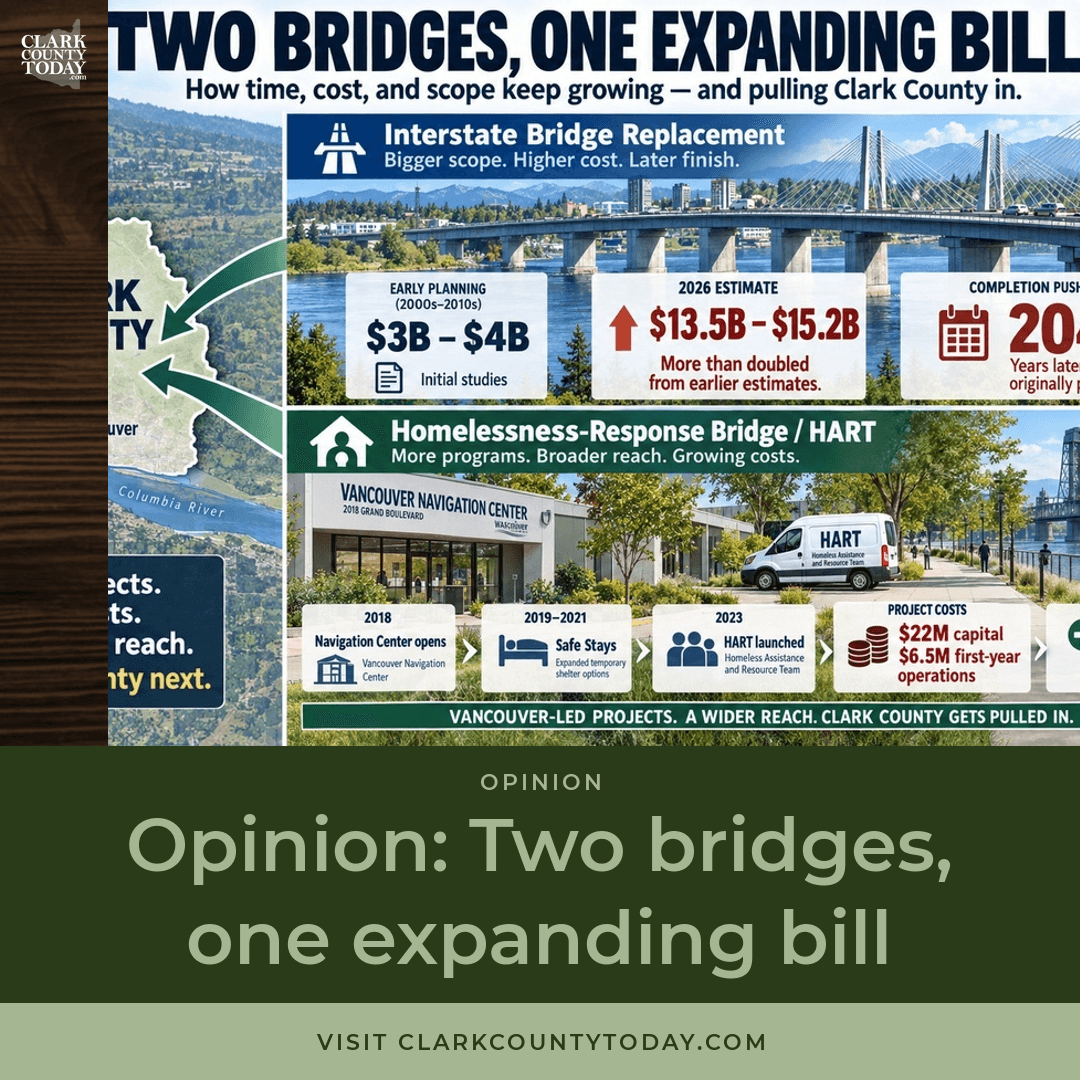
This letter to the editor was submitted by Peter Brackie of Vancouver. Clark County residents are watching two very different bridge projects grow at the same time. One is the Interstate Bridge replacement across the Columbia River. The other is Vancouver's bridge shelter intended to help move people from homelessness toward permanent housing. The missions are entirely different, and the financial scales are not comparable. But place their timelines side by side, and a familiar government pattern begins to emerge. The longer the project continues, the larger the scope becomes, the cost rises, more funding sources are added, and more governments become part of the commitment. The Interstate Bridge replacement is the obvious giant. Its predecessor, the Columbia River Crossing, was once discussed in the neighborhood of 3 billion to 3.5 billion dollars. When the current Interstate Bridge replacement effort was revived, its 2022 estimate had grown to roughly 5 billion to 7.5 billion dollars. Today, the official estimate for the full 5 mile program is 13.5 billion to 15.2 billion dollars,
with about 14.4 billion dollars being used for financial planning. Program officials have legitimate explanations for much of that increase, including inflation, higher labor and material costs, additional design work, risk, delays, and a longer construction schedule. The current project is also more than simply replacing two old bridge spans. It includes interchanges, light rail into Vancouver, pedestrian and bicycle facilities, and other corridor improvements. Some are all of those may be worthwhile, but the lesson for taxpayers remains the same. Time is expensive. The full program that once carried a completion target around 2034 now has a horizon reaching toward 2045, and every additional year brings more management, engineering, inflation, and financial uncertainty. Now look at Vancouver's other bridge. After declaring homelessness and emergency in 2023, Vancouver moved forward with what is now called the bridge shelter. The city currently plans a facility with up to 120 beds, at an estimated cost of approximately 22 million dollars for property acquisition and construction. First year operating and management
costs are projected at about 6.5 million dollars, and are expected to increase with inflation. Vancouver expects the shelter to operate for at least 10 years, using that first year operating figure without inflation, acquisition, construction, and 10 years of operations. Approach roughly $87 million dollars. That is not an official 10-year city budget forecast, but it illustrates the scale of obligation taxpayers are entering into. The shelter also does not stand alone. Vancouver already operates safe state communities, safe park, heart, community court, and other homelessness response programs. Police, firefighters, public works employees and cleanup crews remain involved in responding to the street level consequences of homelessness. In other words, the new program does not necessarily replace the old programs. It is added to them. Clark County is being pulled further into both projects. The Interstate Bridge is a Washington Oregon transportation project, led by WS. and O.Dot. Vancouver has nevertheless been one of its strongest local supporters, while Clark County residents will live with the transportation, tolling, and economic consequences
for decades. Clark County government has considerably less control over the project than the two-state transportation agencies. But county residents will still be paying attention to the final design, the final cost, and the eventual toll burden. The bridge shelter began much more clearly as a Vancouver project. But Clark County is now being drawn into that effort as well. The county has committed approximately $4.85 million dollars toward the shelter through opioid abatement funds and mental health sales tax money. A portion of the shelter capacity will also be available to eligible Clark County residents outside Vancouver. Now another step is appearing. The September 14th Vancouver City Council agenda contains a proposal to accept another $564,000 grant from the Ed and Dolly Lynch Fund through the Community Foundation for Southwest Washington to expand Vancouver's heart outreach services into Clark County. That follows approximately $1.9 million dollars, previously provided by the Lynch Fund to expand heart staffing. The latest grant is interesting, not simply because of the amount. It is interesting because of the direction. A homelessness
response operation developed by Vancouver is expanding beyond Vancouver, and a city program is becoming more regional. Regional cooperation may be sensible because homelessness does not stop at a city boundary, any more than traffic stops at the Columbia River. But taxpayers should recognize the larger pattern. Projects expand, programs expand, funding sources expand, and government partnerships expand. Each expansion creates another continuing responsibility. Past cost and future obligation belong on the same page. Government usually presents a project by explaining what it will accomplish. What the public rarely sees as clearly is the full timeline from initial estimate to current cost to future obligation. That timeline matters because the financial impact of government decisions often becomes much larger than the original project announcement suggests. For the Interstate Bridge, the numbers have moved from roughly 3 billion plus in the earlier era to a current full-program planning figure of about $14.4 billion with the completion horizon stretching toward 2045. For the bridge shelter, a response to a homelessness emergency has become
a roughly $22 million capital project, with millions of dollars in annual operating expenses and an expected life of at least a decade. Meanwhile, the surrounding homelessness system continues. Vancouver reported that heart, police, and public works conducted 48 camp cleanups and removed more than 400 tons of solid waste from public property in 2024. That does not mean the homelessness programs have accomplished nothing. People have moved from safe stays into housing and supportive care, community court has produced graduates, and heart has connected people with services, who otherwise may not have received help. Those successes matter, but so does the larger measurement. As government investment grows, the public should eventually be able to see something else becoming smaller. For transportation, that should ultimately mean a completed project, improved reliability, and an end to decades of planning and escalation. For homelessness, success should eventually mean fewer people living outside, fewer camps, fewer cleanups, fewer emergency interventions, and less need for an ever-expanding specialized response system. That is a much harder standard than counting grants, programs,
employees, or ribbon cuttings. But it is the standard that ultimately tells taxpayers whether their investment produced the intended result. Two projects, two very different missions, but the same question for Clark County taxpayers. How much bigger do they get before the problems themselves get smaller? Clark County is increasingly connected to both bridges, whether through transportation impacts, shelter funding, heart expansion, or the long-term cost that follow. Both projects may ultimately deliver real benefits. The Interstate Bridge may provide the safer, earthquake-resistant crossing this region needs, and the bridge shelter may help many people move from the street into stable housing, but success should not be measured by how larger project becomes or how much government can spend on it. It should be measured by eventually reaching the other side. Two bridges, two very different missions, one common lesson. Time does not simply pass. It adds cost, scope, and responsibility. And Clark County taxpayers are increasingly being asked to come along for the ride.
More episodes
More from Clark County Today News

WA-3 Candidates Agree to Two October TV Debates
Clark County Today News

Clark County Charter Town Halls: 9 Amendments on the Ballot
Clark County Today News

Ridgefield Names Jim Quackenbush as Next Police Chief
Clark County Today News

King's Way Students Honor 9/11 With Flags and Prayer
Clark County Today News