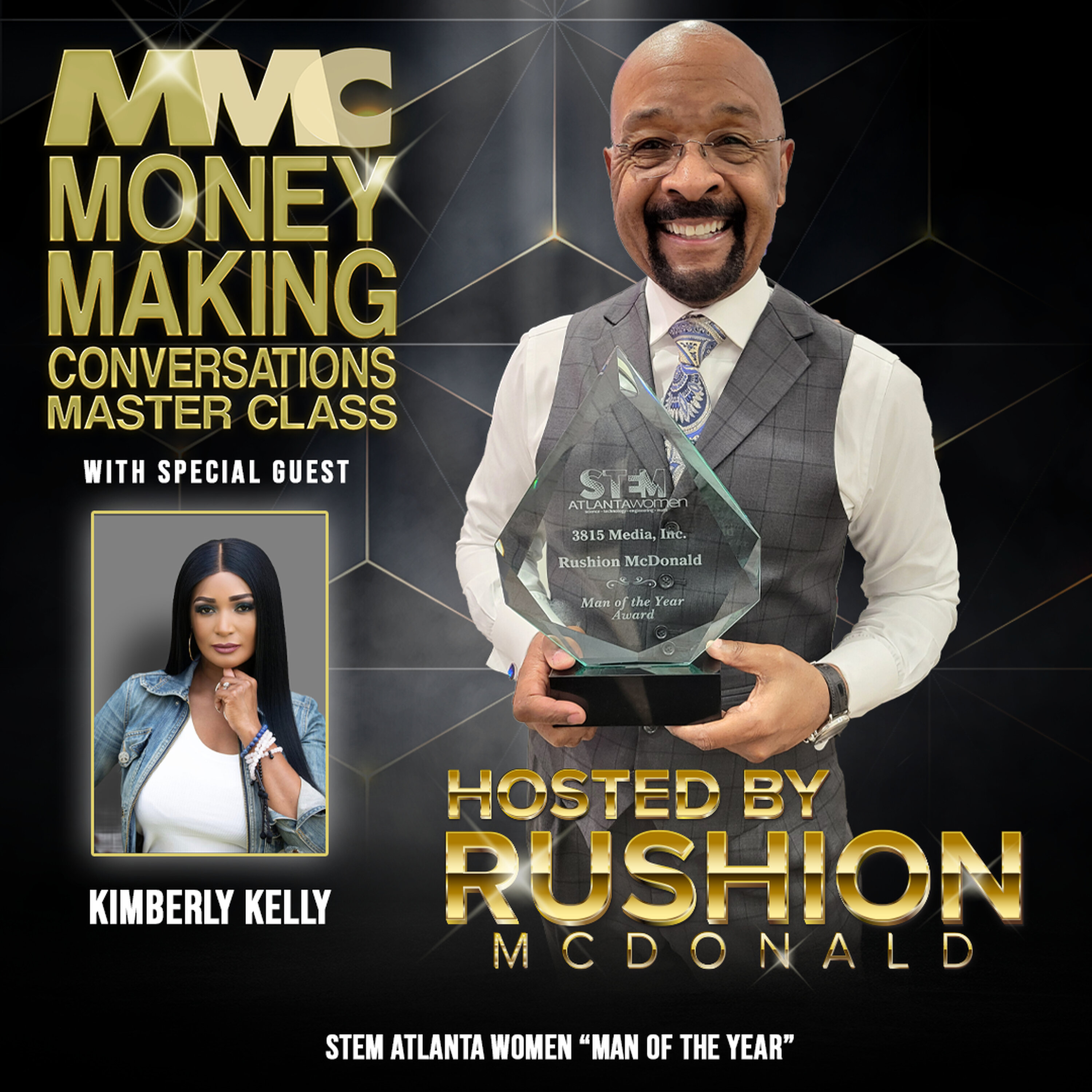
0:00
This is an I Heart Podcast.
0:04
Run a business and not thinking about podcasting?
0:06
Think again, more Americans listen to podcasts
0:08
than add supported streaming music from Spotify and Pandora.
0:11
And as the number one podcaster, I Heart's twice as large
0:14
as the next two combined.
0:15
Learn how podcasting can help your business.
0:17
Call 844-844-I Heart.
0:21
I'm Richa McDonnell, the host of Money Making Conversations
0:23
Masterclass, where we encourage people
0:25
to stop reading other people's success stories
0:27
and start planning your own.
0:29
Now, you don't want to miss an episode.
0:31
So please take a moment right now to follow or subscribe
0:34
to Money Making Conversations Masterclass.
0:37
You can follow me on I Heart Radio app, Spotify, Apple Podcast,
0:41
or wherever you listen to your podcast.
0:43
New Money Making Conversations Masterclass episodes drop daily.
0:47
I want to keep you on alert, because my guests provide tips
0:50
on how you can uplift your community, improve your financial
0:52
planning, motivation, or advice on how to be a successful
0:57
Now, let's get this podcast started.
0:59
My guest puts through some difficult circumstances
1:02
to achieve significant professional progress
1:05
and become a business mogul, M-O-G-U-L.
1:09
Please welcome the Money Making Conversation Masterclass,
1:13
How you doing, Kimberly?
1:15
I'm doing phenomenal.
1:18
Using all the positives, where you coming out the box?
1:20
Yeah, you got to say positives.
1:23
You got to say positives.
1:26
You're coming out the box.
1:28
I'm phenomenal woman.
1:32
Is that where drives your success?
1:38
Keeps me with perseverance.
1:39
Keep moving forward.
1:40
No matter what difficult moment happens.
1:41
Now, let's talk about you in difficult moments, you know,
1:44
because I think that that stops a lot of people, you know,
1:48
because we all have valleys, you know, you know,
1:52
COVID knocked out a whole country and created a difficult moment
1:57
and forced us to live from our home and also sent us
2:02
into a mental spiral, but difficult moments
2:05
or sometimes we can't control.
2:07
So what is a difficult moment that you can share with us?
2:12
I have, and that's a great question.
2:15
I have a pretty lot of difficult moments.
2:19
But just even if I start talking to just about my upbringing
2:24
and being coming from where I come from, South Florida,
2:29
and basically raising myself on my own,
2:31
since I was about six or seven years old, five, six or seven,
2:34
and being brought up in foster care,
2:38
and even after that, being able to live on my own
2:43
at the age of 15 and have kids
2:46
and being able to push through,
2:49
even though I was placed in foster care,
2:52
even though I had basically raised my brothers,
2:54
and even though with those obstacles I faced,
2:58
I pushed there and it became both of their cities
3:01
which kind of shaped me into being a resilient person I am today.
3:05
So I didn't let that be me coming from that having a mother
3:09
who was in a dating drug,
3:11
and not really having a support system
3:14
and things of that nation having to figure out how to raise myself.
3:18
So even with that I continued to move forward
3:20
because there was really no faith in that for me at that point.
3:24
So that was one of the things that kept me pushing forward
3:29
and pressure me and through the difficult moments.
3:32
No, you mentioned it at a very young age.
3:35
Explain to everybody what exactly is foster care.
3:39
So foster care is a place that they put you in basically
3:43
when the parent has either they have,
3:47
it can be from abuse.
3:49
My situation with my mom was the alcoholic and the drug abuse there.
3:53
And they put you there supposed to be a temporary placement,
3:56
but some of some kids can lost in the shuffle and some of them stay until they either age out
4:01
or either family member decides they want to take them.
4:05
And our kids who stayed for some years
4:07
and one of my aunts took us,
4:09
but she didn't realize having three kids
4:11
because it was me and my two younger brothers
4:13
and we were in that place with her out of foster care.
4:17
So foster care is a place that goes where kids are
4:21
and went from traumatic situations
4:24
and they have nowhere to go.
4:26
So that's supposed to be a temporary placement,
4:28
but sometimes it becomes permanent.
4:31
You know, it's really interesting that because I'm trying to get into your world, you know, a young person.
4:36
And was the faith play a role in your life at that early age?
4:42
Yeah, well, I didn't have the faith, but I gained it there while I was in foster care.
4:47
I did gain it there.
4:50
They would take us to like little outings and things
4:53
and one of the places we would go would be to church
4:55
and they had no idea of that during that time,
4:58
but I didn't learn it as a young adolescent during that time.
5:02
I didn't learn how to pray and it just seemed so natural.
5:07
Like I had been, it was a part of who I was and my essence
5:11
because I remember times where I'm like,
5:13
okay, I just feel like I had the presence of God with me
5:16
doing those difficult years and growing up.
5:20
Because you have to have something to believe in.
5:23
You've got to have something to hold on to
5:25
because your world, I think, is just spinning out of control
5:28
and you have the age where you can control in that belief
5:30
in your conversation early on.
5:32
You said you had a child of the young age?
5:36
I ended up, and it became like, you know,
5:39
the basically kind of stereotype,
5:43
My mom had me young.
5:45
I ended up in foster care.
5:47
My mother's ended up in foster care
5:49
because we really didn't have any directional one really raising us.
5:52
And then I became a young mother as well
5:56
at that time, even I was raising my brothers.
5:59
Because I didn't have anyone basically taking care of me.
6:04
I got in with wrong people,
6:06
not having any adult supervision
6:11
made not for great choices at that time.
6:16
You know, the reason I'm just talking about this
6:19
because you're a very successful person today,
6:21
your business model.
6:23
But I just wanted to lay out,
6:24
because a lot of people don't know,
6:25
how did they get there?
6:26
You know what you get?
6:27
She's a real-to-reel storage agent.
6:29
She's just mobilizing out there.
6:31
She's running business.
6:32
But everybody's journey to that pathway is not the same.
6:35
Everybody's journey is not through college.
6:37
Everybody's journey is not PhD.
6:39
Everybody's journey is not to parents.
6:41
But it always amazes me when people like you,
6:46
I grew up with my parents,
6:48
stayed together my whole life, you know.
6:50
And that impacted me, you know.
6:53
Not saying I had the greatest parents,
6:55
but I had parents who were there to me
6:57
saw me through high school and saw me through college
7:00
and it forced me to be a better person
7:04
because I had two people I can communicate with.
7:06
You and foster care.
7:08
You have two brothers that you're trying younger brothers.
7:11
Then you become a young mom.
7:13
At what point in your life did you say enough?
7:16
It's enough or you start saying,
7:18
you know, I got to give my life together.
7:20
I got to control the narrative.
7:22
So to be transparently honest with you,
7:26
it wasn't even an option for me.
7:29
I always had that mindset because I had been taking care of my brothers
7:33
since I was so young.
7:34
So just to give you a clue when we got,
7:37
when we were taking into foster care,
7:40
I literally would not go inside the home of the foster mother
7:43
until because they had separated me and my two brothers.
7:46
I sat on the suit and just sat there
7:50
and begged them to please play my brothers with me.
7:52
And they put us all together to keep us together.
7:56
So it wasn't even a thought process of,
8:01
I just always had to be in that kind of survival mode.
8:07
So whatever I had to do,
8:08
it was like I had to make sure they was taking care
8:11
because there was nobody really,
8:13
I couldn't look and say,
8:15
okay, this person or these people
8:18
are going to make sure me and them are good.
8:25
because I have a very strong person.
8:29
five, two, five, three, five, four,
8:32
will you leave me the person telling you,
8:37
What were you at physically being this demonstrative?
8:41
And I said demonstrative in a good way,
8:43
demanding that you have standards
8:46
and you're not going to accept standards that you feel
8:50
below what you want,
8:51
living conditions you want,
8:56
affirmable for somebody young.
8:58
Where did that come from?
9:00
So I think it just came from the mid-fact
9:03
of me taking care of them
9:05
and knowing that like,
9:08
if my mom will leave a call for a couple of days, right?
9:12
I just knew I just kind of automatically took that muggly role
9:16
So it was just like,
9:18
even though they were my brothers,
9:21
and I was a protector.
9:24
when they came and took me away from the school,
9:26
and then I didn't have my brothers,
9:28
it was like I was just sitting there,
9:32
where are my brothers?
9:35
and it wasn't like a mean thing,
9:36
it was more so like I was in distress.
9:39
We give, please get my brothers.
9:41
I was about nine or ten at the time.
9:48
so I'm five, eight now.
9:50
So I would think I would be like five,
9:52
about five, five at the time.
9:53
So I know I was 99 pounds to be waiting that time.
9:58
and the blessing was,
10:01
I had a path at that time
10:02
because my foster mother,
10:04
she was kind enough,
10:06
what I was experiencing,
10:08
and I was late to the right person
10:10
because she was able to facilitate that
10:13
and make sure me and my brothers stayed together.
10:16
But she went and called them.
10:18
And today, you know,
10:19
your real estate broker
10:21
tell us about your company.
10:23
So I have a real estate broker
10:25
here in the south side,
10:27
I thought I was a realtor,
10:29
and then I decided,
10:31
I love what I do because my goal is
10:34
to educate, motivate,
10:35
and basically teach people,
10:39
that we can do this,
10:40
like we can all real estate,
10:42
and there's so much out here
10:44
that we can do as far as entrepreneurs,
10:46
or whatever it may be,
10:47
whatever your desires are,
10:49
so at the third year point,
10:52
you don't have to be a broker.
10:54
And then as the market changes,
10:56
we went into COVID,
10:57
so many things transpired during that time,
10:59
so I'm always in the mindset of,
11:02
you want to be adaptable,
11:04
and then I tried to open up my brokerage,
11:07
I have six agents right now,
11:09
and I am so excited about that,
11:11
because when learning,
11:12
we're going together,
11:13
and I'm learning as well,
11:15
along with the path,
11:17
going with my agents,
11:20
it's a beautiful thing.
11:23
you own money making conversation,
11:25
so we're about to go into master class here,
11:27
with Kimberly Kelly,
11:29
Now, you're a broker.
11:30
Now, you got agents under you.
11:33
How does that model work?
11:35
How does that financial model work?
11:37
I'm not trying to ask for any money in the day,
11:40
because you could just do it by yourself,
11:42
now you got agents.
11:43
How you convinced in the work under you,
11:45
how does that model work for your agency?
11:49
So, the model for my agency is more so like,
11:55
how can I articulate this properly?
12:00
it's usually by word of mouth.
12:03
I believe it or not.
12:04
It's usually by word of mouth,
12:06
and the agents that come to me are agents
12:08
who really who want that kind of,
12:13
I'm a small brokerage.
12:14
I'm not a big one yet.
12:17
I like that one-on-one,
12:19
I like that one-on-one personal touch with my,
12:24
where I can sit down,
12:25
and I can talk to them.
12:26
I answer my phone every time.
12:27
So, as I'm growing,
12:36
a big corporate model,
12:37
but it's a model that works for us,
12:40
where I can do that one-on-one training.
12:43
I can do that one-on-one marketing strategy.
12:46
I can do that one-on-one.
12:49
we can continue to visualize things,
12:52
celebrate small victories,
12:54
and it can continue to educate ourselves,
12:58
in the real estate space.
13:06
when I listen to you,
13:09
it's about relationships.
13:11
It's about branding.
13:13
It's about branding.
13:15
Is there a price range
13:16
that your firm handles
13:17
as far as houses do?
13:18
We're showing you how to houses
13:19
from 250 to half meter.
13:21
Are we how to houses
13:22
from half meter to me?
13:23
Is there a price range
13:27
Well, within my agency,
13:29
when I started out my agency,
13:31
it was more so about my goal
13:33
was to educate first-time home
13:39
Coming from where I come from,
13:41
that was very important for me,
13:42
because where I grew up,
13:44
it really didn't see any home owners.
13:47
that was a passion.
13:52
it is like 250 and above,
13:54
because of the changes within the market,
13:56
you really cannot find anything,
13:59
that's $100,000 price point.
14:06
and even farther than that,
14:09
but both basically,
14:10
the main is 250 to about 750 right now.
14:15
we're going to hear more
14:16
from the business mogul,
14:17
and it's important to understand her story,
14:19
because her story might be your story.
14:20
But what she didn't let
14:23
even at a young age,
14:25
the successful business mogul,
14:28
she's doing more than just,
14:30
We're going to come back
14:31
and hear a whole lot more,
14:33
I'm going to call my friend now,
14:36
I'm not corporate yet.
14:37
I'm hands on right now,
14:38
but I got big dreams,
14:39
because she's on money
14:40
making conversation,
14:42
She's not reading other people's success stories.
14:44
She's planning her own.
14:49
Please don't go anywhere.
14:50
We'll be right back
14:51
for more money making conversations,
14:55
for you to do me a favor.
14:59
Money Making Conversation.
15:01
And you can find it
15:02
on the I Heart Radio app,
15:04
Spotify, Apple Podcast,
15:06
or wherever you get your podcast.
15:08
Please do me that favor.
15:10
Follow or subscribe,
15:11
Money Making Conversations.
15:14
and not thinking about podcasting.
15:17
More Americans listen to podcasts
15:19
than add supported streaming music
15:20
from Spotify and Pandora.
15:22
And as the number one podcaster,
15:24
I Heart's twice as large
15:25
as the next two combined.
15:26
So whatever your customers listen to,
15:28
they'll hear your message.
15:29
Plus, only I Heart can extend your message
15:31
to audiences across broadcast radio.
15:33
Think podcasting can help your business.
15:38
Let us show you at iHeartAdvertising.com.
15:41
That's iHeartAdvertising.com.
15:44
On the serving pancakes podcast,
15:46
conversations about volleyball
15:47
go beyond the court.
15:48
Today we have a little
15:49
best friend compatibility test.
15:52
How long have we been best friends for?
15:53
This is the day we met.
15:54
As the league won volleyball season,
15:55
heads towards its final stretch,
15:56
there's no better time to tune in.
15:58
We really are like,
15:59
yin and yang, vodka and tequila.
16:01
You'll hear unfiltered analysis
16:03
behind the scene stories
16:04
and conversations with leaders
16:05
making an impact across the sport.
16:07
Today we have Logan Limeke.
16:08
I feel like our fan base in general
16:12
which is like a comforting feeling
16:13
getting to play at home.
16:15
Whether you're following the final push
16:17
or just love the game,
16:18
serving pancakes brings you closer
16:20
to the action and the people
16:21
shaping the future of volleyball.
16:24
had that microphone on.
16:26
We make mistakes or
16:28
cussed at our coach
16:29
like my time or two times.
16:31
Open your free I Heart
16:33
search serving pancakes
16:36
serving pancakes and we'll
16:37
catch you on the flip side.
16:40
Presented by Capital One,
16:41
founding partner of I Heart
16:47
Welcome back to Money
16:48
and Making Conversations
16:49
Masterglass with me,
16:51
You know, she's successful.
16:53
But that's not the story
16:54
she wanted to tell.
16:55
She wanted to tell the part
16:57
about overcoming difficult
17:00
You know, going against the odds,
17:02
being a single mom,
17:04
and still being successful,
17:06
which means that a lot of people
17:08
need to hear that side of the story
17:09
because that's what.
17:10
A lot of people dealing
17:12
where they might consider
17:16
living in foster care,
17:17
you know, her mom was
17:20
That didn't stop her.
17:22
she wanted to maintain her
17:24
family, her two young
17:27
That didn't stop her.
17:28
You know, getting the clear
17:29
understanding that success
17:30
was somewhere out there for
17:34
you just had to figure out
17:35
how to find it, correct?
17:40
Now tell us about your son.
17:50
You could continue.
17:53
And then I ended up having
17:57
By the time I was 18,
18:03
and I'm 18 basically,
18:06
and then I also have
18:11
How are they at that time?
18:17
I want to say about four years,
18:19
and then the other ones
18:20
probably like six years.
18:27
adolescents at this time.
18:28
Well, two young kids,
18:31
we're two young kids.
18:35
So, we're all basically living.
18:39
let's put this way.
18:40
The success sign is not hanging
18:42
over that door for you.
18:47
At that point, it's like,
18:49
but it never dawned on me,
18:51
that I never dawned on me,
18:56
was never taught to me,
18:58
that I wouldn't be successful.
19:01
because it was like,
19:02
I wasn't brought up with the,
19:07
I kind of just had to figure out my own lane,
19:11
what would work for me,
19:16
just to help us out with the audience here.
19:17
Now, we got to get forward,
19:19
the forward motion,
19:22
it's starting to pick up steam.
19:23
When did you start getting on that track, Kimberly?
19:29
it was like a situation,
19:32
like, looked around the,
19:34
and I was just like,
19:38
and I probably was like 19 at this time,
19:39
and I'm still trying to get my high school diploma,
19:43
it's just so much what's happening,
19:45
and I was just like,
19:48
I got to get it together,
19:50
we used to call them,
19:51
shorties or whatever,
19:52
I got to take care of my kids,
19:53
and I went back and got my high school diploma,
20:00
this full play started going to me,
20:02
they had these teenage workshops
20:03
where you can go and learn how to do interviews,
20:06
how to write resumes,
20:10
the government had offered,
20:11
and I just threw myself into that started learning,
20:13
learning, learning, learning,
20:15
education was going to be,
20:17
I outlet it for me at that time,
20:22
anything that I could learn,
20:23
because I was an advert reader,
20:26
and I just picked up books,
20:27
and I just kind of carried it along,
20:30
and so then I was like,
20:31
okay, I'm going to college,
20:32
and then I went to school,
20:33
and I got my degree in electronics engineering.
20:36
What college did you go to?
20:37
What college did you go to?
20:41
it's called Broward County Communication,
20:42
Broward County College,
20:44
and then I came up to Atlanta,
20:46
and I went to the cab pit,
20:47
and I got my technical degree
20:50
in electronic engineering,
20:54
I just kind of just,
20:57
just full-fledged forward,
21:00
and just learning as much as I can about,
21:04
because that's what it was at that time.
21:08
And so it's really,
21:10
thank you for sharing the story so far,
21:12
because of the fact that,
21:15
you got to figure out your path,
21:17
everybody who's listening to this conversation
21:20
or any conversation you hear on the show.
21:23
This is a path that she is going about doing it.
21:26
My previous interview,
21:27
she went to Spellman,
21:28
and went to University of Georgia.
21:31
That's not your story,
21:33
but she also didn't have two kids
21:34
before the age of 19.
21:36
She also wasn't in fourth foster care,
21:38
and that's the path that she went,
21:42
that nobody else can be successful.
21:45
There are people who have stories
21:46
that maybe even more dire
21:48
than Kimberly Kelly,
21:49
but her story deserves
21:51
a platform to be heard,
21:53
and that's what I'm allowing to happen
21:55
because I don't want excuses.
21:58
Not after hearing Kimberly's story.
22:00
Ain't that right, Kimberly?
22:01
Thank you very much.
22:02
Absolutely absolutely.
22:03
You can do anything.
22:05
There is nothing that you can do in this life,
22:09
and once you believe in yourself,
22:13
as long as there's an opportunity
22:15
you wake up in the morning,
22:19
You can absolutely do it.
22:21
It took me, if I did it,
22:23
for where I come from,
22:25
if you just believe in yourself,
22:27
if you just look in front of you,
22:29
you get up in the morning,
22:30
put one foot in front of the other,
22:34
you may feel like the world is caving in on you,
22:37
and sometimes it is caving in on you.
22:39
Give yourself a break to breathe in,
22:42
pray if you have a spiritual sense,
22:44
but practice resilient.
22:46
If you have a support system
22:49
a strong support network.
22:51
And even if you don't have that,
22:53
go look in a mirror and talk to yourself
22:55
and say, hey, you know what?
22:58
And then, especially if you have your children,
23:01
just look in their eyes,
23:05
that in itself is motivation.
23:08
You know, the one thing I really appreciate
23:10
that's conversation is that, you know,
23:12
it's a journey when you could have not
23:15
went and got your degree.
23:18
You could have not went to technical.
23:20
You could have not pursued,
23:22
because even when, you know,
23:23
you got to get a license
23:24
be a real estate broker.
23:25
You know, you got to study.
23:27
and then not just passing it out
23:29
and then the fact that,
23:31
now you're a leader,
23:32
you're a leader of people,
23:34
which means that that's even more important.
23:36
But when you're in business,
23:38
you have people who want to get in business
23:40
with your partnership,
23:42
how does that work?
23:43
Are you in business by yourself?
23:45
Are you in business with another partner?
23:47
Are you just a solo entrepreneur?
23:50
I'm in business when I want my spouse.
23:52
I'm in business when my husband.
23:54
So we have a couple,
23:57
we have three businesses.
23:58
I have the real estate side,
24:00
which is, you know,
24:01
the real estate brokerage,
24:02
and we have something called,
24:03
we have a business called
24:05
Kate Kelly Ventures,
24:06
which is property preservation.
24:09
with all the things that were happening
24:19
if any change comes,
24:22
the property preservation company,
24:25
and that is going wrong with sell.
24:28
and that basically is something,
24:29
where you just go in
24:30
and work with paint
24:32
and asset management,
24:33
management to provide services,
24:39
and maintenance to make it properties
24:40
in the real estate world.
24:42
You're just something,
24:44
You just want to make a machine.
24:45
Just want to make a machine.
24:47
You're on the right show, too,
24:48
to tell your story.
24:50
I really get up, you know,
24:52
I'm so happy that you're honest
24:55
because so many people want to like,
24:59
makes them feel good,
25:00
but then they leave out important information,
25:02
they don't help the average person understand,
25:04
it can be them, too,
25:05
that they can make it, too,
25:06
they can achieve success.
25:07
So, I want to thank you,
25:09
from bottom of my heart,
25:10
for coming on Monday,
25:11
making conversation,
25:12
sharing your story,
25:13
but also both sides,
25:14
the success of being a single mom,
25:16
the success of being a black woman,
25:18
who is being stereotyped,
25:20
the success of being a business on success,
25:23
of being married to a wonderful man,
25:25
success of being an entrepreneurial spirit,
25:29
continue success in your life,
25:32
and thank you for coming
25:34
making conversation,
25:36
And thank you so much,
25:37
I'm so honored that you have me on your show,
25:39
and thank you for all that you do,
25:42
the way you do your shots.
25:43
Thank you for listening to this episode.
25:45
Now, I need for you to do me a favor.
25:48
to follow or subscribe
25:51
making conversation,