Urban Geography: Why We Live Where We Do | Wendover Productions
About this episode
Wendover Productions is made possible by:
Get every episode summarized
Each time Wendover Productions publishes, we email you a written briefing from the transcript — the topics, who appeared, and any specific claims, with the ad reads skipped.
Email me new episodesFree for 3 shows. No card needed.
Transcript ready
347 searchable segments. Every word is indexed and playable.
Full transcript
Wendover Productions — Urban Geography: Why We Live Where We Do | Wendover Productions. Machine-transcribed; use the interactive transcript above to jump the player to any line.
Propel Fitness Water With Gatorade Electrolites, Zero Sugar, and Vitamins, Propel hydrates better than water to help you get the most out of your workout and get back to your best self. What propels you? Propel with Gatorade Electrolites. When you need to build up your team to handle the growing chaos at work, use Indeed Sponsor Jobs. It gives your job post the boost it needs to be seen and helps reach people with the right skills, certifications, and more. Spend less time searching and more time actually interviewing candidates who check all your boxes. Listeners of this show will get a $75 sponsor job credit at Indeed.com slash podcast. That's Indeed.com slash podcast, terms and conditions apply. Need a hiring hero? This is a job for Indeed Sponsor Jobs. Fall has never looked or tasted this good. Sweet Greens Fall Harvest Menu is back with seasonal favorites dressed to impress and made to be devoured. Warm roasted sweet potatoes, crisp apples, maple glazed Brussels and crave worthy flavors
in the autumn harvest bowl, maple glazed salmon plate, and roasted bacon Brussels side. The season's most desirable menu has returned to sweet green. Featuring falls best dressed. Make your move. Order on the sweet green app. This is Wendover Productions, sponsored by the Great Courses Plus. Here's an interesting question. Which city do you think is more dense? Paris, France, or New York United States? It probably seems obvious. New York, the land of skyscrapers, the Big Apple. Right? Wrong. New York, in fact, has a population density of less than half that of Paris. Paris is 56,000 people per square mile, while New York's is only 27,000 people per square mile. To find a European city with a comparable population density to New York's, the densest American city, you have to go all the way down to number six on the list, Leon, France. New York, of course, has a super dense urban core, but then around it is miles and miles of Siberia,
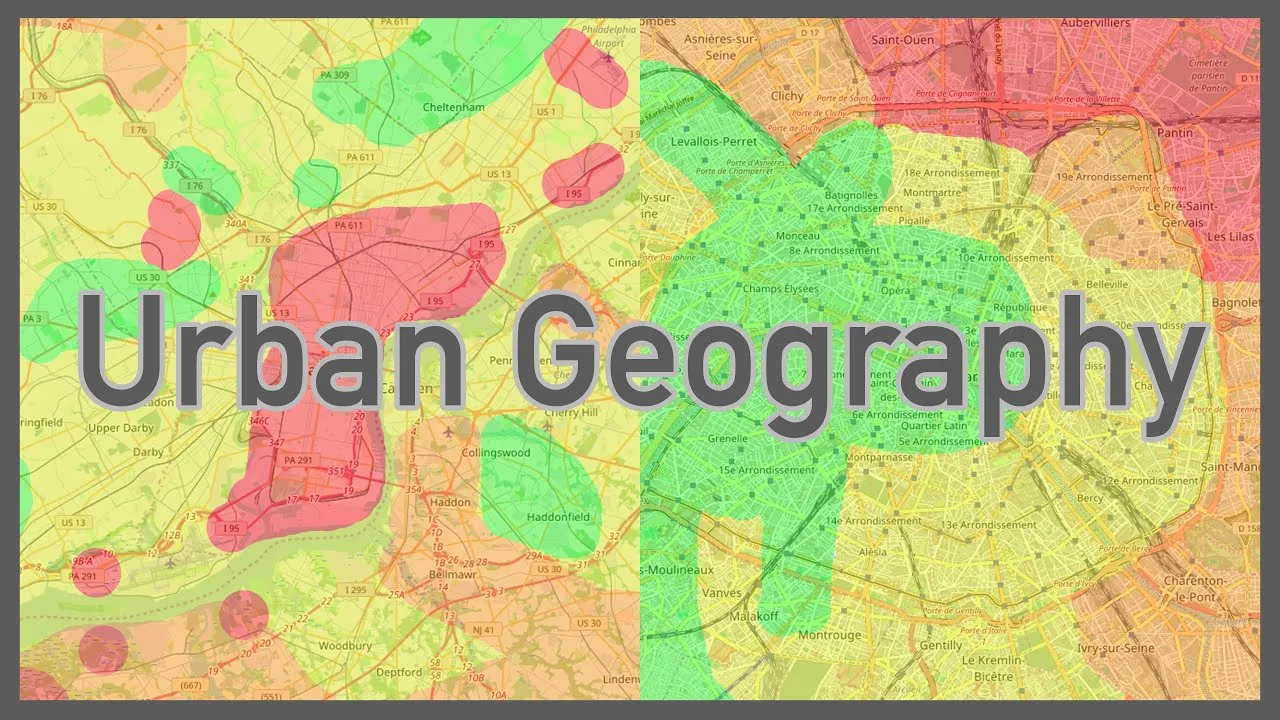
just like almost every other American city. Paris, on the other hand, packs almost its entire population into a compact urban core. There's also another interesting pattern that differs between the two continents. Rich Americans live outside the city. Rich Europeans live city center. Compare the income map of Paris to that of Philadelphia. Of course, it's not perfect, but you can definitely see a pattern. The most commonly cited reason for both these trends is the difference in age. Most European cities have existed for hundreds if not thousands of years, while all but a few American cities have only gathered enough population to be called cities in the past one or two hundred years. What that means is that European cities existed when all but the super rich had to commute to work by foot. In the middle ages, Paris had a population of two to three hundred thousand people, but you could walk from one side to the other in 30 minutes. It was incredibly densely populated. You just had to live within walking distance of work.
Therefore, the rich paid more for the houses closest to the center of the city. This is a similar reason to why in historic European hotels, you'll often see the nicest and largest rooms on the lower floors. The opposite of what you'd see today. Before elevators existed, the rich didn't want to have to walk up as many flights of stairs. Walking distance was not only important to big cities. Small villages across Europe were almost always the same size because their population was dictated by the walkability of the surrounding fields. European farmers tended to live in small towns and walk to their fields during the day, rather than the home setting approach used in America. Therefore, villages would only be as large as the amount of people needed to work in the fields within walking distance. American cities, on the other hand, began their period of rapid growth in a more modern era when decentralizing technologies were much more advanced. By the time North American cities grew larger than the distance people could reasonably walk, there was already the technological capability
to create public transportation systems. The first major public transportation innovation was the steam train in the mid 19th century. This was a very expensive means of transport and was therefore only for the super rich. Interestingly, because steam trains take an enormous amount of time to reach speed, the towns that the rich commuted from, known as railroad suburbs, were generally not just at the nearest bit of countryside, but separated from the city by a few miles of countryside. The impact of railroad suburbs remains today. On the tracks of the old Philadelphia mainline, there's a stretch of super rich communities with huge estates and country clubs from Ardmore to Melbourne. The demographics just never changed from the time of the railroad suburb. A few decades later, street cars emerged and quickly became an instrumental part of the American commute. Much like steam trains, street cars also created new communities. This time with slightly less rich, upper middle class individuals. In Washington, D.C., the wealthy suburbs of Tenleytown,
Chevy Chase, Bethesda, McLean, Rockville, and more all grew as a result of the street car. But once again, propel fitness water with Gatorade electrolytes, zero sugar, and vitamins. Propel hydrates better than water to help you get the most out of your workout and get back to your best self. What propels you? Propel with Gatorade electrolytes. When you need to build up your team to handle the growing chaos at work, use indeed sponsor jobs. It gives your job posts the boost it needs to be seen and helps reach people with the right skills, certifications, and more. Spend less time searching and more time actually interviewing candidates who check all your boxes. Listeners of this show will get a $75 sponsor job credit at nnd.com slash podcast. That's nnd.com slash podcast, terms and conditions apply. Need a hiring hero? This is a job for indeed sponsor jobs. Fall has never looked or tasted this good. Sweet Greens Fall Harvest Menu is back with seasonal favorites, dressed to impress and made to be devoured.
Warm roasted sweet potatoes, crisp apples, maple glazed Brussels, and crave worthy flavors in the autumn harvest bowl, maple glazed salmon plate, and roasted bacon Brussels side. The season's most desirable menu has returned to sweet green. Featuring falls best dressed. Make your move, order on the sweet green app. Walking distance influenced geography. Streetcar commuters had to live within walking distance of a stop. So naturally, there would be a radius of civilization around 20 or 30 minutes walking distance from a stop. Then pass that, nothing. That meant that between the lines, there was all this open space where nobody could commute from. Enter the automobile. At first, the car was only for upper class individuals, especially with the distraction of the two world wars and great depression. However, by the time young Americans returned from World War II, there had been enough technological advances to make the automobile affordable for the middle class. Over 50% of households had cars by 1950.
At the same time, the government was offering loans to returning veterans, which significantly increased the number of Americans who could afford to buy homes. Instead of buying a small, central city home, this generation opted to use their new cars to commute from cheaper, nicer, and larger suburban homes. The idea was that the working parents would go downtown each day, while the rest of the family would stay to enjoy the suburb. It was the perfect deal. So that whole history was absolutely true, but it doesn't entirely explain why European cities didn't experience suburbanization as well. In Germany, for example, many, if not most, cities were bombed to rubble during World War II. They had the opportunity to rebuild in any way they wanted, but then chose to keep their compact design. Today, the average metropolitan population density in Germany is four times higher than the US's. At the same time, other cities across Europe that survived the war experienced enormous population in fluxes and still maintain their mammoth population densities.
Perhaps the least commonly cited reason for suburbanization in the US is crime. It's a bit of an ugly period in American history that we sometimes forget, but crime levels were absolutely insane in the 70s, 80s, and 90s. There are a ton of different theories why this is. Perhaps the most interesting being that the rise in gasoline-emitted lead caused lower IQs and higher aggressivity. New York had an astronomical 2,245 murders in 1990. London didn't even have that many in the entire 90s decade. Violent crime rates are still consistently 10 or more times higher in the US. In 1992, a poll was conducted asking departing New Yorkers why they were moving to the suburbs and the most commonly cited reason was crime at 47%. Cost and quality of living were way down at lower than 10% each. Crime rates are significantly lower in suburbs as they are typically havens for higher income individuals.
Europeans don't have to worry as much about intercity crime, so they're much more willing to live downtown. Land for suburban housing is also readily available in the US because farmers have always been quick to sell their relatively unprofitable land to developers. By contrast, in France, for example, agricultural subsidies are 12 times higher per acre of land than the US. That's a big reason why large European cities are so closely surrounded by small farms. In many European cities, you can literally take the city bus to farms. Lastly, all sorts of energy are cheaper in the US. A gallon of gas costs as much as $7 in some parts of Europe compared to the US average of $2.20. It's significantly more expensive to commute by car in Europe, so there's more motivation to live closer to work where either the drive is shorter or you can take public transportation. Also, big suburban homes aren't as attractive in Europe because electricity and heating costs are higher.
Suburban life really didn't live up to expectations. Americans now spend an average of four and a quarter hours per week sitting in cars, buses or trains traveling to or from work. That's 2.5% of their entire lives. It's also been scientifically proven that commuting from the suburbs is linked to higher blood pressure, lower frustration tolerance, and higher rates of anxiety. Also, the suburbs are no longer the countryside havens that they once were. They're just a continuation of the urban sprawl. Rich Americans are therefore beginning to return to the city. With lower crime rates, higher fuel costs, and an overall shift in attitude, urban cores are having a second renaissance. So that's why we live where we do. It's a complicated, controversial and surprisingly political history. I hope you enjoyed this whenever productions video. I first need to thank my amazing sponsor, The Great Courses Plus. The Great Courses Plus is a subscription on-demand video learning service
where you can watch unlimited top-notch courses from Ivy League professors, National Geographic Scientists, Culinary Institute of America Shifts, and hundreds more highly qualified individuals. If you enjoyed this video, I highly recommend the course on cultural and human geography. It's a super interesting topic, and this course absolutely does it justice. You can watch this or any other of the hundreds of courses for free when you sign up for 30-day free trial using the link www.thegratecoursesplus.com or the link is also in the description. I also recently started a Patreon, which you can go to by clicking here. There are a bunch of great rewards, like early access to videos, stickers, t-shirts, and best of all, every dollar contributed there goes right back into the channel. Aside from that, please follow me on Twitter, at wheneverpro. Watch my last video on the story behind the 787 and A380 planes. Check out my fan-moderated subreddit at www.reddit.com
slash whenever productions. And most of all, subscribe to this channel. Thanks again for watching, and I'll see you in two weeks for another Whenever Productions video. Have you heard that McDonald's spicy chicken McNuggets made with spicy tempura and a blend of aged cayenne? Ah, back. Remember to grab a few extra napkins. For a limited time at participating McDonald's. When you shop pick up at Fred Meyer, you can expect the savings you love
and fresh groceries selected just for you. Our associates are committed to getting every detail right, carefully hand picking your items, checking for quality and freshness and packing your order with care. Because bringing you fresh, quality groceries is what we do best. And right now, enjoy $30 off your first online order of $75 or more. Restrictions apply, seasite for details. Fred Meyer, fresh for everyone. Close your eyes, exhale, fill your body relax, and let go of whatever you're carrying today. Well, I'm letting go of the worry that I wouldn't get my new contacts in time for this class. I got them delivered free from 1,800 contacts. Oh my gosh, they're so fast. And breathe. Sorry, I almost couldn't breathe when I saw the discount they gave me on my first order. Oh, sorry. Namaste. Visit 1-800-contacts.com today to save on your first order. 1-800-contacts. Get business done with the new American Express Graphite Business Cash Unlimited Card
with unlimited 2% cashback on all eligible purchases. Unlimited 5% cashback on flights and prepaid hotels, booked through American Express Travel Online, and a flexible spending capacity that can grow with your business. You'll have the confidence to keep building. Apply today and earn a welcome offer of $1,500 cashback. After you spend $50,000 in qualifying purchases on your new card within the first six months of card membership, terms apply, learn more at go.damax-graphite.
More episodes
More from Wendover Productions

The Logistics of German Reunification | Wendover Productions
Wendover Productions

The 8 Flights That Show How COVID-19 Reinvented Aviation | Wendover Productions
Wendover Productions

TWL #5: Timekeeping on Mars | Wendover Productions
Wendover Productions

TWL #10: The Day Sweden Switched Driving Directions | Wendover Productions
Wendover Productions