Get every episode summarized
Each time Alpha Male Podcast - Christian Survival publishes, we email you a written briefing from the transcript — the topics, who appeared, and any specific claims, with the ad reads skipped.
Email me new episodesFree for 3 shows. No card needed.
About this episode
“That is what we're going to talk about today.”From the transcript
Combat Veteran; U.S. Marine Corps Urban Warfare Instructor;
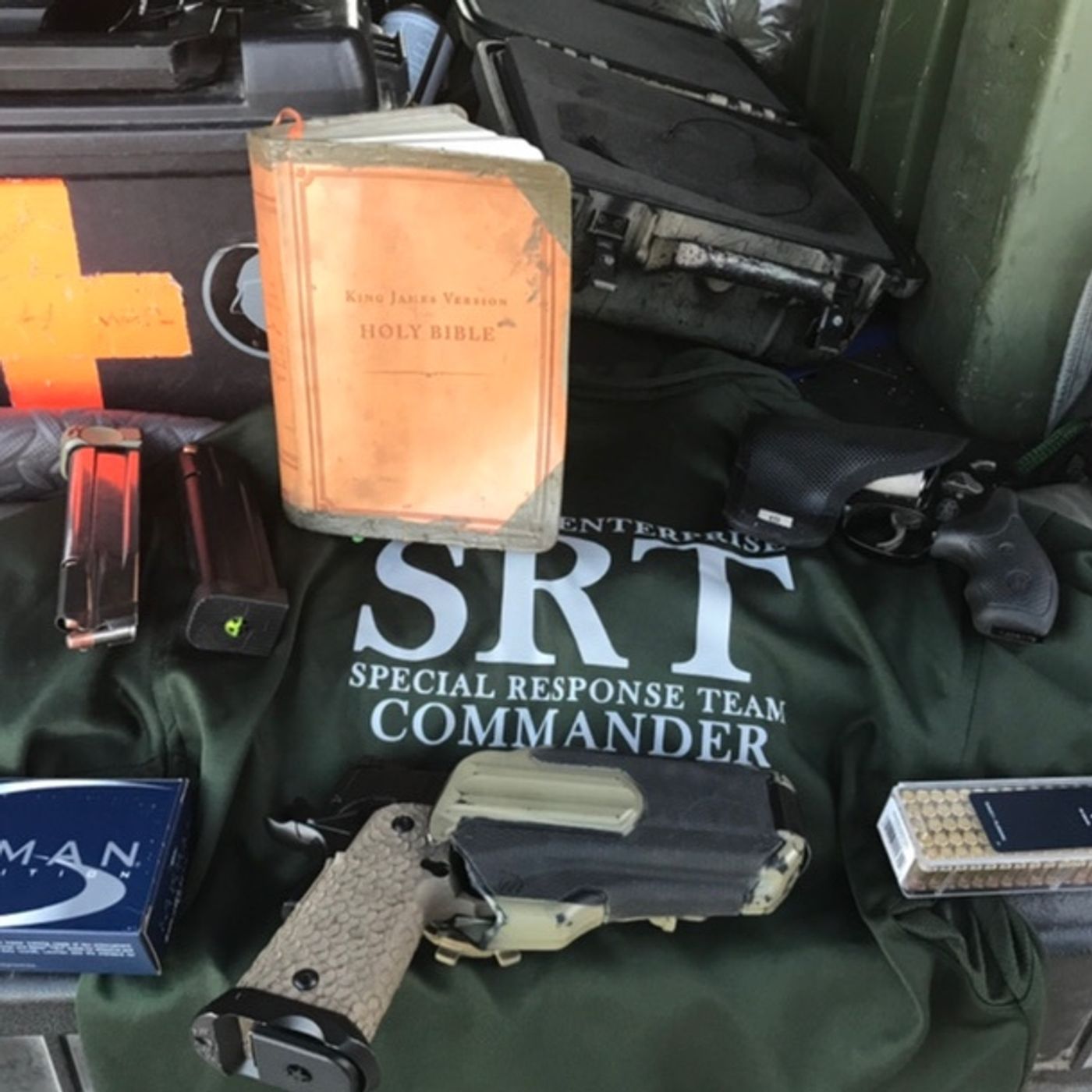
S.R.T. Commander Active Shooter Response Team
Law Enforcement Los Angeles Police (L.A.P.D.) Police Officer / Fugitive Recovery
F.B.I. Instructor N.R.A Instructor
Competition Shooter; Multi Time State Rifle Pistol Champion
Hunting; Life Long Hunter Proffessional Hunter and Guide
Private Security Contractor; Several Agencies, Current.
Patreon
https://bit.ly/3jcLDuZ
the LORD is a Man or War, Exodus 15
Get every episode summarized
Each time Alpha Male Podcast - Christian Survival publishes, we email you a written briefing from the transcript — the topics, who appeared, and any specific claims, with the ad reads skipped.
Email me new episodesFree for 3 shows. No card needed.
Hosts & guests
Transcript ready
699 searchable segments. Every word is indexed and playable.
Full transcript
Alpha Male Podcast - Christian Survival — Urban Survival- City Prepping. Machine-transcribed; use the interactive transcript above to jump the player to any line.
Tyler Reddick here from 2311 Racing. Another checkered flag for the books. Time to celebrate with Chamba. Jump in at chambacacino.com. Let's Chamba. No purchase necessary, BTW Group. Boy, we're prohibited by law. CCNC, 21 plus sponsored by ChambaCacino. Surviving in the city. Urban environments. That is what we're going to talk about today. Hopefully in this podcast, we keep God at the center, biblical, Judeo-Christian values, and real world firsthand experience, all in that military law enforcement private security contracting. And that's probably what's most germane viable points in the show notes. Blessed be the Lord, my rock, who trains my hands for war and fingers for battle. OK, the cities. Now, I'm much more of a country boy live out in the middle of nowhere and a cabin in the woods,
literally, wood stove. On one of the least populated places in the country, I do that on purpose. I do that, I think partially because I've spent big chunks of my life in the city. To give you some bonafides as to why I live the way I live now and experiences that I've had so I can talk to this topic, I joined the Marine Corps pre-9-11. I remember seeing the Twin Towers come down. I remember shipping off to war and I was in Kuwait waiting for the war to kick off. I point this out because I had a dramatically different perspective than pretty much everybody else that came after me, not necessarily saying they didn't have it better or worse or different. It was just a completely different experience that I had during the invasion, even compared to when I went back later and had experiences in the global war on terror after that.
I got to see a functioning society. I am not going to talk, I'm not the guy that tells a bunch of war stories, but I had a special assignment where I was in Baghdad before we liberated it. It was a functioning society. It was one of the biggest cities in the world. It had Jews that had Christians, I had European immigrants living in some form of relative homeostasis compared to modern cities. And I got to see it as a functioning society and then very quickly after we liberated it, I got to see it descend into chaos very quickly within days. You know, take out the power grid, looting, rioting, robbing, people getting used out there. Well, let's just say it was a nasty place to live after we liberated it. The Christians that were there were genocided, killed, or fled along with the Jews and, you know,
so us liberating it that there's a lot of stuff that happened there. And a lot of civilians died. If you wanna look at Iraqi civilian casualties or whatever, but I got to see a functioning city, geopolitics aside, I got to see a functioning city descend into a third world crap hole where murdering and terrorism and, you know, tribalism and a failed state was the new normal. So I know a little bit about that. I've also served in the U.S. I worked on LAPD. If you're not familiar with my law enforcement background, I work regular assignments and more specialized assignments. And those more specialized assignments had me working in some of the nastiest high crime places in Los Angeles, which would make it some of the nastiest as far as crime goes, places in our nation. I got to live that and do that. Places the average American would not want to go,
would not want to see the city underbelly of the city of angels. I know a bit about that. I also served as the commander of a tactical team to stop active shooters in a large metropolitan area. And I've had to deal with civil unrest. So both here and abroad, I know a little bit, about a little bit, not everything. I have a lot that I don't know. But again, with that said, there's a reason I don't live in the city. When I was young and in my 20s, I thought, oh, it'll be great, that's where the girls are and the fun is and after I got to experience cities and all their faded glory, I got to realize that it's not. I think how I should live or how most people should live. But anyway, there's a reason I say, get out of the city. That said, many of you will not get out of the city. You will stay in Sodom and Gomorrah and places like that and say, oh, it's not so bad.
So my first thing is, I'm not saying you should live in a city, but here's the thing. Do an area study of the city, of your urban environment. And don't think, oh, I live in a good big city. It's not as bad as, like, stop, like, I live in a cool seven Nashville, it's country music. Right now, there are drug dealers and pimps and child traffickers and addicts that would beat you to death for their next fix of methamphetamine. That is the city that you live in, make no mistake. Do an area study of the city where you live, including the hinterlands. If you're like, I don't live. If you live in the metro area, right, doesn't have to be this proper city limits, right? If you could climb on top of your roof, if there weren't trees around and you could see a business
you probably live in a city and in an urban area. So I'm not talking about just the city limits, but anywhere in that metro area. Do an area study, look at crime maps and crime statistics. And here's a couple of things I'll tell you from my time in law enforcement. A lot of places, especially places that wanna bring in tourism, they may be, let's just be nice and say flexible about how they categorize crimes. So in theory, a police officer could write a report for assault with a deadly weapon, ADW. Somebody beat somebody, beat somebody, almost a death with a pipe wrench because they're both high on meth and somebody hit on somebody's girlfriend or whatever the case is. Assault with a deadly weapon. Well, it could go to your watch commander or however that division or precinct is run and they could say, well, this, we want tourism here.
So we're gonna classify this as a misdemeanor battery and then when it goes up to the district attorney, they can knock it back up to an ADW because that's all. There's nothing saying you can't do that. And then when people look up violent crime stats, a bunch of the violent crimes are not actually on there. So just be aware that that theoretically could be a thing that happens all the time. But you can only cover up so much. So look at violent crime, look at crime statistics, violent crime, thefts, crimes against, there's two big categories of crime, as you're gonna look at as crimes against, people and crimes against property. So look at both of those, look at a map, look at hotspots. If you live in a nice area, probably you're gonna have a lot of crimes against property because people like to steal nice stuff. So if you live in a nice area, that's probably gonna be more of it. And if you, and in the ghettos, so called, right, there's not a lot of nice stuff to steal
and if it does get stolen, it's largely not reported anyway. So mostly crimes against people. But look, you get an idea of those areas, get a look at crime trends, talk to anybody you know that's law enforcement that will give you the actual scoop. Talk to, you know, anybody you know any EMT, EMS's, they have a pretty good handle on where a lot of the overdoses are, what the street drugs are, where the areas are. So do an area study, start out with the crime statistics and then move out to infrastructure, things like rail lines, major bodies of water, a lot of, well, pretty much any city has to be built on water. So look at your major sources of fresh water for bad time scenarios. I mentioned rail lines because when things get bad and they can get bad really quickly, if you're not, it's better to bug out a month early than a minute too late because you probably,
think about traffic in your city in a normal day when a very small fraction of the population is on the road. Now imagine the majority of the population is trying to get out in a panic and only takes a couple of accidents on a couple of the major arteries into and out of that city to the hinterlands to stop that traffic. So just assume you're not gonna be able to drive out of there on the major on any normal road if there is a big accident. So I say look at the rail lines because you could probably bug out that's your next best bet. Most people don't think of that. And I'm not so vain as I think most people are gonna listen to this podcast. You know, I'm not one of the giant major podcasters with, and that's fine with me. So look at other avenues of egress, streams, rivers, generally we'll lead into and out of cities. And rail lines that people have largely forgotten about. But they're still there and they're easy to walk on. They have to be relatively flat. So look at those for ways to get out of the city because if you wanna, if you wanna just see how long you can stay in Sodom and Gomorrah until it collapses, those are gonna be better avenues of egress.
So have those and have a plan for those. Maybe on when you're doing your cardio and working out anyway because I don't care where you live, cardio is important. Cardio, cardio, cardio. I don't have TV, but I think that's one of the rules for like zombies like cardio. So cardio is important, right? Whether things get bad or they stay relative, whatever normal is now. You wanna live a better life and be healthier cardio in addition to lifting heavy things. Where was I going with that? Oh, so when you're out doing your cardio, maybe do some recon oitering, some recon. And run along rail lines, run along things that aren't regular rows that can get you out of the city. Cause again, those probably aren't gonna be viable options unless you get out before the majority of the population does.
Which I would say is right now, if you can get out to leave the city. But that's my opinion again, if you're listening to this, you probably live in an urban area. So there's that. And there's legit reasons I should have started with this, but there's legit reasons why you may wanna be in a city. You are legitimately trying to fight crime. You are like an inner city evangelist trying to spread the light of the gospel to inner city children, something like that. That would be a good reason to be in a city. Some of the few good reasons I could think to be in a city. But aside from that, come out of for my people, Revelation 18. But where was I? Getting out of the city in a disaster, think of alternate routes. It's kind of like a good practice. This is a good practice whether you live in urban environment or not. Anytime you go into somewhere, a Walmart, a business, you look for all the exits. When a panic happens,
the majority of people will go out the way they came in. Guess what you should probably not do? Go out the way you came in, especially like even if it's like a fire or something. Go a different way. So when you walk into an area, look for the exits. Most people, if there's a big disaster, they're gonna try and leave the way they normally do. In their vehicle, on a freeway, on a highway, the way they normally go when they're going to their favorite Walmart or if they're Gucci going to Target or whatever they're doing, they're probably gonna try and do the same thing. Same highways, same thoroughfares, and again, that's you can run into traffic on a normal day with a few accidents. Imagine when that's 10 times worse. You're just gonna be at a standstill and it may never move again. So alternate ways, think outside the box. Tyler Reddick here from 2311 Racing, another checkered flag for the books. Time to celebrate with Chamba. Jump in at chambacasino.com. Let's chamba.
No purchase necessary. BGW Group, void work prohibited by law. CCNC, 21 plus, sponsored by Chambacasino. Warning, the following Zippercruder radio spot you are about to hear is going to be filled with F words. When you're hiring, we at Zippercruder know you can feel frustrated for Lauren even. Like your efforts are futile. And you can spend a fortune trying to find fabulous people only to get flooded with candidates who are just fine. Fuck. Fortunately, Zippercruder figured out how to fix all that. And right now, you can try Zippercruder for free at zippercruder.com slash zip. With Zippercruder, you can forget your frustrations because we find the right people for your roles fast, which is our absolute favorite effort. In fact, four out of five employers who post on Zippercruder get a quality candidate within the first day. Fantastic. So whether you need to hire four, 40, or 400 people, get ready to meet first rate talent. Just go to zippercruder.com slash zip to try Zippercruder for free.
Don't forget that zippercruder.com slash zip. Finally, that zippercruder.com slash zip. Cities kind of by definition are net importers of basic survival needs, food and water. Again, they usually have to be built on water. A lot of you living in urban environments are drinking recycled feces water now. That's what they think about you and how much they value in good times. You're probably drinking recycled feces, like recycled waste water. That's the thing that you're probably doing right now in a major city. Again, that's how much they value you to the people that run those places. So you probably should be filtering your water now. You certainly, certainly, certainly should have multiple ways to get clean water in the city after a disaster if you can't get out. If you don't get out early, a minute too late is probably too late. If you're stuck there, you need to have ways
to get fresh water, so water sources. And even if they're clean now, they probably won't be in a disaster because guess where people are gonna go to the bathroom in a disaster, anywhere they can. You might think you know what to do, but the average blue-haired college-educated liberal woman that has a bunch of degrees on the wall may have never taken a dump outside in her life with all that education. And they're just gonna go wherever. And wherever, when it rains, it's gonna run into fresh water sources. So they're not gonna be fresh for very long. So multiple ways and places to get fresh water. If the grid goes down, likely you will only have enough fresh water to whatever is in the tank, whatever is in the water tanks. In most cities, municipalities, you'll see water tanks. Water towers. That is so they can run these giant pumps, not continuously, but run water up in there, and then obviously gravity, so it has water pressure to force water down
and that's how it comes out your pipes. But whatever's in there, when the grid goes down, they're not gonna have any more power likely to continuously run water up into the tank, which means you will have zero water pressure. So as soon as there is a disaster, fill up everything you can with the clean, your daily recycled poop water that you drink now, or hopefully you don't drink, but you may put that into as many containers as you can find that you don't already have stored. Obviously start storing the water now. It doesn't have to be expensive. Take any decent container, like you probably shouldn't be drinking soda, but if you do, clean out the containers and fill them with water and the store them wherever you can, under sinks, under beds, so you have clean water now. But if there is a major disaster, whatever extra you can get, start storing water and whatever containers you have, they make bladders that go into bath tubs. That's probably gonna be one of your better bets if you have time. Just fill it up with as much clean water as you can. It's a lot easier to do that than try and purify water after the fact.
As somebody that has drunk a lot of nasty water and at times suffered the consequences. And like things like life straws, they're an emergency item. And they don't work as well as marketing would have you believe they do work. But if you try to get your entire daily supply sucking out of a life straw, just for drinking and staying alive, it's not great. So it's a lot easier to store fresh water than the energy required to make fresh water. So keep that in mind, water is a big deal and dirty water kills a lot of people. And if you get really, really thirsty, indie hydrated, you're probably gonna take a chance and that very well could kill you depending on what's in the water. So don't be that guy, think plan ahead of time, clean water, clean water, clean water. A lot of this because if there is any kind of major disaster, there's been a number thrown around, let's assume it's true, obviously nobody sees a future. But if a grid goes down for a year, 90% of the population is going to die.
That's the projection for the US population. If a grid goes down for a year that I've heard over and over again, again, I don't know if that's true. I don't see the future. Obviously those people do not see the future. But let's just let's take that's like a bunch of smart think tank stuff and people that I've heard, they say that 90% of the population will die in a year without power, not because you need power to live, but because that's how food gets in, that's how clean water gets clean. That's how they recycle your poop water and sell it back to you. And without that people will die, 90% of people. Now that's not homogeneous, right? That's not a 90% across the board. It's not like decimation in the Roman ranks. If you're not familiar with that, if a Roman unit got dishonored in battle, they would just go in every 10th man, they would just kill. That's where we get this term, decimate. It won't be like that. It won't be just randomly 10 people, or nine people dying, one person is left for you, 90%. Probably gonna be a way, way, way, way higher death rate
in the cities than in the countries, in the country, in the country, in the hinterland. Why? Because that's where the resources come from and they're not gonna be coming to you anymore. So a very large chunk of the population is gonna die in the cities. And if you're in the city, you're part of that population. So you really need to think outside the box here if you want any monochrome of survival. So even if you're like, I have a nice apartment, I guess where people are gonna go when the peanut butter and chocolate hits the fan. Nice places, like all the people from the ghetto, there's barely stuff to survive in the ghetto now. Guess where they're coming, your nice apartment, your nice townhouse, your nice condo, your nice house on the edge of the city. That's where they're coming to get stuff, whether you have or not, that's where they're coming. So don't be there, even if you live in the city and you have stuff in the city, have a way to get that some more people probably aren't gonna look at least for a while. Places, again, think outside the box.
Because again, if you don't leave plenty early, if you're a minute too late, you're probably not leaving. And at that point, it's probably better to hunker down for quite a while until a large part of the violence is subsided, people are out of calories, they don't have the energy to pursue you or kill you or whatever. So think of good places to hide. Think about like where people hid during the Holocaust. As sad as that is, people survived that and they did it by hiding places, most people weren't going to be or look. So think about things like that. Does that sound pretty bleak? Yeah, well, again, if you want to hang out in Sodom and Gomorrah, then you're gonna read the consequences. So think about places people aren't likely to look. Maybe places in industrial parts of the city, where people aren't gonna think that places like warehouse is a food, obviously, that would be a bad place. But industrial parts of the city, any big city is gonna have large industrial parts.
Where generally, let's say people aren't gonna think to look or think to raid or even bother with. Those are the places you might want to think about getting to if you can get there, like gravel pits, landfill, like somewhere like you wouldn't think to go there, that's why you should go there because people aren't gonna think to go there. So just keep that in mind. Obviously, I talk a lot about guns, a large part of portion of my life, I've been blessed to make my way with God and firearm, right? My primary breadwinn jamas is a private sturdy contractor. I've, you might know for my bio, I know a lot about guns and do a lot with guns, been blessed a lot with my use of guns and my ability with guns. That said, you should have some guns, but don't think that all your problems are gonna be saved with the gun. Don't be the guy that's like, yeah, I live in the inner city, but I've got my AR and my plate carrier, so I'm good, bro. Okay, well, when they're going cul-de-sac to cul-de-sac
and throwing mallets off cocktails from an area you can't even see or defend from, they're throwing it from your neighbor's house, which they've already taken, and they're lobbing mallets off cocktails on your roof and burning you alive because your roof is made of asphalt, you're not shooting your way out of that. Like, because there's nothing to shoot, you're gonna shoot the fire, like what are you doing? So, don't, of course, I think you should have guns. You should have a gun on your, you should have a hand gun on your hip now because you're a man and you're red-blooded and you live in America. You should just have a hand gun. Like, are you awake? Why do you not have a hand gun on you? Why do you not have a rifle in your truck? Of course, I think you should have these things, but if you think you have these things, so therefore, in a major disaster in a city you're gonna be okay, you're not. That, I mean, that, hopefully they can save you, like they are, like they fire extinguisher in a situation where deadly force is called for. If a man sheds man's blood by man, his blood shall be shed, it is written. But outside of that, like, yeah,
you might be able to scavenge some pigeons or whatever it is. I've actually trapped pigeons when I live in big cities because I didn't want to become soft and rely on the grid for all my food, so I would trap pigeons and pigeons are delicious. They were brought here for food. But, you know, outside of that, the amount of food in a city is not gonna sustain it for a long. So, guns are not gonna solve all your problems. So, obviously, have guns. AR is the de facto fighting rifle of our time. Shotguns are very versatile, handguns. Obviously, have a handgun on you. I could probably do an entire episode. Maybe I would have gunfighter life for urban survival firearms, but you could debate and it would be a good debate in an urban environment where you'd be better off with a shotgun, a riot gun, a combat shotgun, or a fighting rifle or a fighting carbine. That would be a good debate, but just pick one and run with it and know the versatility of it, know what it can do and can't do.
Shotgun, you could do things like breaching if you're trained because if you're not, you're likely to injure yourself and blowing off one of your fingers and a nasty dirty environment full of poop water everywhere. It's probably not a good way to go out, but there is some versatility in the shotguns. There's less lethal options because just because it's the apocalypse, I mean, you can just go around killing everybody that you want that's unless you're a psychopath, that's you're not gonna do that anyway. Nor would it be justified. So, are you gonna shoot some hungry eight-year-old girl? Hopefully not with a bullet, right? But if she's trying to steal your backpack, maybe a bean bag load so you don't die. So there'd be some use for some left-least options which shotgun would give you. But anyway, I don't wanna fall into a whole gun debate here. Obviously, have firearms. Depending on the situation, you may very well want some overt firearms, like you may wanna be walking around so it appears that you're a hard target
and you may also wanna be able to put those guns in a pack or cover them up and you may wanna be covertly armed so it doesn't look like you're running around with an AR because that might be bad. All right, what if there's a shoot on site order for anybody with a firearm and whatever area you have to go through? So, firearms you can seal in certain times. It may also be good. So I think both situations could be equally likely. So have a contingency plan for both. Just some observations I've seen in crime and in like overseas cities when things get bad. A lot of the really bad activities gonna pick up during nightfall, but a lot of them are gonna, you know, people are gonna get tired right around day break. Like four in the morning, five in the morning, six in the morning. So if you're planning on leaving one location to go to another, that's probably the optimal time that you wanna travel depending on weather and things like that, but probably don't start traveling right at sundown. Obviously don't travel during the day. If you can help it, if there's any kind of civil unrest,
but likely you're just in general and this is gonna be specific to you in general, start traveling when all the people that have been drinking and partying and burning stuff down start to get really tired, which crime statistics, things like that, generally gonna be around day break. Think about in normal times, the times it drunks clear out of bars and the part of your stop and they get really tired and fall asleep assuming they're not on meth, but like, you know, four or five, six in the morning. So that's probably the time you wanna plan on traveling. If you don't get out, you know, early, if you're a minute too late, you're probably gonna wanna be able to sustain yourself and bug in and probably an alternate location, not the nice place where you live as you can help it for a while. And then when you get safe to travel, so have a way to have a man-portable system, whatever kind of bag you want, bug out bag, inch bag, whatever. To be able to move to one of those locations
and stay there, probably covertly. So not building, not building fires, not singing kumbaya with your guitar and the apocalypse, but like, somewhere you can basically hunker down and just survive. Again, think about like the Holocaust and be in Cognito until you think you can get out and live. So just some things to think about. I know it sounds bleak, that's why I don't suggest you live in a city. But you do you. I should still try and help people to live in cities, right? So those are my thoughts on surviving urban environments. I know I'm like close with the tactical verse of the day and I might do that, but just a theological thing here to think about. So God made man and put him in a garden. The first city was made by Tain. The first murderer mentioned in the Bible. So he murdered somebody and then he builds the first city.
After you know getting the mark of can and going, I think to the land of Nod builds a city called Enoch. Yeah, the first murderer builds the first city. God made man and put him in a garden. The first murderer built the first city that we know of in the Bible. So just some theological things to chew on there. Glean from that what you will pray about it, think about it. And mentioned Revelation 18, come out of from my people. Revelation 18, then I heard another voice from heaven saying, come out of her, my people, that you be not partakers of her sins and that you receive not of her plagues. And my comments, I want to be clear, I don't see the future. Our civilization could peter on or continue on or in a slow decline for another several hundred years. I don't see the future if you want to keep the big city job so you can afford shiny rims for your vehicle
or whatever the case is, right? You do you, I don't see the future. Hopefully you will never need disinformation. Hopefully it's just a thought experiment for you. I appreciate you guys, I appreciate you listening and have a blessed day. Hello, it is Ryan and we could all use an extra bright spot in our day, couldn't we? Just to make up for things like city and traffic, doing the dishes, counting your steps, you know, all the mundane stuff. That is why I'm such a big fan of Chamba Casino. Chamba Casino has all your favorite social casino style games that you can play for free anytime, anywhere with daily bonuses. So sign up now at chamba casino.com. That's chamba casino.com. No purchase necessary VGW group void for prohibited by law, 21 plus terms and conditions apply. Finding great candidates to hire can be like, well, trying to find a needle in a haystack. Sure, you can post your job to some job board, but then all you can do is hope the right person comes along,
which is why you should try Zip Recruiter for free. At ziprecruiter.com slash zip. Zip Recruiter doesn't depend on candidates finding you. It finds them for you. It's powerful technology identifies people with the right experience and actively invites them to apply to your job. You get qualified candidates fast. Also, while other companies might deliver a lot of, hey, Zip Recruiter finds you what you're looking for. The needle in the haystack. See why four out of five employers who post a job on Zip Recruiter get a quality candidate within the first day. Zip Recruiter, the smartest way to hire. And right now, you can try Zip Recruiter for free. That's right, free at ziprecruiter.com slash zip. That ziprecruiter.com slash zip, ziprecruiter.com slash zip.
More episodes
More from Alpha Male Podcast - Christian Survival

Time Spent - Or Wasted ?
Alpha Male Podcast - Christian Survival

9/11 Aftermath 20 Year War on Terror Reflections - Classic Cast
Alpha Male Podcast - Christian Survival

A Case For Armed Christians - Classic
Alpha Male Podcast - Christian Survival

Have Dominion - Classic
Alpha Male Podcast - Christian Survival