About this episode
Get every episode summarized
Each time Wendover Productions publishes, we email you a written briefing from the transcript — the topics, who appeared, and any specific claims, with the ad reads skipped.
Email me new episodesFree for 3 shows. No card needed.
Transcript ready
319 searchable segments. Every word is indexed and playable.
Full transcript
Wendover Productions — Volkswagen's China Problem | Wendover Productions. Machine-transcribed; use the interactive transcript above to jump the player to any line.
China in 1983 was the version of China that made its transformation into what it is today, so very remarkable. That's to say, it was poor and it was underdeveloped. Its GDP per capita was $302, making for a ranking of 160 first-in-the-world below the Central African Republic, Uganda, and the Camorros. This made the country rather unattractive as an expansion market for multinational enterprises. The population was massive, sure, but it didn't have a whole lot more going for it from the perspective of corporate executives. And ultimately, even if companies wanted to enter the Chinese market, for the longest time they just simply couldn't, it was one of the most closed-off economies in the world. It was a centrally planned socialist economy, incompatible with the capitalist ones from the West, and there were barely even diplomatic relations with Europe and America, let alone economic ones. So it's no surprise that, before the 1980s, no Western auto manufacturer had entered the Chinese market.
Change started after Deng Xiaoping took power. He kicked off the process of economic reform, leading to the process of opening up, leading to the Chinese government inviting a few Western auto manufacturers to form joint ventures with Chinese car companies, leading to the first Chinese made of Volkswagen rolling off the line in Shanghai in 1983. This was fortuitous. VW had been coaxed into forming a joint venture with the Shanghai Automotive Industry Corporation, and it happened at the absolute perfect moment. These same economic reforms that made it possible for VW to enter the market kicked off the transformation into the middle-income behemoth China is today, and its disposable incomes grew and the Chinese middle class expanded, so too to the country's car sales. Since then, more so than any Western auto company, VW has thrived on China sales. In fact, by the early 2000s, the country accounted for half of their global profit. It was the group's single largest market.
Manufacturing costs were cheap, sales were numerous, and profit margins were enormous. At least, until recently. For decades, total sales in China were rising while the group's market share largely held steady. In 2019, sales hit nearly 4 million units, but then the bottom fell out. COVID can explain these years, sure, but not these ones, as VW has struggled to hit 3 million unit sales into the first 3-quarters of 2024 only mustered 2 million. Across the 39 VW group factories in China, earnings are down about 50% from the high set in 2015, while it's looking even worse for certain brands within the group. Skoda, a Czech automaker owned by VW since 1991, has watched its sales absolutely TENK across the 2020s, a disaster for a brand that's tailored designs and even entire models, specifically to appeal to the Chinese consumer. But what makes this a true crisis for the world's largest auto company is that things
are bad beyond China too. This factory in Brussels, Belgium has been building Volkswagen since the 1950s and Audi's since 2006. Now, on account of slumping Audi Q8E Tron sales, VW has announced the factory will close its doors at the end of February 2025. Without a viable buyer for the factory, thousands of jobs are set to vanish entirely. It likely won't be the last plant to close either, as Volkswagen announced that it would also potentially close 3 additional factories within Germany in an attempt at massive overall, something the company has simply never done in its home country. All this, the massive slump and sales, the unprecedented response to right size and stabilize, and the developing domestic distrust coming from it, has seen the groups C-suite shuffled, German factory workers on strike, and pundits declaring this as potentially the beginning of the end of Volkswagen's global dominance. But perhaps most concerningly, there's reason to believe that China is just the canary in the coal mine.
The graph speaks for itself. Here's VW's market share in China. It's in freefall. And here's the market share of BYD. China's newly minted automotive behemoth. Back in 2020, its market share sat at 1.8%. Today, it's at 11%, making it not only the new largest auto company in China, but also the world's largest EV manufacturer, usurping even Tesla. BYD's explosive growth was spurred, like many things in China, by a combination of central planning and free market economics. Around 2020, Chinese governments of all levels, national, provincial, and local, started rolling out a deluge of incentives for EVs and plug-in hybrids. In Shanghai, for example, the municipal government requires car buyers to first purchase a license plate as a method of restricting the number of cars hitting the road. These are sold via a monthly auction where demand always far outstrips supply. Only about 5 or 6% of bidders typically get a plate, pushing prices up to between $12
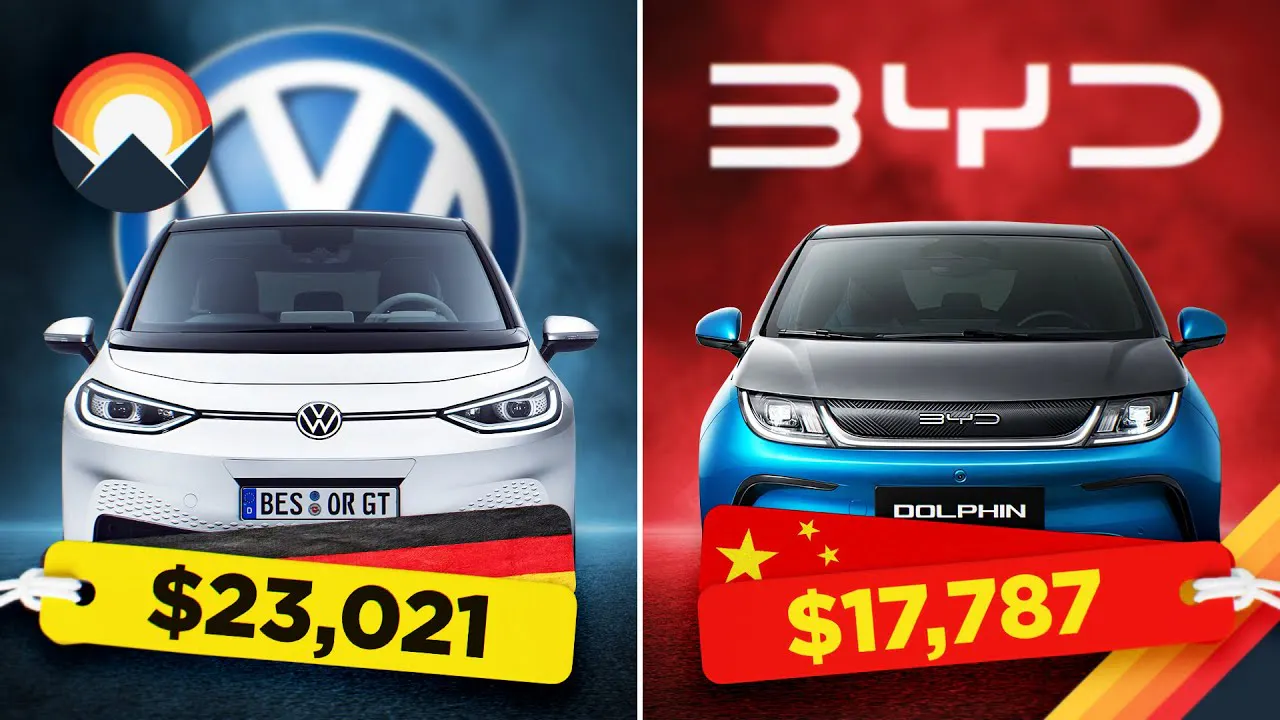
and $14,000. But for a number of years, EV buyers could get a license plate for free, an absolutely massive incentive considering some Chinese EVs now cost less than a license plate in Shanghai. There's also been a litany of buyer rebates, sales tax exemptions, infrastructure funding, direct support of automakers, and more that's totaled up to an estimated $230 billion in funding for EVs by the Chinese government between 2009 and 2023. Whereas elsewhere EV incentives were merely focused on making them price competitive with internal combustion cars, in China they were often significantly cheaper, so it's no surprise their sales exploded. But of course, that just explains why China transitioned to EVs so quickly, not why BYD you served VW. The explanation for that is that, well, BYD's cars were just simply better. In recent years, VW's entry-level EV in the Chinese market was its ID-3, which it was selling for about $23,000.
This model boasts a 0-50km per hour time of 3 seconds, and a certified range of 450 km. In the US or Europe, this would seem like a steel relative to other EVs, but in China, for half that price, about $11,800, a buyer could instead get the upper trim of the entry-level BYD EV, the seagull. This has a slower 4.9 seconds 0-50km time and a shorter 405km range, but it's not too far off. And there are plenty of other BYD EVs selling for well below the ID-3's price, yet boasting better specs. The BYD Dolphin Night version has 520 km of range, yet sells for under $18,000, for example. And the Volkswagen Group isn't doing much better on the other end of the spectrum, either. The Group's two primary luxury brands, Audi and Porsche, are each struggling as well. Audi sold fewer than 15,000 EVs to China in the first 9 months of 2024, and Porsche sales are in such freefall that the company is closing a third of their dealerships in
the country. There is a market for higher end Western EVs in China, but that market has been absolutely dominated by Tesla. The company convinced the government to allow them to build their own dedicated factory in China. The first time ever, a foreign auto company has been allowed to enter the Chinese market outright, not as part of a joint venture with a Chinese firm. Now, Western brands typically are able to command a price premium in China. They're often viewed as luxury goods. The W doesn't necessarily need to beat its Chinese competitors on price for equivalently specced cars, as historically consumers have received the Western brands as just simply better. Until recently, that is. Even if the ID3 or other VW EVs might match or beat B-Y-D equivalents on range or acceleration or charging time, the day-to-day experience of owning a VW EV is reportedly just worse. They lose in the details, and nowhere is that more true than with software.
Now, up until the 2010s, Car Manufacturing was largely an exercise in industrial expertise. With companies like Toyota, Volkswagen, and General Motors vying for the world number one spot in total sales, an account of their ability to produce durable, dependable, fixable, hardware. Then came Tesla, Apple CarPlay, Linguicist, heads up displays, and a myriad of other features running from safety to in-car entertainment that required cars capable of computing, suddenly a software revolution. For legacy car makers, such rapid change was jarring, but ultimately was such that they could at least keep up with through outsourcing to smaller, more nimble software companies. Making revolution more manageable, too, was the fact that internal combustion engine cars simply don't require the same level of software sophistication as an electric vehicle. A touchscreen infotainment system doesn't necessarily need to interact with or be aware of a lane assist or automatic braking safety feature, for instance. So to keep up, Volkswagen at first went the route of other legacy car makers, contract
out the software, focus on their core competency, the hardware. But that changed in 2015, with diesel gates. The scandal involving an emissions control system designed to fraudulently manipulate the results of emissions tests. As part of the ensuing legal settlement, the company invested $2 billion into building out the Electrivi America brand of EV fast chargers in North America, and then $40 billion into their EV program. And as for the software that ran those EVs, and their entire fleet of vehicles for that matter, well, the W was going to do that, too. In 2019, the company announced that they no longer look for software suppliers, but they'd be one. No longer would they mirror the strategy of other legacy automakers. They take the Tesla route. They'd be a car company and a tech company. The vision was straightforward enough, they'd radically simplify, and there would no longer be any black boxes that the company itself couldn't understand under their hoods. Each of their cars, leadership noted, were using some 70 separate computers and across
VW groups' brains, there were eight separate software architectures. Now the company wanted to cut those numbers to three computers per car and one operating system across the entire group. While the concept was simple, the undertaking was a massive, as VW group didn't even have a built-out software branch. So they started from the ground floor, founding a software and technology company now called Kariat here, outside of Munich, an Audi plant, with a host of additional offices extending as far as Seattle to house its 3000 new employees. Now no Volkswagen brand would have to rely on outside software, they'd have one in-house operating system serving their purposes alone, just as soon as they built it. This was a first, a legacy car manufacturer so boldly embracing software. GM hadn't made such a move, neither had Ford, nor Toyota, nor Had Honda, or Hyundai. Neither had even Tesla, who shared the most similar approach to software, as Tesla from its founding was a software developer, making software a core competency from the beginning.
But the problems were immediate. Volkswagen was able to begin delivering certain trims of its first modern electric vehicle, the ID3, in China and Europe, nearly on time. The buyers were asked to patiently wait for software updates before their infotainment systems and heads up displays would be fully operational. For the company's first electric car release in the much anticipated ID series, it was a massive blunder, as Reddit and YouTube became replete with ID3 rants and painful summaries of continued software snafu's. Even matters worse in the same year, software difficulties also delayed the release of the popular VW Golf, as the company simply couldn't ensure network safety in some markets for over-the-air updates. While the launch of the electric ID4 in North America went a bit smoother, software soon proved the vehicle's Achilles heel as about a third of recall notices on the vehicle could be attributed to software problems. Unfortunately for the VW group, Cariots issues were more structural than simply stumbling out of the starting blocks.
News for the ID group are largely attributed to Cariots' most rudimentary product, E3 1.1. The platform designed for the group's mass market EVs. But Cariots in 2019 was also tasked with the concurrent development of two other platforms, E3 1.2, a step-up in complexity designed for higher NDVs from the likes of Audi and Porsche, as well as E3 2.0, a software product that would usher in autonomous driving for the group in the late 2020s. Cariots struggled with these products too, leading to delays on Porsche's EV Macon and more recently, Audi's Q8E Tron, once again on account of software. Well, Bentley, counting on E3 2.0 to usher the brand into its EV era, has already announced that its full transition away from internal combustion isn't likely until the mid-2030s, in part because of uncertainty over whether Cariots can deliver a reliable product. From the beginning, Cariots was found to become a central strength of the group, so it's been central in both near and long-term product roadmaps.
And because it has failed so spectacularly up until this point, it's left the entire group from mass market to luxury in a state of uncertainty. And beyond the operational implications, the end result is still not what it needs to be. And, adotally, the reviews indicate that while VW software might be improving, it's still far behind that of BYD or Tesla. So now the company is in damage limitation mode. Along with the factory shutdowns, it's aiming to cut pay by 10% across the board, and is already finalized to plan to do so with managerial staff largely through a reduction in bonuses. To avoid further factory closures and pay cuts, though, the company needs to make some bold moves. It's starting by trying to find the next China. And VW believes one prime emerging market opportunity is here in Brazil. This is, in fact, where VW opened its first international factory in the 1950s, and today boasts four factories, but the company still believes there's more juice to be squeezed. It's aiming for 40% market growth by 2027 by introducing 15 new electric and flex-fuel
models to Brazil. At the end of the day, though, VW still thinks it can salvage the Chinese market. All they need to do is follow the lead of the new market leaders. After plenty of public rhetoric on how they won't get coaxed into a price war with the Chinese manufacturers, VW has been coaxed into a price war with the Chinese manufacturers and dropped prices across its lineup to build back market share. Recently, it also introduced the ID code concept, a fully electric vehicle equipped for fully autonomous driving developed specifically for the Chinese market with the kind of techie futuristic features that have helped propel BYD sales. This includes a self-cleaning mode where the car uses UV light to purify the air and a built-in robot vacuum cleaner to clean surfaces. VW also took a 4.99% ownership stake in Chinese EV startup X-Pang. By collaborating with an established in-market brand, Volkswagen says it will cut production time by 30% and production costs by 40% on the two models it plans to introduce with X-Pang in 2026.
But ultimately, if VW EVs are going to be competitive anywhere, they're going to have to get good as software. In July, Volkswagen announced a joint venture with American EV Darling Rivian known for breaching the SUV and recreational vehicle markets. The initial $1 billion investment will be followed by another $4.8 billion in the next several years, all dedicated to research and development and the integration of Rivian software into Volkswagen vehicles set to launch by 2027. Rivian pioneered what's called a zonal architecture, basically splitting up a cars network to reduce wiring and hardware and its interdependence on other systems, and the plans are to implement it first into Volkswagen's luxury brands, Porsche Audi, and eventually downmarket to VW vehicles themselves. The transition towards electric vehicles has been a difficult moment for the old guard of the auto industry. Few would have predicted that a Silicon Valley startup could explode into the world's most valuable auto company, but then Tesla did. The incumbent to manufacturers eventually took this threat seriously, recognizing that
it's now only a question of how long the transition towards EV takes, not whether it'll happen. But suddenly, BYD has become, effectively, the second Tesla, the second EV manufacturer to achieve explosive growth. And unlike in the case of Tesla and the West, as BYD rose, so too did a litany of other smaller Chinese EV manufacturers. It's a far more diversified market than it was seen in the US and Europe during the big growth years of Tesla. That's to say, the challenge to the incumbents this time is even stronger. Perhaps the one upside for Volkswagen is that it's having to confront this challenge now. Chinese EV manufacturers are just starting to ramp up exports. The cost of these EVs is just so much lower than competitors that they're sure to quickly entrench in markets around the world. In response, the EU set tariffs that cut into this cost advantage, alleging that the prices are made possible by significant government subsidies. The US, under similar logic, set a 100% tariff, making it effectively impossible for Chinese
auto companies to compete in the markets. But tariffs are not a wall. They're just a hurdle. And with time, the Chinese companies will find a way. Already, BYD is pivoting its Europe strategy to hybrids, as these are not covered by the tariffs. The EU, one could say, has the opportunity to figure out how to meaningfully compete against Chinese EVs in China before they have to do so across the globe. All the other auto companies, without a significant China presence, are not facing these same challenges, so they're not able to put their products to the test in the same way. On the outside, EVs look like cars. They are, of course, and in many cases, their bodies are identical to those of gas-powered equivalents. But what makes this industry transition so tumultuous is that, on the inside, the factors that influence competency in EV design and manufacturing are so fundamentally different than those that went into internal combustion cars. Over a century of institutional knowledge within companies like VW is now almost worthless.
Perhaps the biggest value they retain is just their brand. There's every reason to believe that successful internal combustion vehicle manufacturers won't turn into successful EV manufacturers. The task ahead for VW and other incumbent car manufacturers is so tremendous that, looking back in the decades to come, the ones that make it will perhaps be more remarkable than the ones that don't. China is fascinating. I never get tired of trying to understand the ways in which this nascent superpower is increasingly affecting the entire world, and clearly, if you've made it to this point in the video, you're on the same page. That's why I'd recommend you watch Polymatter series, China, actually. It's a nebula original that attempts to dive deep into how the country actually works. For example, you've heard about Chinese censorship or their one-child policy or their elimination of poverty, and you probably remember the surface level explanation for each of these, but do you really, truly understand each on a nitty-gritty level? That's what China actually is for. It's a really interesting show, and this is just one example of nebula-exclusive content
that's worth watching. As you probably know by now, nebula is a streaming service started by digital creators, myself included, designed from the ground up to be THE BEST HOME TO VIDEO CONTENT. Quite a lot of thinking has gone into what that actually means, but it starts with the fact that it's completely ad and sponsorship-free, which means the way we make money on it is through charging one low subscription fee. I know at first this sounds like a downside, but I believe it's the opposite. With this subscription fee, we're able to not only provide stable, predictable income to a curated selection of top-quality creators, we're also able to fund the production of top-notch higher-budget nebula originals. The idea is that there are all these digital creators out there that have great ideas about new things to make. They just need a little more money to do so than what YouTube's economics can support. This has produced shows like The Getaway, a reality game show on wheels produced by the Wendover and Jetlag team, or Night of the Coconut. I'll film about an interdimensional genocidal coconut by Patrick Willems, and it really doesn't matter if you still have no idea what that means. It's really good. You should really watch it. Or Boomers. A brand new doc by Tom Nicholas about how the baby boomer generation managed to amass
so much wealth and power and the consequences of this phenomenon. These are just a few of my favorites, but it's worth knowing that our 2025 Nebula Original Calendar is the busiest and highest budget it's ever been. We're making lots of really cool stuff. If you want to check Nebula out, you can do so for 40% off when you head to our link nebula.tv slash Wendover and using that link will even help support the channel. So thanks and advance for your support.
More episodes
More from Wendover Productions

The Logistics of German Reunification | Wendover Productions
Wendover Productions

The 8 Flights That Show How COVID-19 Reinvented Aviation | Wendover Productions
Wendover Productions

TWL #5: Timekeeping on Mars | Wendover Productions
Wendover Productions

TWL #10: The Day Sweden Switched Driving Directions | Wendover Productions
Wendover Productions