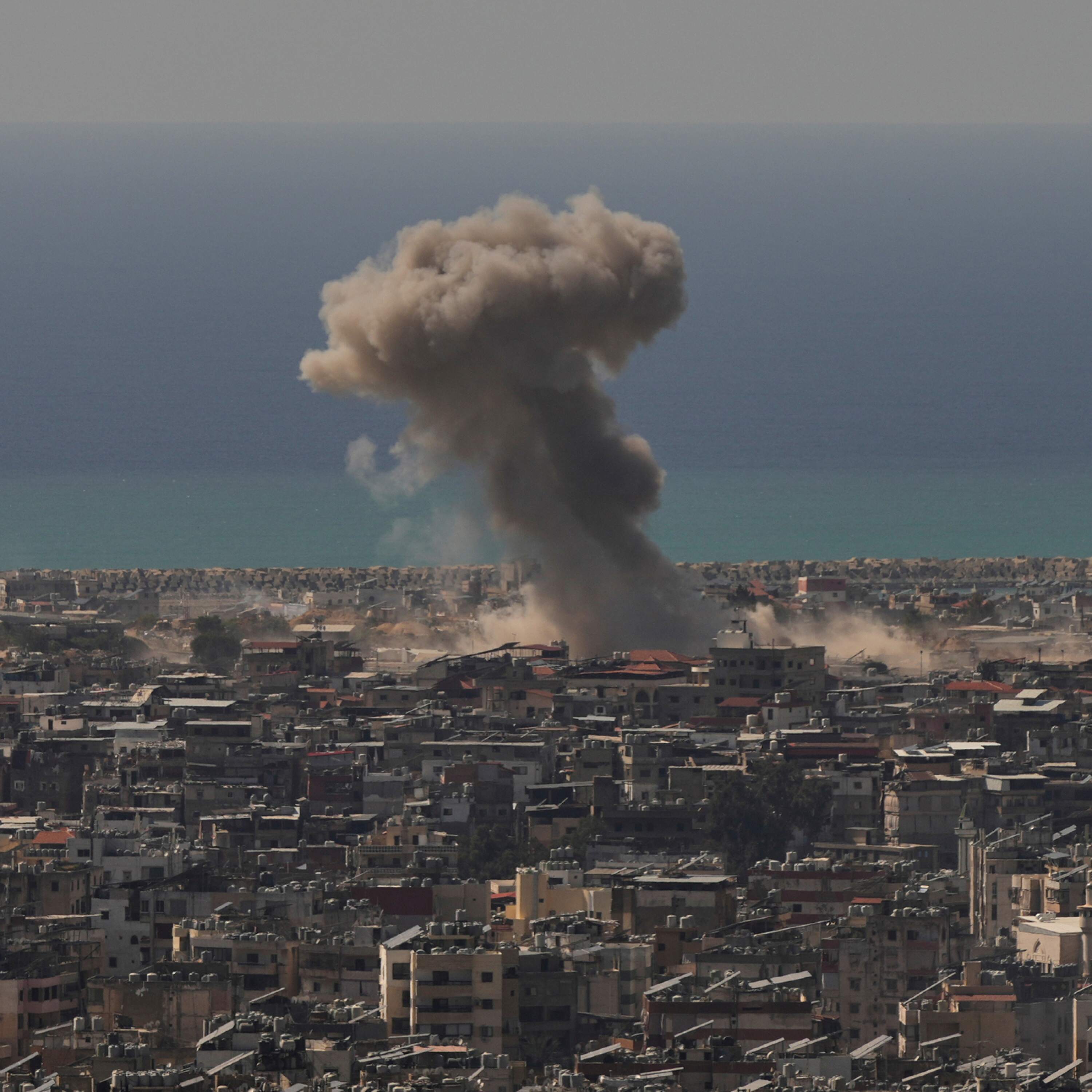
About this episode
Then, artificial intelligence is playing an important role in the war in Iran. We look at how it's being used and how it is changing warfare with Paul Scharre of the Center for a New American Security.
And, the internet is full of memes around the ongoing war, many made and posted by the White House account on X. Nottingham Trent University's Tine Munk weighs in on the objective of these memes.
See pcm.adswizz.com for information about our collection and use of personal data for sponsorship and to manage your podcast sponsorship preferences.
NPR Privacy Policy
Get every episode summarized
Each time Here & Now Anytime publishes, we email you a written briefing from the transcript — the topics, who appeared, and any specific claims, with the ad reads skipped.
Email me new episodesFree for 3 shows. No card needed.
Hosts & guests

Transcript ready
297 searchable segments. Every word is indexed and playable.
Full transcript
Here & Now Anytime — War is deadly. Why is Trump turning it into a meme?. Machine-transcribed; use the interactive transcript above to jump the player to any line.
Support for here and now any time comes from the VCU School of Business, offering graduate programs for military families and veterans in accounting, information systems, supply chain, and more, including MBAs. Learn more at business.vcu.edu slash GRAD. WVUR Podcasts, Boston. Anyone that's interact with AI knows that AI can make mistakes. How do we use this technology and how we make sure that it's making the US military more precise in its operations? Artificial intelligence, memes, and the art of war in 2026. It's Tuesday, March 17th, and this is here and now any time from NPR and WVUR. I'm Chris Bentley.
Today on the show, how the US and Israel are using AI in their attacks on Iran, also chat is it cringe to post pro-war memes? It looks like internet humor, but it basically function like political communication of propaganda. That trolling, as a White House comms strategy, coming up in about 15 minutes. But first, an update on the war, Israel says it killed two of Iran's highest ranking leaders in an air strike overnight. They are the country's top national security adviser and the head of the besiege militia. Meanwhile, President Trump is bashing allies for declining to help secure the straight of Hormuz, which has been effectively closed by Iran, and a top aid to the director of national intelligence in the US has resigned, in protest of the war. Those are some of the things we wanted to ask John Feiner about.
He was a national security adviser to former President Joe Biden, and he spoke to Scott Tong. Before we get to this straight of Hormuz, these Iranian leaders, Israel says it killed if true, what would this significance be? Well, if true, it continues a pattern in which the United States and Israel have been able to penetrate Iran's intelligence apparatus to the extent that they are able to locate Iranian leaders and conduct strikes that take them out, that suggest significant operational success, significant intelligence success. But whether they are able to convert these operations, these actions into actual strategic victory in this conflict to remain quite elusive, I think, for the United States and Israel. The Iranian regime has continued to hold together. Its capacity to wage war has been diminished, but not eliminated entirely. And for the foreseeable future, I think that is likely to be the case. And if the war ended today, the Iranian regime would still be in place. It would still be able to threaten its allies.
And so we would have to think about whether all of this was worth it, given the market impact and other things. Iran still potentially blocking the Strait of Hormuz. So let's talk about oil flow, oil flows in diplomacy. I mean, this episode is pushed up, oil prices, the international price of oil, that everyone pays a gallon of gas in this country is now $379 on average, according to AAA. President Trump asked US allies to give military help to protect and reopen the waterway. For now, Germany, Japan, Italy and Australia have said they will not. France, South Korea and the UK have been non-committal. John, we just heard the President talk about NATO. Is Trump's rocky relationship with Europe and other allies coming back to bite him here? Well, I think you're seeing what happens when you decide early in a demonstration that actually you don't need friends in the world. That you're better off not having the burden of international relationships that sometimes call on me to help other countries and sometimes other countries or in a position to help you.
The administration made that decision very early. Now, President Trump, not having consulted really with any of our friends and allies other than perhaps the Israelis before waging this war, wants to invest them in a conflict that many of them do not support, even if rhetorically they're being relatively quiet about it at this point. And so you're not seeing them step up and assist the United States, which I don't think should surprise anybody. So in private diplomatic channels, how do you imagine these conversations going? I think that these countries are trying very hard not to have an additional rupture in their relations with the United States. You know, Trump threatens them with tariffs, sometimes he imposes tariffs on them, sometimes on our adversaries more often even on our friends. And so they have their own battles to fight with the administration and they are looking to avoid any additional points of friction, but they're also not stepping in to provide support for a war that I think many of them rightly believe is unwise. So they're doing this delicate dance and you're seeing the president's increasing frustration
that they're not providing more support than he would like. John, what about economic reasons to say no? The world has seen $100 oil before. Are we at an economic emergency in the world yet? So I think what you're seeing is countries questioning whether a military solution to this conflict is going to resolve the economic situation. The United States and Israel have dropped an enormous number of munitions, bombs on Iran, on Iran's leadership, on Iran's military targets, on Iran's energy infrastructure. And Iran has retained the ability to hold the straight-of-four moves this critical water way at risk and there's not a lot of evidence to suggest that additional bombing is going to alter that fundamental situation. So the longer that the global economy is dealing with 100 plus dollar of barrel oil, gas prices high, this is going to become a very severe constraint, it's not just oil. It's also natural gas, which is a critical input in power generation in countries.
It's minerals like helium that are critical to industrial capacity, including the production of advanced semiconductors around the world that fuel the technology industry. So there's a lot going on here and the globe is paying a significant price for the war that the United States has launched. Yeah, and fertilizer, yet raw material for fertilizer around the world. John, quickly, let me ask how you think American allies are looking at the domestic situation here. Democrats pose this war, the president and not as Congress beforehand. And today, Joe Kent, one of Trump's top national security officials, resigned and protested over the war. How is that being seen from the outside? Well, look, I've been critical of this war, I guess, from his statement, Joe Kent was critical of this war. I do not associate myself with a lot of the important views expressed by Joe Kent. So I think that's less of a relevant factor here and more what that suggests is the president has put into positions of authority in this country, people who have extreme views on a wide range of topics, including, in some cases, anti-Semitic views and other views that
should be outside of the mainstream. And I think many other countries look at that, look at some of the discourse and dysfunctionality in our country. And even more reason why when the president says, hey, we need some help here from our traditional friends and allies, they are more likely to sit this out than they are to join in. John Feiner is former principal deputy national security advisor in President Biden's White House. John, thank you. Thank you. Coming up next, the role of AI in the war will be right back. Support for here and now any time comes from Select Quote. If you're new to life insurance, you're not alone. Thankfully, there's Select Quote. For over 40 years, Select Quote has helped more than 2 million Americans understand their
options and get the coverage they need. Select Quote takes the guesswork out of finding the right life insurance policy. Life insurance is never cheaper than it is today. Get the right life insurance for you, for less, and save more than 50% at selectquote.com slash anytime. That's selectquote.com slash anytime. The head of U.S. Central Command, Admiral Brad Cooper, recently extolled the virtues of artificial intelligence on the battlefield, saying it helps American troops and spies quote, sift through vast amounts of data in seconds and to make smarter decisions faster. But there's reason to be skeptical, not least of which being the report-adduce of AI in target selection, when Iran's health ministry says U.S. and Israeli strikes have killed at least 1,200 civilians, including children. Paul Shari worked at the Pentagon on weapons and technology policy and as a former Army Ranger.
Now he's at the center for new American security. And he told Scott Tongue, the military is, indeed, using large language models in its war with Iran. U.S. has the need to sift through massive amounts of information, drone videofeed, satellite imagery, signals intelligence collection, other forms of intelligence, sift through all that to make decisions in real time about targets on the ground in Iran, senior military commanders, mobile drone launchers, mobile missile launchers, and then prioritize those. And we know that language models are being used as a tool to help the military assess those targets and prioritize them and then build those in discrike packages. There's a lot of details though that they say that we don't fully know yet because these are being used in a classified environment by the military. I imagine the promise of AI is that it processes data so well that it might be able to be used to make more accurate strikes, reduce civilian casualties. Is that necessarily true?
Well, not necessarily. That's one of the hopes of the technology. I think it certainly has that promise, but that depends a lot on how it's used. I think anyone that's interact with AI knows that AI can make mistakes. Systems can sometimes be wrong. You need a human checking them. We do have humans in the loop checking those outputs right now, but there's a problem of, first of all, just making sure that the systems are reliable, that given the volume of information that humans are able to actually double check all that accurately, and then moving forward, there are a lot of open questions about what does that balance look like between AI and human decision making? Are humans always going to be in the loop for these decisions or is there some time in the future where maybe AI is going to be making its own decisions about what targets to attack in the battlefield? I want to ask you, Paul, about the potential limits of the super high-tech war fighting. I mean, I'm thinking about Iran, and its use of low-tech mines in the Strait of Hormuz
really cheap drones to attack Americans in the region, neighbors in the Gulf, is there asymmetric way for countries like Iran to counter? Oh, absolutely. I mean, I think one of the takeaways here is, all this technology drones AI will proliferate very, very quickly, it'll be available not just to the United States and China, and other advanced militaries, but to less capable countries, even to non-state groups, and lots of different actors are going to have the ability to fuel drones, fuel low-cost missiles, eventually use AI as AI tools proliferate as well, and it's going to relatively level the playing field. Now, big militaries are always going to have advantages, but there are going to be lots of ways that other actors can thwart them that can impose costs on them. We've seen that not just in Iran's operations, we're despite an overwhelming advantageant
conventional power by the United States, Iran's still been able to launch over 2,000 drones across the region, causing a lot of damage, a lot of disruption across the region, and of course, to the straight-up hormones and disrupting oil shipping and the global economy. But we've seen this in other conflicts as well. In Ukraine, the Ukrainian military was able to basically neutralize Russia's Black Sea naval fleet using small, cheap, expendable, explosive drone boats. Yeah, and Paul Rollquick, before we let you go, are there clear rules about AI use in war, when it's ethically, legally okay and not okay? Well, no, not yet. That's been a topic of a lot of debate, certainly in the last few weeks, in the dispute between Anthropic, one of the world's leading AI companies in the Pentagon, surrounding, for example, lethal autonomous weapons. But there's no international treaty, there's no international set of rules about how AI should
be used in warfare other than what already exists, which is the law of war, and certainly countries should be complying with. But specific to AI, it's really an open question. And are there going to be any new rules that govern how AI is used? There's certainly some risk that it could be quite dangerous, and I think there's probably a need to be having that conversation. One of the central questions is about the role of humans versus machine decision-making over targeting and kill decisions on the battlefield. It's one thing for AI to be sifting through this information and helping people make decisions. But if we move in the future towards some tipping point where humans are letting the AI make these targeting decisions, is that acceptable? Is that morally right? And some of that depends upon how reliable the technology is. But there are also, I think, really important legal and ethical questions as well. And I think there's strong reasons to want humans involved in these decisions,
not just because humans bring a lot to the table in terms of understanding the broader context and applying judgment, but also because humans understand the stakes of war. You know, humans can see something like this accident, this attack on this girl school, and the casualties of that, and understand the consequences, and a machine doesn't. And I think it's really important to keep that element of human empathy and moral judgment in war as well. Paul Shahari is executive vice president at the center for a new American security. His books include four battlegrounds, power in the age of artificial intelligence. Paul, thanks so much. Thank you. Thanks for having me. So there's the issue of AI potentially alienating members of the military and intelligence agencies from the cost of their decisions, but then there are those who'd rather not ring their hands over death and destruction in the name of American power coming up war as content.
And how the White House is selling war in Iran to Americans online with clips from Braveheart, Grand Theft Auto, and even Wii Sports. Come to think of it, Operation Epic Fury even sounds like a forgettable video game. We'll be back in a minute. Way back in the 2015-2016 campaign for the White House, Trump supporters bragged about winning the meme wars. They flooded the internet with pro-Trump posts, often explicitly racist and sexist, meant not just to grab attention, but to get a rise out of their perceived political enemies.
Ten years later, Trump is in his second term, launching his second war against Iran alongside Israel, and the meme wars are an official front of American public policy. If you haven't seen the White House's social media feeds lately, they're full of stuff like this, videos splicing footage of real-life killings in Iran with scenes from top gun, call of duty, and mortal combat. The White House captioned that one justice the American way. What's the point of all this? Well, one person who's been thinking about the memeification of war is Tina Monk that nodding him Trent University in the UK. Here's her conversation with Scott. Well, it's interesting because an emitted warfare in itself is a form of information warfare,
where it's conducted through the creation and adoption and circulation of memes, basically to achieve political or strategic or ideological objectives. But when we see the White House using the meme format in direct communication, it's something changed. It's no longer just culture. It's about states, the way states are messaging the population. So it looks like internet humor, but it basically functioned like political communication of propaganda. I mean, we're talking about this is people killing people. Is it appropriate to reduce it to a video like this, a manly video like this? I think it becomes problematic because it's disincenti-ized how we see war and how we understand war. But also, it's framed like a video game on action heroes where we can see the enemies faceless or abstract or dehumanized. And in some way, it becomes entertainment and war
is ugly and bloody and the human suffering. But here it comes quite a weird way of a reality show where we have winners and we have losers. But it's not just the US who is using this format, a number of other states are using it as well. And we can see Iran is using exactly the same format against the US. You mentioned what Iran is doing and it has put out an AI-made video featuring Legos, right, casting the Americans as the Lego villains for a dramatic music underneath. What is Iran trying to do there? So they're also exactly the same way just turning around with the losers and winners and they are portraying of course themselves as winners and they're linking for example the administration and the US president to the Epstein files in that little video.
So they use the same format of popular culture in order to reach out and communicate directly to their population. Basically in the same way as we can see the lighthouse are using the other types of video which is quite fast where you have all the hits, the wins and the clear outcome. And there's no doubt there's no visible consequences in building these videos. Well you mentioned Legos which originally were meant for kids which leads me to want to play another White House meme video. Let's listen to that. That of course was SpongeBob the cartoon character next to Missile footage from the US military. There's another one featuring Pokemon. So these are TV shows, these are games for kids. What is the message there intended or not? Well it is in all these videos but also in this one it is to create a bit of fun. It should be
read as a bit of fun. So it's merging fun and political messages at the same time and not everybody are able to differentiate between what is the message in the actual meme, what is the message in the video. Is this a joke or is it a political signal that we are sending? But it's softened up by using characters that we all know from movies, from series, from games. So it is a way of reading out to a large audience at once and also to create a narrative that taps into popular culture, to tap into what people already understand. And then it allows a narrative to spread really rapidly and change in real time as well. And Tina Monk, given you, I mean you analyze this messaging, I want to ask you about what's happened in the past where there were wartime propaganda posters in the United States.
The picture of Uncle Sam and World War I pointing straight out at me on the street saying, I want you for the US Army. Of course, Rosie the Riveter showcasing the role of women and their muscles in World War II. Are today's videos that we're talking about a version of the same thing or are they entirely different? So the memes function today much like these propaganda posters that you just mentioned what they did in the past. They are simple, they're visual, and they are emotionally charged tools used to shape the public perception during a war or a conflict. But what I think and what I have observed is that the memes goes further. So they are faster, they are participatory, and they're highly adaptable. So instead of being produced only by the state, they are created, they're remixed, they're shared by the online users as well. And that allows, as I said before, the narrative to spread rapidly and also change in real time. So if you compare these two, so why the propaganda posters aim to persuade the memes actively
mobilize and also engage an audience and make them quite a powerful tool in the contemporary information warfare. And I think that the key distinction between them, otherwise it's basically a bit of the same. Teen Among Studies Digital Warfare, so you've seen your lecture of criminology at Nottingham Trent University in the UK. Tina, thank you very much. Thank you for having me. That's it for the show today. But there's always more on our website here at Now.org. Today we're celebrating St. Patrick's Day with a story about the history of the holiday and, of course, some Irish music. Check it out at here at Now.org in slunch it. Here and now any time comes from NPR and W.B. U.R. Boston. Today's stories were produced by Sam Raifelson, Julia Quirkin, and Hopsa Claraci. Our editors for Todd Munt, Mikhail A. Rodriguez, and Mikhail Scotto, technical direction from Caleb Green and Matt Reed. Our theme music by
Mike Mosquetto, Max Liebman, and me Chris Bentley. Our digital producers are Collison Hagen and Grace Griffin. And here and now's executive producer is Alan Price. Thanks for listening. Happy St. Patrick's Day and we'll be back with you tomorrow. This message comes from Mintmobile. If you're tired of spending hundreds on big wireless bills, bogus fees and free perks, Mintmobile might be right for you with plans starting from 15 bucks a month. Shop plans today at Mintmobile.com slash switch. Up front payment of $45 for three month five gigabyte plan required. New customer offer for first three months only. Then full price plan options available. Taxes and fees extra. See Mintmobile for details. This message comes from in PR sponsor OnePassword. Anyone else feel like 99% of your emails and
texts are password reset codes? Trusted by millions of users and over 175,000 businesses. OnePassword lets you skip the resets and sign in securely with strong, unique passwords that auto fill across all your devices. You can safely share logins, store cards and files, and finally stop using your pet's name as a password. Try it free for two weeks at OnePassword.com slash in PR. This message comes from Midi Health. Introducing H.Well, longevity care designed by women for women. Whether you're looking to prevent future health issues or just feel more like yourself. Learn more at joinmidi.com. That's join
More episodes
More from Here & Now Anytime

The story behind the photo that captures the horror of 9/11
Here & Now Anytime

The conservative movement, one year after the killing of Charlie Kirk
Here & Now Anytime

9/11 and the long shadow of Islamophobia
Here & Now Anytime

Israel faces global outrage over West Bank violence
Here & Now Anytime