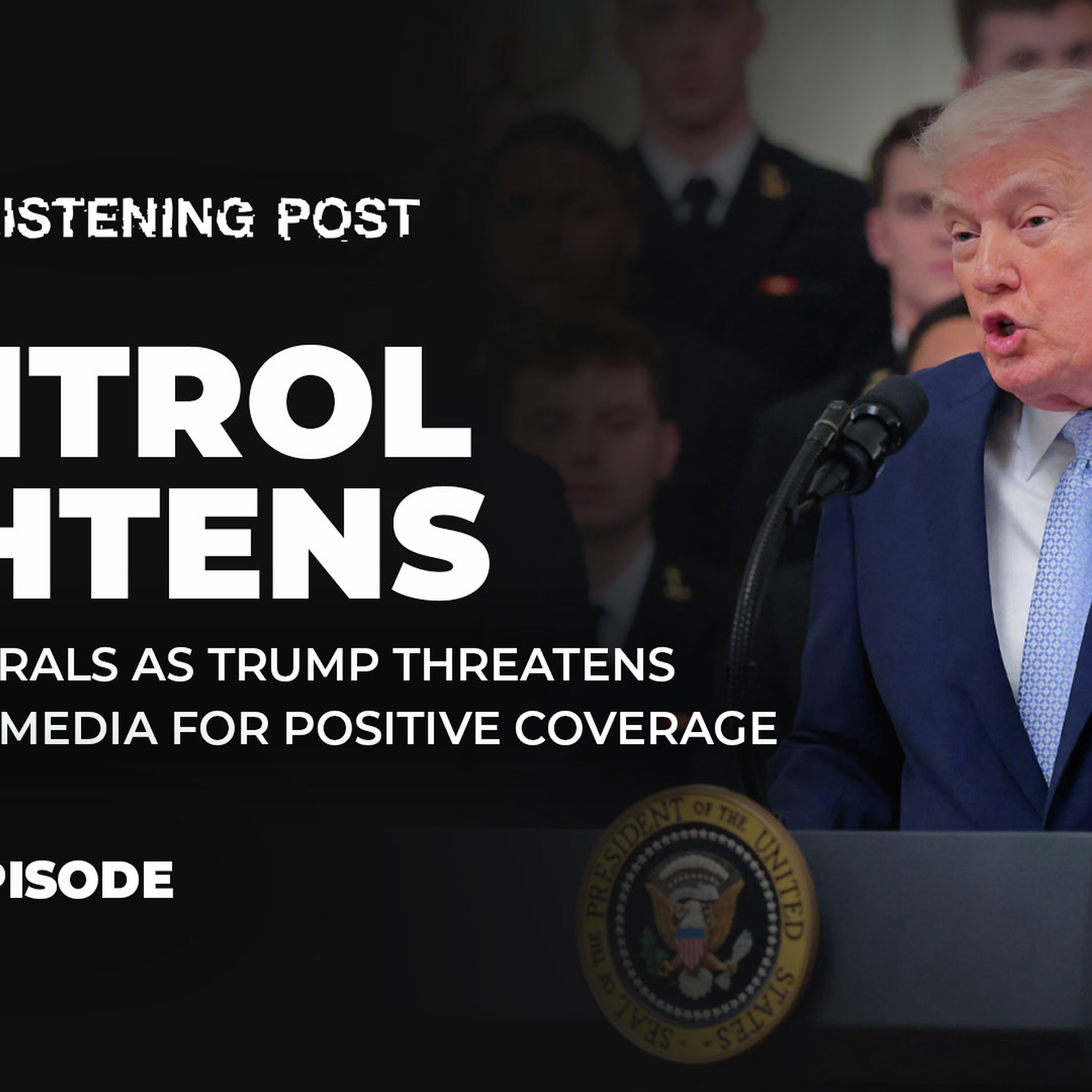
War spirals as information control tightens | The Listening Post
About this episode
Get every episode summarized
Each time The Listening Post publishes, we email you a written briefing from the transcript — the topics, who appeared, and any specific claims, with the ad reads skipped.
Email me new episodesFree for 3 shows. No card needed.
Hosts & guests

Transcript ready
324 searchable segments. Every word is indexed and playable.
Full transcript
The Listening Post — War spirals as information control tightens | The Listening Post. Machine-transcribed; use the interactive transcript above to jump the player to any line.
This week on The Take, we're marking one year since a pair of devastating earthquakes hit Turkey and Syria, with a new digital interactive. Listen and watch stories of survival, recovery, and coping with the grief at Al Jazeera.com forward slash earthquakes. Again, that's Al Jazeera.com forward slash earthquakes. The war on Iran and the way it's being covered, starting with the U.S., where the White House says the journalism is insufficiently patriotic, and there is talk of treason in the air. Sensorship is taking place across the board, ranging from self-sensorship to the kind imposed by some of the states involved. And we focus on Lebanon, around 20% of Lebanon is displaced as we speak, which is real is threatening to turn into the next Gaza, and where its soldiers are running on muck once again.
This week brought significant developments in the U.S.-Israeli war on Iran, from the ongoing efforts to decapitate the leadership in Tehran, to the continued blockade of the Strait of Hormuz, and now major strikes on energy infrastructure across the region, bringing the conflict into a much more perilous phase. Our focus, as always here, at the listening post is on the journalism, what it's up against, the way the war is being covered. For reporters in the U.S., Israel and Iran, the challenges differ, but they face the same reality. This war is escalating and has become a story in which propaganda, the projection of strength, can matter as much as military might does, which means that news organizations are under pressure from multiple sides, from vested interests, shaping the narrative, to leaders who, for whatever reason, want to keep on fighting. The stakes are growing by the day and the trajectory that this story takes could be affected by the decisions being made not just in war rooms, but in newsrooms.
The Fargo War, the media war, the formation war is very important for all sides to try to shape the narrative, especially in the United States, with increased pressure by the administration to shut down certain conversations critical of the war. The leaders are gone, and we could do a lot worse. Americans know all about their corporate media outlets, self-sensoring at times, but journalists there are unaccustomed to censorship imposed from above by the government. It is nothing new to Iranians where such restrictions are a fact of life, and whenever Israel finds itself at war, usually by starting one, journalists have to deal with military censors, telling them what they can or cannot report. But Americans have never had someone like Brendan Carr, who heads the U.S. broadcast regulator, threatened to pull the licenses of news outlets over their critical coverage of the war.
At no time have they had a secretary of war, let alone one who rants the way Pete Hexeth has, instructing journalists on the kind of spin America's latest war effort requires. For example, a banner or a headline, mid-east war intensifies what should the banner read instead about Iran increasingly desperate. President Donald Trump went further than that, saying some journalists should be charged with treason, a crime that in the U.S. is punishable by death. The United States has very strong and broad protections where you can actually publish if you remember the media, much more so than other Western countries. So they're going to find it hard to make good on this threat, but at the same time, just the fact that they're able to make this threat can have the intimidating effect that they're looking for, and lead media outlets to self-sensor. The U.S. government expects to be served by a mobilized media to advance the interests
of the state, rather than any considerations for professional journalistic standards, although the Gaza genocide, much of the corporate media in the United States willingly forfeited its professional responsibilities. All wars empower authoritarian tendencies. Strengthen authoritarian moves. The war is also shutting down a free-flow of information in Israel ramping up the repression tactics in Iran, but for America whose exceptionality lies in the free speech and the first amendments. This represents more of a threat, because U.S. society can move to look more like our adversaries than ourselves. Or like their ally in this war, Israel. Military censorship there goes back decades. Journalists have had to deal with it during the genocide in Gaza, the ongoing attacks on Lebanon, but the conflict over Iran has deepened those restrictions.
They now go beyond the clamp down on live coverage. The images Israelis are able to see of projectiles incoming from Iran. The Israeli government does not allow us or want us to show where that may have come up. They affect what Israelis are able to know about their military stockpots, the very real concern that they have been depleted and that Israeli lives are now at risk because of that. The Netanyahu government does not want those vulnerabilities out there. We're watching from above. The reporting is censored accordingly. The Israeli military and the media shape everything that Israelis understand about the war. Certain live broadcasts have been shut down, and the police have actually been out searching for certain journalists, so there's a lot more of a crackdown. And Israeli journalists who don't comply can suffer from serious penalization, arrest, equipment being taken away. But the truth is that Israeli journalists, most of them comply anyway, basically echoing
the military narrative they don't really question it. We have numerous military analysts who have been stating for months that depletion is a real risk, but if you look at the Israeli media, this is being presented as not factual information. I put my trust on military analysts who have repeatedly concluded that interceptors are an increasingly short supply, and that replenishing them is going to be a very difficult task. A big part of it is information warfare, psychological warfare propaganda. There were reports the last few days that Netanyahu was assassinated, and it was all over the internet, even though there was not even a target of that kind as far as I know. But a lot of people started to believe that. And so the downside from the Israeli perspective of putting so much crackdown is that people start believing all types of things because there's no truth coming out.
Iran is out to plug leaks as well. Its police chief announced that 500 citizens have been arrested this past week for sharing information to quote hostile entities, which likely includes foreign news outlets. Tehran has allowed some of those news teams into the Islamic Republic, CNN and Sky News, but has walled off others like Iran International, which has far more viewers in Iran than Western outlets do. The Persian language channel that operates in exile out of London often provides a platform for Reza Palafi, the son of the former Shah, who wants his family to return to power. The channel has also been known to cozy up to the Israelis. I believe in you, I respect you, I admire you, I know that Iran can be great again. Iran is a deeply polarized society. You have liberal Iranians, some of whom are actually in favor of foreign strikes, and you have deeply committed Iranians supporting the government's war efforts.
You have outside influence operations, the Mossad and media networks, such as Iran International. And so Iran has tried to clamp down on that by criminalizing any kind of citizen statement to these foreign channels to try to shut down the leaks. Iran has arrested several hundred people now and claims that they were leaking to the enemy. The next time espionage is regularly logged against, not actual spies, but against journalists and attempt to clamp down on inconvenient information getting out. You know, they say, you're a foreign agent, we're going to put you in prison. For all the lack of press freedom that the Iranian media has to endure and the restrictions that foreign media and Iran are compelled to accept. We came overland among the only international journalists currently allowed in. Iran has provided foreign media more access in Iran during wartime than Israel ever allowed
in the Gaza Strip. For more than two years now, Israel has systematically prevented the entry of a single foreign correspondent into the Gaza Strip, unless basically going as an adjunct of the Israeli military. U.S. polls indicate that fewer than 30 percent of Americans approve of this war. At the outset of the Iraq war, the opposite was true, more than 70 percent supported it. Getting a country onto a war footing requires groundwork, militarily and psychologically. And John Bolton, who was the national security adviser during Donald Trump's first term, understands that. A notorious warhawk, Bolton also worked under George W. Bush. Last week he told National Public Radio that one of the White House's failings on Iran was not, quote, preparing the American people ahead of the attack. The way he and the Bush administration did in 2003, when the U.S. media also played
a major role, helping to push the bogus claims of Iraqi WMDs. Donald Trump is not seeing the same complicity in the coverage this time around. For the president and his administration, that's unpatriotic. Hence, the threats against journalists, the loose talk of treason. What does any desperate leader who has launched a war that's gone them into hot water? They resort to threats to try to silence the people who are reporting about this. Rather than stop the root of the problem, which is the decision to go to war. And we should be very glad that reporters are not listening to the demands for a patriotic press. The highest level of patriotism really is the willingness to scrutinize and irresponsible in the reckless government that is steering the country into disaster. That's what true patriotism is, I think. A major part of this is propaganda. The media forming and controlling narratives, but it also means that programs such as yours
are more important than ever because ultimately, the narrative that prevails ensures which side lasts longer in this conflict. Israel is continuing its targeting of Iranian political leaders, killing three more senior figures there. Much of the coverage in Israel and across international media has ranged from the triumphalist to the awestruck, largely side-stepping, the legal matter of how these assassinations violate international law. Minakshi Ravi is here with more. Extrajudicial killings have long been a central tactic of the Israeli state. This past week, Israel announced it had killed three senior figures, including the Secretary of Iran's Supreme National Security Council, Ali Larijani. The news zipped across Israel's outlets. Beyond Israel, much of the media coverage focused on the sophistication of the operation,
the intelligence gathering, the covert planning, the execution. What was largely missing was any serious discussion of legality. No state is authorized to kill a civilian from another country, even one in political office, even one accused of ordering violence. In the media's reporting on Larijani, the focus has been on his record, including his role in ordering the mass killing of Iranian protesters in January this year. He was eliminated. Why is this important? Because this is the person who is in charge of the bloody crackdown. Coverage like this is part of a wider pattern. When the Israelis killed their political enemies, two things are foregrounded. The sophistication of Israeli intelligence, particularly Mossad, and the crimes of those targeted. Social media posts like this one make the rounds. Benjamin Netanyahu, alongside US ambassador to Israel, Mike Huckabee, taking pleasure in crossing names off a list of targets. So it's a punch card.
Today I raised two names on the punch cards, and you see how many more to go on this badge. Killing as a numbers game, where targets are counted, names are erased, and the question of legality disappears. Thanks, Meena. There are millions of other people directly suffering the effects of this war without attracting much media coverage, the people of Lebanon. Many forces have begun ground operations there, and many fear that their goal is to occupy once again, the southern part of the country. One out of five Lebanese citizens has already been forced from their homes. The UN says Israel has wounded or killed the equivalent of one classroom of school children per day. Having destroyed entire residential buildings in the middle of Beirut, and bombed civilian infrastructure to isolate the south, Israel has also showered Lebanon with propaganda leaflets, boasting openly that it will turn the country into the new Gaza.
One news outlet covering these developments is the Beirut-based megaphone. Its co-founder and managing director, Jean-Cassier, joins me now. The Israelis have forcibly displaced hundreds of thousands of people across a broad patch of south Lebanon, talked to us about what's happening down there, and how effectively our journal is able to report from that area. Yeah, thanks for having me to start to give some facts and figures around 20% of Lebanon is displaced as we speak, so it's a million people out of a six million people country. It's extremely difficult to report from the south. Israel is clearly trying to isolate the south. This comes after marking entire areas that amount to 15% of Lebanon in red on the map, which basically means an evacuation order for everybody within those areas, including a big city like here and entire villages. So the intention is very clear. Nobody should get close to the south.
It's extremely difficult to have an actual verification process and getting images that are directed from there. The only journalists who are still daring to go there, most of them are foreign journalists and most of them have to do it within a security framework. So either within the army or within also some tours organized by Hasbullah or within special missions that are basically supported or protected by security personnel. The Israelis are also bombarding the Lebanese with propaganda, with psychological warfare. Walk us through some of the things that they're doing on that score. How reminiscent is this of what we've seen in Gaza? Talk to us about some of the similarities, maybe the differences. Yeah, I mean, I'll start by saying the differences like Gaza is a genocide and it's very important out of respect for what the Palestinian people endure, not to make false comparisons. But the similarities, unfortunately, do exist. It starts with the mass evacuation, basically overnight asking the entire southern suburb
of Beirut, which amounts maybe to half of Manhattan to evacuate, create a panic among people who flocked to the streets and ended up sleeping in their cars that night. The same happened with the evacuation order I mentioned in the entire southern Lyttoni area. This also is coupled with fake calls asking for evacuation specific building, which contributed psychological warfare, add to it the constant buzzing of the drones above our heads, which creates a lot of ambient anxiety in the city and this preceded the current escalation post March 2. And finally, what we've witnessed a couple of days ago, which is the leaflets that were dropped from the sky, from the warplanes, and those leaflets ask basically that it needs to scan a QR code and to join information WhatsApp groups that the Israeli Army manages. We should also add to it the discourse of Israeli ministers such as Smotrich, who clearly
threatened to turn the southern suburb of Beirut Tahi into a new canunis, which adds to a lot of rhetoric of erasure and annihilation that has been coming out of a lot of Israeli officials when talking about Lebanon. And finally, we have the media phenomenon which is Ali Khai Adrahi, the former Arabic speaking spokesperson of the Israeli Army, which constantly not only threatens the Lebanese through those evacuation orders, but also engages with critics that are coming out of social media, which creates further fear. Imagine a person working for the Israeli Army responding to a meme or responding to a joke that a comedian, for example, or a social media commentator would say about you. And on the one hand, it tries to create some familiarity with the Lebanese audience, but on the other hand, I personally feel that it's extremely threatening. It means that they're observing, it means that they're very much aware of all the conversation going on in Lebanon's social media landscape.
And finally, try a lot to weaponize the legitimate criticism that exists in Lebanon against Hasbullah for their own propaganda and for their own discourse that they're here to liberate. Why do we all know that Lebanon has always been under threat from Israel way before the existence of Hasbullah? Well, let's dig into that angle right now. The way Hasbullah is perceived in Lebanon, there was a government directive this past week issued a state run news outlets not to call the organization a, quote, resistance group. So how is Hasbullah perceived by the Lebanese people, by the government there, by the media and beyond? I mean, it's very important to mention the broader framework under which we are operating as journalists. We're covering an Israeli war and Israeli aggression against a deeply divided country. And this division is not necessarily related to our stance toward Israel. I think most Lebanese do not see in Israel any potential ally, the overwhelming majority
sees Israel as an aggressor, but the dispute is around Hasbullah's role. Hasbullah is multifaceted. Hasbullah used to be a very legitimate resistance movement and up until the year 2000, until it decided to become more hegemonic at the Lebanese level. And a lot of people who opposed Hasbullah's hegemonia in Lebanon paid a very heavy price, including being killed. Another point of this agreement is Hasbullah's deep connection with the Iranian regime. And this is something that created a lot of backlash when the rockets were fired on March 2nd, because it was seen as direct support for the regime at a time where Hasbullah remained quite passive over a year when we had more than 10,000 Israeli violations of the ceasefire. We didn't see any rocket being fired. So there is a lot of attention around Hasbullah's role and Hasbullah's motives when it comes to its regional affiliation, and also it's a local hegemonic project. Given all of that, Jean, the context, the politics, how freely are Lebanese journalists
able to report on Hasbullah? Are there restrictions? Are there red lines formal, informal? Is there censorship or self-sensorship at play? We're in a country that's deeply divided, so this kind of allows for a margin of criticism against the other party. This doesn't mean that Hasbullah has ever been a big fan of freedom of expression. I mean, a lot of journalists paid a very heavy price for their critical stances, the latest being Lakhman Slim. But today, as we speak, the main threat on journalists is coming from Israel, because in the 2024 war, we had several of our colleagues that were assassinated, starting with Isam Abdullah, the photojournalist. I'm not saying this to deflect the attention that Hasbullah has a clear authoritarian and hegemonic tendencies, but as we speak today, the main threat is coming from Israel. The work that you do at megaphone focuses on documenting everyday life under attack. Give us an idea of a recent story that has stood out for you, and how do these kinds
of stories challenge the narrative that's out there on Lebanon of a fragmented or collapsing country? Yeah, I mean, I wouldn't pick one, but I would pick maybe a theme that we're covering, which is the amazing grassroots solidarity efforts. Lebanon is kind of forgotten in this regional conflict. There's not a lot of money that's coming in, like it was the case in the 2024 war. It's still a country that is suffering from a very acute economic collapse, so people have been in poverish for the last six years, but still, despite the polarization that exists, despite the sectarian tensions that exist, we still find like remarkable solidarity efforts that are happening at the grassroots level, from community kitchens to initiatives that are providing shelter for migrant domestic workers or for queer people, or for people who are not a part of the map of eight, two personal initiatives from restaurants or from shops that are providing washing machines for people who have left their homes, all sorts
of grassroots initiatives. This is something that is showing a picture of the country, a country that is still possible. This is what I would call it, at times the level of division in Lebanon makes you feel that this is an impossible equation, but when you see the solidarity happening, or organically, despite all forms of political divisions that exist, this is the kind of narrative that megaphone is showing. We're not denying the divisions, but we're showing another facet of Lebanese society, one that is determined to be resistant to any form of aggression and to also provide aid and consider that any Lebanese displaced is a person that concerns us all. John Kasier, managing director of megaphone, thanks for speaking with us here at the listening post today. Thank you. And finally, another disturbing similarity between what is taking place in Lebanon and what Israeli soldiers showed of themselves in Gaza on social media.
Once again, they are documenting through their phone cameras their appetite for looting homes, stealing personal property, playing with what they find there, including women's lingerie. All to further humiliate the Lebanese people they have already displaced or killed. Their behavior relies on impunity, allowing these soldiers to share these videos with no regard to the potential consequences because in Gaza, there were not. The videos also serve as a reminder that in many cases, these are not full-time soldiers. There are thousands of reservists involved. They come from every corner of Israeli society, people who will soon return to civilian life, their day jobs, like this character. A doctor whose job it is to preserve Israeli lives when he is not taking and dehumanizing
the lives of the other and then bragging about it on social media.
More episodes
More from The Listening Post

Hormuz: Spin in the Strait | The Listening Post
The Listening Post

“A war in search of a strategy” - Trump-Netanyahu's war with Iran | The Listeni...
The Listening Post

Trump, Iran and geopolitical mind games | The Listening Post
The Listening Post

The AI alarm cycle: Lots of talk, little action | The Listening Post
The Listening Post