About this episode
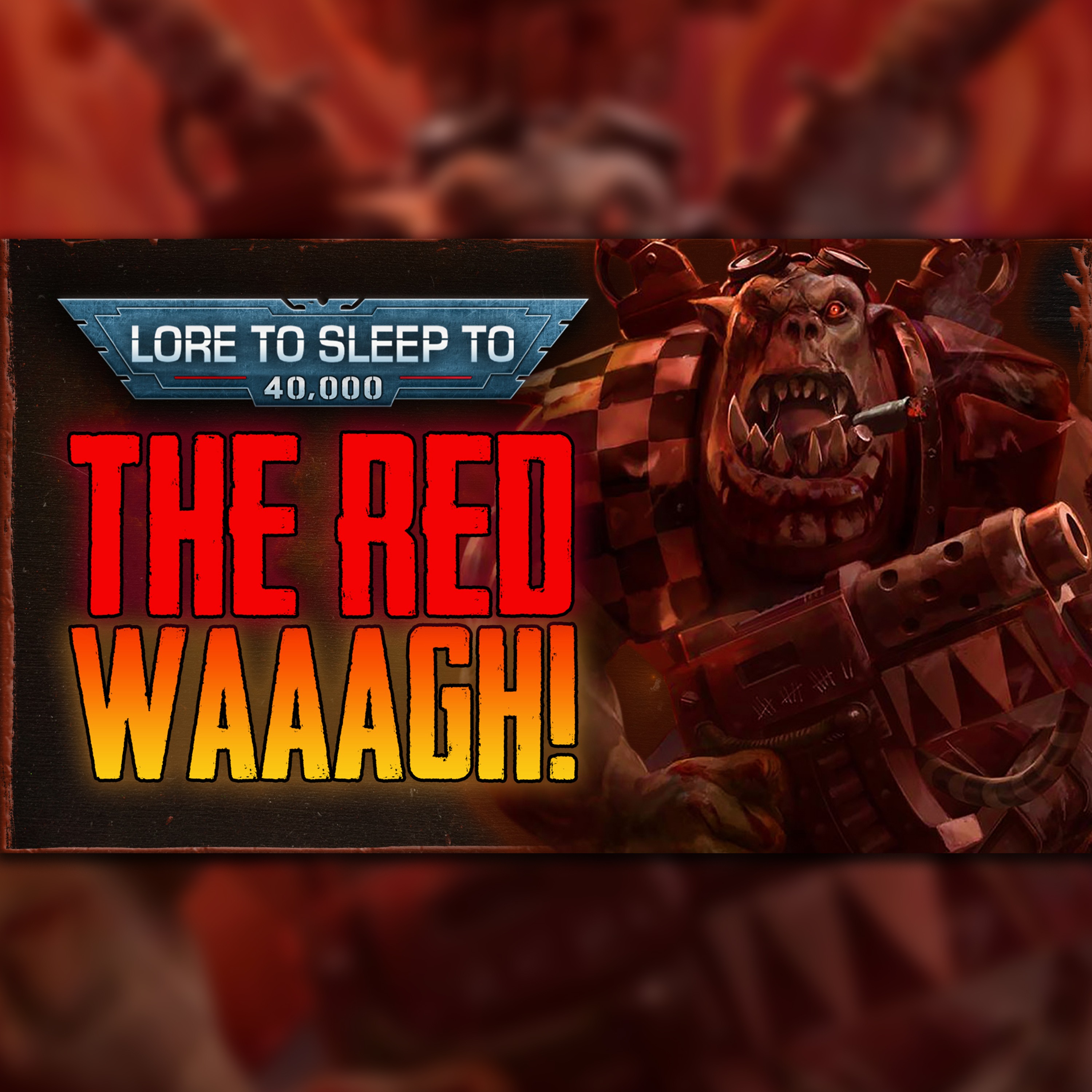
Warhammer 40k - Sanctus Reach: The Red WAAAGH!
Get every episode summarized
Each time Lore To Sleep To publishes, we email you a written briefing from the transcript — the topics, who appeared, and any specific claims, with the ad reads skipped.
Email me new episodesFree for 3 shows. No card needed.
Hosts & guests
Transcript ready
895 searchable segments. Every word is indexed and playable.
Full transcript
Lore To Sleep To — Warhammer 40k - Sanctus Reach: The Red WAAAGH!. Machine-transcribed; use the interactive transcript above to jump the player to any line.
Obsturia was a world of black stone and radiation. Solar flares from sanctus, the star at the heart of the reach regularly battered its surface. Its barren crust was hardly welcoming, even by the standards of the Imperium. But the world possessed one distinction that made it considerably more important than its appearance suggested. Sleep well and enjoy part one of the war for sanctus reach. But before we continue, I just wanted to briefly direct you towards another project of mine. If you enjoy the atmosphere here, I think you'll really enjoy my Sleepy Scriptorium channel, where instead of 40k elder scrolls over trench crusade lore, it's non-fiction history. I would love it if you gave it a try and subscribe over there. I think there will be something for everyone, for ancient Egypt, the White Earp, Robert the
Brutes to the Kamaura period, and Vikings toward War 2. I'll put the link in the description and comments below. I appreciate you all. Now back to your regularly scheduled sleep content. Obseria was the home of the Obsidian Glaves space marine chapter. And when War grug came crashing into the sanctus reach, Obseria was the first world to stand directly in its path. The Obsidian Glaves mobilized the majority of their chapter against the invasion. Hundreds of thousands of orcs were killed after making planetfall. For almost any other invading army, losses on that scale might have represented catastrophe. But for an orc war, they barely qualified as discouragement. Millions of more greenskins descended upon Obseria every day.
The defenders killed them by the hundred thousand, but the war replaced them by the million. Eventually, there were no Obsidian Glaves left to continue the exchange. This was how Grok face-ripper entered the sanctus reach. Not with a carefully constructed campaign plan, or a grand political objective, or some ideological crusade. War grug was an enormous migration of violence, a teaming fleet of orcs smashing its way across the system, because its leader had developed precisely the sort of reputation that made other orcs want to follow him. Grok himself stood nearly ten feet tall, an enormous mass of scarred muscle, with a timber that required very little encouragement.
As a younger orc, he had seized command of his tribe by killing its previous war boss, Grok of the tyrant. Leadership disputes were hardly unusual among orcs. The particular brutality with which Grok ended this one was enough to earn him the name by which you would become famous. Face-ripper. It was not an especially metaphorical title. Grok carried an enormous power claw, fitted with a crude bus saw. And he had apparently considered the nickname less an embarrassing incident from his youth than a professional obligation. At the slaughter of Black Gulch, he tore open a malfunctioning space-per-ring drop pod and killed all ten warriors trapped inside. He subsequent to revenge strike, managed to badly wound him, covering his body in thick
scars. He had failed in the considerably more important task of actually killing him. If anything, surviving only made the legend larger. Grok possessed the kind of absolute self-confidence that works particularly well when attached to an orc large enough to murder anyone inclined to challenge it. He had led his own charges regardless of the odds. It made examples of subordinates who questioned him. His followers claimed that he had never lost a fight. Whether every part of that reputation was true mattered somewhat less than the fact that other orcs believed it. Among the greenskins, success attracts more success. A war boss who wins battles draws warriors eager to join the next one. More warriors means larger victories.
Larger victories attract still more orcs, and so what began as the rise of one particularly violent chieftain can become something capable of consuming worlds. By the time Grok reached Sanctus Reach, that process was already well underway. At the center of his growing armada, lumbered the wrath of Grok. Calling it a spacecraft, perhaps, gives the wrong impression of deliberate engineering. It was a gigantic mass of scrap metal, subsequently reinforced with enormous slabs of obsidian, ripped from the crust of the world whose defenders Grok had just exterminated. In the name eventually attached to the invasion, came from a distinctly orcish combination of superstition, practicality, and gratuitous violence. Grok had at some point been informed of an ancient orc wisdom that red vehicles went faster.
Unfortunately, acquiring enough actual red paint required bordering. When Grok regarded time spent bordering, it's time that could instead be spent killing someone. His followers arrived at an alternative. After battle, the orcs smeared their vessels with the still bleeding remains of their enemies. Thus, the enormous fleet following Grok through the stars became coated in gore as its victories accumulated. The campaign carving its way across Sanctus Reach acquired a fitting name, the Red Wall. Obserium had demonstrated what happened when a world tried to stop it by force. The Hive World, Gould, Jensen, demonstrated what happened when one tried to save only part of itself. The Hive World was honed more than 200 billion people.
Faced with the approaching wall, its planetary governor ordered the local defense forces to abandon their wider responsibilities and concentrate upon his own capital, Hive Jensen. The order worked, technically. The capital survived for three days longer than the rest of the planet. By then, everything outside it had already been ransacked. Elsewhere, there was not always even a battle to record. At the rogue trading post of Malagai Morca, merchants with sufficiently good connections received enough warning to flee before the greenskins arrived. Grok's warriors found nobody worth fighting and simply stripped the abandoned world bear. The warriors rest had suffered orc rates even before the main fleet arrived. Crude vessels bearing the Jolly Ork symbol striking the otherwise peaceful Agri-world.
Imperial observers suspected that these raiders had been the outriders of Grok's wall. The first scattered indication, something much larger, was following behind them. And by world, the pattern became difficult to ignore. Red Waw was not raiding Sanctus reach. It was moving through it. And directly ahead of it lay a lark prime. A lark was no ordinary Imperial world. More than 400 million people lived there, scattered across a planet ruled by ancient noble houses whose warriors piloted Imperial knights. These towering war machines had defended a lark for generations, and now their rulers were preparing for warfare on the scale none of them had ever witnessed. Imperial reinforcements were already on their way.
The lords of a lark however were not convinced that they would arrive in sufficient numbers or in time. That fear was not unreasonable. Somewhere behind them was Obsteria, where a space marine chapter had thrown nearly everything it possessed into the path of the wall and vanished beneath it. There was gold, jensen, or 200 billion Imperial citizens had discovered how little three additional days could mean. There were stripped worlds, shattered settlements, and an orc fleet whose flagship now carried pieces of a dead chapter's home world bolted directly onto its hall. And at the center of that fleet was Groc face-rippa. Their victory brought him more warriors. Every enemy strong enough to resist him promised a better fight. The prime was gathering its armies, fortifying its cities, awakening its knights, and calling
desperately for aid. From the Imperial perspective these preparations were necessary for survival. From Groc's perspective they were an advertisement. The greatest fight in Sanctus Reach was waiting for him, and the Red Wall was coming to collect. The first warning came in the middle of the night, on the Vernau Equinox of 998 in 41, the twin astropaths of House Kestren awoke from the same nightmare. Both had seen something coming. Both had heard a billion beast-y old voices joined together in a single endless war cry, and both began vomiting green actoplasm. Barefoot and shaking, they ran through the halls of Castle Kestren, the chambers of
their master, Lord Galmort. Their words tumbled over on another as they tried to explain what they had witnessed. Then the seizures worsened, and the twins collapsed into fever dreams. Galmort understood enough, and Orch invasion was approaching the lark prime. At a rating-force, at a scattered band of pirates, a da wa. Before morning, messenger skulls had been dispatched to every major nighthouse upon the planet. Almost every one of them was ignored. The reaction said quite a bit about a lark prime. The world gruck was approaching, was powerful. Its rulers possessed imperial knights, ancient engines of war, capable of carrying a single noble warrior into battle inside of a walking fortress of armor and weaponry.
But what a lark prime did not possess was unity. These nightly houses had feuded for generations. Ancient rivalries, political grudges, and the accumulated weight of tradition had produced repeated civil wars across the planet. When House Kestren warned that an orc wall was approaching, most of its rivals did not immediately begin preparing for invasion. They assumed Kestren was lying. After warning, they reasoned, might be an attempt to distract competing houses, while Galmort increases his own influence. Only one lord took the warning seriously. Nero de Galio had encountered Orcs before. His night had fought the green skin pirates raiding Squires rest, and he had no illusions about what a much larger force might accomplish.
If the red wall had been powerful enough to overwhelm the obsidian claves, then the scattered houses of a lark prime did not simply assume that their knights would save them. Nero's own astropath had also gone mad shortly before Kestren's messenger arrived. That was confirmation enough for him. At dawn, Lord de Galio gathered his most trusted nobles and proposed something that by the standards of a lark prime, bordered on sacrilege, they would break into Sacred Mountain. Sacred Mountain was older than the political order surrounding it. The relics inside dated back to the founding of Alarx Nighthouses more than 10,000 years before, and local law expressly forbade a breaching its holy ground. As claimed that the seal gates themselves were cursed.
Nero's Chamberlains reminded him of all of this. Nero's answer was essentially that a curse mattered considerably less if everyone was about to be killed by Orcs. Across the planet, astropaths were already collapsing into fugue states, tearing at their own skin and speaking of green tides. Even if every nighthouse somehow put aside centuries of hostility and gathered its strength, Nero did not believe they could defeat Wargruck alone. But Sacred Mountain might contain something capable of summoning help. And if it did, they needed it now. And willingness to violate 10,000 years of law was especially remarkable on Alarx Prime, because law was something the planet possessed in almost comical abundance. No law enacted upon Alarx had ever been repealed, as the centuries accumulated so had the rules.
It was illegal to yon during daylight hours. It was illegal to speak while a no-boss talking within earshot. It was illegal to point at the stars. The result was a society in which roughly two-thirds of the population had at some point been incarcerated or exiled by the justice years, serving the various nighthouses. Many of Alarx's smaller inhabited islands had consequently become enormous penal colonies, populated as much by victims of obsolete legislation as by actual criminals. Geography had shaped the world almost as strongly as law. Most of Alarx Prime's surface was covered not by ordinary oceans, but by thick, sulfuric liquid. Its principal landmass was sacred isle, while the surrounding islands belonged to the individual
nighthouses. Among the most powerful of those houses was the gallio. House the gallio had built its influence through an old alliance with the Adeptis Mechanicus, but also through something unusually practical for an Alarx in noble family. It could move. Centuries of seafaring had transformed the house from the owner of a single night into the master of several dozen. Its greatest possession was not a castle at all, but ironed a gallio, a vast fusion-powered structure assembled originally from prison halls and gradually covered over by accumulated soil until it resembled a small or official landmass. The cities stood upon it, industries operated across it, and when war came the entire island moved.
Its accompanying fleet would bombard an enemy coastline while the island itself closed with the shore. Bridges would extend from mobile landmass, and the gallio's knights would march directly from sea to battlefield. Daru de Gallio had therefore spent much of his life ruling a household whose traditions were still ancient, but whose survival was always dependent upon knowing when to act. And now he acted again, he climbed into the white warden, his personal night, traveled to Castle Kestren and convinced Galmour to join him. There, their retainers cut through the adamantium seals of Sacred Mountain. Inside were relics that had remained hidden for millennia. Among them, they found an astropath suspended in stasis.
Ancient and grotesquely altered, preserved alongside forgotten technologies connecting flesh and machine. Daru de-activated the stasis field. The astropath awakened long enough to unleash a psychic scream that echoed outward into the void, and then he died. The ancient machinery surrounding him confirmed that the scream had served its purpose. A distress call had been sent. Unfortunately, saving a lark prime still required a lark prime survived itself. A month passed. Rather than rally around Gallio and Kestren, houses vellumestren, brahmiqa, taren and kimada condemned them for violating Sacred Mountain. The fragile peace had existed between the nighthouses, began to collapse.
For a moment, a lark prime stood on the edge of yet another civil war. Then the rocks chambers came alive. Castolin, Jack, and Stein was coming. Iscadian flea had originally been dispatched to reinforce Goul Chenson. He had arrived too late to save that world, but the same cumbersome nature that slowed grucks massive fleet, allowed the cadians to outrun it. Along the way, Stein had rendezvoused with black armored vessels, responding from the nearby Skolo progenium world of edificus. The relief force reached a lark first, and within two weeks, the cadians had turned cities, fortresses, and island prisons, into prepared defensive positions. Agedest lions crossed the ground. Bunkers were reinforced.
Regiments of guards were settled into trenches and firing positions, while anti-aircraft batteries prepared to contest the skies. Some of the nighthouses finally put aside their feuds long enough to join them. Along their warriors, was Sire Garrett de Gallio. Garrett fought as part of one of house de Gallio's other basterlances. It had already earned a reputation for courage and skill. His uncle had trained him with the sword, and Garrett had collected honors both in battle, and in the ritualized combats of a lark's nobility. Now he waited inside a night errands, for a contest that would make those earlier victories, seemed very small indeed. And somewhere beneath Sacred Mountain, waited something older still. The people of a lark called it Garantius.
Every island had its own version of the story. Some claimed Garantius was an iron giant. Garantius said a psychic ghost had been imprisoned inside a machine. Still others believed in immortal night had somehow survived from a forgotten age. None of them truly knew. What they did know was that the ancient green in bronze night had emerged from Sacred Mountain, again and again across thousands of years, whenever a lark prime faced disaster. The ship had destroyed Xenos raiders. It fought, renegade space marines. He had suppressed a plague capable of reducing the planet's metal to dust. When an inquisitor once resolved to destroy a lark prime after a demonic incursion, Garantius had answered by blowing up the inquisitor's ship before the order could be transmitted.
The Imperium later recorded the event as a regrettable accident. Now another disaster was approaching. Above a lark prime, the void was filling with orc ships. Below, millions of cadien soldiers watched behind hastily prepared fortifications. Night households armed their ancient war machines. Garant de Gallios stood ready with his kin. Deep inside Sacred Mountain, for the moment, the forgotten guardian remained silent. Across the cadien lines and trenching tools kept moving. Castel and Stein had already reminded his soldiers of the old principle. The more sweat spent digging now, the less blood they might have to spend later. They would soon discover just how much blood the Red Wall intended to collect.
For several nights, the people of a lark prime could watch their invasion approaching. The lights appeared first as little more than new stars. Then, night after night, they grew larger. Hundreds of engine flares burned against the darkness as Grox fleed, clung upon the planet. The cadien had done everything they could with the time available. Castel and Jacquerin Stein had surrounded vital positions with anti-aircraft guns, reinforced the ground defenses and brought millions of imperial soldiers into readiness. Even a lark's feuding nighthouses were maintaining an uneasy truce. From the ground, there was reason for competence. Thean reconnaissance images showed an orc fleet that looked almost offensively primitive. The invading vessels appeared to be little more than enormous masses of rusted iron, wielded
together into shapes that had somehow acquired engines. Some of a lark's nobles began placing bets on how many ships their knights would destroy if any survived the cadien guns. Herodogalia was not amused, neither were the cadien's. They had fought orcs before. The first rust ships reached low orbit Stein gave the order, and the sky turned red with lasken in fire. The shots struck their mark, and almost nothing happened. The apparent heaps of scrap were surrounded by powerful force fields. Their construction might have offended every principle of conventional engineering, but the shields surrounding them were another matter entirely. Again and again, cadien fire struck those protective bubbles and dissipated. The defenders kept firing.
Perhaps one ship in twenty was destroyed, and the rest entered a lark's atmosphere. Then they stopped behaving like spacecraft, and became projectiles. Enormous rust ships screamed downward through the atmosphere, and slammed directly into the surface. The impact of each one shook the earth hard enough to stagger imperial knights. Great ramps crashed down. Patches opened, and thousands of orcs began pouring from every available gap in the hall. Behind them came vehicles. Behind those came war engines so large that some tore their way through the sides of their own transports to get out. Wag rock and landed. The initial assault concentrated around Sacred Mountain, a thousand mile ring of imperial fortifications opened fire.
Wag rock cannons hammered the gathering orcs. Last cannons tore apart walkers and vehicles. Heavy bolter swept the approaches as soon as the green skins entered range. The cadians killed them in enormous numbers. In the orcs continued advancing. By the time they reached the outer defenses, their charge had become a physical mass. Ring skins piled over one another, using the bodies of those in front as steps to reach the imperial positions. Guardsmen were dragged from walls and disappeared beneath the horde. The first line buckled. Larks novels decided it was time to show the newcomers how war was fought on a night world. More than two dozen imperial knights charged. Lord Gullmord Kestren led the attack with warriors from houses vellumestren, brahmicah,
and taren joining the events. Their battle cannons tore holes through the green skin ranks. Thermal weapons burned apart orc machines. Smaller weapons that could threaten tanks simply burst against ion shields or ricocheted from night armor. For a time it worked spectacularly. The knights carved a cord or directly through the orc army. They also kept going. Stein watched the attack from the imperial fortifications and began issuing orders over the rocks. One by one the nobles muted him. This was their battle now. The knights plunged farther into the horde searching for the orcs leaders and destroying anything large enough to attract their attention. Behind them however the green skins flowed back together. The knights had transformed a counterattack into a charge and the charge had carried them
beyond kadean support. Then the largest rust ship opened. A slab of metal taller than a habblock crashed toward the ground. Most of the knights managed to reverse clear. Sire focused not. It is night disappeared beneath it. The impact threw an enormous cloud of dust across the battlefield. Blinding the kadean fire lines just as the orcs surged forward again. In a minute the green skins had torn open the imperial position. Then the dust began to settle. And something enormous was walking out of the ship. It was an orc war effigy. A towering machine large enough to make the imperial knights surrounding it look small. Its first cannon shot destroyed Sire Farageist.
Sire Luminor charged it and managed to bury his reaper chain sword in the machine's armor before the orc construct answered with a point blank rocket and a sweeping chainsaw arm. Luminor's knight was mangled beyond recovery. Another knight fell and then another. The nobles who had moments before been carving through ordinary orcs were suddenly fighting something built to kill war machines like their own. Galmour Kestren managed to get behind it. His thorough cannon destroyed the effigy's engines and severed one of its arms. Then something climbed out of the machine. Gruck and the war boss leapt onto Galmour's knight. The nobles opened fire with his heavy stubbers at point blank range, but the rounds bounced from Gruck's armor. Galmour tried instead to overload his eye on shield and electrocute the orc clinging to
his hull. He ordered the other knights to hold their fire, but Silvast for Mester and fired anyway. His battle cannon struck Galmour's cockpit and collapsed the eye on shield. Gruck tore open the knight's hatch and a moment later, Lord Galmour Kestren was dead. His son Maloris charged for revenge and Gruck killed him too. The surviving knights were swallowed by the orcs surrounding them. Greenskins climbed their legs through explosives into machinery and hacked through exposed cables. The knight was dragged over by a tractor beam and dismantled by mobs carrying welding equipment. By the time the survivors attempted to retreat, House Kestren had effectively seized to exist. Every one of its knights had been killed.
Was saved the Imperial line was not another glorious night charge. Rather it was 30 tanks. The Kadean 1652 known as the Steel Host crested the hills and opened fire. Where the nobles had charged directly into the orcs, the Kadean armor did almost the opposite. The tanks reversed as the greenskins pursued them, keeping the enemy at range while maintaining a continuous bombardment. The tanks abandoned the shattered imperial positions and ran toward the new fight, which was precisely what the Kadeans wanted. Hellhound swept forward and drowned the pursuing mobs and flames. The remnants of the Orc vanguard were finally driven back long enough for the imperial survivors to reorganize. The first battle, Zofar, the invasion had been slowed.
House Kestren had been annihilated and Stein now understood the scale of the problem. Most orcs were still emerging from the rust ships. Reconocense units reported that greenskins were already salvaging wreckage from the battlefield, including the remains of fallen knights. Our hordes were forming, more ships were landing. Stein calculated that if the vessels still descending carried anything close to the numbers already on the ground, a large prime could fall in less than a week. He needed to change the nature of the battle. The open plains favored the orcs because their numbers could spread across them. And therefore withdrew toward boiling river, where two great crossings, bridges Zeta-Sek and Zeta-Turt, would force the greenskins into narrower fronts.
There the Kadeans constructed what they called Stein's Anvil. Infantry lined the river banks. Heavy weapons covered the approaches. The artillery of the 1653rd waited behind them. Steelhouse provided mobile armor. If the orcs insisted on charging, Stein intended to make them charge through the smallest doorway he could find. The orcs, of course, obliged. Asylisks, wifers and mantacors opened the battle by tearing enormous holes in the approaching horde. Kadean infantry fired disciplined volleys into anything that survived. Some orcs attempted to avoid the bridges altogether. They jumped into the river. That was when they discovered why it was called boiling river. Soforus vents heated sections of the toxic water, the temperatures that would have killed
a human almost immediately. The orcs kept swimming, however. The river itself killed surprisingly few of them, but it did slow them down. Thousands of last guns took care of the rest. Soon the current was carrying orc corpses toward the great estuary. At the bridges, Stein reinforced the bottleneck with bouldering slabsheels. And then, Grok arrived. This original war effigy had been reduced to a wreck during the earlier battle. So the warboss came to the front inside a huge horned wagon. Kadean fire stripped armor from it as it approached, but the vehicle kept moving until its doors opened, and Grok emerged with his meganab bodyguard. He charged bridge Zeta turrets. The boulders locked their shields.
Grok hit them like a projectile. The impact knocked the massive ab humans from their feet. He drove through their formation with his power claw. At one point, avoiding a blow from the sergeant before throwing the bouldering bodily from the bridge to the river below. More boulders arrived. It soared drugs, meganops. The bridge became an enormous brawl while the orc army piled in behind them. Eventually, numbers one, the orcs crossed. At this time, Stein had planned for it. The Kadean line with the dru in stages. One platoon fired while another moved behind it. The first formation emptied its power packs. It dropped back while the necks took over. For orcs managed to catch a retreating unit. They butchered it.
Then they discovered that chasing those guardsmen had carried them into a prepared killing grouts covered by heavy weapons. Again and again, orcs broke through one line only to expose themselves to the next. Stein's anvil was working. For every Kadean killed, Stein estimated that perhaps 50 or 60 orcs were dying. Then green lights appeared behind his army. They swelled into enormous shimmering bubbles, and orcs stepped out of them. The green skins had teleported forces directly behind the Kadean lines. Blue painted warriors materialized only a few hundred feet from the artillery positions and immediately overran them. Within minutes, the basilis and waverns had been captured. Then the orcs turned the guns around.
Earth-shaker shells began falling into the Kadean retreat. The careful choreography had collapsed. Doctors who had spent the battle moving in discipline formations were suddenly being killed by their own artillery. Orcs swimming the river reached the banks, others poured across the bridges. The withdrawal became a route. And then Stein received even worse news. Two more orc hordes had landed to the southeast, and were moving to cut off the imperial escape route. Stein's anvil had not only broken, but the Kadeans were in danger of being surrounded. Within came a voice from across the vox. Lord Nero de Gallio had arrived, and he had brought his island. Ion de Gallio drove itself into the mouth of the great estuary.
It's immense bulk plugging the kilometer wide channel. It ramps, crashed down onto the mainland, and imperial knights began marching across them. Not a handful. Dozens. Scores. The knights divided as they advanced. Some moved towards Zeta Turbs to relieve the Kadeans. Others raised east to intercept the new orcs armies closing upon Stein's retreat. With the tarmed and pestish troops simultaneously descended upon the captured artillery batteries, killing the greenskins occupying them. Slowly and at tremendous cost, the Kadeans recovered enough order to escape. Nero was not finished. His alabastered lancers smashed into the orcs masked around Zeta Turbs. Their weapons ripping apart the tightly packed greenskins. When Nero took his finest knights onto the bridge itself, he intended to destroy it.
Thermal cannons melted through its supports, but the ancient structure refused to collapse. With Gruk and his mega-nobbs forcing their way toward him, Nero drove the white warden into the orc mass and brought its reaper chain sword against the central stanchion. The blade cut at the bridge held. So Nero shoved the barrel of his battle cannon beneath the damaged structure and fired. Then the white warden began to lift, and the bridge finally broke. Half of Zeta Turbs collapsed into boiling river, taking hundreds of orcs with it. Among them were Gruk and his mega-nobbs, who had reached within meters of Nero before the structure disappeared beneath their feet. For the second time since the invasion began, Gruk vanished from the battlefield. The orcs answered by concentrating everything they could against House DiGalia.
War machines emerged through the smoke, and the knights began taking losses. Nero ordered his surviving lancers into the shallows of boiling river, and withdrew downstream beneath overlapping ion shields. As the orcs pursued, the guns of Isle DiGalia opened fire. Shells tore through the pursuing vehicles. Aircraft disappeared in columns of water and flame. What remained of the orc pursued scattered rather than face the floating fortress. Nero's battered knights marched home. The battle of the bridges was over. This time something important had changed. Gruk's assault had lost its momentum. It was not a victory. House Kestren was still gone. The original defensive line had been shattered. Cating formations had been mauled.
Their own weapons briefly turned against them, and orc armies still covered enormous stretches of a large prime. Gruk himself had already survived things that should have killed him, but the defenders had discovered that the Red Waw could be stopped, not everywhere, not for long, and certainly not cheaply. The orcs could be funneled. Their hordes could be separated. Their enthusiasm for charging directly toward whatever looked most dangerous would be turned against them. Cating discipline and a loracan knights could complement one another would neither try to fight the war alone. For the first time since the rust ships struck the earth, Lord Prime had survived one of Gruk's great assaults without simply giving ground. Now Stein intended to make that less count, because the road behind the imperial survivors led back towards Sacred Mountain.
Something ancient had finally begun walking out to meet them. By the time the imperial survivors reached Sacred Mountain, the first fury of the Red Waw had finally begun to slow. It did not become smaller. If anything, Gruk had responded to the setbacks at Boiling River in exactly the manner expected of an orc warbos. He gathered a larger army. Stein's strategies estimated that the greenskins scattered across the lorac prime still numbered in the billions. Rust ships continued to discouraging warriors. Hordes that had landed far from the original battles were now being drawn toward the smoke, noise and violence around Sacred Mountain. The Imperium had one time, nothing more. Stein knew that if the orcs were allowed to consolidate, the war would become one enormous
defensive siege. The Cadians would lose the mobility that had kept them alive, even a lorac's knights could eventually be overwhelmed. So instead of waiting for the siege, Stein prepared another trap. The steep approaches to Sacred Mountain forced the orcs into broken terrain, slowing their vehicles and separating their formations. Imperial guns would cover the slopes. The knights would anchor the line. Stein himself would stand close enough to the front. It Gruk might be tempted to come for him personally. That last part was deliberate. Stein had fought greenskins often enough to understand how much an orc army depended upon the presence of its warbos. Gruk publicly enough and the war might collapse around his body. It was a dangerous gamble, and then an old legend arrived to improve the odds.
House Bramaka marched into position alongside the surviving knights of Vela Mistran. Behind them came the Rantius. The ancient knight moved slowly at first. His armor pitted green and bronze. Its whole carrying scars accumulated across a span of time no human pilot should have been able to survive. Stein tried to contact it. Gruk's rantius ignored him. No one on a lorac prime knew exactly what the thing was. Stories about Gruk's rantius had survived for thousands of years, with agreement had not. Some traditions described in a mortal warrior sealed inside an ancient knight. Others claimed it was a psychic presence wearing a machine as a body. Whatever the truth, the rantius had been appearing whenever a lorac prime faced catastrophe, for longer than most imperial institutions could maintain an accurate archive.
It had killed creatures beneath Sacred Mountain in the 33rd millennium. It had fought demons. It had destroyed Renegade Space Marines. It had prevented a plague from consuming the planet's metal. It had exterminated tier-knit organisms before they could draw a tin-roll of high-fleet Gorgon toward a lorac. A lorac's nobles had grown up with these stories, and now that story was standing beside them. The effect upon the knight-houses was immediate. The rantius did not give a speech. It did not identify itself. It did not explain why it had awakened. It simply walked to war. That was enough. The nobles watching it remembered every tale their families had passed out. Whatever rivalry still remained between them, the sight of their ancient guardian moving against the orcs gave those stories a living shape. In the guns opened fire, and the clockwork massacred began.
Stines artillery hit the orcs at extreme range. As the horde climbed higher, tanks and night-battle cannons joined the bombardment. The broken mountain slopes forced the green skins into separated columns that imperial gunners could dismantle almost one at a time. The clockwork vehicles bounced across the screen and exploded beneath last cannon fire. Aircraft swept toward the mountain and fell burning beneath hydra batteries. Even the green skins to the portation attacks, which had shattered the imperial defense of Boiling River, achieved little this time. Green energy flared behind the Kadean lines, and meganob appeared among the rocks. This time the guardsmen were waiting for them. Hundreds of last guns fired almost immediately. Grantus went a little further.
Ancient night accelerated down the slope and left directly onto one newly arrived group, crushing several beneath its feet, before vaporizing the rest with its thermal cannon. For a time later, three orc aircraft came low across the battlefield. Grantus jumped at those two. It smashed two out of the air with its own body and shot down the third. Stine, who had already seen rather a lot in his career, was beginning to find the night difficult to process. For once, everything was happening almost exactly as he intended. Orcs were being forced into fragmented attacks. The Kadeans were firing from prepared positions. The knights were supporting rather than abandoning the line. Grox warriors were dying before they could bring their numbers into play. But a trap designed for Grox only mattered if Grox actually entered it.
Eventually he did. Three orc battle wagons appeared below the imperial positions, climbing through the storm of fire. Behind them came Grox's personal transport. Normus and heavily reinforced, using the vehicles ahead of it as a moving wall of scrap. Two of the escorts were destroyed by the knights. Third crashed into a ravine. Grox wagon continued directly towards Stine. In garantius changed course. The ancient knights struck the battle wagon from the side. The vehicle flipped over and skidded across the slope and orc spilled from it. Among them was Grox face river. He came toward the imperial position wounded, furious, and carrying the enormous, sawbladed power claw that had already killed the rulers of House Kestren.
But Stine had been waiting for him. Three Kadean weapons teams revealed themselves from concealment. Stine raised his plasma pistol and fired first. The shot struck Grox in the torso. Then came the grenades. Crack rounds exploded around the war boss in rapid succession. Bring him from his feet beneath the storm of dust, fire, and stone. Barantius walked forward and kicked Grox wrecked battle wagon. The vehicle rolled over the fallen war boss and came down on top of him. Everyone saw it. Now is the important part. The Kadeans saw it. The knights saw it. The orcs saw it. One moment Grox had been charging toward the imperial commander. The next, the legendary war boss was buried beneath the wreckage, his own transport.
The reaction spread through the wall almost instantly. Stine gave the order to charge. A thousand Kadean searched from their defenses. By the time they reached the lower slopes, much of the Orc Vanguard was already trying to retreat. The retreat collided with warriors still attempting to advance. The great horde began fighting itself simply through confusion. Imperial artillery took advantage of this. Basilisks and Wyverns walked barrage through masses of green skins packed together, with nowhere sensible to go. A carefully gathered army Grox had assembled for his largest attack on Sacred Mountain, disintegrated in front of them. Stine had gambled that killing the war boss would break the law. And for the moment, it was completely right. There was only one complication.
Grox death had not been entirely the work of the Imperium. Big Mac Magrock had watched the attack from elsewhere on the battlefield. Unlike Grox, Magrock could see the trap. He had also apparently decided that allowing Grox to walk into it might be useful. Shortly before the war boss made his final charge, Magrock had disabled the force field protecting Grox's vehicle and activated his own teleportation equipment to ensure that he would be safely elsewhere. When one of his subordinates offered to fire upon Garantius, perhaps saved their leader, Magrock declined. He watched the Cadian's blast Grox from his feet. He watched Garantius roll the wrecked wagon over him. Then Magrock decided it was time for someone cleverer to take charge.
The Red Wall had just lost the one thing holding it together. That mattered far beyond Sacred Mountain. His word of Grox falls spread. Arguments began inside the Ork army. Arguments became fights. Fights became battles. Posses who had followed Grox because he was the strongest Ork among them now saw an empty position at the top of the wall. And there is only one properly Orkimethet of deciding who deserved it. Everyone started hitting everyone else. Being recognized the opportunity, the Imperium could not simply exterminate the green skins. There were still billions of them. What it could do was encourage the Orks to exterminate each other. Over the following days, Cadian attacks were directed not at destroying enemy forces, but at separating them.
Embodments and raids drove wedges between the different clans and tribes. New painted orks were pushed away from red marked vehicles. Black and white formations were separated from yellow armored mobs. Every gap made cooperation more difficult. Every isolated tribe gained another rival. The Red Wall ceased to behave like one army and became many. Meanwhile, fighting around the wrecked rust ships continued. One of Ork's free blades, Dyros Kamata, used the confusion to charge directly to the wrath of Gork. Inside the flagship, Ork Mechs had been cutting apart the wreckage of the knights destroyed during House Kestrens failed charge. Some of their pilots were apparently still alive. Dyros stormed into the hold, killed the Mechs, and began searching the room into machines
for survivors. It was a small episode compared with the battle raging outside, but it captured the strange reversal now taking place across the laryk prime. Hours earlier, the Orks had been dismantling Imperial knights as trophies. Now a knight was walking through Grux own flagship, recovering the men they had left for dead. That sacred mountain, the ancient guardian of a laryk stood among the defenders. House Kestrens had been destroyed, and Cadyn regiments had suffered enormous losses. Boiling river had run thick with the dead from both sides. None of that had been undone, but Grux face-ripper was gone. And for the first time since the Red Wall entered Sanctus Reach, the great Ork invasion no longer had a single will behind it. The war was not over.
Billions of green skins still remained, and somewhere among them new leaders were already emerging. With the force that had destroyed worlds and exterminated the obsidian glaves, it finally had been broken apart. Not by one perfect weapon, or one legendary knight, not even by Stein's strategy alone. It took Cadyn discipline, a laryk in war machines, the stubbornness of men who survived long enough to learn from their defeats, and one ancient knight that had chosen for reasons no one understood to walk out of the sacred mountain exactly when a laryk prime he did it most. Grux face-ripper was dead, at least that's what everyone believed. His body lay somewhere beneath the wreckage of his battle wagon. The surviving followers had been driven from sacred mountain.
Across a large prime, the armies that had once answered to a single war boss were breaking apart the rival tribes. For the Imperium, it should have been the moment the invasion began to die. That, it changed commanders. While the other orc bosses fought over who deserved Grux throne, Big Mac Morgrock had begun acting as though it already belonged to him. It spent years waiting precisely for this opportunity. And in retrospect, Morgrock had been shaping the Red Wall for far longer than anyone realized. The force feels that protect the rust ships had been his work. So had many of the enormous orc walkers encountered on a laryk. Even Grux's path through Sanctus Reach had not been entirely accidental. Morgrock had deliberately helped steer the wall toward Obstoria in the hope that the Obsidian
Glaves would kill Grux for him. They had failed. But the Battle of Sacred Mountain is planned finally succeeded. Or so Morgrock fought. Morgrock was a very different kind of orc. Grux solved problems by charging them. Morgrock occasionally committed the deeply suspicious orcish act of thinking first. Is plan for a large prime was to create battles large enough that the other clans could not resist joining them. Every spectacular victory would draw more orcs to his side, until, without ever forerally asking permission, Morgrock became the new warlord simply because everyone else was already following him. The strategy worked. On the auspices of Anna, he sent waves of apparently crude vehicles directly toward prepared Katie and guns. The Imperial defenders annihilated them and created a wall of wreckage across the battlefield,
which was exactly what Morgrock wanted. Most of the vehicles had been empty. The destroyed wagons concealed the real or infantry advancing behind them, allowing an armored horde to close the distance and crash into the Katie and positions. Then Morgonauts began falling from orbit directly into the imperial rear. Across the planet, other orcs adopted similarly destructive methods. The smoldering Isles disappeared beneath the sulfuric cyclone and an orc assault. Katie and militia and knights fought through acid rain so violent that exposed infantry could be stripped to the bone, an armored vehicle slowly dissolved beneath it. One port after another fell, blasts surviving noble fought until his knight detonated amid the ruins, and when the storm passed, the island belonged to the orcs.
On aisle Kamada, Bloodhacks' commandos discovered imperial supply routes, it beneath passing transports, and used the vehicles themselves to infiltrate the Great Oasis. The sabotage destroyed Katie and ammunition stores from inside the perimeter. By sunrise, the support resumant stationed there had been wiped out, and their tanks did not remain imperial for long. Every battlefield was producing more wreckage, and for the orcs, wreckage is rarely just wreckage. It became tanks, walkers, weapons. Captured imperial machinery was hammered back into service, sometimes so thoroughly altered that the defenders of Alaric found themselves fighting grotesque versions of their own war machines. Alaric's war fed itself. A longer Alaric resisted, the more material the orcs had to build next attack.
Even more grog attempted something considerably larger. Regenerations, the people of Alaric Prime, had watched a celestial body known as the frozen comet travel through Sanctus Reach. More grog built a tractor-weapon capable of changing its course. The claw of morec reached into the heavens, seized the comet, and began dragging it toward Sacred Mountain. While grog's reasoning was characteristically straightforward, if you wanted to destroy a mountain, dropping another mountain onto it seemed like a perfectly reasonable place to begin. Castilian Stein was unable to bombard the weapon, as Orc force feels protected it. Stimpester Prime Salem Whitlock proposed something more dangerous. If a tractor beam could pass through the forcefield, there had to be an opening surrounding
it. His sions would jump through that opening. Whitlock and his men descended directly through the narrow gap around the beam, infiltrated the orb position, and destroyed the shield generator from within. The surviving Valgris then struck the exposed tractor-weapon, and the rust chip containing it exploded. The frozen comet remained on course for Alaric Prime, but its trajectory had changed. Instead of striking Sacred Mountain, it was expected to fall into the ocean to the north. For a moment, another catastrophe seemed to have been prevented. Meanwhile, the Orcs were converging. Not with Grog's old headlong aggression, but with coordination. Stein could see it in the movement of the enemy columns. Different tribes were approaching Sacred Mountain from several directions, at almost the
same time. Somebody was organizing them, somebody with a brain. As the Imperium prepared for the final battle, Alaric Prime revealed one more secret. Sacred Mountain began to move. Ancient gates opened. Hidden fortifications emerged from beneath rock and earth. Artillery positions unfolded from the mountain side. Defensive walls rose into place. A boiling moat filled the chasm around the mountain, as buried mechanisms awakened. After thousands of years. In the pierce, Sacred Mountain had never simply been a mountain. It was fortress Alaric. Colossal fortified tomb built around the resting place of the world's founder. Hidden beneath layers of stone for so long that even Alaric's own noble houses had forgotten
much of its purpose. Durantias had been guarding it all along. Cadians flooded into the newly revealed fortifications, the remaining knights gathered around them. For what everyone understood might be the last time, Alaric Prime prepared to hold the line. Then Mo'groc arrived. His armies surrounded the fortress and their millions. Rockwalkers projected fields that caught in coming artillery shells in midair. Robbing stone of the long-range firepower upon which so many of his previous victories had depended. Other mobs dumped scrap into the boiling moat until crossing points began to appear. Some or simply drove vehicles into the water, until the wrecks piled high enough for the warriors behind them to climb across. It was wasteful.
It was ridiculous. But it worked. Surviving knights charged out to meet them. House de Gallio led the counterattack. Durantias strode into the horde with Nero following behind. Old ruggists followed the nobles even to the final battle. Silvost Vela Mistrin, who shot at help to grob kill Lord Galmort, found himself overwhelmed by orcs while knights nearby watched. No one moved to save him. His machine was dismantled around him. Amid Alaric's aristocratine, even the apocalypse apparently did not cancel every death. Battle spread around the entire fortress. And then Stein looked up. And Orc rust-ship had somehow lifted itself back into the air. Witlock's arriving aircraft moved to intercept it, but they never reached the ship.
All of the artillery shells, Maul Grox magnetic fields had trapped above the battlefield, suddenly launched upward. Vehicles went with them. A storm of metal rose into the sky and exploded among the imperial aircraft. The burning rust-ship continued climbing, straight toward the frozen comet. The ship detonated beside it. The blast changed the comet's course yet again. This time there was no ocean beneath it. There was only fortress Alaric. Stein ordered everyone towards Shelter. Then he realized there was no shelter deep enough. There was no withdrawal fast enough. So he changed the order. If they were all going to die, they would all die attacking. Cadians poured from the fortifications. Ogrins charged.
The remaining knights formed around the thickest concentration of imperial troops. The comet filled the sky. Just when it struck, the world became white. Anything beyond the protection of a power field was incinerated. A whole side of sacred mountain disappeared. Stone, armor and ancient machinery were ripped apart. The impact exposed the interior of fortress Alaric and opened an enormous breach directly into the structure. Cadians died in moments. The surviving orcs charged straight toward the opening. Sacred mountain had fallen. And somewhere beneath the smoke and wreckage of a completely different battle, another piece of the war was moving again. A group of orcs teleported onto the old battlefield where Gruk faced Ripper and supposedly died.
The battle wagon began pulling away the wreckage. A scarred green fist suddenly punched down from beneath it. Gruk had survived. The orcs recovered their supposedly dead war balls and teleported away with him before anyone noticed. So the red wall had not lost Gruk after all. But more Gruk did not know that yet. Neither did Stein. Neither did the surviving nobles of Alaric. They had more immediate concerns. The nighthouses had combined their ion shields in the moment before impact, forming a vast protective dome over hundreds of Cadians. Many of the knights burned themselves out of maintaining it. Their sacrifice saved Stein. It saved part of his army. It did not save the mountain. And around them, millions were dead.
Orcs protected by their own force fields were already moving through the breach. Stein sat amid the devastation with the dying astropath Zeal in his arms and watched the surviving greenskins close in. Then Zeal pointed toward the sky. More trails were descending through the atmosphere. For instance, they looked like additional meteorites. But they were not. They were imperial drop pods marked with the insignia of the sixth Legion of the Emperor's Angels of Death.
More episodes
More from Lore To Sleep To

Warhammer Fantasy - The Old Ones & the Coming of Chaos
Lore To Sleep To

Warhammer 40k - Crimson Slaughter
Lore To Sleep To

Trench Crusade - The Great Powers of Europe
Lore To Sleep To

Warhammer 40k - The Fall of Cadia
Lore To Sleep To