About this episode
Today, the US and China are at loggerheads. There’s renewed talk of a Cold War as Washington finds various ways to cut China out of key supply chains and to block China’s economic development in areas like semiconductors and renewables.
There’s trade, of course, but the imbalance in that (some $370 billion in 2022) tilts in China’s favour and only serves as another source of ammunition for America’s Sinosceptics. China, on the other hand, is also decoupling in its own way, moving fast to cut its reliance on imported technology and energy.
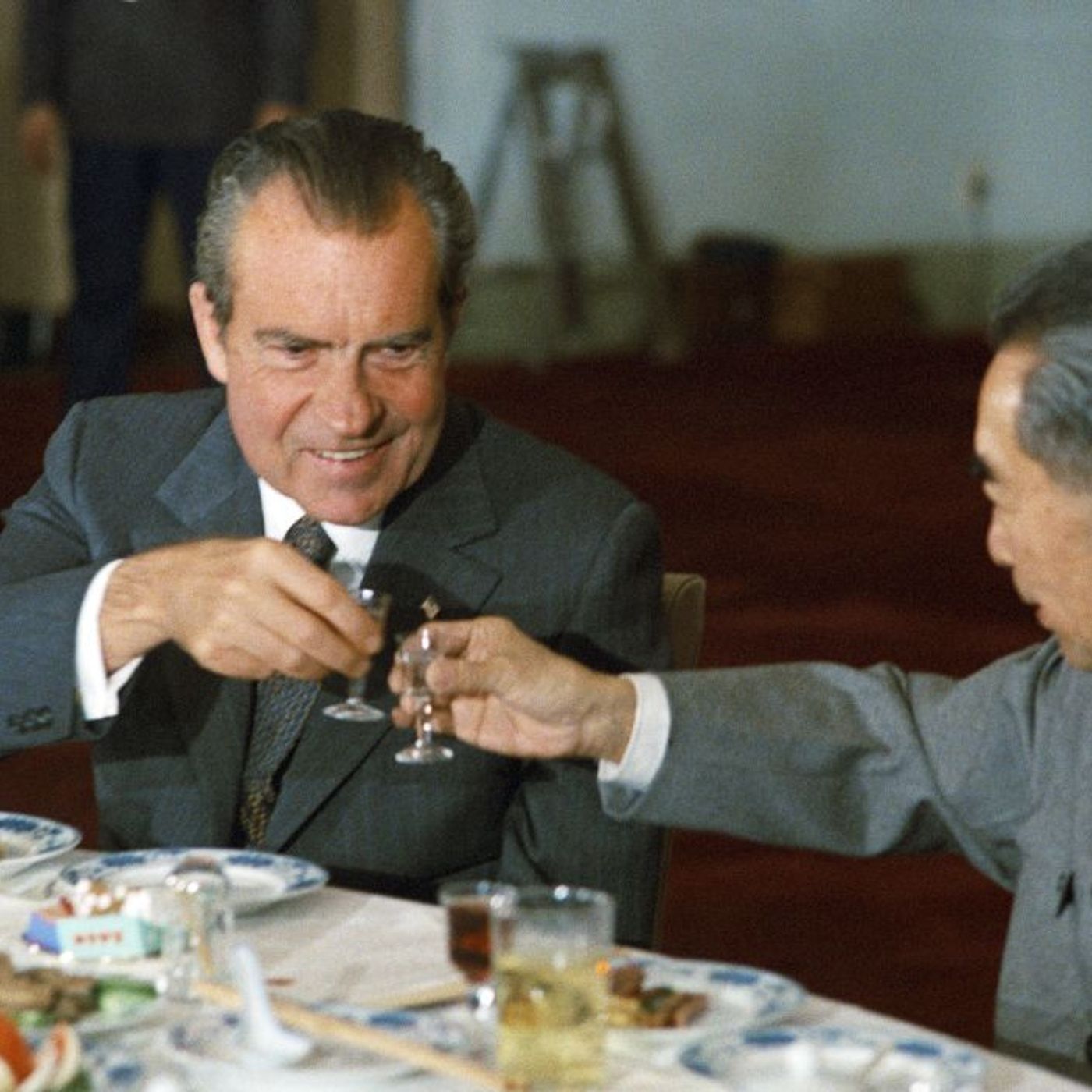
At this moment, it seems like US-China tensions are inevitable – but look into the not so ancient history, and you’ll find a totally different picture. In fact, when it comes to Communist China’s early entry into the global economy, American policymakers and businesspeople were vital in the 1970s and 80s. You could even say that a big part of China’s economic success was ‘Made in America’.
I'm joined on the podcast by Elizabeth Ingleson, Assistant Professor of International History at the LSE, whose upcoming book contains some very interesting research on this question. It’s called Made in China: When US-China Interests Converged to Transform Global Trade. We discuss President Nixon's visit to China and how that opened up decades of American economic support to the Chinese miracle – including at the expense of its own workers.
There’s trade, of course, but the imbalance in that (some $370 billion in 2022) tilts in China’s favour and only serves as another source of ammunition for America’s Sinosceptics. China, on the other hand, is also decoupling in its own way, moving fast to cut its reliance on imported technology and energy.
At this moment, it seems like US-China tensions are inevitable – but look into the not so ancient history, and you’ll find a totally different picture. In fact, when it comes to Communist China’s early entry into the global economy, American policymakers and businesspeople were vital in the 1970s and 80s. You could even say that a big part of China’s economic success was ‘Made in America’.
I'm joined on the podcast by Elizabeth Ingleson, Assistant Professor of International History at the LSE, whose upcoming book contains some very interesting research on this question. It’s called Made in China: When US-China Interests Converged to Transform Global Trade. We discuss President Nixon's visit to China and how that opened up decades of American economic support to the Chinese miracle – including at the expense of its own workers.
Become a Spectator subscriber today to access this podcast without adverts. Go to spectator.co.uk/adfree to find out more.
For more Spectator podcasts, go to spectator.co.uk/podcasts.
Contact us: [email protected]
Hosted on Acast. See acast.com/privacy for more information.
Get every episode summarized
Each time Chinese Whispers publishes, we email you a written briefing from the transcript — the topics, who appeared, and any specific claims, with the ad reads skipped.
Email me new episodesFree for 3 shows. No card needed.
Hosts & guests

No transcript yet
This episode has not been transcribed. Request it and it moves to the front of the queue.
More episodes
More from Chinese Whispers

New podcast: Quite right! with Michael Gove & Madeline Grant
Chinese Whispers
Sep 10, 202518:23pending
A compilation of Chinese Whispers: understanding China
Chinese Whispers
May 5, 20251:37:57pending
What does it take to be 'an old friend of the Chinese people'?
Chinese Whispers
Apr 7, 202537:44pending
From Chimerica to Cold War II: how US-China relations soured
Chinese Whispers
Mar 24, 202536:32pending