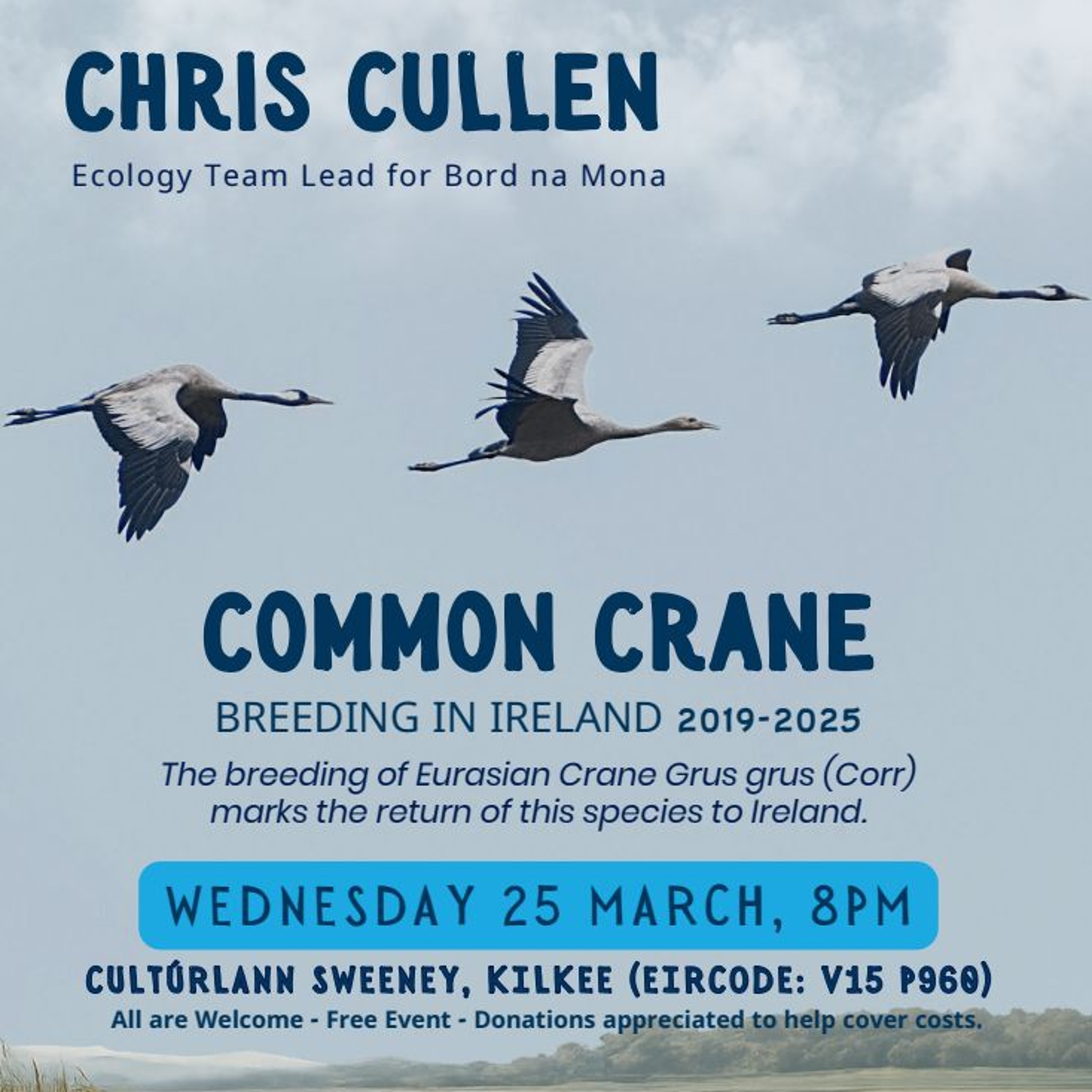
We're going to talk now about one of Europe's most iconic birds, the Eurasian Crane, which
is making a remarkable return to Ireland, even beginning to breed here again in recent
And there'll be a talk in Kilt Key to explore that story this week and what it means for
wildlife more broadly.
And I'm joined now by the Claire-based ecologist and bird expert, Chris Colin, Chris, good
Thanks for having me on.
Thanks for being with us.
So can you explain to people the significance of the Eurasian Crane and its return to
How big a deal that is.
So, first of all, I'm delighted to be giving a talk on how many of this evening in support
of the West Claire Wildlife Club, I suppose at the recent story of breeding cranes in Ireland
down is very much that of a returning species.
We know that cranes occur in Ireland from as far back as the post-lacial period, but
they were lost as a breeding bird and most likely becoming extinct by the end of the
In recent years, the population across Europe has been increasing, possibly as a result
of climate change with breeding records and places like Belgium and the Netherlands and
closer to home and places like Scotland.
That being said, it was still a great surprise when in 2020, a pair was discovered with an
SNS in a cutaway bargain in the midlands of Ireland.
So why is Claire the wider region becoming a place where the Eurasian cranes are
returning and I guess that begs a follow-up question of what kind of habitats cranes need
and are we doing enough to protect those habitats?
So, the cranes are an iconic wetland species.
They have very much got a strong association with piglands as well.
In terms of in the Claire context, we know of course that cranes occur historically in Claire
because we have found bones of cranes in as part of archeological excavations.
At the moment, the habitats that cranes are selecting in the midland are re-wetted
So these are bogs that have been formally subject to peace extraction and have now been naturally
re-wetting or rehabilitated over time and it's very much a case of the habitats on sites
being a mosaic as we call it, well, wetland but then wetlands and open water bodies and
that's the sort of habitat they're selecting.
Can we give any credits to conservation efforts?
Chris, is the return of the erasian cranes as a design that the conservation efforts
in Ireland are working?
I suppose the wider conservation efforts probably across Europe can be attributed to some
of the population increase.
We know for certain that a reintroduction program in the UK has benefited the crane
But generally speaking, they've been on an upward trajectory in terms of the population.
Now, peak and rehabilitation, such as what Borg and Moana's carrying out is under the
peak and climate action scheme, does create habitats for cranes, possibly for the future.
And at the date, we have re-wetted about 25,000 hectares of coca-wet bog.
So you could call that a form of conservation, if you know what I mean.
And your talk is at cultural and swiney this week, as I mentioned, it's on Wednesday
at 8 p.m., what can people expect if they come along and do they have to register to
I don't believe you have to register.
I think attendance is free and what I'll be talking about is basically the history of
the burden in Ireland, the recent trends in the population across Europe, and then a
bit of detail on the specific breeding size, the year-to-year breeding, and their general
Well, I'm sure there will be a good attendance at us, the Claire-based ecologist and bird
expert ecology team lead four-board pneumonia, and the man who will be giving the talk at
cultural and swiney in Kalki this coming Wednesday evening is Chris Colin-Kris, I appreciate
you joining us on the show.