Loading...
news
What are the global risks of turning energy sites into battlefields?
About this Episode
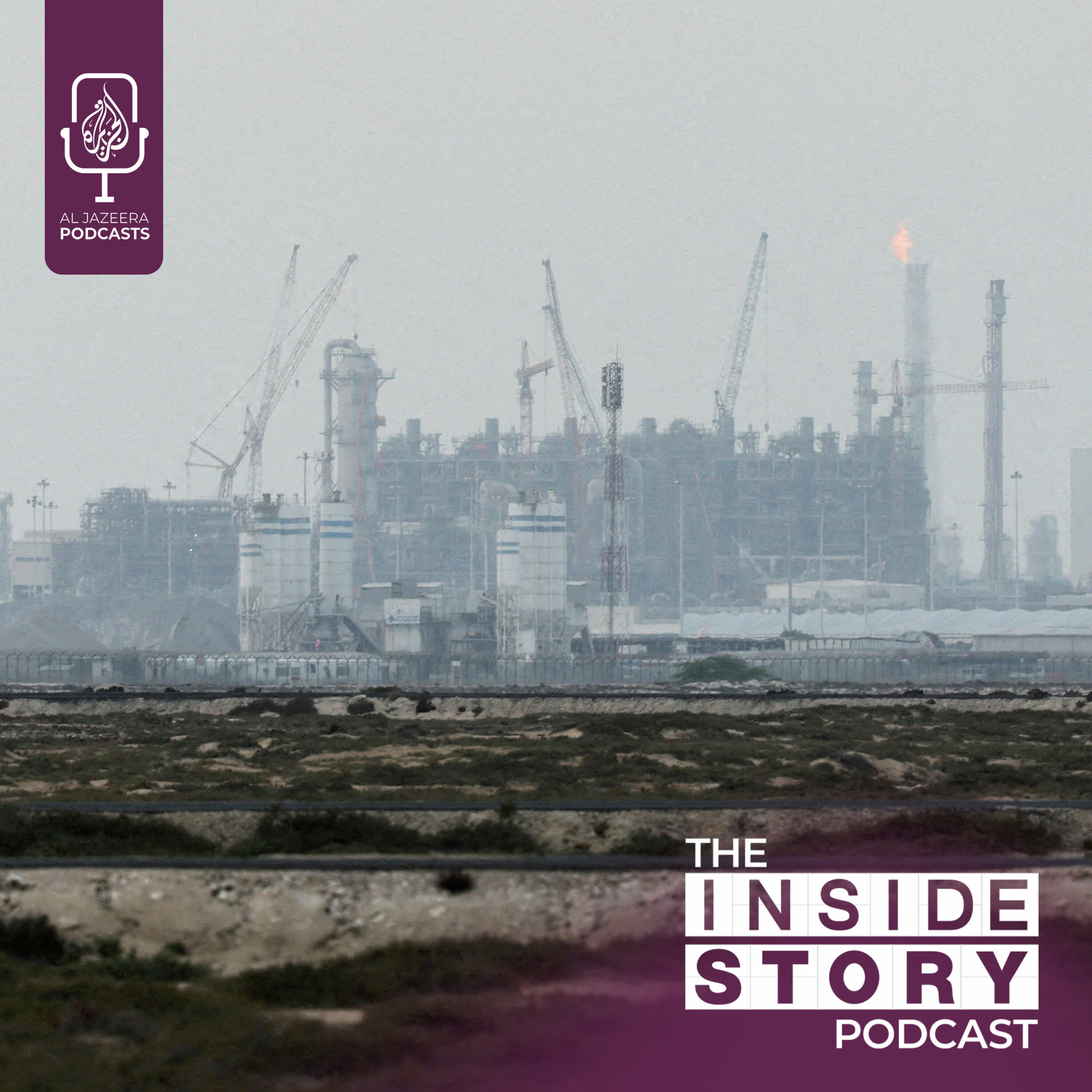
Energy prices have soared since Israel attacked Iran's South Pars gas field. Iran has targeted oil and gas facilities in neighbouring countries since early in the war. And it's warned of more to come.
In this episode:
- Mohsen Baharvand, Former Iranian ambassador to the United Kingdom
- Jim Walsh, Research associate in MIT's Security Studies Program
- John Sfakianakis, Chief economist at the Gulf Research Center
Host: Imran Khan
Connect with us:
Hosts & Guests

Transcript
What are the global risks of turning energy sites into battlefields?
I'm Imran Khan and you're listening to the Inside Story podcast where we dissect, analyze,
and help define major global stories.
Let's bring in our guests.
Joining us from Tehran is Morsen and Bahravan, former Iranian ambassador to the United
Kingdom.
He's Massachusetts.
He's Jim Walsh, a research associate in MIT's security studies program in India.
He is John Safianakis, chief economist at the Gulf Research Center.
Thank you.
Oh, for joining us.
I'd like to start in Tehran with Morsen, first Morsen.
The strategy here seems to be Israel attacking crucial infrastructure and then Iran attacking
back in Khan, diesel nation plans, energy infrastructure.
But how sustainable is that strategy?
Because you are alienating all your Gulf allies.
Yes, I understand that really this is a very complex situation.
There is no clear answer for that.
But what I can tell you is that maybe attacking on the facilities is not attacking on the
country hosting the facilities.
If we put ourselves in the shoes of the people here, they may see it as attacking on a kind
of global economy, which is unified in the world economy.
As you know, Iran, maybe this is only repetition of what always is being said, but Iran has
nothing against neighboring countries, Arab countries.
But the world economy is unified.
Iran is benefiting from these unified facilities, energy flow and the flowing of energy from
the Persian Gulf outside.
Therefore, if you deprive one player and attack one player, attack the facilities of one
player, which is Iran, maybe they will consider it logical to stop the flow of energy
from all reach.
John, I want to bring that way, and in me, sorry, I'm just going to put your point here.
I'm going to put your point to John Saffkin in our case.
This is the strategy to pressure the world economy.
This was all completely avoidable and entirely predictable.
We knew that this was going to be Iran's strategy, but the U.S. didn't seem to know or didn't
care.
Now it does because now they're talking about it, right?
Well, if they knew about it, they couldn't do anything about it, meaning that somebody
will be in the middle, unfortunately, because this war has to continue, and this war needs
to have an end.
Whether the Gulf countries are considered to be part of the global economy, the answer
is yes, but also they're not supposed to be, and nobody expected that they'll be in
the middle of this, and they should not be the recipients of anything that Iran responds.
So if the U.S. hits them, and Iran cannot hit on the U.S., the justification of hitting
the Gulf states and energy infrastructure of the Gulf states, when the Gulf states have
not done anything, it is hosting for sure, but that is not enough to justify the response
and the ferocity, and the confusion that Iran has done.
But the same logic, the U.S. could continue forever pounding on Iran without any concern
for a life civilian or otherwise, and that in itself is quite problematic.
I want to bring in Jim here, Jim.
You're a research associate in MIT Security Studies program.
How much security is this bringing to the Gulf?
It's no, right?
Not now.
Obviously initiating a war, a war of choice, not a war of necessity, is going to be disruptive.
And what's more, when you take a regular war and you turn it into a fight for survival,
which is what the U.S. has done by declaring its goal as regime change and then unconditional
surrender, what that, what Iran hears from those terms is this is a fight for survival.
So I don't think anyone should be surprised that they're hitting other states in the
region.
Many of these states hold U.S. bases, like that would be justification enough in some circumstances.
But it also has to be set out loud that some of the states in the region lobbied for this
war.
The Washington Post has reported that the Crown Prince of Saudi Arabia was advocating
on the phone to Trump to initiate the war, and then after the war started, was on the
phone advocating that he finished it or complete it, whatever that means.
So it's not surprising that Iran, Iran doesn't want to get into a conflict where it's everyone
against them.
But they want to raise the cost of this to the U.S. so the U.S. doesn't come back in
six months and we do this all over again, like we did six months earlier.
So it's really, who can take more pain here?
And the U.S. take the political pain, the economic pain, or will Iran run out of drones and
missiles first, or reach a threshold where their pain is too great, and that's why we're
on uncertainty.
We're in a dangerous period of uncertainty where this could definitely escalate if either
side chooses to move in that direction.
Sorry, Jim.
I'm just going to interrupt you there.
I want to bring your point to Mohsen in Tehran.
Mohsen, it's a very interesting point, right?
What is the pain threshold here for Iran?
How much pounding of the capital cities can they take, destruction of oil facilities, etc.
Before they have to go to the negotiating table?
The negotiating table, we don't see here in Tehran any sign of the other side to be interested
in diplomacy or negotiation because negotiation table was in reach and they were sitting
around it.
But in the middle of negotiations, this attack was initiated.
Therefore, Iran is a large country.
I mean, that can merge the whole economy of the world in this conflict.
I mean, that I don't see an end to it because too bad act cannot result in a good thing.
Then continuing pounding Iran cannot bring negotiation or conciliation.
The first step is to seize the hostilities.
When I think about any viable or sustainable piece, otherwise, with the force, you cannot
bring people to the negotiation and even if you have a negotiation under fire, that negotiation
cannot be legally binding in future.
Therefore, they need to first seize the hostilities and then think about the negotiations.
Iran always has been ready for negotiations but at this time, I'm going to stop you there.
I'm going to stop you there because I, and again, they attacked you.
Well, that's the exact point, right, Jim?
There were negotiations taking place.
They were taking place on the eve of the war.
But we talk about appetite for destruction here as it were.
One of the key things Iran is doing is forcing global energy prices to spike.
At some point, if it does, I mean, oil is already at, well, 116, you know, that kind of
level, it figures to 150 to 200 dollars, then America has to stop.
And that is a new way of warfare, right, economic warfare.
Well, I mean, we did see that partly during the oil and bargo of 1973, when oil was used
as a weapon in the wake of war in the Middle East.
And we saw it again during the Iran-Iraq war when we had the so-called tanker war, but
to more limited effect.
And this is really the biggest use of oil and shutting down oil supply that we've seen
in history, even larger than those previous examples.
I think it's a function of two things.
It's going to be a function of duration.
How long does it go on?
Like, let's just assume it's going on at this level, which is pretty intense for Iran,
by the way, but it goes on at this level for how long.
And the longer it goes on, obviously, the more intense the damage and lasting the damage.
But there is a second variable here, not just duration, but intensity.
And all wars have the capacity to escalate and expand, particularly wars that involve
a fight for survival.
I can't underline that enough.
States will go to the edge in order to survive.
And if you just look at Ukraine, Russia, we see enormous destruction of the economic
infrastructure there, attacking nuclear power plants, the grid, all sorts of things.
So this is, you know, this happens in war.
So if this war intensifies, you will see this, the nature of the destruction intensify.
And then when you get into not simply shipping, but production facilities, then the impacts
will linger.
Oil is pretty good at sort of recovering from this or that.
It's liquid, if you will.
But if you go after production, that's a different thing.
So I worry about this escalating because we're in a fight where one party sees it as a
fight for survival.
Most of that's a very good point.
And it's been said that Iran is a regime, a government, a government system that can
survive everything, all but a complete occupation.
Do you think Iranian still feel that way, the Iranian establishment still feels that way?
I think we have to take the lesson from the past experience as well.
I mean, first of all, the destruction which is happening is exactly what Israel wants.
I mean, that inflicting destruction on a country is not an strategy.
It's just an act of violence and destruction.
And even if a government is completely destroyed, then you have to face a nation and a country.
I mean, the experience in the past situation like Iraq, Afghanistan and other countries as
well, you cannot destruct the facilities, even the government and then overwhelm a country.
Then you face the nation and that would drag you in an endless war, civil war and also
war of people against you.
Therefore, this is not an strategy.
This is just inflicting destruction as much as possible to the region.
And that's what Netanyahu and Israel want.
And even if I don't think Americans also want that, but they are dragged into war to make
destruction to the region as much as possible.
You know, yesterday, even Netanyahu was saying that, that telling it was the nuclear facilities
or nuclear program was not his problem.
He said that you know, understand that how powerful Iran was.
You know, he was thinking, now we understand that we have to destruct all that facilities,
defense facilities that they have.
This means that you want to destroy this region in a way that nobody is going to stop you
there because you keep making a lot of points.
A lot of points that I want to put to our guests.
John, in Riyadh, John, I was speaking to an oil analyst just earlier, I was speaking to
several throughout the period of all of this.
One of the things that kind of struck me is when he said, I don't know what the Israeli
strategy is because if the Israelis go in and destroy energy infrastructure, whether it's
in Riyadh, whether it's in Qatar, whether it's anywhere else in the region, and that spikes
the prices, that actually puts a lot of pressure on Donald Trump to bring the war to an end.
And the Israeli strategy seems to be chaos.
So do you see a Israeli strategy here that makes sense to you when it comes to these
attacks?
Well, I think we need to, as you said, distinguish one from the other.
I think there is a threshold, which is oil at anything between 150 dollars or barrel
to 180, where the global economy, but also the Trump administration will be under severe
pressure to relinquish and get out of the war.
So I think the strategy today from Israel is to militarily continue the war and from the
U.S. to do the same, taking into account that there is less collateral damage both from
the Gulf side, but as well as everybody else.
But as President Trump said, that there are certain inclusions to the thinking that this
has to be dealt with, and even if we have collateral damage in terms of inflation, high oil,
prices, and so forth, that's the price for the world economy to pay.
Jim, it's a similar question to you.
The strategy from Israel, and we've seen this in Gaza.
We've seen this in Lebanon.
It's to push the U.S. further and further and further into the war, to drag them in
to the war.
There's almost no one.
And if you take Donald Trump's words at face value, he says he didn't know that they
were going to attack Iranian energy infrastructure.
That came as a surprise to him.
That means two things, right?
That means either he's lost control of communication with the Israelis, or the Israelis are going
it alone, or, and this is more scary, is that the Israelis are just doing what they do
and pushing America into a war they can't control.
Which one is it?
Well, it's a bit of each, but what I would underline is, I think Netanyahu, in particular
in the Israeli government, in this case, they're going to, they're all have always historically
been inclined to push just to the edge and beyond the edge, to push them, the limits
beyond and into the next stage, and then sort of pay the penalty or be scolded afterwards.
Now, there's different reporting around whether Israel informed the U.S. or not, but I think
the basic dynamic that you're pointing to is fundamental here, obviously the U.S. and
Israel shared a desire to punish and hurt Iran.
But they have strategies that are divergent.
I would say they're interested divergent, but I'm not really clear what the U.S. interest
is here.
It seems more based on emotion and whim, the national interest.
But in any case, the Israeli interest and their strategy is simply to weaken every country
in the region.
That's been the strategy for a while.
It's what they've done in their own backyard.
It's what they've done as they've moved out over these last few years, deeper and deeper
into the rest of the Middle East.
That's why they opposed the Iran nuclear deal, the JCPOA.
You think that that would have been in their interest for Iran not to have had a nuclear
weapon, but now they were against it because their preferred strategy is to just keep
it to punish and to weaken the countries around them.
And yes, they'll say there was short-term cost to that, but we're willing to run those
costs.
And I think Israel sees this as a window of opportunity.
They've got a guide that they've sort of manipulated or whatever reasons isn't inclined
to stop Israel from doing what it's doing.
And they see this as a chance and they're taking it and they're going to push on this
as hard as they can until they're told to stop.
And their general objective will be just destroying the infrastructure and capacity of Iran,
thinking that that pushes everything off into the future.
It's another version of that terrible phrase I hate, but mowing the lawn.
They just think that it's the tactic, not the strategy, it just continually degrade
the capability of everyone in the region.
Now there is a twist in the tale here.
I just want to read out some words from Scott Vicente who is the energy secretary of the
U.S.
He said this.
In the coming days, we may unsanction the Iranian all that's on the water.
It's about a hundred and forty million barrels.
Moussen, to your point, the energy infrastructure war, does these words show you that the Americans
are now so desperate that they are willing to put money not effectively in Iran's pocket
because of the other sanctions, but this is a twist that we didn't see coming.
Your strategy of global economic chaos, do you think that is Scott's words are proof
that that's working?
He says that or not, that amount of oil is out of region and is reaching to its destination.
That's just, first of all, a kind of rhetoric.
But let me tell you something personally, if he's serious, then let's remove the sanction
and embargo on the Iranian oil sector and also facilitate the flowing of oil from
the state of Hormuz and seize the cessation if they are really serious on that.
I personally think that can be a point of initiation to remove sanctions embargo on the
Iranian oil and the Iranians also secure the state of Hormuz for the ships coming and
going out of the state of Hormuz.
But I don't think the Americans saying that are serious or they are signaling a kind
of reconciliation in these case because I want to put that to John in area.
John, this is a, you know, war makes very strange bedfellows, right?
You've got Russia being unsanctioned.
This was not seen.
We've got this quote from Bessam.
This just goes to show that there's panic and where is that panic coming from?
Is it coming from the oil producing nations and putting pressure on the US?
Is this within the US, do you think?
I think that the world has less available oil.
The supply has been taken out.
No doubt the closure of the streets due to Iran's decision has taken out a lot of oil,
which is, you know, between 20 to 25%, which is between 12 to 16 billion barrels a day.
So that oil is not readily available and not readily available in all the geographies
and graves of oil.
So somebody has to find it and the US had to take action as well as the IEA, the G7 countries
to release oil and to make, as you say, Russian oil readily available.
So the importance of the Gulf has just been realized as a result of this crisis because
before we were talking about decarbonizing and moving into other sources of energy, green
technology, and so forth.
But right now, oil is going up because the streets are closed due to, again, Iranian
action, not because of American action.
So that has to be addressed.
Having said that, Iranian oil shipped to China is still able to go through as well as liquid
petroleum gas to India.
And that is important to note.
But yes, to your question, Scott Besson's comment is trying to alleviate the upward
pressure.
My issue is that none of this will help and oil is going to continue to spike.
We're going to see oil at 150 if not more.
Jim, I want to talk about energy diplomacy here because this is the crucial point.
Iran, and Mossin has said this very eloquently, they were in negotiations.
They were there at the table.
There was a deal that was already there.
It just needed to be reshaped for the modern day.
It was signed in 2015, the so-called Iran nuclear deal.
No one, no one now, can trust the Americans.
That's hit home with the Gulf countries because they are being attacked and they thought
having an American air cover, American air bases would insulate them.
It hasn't.
So America has lost all credibility in the world.
Do you think that's right?
Well, I think people tend to over-emphasize the importance of credibility.
Credibility is one element that goes into how governments make judgments about what to
do.
Power matters.
If you're the most powerful country in the world and you're a little tiny country, then
even if the big country doesn't have a ton of credibility, they're still really powerful
and you have to take that into account.
There are other things that matter, too, but does this make it harder to go to the negotiating
table?
Yeah, it does.
But I will say that they were at the negotiating table in June and then Iran got bombed and
they were again in January and that tells me that even if you don't trust the other side,
sometimes you have to negotiate and see if there is a way out of the dangers that you face,
whether you like or trust the other side or not.
As it relates to this, this war is not going on forever.
It's not.
At some point, it's going to end and if it ends, that's probably going to mean a negotiation.
So we're going to get one.
It'll just be, you know, close your somehow settling this up because we're facing a very disruptive
future in the Middle East.
I mean, once this is over, think out, everyone's going to be thinking about one another,
all the different countries.
So this is Jim.
We have run out of time and I want to thank all our guests, Mosin Bahravan, Jim Mosin
and John Saffkinakis.
This episode was produced by Mahan Pillai.
The program was edited by George Joseph, a new head and Joed Freemes.
You can catch every episode on the inside story podcast and don't forget to subscribe
and review us on your favorite podcast app.
Share the episode.
Leave a comment too.
We'd love to.
Thank you for listening.
Tune in on Saturday, for our next edition.
Coming up on the take.
The US's relationship with Europe takes another rough turn as the war in Iran continues.
That's the take by Al Jazeera.
Find it wherever you get your podcasts.


