About this episode
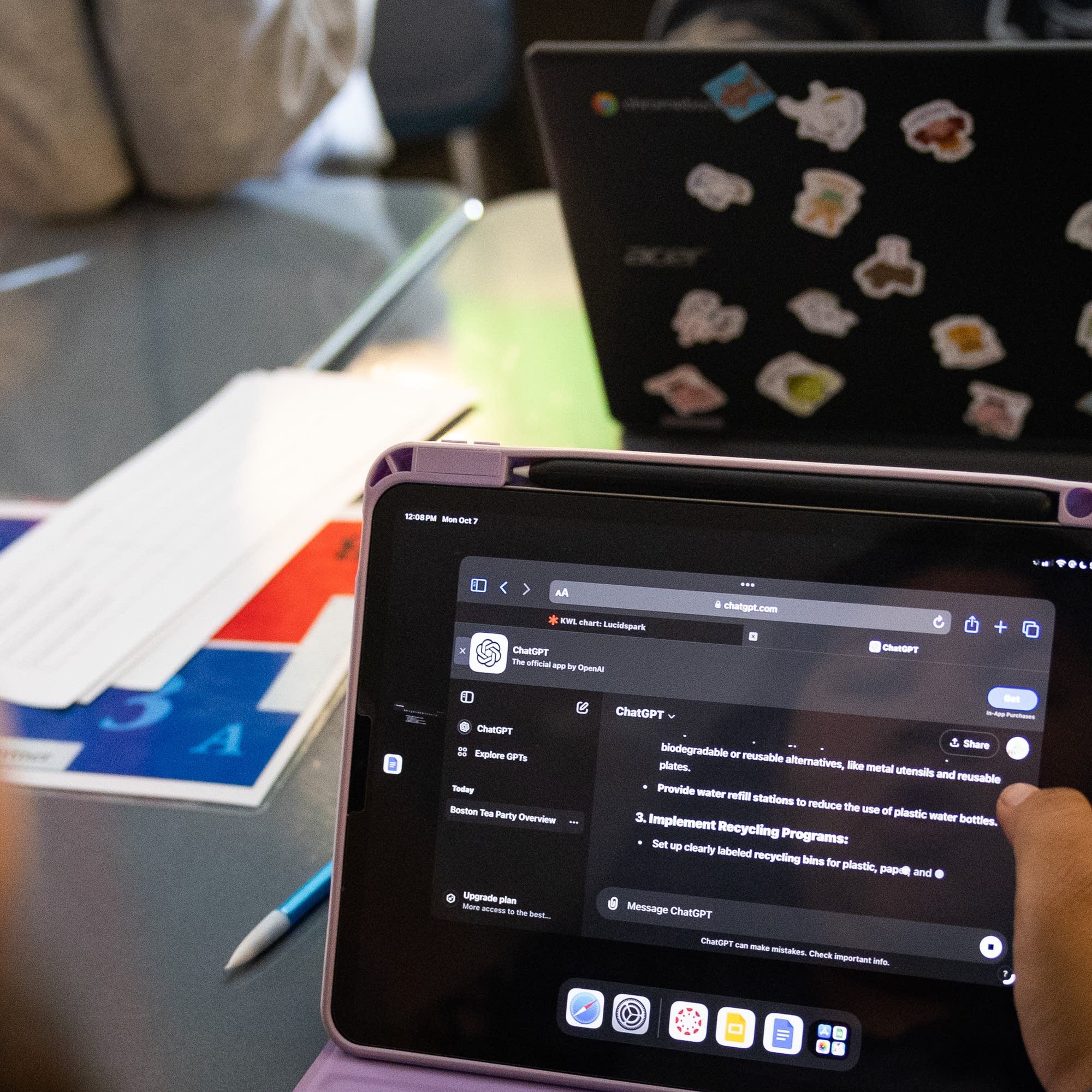
More than 60% of middle, high school, and college students in the U.S. are turning to AI for homework help, according to a new study from Rand. Some use it to help them brainstorm or like an encyclopedia. Others do it to get answers.
But while kids are relying more on AI, about two-thirds of students surveyed in the study also believe that this AI use will hurt their critical thinking skills.
Marketplace’s Stephanie Hughes spoke with Heather Schwartz, co-director of the American Youth Panel at Rand and one of the authors of the report, about why students are worried.
Get every episode summarized
Each time Marketplace Tech publishes, we email you a written briefing from the transcript — the topics, who appeared, and any specific claims, with the ad reads skipped.
Email me new episodesFree for 3 shows. No card needed.
Hosts & guests

Transcript ready
143 searchable segments. Every word is indexed and playable.
Full transcript
Marketplace Tech — What do students lose when they rely on AI for homework?. Machine-transcribed; use the interactive transcript above to jump the player to any line.
The danger of using AI to write a first draft of anything. From American Public Media, this is Marketplace Tech. I'm Stephanie Hughes. [♪ OUTRO MUSIC PLAYING [♪ More than 60% of middle high school and college students in the US are turning to AI for homework help, according to a new study from Rand. Some use it to help them brainstorm, or like an encyclopedia. Others do use it to get answers. But while kids are using AI more, more than two thirds also believe that this AI use will hurt their critical thinking skills. I asked Heather Schwartz, one of the authors of the report about why students are worried. I have a daughter who's 13, and I help her with math. She's taken a picture of a math question, plugged it into chat GPT, gotten a really beautiful and elegant answer. And not just, you know, the answer is 67. It walks you through the logic of the whole question.
But as you're doing that more and more, and you are not the person who is cognitively struggling through that question to produce that answer, but you're a consumer, you're a passive consumer of work that was already cognitive work that was done by someone else, in this case, AI. It's just not the same kind of learning experience. And, you know, while this jury is still out on exactly how AI is going to be impacting students' learning, there's some studies out already that show some distressing results, meaning kids using AI are showing gains while they have access to the AI. But then once you take away the crotch, you take away the AI, some of these kids are doing worse on the assessment than the students who never had access to AI in the first place. So the fact that the kids themselves are saying that this is harming critical thinking skills, I think should be, you know, sort of a canary in the coal mine. No, it's not proof that it is, but if they think it is, I think that's something
we should be listening to. If students' ability to think critically is being hurt now, as they are worried about, what could it mean for when they are in the workforce in five to 10 years? So if we are taking away the cognitive friction from learning and children are becoming passive consumers of information, I just don't think that they're going to be learning as deeply and then acquiring knowledge that they can then transfer to their work tasks in the future. I think it's so important that we need to protect like first draft thinking. I'm not trying to stake out an anti-AI position. I'm just saying that what I think is, you know, the picture that's starting to emerge, it's really important to scaffold and introduce AI at the right time, aka not before the first draft, only after first draft. The first draft means that like metaphorical blank page where you have to take and struggle through to synthesize the information that you possess
and you're having to pull together a bunch of skills in order to put that pen to the page and generate the first draft. And if you're skipping that step, you're just not the one who is exercising those muscles and when you've never developed those muscles in the first place, they're just not there for you to call on later. We'll be right back. You're listening to Marketplace Tech, I'm Stephanie Hughes. We're back with Heather Schwartz at Rand. What do you think educators should be doing to make sure students use AI as a tool but not as a crutch? I think in practice that what we will need is some AI free time protected in classrooms. And the reason I say classrooms is because it's just, as a parent, I'm saying just how challenging it is to protect and create AI free time at home. If you're connected to the internet and you do a Google search, there's AI embedded in your Google search,
providing that response Gemini at the top. It's very hard to not use AI. And so with, in the classroom with teacher-led instruction and teacher supervised independent practice, I think that could be the pragmatically speaking, maybe the space where we can have students have that first draft thinking, so to speak. I think that all of us have had a moment where we wished something we had to do was done already, but to quote Miley Cyrus, I feel like it's, and as you were talking about, it's a climb, that matters. I do wonder, how do we sell kids on this? Well, I don't have a silver bullet answer, but what I've told my daughter is, I know it's attractive, but ultimately you're cheating yourself. And she nods her head whether, I don't know whether she's truly believing all that. Is it 13-year-old on church, hard to tell what she's thinking? Yeah, at least she didn't rule her eyes. That was the score right there. Yeah. But yeah, I mean, ultimately,
people need to grow up with critical thinking skills and the ability to interpret, the ability to analyze information, to make an informed decision. To me, that's like a building block of human agency. And if we are short-changing kids on the ability to be a critical thinker, we're taking away their agency. And I just, I feel like the stakes are pretty high, and we really do need to protect this time for students to have cognitive friction. I think that's an inherent part, not just a bug that we should try to solve for, but an inherent feature of learning. And it's uncomfortable. And so that's the very reason why it could be easily edited out. And schools right now are definitely not there yet. I mean, we asked about, does your schools have rules for whether you can or can't use AI? And it's all over the place. The minority of students say that there's a school wide rule, whether it's a yes or whether it's a no. And in most cases, they either don't know or they say it depends on the teacher.
So it's just too higgledy-piggledy right now. You said very scientific. No, it's a great word. But I just think we need to be super careful about when we sequence in and layer in the student-facing AI in the learning process. That's Heather Schwartz at Rand. Daniel Shin produced this episode. I'm Stephanie Hughes, and that's Marketplace Tech. This is APM.
More episodes
More from Marketplace Tech

Raising kids in an AI-driven world
Marketplace Tech

What AI can and can't do for you (for now)
Marketplace Tech

Amid Silicon Valley scramble for AI agent productivity, "token anxiety" takes ho...
Marketplace Tech

Anthropic’s new, powerful allies: Elon Musk and SpaceX
Marketplace Tech