About this episode
Then, retired Lt. Gen. Mark Hertling gives his perspective on the objectives of the U.S. military and how long the war may last.
And, former Iranian prisoner and human rights activist Shirin Nariman is watching developments in Iran closely. As a supporter of the National Council of Iran Resistance, Nariman is hoping that the death of Ayatollah Ali Khamenei and his advisors will pave the road for democracy and human rights in the country. She talks about the situation in Iran and its reverberations around the region.
See pcm.adswizz.com for information about our collection and use of personal data for sponsorship and to manage your podcast sponsorship preferences.
NPR Privacy Policy
Get every episode summarized
Each time Here & Now Anytime publishes, we email you a written briefing from the transcript — the topics, who appeared, and any specific claims, with the ad reads skipped.
Email me new episodesFree for 3 shows. No card needed.
Hosts & guests

Transcript ready
245 searchable segments. Every word is indexed and playable.
Full transcript
Here & Now Anytime — What does the U.S. want from war with Iran?. Machine-transcribed; use the interactive transcript above to jump the player to any line.
Support for here and now any time comes from the VCU School of Business, offering graduate programs for military families and veterans in accounting, information systems, supply chain, and more, including MBAs. Learn more at business.vcu.edu slash GRAD. W-B-U-R podcasts. Boston. To be clear, this was a war of choice, not necessity. Iran had not issued a threat to the United States. We just decided this was a good time to whack them again. The U.S.-Israeli War against Iran is expanding, with counterattacks by Iran against American bases and allies across the Middle East. It's Monday, March 2nd, and this is here and now any time from NPR and WVR. I'm Chris Bentley.
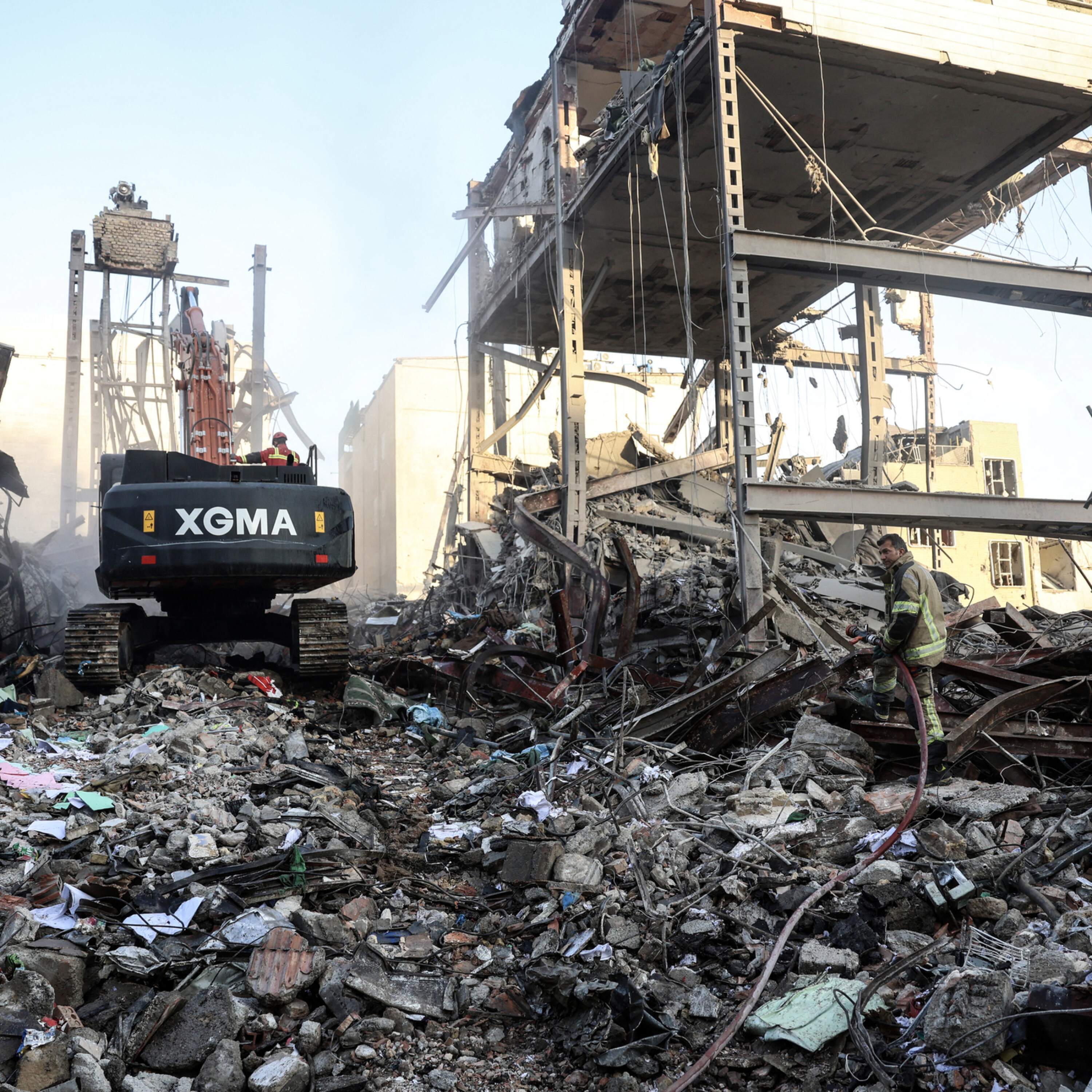
The U.S. and Israel have started a war with Iran that has already expanded into several countries in the region and killed hundreds of people, including civilians. We'll get a few perspectives on today's show from a retired American lieutenant general who worries about the apparent lack of a plan or even objectives with this war. Those extremists will come to the forefront and will argue that the nation is under siege and under greater threat, so it remains to be seen what's going to happen. And from an Iranian-American and former political prisoner who's been calling for regime change for years. But first, this is the second time in less than a year that the United States and Israel have attacked Iran. Well, the last war lasted only 12 days. President Trump says this one could last weeks. At the Pentagon this morning, Chairman of the Joint Chiefs of Staff General Dan Cain offered no timeline. This is not a single overnight operation.
The military objectives at Senkham and the joint force have been taskwists will take some time to achieve, and in some cases will be difficult and greedy work. Even the president's timeline of several weeks could be a vast under-estimate, says hearing now security analyst Jim Walsh. He's with MIT's Security Studies program. He spoke to Indira Lakshmanan. Well, when you think back to the attack in June, which was much more limited in narrow and scope, that went on for 12 days. And the point there was to try to hit some nuclear facilities. You're talking about regime change. It's going to take quite a while. Now, remember, we use the word regime change. But if you're on the other end of that stick, that's regime survival. Most countries fight very hard not to be destroyed and to survive. So, and if you're not going to put people on the ground, all you're going to do is bomb from the skies above. This is going to be a very difficult mission. Well, Jim, let's try to parse those U.S. goals, because the president this weekend
indeed said he was attacking the Islamic regime and that it would be up to the Iranian people to seize the moment and build a new government for themselves. He said, I made you a promise. I've kept that promise. Now it's up to you. This is your one chance to build a new government. That sounds like regime change. But just today, Secretary Hegseth said, this isn't a regime change war. And the president has just said at the White House that he ordered the attack to thwart Tehran's nuclear and ballistic missile program. So, is this or isn't this a regime change war? Well, I got to say off the top that it's not, it doesn't inspire a lot of confidence that after day three, they're changing their story, right? This was supposed to be a week and change. Now it's four to five weeks, maybe much longer. It was originally regime change, regime change, regime change. Now they're backing off. Well, it's a little hard to back off. After you kill the leader of the country, you say it's regime change and Israel is constantly calling it regime change. So it doesn't matter what Hegseth says at a podium, what matters is what the Iranians believe,
and they believe it's about regime survival. President Trump today said he wouldn't rule out U.S. boots on the ground in an interview he did with the New York Post. He also told CNN's Jake Tapper that a big wave is yet to come that we haven't seen anything yet. We know that Americans don't want U.S. troops overseas, especially after the long, deadly entanglements in Iraq and Afghanistan has the president made a case to the U.S. public for putting boots on the ground. He hasn't made a case for the war at all. There's been no case. There's been nothing like out as there was in previous occasions describing the state of Iran's program. He had previously said it was obliterated. We know they haven't restarted the sensitive facility. So how is it that it is a suddenly overnight a threat? And again, the U.S. intelligence community has said four decades and up until this moment that Iran is not actively engaged in a working nuclear weapons program. It has nuclear assets. It has enriched material, but it does not have an active nuclear weapons
program. Now, it certainly has ballistic missiles, but that's their defense. Like no country's going to say, oh, I'm going to go defenseless. So Israel can attack me anytime it wants to. And to be clear, this was a war of choice, not necessity. Iran had not issued a threat to the United States. We just decided this was a good time to whack them again. Six months after having already done it once. So we know that an Israeli strike killed Iran's supreme leader on Saturday. Now with Ayatollah Hamaneh, who was in power for 36 years dead, what happens in Iran now? Well, in theory, what you would have is the assembly of experts, which is a governmental body made up of clerics, would meet and select a new leader. And that's the sort of thing that would happen if Hamaneh had died of old age or something. But you know, we're in the middle of a war now. You'll remember back in the June attack, only six months ago, seven months ago, that Hamaneh, in anticipation of being killed, actually pre-designated three potential successors.
And so I expect that it will move in that direction. I'm not sure they'd want to pull together a big, you know, group together of the assembly to select that now. I think it's probably happening behind the scenes. As you said, Jim, the president last summer said that he had totally obliterated Iran's nuclear program, which as you've just said kind of takes away the argument then that the purpose for this was to obliterate the program that's already been obliterated. But tell us what does victory for the Trump administration look like in Iran? Well, that's the question, isn't it? Like before you enter a war, you're supposed to figure out your objectives, the costs you're willing to pay, the objective you're trying to achieve, and how you would know if you reach that objective. Now, if your objective is regime changed, that's one set of metrics. If it's obliterating a previously obliterated nuclear program, that's a different set of objectives. So it depends on what the president wants. But if it's regime change, it will be very difficult to achieve.
So the president just said that his goals are to destroy missile capabilities and annihilate Iran's navy. Ensure Iran will never have a nuclear weapon and ensure the regime can't arm and sponsor groups outside its borders in the few moments we have left Jim reaction. Yeah, well, it's what the navy part is hilarious. You know, if you can laugh about it because Iran doesn't have a navy, it was never a naval power. That's like, I don't even know what that's about. I think it's going to be very hard to achieve all those objectives. And I expect that tomorrow they will change and the day after that, they will change. And we will hear a different story depending on how things go on the ground and in the air. Jim Walsh from MIT Security Studies program here now, analyst. Thank you so much. Thank you. We'll get some more analysis of what the U.S. is even doing with this war and what might happen next after the break.
Support for here and now anytime comes from the VCU School of Business. Two hours south, Richmond feels close but not crowded. Graduate students come to the VCU School of Business for a variety of reasons to study accounting, hone their skills in decision analytics and marketing, or make a career change into finance or supply chain. Classes are scheduled for working professionals with flexible evening options including online and on campus. The VCU School of Business is open for business, open for opportunity, learn more at business.vcu.edu slash g-r-a-d.
Retired Lieutenant General Mark Hurtling served 38 years in the Army. He was deputy commander for U.S. forces in Baghdad. In 2007 and 2008 he served as a division commander controlling northern Iraq, leading nearly 100,000 troops of American soldiers and Iraqi army units. So far the American Israeli war in Iran has been in the form of air strikes. Retired Lieutenant General Hurtling told Robin Young that air campaigns can destroy things but what they can't do by themselves is build political outcomes. What we're seeing is terrific strikes and external strikes alone rarely produce democratic changes. They sometimes even in countries and unfortunately I have a great deal of scar tissue from Iraq on this. They sometimes strengthen hardliners. They create
additional chaos and they bring a lot of extremists on both sides to the forefront who will in the case of Iran because of their culture in the last 47 years since the revolution have become somewhat rabid and have accused the U.S. and Israel of being the great Satan. So those extremists will come to the forefront who will argue that the nation is under siege and under greater threat. So it remains to be seen what's going to happen. Well, you know Iranian experts have been saying that there's far fewer of the supporters of this extreme ideology of the supreme leader than there were maybe 50 years ago of the first supreme leader now. But you know it sounds like you're saying what we have seen in recent wars that it tips the balance when it is another country coming and involving you into regime change. You might even bring out people who also disliked that regime. Well, and the mantra of it being regime change implies there's going to be a new regime.
But right now we don't know who that is or how it's going to take charge of a country. And when you continue to bomb the security forces, which I mean we can debate whether or not those are valid targets in terms of what we're trying to do. But if you continue to eliminate the security forces, if you've eliminated most of the leaders, if you've used cyber weapons to thwart the potential for communication between people who might be standing up a new regime, it's going to be much more difficult. So there is not going to be the cohesion that you would expect or that we even saw in Iraq and Afghanistan where the regimes were replaced. Now they weren't replaced very effectively in many cases. But at least there was a plan. Right now, I don't see a plan. There may be one. I just don't see it for replacing the leaders. You know, Secretary Hegseth said this morning that the regime has been replaced. I'm not sure that's true. I think we've decapitated the regime, but without a replacement that would lead the people into a new tomorrow.
Well, and this again, this language sounds so familiar, decapitated the leadership. We spoke, you know, 20 years ago about, oh, wait, wait, this is a snake with many heads, you know, not just one. I mean, it's horrible. You know, the word decapitation is horrible, but you say there's a persistent belief in Washington that enough explosions will cause the Iranian people to rise up against their government. History suggests otherwise. Authoritarian regimes facing external attack often consolidate internal control, even when their leaders are eliminated, which is kind of what you're saying. I could you comment more? You talked about having some scar tissue, you know, from the last two wars, Iraq in particular. I've been thinking about this. I've been hearing over the weekend, different people like General David Petraeus also has that scar tissue, and others saying that they anticipate that in order for there to be the change that the US seems to be looking for, there need to be at least 500,000 US boots on the ground, and it
takes six months to train them. I've heard this several times. It reminds me of before going into the past wars. We heard from analysts like the great Anthony Cortesman, who said the same exact words, half a million, you know, 500,000 boots on the ground and people are like, no, that can't be. What is your sense if in fact, and you know, what is his saying that that's the direction we're going and everyone saying there won't be boots on the ground. But do you agree that if there are, that's how many there would be needed? I would say even more than that. This is not an environment that is replicates Iraq at all. You're talking about a country that's three times, three and a half times the size of Iraq, with about three times the number of people. It has, there are 90 million citizens of different ethnic varieties. You have Kurds, you have the Shia, you have all all sorts of extreme views in terms of the culture inside of Iran. It is a beautiful culture, no doubt about it,
that it has been oppressed, and it has become an evil regime. But when you're talking about sending Americans in, the same Americans that for the last 40 years, they've been calling the great Satan, you know, after they've bombed the country and probably killed a significant number of people, just like in Iraq. In Iraq, I mean, I was in the Pentagon as a war planner in 2002, when the plans to go into Iraq were being formulated. And there were a lot of the civilian leaders who said, hey, we sent too many forces to Desert Storm, and we had about 400,000 plus during Desert Storm in the 1990s. And Secretary Russell said, oh no, we can do it with a quarter of that or a third of that. Well, he was somewhat contrary to what the military leaders were saying, that they needed much more. And he said, no, no, we can do it because we're such a great force, and we've learned so much. Well, we found out that we didn't have the civil affairs forces, we didn't have the military
police to quell revolts, we didn't have the trainers that we needed to retrain the Iraqi army. There was the establishment of debathification, which created a real hole within the retired community of military leaders in Iraq and others. You would have that in spades in Iran, I think. So if people are predicting already how many boots we should have in the ground, that's off the top of the head, and it's not considering a great mission analysis in terms of what we need to put on the ground. And if I can just say one more thing, I sure the hell hope we don't do that. It would be an unbelievably tough environment against probably a determined population that probably does not want to see Americans on the ground there. Retired Lieutenant General Mark Kirtling. Thank you so much and thank you for your service. Thank you, Robin. Appreciate it being with you.
One more perspective for you on today's show. Coming up after the break, an Iranian American shares her thoughts. Robin has that in just a minute. This message comes from rinse. Who knows that greatness takes time. So does laundry. So rinse will take your laundry and hand deliver it to your door, expertly cleaned. And you can take the time pursuing your passions. Time one spent sorting and waiting, folding and queuing, now spent challenging and innovating and pushing your way to greatness. So pick up that Irish flute or those calligraphy pens or the daunting beef Wellington recipe card and leave the laundry to rinse. Rinse, it's time to be great. This message comes from Intuit TurboTax. With TurboTax expert full service, match with a dedicated expert who will do your taxes for you from start to finish getting you every dollar you deserve. It's that easy. Visit TurboTax.com to match with an expert today.
This message comes from duck.ai. Chat privately with popular AI's now. Go to duck.ai slash NPR. Your information is protected. It's free and no account is required. By duck.go or AI is always optional. This message comes from Mintmobile. If you're tired of spending hundreds on big wireless bills, bogus fees and free perks, Mintmobile might be right for you with plans starting from $15 a month. Shop plans today at mintmobile.com slash switch. Up front payment of $45 for 3 month 5 gigabyte plan required. New customer offer for first 3 months only. Then full price plan options available. Taxes and fees extra. See Mintmobile for details. So what if it has it been like for members of the Iranian diaspora to watch this war unfold? Sheeran Naranam became a human rights activist in the pro-democracy movement of the 1979 revolution that overthrew the U.S.-backed royal dynasty of the Shah, but that imperial state was replaced
by the current Islamic Republic and then supreme leader Homeni. And Sheeran was jailed two years later at the age of just 16 in a notorious prison where she saw and experienced severe torture. Sheeran, we welcome you and I guess just want to ask straight away how are you doing today? Thank you for the opportunity. Well, I feel we are close. We are much closer to end of regime. It's the theocracy that has been ruling. You know, I have seen death. I have seen how my friends and family members and cellmates were taken for executions and they were executed. So and if it wasn't for my belief of and the promise that I made each of them that at each time that I said goodbye, they asked me not to forget and not to give up and I stayed with those promises that I made and it was if it wasn't for the support of this particular opposition that I have,
you know, I support the National Council of Resistance, which is led by a woman, Maryam Rajavi. I would have given up maybe a long time ago, but I always had a hope that this regime will be overthrown and Iranian people will be free. I just want to ask Sharon because we just had a military analyst on it and as he writes, the hope is not a method and there's a lot of concern that while the current Supreme Leader Ayatollah Ali Hamanay and other senior officials in Tehran are dead, there's really not a lot of chance for regime change unless there are U.S. boots on the ground. You've said we have to fight. Who has to fight? Well, Iranian people, let me let me to be clear. We never ask for any foreign intervention and we never ask for boots on the ground. This is something that Iranian people have to do it. We have to do it and only the opposition that has enjoys of a strong support inside of Iran and
has very organized resistance units in Iran can carry this out. So when we are talking about fighting them, we are talking about us, Iranian fighting back the IRGC members and besieges. How does this happen? Because we saw even just during demonstrations, these were just peaceful but vocal protests, thousands of Iranians were murdered. Exactly. See, we knew all along that this regime is not going to go peacefully and they're going to fight. That's what you need to have to be able to fight back and that's what we've been working so hard to ask everyone to the whole world to accept the Iranian rights to fight back the regime. So now we are in those times. I think it's too early right now. I think gradually with the patience we are going to see we do have, we enjoy a large support of resistance units inside of Iran, more than 50,000 units and we are seeing actually since January a
great expansion because people, ordinary people had got to the point that this regime you have to fight back. This regime is not going to let go. Well, let me ask you, what are you hearing because there's been a lot of concern that, first of all, the internet is down that everything's being blocked and the US has cut funds to things like Voice of America. But have you been able to speak to anyone? Yes, actually, as a matter of fact, I talked to Arnis this morning. She made a quick call and she told us that all the police stations and judiciary building has been bombed and she said we see everywhere just explosion and they just called to let me know that they are leaving town, they are living in Tehran. So she said we are going to leave Tehran for now to go to a safer place. So as you know, it's what it looks like and we can only see why the films that are videos and films that are coming from Iran or you know covered in a different ways but what is very clear
and we also know for sure that there were a few of the police stations had been taken over by the resistance units and they disarmed them and this is how we are becoming armed inside of Iran. Sheeran, I have to hold you up there just because of our time. I'm just really hoping that we can stay in touch with you as you stay in touch with family in Iran and what you, as you called it, the resistance movement, Sheeran Arman, human rights activist, former Iranian political prisoner and again we will stay in touch with her and others in the diaspora. That's it for today's show. Here in now any time comes from NPR and WB War Boston. Our producers today were Julia Corcoran, Jenna Griffiths, and Karen Miller-Medson. Our editors were Todd Munt, Mikaela Rodriguez, Michael Skado, and Cat Welch. Technical direction from Caleb Green and James Trout. Our theme music is by Mike Mistetta, Max Liebman, and me, Chris Bentley. Our digital producers are Alison Hagen and Grace Griffin, and here in now's executive producer
is Alan Price. Click the follow button wherever you're listening to this podcast right now so you keep up with us. We've got new episodes every single weekday of the year and we'll continue following all the news including the War in Iran. Thanks for listening. We'll be back with you tomorrow. This message comes from Mint Mobile. If you're tired of spending hundreds on big wireless bills, bogus fees, and free perks, Mint Mobile is for you. Shop plans at mintmobile.com slash switch, taxes and fees extra. See Mint Mobile for details. This message comes from Prolon, feeling heavy and depleted after the holidays. Prolon's five day fasting mimicking diet aims to make it easy to reset your body, habits, and energy heading into the new year. Developed at USC's longevity institute, the goal of Prolon's nutrition program is to rejuvenate you from within by working at the cellular level to support fat loss, glowing skin, and sharper focus.
Get 15% off plus a bonus gift when you subscribe at ProlonLife.com slash NPR. From Toyotas to Aston Martin's, eBay has thousands of cars and the largest online selection of vehicle parts and accessories. eBay, things people love.
More episodes
More from Here & Now Anytime

The story behind the photo that captures the horror of 9/11
Here & Now Anytime

The conservative movement, one year after the killing of Charlie Kirk
Here & Now Anytime

9/11 and the long shadow of Islamophobia
Here & Now Anytime

Israel faces global outrage over West Bank violence
Here & Now Anytime