About this episode
This episode: voting correspondents Miles Parks and Hansi Lo Wang, and senior political correspondent Tamara Keith.
This podcast was produced and edited by Casey Morell and Bria Suggs.
Our executive producer is Muthoni Muturi.
Support public media with NPR+ and enjoy perks for over 25 podcasts like this one. This show’s perks include bonus episodes and sponsor-free listening. Learn more at plus.npr.org.
See pcm.adswizz.com for information about our collection and use of personal data for sponsorship and to manage your podcast sponsorship preferences.
NPR Privacy Policy
Get every episode summarized
Each time The NPR Politics Podcast publishes, we email you a written briefing from the transcript — the topics, who appeared, and any specific claims, with the ad reads skipped.
Email me new episodesFree for 3 shows. No card needed.
Hosts & guests


Transcript ready
305 searchable segments. Every word is indexed and playable.
Full transcript
The NPR Politics Podcast — What's going on with vote-by-mail?. Machine-transcribed; use the interactive transcript above to jump the player to any line.
This week on Newsmakers, after more than a decade in comedy, I wasn't sure that we would get here. Robbie Hoffman is fearless. I had a small feeling I wasn't sure. And fully herself. My line, Lord. Hello. You can go out and flash. Well, I'm not home now. I'm doing something. We plunge into comedy and success with Robbie Hoffman on NPR's Newsmakers. You may have seen some headlines this week about President Trump pushing to restrict vote by mail. Tim and I have. And frankly, it's a little confusing. We have a lot of questions. So today on the show, we're bringing in our reporter who is monitoring every twist and turn in this critical legal battle to explain exactly what's happening. And the implications before voting in the midterms starts as soon as next week. It is the NPR Politics Podcast where recording this podcast at 1.02 PM on Thursday, August 27th, 2026. I'm Miles Parks and I cover voting.
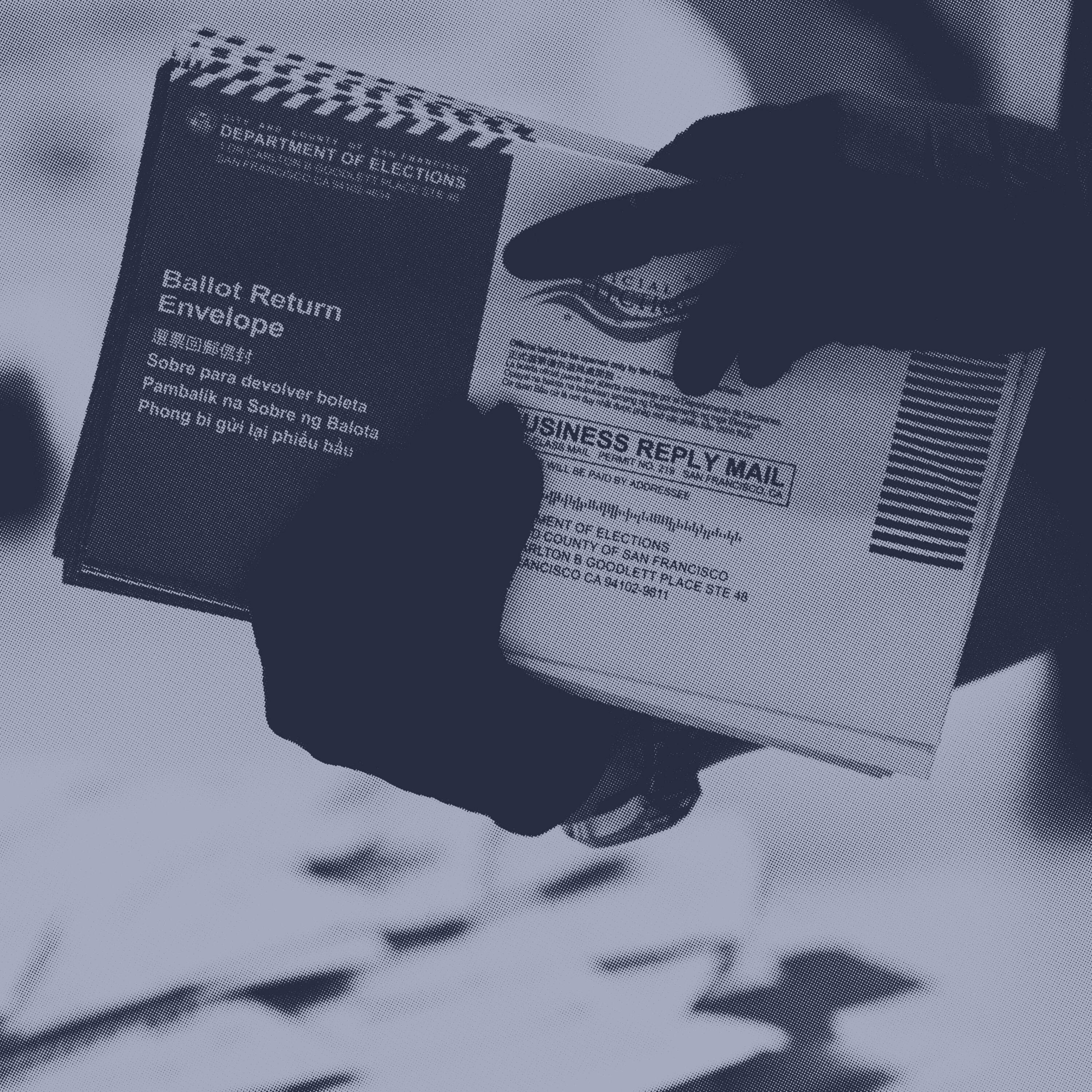
Manzilo Long, I cover voting in the US Postal Service. And I'm Tamer Keat by Cover Politics. So Hansi, as I mentioned, you have been monitoring every single legal brief and development in this USPS case. But I actually want to start from the beginning with President Trump's executive order, which began this whole thing. He has long railed against vote by mail, falsely saying that it is rife with fraud, despite voting by mail numerous times himself. And in March of this year, he signed an executive order regarding vote by mail. Can you explain what that executive order sought to do? There are two key parts of this executive order. One of those parts calls for the Department of Homeland Security to come up with a list of adult US citizens living in each state. And the part that's gotten a lot more attention involves the US Postal Service. And before I keep on going, full disclosure, USPS is a financial support of NPR. What President Trump's order basically called for is the Postal Service has to deliver mail and ballots only to people on lists of mail and voters
that states would have to turn over to USPS. And states would also be required to have certain barcodes on their ballot envelopes. A huge undertaking to be sure. But, Tam, I mentioned that the president has been railing its mail voting for a while. What else can you tell us about the rationale behind this executive order? Yeah, I mean, this is a core belief for President Trump that mail-in voting is flawed. Here he was in the Oval Office, while he was signing the executive order. The cheating on mail-in voting is legendary. It's horrible what's going on. And it's very clearly covered, very, very clearly. So I think this will help a lot with elections. As is often the case with his descriptions of voting and fraud, he is saying things that are not true. But this is a core belief of his, something that he is passionate about, something he's trying to get changed by Congress through the law.
But he's also then tried to do it through executive action because he couldn't get Congress to do it. Yeah, and this is like a core tenant of many people in the far right, frankly. I've been talking about this for years, wanting to eliminate mail voting. Also wanting to move towards a single election day, essentially. Hansi, this executive order, though, was almost immediately challenged in court. Why exactly? Or what was the argument against it? Well, there are two main legal arguments. One, Trump's order overstepped a president's authority. And this is a claim being made in all these lawsuits. Because under the Constitution, states and Congress have the power to set federal election rules, not the president. Another key argument is that the postal service has no authority to control mail-in voting. It's job is to deliver the mail. Hansi, what is the status of the legal challenges? There's a lot going on, but the latest development, as we're talking at this moment, the postal service is no longer blocked
from working on Trump's executive order. But that may change because there may be some back and forth in terms of court rulings over the next few days, with the next few hours we will have to see. And I know these challenges have been getting a lot of attention. Like Miles said earlier, because of a Supreme Court ruling earlier this week, but it's really important to point out that was not the main event of these legal challenges. The justices at the Supreme Court have not ruled yet on whether President Trump's order is legal. And what we got was a ruling on a procedural question. And that decision is not the final word for these challenges. We are still in the middle of this legal fight. And I'm watching right now for new rulings by federal judges in Boston, possibly in Washington, D.C. And those are expected to be appealed all the way to the Supreme Court. And at that point, that will likely be the final legal battle to watch. I guess the big question I have here, Hansi, is just for voters who, and many, many millions of voters were probably planning or are planning to vote by mail
in this year's midterms. What does all of this mean for them? You know, so far, President Trump's order has not directly affected mail and voting. And right now, voting by mail is still a viable option to all voters who are eligible for it in their states. And the Postal Service is expected to deliver mail and ballots as usual. And it's really unclear what impact, if any, Trump's order will actually end up having. You know, even let's assume this order overcomes legal hurdles. There are still major practical hurdles. North Carolina has to start sending out mail and ballots to absentee voters next Friday, September 4. And a big question is how can the Postal Service and state election officials carry out a very new process and involves uploading state mail and voter lists and new envelope barcode requirements and other technical details so close
to the start of mail and voting for the midterms. That's a major question hanging in there there. In addition to legal questions, they have to get sorted out. So again, in the meantime, average voter, if you're eligible to vote by mail, you currently still have that option. Well, and it's notable that you mentioned North Carolina because that's the state with a lot of overseas military voters. And that's why there's such a lead time because these aren't just people who are like, yeah, I don't feel like going out to vote today. It's people who are literally outside of the country serving the nation right now. Also, Hansi, you bring up this idea of the practical hurdles. I guess I'm a little unclear on if the USPS even has the capabilities to be able to implement this order. There's been so much talk about over the last few years about downsizing aspects of the USPS in terms of service deliveries and things like that. This seems like a massive undertaking for an organization
that has already been going through a lot of change. That's a good question to ask. The Postal Service just put out a new statement saying that, despite its financial challenges, basically it can carry out this order if it is allowed ultimately by the courts. But what's interesting is that in a court filing, one of the challengers of the order saying the court filing, that the lawyers for the challengers asked the Postal Service, when do you expect this online portal that state election officials are supposed to use to upload their lists of absentee voters? When is that portal going to be live? When is that going to be ready to go in case courts allow this to happen? This order to be carried out. And the Postal Service, or at least their attorneys did not give a date. And so it's a real big question again. If the courts allow this order to go forward, how will the Postal Service, can the Postal Service make this happen? And like you said, numerous times,
that is a very big if. I just want to note that for people. All right, more on vote by mail and listen to questions in just a moment. This message comes from HomeServe. A burst pipe, a dead water heater, the AC calling it quits. Who do you call? HomeServe is an easy way to handle unexpected home repairs, with plans covering stuff basic homeowners' insurance usually won't. Instead of scrambling for a contractor, you make one call to get the repair process started. Join the millions of customers who trust HomeServe right now. Go to homeserve.com slash podcast for 50% less your first year. Savings compared to renewal price, void and Florida. You count on sunscreen to protect your skin, but that SPF rating on the bottle might not be exactly as advertised. So you can measure an SPF 50 at one lab and an SPF 30 at another. On the Sunday story, is it time to update sunscreen guidance? Listen now to the Sunday story from the up first podcast on the MBR app.
Hey, you know that nagging voice in your head? The one telling you to put the phone down and stop doom scrolling? Well, it's time. Look up. Take a daily curiosity break with shortwave and pair a science podcast. Let your mind wander to the edges of outer space, or wonder about what's lurking in the depths of the sea floor, all in under 15 minutes. Shortwave, your daily mental recent. Listen on the MBR app or wherever you get your podcasts. And we're back and moving into the section of the show, Hansi, where we are going to let the listeners ask you some questions. We got one from Pat in Colorado. And Pat asks, I live in a state, Colorado, where mail-in voting is the norm. What will happen in such states if there is no further action on Trump's latest EO by the courts, or if they decide for the Purcell rule that it's too close to an election to do anything? There's no way such states can go to in-person voting in mere weeks. So a lot to unpack there, Hansi, but I guess we should start with the Purcell rule that Pat mentions. Can you explain how that potentially could play into all of this court fighting?
Well, there's this legal idea that came out of a Supreme Court ruling from 20 years ago. The idea is basically that when federal courts are deciding election-related cases, they should not make changes to voting rules close to an election to avoid confusing voters, and election administrators. But here's a rub. What is too close to an election? The Supreme Court has not given a definitive answer on that. And many electional experts point out the timing of the court's rulings that allow for changes to voting rules. They have been really all over the place. And arguably this really isn't a rule. And we'll just have to see if and how what, you know, what sometimes you know, is the Purcell principle, quote unquote, how that might factor into this case when it likely reaches the Supreme Court again. Okay. So now we understand the principle, as such as it is. Can you answer the rest of Pat's question, which is, well, that's going to happen for states that primarily vote by mail? That's the big chaotic scenario where basically right now this final rule from the Purcell
Service says that the Purcell Service will not accept mail and ballots from state election officials to be sent out unless those state election officials go onto an online portal and upload essentially their list of absentee voters. An online portal that does not currently exist. As far as we can tell. And if that sounds kind of, you know, not a big deal, this is a very, very busy time for election officials across the country. And there is a high risk potentially of names getting missed, names being misspelled. There's just a lot of potential ways that eligible voters could get caught up in some type of mistake or some type of data transfer error or their name is on a list. And then the Purcell Service still for whatever reason doesn't end up delivering their ballot or
doesn't accept the ballot for them because there's some process that hasn't gotten worked out later on down the line. This is a very new process to introduce at the very last minute, right before mail-in voting officially starts for the midterm elections. So just like any other last minute change, there's a high risk of it causing chaos. Election officials always talk about the fact that they are basically professional disaster mitigators that they are planning for all the different scenarios. And so I think you can also be sure that election officials in those states are trying to game plan all the different ways that this could go. Okay, we have another question, this one from Mike in Minnesota. He asks whether there is any sense of how many voters who are legally eligible to vote would be caught up in these plans meant to reduce or eliminate the risk of non-citizens voting. And to explain, President Trump has long claimed that people who are not citizens are voting in massive numbers and that vote by mail is a point of vulnerability. That's another sort of one
of his justifications for this. Yeah, and also worth noting, I say this on the pod multiple times a week, but there is just no evidence to support that claim about non-citizens, you know, greatly impacting American elections. Basically, every piece of research and auditing on this fact has found it to be a minuscule number of non-citizen voters in every election cycle. But, Hansi, what do you make of this broader idea of just like how many people could be caught up in all of this? Well, back in 2024 and 2022, the most recent federal elections about a third of voters in those elections voted by mail. That's according to election assistance commission surveys. And so that's a substantial size share of voters. And we'll have to see how many voters end up choosing to vote by mail for this election. But there is a real risk of eligible voters getting caught up if this order is allowed to be carried out, this change in how the postal services processes and accepts
ballots from state election officials. If your name is not on a list for whatever reason, you may not end up getting a ballot or getting it on time, maybe comes late. A lot of different scenarios could come up. And so it is a real risk that right now, challenges of President Trump's order, they're trying to lay that all out in court filings. Well, and I think this question also gets to this point of I don't think any political scientist can say confidently how any of these chaotic scenarios would actually impact the election results. I thought this was really interesting. Election law attorney Ben Ginsburg, who is a long time Republican election attorney, came out this week and basically said that he felt that if some of these restrictions on vote by mail did go into effect, that you would actually start seeing many more elected Republicans come out against them because this is his quote, Republicans are the older party and older folks like to vote by mail and Republicans are the rural party said this on CNN. And so I think there is this kind of
pretty outdated sense that these sort of voting restrictions would generally hurt Democrats. But I thought it was really interesting to see a long time Republican come out and say that seems to be probably a misunderstanding or at least an oversimplification. What else are you watching at this point? Well, I'm keeping an eye out for potentially a flurry of more court filings, more rulings from these federal judges and the lower courts. This again, this legal fight is not over and I think if any listener, any concerned voter wanting to figure out what's happening here, I think take a breath over these next few days, maybe over the next few weeks depending on how quickly this all plays out. There's going to be a lot of court action, but that court action does not necessarily translate to the final word on what's going to happen. And so again, at the moment, President Trump's executive order has not directly affected mail and voting for the midterms. It is still a viable option and we're going to have to see what the final word is likely from the Supreme Court. All right, well, let's leave it
there for today. Hey, Miles. Let's do it. Come back tomorrow and we're going to hit all the other topics that we did not get into this week. I'm Miles Parks, I cover voting. I'm Hans Ylouang, I cover voting in a U.S. Postal Service. And I'm Tamara Keith. I cover politics. And thank you for listening to the MPR Politics podcast. This week on Weight Weight Don't Tell Me, we talk with our panel, Joy-Land Nicole Johnson, Peter Gross, and Tick-N-Taro about the new trade war with Canada. I can't imagine maple syrup being any more expensive, like it costs as much as a car, like the mistroke. What kind of car are you buying? Don't miss our full conversation and the rest of our games. Listen to the Weight Weight Don't Tell Me podcast in the NPR app or wherever you get your podcasts. How will a historically unpopular President navigate a midterm election season that may leave him with a lot less power? Stay caught up on the latest news with Trump's Terms, the podcast where we curate NPR's coverage of President Trump in short episodes focused on a single story.
Follow Trump's Terms on the NPR app or wherever you get your podcasts. The NPR app cuts through the noise, bringing you local, national, and global coverage, no paywalls, no profits, no nonsense. Download it in your App Store today.
More episodes
More from The NPR Politics Podcast

How 9/11 reshaped U.S. intelligence | Sources & Methods
The NPR Politics Podcast

The legacy of 9/11
The NPR Politics Podcast

The young conservative movement post-Charlie Kirk
The NPR Politics Podcast

How Trump's immigration policy has evolved
The NPR Politics Podcast