Loading...
About this Episode
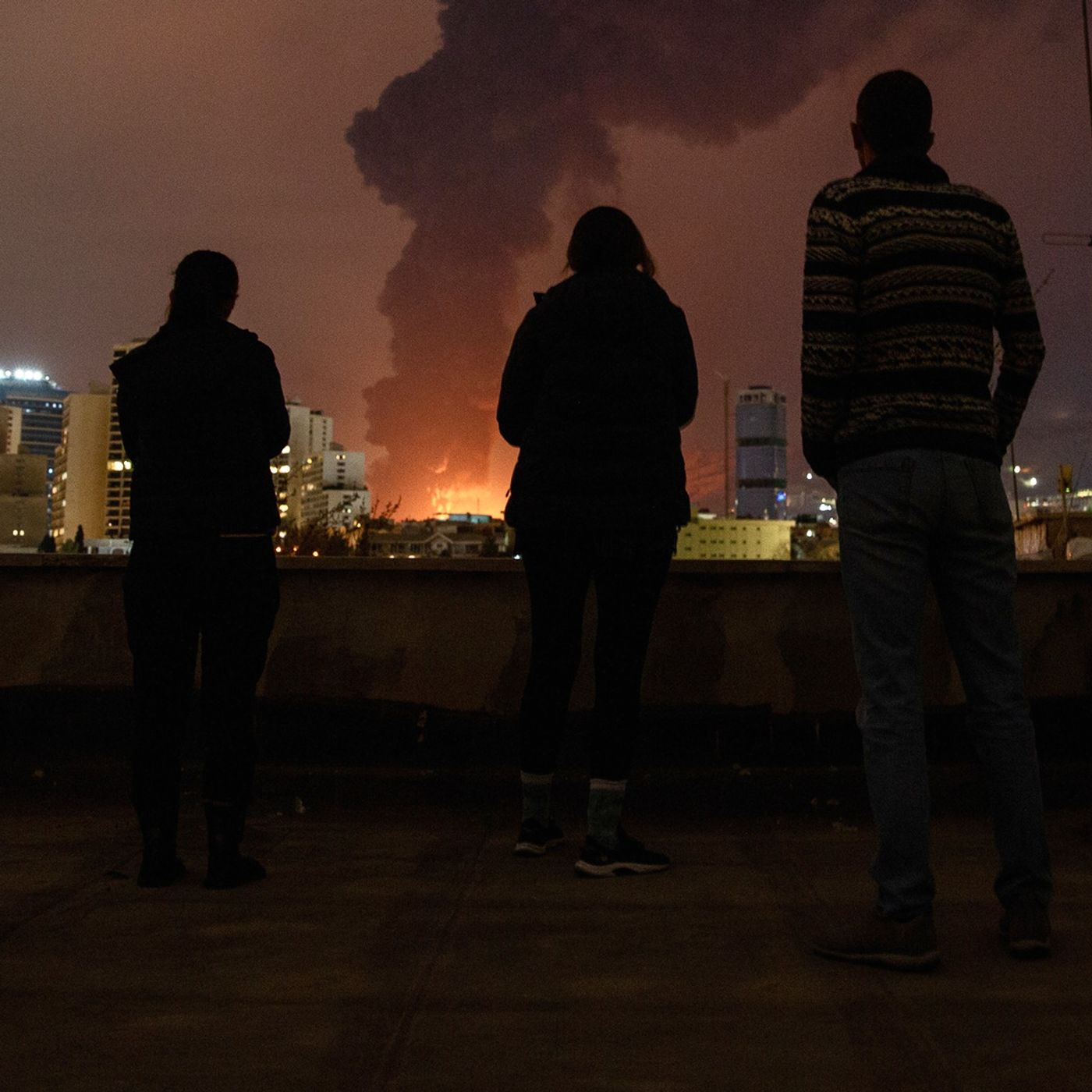
What began as a relentless U.S.-Israeli military assault on Iran has turned into a wider crisis as the disruption of the world’s oil markets spreads beyond the Middle East.
Eric Schmitt, a national security correspondent for The New York Times, discusses what we know about the players involved in the fighting.
Guest: Eric Schmitt, a national security correspondent for The New York Times based in Washington.
Background reading:
- War with Iran has become the world’s latest economic hazard.
- Follow updates on the fighting in the Middle East.
Photo: Arash Khamooshi for The New York Times
For more information on today’s episode, visit nytimes.com/thedaily. Transcripts of each episode will be made available by the next workday.
Subscribe today at nytimes.com/podcasts or on Apple Podcasts and Spotify. You can also subscribe via your favorite podcast app here https://www.nytimes.com/activate-access/audio?source=podcatcher. For more podcasts and narrated articles, download The New York Times app at nytimes.com/app.
Hosted by Simplecast, an AdsWizz company. See pcm.adswizz.com for information about our collection and use of personal data for advertising.
Hosts & Guests

Transcript
From New York Times, I'm Michael Bobaro.
This is the Daily.
Over the past few days, what began as a relentless US-Israeli military assault on Iran has drawn
in at least 14 countries from Lebanon.
I, with my family, live in a neighborhood just outside of Beirut.
We are having to wake up in the middle of the night at 4 a.m., or 5 a.m., 6 a.m., hearing
these missiles and bombs constantly hitting our neighborhoods and our people.
To the United Arab Emirates, we heard some explosions from the interceptors, and that's
when we went with my family to the basement to get some shelter.
To Saudi Arabia.
When we were all on the plane, I came from Saudi Arabia, everything was fine to go and
they told us to get off.
They said it wasn't safe to fly because of the missiles.
So we thought we were going to be stranded.
As the conflict has transformed into a region-wide crisis, and now the impacts of that war are
going global.
A major shipping route for oil has effectively been shut down amid this war, sending shockwaves
through the markets.
As the disruption of the world's oil market spreads from the Middle East to Europe, Asia,
and North America.
The price of crude oil has risen above $100 a barrel, as the Strait of Hormuz is effectively
closed, and Iranian fuel depots are battered.
Today, Eric Schmidt, on what we're learning about all the players involved in this conflict
from a week of war.
It's Tuesday, March 10th.
Eric, thank you for making time for us.
We appreciate it.
Sure.
Of course.
So we wanted to speak with you one week or so into this war about what has been accomplished
or has failed to be accomplished by all the major governments involved in this conflict.
The way I wanted to loosely organize our conversation was by starting off with what has
been done to Iran by the US and Israel in the first half of this episode, and then in
a second half, walk through what Iran in retaliation has done to the region and the world, if
that makes sense to you.
That makes a lot of sense.
OK, so with that blessing, we will proceed.
We know quite well at this point that the United States objectives in this conflict
have whipsawed, starting with the mission of getting rid of Iran's nuclear program,
then it became outright regime change, then it was the US being willing to work with
regime insiders to this latest demand for President Trump for total regime surrender.
So overall, a pretty incoherent set of messages, given that, let's focus on what we know has
actually happened on the ground.
The targets that the US and Israel have struck and what shape that has left the regime in.
And I think we can get pretty detailed and specific here.
So where do you want to start?
OK, so about 10 days into this military campaign, the Israeli and American militaries have
struck more than 4,000 targets over this time.
Period, yeah.
So this includes obviously the first day strike that killed the supreme leader, the main
political goal, I think of Israel, and to some extent the United States.
But from a military standpoint of these 4,000 targets, they've really focused heavily on
eliminating Iran's air defenses.
These are the surface air missiles that could attack American bombers and Israeli jets,
those kind of things.
So they've gone after that to give the Israeli and American air forces freedom of movement
in the skies.
The other big targets include the ballistic missiles, which actually go up into space and
come back down again.
They arc back down against the long range, very fast moving targets that cause a lot of
damage.
The other main focus has been to strike the Iranian navy.
These are the ships and boats that can basically interfere with commerce in the Persian
Gulf and elsewhere.
So the United States believes that they've sunk much of the Iranian navy and thus eliminated
much of the threat, at least from their major navy vessels of commerce in the region.
Right, I've read something like 42 Iranian ships have been sunk.
Yeah, the number keeps increasing because they've been focusing on that.
The threat still remains from Iran's small boats, but the main navy strikes has been
very important.
And then lastly, the United States has tried to go after Iran's formidable drone program.
These are the same drones that Iran has manufactured and have been used by the Russians in
Ukraine.
These are formidable because as much as the United States has air defenses against these
and a right array of things from jamming to small weapons to actually counter drone drones,
if you will, they have so many of these drones.
The defenses just can't be everywhere at once.
So how does this all add up after about 10 days of war from both the Israeli and the American
Air Forces?
The Pentagon basically believes that they've reduced the number of missiles being fired
by Iran by about 90 percent on the first day.
And the number of drones being fired by about 83 percent.
Very meaningful.
Pretty significant.
But in confidential briefings to Congress late last week, Pentagon officials told lawmakers
that the Iranians still have as much as 50 percent of their overall missile fleet still
intact.
That's getting hammered away every day.
So by now, it's probably chipped down a little bit more low that.
The more important is the drones are probably even more than that.
They can still manufacture these drones at this point.
They still have huge stockpiles of these.
So even though the United States and Israel pose significant damage on these stockpiles,
the Iranians still have a fair amount left.
And that's the race that we're in here.
And Eric, when you say race, just help me understand what you mean there.
Race between what?
So the race here, Michael, is between Iran's ability to fire off as many of these missiles
and drones as possible, to inflict as much pain as possible, physical pain, economic
pain, political pain, versus the United States and Israel's ability to knock out that ability
to fight back.
That's the race that's underway.
How quickly can the Iranians fire enough of this stuff off to really increase the
pain to its maximum point and how quickly can the US and Israel suppress that Iranian
ability?
Got it.
And presumably the US has enough munitions to go longer than Iran.
Well, the munitions has been a key question because some kinds of munitions are in shorter
supply than others.
This was very important at the beginning of the war because the United States was having
to use very expensive what they call standoff weapons.
That is expensive missiles that they can fire from outside of the range of Iranian air
defenses.
We've now shifted into a different phase of the air campaign.
With most of these air defenses destroyed or degraded, the US now can come in and drop
other kinds of bombs, satellite and laser-guided bombs that are much more plentiful and cheaper
and that are much greater stores.
What's in short supply is what's on the ground, however, the interceptors.
These are specially made missiles that are meant to protect against those ballistic missiles
and other cruise missiles that we talked about earlier that Iran is firing.
That's what's in short supply.
The US military says it has enough to protect its bases, but many of the Gulf countries
are finding they don't have enough to protect their own populations and they're pressing
the United States and other countries to see if they can provide more on an emergency
basis.
A lot of what we've been talking about so far are the military targets of Iran and the
United States, but there are additional targets that are a little more ambiguous.
I'm thinking about over the past couple of days, strikes on something like 30 Iranian
oil depots, and I want to understand whether that should be seen as a military target or
is it more civilian infrastructure targeting what the rationale is?
Yeah.
You put your finger on a very important point, Michael, because this has highlighted one
of the rare early divisions in the war between Israel and the United States.
Israel struck these oil depots because these are important to fueling the Iranian war machine.
This oil is being used for that purpose.
They want to take out that ability to do so.
They warned the Americans that they were going to do this and the Americans were okay
with that.
What they didn't know was Israel was going to blow up 30 of these things and create this
horrific image of black, billowing smoke and oil depots blowing up at a time when oil
prices are spiking and underscoring one of the big concerns that President Trump has.
The Americans made their objections known yesterday, very clearly and apparently President
Trump was quite upset and made his objections known.
The Americans were okay to appoint with the Israelis taking out what they consider military
targets, but they felt Israel overdid it and basically created a problem, not just an
optics problem for the United States, but a real economic problem.
It just kind of helps drive up these oil price concerns.
So when the targets have been military in nature, the U.S. Israeli strategy so far seems
like it has been pretty effective where the targets have veered into more civilian infrastructure.
There has been conflict and controversy around it.
I'm curious how we should think overall 10 days in about whether these U.S. Israel attacks
have been precise and if this is the right word to use here, moral.
Well, clearly you've got more than 1,000 people killed on the ground in Iran.
So some of these strikes, they maybe they've achieved both.
Maybe they've struck a military target, but they've also killed civilians in the process.
The biggest example of this was a strike against an Iranian naval base and next to the
base is an elementary school where 175 people were killed.
Now this investigation which the United States military says it's conducting and ongoing
is focused on how did this happen?
Was this a bomb that went astray?
Was this just bad targeting information that they had?
Because this school actually several years ago was part of this naval base and then sometime
ago it was split off and it just became an elementary school.
Which the U.S. may not have known.
Exactly.
And this sadly has happened before.
But you should have.
They should have known this as they check these things because it's very clear if they
look at the satellite imagery, they look at other things, there are school kids out,
running around in fields and things like that and there's a fence that now separates
the base which was attacked and this school which is just a couple hundred yards away from
it.
So you could see sadly how this thing might have happened.
I'll told Eric how many Iranian civilians have been killed as far as we know.
I believe Iran's envoy to the UN has said 1,300 Iranian civilians have been killed.
I'm sure all these numbers will be disputed throughout the conflict.
But do we have a sense of the number of Iranian civilians killed?
Yeah.
Those are the kind of estimates that certainly we at the New York Times are using.
The United States has not come up with a formal estimate yet as to civilian casualties
on the ground.
The military makes a point to say because of the precision weapons they're using, they
do all they can to avoid putting civilians at risk and to minimize the danger of civilian
casualties.
But in any kind of war, any kind of conflict, this is going to happen.
If this was a mistake, is it a war crime or if it's a mistake, it's just a mistake?
Sadly it's more probably in the category of it's mistake.
War crime would be something that we obviously deliberate.
Some kind of target that you knew had in this case women and children.
And that would be something much more serious.
I think in this case, at least if it's similar to the cases of civilian casualties and incidents
that I've reported on the past and other conflict zones, it's somebody screwed up.
So despite all of the damage that the US and Israel have inflicted, primarily on Iran's
military and the government.
What seems very clear at this moment is that the onslaught has failed to topple the regime.
One of the stated goals of this mission, even though it has changed many times, was to
topple the regime and yet a new Supreme Leader has been appointed.
And it does not appear that the regime isn't any great jeopardy of collapsing, correct?
That's right.
And in fact, not only that, but it looks like the United States knew this, at least the
intelligence services of the United States knew this even going into this fight, because
they basically assessed going into this war that any kind of military operation, sort of
some kind of land invasion, which has never been envisioned here, but any kind of major
air campaign like we're seeing now would fail to dislodge the theocracy that runs Iran
today.
It's just too entrenched.
They've thought about this for years and years of how to survive.
And they expected this kind of attack, and at that day has come now, and now we're kind
of seeing the strategy that they have been thinking about for decades.
Just to be clear, you're saying that the United States assessed that the campaign that
it's now waging against Iran was unlikely to do the thing that we have articulated as
our goal for this conflict.
That's right, in a confidential assessment by the National Intelligence Council, which
is a combination of the various intelligence agencies, that was their assessment going
into this war.
And there are basically no examples going through recently recent military history of an
air campaign alone toppling a government.
You almost have to have some type of force that goes in on the ground, or you have to
stir the population itself to take up arms and throw off whatever's left of the former
government, such as it is.
But by itself, this assessment concluded it's not going to get rid of this government
that the president said he wanted to do.
Fascinating.
Eric, to the point of that assessment, and its determination that the regime would be
very hard to topple, what should we make of the choice of a new supreme leader, the
son of the previous Ayatollah?
Is there any reason to think that he's going to change the direction of the regime?
What do we know?
In one word, no.
Mushtaba Khamenei is a hard liner, perhaps even more so than his father.
He's very close to the Islamic Revolutionary Guard Corps, which is the parallel security
structure that operates in Iran.
It shows the influence that the IRGC, this revolutionary guard court, still has, not only
on the military level, as they continue to fire the missiles and drones we talked about,
but also at the political level and choosing the next ruler here.
If anything, this is the most defiant choice that the Iranians could have come up with.
This is a ruler that the president and other American officials have said they don't
think they don't have a lot of confidence they can work with.
They had other people in mind who obviously wouldn't necessarily be compliant with everything,
but they thought they might be more pragmatic.
They could work with the United States and work with the West.
Right.
But others who turned out died.
Yeah, they either died or they got sidelined, but this was kind of a model that the United
States and the Trump administration thought they could adapt from Yvonne Zueila, where
they obviously went in and seized the dictator, Nicolas Maduro, and installed his vice president,
Delci Rodriguez, who's been so far working very closely with the Trump administration there.
Now Iran is a very different place than Venezuela and the regime, you know, much more entrenched
in both the political, military, and economic interests of the country.
So it may have been misguided to think along these lines, but that seems to be what
had influenced the administration as it thought about these things.
Now the Iranians have come back, or again, the most hard line kind of defiant choice that
you could have picked.
So this appointment, along with what you described as the regime's remaining munitions,
which are meaningful, should deepen our sense of the regime's permanence, or its
unlikeliness to fall.
That just does not seem very plausible at the moment.
Yeah, I would use the word resilience rather than permanence, because you never know.
But this shows the resilience of this regime, even in its battered state, that so long as
it can hold on, it wins.
That's basically what it mounts to for them.
And at this stage, it seems less and less likely that the Iranian people are going to
be rising up.
And no doubt things like the strike on the elementary school and the strike on these oil
depots, those may not inspire the Iranian civilian population to see the U.S. or Israel
especially as their allies or their liberators.
I think that's right.
And you certainly haven't seen, as President Trump urged, you haven't seen protesters rise
up against this government.
You haven't seen military officials defect as he called on them to do.
You haven't seen any signs of rebellion or insurgencies in any part of the country that
would divert Iranian attention.
I think what you've seen, as you said, on the contrary, other incidents that might actually
galvanize the regime's supporters, and now they'll rally behind this new younger leader
for the fight as long as it takes against the United States and Israel.
OK, well, Eric, when we come back, we're going to talk about the pain that Iran has
inflicted across the region and in a very real sense across the world in its response.
We'll be right back.
So, Eric, help us understand Iran's military response so far, which has wreaked all kind
of havoc as we've hinted at across the region and the world because of spiking oil prices.
And I'd say to the untrained eyes, some elements of Iran's retaliation seemed carefully
planned, others seemed like wild firing in every possible direction.
That's right.
I think this is all part of their strategy to focus, first of all, on unleashing its arsenal
of missiles and drones and any other weaponry, first and foremost, at the United States,
bases around the region, all within missile range of Iran, as is Israel.
You're also seeing Iran wanting to widen this conflict, to internationalize this conflict,
to inflict as much pain on as many actors as possible.
That's why you're seeing not only strikes against American military bases in these countries,
but against civilian infrastructure across the Gulf region, for instance, in the United
Arab Emirates, in Kuwait, in Qatar, in Bahrain.
You're seeing attacks on oil infrastructure.
You're seeing attacks on airports.
You're seeing attacks on hotels.
You're seeing a wide range of strikes to as far away as striking the island of Cyprus
and missile strike launched toward Turkey, a NATO ally that was knocked down.
The idea here that the Iranians have is to inflict as much pain, to bring as much pressure
on the United States and Israel to wrap up this campaign as quickly as possible.
Well, just explain the idea that these seemingly at times, indiscriminate, but obviously sometimes
not at all, indiscriminate targeting of embassies, consulates, office buildings, high
rises across the whole region, how that brings pressure to bear on the United States to
end the war.
Well, in a very concrete way, you look at the example of the drone strike on the port
in Kuwait on March 1st, that killed six U.S. service members and wounded several others.
Now you've got Americans coming back in caskets, where the president over the weekend had
greeted the remains at Dover Air Force Base, so a very somber scene there of American
casualties once again coming out of the Middle East.
But you also see, as you said in this kind of scattershot approach, wanting to create
as much economic and political uncertainty as possible.
You have countries in the region shutting down their airports, because you basically can't
guarantee the safety of commercial air traffic.
You have oil tankers and other commercial tankers holding up inside and outside the
Strait of Hormuz, this narrow stretch of water that's a key gateway in and out of the
Persian Gulf for all this commerce.
So you have the actual physical pain of casualties, you have the economic pain, and you're
now forcing the hand of these various governments in the Gulf to do something.
They've wanted to stay on the sidelines for the most part, publicly saying they do not
want to war in their region, they would much rather have a diplomatic solution, but now
their countries and their populations are coming under attack.
And it's not just the Gulf countries.
It's countries in Europe who have sizable populations in the region, France, England,
these kind of countries, which it said they would not participate in any kind of offensive
action against Iran, are now in the position of having to help protect their civilians
that are living in these countries.
So the strategy, quite clearly you're saying, is for Iran to, in a very real sense, drag
as many countries as possible into the conflict.
Even drag Europe into the conflict so that all these countries are placing phone calls
or communiques to Washington and saying to President Trump, let's be honest, you're
the one who can pull the plug here.
And so given all the pain that we're experiencing here, we're asking you to do that, wrap this
up.
Is it working as a strategy?
Well, the Iranians have a code name for this.
They call it Operation Madman.
Well, who's the madman in that?
They try to present themselves as a madman and basically saying you've got to do something
here.
Now, there are analysts who are saying this is actually backfiring on the regime in
Tehran because look what's happened.
You have all these countries that were originally sitting on the sidelines.
And now very reluctantly, they're basically saying, okay, we're not only going to allow
American planes to use our bases in a broader sense, in the case of Britain, which had
very briefly denied U.S. access to planes.
But they're basically coming in saying, okay, we're going to bring more forces in.
And if need be, we may actually attack Iran.
There are some reports that some of the Gulf nations are considering taking strikes of
their own.
They basically show their domestic populations, we're going to stand up for you and protect
you.
Well, you're saying the flip side of regionalizing the war, the Iranian strategy, is
that the region might bring the war right back to Iran.
But I do want to fact check you for a minute on this.
So what extent are the Gulf countries, I'm thinking of the UAE, Qatar, Bahrain, or Europe
for that matter, are defined allies in a military sense?
Are they actually joining the offensive effort rather than just defending their interests?
No, and it's a good point.
But rather than sitting on the side and sitting on their hands and being neutral, they're
now weighing in at least in a defensive way and bringing defensive assets, air defenses,
other planes and ships that can help protect their forces.
This takes some of the burden off the United States and Israel to do some of the same.
If you have these kind of allies bringing their troops and assets into the region to do
what was up until at least a few days ago was left solely up to the United States and
Israel to do for themselves.
Eric, in the first half of our conversation, you brought up the metaphor of race, the race
between the munitions that Iran has left to fight back and that the US, Israel, have to
degrade Iran's military.
It seems like there's a second race happening here, which is the region's tolerance for
pain and its intolerance for pain and therefore it's a termination to collectively enter the
war and perhaps make Iran's life really miserable.
And it feels like a huge pain point in this second race is oil.
It is.
You have obviously the physical pain of your civilians being under attack, but as you've
point out economically now, as oil prices are driven up by this tremendous attack and
this all this uncertainty, now all these costs are suddenly being passed along to countries
in the region and their populations and suddenly prices are going to be skyrocketing globally.
So here again, how much pain now can the United States and Israel along with their nominal
allies in this?
How long can they take?
How much will they accept?
So if the point is to apply pressure to President Trump, we're seeing it right now this week
and as we see oil prices skyrocketing above $100 a barrel and the Pentagon talking about
this lasting for weeks before they achieve their military objectives, this suddenly is
starting to feel very painful for American consumers who are already concerned about
inflationary effects in this country.
And it's worth noting that Iranian leaders are talking about this openly.
And they are saying if you think oil prices are high now because of this war, you just
wait and see they're going to go higher and higher and they're almost gooding President
Trump at this point on the subject of oil.
That's right.
They're almost daring him to continue these attacks and if it means $4 and $5 a gallon
price at the pump for American citizens, all the better for the Iranian government.
One thing we haven't yet touched on Eric is whether Iran has any allies in this conflict.
Iran is one of the loneliest countries, frankly, in the world, but it has long maintained
a strong relationship with Russia and Russia has been kind of happy to advertise the fact
that it's working with Iran in this conflict, but how meaningful is that help and how meaningful
threat is it to the US, to Israel and their allies in the region?
Well, we saw some reporting last week, for instance, that the Russians are providing intelligence
to the Iranians targeting intelligence to let them know the location of American vessels
and troops in the region.
Now, Russia has provided information like this and intelligence like this for the Iranians
for many years.
Obviously, being in a war makes it a little bit different, but the military and intelligence
officials I talked to, well, generally concerned overall about this.
Their hair wasn't on fire, about this isn't going to change the nature of the war and
the fact that the Iranians are under such pressure, also made it unlikely they'd be able
to utilize this Russian intelligence in any way.
But Russia is turning out to be one of the great beneficiaries of this war.
Vladimir Putin is sitting fat and happy in Moscow watching that global price of oil go
up.
And for Russian oil, that means more money in his coffers as he spreads it around.
Well, and perhaps more money for the Russian war in Ukraine.
So quite perversely, if you're the United States, this war may subsidize Russia's war
in Ukraine.
That's right.
And as you mentioned, Ukraine, this is also going to put more pressure on not only the
United States, but European governments who are supplying weapons to Ukraine.
Some of the very weapons that they're now going to want to hold on to to be able to
use in the Gulf, some of these interceptors, for instance, against missiles, which Russia
has used so lethally against Ukrainian cities in the last several weeks and months.
So Russia is coming out looking like a winner in this war so far.
Right.
Wars have many unintended consequences.
So here's where we are a week or so into this war.
The regime isn't going anywhere.
Trump wants a total surrender.
And that seems to be a conflict that's not going to be resolved anytime soon.
Those two polls.
And so unless the madman's strategy that Iran has laid out inflicts so much pain that
the president pulls the plug on this operation, we are looking at a conflict that is probably
going to be lasting many, many more weeks.
Well, it could.
You're dealing with a very mercurial president, Mr. Trump.
He could decide and declare tomorrow, and it doesn't look very likely that he has achieved
his war goals.
This is what Israel is actually very concerned about.
The Trump, because of these domestic pressures, because of the pressures coming from regional
allies, will cut the war short of where the Israeli military wants to be in terms of degrading
and destroying Iran's capability, and its missile capability, and also the remnants of its
nuclear program.
So again, we're back to this concept of a race here.
How much pressure can the Iranian stand?
How much pressure can the Americans, and specifically the Trump administration stand at this
point?
But the costs on both sides are going to be going up.
Hmm.
I don't want to end, Eric, by summoning your experience covering so many wars over the
past 30 or something years, including the First War, Interact, the Second War, Interact
War in Afghanistan, to name a few.
And these conflicts range from very limited wars, wars that take a week or two have very
clear goals to the forever wars, with much muddier objectives and stunningly long time
horizons.
So far, if this doesn't seem like an unfair question, where does this seven, eight day
long war so far stand alongside those conflicts you've covered?
I think I go back to the first war I covered, the first Gulf War, 1991, where the air campaign
lasted about 44 days.
Roughly six weeks or so, and that was the precursor to a land invasion.
What we are not seeing here, however, is any sign of a major ground force that would go
in.
Yes, the president has talked about possibly sending in some special operations, commandos
to deal with certain targets, including the remnants of a nuclear program, but we're
not seeing the marshalling of vast armies ready to go on and take over this country, 90
million people, a much more challenging task.
Most impossible to think of from the commanders I talked to.
So I think it's probably airing more on the side right now of a limited air war, limited
in the sense of maybe weeks rather than months, but it's very hard to tell.
With most of these wars, the United States has gotten into them, not always with the
clearest objectives, or not understanding the dynamics on the ground and how they can
shift underneath you and change the dynamics.
That's certainly what happened with George W. Bush in Iraq.
If you remember, he declared a mission accomplished very quickly, and before you know it were
a decade into a campaign, it cost many lives and nearly a trillion dollars in American
treasure.
But I think what strikes me most, having covered conflicts over the last nearly four decades,
is this president feels so emboldened to use the American military in a way to solve
foreign policy conflicts.
It's much different.
I think that any of his predecessors, he's coming off of a high, of last June, of striking
in a limited strike against Iran's three major nuclear facilities, a very successful,
but very limited mission.
The second key accomplishment he's made in a military sense is, again, the capture of
Venezuelan President Nicolas Maduro.
Now, Venezuela's story still has a lot to play out.
But I think those conflicts and some other smaller ones that he's engaged in around the
world has really emboldened the present.
I think he can take on pretty much any conflict in the military has come through for him in
a successful way.
Made him look good, made the American military look good, and it's led him to talk about
the military in these kind of World War II ways that he talks.
This bravado that he and Defense Secretary Pete Hegseth like to talk about things.
Maximum lethality, not tepid legality, violent effect, not politically correct.
We're going to raise up warriors.
He seems to revel in the violence of war.
To extent, I've never heard Defense Secretary talk about this.
Only the United States of America could lead this, only us.
But when you add the Israeli Defense Forces a devastatingly capable force, the combination
is sheer destruction for our radical Islamist Iranian adversaries.
He talked about the Iranians.
They are toast and they know it.
Or at least soon enough, they will know it.
We are punching them while they're down, which is exactly how it should be.
These are all phrases that they're trying to deflect the ugliness of conflict and underscore
the glorification of their victories so far without really addressing some of the harder
subjects.
Where does this all end?
That's the question we still haven't heard from Trump.
We don't know what the ultimate end game here is.
And what does that tell you?
Or what should that tell us about the nature of his conflict and the people who are behind
it?
Well, certainly it talks about the senior most levels, at least of the civilian ranks of
the Pentagon.
They're all in on this fight.
That seems to be the atmosphere that's cresting at the Pentagon into some extent at the
White House.
At least it was going into this conflict.
Now, again, maybe 10 days after some of the reality is starting to sink in that this is
not going to be as easy as they thought it might have been.
And that in the end may leave a very different military legacy for the president that I think
he first envisioned when he ordered this attack.
Well, Eric, thank you very much.
We appreciate it.
Thank you.
On Monday afternoon, President Trump sent his latest conflicting messages about the
duration of the war.
In an interview with CBS, he said that the conflict could be nearing an end.
That remark sent the price of oil plunging.
But shortly after, Trump told lawmakers in Florida that his timetable for ending the
conflict was open-ended.
We've already won in many ways, but we haven't won enough.
We go forward more determined than ever to achieve ultimate victory that will end this
long-running danger once and for all 47.
We'll be right back.
Here's what else you need ten or a day.
On Monday, the AI company Anthropic sued the Department of Defense saying that the
government's punishment of the company exceeded its legal authority.
The Defense Department labeled Anthropic a supply chain risk and cut off its access to
the military after Anthropic disagreed with how the Defense Department should use AI.
In its lawsuit, Anthropic accused the government of trying to penalize the company for simply
expressing its views.
And both defendants have admitted that they acted on Saturday because of ISIS.
Federal prosecutors have charged two men with attempting to support the Islamic State after
they tried to detonate two explosive devices near the official residence of New York City's
mayor, Zoran Mamdani.
Police said that one of the men, Ibrahim Qayumi, declared his allegiance to ISIS after
his arrest.
As Qayumi was being placed into an NYPD vehicle following his arrest, a person in the crowd
asked why he had done this.
Qayumi responded with ISIS.
Neither of the explosive devices detonated and no one was injured.
But one of the devices tested positive for a highly volatile material used in numerous
terrorist attacks over the past decade.
Today's episode was produced by Eric Krupke, Rochelle Bonja, and Mary Wilson.
It was edited by Paige Cowatt and Liz O'Bailan, contains music by Mary Luzano and Dan Powell.
Our theme music is by Wonderly.
This episode was engineered by Alyssa Moxley.
That's it for the Daily.
I'm Michael Babbara.
See you tomorrow.


