About this episode
Get every episode summarized
Each time Radio Islam publishes, we email you a written briefing from the transcript — the topics, who appeared, and any specific claims, with the ad reads skipped.
Email me new episodesFree for 3 shows. No card needed.
Hosts & guests
Transcript ready
471 searchable segments. Every word is indexed and playable.
Full transcript
Radio Islam — What We Want - The Wars We See. Machine-transcribed; use the interactive transcript above to jump the player to any line.
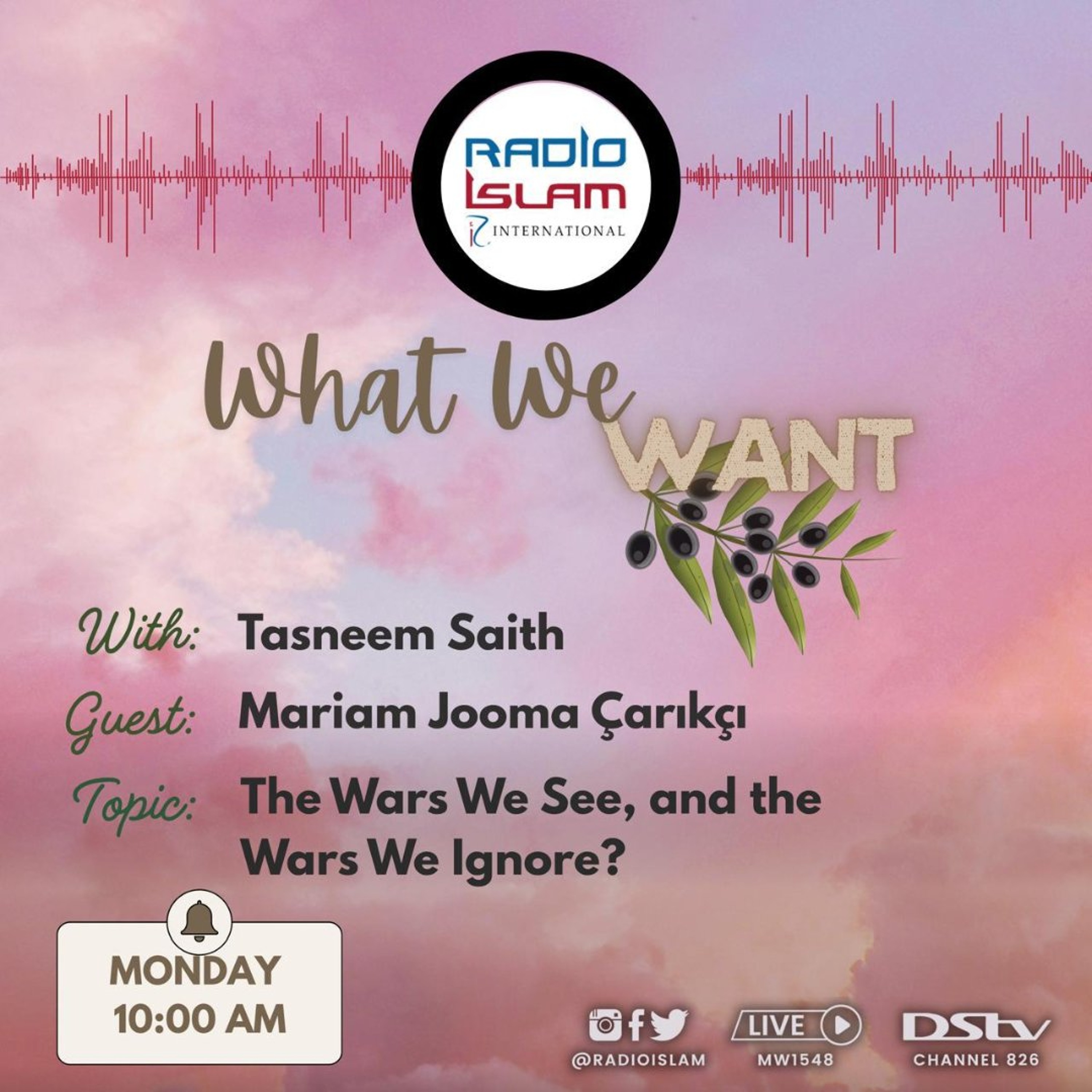
The what we want program with sister's name, safe on Radio Islam explores journaling and reflections inspired by the wisdom. Manarafa Nefsahu for Kadarafa Rabbahu, one who truly understands themselves, gains a deeper understanding of their Lord. Tune in every Monday morning from 10 to 11 a.m. on Radio Islam International. Bismillahirrahmanirrahim. All praise belongs to Allah, the creator of the world, the turn of the heart, the one who seems to remind us of the region and must you when we return. Salat insalamu ala wa bi-lavid nabi Muhammad salallahu alayhi wa salam the umahatuh muminin, his family, his friends, his companions, and all those who walk the path with truth, with sincerity.
As-salamu alaykum wa rahmatullahi wa barakatuh and welcome to what we want. I'm your host, disneyim safe. Yes, indeed. This is Shaktir Safe with Food for your soul and your favorite learning station, Radio Islam International. And alhamdulillah, jellis and us today we are having a conversation that may challenge us, make us feel a little uncomfortable, but hopefully insha'Allah also encourage us to look beyond the headlines. And we live in a world, dear listeners, where some of the wars dominate our screens. While others receive very little attention and behind every conflict we need to remember, they are humans, they are families, they are children, they are mothers, they are babies and they elderly who are vulnerable and these communities whose lives have changed overnight forever. And that is what we are talking about today, the wars we see and the wars we ignore. Joining me is someone who is, who has spent many years studying the politics, power,
and economic shaping Africa and the wider Middle East. My very special guest is an independent political analyst, researcher and writer. Her work explores some of the most important geopolitical questions of our time, from Sudan and Somalia to Palestine, Turkey's growing role in the region and the relationship between Israel and Africa. With a background in journalism in international political economy, she has worked with organizations including the Institute of Security Studies and Reuters and has contributed analysis to South African and the international media platforms. She also is the author of the book, Kurdistan, Achievable Reality or Political Mirage. To all our listeners of Radio Islam, this is Sister Miriam Jumachariccha. Assalamu Alaikum Warahmatullahi Wabarakatuh, Sister Miriam, and welcome to what we want. Walaikum, Assalam Warahmatullahi Wabarakatuh, Chazakulah Tasnim for having me,
Israeli is a pleasure. Alhamdulillah, Chazakulah, I find up with you with us. Sister Miriam, then we are just going to dive right into the topic of discussion today. So some of the wars that we have on our screens every single day we see them, right? While others barely make it even on the news. Why do you think these certain conflicts received so much attention while others are almost forgotten? Absolutely, Tasnim. So you know the thing is we tend to look at newsworthiness on a level of visibility, the scale of visibility and not necessarily the visibility of suffering. So when we look at how you know conflicts, for example, the Russia Ukraine issue has been covered, you understand that there have been you know deep analyses as to how communities exactly as you've said in your introduction have been affected deeply how the psychological impact of the war and so on has manifested especially in children and women.
But that has not been the same as we've seen with you know not just Gaza but with Kashmir, with Sudan, with the Rohingya case. And we have and as you have asked you know why why is this? And I think we have to look at how media attention works and media attention basically follows political interest and also basically the resources and the availability of those resources in terms of who is able to manifest the story in a way that makes it attention grabbing in this very attention, attention sparse economy that we have at the moment because of social media. But there's also what I have argued before a hierarchy of whose suffering is considered politically consequential. And as Africans, as South Africans we know that our continent tends to be the last on the list in terms of you know the urgency around issues that affect us.
And you've seen that Africa is repeatedly you know experienced devastating conflicts. So if we think even about the Herrero, the genocide that was committed against the Herrero people by the Germans, you know it's not even it doesn't register as a blip on the western. Political consciousness, whereas you have of course you know the example of the Holocaust is constantly given through mainstream media. So we see that there is definitely a hierarchy of humanity and that really is to do with who's interested in threatened whose resources or regional disabilities being threatened. And again to come back to the contemporary question Sudan is perhaps the question at the moment as to you know understanding not just why isn't this war being covered but whose interests are being served by keeping this war poorly understood. So people are not even sure what's going on in Sudan, normally people would say yes no they are Muslim brothers and sisters but without necessarily understanding what's happening behind it that's not a it's not a floor of the average person that's to do with how it's been covered.
So it's there's definitely no shortage of human suffering we could say but significant shortage of political attention to certain people suffering. In system, I mean you spend years looking at the politics and the power and particularly across Africa and the Middle East. But and I think it's a Sudan is really a place to an important place to start right there's so much of suffering but many of us don't fully understand what's happening there what are we missing. So you know Sudan is not simply a story of two generals fighting which is what we've been offered by the mainstream media and you know to the credit to their credit social media. Content providers from Sudan themselves have tried their best to elaborate on the fact that what's happening there is actually a consequence of a long history of just you know not not just a political fighting but it's to do with unequal development.
So if you look at how Sudan had actually you know how it was created as a state it was obviously was it fought against a British colonial rule and suffered real significant human loss but also loss of resources in terms of their actual ability to produce and the breakdown also a very interesting point of the the Sari movements in Sudan so the so the the Sufi brotherhoods in Sudan used to have and and still due to a large extent but not as significantly significant as before but they the power of the Sufi brotherhoods used to be the glue almost that kept people together and that actually facilitated communal relations. So where one tribe for example would have an issue with another to do with water resources or grazing also on you would have a system based on cherry a law of the land and Islamic law that was very well regulated through the Sufi brotherhoods and with colonialism those structures were weakened and they were made symbolic and so this is this is something I think we've seen not just
in Sudan but across the Muslim world where the separation between Islam as a form or as a how would you say a judicial system that regulates you know not just our spiritual aspects but also the economic and social relations become symbolic and superseded by a secular system. So one of the things about Sudan is that it started if you look at the Darfur question right back in 2000 early 2000s and that was to do with grazing rights between the two tribes well they're definitely more than two tribes that are involved but they were at that time the two main tribes that were kind of coming into conflict regarding particular grazing area and then also again touches on the ecological and the ecological aspect we talk about political power and military power you know quite casually without necessarily referencing the impact of global climate change on you know local communities and so you know desertification lack of water resources have all been local grievances that have then become exploited until the larger a larger platform.
So yes when it comes to Sudan I think we have to remember we can't reduce it to just two generals if you do that you understand the military battlefield but you won't necessarily understand Sudanese people's grievances which extend far beyond that. So why is the world so slow to respond to Sudan I mean who are the people or the interests that shape that response. You know I think there's as we've said there's a tendency to view African crises through humanitarian disaster framework and we don't ask who has political and economic interest at stake we look at a conflict and when I say we I mean generally the world and the media Western media that has shaped the world your Africa. I mean look myself even being someone who's familiar with Turkey if you look at the way in which Africa was understood by a fellow let's say it's not necessarily third world but a fellow global sounds if you want to put it that way in terms of its allegiance country there's very there was very little understanding of what Africa you know was the world.
You know was about aside from animals and and so on and that particular portrayal you know is very specific there's a reason for that it keeps the understanding of people's agency out of the question so it becomes a charity case Africa is a charity case so they need more aid or they need a world bank loan or they need the IMF to step in the need the UN but there is no serious discussion of what other people within those context asking for and again Sudan comes back to being a good example because if you look at how the protest had actually started with regard to opposing the military take over of the civilian government you see that it was actually started by university students and that actually has a long history and Sudanese political history where the student class at the fair and guard of changing the system yet that voice has been completely drowned out we we don't we know about the UAE's involvement we know about you know potential Israeli alliance with the UAE in Sudan but we not necessarily
we haven't asked the question of what are the actual Sudanese activists groups and opposition groups what's their position and and how have they negotiated their power within their particular context and that's why I think you know activists and academics and people like for example professor Amira Osman who is based in South Africa who is Sudanese herself and who actually has projects happening in Sudan to assist people in the world and also the people affected by the war are so important and why they need to have a bigger platform to inform us who we are a necessarily third person spectators almost and you've mentioned something about the global south you also looked at Somalia and other parts of Africa we when we look at these different conflicts do you see you you mentioned a bit of the connection between the UAE and Israel between them can you just elaborate a little bit more on that.
So the whole of Africa has become I think over the past 20 years a major site of contestation between the US Turkey the Gulf States and indeed Israel and Israel looks at Africa as a site and particularly the horn as a site for expanding its its influence in terms of you know the Israeli mindset is always about getting supported. So it's for its signers project and it's so it's about creating proxy states or proxy pro Israeli actors that will then be a bulwark against the pro Palestinian perspective and we know that Africa has generally had I mean the organization of African unity that preceded the African Union was emphatic about its support for Palestine. So in terms of the horn it is a serious area of contestation but it's important for us to understand that you know the countries that make up the horn is Ethiopia Somalia Djibouti Sudan they all have different histories but they are recurring patterns so we see a weak contested state institutions increased militarization so if you think about Djibouti alone it's got to be a lot of people.
I think it houses at these five different international military bases in that very small strip land or which means that it's using itself as a landlord basically so it's renting out its space for international military bases which has some really implications for sovereignty I mean how do we expect them to have an African Union or even a stand by force that has been you know been by the United States. So we have a lot of African Union system for a while how do we look at it as legitimate when you have you know Chinese US French and you know other Bay Russian I think is a Russian base as well based right at the you know at the tip of what is a very strategic straight so what are the connections the connections are that the that area is used as real estate for international expansion and
But again I tend to to go to the to to look at things in a way of saying yes there are those realities of the great powers but that does not remove our agency and I was listening to the thinking Muslim podcast yesterday and listening to brother Samy Hamdi was quite inspired by what you would say with regard to the question of agency about how you know we tend to to assume that the our mostly leaders are pathetic and there's nothing that we are doing and so on but the question then comes down what are we doing as individuals and Lastly, I think this is for a point that really would like again part is that you know being an activist is not a it's not a label you give yourself Anyone can I know something so you don't need to have a label of being an activist To be able to do you know kickstart that sense of ownership over what's happening in the world,
whether you are a mom that, you know, is having good conversations with your kids and discussing and debating, or teacher or shopkeeper who is emphatic about the boycott and explains to your customers why it's important. Everybody has a role to play. And I think the idea that we have some superior morality for a group of people called activists, it takes away that agency and it removes also guilt, I think, that we should be feeling for not doing enough. 100% I love that you've mentioned that. And also going back to Sudan, right? It's also in such a strategic part of the world between Africa and the Arab world and the Red Sea. How does that position also affect what's happening there? Absolutely. So as we've suggested, you know, it's at the crossroads between Africa, the Arab world, the Red Sea, the Gulf and the Nile and those are all.
And particularly, you know, the Red Sea Gulf and Nile, that's a main theater of contestation. And not just for trade, I mean, it's literally to do with livelihood. The Nile River Basin states have competing interests. If you look at the rivalry between Ethiopians who don't have a long-running rivalry, it has a lot to do with who has access over the Nile. So it's, it's coastline gives it enormous strategic significance. And Egypt also has major interests because of the Nile. So as you've said, you know, it sits within the wider competition and it involves the ports, military access and so on. So it's not geographically peripheral, which is what makes the lack of coverage actually more sinister because it is so critical to having, to understanding and to reconciling and resolving the Sudanese issue, that the reason why it's been extended for this time
can only point to, you know, sinister interests that are being, that are benefiting from its continued war. Mm. Rath is very, very important to exactly of us sharing that systemarium we're going for. A quick ad break in Shallah, hold your swords and your listeners don't go away who get into the conversation a little deeper after the break. Welcome back and we join by systemarium Shumar who is a very good political analyst on helping us understand what is definitely going on in the media world and why certain wars are not being shown to us. And systemarium, I actually saw post, I think it was on your status this morning in circling around on social media that Mr. Al-Aqsa is under a total media block out. And the style is so beautiful with our conversation this morning. Let's, let's talk about Palestine. Why has Palestine being such a major political
forline around the world? So Palestine has certainly become the question of our time. And it isn't simply another foreign policy issue as perhaps we would say Ukraine has become for Western countries. As we've seen, it is about international law. It is colonialism in its deepest and ugliest form. Occupation, sovereignty, the credibility of the international system, but also about race. And it's about whose suffering gets to be acknowledged as suffering. And I think, you know, for much of the global South, Palestine actually resonates because of the historical experience of colonialism and dispossession. And that's why I think it becomes so, how do you say, infuriating, I guess, or frustrating when you look at how particular African countries have,
and even Latin American countries and South American countries, have become aligned to Israel. And you wonder, how is that possible? If you consider your history, how could you possibly look at a state like Israel and see some form of solidarity with it. It stands for everything that actually goes against the idea of human freedom. So, you know, what it's done also is to expose these contradictions in the international system. So where we've had this language of universal human rights, we're seeing a very selective application of those principles. And that's why I think Palestine has become such a politically dividing line. And just as we've seen people that you would have expected to find solidarity with or have a sense of solidarity with the Palestinians, we've also seen unlikely alliances.
So, you know, people, particularly Western audiences who have not had media access before, suddenly finding out the truth about what's going on. And almost being confronted with an existential question of my entire life has been a lie, you know, in terms of... how the world works. And I think that that's actually why Palestine is such an important question. But again, I do emphasize that we should not have a hierarchy of victims. So, you know, it's not a competition between Palestinians or Sudanese or the Rohingya or the Kashmiris or any place in the world where we have oppressed. People, including our own South Africans and our own other African immigrants who have been experienced incredible violence recently, you know, there should be a sense as Muslims that justice is indivisible.
And we, you know, the examples Alhamdulillah of the Sahaba and the Khalif's who practiced in a way that their own families would be, you know, where they would take to test their own families or their own selves if it was in the interest of justice, you know, that was the main goal, even if it's against yourself. So, I think, you know, Palestine has opened our eyes wider. We've had the idea of Palestine, you know, as a cause. But Palestine as a microcosm of global politics is something else where you begin to understand the real similarities between what's going on and what's happening on a macro scale. So, even occupation, you know, if you look at gentrification, for example, in the Cape Town area, in the western Cape, and you look at how local people are being outpriced out of areas that have, you know, literally been there,
in their families for centuries. And now they're having to keep up with exorbitant prices because of an influx of international, basically, A.K.A. western money that, you know, sees that it is a lovely holiday spot. Then we have to understand that occupation is not just militarily, it's not just a military thing, this economic occupation, this disenfranchisement based on spatial about it that continues today. So, you know, it allows us to see the interconnectedness between people. And I think that's been both inspiring and disappointing to see some being completely unable to see the interconnectedness between a Congolese child and a child in Gaza and a child in Google Eto.
And then completely inspired, on the other hand, by people who are able to make broader connections between what's happening. I love that how you said it because I think Palestine is a critical issue and we also believe that we need to show sincere solidarity with all the other oppressed people around the world, like, recognizing, like, Runya and the Uighurs. How do you pronounce it? Uighurs, right? And those suffering across Africa, how do you stand firmly with Palestine while also recognizing that these are the other countries that are struggling and they connected also? Yes, so it's actually pronounced Uighurs. Uighurs, if you'd like, if my husband will forgive me if my pronunciation is incorrect. But, yes, how do we do that? How do we do that? It's a universal principles. And again, it's to do with not necessarily diguting Palestine
by saying, oh, yes, but there's also this and that. But it's also about, as we've said, in your everyday life. For example, as South Africans, the question we deal with every day and yet I think we forget the issue of racism and the way in which we deal with other South Africans, you know, how consistent are we in our own behavior? So we don't need to even take it beyond the household. You know, look, have a sense of what your values are and hold yourself accountable to implementing those values, no matter the context. And I think, you know, solidarity isn't diminished when we recognize another person suffering. So by saying that, you know, there are other people there. It doesn't mean that Palestine has less significance. In fact, genuine solidarity becomes stronger when it's consistently rooted in principle. You know, rather than what I would argue is selective outrage.
So based on what's happening in the news, we have, you know, that we need to take action with my boycott and then, you know, two months later, we're not as hyped up. So it's about being consistent. And I guess that also comes back down to how do so some sense, even a small act done consistently is, you know, has more worth. Then something that you do in a big scale for an intimate and period. And it's crazy how, I mean, Alhamdulillah, how the Syirah and Rasousa Rezams example, if we're able to really appreciate it from an aspect of leadership and political guidance, you know, how much it has to offer us as ordinary, I guess, Muslims. I've been dying to ask you this question. I researched, you've researched Israel's relationship with Africa. What does that relationship look like today? And why is it important for us to understand it?
So as I mentioned, Israel is looking always for proxy supporters. So ideally, there would one states, you know, that are strongly aligned with it with Israel. But because of what happened and the fact that it's become a liability. So I think we shouldn't have, we shouldn't also be, how do you say, Rose have rose into glasses and assume that, you know, the West has now suddenly woken up to the evil that Israel and Zionism is a broad. But that they've understood it's a liability. And their support for Israel then comes at a cost. So you look at the American political landscape and you realize that candidates have now understood that being pro-APAC has got a price. So where Israel then comes in in terms of Africa is that it then uses its engagement not just as diplomacy or development assistance,
which is how they have tended to present themselves from the 60s. So when Golden Mayor, the first Prime Minister, she had said, you know, Africa is kind of the next frontier for us because we need those allies. You know, the UN Africa represents a major constituency. And if you have influence over African countries, you're the UN voting is then influenced in your favor. But aside from that, you know, it has commercial and strategic areas. And in South Africa, I think we have to look at how Israel and Zionist, I guess, project has infiltrated through security and surveillance areas, agriculture, agri-tech, water technology. So if you look at those things, you know, it's like, oh, they're helping us. How nice. They're helping us learn how to, you know,
do farming or such large scale irrigation. How lovely. But when you look at what actually happens in that process, you get locked into an agreement with them where you can only use Israeli suppliers, you can only use particular, you know, products. And you essentially become a consumer. So Israel's influence in Africa has a lot to do with undermining the concept of sovereignty. But it's a very sinister and how do I say a subversive form of it. So again, as we said, it's not military, military. It comes through economic, economic outmossiling, I guess, of the local economy. And so it's a relationship with Africa is not static, you know, and it's not also a conspiracy. There's real diplomatic, commercial security and political interests that I play. If you look at how they've interacted with traditional leaders in South Africa,
you know, bypassing the South African government and going straight to traditional leaders and setting up, you know, projects supposedly development projects with communities in rural South Africa. But why would you bypass the state? It's because the state's position on Israel is, you know, is not something that they appreciate. So then they go into subverting your power. And that's where you look where you find the case of the hollowing out of the state. So just as we've had with the Gupta's, for example, or we've had with apartheid architects who've manipulated the state for their own benefit, you have now with the Zionist infiltration a state that is essentially outsourced to private interests that are not based in South Africa. So if you look at the guy who actually funds most of the political parties, opposition parties in South Africa,
he's a, you know, he's a Zionist. He sits on the board of the organization that actually supports IDF soldiers. But he's given over 100 million rent to opposition parties in South Africa. And when you ask where he's made that money, you look deeper into it, that the Daily Maverick did some great research on this and great reporting on this and also the investigative unit of the Daily Maverick. They've come up with some great evidence that show that actually this guy, Moshal, has made his money off of being basically the owner of Superbett, which Superbett is a gambling company, yes, and a sign. And then you feel, look at what does gambling do? What are the social yields that come with gambling and how?
Is it that the poorest of the poor in South Africa, the ones who spend the most of their money on gambling? And then you ask the question, are immigrants, for example, as Chisinthar has to say, that immigrants are at the root cause of South Africa's economic issue? Or is it people like this Moshal guy who's actually infiltrated the system to such an extent that he's not even aware of the damage that is being done on a very micro family level with the industry that he breaks? And it has political consequences because the parties that he funds have been hesitant to be strong on the gambling licenses and the provisions around restricting gambling. And they actually have a whole system that's allowing indigents on Africans to basically wallow and offer the internet and yet be seen as vanguards of democracy.
I love how beautifully, absolutely well you've articulated that. Yes, exactly, it's about capitalism, the power struggle. And we don't really understand it as normal citizens in South Africa. This is the struggles that are connected by certain people who have that power. So, Sister Mariam, I think you have martiala work in journalism, including with the Reuters Institute of Security Studies. From your experience, why do some stories become impossible to ignore while others start up to get any attention? I journalism isn't produced in a vacuum. And previously, I mean, it's been a bit of a mess. Young journalism graduate, you know, the editor was the be all and end all of your story. So, no matter how brilliant you might have thought it was, if the editor said no, it's no.
However, we have social media now that bypasses the editorial process. But what, you know, previously it was a matter of resources saying, okay, we can only have on page one, we need to have this story because this is more compelling than the page two story. But now it's not just a matter of what goes on each page, but it's how long is this video? How much time will it take for me to actually understand this concept that they're trying to put forward? So, it's the attention economy as many media theorists have now articulated recently, in particular, that, you know, we are fighting judges for resources, but we literally, as media practitioners, you are scrambling for people's attention. And I think that makes a huge difference because it then dumbs down. You'd have to dumb down the news to make it more almost palatable.
So, provided in a video format, not reading because people don't read. Then it might have some kind of entertainment element, maybe a good soundtrack that will get people to, you know, keep their attention and not swipe. And essentially, it comes down to, I think, you know, if we think about it, the jihilification of knowledge. So, you have the information, but it's not benefiting from it. And I think that is where is the biggest question, you know, is how do we, as perhaps Muslim journalists, how do we help to improve the situation and not just create Muslim organizations, because I think there's a tendency to people to feel like, oh, okay, then we might just create our own one, and then we have our own, I think, like, Al Jazeera, for example, then that's... But it's more than, you know, changing one system for another, it's to do with how do you actually... What are you offering?
What are you offering? What is news? Why is it news? Why is it actual impact of your news? Why do you want people to do with it? And yeah, that's a big question that I don't have the answer to, and I think Alhamdulillah, we've got brilliant strategists, you know, who have been thinking about it for some time. And in Shahrullah, we will find our way. We will find our way. A system where you're in closing, or I know we're almost wrapping up towards the end of the program, but just a little bit on the digital upside, if you can give us a bit of insights, why they have, and why is they playing currently on the ground, your most general upside in Shahrullah? You know, I would be misplaced if I said I had any definitive answer for you. I honestly don't know what the most recent moves are, but I do think that as many, many writers and activists have said before,
just importantly, the conflation between the dome of the rock and the rock and the rock sign itself, that's already been a quite a strategic win-fold for designers, by, you know, not allowing us to understand exactly what is being, what area are we talking about? And as many people have said before, I mean those who are knowledgeable, more knowledgeable than myself, that the whole area that surrounds the precinct, that's considered part of Mash'ra-Uksa. So, whether it's shops or marketplaces or whatever, that within the synetics, all part of that. And, yeah, I think the idea that, you know, it's a simple, not simple, but I mean within just the most precinct alone, is again a strategic thing, you know, so that we forget that the excavation of land and occupation of other sites close by, also part of Mash'ra-Uksa itself, which means that they try to remove the urgency around,
which we should be thinking about and acting with regard to Palestine. But I do also want to just say that, you know, it kind of enclosing, that we should always understand that people are not just statistics, right? And the Palestinians have shown us, the Surinis have shown us, through their resilience, of how they continue to, you know, marry, celebrate, educate, give birth, within the context of violence, that life continues, and that there is joy. So, that also means that we need to respect the fact that they are a very complex, you know, individuals, they complex human beings that are being affected by all of this. And they're not just categories, they're not a humanitarian crisis, they're not a political crisis, they're not collateral. And if we're able to internalize that for ourselves, it does motivate, I think, it does motivate you to say, you know, I can make a difference, even if I feel I'm just maybe a stay at home mom,
that's not necessarily interested in world politics, but by my appreciation for another mother in, you know, in Xinjiang, who's been oppressed for simply wearing her job, that allows us to connect as a mother. Thank you, Zahkala, so much, Sister Miriam, I have to say, I'm really grateful for you, you such a humble soul, Mashallah, for just sharing your knowledge and helping us look beyond the headlines and understanding so much that you want to act with us today, I really have to say, I use Zahkala for your time. And I think these difficult conversations are very, very necessary, important for us to have on such platforms. Zahkala, so much for having me, it's only been a pleasure, and my little, take your show and the channel from strength to strength. Zahkala, I'm very grateful for you, I think, for every person around the world,
whether you in Sudan, in Palestine, in Kashmir, in Ruinia, wherever you are, wherever you're facing oppression, in Africa, in South Africa, may Allah, I think protect all the vans, all the vans out there, and open our hearts as people to see the suffering of people suffering, like to see them suffering everywhere in the world. So, yeah, Zahkala, Sister Miriam, if there's anything you'd like to quickly share with us, or yeah, to our listeners, just a bit of advice. Oh, no, Subhanallah, I think, you know, exactly as you've said, that we continue to, you know, not just create, but solidify our bonds of brotherhood across humanity, and not just between us as Muslims. And as South Africans that are facing an interesting time, I think, when there's a whole discussion around Muslim identity in South Africa, now's the time for us to be able to express all the Islamic ethos that we know we have.
With regard to neighbours and interactions on a daily level, how do we just make someone else's day brighter? And by doing so, emphasize that Islam is about bringing goodness to the world. JazakAllah, here, and as you mentioned, searching and researching and learning from the Syirah of the name of Muhammad, Salallahu alayhi wa sallam. So, JazakAllah, here again, and to all our listeners, remember, solidarity should never be selective. And every human deserves justice, integrity, and compression. So, until next week, same time, same place, from myself to the steam, and my very special guest, system, Miriam, we leave you all with peace. This is what we want. Assalamu alaikum warahmatullahi wa barakatuh.
More episodes