Loading...
educationself improvementhealth
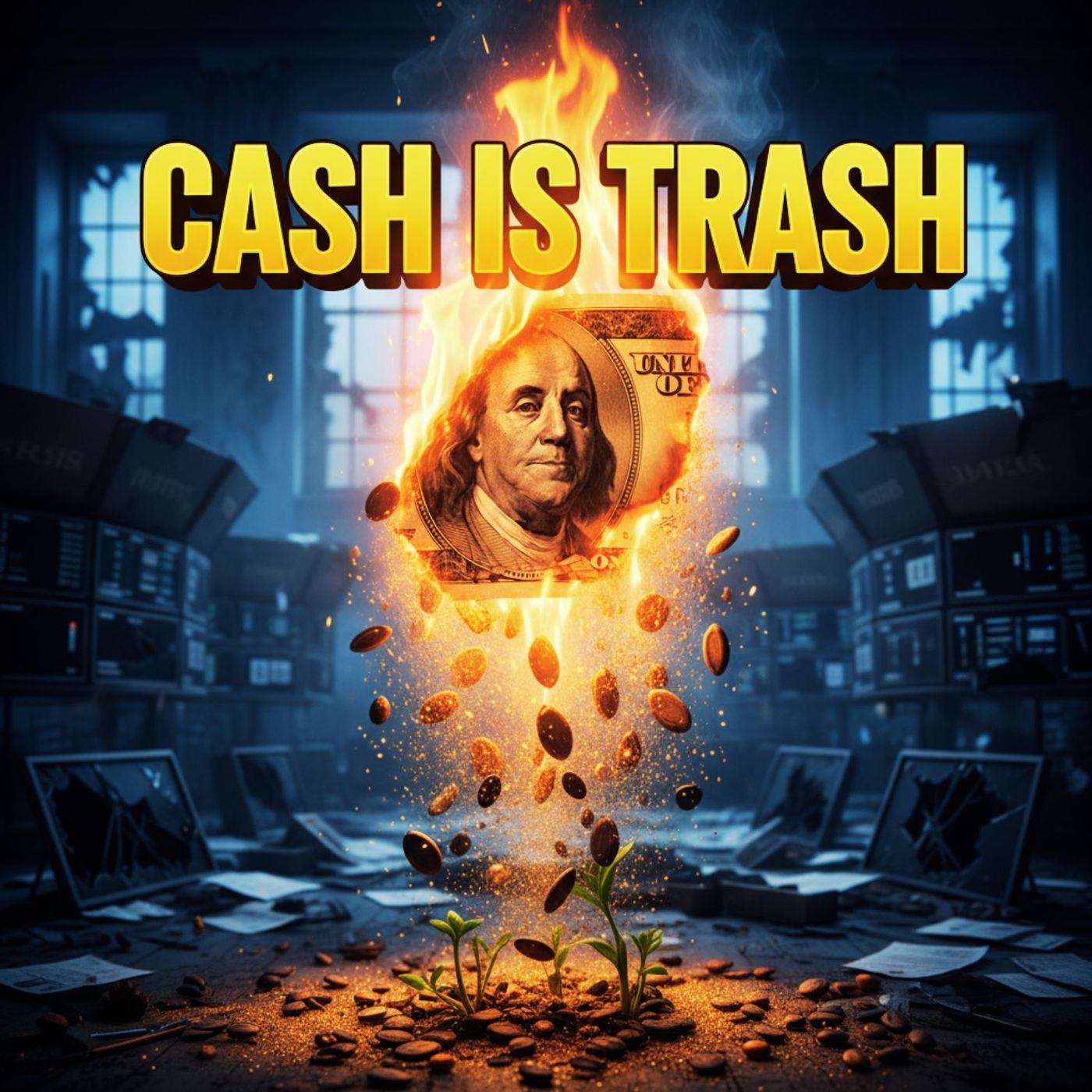
When Money Dies: The 6 Assets That Outlive Empires
About this Episode
Is Your Bank Account a Ticking Time Bomb? The 4,000-Year Secret to Surviving Economic Collapse
What if the numbers in your savings account aren't actually money, but a countdown to zero? 📉 History has a brutal track record: from the denarius of Ancient Rome to the modern-day bolivar, every single fiat currency in human history has eventually returned to its intrinsic value—nothing.
In this episode, we’re stripping away the jargon to reveal why savers are losers and how the elite actually protect their legacy when monetary systems crumble. This isn't just about 'inflation'—it's about the systemic currency failure that resets the global stage every few generations. If you think your pension is safe, this might be the most controversial (and vital) wake-up call you’ll ever hear. 🏛️🔥
The 6 Assets That Survive the Crash
While paper burns, these tangible assets remain the ultimate safeguards of wealth preservation. We break down the historical blueprints of the 'Great Resets' past and identify the only six things you should own before hyperinflation hits your doorstep:
We are currently witnessing a shift in the global financial security landscape that mirrors the falls of empires past. Whether it’s Venezuela, Zimbabwe, or the Weimar Republic, the patterns are identical. This episode isn’t just about fear; it’s about financial sovereignty and the peace of mind that comes from holding physical assets instead of digital promises. 🛡️
Don't let your hard-earned prosperity vanish into thin air. Learn how to transform your 'paper wealth' into a legacy that lasts.
🚀 STOP RELYING ON THE SYSTEM. Subscribe now to master the art of wealth preservation and share this episode with someone who needs to hear the truth before the next economic collapse.
#CurrencyCollapse #WealthPreservation #FiatMoney #FinancialSovereignty #GoldAndSilver #RealEstateInvesting #EconomicHistory #Hyperinflation
Become a supporter of this podcast: https://www.spreaker.com/podcast/life-hacks-diy-more-transform-your-everyday-with-simple-tricks-and-diy-magic--5995484/support.
You May also Like my other FREE web apps:
SkyNearMe.com – Your all-in-one "Sky Super-App." Track real-time weather, sunset and air quality, stargazing conditions, 5G signal mapping, drone flight zones, solar potential, track satellites, rocket launches, UFO sightings in your local airspace and even get your Sky Horoscope and more!
MyDisasterPrepKit.com – Gamified survival training. Generate custom survival plans and simulate scenarios ranging from hurricanes to zombie outbreaks.
🤖Nudgrr.com (🗣'nudger") - Your AI Sidekick for Getting Sh*t Done
Nudgrr breaks down your biggest goals into tiny, doable steps — then nudges you to actually do them.
What if the numbers in your savings account aren't actually money, but a countdown to zero? 📉 History has a brutal track record: from the denarius of Ancient Rome to the modern-day bolivar, every single fiat currency in human history has eventually returned to its intrinsic value—nothing.
In this episode, we’re stripping away the jargon to reveal why savers are losers and how the elite actually protect their legacy when monetary systems crumble. This isn't just about 'inflation'—it's about the systemic currency failure that resets the global stage every few generations. If you think your pension is safe, this might be the most controversial (and vital) wake-up call you’ll ever hear. 🏛️🔥
The 6 Assets That Survive the Crash
While paper burns, these tangible assets remain the ultimate safeguards of wealth preservation. We break down the historical blueprints of the 'Great Resets' past and identify the only six things you should own before hyperinflation hits your doorstep:
- 🚜 Productive Land: The ultimate hedge that provides both utility and life-sustaining resources.
- 🥇 Precious Metals: Why Gold and Silver have remained the world's most honest money for four millennia.
- 🛠️ Essential Skills: The one asset the government can't tax, seize, or devalue.
- 🏠 Strategic Real Estate: How to maintain equity and shelter when traditional savings evaporate.
- 💱 Foreign Currencies: Navigating the geopolitical chess board to avoid being trapped in a failing domestic economy.
- 📈 Pricing Power Businesses: Why owning a company that can raise prices at will is the ultimate inflation-proof strategy.
We are currently witnessing a shift in the global financial security landscape that mirrors the falls of empires past. Whether it’s Venezuela, Zimbabwe, or the Weimar Republic, the patterns are identical. This episode isn’t just about fear; it’s about financial sovereignty and the peace of mind that comes from holding physical assets instead of digital promises. 🛡️
Don't let your hard-earned prosperity vanish into thin air. Learn how to transform your 'paper wealth' into a legacy that lasts.
🚀 STOP RELYING ON THE SYSTEM. Subscribe now to master the art of wealth preservation and share this episode with someone who needs to hear the truth before the next economic collapse.
#CurrencyCollapse #WealthPreservation #FiatMoney #FinancialSovereignty #GoldAndSilver #RealEstateInvesting #EconomicHistory #Hyperinflation
Become a supporter of this podcast: https://www.spreaker.com/podcast/life-hacks-diy-more-transform-your-everyday-with-simple-tricks-and-diy-magic--5995484/support.
You May also Like my other FREE web apps:
SkyNearMe.com – Your all-in-one "Sky Super-App." Track real-time weather, sunset and air quality, stargazing conditions, 5G signal mapping, drone flight zones, solar potential, track satellites, rocket launches, UFO sightings in your local airspace and even get your Sky Horoscope and more!
MyDisasterPrepKit.com – Gamified survival training. Generate custom survival plans and simulate scenarios ranging from hurricanes to zombie outbreaks.
🤖Nudgrr.com (🗣'nudger") - Your AI Sidekick for Getting Sh*t Done
Nudgrr breaks down your biggest goals into tiny, doable steps — then nudges you to actually do them.
Hosts & Guests
Transcript
At the UPS store, re-insure your small viz stand out with a variety of high quality paper stock options,
banners, posters for stores, and more.
Most locations are independently owned.
Product services pricing and hours of operation may vary.
See center for details.
The UPS store.
Be unstoppable.
Come into your local store today and get your print on.
Drew McIntyre here from WWE.
Wheeled in the claymore can be a life of chaos.
When I'm not dominating in the ring,
Chumba Casino is how this warrior takes a wee break.
With hundreds of online social games and new weekly releases,
there's always something fresh to try.
And those daily busts, next level.
Even my free time feels like foul howling.
So when life feels like a battle,
kick up your feet, have some fun.
And let's Chumba.
No purchase necessary.
VGW Group Void were prohibited by law, CTs and Cs.
21 Plus sponsored by Chumba Casino.
So I want you to just picture the scene for a second.
We are in Vimar, Germany.
Right.
It's 1923.
And we're standing right in the middle of the bustling cosmopolitan heart of Berlin.
And I want you to imagine this man,
let's call him Friedrich.
Okay.
Friedrich is, he's a banker, he's sophisticated, highly educated.
He spent the last, I don't know, 30 years meticulously building
what anyone, literally anyone would consider
a profoundly responsible fortune.
A very safe portfolio.
Exactly.
He played entirely by the rules.
Yeah.
He holds this massive portfolio of government bonds.
He's got a guaranteed state pension,
a robust savings account
at one of the most prestigious marble-columned banks in Berlin.
Right.
The establishment.
Yeah.
And if you looked at his ledger in 1915 or even 1920,
he was wealthy.
He was a secure man.
But by November of 1923,
Friedrich is standing on a freezing street corner,
staring at a bakery window
and realizing with this absolute mind-shattering horror
that his entire life savings,
yeah, three decades of discipline,
of compound interest, wealth accumulation,
it literally cannot buy him a single,
stale loaf of bread.
The psychological violence of that moment is,
I mean, it is almost impossible for us to fully grasp today.
It's terrifying.
It really is.
Because everything he worked for,
his entire life's energy was denominated in German marks.
And by that November, those marks weren't just, you know,
devalued, they were completely, functionally extinct
as a store of value.
Right.
People were literally sweeping them into the gutters
or using them to wallpaper their homes
because the paper itself was cheaper
than buying actual wallpaper.
That's just so wild to think about.
Yeah, the sheer velocity of that evaporation
is really the defining characteristic of these events.
And right there, that exact moment
is where this story gets totally fascinating.
Because I want to take you, the listener,
just 40 miles outside of that exact same city,
away from the mahogany desks in the financial districts.
Out there in the mud in the cold, we find a wheat farmer.
Totally different world.
Completely.
This is a guy with no formal education,
a zero financial sophistication.
He doesn't have a stockbroker or any connections
to the elite political circles,
yet in that exact same month,
under the exact same crushing national crisis,
he is richer and more powerful
than he has ever been his entire life.
Because of what he holds.
Right.
His great, the physical tangible wheat
he's literally pulling out of the frozen earth
is worth exponentially more every single day.
The historical record from that period
is just full of these surreal,
almost hallucinatory economic conversions.
Oh, absolutely.
You had desperate people from the city
traveling out to these rural farms
dragging family heirlooms through the dirt.
We're talking grand pianos,
generations of families still.
Sure, coves, diamond necklaces.
Yes, trading them to confused farmers
just for basic saxophower or a side of beef.
There's literally a documented case
of a pig farmer,
trading a single hog for a grand piano.
Wow.
An instrument that just a few years prior
would have taken a senior banker
like Friedrich, months of his salary,
just to afford.
It's the ultimate inversion
of the social and economic order.
It just turns the entire hierarchy
completely upside down, practically overnight.
It does.
You have the exact same macro economic crisis,
the exact same year, same country,
same government policies.
But you end up with completely,
totally opposite outcomes for these two men.
One is reduced to absolute zero.
And the other.
The other becomes the new aristocracy.
And that contrast,
that specific dynamic,
is exactly what we're unpacking in this deep dive.
Our entire mission today
is to explore a fundamental recurring question
that honestly,
most of us never really want to think about.
Which is human nature.
Exactly.
What actually separates those
who lose absolutely everything
from those who survive
and even thrive
when a national currency dies?
Yeah.
Because the thing that separated
that sophisticated banker
and the uneducated farmer,
it wasn't luck.
No, not at all.
It wasn't about who was smarter
or about timing the market perfectly.
It was entirely 100%
about this specific physical nature
of what they held when the music stopped.
We are going to explore the things
that survive when money dies.
And we really need to establish the stakes
right here at the top.
It's incredibly easy for us,
you know, sitting here
in the modern era with our iPhones
and our frictionless digital payment apps
to look at a story from 1923 Germany
and just write it off.
Right, like it's ancient history.
Exactly.
We view it as this
grainy, black and white photograph
of some bizarre historical anomaly
that couldn't possibly happen
in our highly digitized,
super sophisticated global economy.
But the reality of the historical record
is chillingly clear.
And it does not care
about our modern hubris.
Not one bit.
Every single fiat currency
and by that I mean paper
or digital money back
by nothing the government
to create in the threat of force.
Every single one ever created
in the history of human civilization
has eventually either entirely collapsed
or lost the vast vast majority
of its purchasing power.
Every single one.
Everyone.
This isn't some fringe economic theory.
It is a mathematical
and historical certainty.
I mean, even the US dollar
which we consider the absolute
bedrock of the modern global financial system
has lost over 96%
of its purchasing power
since the Federal Reserve was created.
96% that's staggering.
We aren't standing outside
of this historical pattern looking
in, we're living right in the middle of it.
Okay, let's unpack this.
We've got a massive blueprint
for this deep dive.
We're going to trace a 4,000 year
historical pattern of financial survival.
We're going back through the archives,
looking at major currency crises,
hyperinflations,
and financial collapses
across recorded history
from ancient empires
all the way to modern nation states.
It's a long timeline.
It really is.
And what we're going to do is
isolate six specific
historically proven
crisis-proof asset classes.
The names and
the packaging of these assets
might shift slightly over the centuries
but they're underlying
mechanical nature never changes.
So we're going to break down exactly
what they are
and more importantly,
we're going to explain the underlying
mechanics of why they keep working
when absolutely
everything else burns to the ground.
And the first step in this process
really requires dismantling
a very dangerous,
very pervasive illusion.
It's what we can call
the illusion of paper safety.
Okay, what does that mean exactly?
Well, if you walk into a
standard financial advisor's office
today and ask them to protect your wealth,
they're going to give you a list of assets
they consider inherently safe.
They'll talk about high yield savings accounts,
sovereign government bonds,
certificates of deposit, fixed income,
corporate pensions.
Right, the stuff everyone says you should have.
Exactly.
In the modern financial paradigm,
these are the responsible,
conservative choices.
But the historical track record
of monetary failure
shows us something absolutely terrifying.
Which is?
Those exact instruments,
the ones universally labeled
by the establishment as the safest,
are structurally guaranteed
to be the very first things
completely wiped out.
The responsible assets
actually become the most toxic assets.
It's a complete paradox.
But why?
I mean, explain the mechanism
there for us.
Why does this supposed safety
turn out to be a trap?
The moment a system is actually pressure-tested.
To understand the mechanics of that failure,
we kind of have to strip away
all the financial jargon
and look at what money actually is at its core.
Money, especially a fiat currency,
is essentially just a societal scorecard.
Oh, scorecard?
Yeah, it's an accounting system
we've collectively agreed to use
to keep track of who owes what to whom.
It's a measurement of value,
not the value itself.
Okay, that makes sense.
The actual game of human survival
and human civilization
is about tangible value.
It's about chloric energy,
shelter, physical security,
raw materials, utility.
Now, in stable, peaceful times,
the scorecard and the game
are perfectly synchronized.
Right, a dollar bill smoothly
and reliably translates
into a gallon of milk.
Or a gallon of gas.
Exactly.
We trust the translation mechanism,
but when a sovereign currency fails,
which is usually because a government
has printed far too much of it to cover debts
they can't actually pay,
the scorecard violently disconnects
from the actual game.
Oh, well, so the numbers lose their meaning.
Precisely.
The paper notes
or the digital digits in your bank account
represent a promise that society
can literally no longer keep.
The underlying resources
haven't necessarily vanished,
but the measurement tool
is fundamentally broken.
So if your entire net worth
is tied up in the scorecard
in bonds, in cash,
in fixed pensions,
you hold nothing but broken promises.
Well, all the guy with the wheat.
Exactly.
If you hold the tangible pieces
of the game itself, you survive.
Wait, let me stop you right there
because I know what you listening
to this might be thinking.
Real modern financial system
feels incredibly permanent.
It's completely digitized.
It's instantaneous.
It's literally woven
into the fabric of the internet itself.
Sure, it feels unshakable.
Right, trillions of dollars
cross the globe
in milliseconds via fiber optic cables.
Are we really supposed to believe
that a highly encrypted
digitized dollar
moving through the swift banking system
operates on the exact same
fragile psychological rules
as a piece of paper rolling off
a steam press in Weimar, Germany?
Or I don't know,
some Roman silver coin
being clipped by an emperor
two thousand years ago.
It's the most common objection.
And honestly, it's a completely
understandable one
because the technology blinds us
to the underlying economics.
But the medium of exchange
absolutely does not change
the mathematics
or the human psychology of the system.
So the rules are exactly the same.
Exactly the same.
Let's look at the core mechanism.
It's the creation of currency
by decree, right?
Expanding the money supply
faster than the actual
economic output of the society.
Okay.
Whether the unit of account
is stamped on a physical silver coin
that an ancient emperor
is secretly melting down
and mixing with cheap copper
to fund his wars
or it's a piece of paper
rolling off a printing press
to pay war reparations in the 1920s.
Or it's essential bank chairman today
simply adding a digital zero
to a master spreadsheet
to buy treasury bonds.
It is the exact same mechanism
of fiat debasement.
As wow.
In fact, the digital nature
of our current system
doesn't make it safer.
It arguably makes the potential
speed of collapse
terrifyingly faster.
It means the score card
can be diluted with a literal
keystroke instantly
without the logistical friction
of actually cutting down trees
and printing physical paper.
That is a deeply,
deeply unsettling thought.
Just think about the profound
cognitive dissonance
of living through that moment.
It breaks people.
I can imagine.
Imagine you wake up,
you pour your coffee
and you log into your mobile banking app.
The user interface is exactly
the same as it was yesterday.
The biometric face scan works perfectly.
The font is the same.
Nothing looks wrong.
Exactly.
The numbers on the screen,
your life savings,
your checking account balance
are absolutely identical
to what they were 24 hours ago.
Not a single digit has moved.
You feel mathematically secure.
But then you walk outside,
you drive to the grocery store
and you realize
that the real world purchasing power
of those identical numbers
has just evaporated.
The price of beef is quite droopled.
The gas station is rationing fuel.
The psychological shock
of seeing your wealth
exist perfectly on a glowing screen.
But realize it no longer exists
in physical reality.
Yeah.
It must just absolutely break people's minds.
It shatters their entire world view.
That's exactly what happened to Friedrich,
our Vimar banker.
His bank statements
looked pristine.
The math was flawless.
But the reality was gone.
Man.
And this leads us to the fundamental
behavioral shift
that happens in every single one of these crises
across all cultures and all centuries.
Tyler Reddick here from 2311 Racing.
Another checkered flag for the books.
Time to celebrate with Chamba.
Jump in at chambacasino.com.
Let's Chamba.
No purchase necessary.
VTW Group.
Void work prohibited by law.
CCNC, 21 plus sponsored by Chamba Casino.
When paper and digital promises burn,
when the abstract scorecard catches fire
and loses the trust of the public,
humanity instinctively
violently retreats to the physical earth itself.
Which brings us to the first
of our six historically proven assets.
The ground beneath our feet.
Yeah, land.
But we have to be incredibly specific here.
Right?
We aren't talking about buying a speculative plot
of arid desert in Nevada
that just sits as a line item
on a sprawling investment portfolio spreadsheet.
Where your only hope is some developer
buys it in 10 years.
Exactly.
We are talking strictly about productive land.
The kind of land that grows caloric energy.
The kind that holds mineral wealth.
The kind that sits on an aquifer of freshwater
or as a river running through it.
Productive is the absolute operative word here.
You really have to think about what happens
to an economy during hyperinflation.
The complex financial derivatives die.
The stock market might completely detach from reality.
But the underlying biological reality
of the human being does not stop.
We still get hungry.
Exactly.
People still have to consume
a couple of thousand calories every single day
just to stay alive.
They still need a physical structure
to survive the winter.
They need timber, fuel, raw materials
to fix broken machinery.
Whoever legally and physically controls
the absolute source of those essential human requirements
holds real unshakable geopolitical
and economic power.
And it doesn't matter what the central bank is doing.
Not at all.
They hold that power completely
regardless of what the central bank
is doing with the money supply.
We saw this play out with the Vi-Mar farmers
we opened the show with.
They didn't just survive the chaos.
They dictated the new terms of reality.
Right.
Because they had the wheat,
they could demand payment
in whatever retained value.
Gold, foreign currency,
pianos.
Exactly.
But let's bring this out of the history books
and into the modern era.
Look at Zimbabwe in 2008.
This is an ancient history.
This happened in a world
with the internet and cell phones.
Zimbabwe is the perfect modern parallel to study.
You had a textbook case
of extreme hyperinflation.
We're talking astronomical,
almost comical numbers
where a $100 trillion bank note
couldn't buy a single loaf of bread
or even a bus ticket.
$100 trillion.
Yeah.
And when you look at the demographic divide
during that collapse,
it perfectly mirrors Vi-Mar Germany.
You had urban professionals,
people living in horror,
accountants, lawyers,
government workers.
People who did everything right.
Right.
Technically, on paper,
they were multi-billionaires
or trillionaires in their savings accounts.
And they were quite literally starving
to death in their apartments.
They were entirely dependent
on the abstract scorecard.
And what about outside the cities?
Meanwhile, out in the rural provinces,
you had subsistence farmers.
These people had zero bank accounts.
But they held productive land
and they held livestock.
They had chickens, cows, maize.
In a society where the money had died,
those farmers held the ultimate trading power.
They possessed the tangible caloric assets
that desperate city dwellers
would trade absolutely anything to acquire.
Let me try to put this into a perspective
that hits a little closer to home
for you listening right now.
Try this thought experiment.
Imagine a prolonged,
severe power grid failure
in a modern affluent suburban neighborhood.
Okay, grid goes down.
Yeah, we're talking a massive blackout
that goes on for weeks, maybe months.
Supply chains freeze.
Suddenly, the guy living in the massive house
at the end of the cul-de-sac,
who has a multi-million dollar stock portfolio,
a fleet of luxury cars,
and a bank account full of digital zeros.
He is completely utterly helpless.
Right, he can't eat his stock portfolio.
He can't.
His Tesla won't charge.
His digital money can't be accessed
because the ATMs are dead.
But his neighbor,
a guy who maybe isn't wealthy
by traditional Wall Street standards,
but who happens to have a thriving,
massive permaculture vegetable garden
in his backyard,
a flock of egg-ling chickens
and a hand-crank deep water well.
That changes everything.
That person instantly overnight
becomes the single most important,
powerful and wealthy person
in a five-mile radius.
In a true crisis,
the very definition of wealth
violently transitions.
It goes from being defined by
what you claim on a piece of paper,
to be entirely defined by
what you can physically provide to your community.
That analogy perfectly captures
the underlying mechanism.
What productive land provides
is ultimate independence
from the monetary system.
A bushel of wheat
contains the exact same amount
of caloric energy,
it digests in the human stomach
the exact same way,
and it feeds a family
just as effectively,
whether the local currency
is worth a hundred cents,
half a cent,
or is completely abolished.
Doesn't care about the federal reserve.
The nutritional value
of the protein and the chicken egg
doesn't give a damn
about the Fed's interest rate policies
or quantitative easing.
That utter, profound
independence from the abstract
financial system
is exactly what makes productive land
the oldest,
most foundational,
crisis-proof asset in human history.
Okay, so productive land is the ultimate anchor,
but land has a major
glaring potentially fatal flaw
in certain types of crises.
It's stuck.
Exactly.
It is entirely geographically fixed.
You cannot put 50 acres
of fertile farmland in your suitcase
if the political regime suddenly
turns hostile,
starts seizing property,
and you need to flee across the border
in the middle of the night.
You're trapped.
Right.
So if land represents
static, anchored wealth,
how do humans protect themselves
when they need mobile survival,
when they need to pack up
their entire life's value and just move?
That exact vulnerability
is what historically drives
populations to the second asset.
It is the ancient default
that survives every single systemic collapse,
gold.
Uh, gold.
And right away,
before we even dig into the mechanics of it,
we really need to strip away
the modern cultural stigma surrounding it.
In modern finance,
gold is often mocked, right?
It's associated with
doomsday preppers or conspiracy theories
or eccentric internet gold bugs.
Yeah, people roll their eyes.
But the historical reliance on gold
by the wealthiest families
and institutions on earth
has absolutely nothing to do with paranoia.
It is based on cold, hard mathematics
and highly predictable human behavioral psychology.
Right, because think about what happens
when a fiat currency fails.
The society doesn't just sit down
and wait for death.
No, life goes on.
They don't just stop trading.
Complex economy still exists.
People still live in cities.
You still need a plumber.
You still need a doctor.
You still need to buy shoes.
And to facilitate that complex trade,
you desperately need a medium of exchange.
You can't just barter chickens
for complex neurosurgery.
Exactly.
The logistics of pure barter breakdown.
The society needs a functional money.
Not eventually, not when a new central bank
is formed five years later,
but immediately that very afternoon.
And for four thousand years,
the universally agreed upon default
in that exact moment of panic
has always been gold.
We have to ask why, though.
Why gold and not copper or silver or platinum
or, I don't know, seashells?
Right.
It's not because gold is magical
or possesses some mystical intrinsic energy.
It's because purely from a chemical
and logistical standpoint,
it perfectly solves the physical problem of money.
How so?
Well, it is instantly recognizable
across almost all global cultures.
It doesn't tarnish or degrade over time.
A gold coin from the Roman Empire
looks exactly the same today as the day it was minted.
This true.
It is divisible into smaller units
without losing its proportionate value.
It is highly portable.
You can carry a tremendous amount
of stored purchasing power
in a very small physical space,
like just a few coins in your pocket.
Which solves the mobility problem.
Exactly.
And critically, perhaps the most important feature
during a hyperinflationary spiral.
Absolutely no government,
no central bank,
no matter how politically powerful or desperate
can simply print more physical gold
into existence to fund their deficits.
Its scarcity is anchored in the laws of physics,
not the promises of politicians.
Let's look at how brutal this dynamic
can be by examining the French Revolution
because I love this historical case study.
It perfectly illustrates the trap of paper money
backed by false promises.
Oh, the asignus.
Yes.
During the Revolution,
the new French government was essentially broke.
They had massive debts,
they were fighting wars,
and they desperately needed liquidity.
So they came up with this seemingly brilliant plan.
They confiscated massive tracks
of incredibly valuable land from the Catholic Church.
A huge wealth transfer.
It's huge.
And they issued a new paper currency called Asignats.
The pitch to the public was,
look, this isn't just arbitrary paper.
These notes are directly backed
by the real, tangible value
of this confiscated real estate.
It's safe.
And for a brief fleeting period,
the public actually believed them.
The illusion held.
People trusted the Asignats
because the underlying collateral,
the land was visibly real.
But then the insidious temptation
that ultimately destroys every single
fiat currency system in history took over.
They couldn't help themselves.
The revolutionary government's expenses
just kept growing.
The wars got more expensive.
And the political pressure
to simply print more money became overwhelming.
So they started printing more and more Asignats,
completely detaching the paper supply
from the actual value of the church lands backing them.
They flooded the zone.
They flooded the zone with paper.
Within a span of just five years,
those paper notes had lost over 99%
of their purchasing power.
Five years.
I mean, that's a blink of an eye historically.
Imagine saving for 30 years
and having it all wiped out in 60 months.
It's devastating.
And the wealth divide
that this created in the French population
was absolutely brutal.
The historical data shows a clear divergence.
The people who looked
at the macroeconomic situation
recognized the political temptation
to over print early
and quickly converted their paper Asignats
into physical gold.
They preserved their family wealth.
They survived.
They survived the chaos of the revolution
economically intact.
They were able to flee or rebuild.
The people who trusted a state
who believed the government's promises,
who patriotically held onto the paper currency as a crash,
they lost absolutely everything.
They were decimated.
What's fascinating here
is that this exact dynamic
isn't isolated to 18th century France.
We've seen it repeat
with the precision of a metronome.
Over and over.
We saw it in Argentina
during the grueling economic chaos
and debt defaults of the 1980s.
We saw it in Russia in the 1990s
where the rubble entirely disintegrated,
wiping out the savings of an entire generation
after the fall of the Soviet Union.
We saw it in Venezuela over the last decade.
Same exact story.
Gold performs its specific historical function.
But that function is fundamentally misunderstood
by mainstream financial media today.
You constantly hear financial pundits say,
gold is a bad investment
because it doesn't pay a yield.
It doesn't compound like a tech stock.
Right, they compare it to Apple or Amazon.
Exactly, which fundamentally misses the point.
Gold is not designed to make you fabulously wealthy
during times of peace, stability, and credit expansion.
That's what equities, real estate development,
and productive businesses are for.
Gold's historical function is an insurance policy.
It's designed to make you solvent
when absolutely everyone else around you is flat broke.
That is such a crucial distinction.
It doesn't make you rich.
It keeps you solvent.
It's financial body armor.
Precisely.
But I'll push back on this
because I know the exact counter-argument skeptics will make.
Isn't the value of gold ultimately just a collective
psychological delusion?
I mean, we all just kind of randomly agree
it as value because it's shiny and rare.
The you can't eat it argument.
Right, if society truly collapses,
you can't eat a gold coin.
You can't live inside a gold bar.
It doesn't keep you warm at night.
In a true grid-down systemic collapse,
aren't tangible things like can beans,
medical supplies, water filter,
it's an ammunition exponentially more valuable
than a soft-gill metal.
It's the classic seemingly bulletproof critique.
But it fundamentally misunderstands human behavioral math
at a macro-society scale.
Yes, in an absolute apocalyptic mad max
end of the world scenario where all human institutions
completely vaporize,
then yes, caloric energy, water,
and kinetic defense are the only things that actually matter.
Okay.
But economic collapses are almost never
total apocalyptic wipeouts of the human species.
They are monetary resets.
The political system might change,
the currency dies,
but society itself limps on
people still live in their apartments,
farmers still grow food,
trade absolutely still happens.
And in that chaotic transition environment,
you desperately need a highly liquid medium of exchange.
Because barters too slow.
Exactly.
The reason gold works
isn't because it has massive industrial utility
or nutritional value.
It works because it is the only highly liquid,
universally recognized asset on earth
that carries zero counterparty risk.
Let's define that because counterparty risk
is a massive concept here.
What does that actually mean?
Absolutely.
Counter-party risk means the value of your asset
depends on someone else keeping a promise.
If you hold a corporate bond,
your wealth depends on that company not going bankrupt.
Right.
If you hold a government treasury,
it depends on the government's ability
to tax its citizens to pay you back.
If you hold cash in a bank,
it depends on the bank remaining solvent.
Even digital money depends on the electrical grid
and the banking service functioning.
So they're all interconnected liabilities?
Exactly.
They are promises.
Physical gold sitting in your hand
is nobody else's liability.
Its value doesn't rely on a politician
keeping a promise,
a CEO running a profitable company
or a power grid staying online.
It is the ultimate universally agreed upon
insurance policy against the hubris of central planners.
And speaking of central planners,
there is a massive glaring irony happening right now
that most people are completely unaware of.
Oh, the buying spree.
Yeah.
Look at the behavior of modern central banks today.
The Federal Reserve, the PBOC in China, the ECB.
These are the very institutions
that manage, create and defend
our paper in digital fiat currencies.
Yet as we speak,
central banks globally
are hoarding and repatriating more physical gold
than at any point in the last 30 to 40 years.
It's wild.
The institutions that literally print the fiat money
are aggressively buying up the ancient
unpretable default asset.
It's the ultimate tell and global poker.
There's an old Wall Street adage.
Watch what they do.
Don't listen to what they say.
The people running the central banks
understand the mathematical fragility
of a debt-based fiat system
better than anyone I's honor.
Precisely because they are the ones managing it.
They see the numbers.
They know the 4,000-year historical pattern.
They know exactly how this cycle ends.
When the sovereign issuers of currency
are quietly, aggressively accumulating
thousands of tons of gold in their vaults
while simultaneously telling the public
that their fiat currency is perfectly safe.
It is a massive flashing warning signal
that everyday people ignore at their own peril.
Okay, so let's summarize where we are.
Productive land provides ultimate independence.
Physical gold protects your stored savings
and gives you mobility.
But here's the problem.
Both of those assets protect your past labor,
your stored wealth.
You're at savings.
Right, what about your daily income?
Most normal people do not have a vault full of gold coins
to lid off of for a decade
while a new currency is established.
How do you keep making a living?
How do you protect your ongoing cash flow
when the salary you're being paid
is rotting and purchasing power by the hour?
This moves us from static wealth protection
into dynamic wealth generation.
Tyler Reddick here from 2311 Racing.
Victory Lane?
Yeah, it's even better with Chamba by my side.
Race to chambacasino.com.
Let's Chamba.
No purchase necessary.
VTW Group.
Voidware prohibited by law.
CTNCs.
21 Plus.
Sponsored by Chamba Casino.
It transitions us perfectly to the third historical asset class.
We can call it the speed of survival.
The speed of survival?
Yeah, yeah.
We're talking about a very specific type of equity.
Businesses with profound, unshakable pricing power.
Now, we have to be surgically precise here.
In a severe hyperinflationary collapse,
the vast majority of businesses are completely destroyed.
You just go under.
They vanish.
Supply chains break.
Consumer discretionary spending vanishes.
Credit dries up.
And companies go bankrupt by the millions.
But there's a very narrow,
specific subset of enterprise that not only survives the fire,
but often emerges on the other side with a larger market share.
Here's where it gets really interesting.
We're talking about companies that produce and sell things.
That human beings literally cannot stop buying,
no matter how bad the macroeconomy gets.
The absolute essentials.
We're talking about pharmaceuticals and life-saving medicine,
energy refineries, fuel distribution,
basic foodstables like cooking oil and flour,
electricity generation, water utilities,
things you will empty your wallet for
because you absolutely have to.
Exactly.
And the key mechanical feature
that allows these specific businesses to survive
is their ability to raise their prices
just as fast as the underlying currency
is losing its value.
This is the true mechanical definition of pricing power.
Give us an example of how that looks in practice.
Let's look at the contrast.
If you own a company manufacturing high-end,
luxury leather handbags,
and a hyperinflationary crisis hits,
your customer base simply evaporates overnight.
Nobody is spending $5,000 on a purse
when they are struggling to afford heating oil.
Makes total sense.
You cannot raise your prices to keep up with inflation
because demand has structurally collapsed
your debt in the water.
But if you were fine cooking oil
or you generate the electricity
that keeps the city's lights on,
demand for your product does not drop.
It cannot mathematically drop
a low, a certain biological baseline.
Because people need it to live.
Exactly.
And because your customers have absolutely no alternative
but to buy your product to survive,
you can adjust your prices daily,
weekly, or even hourly
to keep perfect pace with the inflation.
Let's dive deep into a real-world example of this
because the logistics are just mind-blowing.
Let's look at Brazil in the 1980s and early 90s.
A classic case.
They were caught in this vicious cycle
of chronic galloping inflation,
frequently running at thousands of percent per year,
thousands.
It's hard to even conceptualize that.
And the way massive supermarket chains
survived this environment
wasn't through elegant financial engineering
or complex derivatives.
It was through brute force, operational logistics.
They survived by literally physically reprising
the items on their shelves multiple times a single day.
You really have to think about the physical labor
and the sheer chaos involved in that operation.
Supermarkets would hire armies of teenagers
whose sole job was to run down the aisles with price guns,
slapping new stickers on cans of beans
and cartons of milk every few hours.
It sounds crazy, but it was the only mathematical way
for the business to survive.
Because they had ultimate pricing power
on essential calories,
those supermarkets and the agricultural companies
supplying them were able to maintain
their real inflation-adjusted profit margins.
The nominal numbers, the actual price tags,
got comically larger and larger.
But the actual purchasing power of the profits
those companies generated remained completely intact.
They survived the fire.
While others burned.
Contrast that brutal efficiency
with a company that was foolishly locked
into long-term fixed price contracts.
Let's say you were a logistics company
and you signed a massive contract
to provide shipping services to a client
for a fixed amount of local currency over five years.
Oh no.
If that currency loses 90% of its purchasing power in year one,
your company is instantly destroyed.
You are legally forced to burn real fuel,
pay real wages,
and deliver real tangible value
in exchange for worthless paper.
You are basically subsidized into bankruptcy.
I really want you to visualize this,
to try and feel the psychological
and physical exhaustion of living in this environment.
Imagine you're a regular middle-class person
shopping for groceries in 1980s Rio de Janeiro.
It was a nightmare.
You walk into the supermarket
right after getting your paycheck
and you literally have to sprint.
You grab a card in a milk, put in your basket,
you walk to the back of the store to grab some eggs,
maybe you run into a neighbor and chat for five minutes.
It's a costly chat.
Exactly.
Because by the time you finish that conversation,
walk to the front of the store
and reach the cashier,
the teenager with the price gun has already come through
and the price of the exact card in a milk
sitting in your physical basket has doubled.
The reality of living on that kind of inflation treadmill
is absolutely soul crushing.
It really is.
You're constantly sprinting,
constantly working, constantly worrying,
just to stay in the exact same economic place.
It destroys the ability to plan for the future.
And that profound exhaustion,
that inability to save
is exactly why owning a piece of a business
with pricing power is such a vital asset class.
The business does the sprinting for you.
That's a great way to put it.
It's important to understand
that this isn't about malicious corporate greed
or price gouging.
It's a structural mathematical reality of the market.
When the currency itself collapses,
the mechanism of who gets to keep their purchasing power
and who gets wiped out
is ruthlessly violently efficient.
If a consumer has absolutely no alternative
but to hand over their devalue
and currency for your product,
you retain your wealth.
If your product is discretionary
or if your prices are fixed by law,
you lose everything.
So this brings up a massive problem.
What if you don't happen to be a billionaire
who owns a major supermarket chain
or petroleum refinery?
Right.
How do you protect your cash flow?
Hello, it is Ryan.
And we could all use an extra bright spot in our day, couldn't we?
Just to make up for things like sitting in traffic,
doing the dishes, counting your steps, you know,
all the mundane stuff.
That is why I'm such a big fan of Chamba Casino.
Chamba Casino has all your favorite
social casino style games
that you can play for free anytime,
anywhere with daily bonuses.
So sign up now at chambacasino.com.
That's chambacasino.com.
No purchase necessary VGW group void
for prohibited by law,
21 plus terms and conditions apply.
For those with significant accumulated beans,
the historical answer is incredibly simple
but completely inaccessible to most.
You simply step off the treadmill entirely,
you leave the game.
Which brings us to our fourth
historically proven asset class,
the ultimate exit strategy of the wealthy,
foreign currency and offshore assets.
This is perhaps the most brutal glaring dividing line
between the elite wealth class
and the working middle class
during any sovereign economic collapse.
We are talking about the strategy
of holding your claims on human labor,
your cash, your bonds, your real estate,
entirely denominated in someone else's stable money.
Safely hides in a different legal jurisdiction
while your own local currency is violently imploding.
Let's look at the Latin American debt crisis of the 1980s.
It is the textbook undeniable example of this phenomenon.
You had massive systemic currency collapses
happening almost simultaneously
across Mexico, Brazil and Argentina.
Hyperinflation, debt defaults, political chaos, all at once.
And the financial outcomes for the citizens of those countries
were drastically, tragically different
based entirely on one factor, where they kept their wealth.
Wealthy, politically connected families in these countries
saw the macro economic warning signs early.
They understood the debt dynamics
and they didn't keep a single dime of their net worth
in local pesos or cruzeros.
Not a dime.
They held massive dollar denominated bank accounts in Miami.
They owned luxury real estate in New York and London.
They had trusts holding Swiss francs.
When the local Latin American currencies entirely collapsed,
when the local banks froze accounts and wiped out the middle class,
the elite wealth was sitting safely offshore.
It was completely 100% untouched
by the economic fire burning down their home countries.
And then you have to look at the devastating tragic contrast.
Think about the diligent, hardworking high school teacher in Buenos Aires
during that exact same period.
This is someone who did everything.
Society, the government and the financial institutions
told them was morally and economically right.
They followed the rules.
They worked hard.
They were incredibly frugal.
They paid their taxes.
And they saved a portion of their salary diligently for 30 years.
But they saved it in local peso denominated bank accounts
and state sponsored pension funds.
And they had to watch, completely helpless,
as essentially all of that stored life energy
evaporated into nothingness in a matter of months.
It's heartbreaking.
The mechanism here is mathematically unforgiving.
It is all about the concept of denomination.
If your wealth, your savings, your future security,
is denominated in a currency that is structurally failing,
your wealth fades with it.
It is anchored to a sinking ship.
But if your wealth is denominated in a foreign stable currency,
safely outside the legal reach of your failing government,
you get to sit on a balcony and watch the local crisis from the outside.
You are perfectly insulated.
This mechanism perfectly explains why in every single country on earth
that starts experiencing severe monetary instability,
whether it's Lebanon, Turkey, Argentina today,
there is an immediate absolute explosion in black market demand for US dollars,
or Swiss francs, or euros.
People just want out.
Right, people aren't paying massive premiums for physical $100 bills
because they have some brilliant contrarian investment thesis
about the long-term strength of the American economy.
They're simply running for the exits,
they're panicking, their houses on fire,
and the dollar is the closest bucket of water.
And historically, the people who recognize the smoke
and get to the exits first keep the most of their wealth.
If we connect this desperate rush for foreign currency to the bigger picture,
it explains one of the most terrifying authoritarian phenomena in modern economics.
It's a concept everyone needs to understand.
Capital controls.
When a sovereign government realizes its currency is entering a death spiral,
and they see the wealthy elite rapidly converting their local money into foreign assets
and moving it offshore,
the government will almost always institute strict capital controls.
They will pass emergency laws that legally restrict or completely outlaw citizens
from moving their money abroad,
or converting their local currency into dollars or gold.
They trap them.
They will limit ATM withdrawals,
they will ban wire transfers,
and they will criminalize holding foreign cash.
It's the ultimate macroeconomic alarm bill.
When the government starts bolting the financial doors shut,
welding the windows and locking the exits,
it is precisely because they know
the smart connected money is already sprinting down the hallway.
Precisely.
The horrifying reality of capital controls
is that they are designed specifically to trap the middle and lower classes inside
the burning building of the collapsing currency.
Wow.
The government needs a captive audience to absorb the inflation.
If everyone can freely convert their pesos to dollars,
the peso dies instantly,
and the government can't fund itself.
By trapping the citizen's wealth inside the failing system,
the government forces the population to eat the devaluation.
It is, at its core, a massive,
unvoted upon wealth transfer mechanism from the citizens to the state.
I have to stop here because just hearing this laid out so bluntly,
it feels inherently deeply unfair.
We aren't here to judge the morality of the macroeconomic machine,
but it sounds like the grand historical blueprint for survival
is just, hey, make sure you're already rich enough to afford a Swiss bank account,
a Cayman Island Trust, and a Miami condo before the crisis hits.
It sounds bleak.
It feels like advice that is completely fundamentally inaccessible
to 99% of normal, hardworking people who are just trying to pay their mortgage.
It is a completely valid frustration,
and frankly, it's the tragic reality of how financial crises operate.
The offshore strategy absolutely requires significant starting capital,
financial sophistication, and access to elite international banking infrastructure.
But this stark reality, the fact that the exits will be locked for the average person,
is exactly why we must look at the remaining assets on our historical
list.
Because we need alternatives.
Right. Because if capital controls do trap you inside your own country,
if the banks won't let you wire your money abroad and you can't access foreign currency,
you have to pivot.
You must anchor your wealth to something massive,
physical, and profoundly local.
You have to find an asset that exists entirely outside the paper banking system,
but is quite literally bolted to the ground you stand on.
And that logical pivot leads us directly to asset number five.
Hey, it's Bubba Wallace from 2311 Racing.
You know what it feels like forever?
Sitting on a plane waiting for takeoff.
Good thing, I've got Jamba Casino.
With daily boost in social casino games on tap,
this is a kind of fun that makes time fly.
Why not turbocharged your downtime?
Play now at JambaCasino.com.
Let's Jamba.
Sponsored by Jamba Casino, no purchase necessary,
VGW GroupFord, where prohibited by law,
21 plus terms and conditions apply.
Real estate.
Now, we have to be extremely careful here.
Real estate absolutely works as a wealth preservation tool in a crisis,
but it works for reasons that are entirely different from what most people think.
Very different.
We are not talking about checking your Zillow or Redfin estimate every morning
and feeling wealthy, because the digital number on your screen
went up by 10% this year due to low interest rates.
Right.
In a true hyperinflationary environment,
nominal numbers, the actual price tags of things,
become a dangerous psychological distraction.
Real estate does not protect you just because the price on a screen skyrockets.
It protects you because a physical building is a tangible object
constructed from unprintable materials.
Right.
You can't print a house.
Exactly.
Think about what a house actually is.
You cannot print a cubic yard of concrete.
You cannot inflate away a steel i-beam.
You cannot magically conjure the thousands of hours of skilled human labor,
the plumber, the electricians, the carpenters.
It took to assemble that structure.
Furthermore, that physical structure provides an essential,
non-negotiable, human, biological utility shelter from the elements.
Let's go back to our starting point in Weimar Berlin
to illustrate exactly how this mechanism saves people.
During that 1923 collapse, people who owned apartment buildings in Berlin
saw the nominal paper value of their properties skyrocket
into the millions, billions, and eventually trillions of marks.
Astronomical numbers.
But those numbers were utterly meaningless.
You couldn't buy a loaf of bread with a billion marks.
But here is the critical wealth saving part.
When the crisis finally burned itself out,
when the hyperinflated mark was completely scrapped
and a new stable currency was eventually established by the government,
those physical apartment buildings were still standing there.
They didn't disappear.
Exactly.
They were still physically intact.
They were still providing essential shelter to humans.
They were still legally collecting rent.
And therefore, they still represented massive, real, tangible purchasing power
in the newly formed economy.
The people who held their wealth in savings accounts
came out of the crisis with absolute zero.
The people who held brick, mortar, and land came out of the fire entirely whole.
We saw the exact same dynamic play out decades later
in post-Soviet Russia during the chaotic early 1990s.
The transition from a state-planned communist system
to a wild west market economy was brutal
and the Russian rubble entirely disintegrated.
Absolutely chaos.
But during the privatization process,
many Russian families had been granted ownership
of the state-owned departments they had been living in.
Often, they received these deeds for free
or for nominal symbolic sums.
As the inflation raged across the country,
and absolutely everything denominated in rubles
vanished into thin air,
these families slowly realized a profound economic truth.
What was that?
Those concrete walls that plumbing and that roof
were their only true remaining wealth.
The political system collapsed,
the currency system died,
but the physical, tangible reality
of their shelter remained intact.
So what does this all mean for someone
trying to understand,
to realiske it as a defensive shield today?
It means you have to clearly ruthlessly
distinguish between nominal value and replacement costs.
Huge distinction.
If a national currency is rapidly losing its purchasing power,
the actual physical cost to build a brand new house,
the cost of the two by fours,
the copper wiring, the cement foundation,
the roofer's wages,
is going to absolutely skyrocket
in terms of that failing currency.
Because an existing standing house
is essentially just a physical manifestation
of deeply stored materials and past labor,
its value on the open market must rise
to match that soaring replacement cost.
As the old saying goes,
you simply cannot inflate away a brick.
It is a profound realization
and it connects directly back to our first point.
Real estate works for the exact same underlying reason
that productive farmland works.
It exists completely outside the permission,
control, and abstraction of the fiat currency system.
It's rooted in reality.
It is a physical object with deep intrinsic utility
that does not depend on whatever arbitrary,
desperate decisions a central bank makes
about its money supply.
The government can change the name of the currency.
They can add six zeros to the bank notes.
They can introduce a new digital coin.
But they cannot change the fundamental biological fact
that human beings will always need a warm,
dry place to sleep.
Okay, so let's take a deep breath
and take stock of where we are on this historical journey.
We have covered productive land.
We've covered physical gold.
We've looked at businesses with ultimate pricing power.
We've discussed the wealthy's exit strategy of foreign currency.
And we anchored ourselves with physical real estate.
Five powerful assets.
All five of these asset classes are incredibly powerful.
Historically validated shields
against sovereign economic collapse.
But if we're being completely honest,
they all share one major, intimidating, massive barrier to entry.
They all require significant starting capital to require.
You need money.
Usually a lot of it.
To buy a farm, or a vault of gold,
or an apartment building,
or to open a Swiss bank account.
But what if you were listening to this
and you realize you enter the crisis with nothing?
What if you have zero accumulated wealth to protect?
What if you are young or you've been wiped out
and you literally just have the shirt on your back
or you just mathematically doomed to starve?
You are absolutely not doomed.
And this brings us to the sixth and final asset class,
which is arguably the most important,
the most resilient,
and the most universally accessible one on the entire list.
Which is asset number six.
Essential tangible skills.
This is the ultimate, truly unconfiscatable asset.
We are talking about what you can physically,
practically do to solve immediate,
painful problems for other human beings in your community.
We are talking about the doctors who can set bones,
the diesel mechanics, the electricians,
the plumbers, the agricultural engineers.
This is the asset that almost nobody discuss
is in traditional Wall Street finance
because you can't securitize it and sell it.
Exactly.
Let's look at the most extreme example
of monetary collapse in recorded human history
to prove just how powerful this is.
We're going to Hungary in 1946.
The hyperinflation following World War II there
was so severe,
so incomprehensibly, mathematically fast,
that prices for basic goods
were literally doubling every 15 hours.
It's hard to even fathom.
The money was losing half of its purchasing power
between breakfast and dinner.
In that kind of hyper accelerated environment,
anyone relying on a fixed system dependent salary factory line workers,
government bureaucrats, corporate middle managers,
was entirely instantly wiped out.
By the time they received their monthly paycheck,
it literally couldn't buy a single cup of flour.
But someone survived right?
Oh yes.
The historical record from Hungary shows
a fascinating survival dynamic.
Skilled trades people survived the collapse.
A highly skilled plumber and bootpest in 1946
didn't accept a useless fixed monthly salary.
He negotiated his daily wage in real time
for every single individual job.
Real time pricing power for his labor.
Exactly.
And he didn't ask for paper money.
He demanded direct payment in physical goods.
He fixed a pipe.
And he demanded payment in coal or cooking oil or winter coats.
He could feed his family
because his physical skill was absolutely essential
and immediately necessary to the survival of others.
Let's really slow down and analyze
the underlying mechanics of why that worked so well.
In a total currency breakdown,
the highly complex, abstracted,
financialized economy dies.
You can't get alone.
You can't use a credit card.
You can't trade stocks.
And so, society rapidly and violently
reverts to something much older and much simpler.
Okay.
That reverts to a barter economy
or at least to semi-barter system
backed by hard assets.
And the moment an economy shifts to barter,
the entire power dynamic of society fundamentally shifts.
The person who actually knows how to weld a broken axle,
the person who can identify and treat
a severe bacterial infection without a hospital,
the person who can repair a tractor engine
so a desperate farmer can actually harvest his crops.
That individual suddenly holds supreme,
absolute negotiating power.
This raises an important question, though,
about how we define the concept of investing in yourself
in our modern hyper-financialized era.
We use that phrase a lot in modern culture.
But usually what people mean is getting a specialized degree,
taking on massive student debt
and learning to navigate a very specific corporate ladder
within the existing stable fiat system.
Right, getting an MBA.
Exactly.
But the Hungarian example and every other collapse
shows a hard economic reality.
When the complex system breaks,
the value of abstract system dependent work
plummets to zero
and the value of tangible physical problem-solving skyrockets.
The person holding a master's degree
in corporate synergy or middle management
might literally be starving in their apartment
while the blue collar mechanic down the street
is comfortably trading his engine repair skills
for a month's worth of fresh groceries.
I really want to reflect on that for a second,
especially thinking about our modern knowledge economy.
We play such an incredibly high societal,
cultural, and financial premium today
on people who manipulate spreadsheets,
who optimize digital ad campaigns,
who rate endless emails,
or who manage other managers.
It's true.
And in a stable, expanding fiat system,
that makes perfect sense.
That's where the cheap capital flows.
But in a systemic collapse scenario,
it is a stark, terrifying awakening.
Because the truth is nobody
absolutely nobody is going to treat you a 50-pound bag of flour,
a gallon of clean drinking water or antibiotics
for a beautifully formatted PowerPoint presentation
or a consulting framework.
It's a harsh truth,
but it's a completely necessary one to confront
if you want to be resilient.
And the true beauty of essential skills
as a wealth class is their supreme resilience.
Acquiring these skills requires absolutely zero financial capital.
It requires time, discipline, sweat, and effort,
but it does not require millions of dollars.
Anyone can do it.
Exactly.
And once you have deeply ingrained a skill
into your mind and your hands,
it becomes the ultimate form of uncomfuscatable wealth.
A desperate authoritarian government
cannot seize your ability to fix a diesel engine.
They cannot legally confiscate your knowledge
of human anatomy or emergency medicine.
They cannot tax your understanding of plumbing into oblivion.
And hyperinflation cannot erode the fundamental biological fact
that people will always, always need their roofs repaired
and their water pipes fixed.
It is the one single asset on this list
that is truly inextricably a part of you.
So let's pull all of this together.
We have just walked through 4,000 years
of documented human economic history.
We've gone from ancient Roman Emperor secretly clipping
into basing silver coins
to the French Revolution's disastrous paper SNS
to the psychological shock of Vymar Germany's hyperinflation
to the Latin American debt crisis in the 80s,
the collapse of post-Soviet Russia in the 90s
and the brutal modern realities of Zimbabwe and Venezuela.
A long repetitive history.
And across all of that immense time,
across completely different cultures,
technologies, and political systems,
the exact same six categories of assets
have consistently, mathematically,
absorbed the wealth that flees a dying fiat currency.
Productive land that yields calories,
physical, unprintable gold,
essential businesses with unshakable pricing power,
foreign currency holdings outside the system,
real physical estate bolted to the earth,
and essential, tangible problem-solving skills.
The sheer historical certainty of what we've unpacked today
leads to a very uncomfortable paradigm shifting truth.
We modern humans tend to view our current monetary stability,
the fact that a dollar today roughly buys what it did yesterday
as the natural, permanent, default state of human civilization.
But it's not.
The historical record vehemently violently disagrees.
Stable, perpetual fiat currency is not the rule.
It is a rare, fragile historical exception.
The vast, overwhelming majority of paper currencies
ever created by human governments
have ultimately failed, collapsed,
or been dramatically devalued to wipe away sovereign debt.
The pattern holds, it never breaks.
And the tragedy is that the people who got utterly
permanently destroyed in every single one of these historical crises
were not the reckless gamblers.
They weren't the speculators taking massive risks.
Who were they?
They were the responsible citizens.
They were the free tricks.
They were the hardworking, patriotic people
holding the very assets that their financial advisors,
their governments, and their culture explicitly
told them were the safest.
Savings accounts, government treasury bonds, fixed state pensions,
they put all of their faith in the abstract scorecard,
and they completely ignored the physical reality of the game.
And that, ultimately, is the central lesson
of this entire deep dive.
It is a lesson written in the financial ruins of dozens
of fallen empires and collapsed nation states.
When the next major sovereign monetary crisis
inevitably arrives and 4,000 years of unbroken human behavioral pattern
suggested absolutely will, it is not going to matter what you knew.
Not at all.
It is not going to matter how many economic textbooks you memorized
or how closely you followed the stock market
or what your job title was.
It will only, purely, ruthlessly matter
what you physically, tangibly held in your possession
when the music finally stopped playing.
We spent our entire lives our best years
diligently, exhaustingly trying to accumulate the fiat currency
of our specific country.
We trade our precious time, our physical energy,
and our youth for these digital numbers and pieces of paper,
operating under the deeply ingrained, unquestioned assumption
that the rules of the financial game are permanent
and will never fundamentally change.
A dangerous assumption.
But history proves time and time again
that the board gets violently flipped every few generations.
The rules change overnight,
and the wealth is rapidly redistributed
to those holding the right assets.
But as we close out today,
I want to introduce one final entirely new variable
into this equation.
Something that the Weimar bankers,
the French Revolutionaries and the Zimbabwean farmers
never had to face.
Ah, the new frontier.
And that is the rapidly approaching reality
of central bank digital currencies or CBDCs.
Think about the implications of this.
For 4,000 years,
the ultimate defense against a failing currency
was to simply take your wealth out of the system.
You bought gold, you bought foreign cash,
you operated in the gray market,
or the barter economy.
Physical cash provided anonymity and an escape hatch.
Right.
But what happens to this ancient survival playbook?
When the failing Fiat currency is entirely digital,
programmed,
and directly controlled by the central bank?
What happens when the government doesn't just print money,
but have the technological ability
to track every single transaction you make
in real time?
What happens if they program the digital money to expire
if you don't spend it fast enough,
forcing you to consume?
Or worse,
what if the capital controls we talked about earlier
aren't just laws on a piece of paper,
but are hard-coded into the money itself,
literally preventing your digital wallet
from purchasing an eaglet or foreign currency,
or a plane ticket out of the country?
If they can perfectly track,
restrict, and freeze your ability to trade,
does the ancient playbook of land,
gold, and skills still save you?
Or does it trap us in a completely unprecedented,
inescapable financial architecture?
This is the frontier we are standing on right now,
so I want to ask you directly.
Look at your own life,
your own portfolio,
your daily habits,
and the actual skills in your hands.
If the board gets flipped tomorrow,
and the exit are digitally locked,
which of these six historically proven assets do you actually hold?
And how do you plan to protect your family's labor
in an era of programmable money?
Think about it, leave a comment below,
tell us exactly where you stand,
and what your strategy is,
and let's keep this vital conversation going.
Bubble Wall is here from 2311 Racing.
You know what's slower than a pace car?
Waiting at the car wash.
That's when I fire up Chamba Casino.
It turns those slow minutes into fast fun.
With new games every week, you'll never get bored.
Next time you're stuck in the slow lane,
speed up with Chamba.
Play now at chambacasino.com.
Let's Chamba.
Sponsored by Chamba Casino,
no purchase necessary VGW GroupFord,
where prohibited by law,
21 plus terms and conditions apply.
More from Life Hacks DIY & More - Transform Your Everyday With Simple Tricks and DIY Magic!
View all episodes →
Stop Relying on Willpower: The 5-Minute Brain Hack for Instant Discipline
Life Hacks DIY & More - Transform Your Everyday With Simple Tricks and DIY Magic!
Apr 7, 2026·48:51·pending

Escape the Average: The Brutal Truth About the 1% Gap
Life Hacks DIY & More - Transform Your Everyday With Simple Tricks and DIY Magic!
Apr 7, 2026·42:20·pending

