Loading...
About this Episode
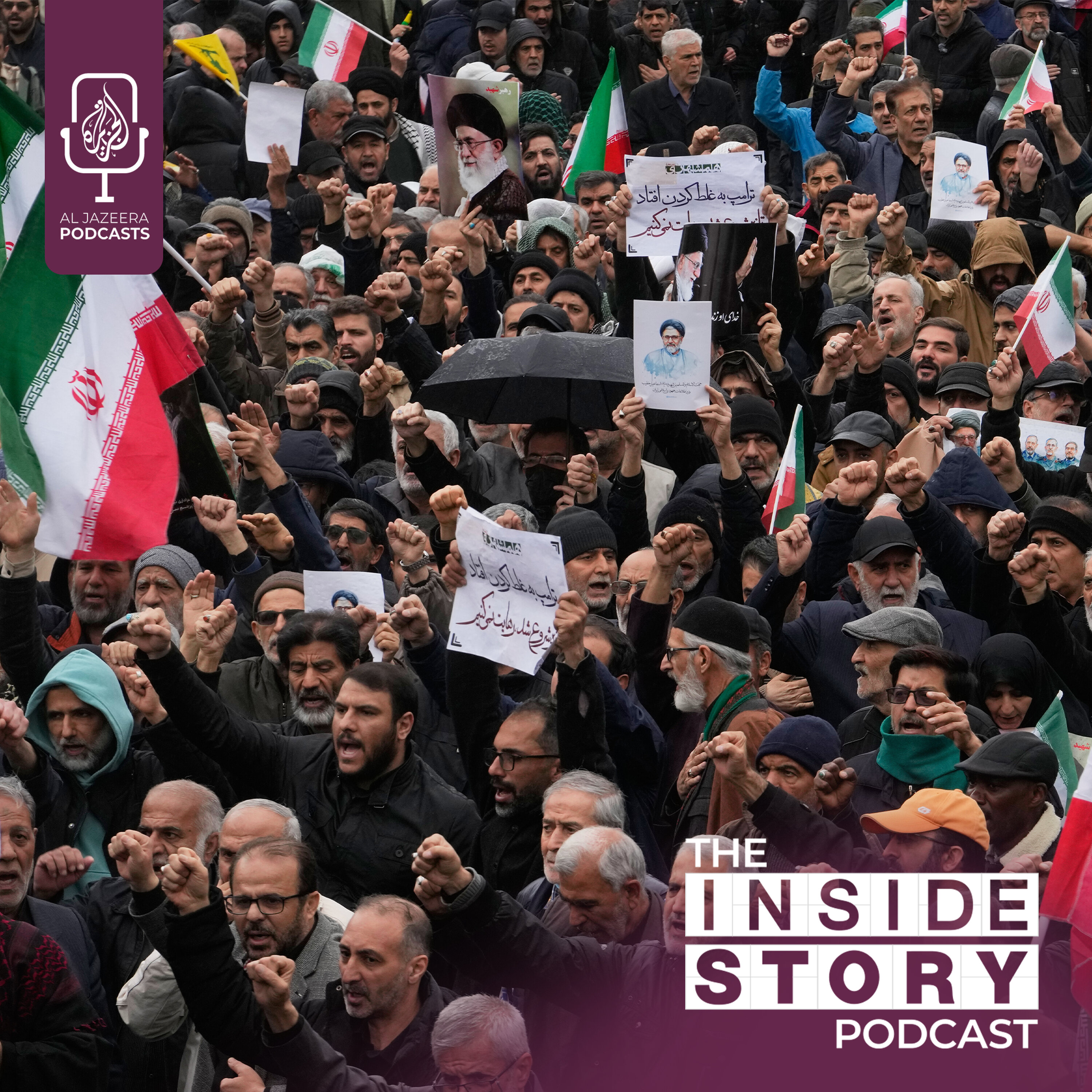
Who's left running Iran? Much of the top leadership has been assassinated but the country is still fighting. How has it been able to withstand such blows? And can the Iranian government survive this war?
In this episode:
- Hamidreza Gholamzadeh, Director, House of Diplomacy.
- Ali Vaez, Director, Iran Project, International Crisis Group.
- Tim Ripley, Editor, Defence Eye.
Host: James Bays
Connect with us:
Hosts & Guests

Transcript
Al Jazeera Podcasts
Who's left running Iran? Much of the top leadership has been assassinated,
but the country is still fighting.
How's it been able to withstand such blows and can the Iranian government survive this war?
I'm James Bayes and you're listening to the Inside Story podcast
where we dissect, analyze and help define major global stories.
Well, let's bring in our panel of guests who are going to discuss all of this on today's Inside Story.
And in Tehran, Hamid Reza Ghulamzadeh, director of House of Diplomacy, Think Tank.
In Geneva, Ali Vias, director of the Iran project at the International Crisis Group.
And in London, Tim Ripley, defense analyst and editor of Defence Eye.
Can I start with you, Hamid Reza, there in Tehran.
In Tehran, you have had many of your leaders killed right at the beginning of this war.
There's been a policy by Israel particularly, but also the US of assassination and decapitation.
Over 40 top officials and commanders have been killed.
Who is running things in Tehran?
Thank you very much for having me.
You know, if you look at Iran, the way the Americans and Israelis look at it and call it a regime,
then it would be dependent on the people and figures.
But if you look at it as a country which is and a normal country working just like any other country, it is a structure based.
So the system and the structure of the power is working.
And for Iran, that's the story.
Every official has its own position.
After the 12th, they were last June.
It was ordered to all the officials, either politicians or the armed forces, to appoint at least three substitutions for themselves.
So at least three people or up to five people are clear to be in the chain of command for each position.
So with that, even if the people are removed, the system would work very smoothly and very correctly as it has been supposed to do.
But who is an overall charge?
Because it's supposed to be the new Supreme Leader, the son of the previous Supreme Leader,
Mojtaba Hamanai, but no one has seen him.
It's two weeks since he took control supposedly.
He's not been seen when he got the job.
He's not been seen at very important time in Iran.
It's Eid and it's also narrows the Persian New Year.
He's not been seen. Where is he? Is he even alive? Some are asking.
So a commander in chief doesn't rule by being seen.
He rules by giving orders and he is doing the job by whatever it needs to do.
And with the assassination that began with the assassination of the Supreme Leader, the previous Supreme Leader,
everyone is demanding top officials not to appear in the public in order to prevent any sort of assassination.
So we just lost a Minister of Intelligence, Hattib, a spokesperson of the IRGC, Secretary of the Supreme National Security Council,
and in the region many people have been assassinated in recent days.
So in order to prevent that, even the public are publicly demanding the officials not to appear.
So when, for example, for the eight prayers the other day, people came actually, some of the officials appeared in the public prayer.
Many people actually asked them not to do that. They criticized why they appear in the public.
Because people have this understanding that they need to command their jobs and they need to carry out their duties and it doesn't need to be in the public.
So people have understood that and they don't need to come to the public to be in one or the other traced by the Americans and Israelis.
So that's the way he is right now controlling the government as the top leader.
He is in touch with the commanders and the politicians and they are doing their job.
Everything is working actually here.
Okay, let me bring in Ali Vires. Yes, there is this policy of decentralization and we'll come into that in more detail in our discussion.
But for any country to lose this number of leaders, to lose the Supreme Leader who have been in charge for so long,
and some might say Ali Larajani, who obviously was not the Supreme Leader, but a very important security official in some ways in terms of the organization of the country,
was perhaps more important.
Well, James, this just shows you how resilient the Islamic Republic is.
It is a regime that is very entrenched and is also very deeply benched.
I think one problem that the US and Israel have is that they end up believing their own rhetoric that they're dealing with a foreign terrorist organization here.
Whereas, in fact, this is a state and it has layers and layers of people who can step in and take over positions.
Now, when it gets to the Supreme Leader, I am of the view that Ayatollah Ali Khamenei, the Supreme Leader who was assassinated, was the last Supreme Leader of Iran.
His son, even if he is alive, owes everything he has, his position to the revolutionary guards.
If this system survives, if the country survives this war, it would be thanks to the revolutionary guards,
and so they would be at the pinnacle of power and they are the ones who are calling the shots.
Do you think Ali, do you think Ali is possible that he's not alive?
Do you think that that is a gambit that could be played by this government?
There's no way the Israelis and the US can target a man who's not actually alive, of course.
We can't rule anything out because there hasn't been any sign of life.
We have seen two statements from him, read by somebody else, but we have not seen any image or any audio that indicates that he is indeed alive.
I understand that for security reasons, he should not probably not take any risks, but again, we don't have any evidence to point to the country.
The final point I'll make is that people like Ali Laryjani, the National Security Advisor, were killed, but was killed just a few days ago.
We're really stepping in to fill the vacuum and run the country.
And that power, I think, has now gravitated towards the Speaker of Parliament, Muhammad Barabadi Baf, who's also a former commander of the Revolutionary Guards.
And even he is eliminated, I'm sure that there would be other people who would be able to step in and prevent the system from employing.
Tim, we heard Hamid Razer say he doesn't need to appear in order to run things from behind the scenes, but normally you'd expect in a country that is facing the challenges and the bombardment that Iran is facing.
A leader to appear or his voice at least to appear, to rally the people at such a difficult time, would you not?
It's a very obvious point, but remember this country is under direct attack and its leaders are a prime target, so it's obvious they try to make very drastic security precautions to prevent themselves being targeted and located by the Israelis and the Americans.
We've heard lots of stories about how the Americans and Mossad are tracking Iranian leaders through the traffic cameras or the mobile phone systems.
All those electronic footprints could lead to the Americans and the Israelis towards these figures.
So trying to cut themselves off and trying to hide is an obvious thing to do at this moment in time because the strategy of the other Iran is to survive at the end of it.
If they have a political leadership that can stand up and say we are running the country, they can claim victory.
So in the duel between the Americans, the Israelis and the Iranian government, surviving must be a number one priority for the Iranian state and to do extreme measures to protect itself has to be an obvious thing to do.
Hamid Reza clearly, the intelligence in Iran was compromised for them to be able to target so many leaders, but do you think going forward as the commands transfer to a different level?
It's going to be harder for the CIA and Mossad. They clearly had built up a good intelligence picture on the leaders, but as it transfers to the second and command or the third in command might be much harder for them then.
As it moves on forward, it would be more difficult for the Americans and the Israelis to target the officials, the security and the considerations would be stronger here in Iran.
And on the other side, the figures are more unknown to the Americans so they cannot easily find out who is placing who and who is doing the things and it would be more difficult to find out about them and then find intelligence and then target them.
So every layer that we go on, it would be more difficult for them and it would be better for Iran. That's why one of the reasons that he said that time is in favor of Iran and as we go on in time, it would be better for Iran and more damaging to the Israelis and the Americans because they have already actually run out of bank of targets.
They have run out of bank of officials as targets and then it would be just going to destroy the infrastructure or the civilians and houses to be attacked.
Actually, for the past couple of days, everything that has been attacked into Iran were residential buildings, just people who are retired people, at least two or three people I know were just retired people without any connection to the IRGC, to the military, to the government.
No, nothing. So they're just killing civilians in order to make people frightened. That's all that the Americans are doing right now. And if they go as President Trump has threatened to go for the infrastructure, then it would be something that like what happened in Southwest and in Qatar in the attacks about the oil infrastructure.
So when we are moving on, when the time passes, it would be more difficult for them and easier actually for the Iranian side to make better targets in the fight.
Tim, I mean, if we look at what President Trump said, and I know when you look at his aims and what he wanted to do with this war, some it's very contradictory and he said so much.
But one of the things he said was he wanted a Venezuela model that perhaps he could get someone who could take over the country with all of its structures intact.
He wanted an Iranian version of the Venezuelan Vice President Delci Rodriguez. They've made that impossible, have they not, with this continual tactic of assassinating leaders.
President Trump has famously said, you know, we're running out of people to talk to. I mean, that's one of his quotes that has come out with.
I bow to the expertise of my two colleagues here on Iranian politics, but I would sort of imagine that around has a deeper leadership as a deeper ideological motivation than the Venezuelans or other countries where Trump has intervened in the past.
It's a very different society, a different political culture, a different political leadership, and a different scenario.
So, I mean, lots of commentary about how President Trump has bitten off more than he's chewing this war, and certainly American understanding of how the Iranian leadership works, it's been found wanting.
Ali, let's talk about Iran's military strategy here, and we'll get to that policy of decentralization. I mean, Iran has relied in the past on its axis, on its proxies. They have been degraded.
It seems the things they're relying on now are their missiles and this policy of decentralization and fighting an asymmetric war, not fighting the US at its own game, but basically leveraging effects on the global economy.
Within that strategy, how important is this mosaic defense that they've got?
Well, it is very important because the US has demonstrated extraordinary capabilities in the past and in this conflict as well, but especially in the invasion of Iraq in 2003, of destroying command and control.
And so that's when the Iranians realized that they would have to hedge their bets. They would have to divide command and control among all the 31 provinces so that cutting off the central node doesn't paralyze the entire system.
Now, that creates potentially some space also for freelancing, which could be dangerous, but in this particular conflict, I don't think that command and control from terror has been disconnected.
Remember that the Iranians knew as of June 2025 at the end of the 12th, they were that another round was coming, another conflict was around the corner, and so they had all sorts of contingency plans in place.
They had an escalation roadmap that I feel that they are implementing step by step, and that has been clearly communicated to all the command and control throughout the provinces.
So I don't see a lot of space for freelancing at this moment. And again, the central node is still operational, but the concept is basically to stretch this conflict in time and in space because Iran has a much higher capacity to absorb pain.
Then the United States and Israel, and so the idea is that eventually the US and Israel would have to blink first because Iran can has longer endurance in this conflict than they did.
Hamid Reza, you told us earlier on about this Mosaic strategy that they designated people three ranks down in case people were assassinated, but isn't there a problem there that you are going to get less experience, less competent, less capable people as more junior officers step up?
To some extent you can say that, but there is one point other you can take it positive or negative, but many of the officials and commanders who have been killed so far have been in power for decades.
This means that they have been very experienced, but it means that they have been conservative as well and many people, many younger generations have been along with them throughout these decades.
So they have been trained and they have been informed by what they were doing and they are familiar with the decisions and are younger and actually less conservative compared to those people who are replacing them.
So to some extent, yes, to some extent, no, it would be actually better for them to be with more ideas about what to do with more solutions and with more options on the table.
And we can say more courage, maybe we can say or let's say more adventure, adventurous thinking in their command.
So I don't think and we are not seeing for the past three weeks that this loss has made Iran weaker compared to the past and actually what we are seeing as we are going on, we are seeing stronger and more courageous activities from the armed forces.
Ali, I mean, you said to us, you believe for now there is still some central control, but the plan is if they have to delegating everything to 31 different units, full service units that can fight.
Isn't there also a problem there for all of us that then there could be knee jerk reactions. There are no checks built in.
You could say escalation is built into such a system.
Absolutely, but that's also the point that the more the US and Israel managed to remove experienced more pragmatic on relative terms leaders, the higher the risk will be that there will be even more conflagration and more disasters around the region.
We knew that Ayatollah Khamenei and Ali Larjani and people, people like them were cautious and to a degree even restrained in the way that they were behaving in a way one could say that they had become predictable.
Now you have a younger generation less experienced more hard line, I would say, who are willing to take bigger risks. And that's also part of the point that if the US and Israel want to continue to this war, they would end up in a situation that is even more unpredictable.
That is by design and not by improvisation. Iranians concluded that Trump Trump's madman strategy could only be countered with a madman strategy of Iran's own making.
And this is why the more power fragments and the more it is in the hands of inexperienced people, the more Iran is going to act like a madman.
Tim, as someone who's covered numerous conflicts around the world and studied them, what are the dangers of this multi-layered security system with overlapping forces?
I mean, is there a danger that things get more chaotic? There's no central chain of command, potentially different allegiances. They could turn on each other. This could be a recipe for civil disorder or eventually civil war.
It's obviously what the Americans want. And that's how they are trying to drive wedges in the Iranian elite and the Iranian government.
But it also is a strength because this is turning into a war of attrition with both sides trying to hit the others' weaknesses.
Now, the more and more that the Americans go after these prestige targets that the factories, the missile bases, the nuclear sites, the more the Iranian side has an incentive to go after the weakness of the Americans, which is fundamentally the Gulf oil industry and the price of oil.
Now, that needs to be done in a relentless way if it's to be effective. So, you know, we're seeing this for the past week.
After the gas field was hit, the Iranians have reacted, which shows that they are understanding what's going on around them and that there is a chain of command and intelligence structure that's feeding them information about what to attack and what are the best places to attack.
And they're continuing with this strategy of hitting the American weakness. Now, in any war of attrition, it's who blinks first, who suffers the most losses, who can't take the pounding anymore.
Now, the Americans and the Israelis are there also have an issue of divergence of objectives. The Israelis, as we've talked about before, want to cause as much damage to the Iranian state, the Iranian military is possible.
The Americans obviously don't want that to go as far as undermining the global economy.
So, the potential for this thing going out of control are enormous, not just within Iran, but on the US's railing side.
So, the more this thing goes on, the more danger there is, but that is an inherent problem with the conflict, not just the Iranian command and control structure.
Ali, I mean, if we look at the region, obviously every country in the region, the circumstances are unique and every country is different.
But if you look at Iraq, 2003, Libya, 2011, Syria, more recently, 2024, in the end, those in power fled when they lost control of the capital.
But of course, in all of those cases, ground forces were in some form involved, only one of them involved US ground forces.
Do you see any way that if the US wants to topple this regime, it can do it without ground forces?
No, I don't see any realistic option available by using only air power.
In all the cases that you mentioned, the power structure was like a pyramid sitting on its head.
In the Islamic Republic, you have a multi-layered and multi-center power structure with overlapping responsibilities and authority.
And this is why you can't really bring the regime to its knees by killing the Supreme Leader or his successor or his successor successor.
Or some senior officials. I mean, it is quite stunning in the annals of war to take out so many three-star, four-star generals and top command and for a system to continue punching and acting according to a plan that was already put in place even prior to this conflict.
Now, the US might try to take over some of Iran's territory, like some of the Gulf Islands in order to try to reopen the state of foremost.
That is a very risky operation, wouldn't necessarily deliver the expected result, but it also is certain not to generate the outcome that the US might have in mind, which is regime change.
Because at the end of the day, you really need a high number of armed, either oppositional boots on the ground, which currently doesn't exist.
And creating it would create a lot of time and it could go wrong and more than one way. It can result in civil strife in a country like Iran, which has a lot of ethno-sectarian fault lines.
So, all in all, I think the US got into this without really a strategy for the day after, but a lot of wishful thinking.
Thank you very much, Ali Vias, Hamad Reza, Gullam Zadeh and Tim Ripley.
The episode was produced by Muhammad Ali, the image in Kimberlaw, Pizza and Niki Duda.
Studio Sound was by Suraj Sankar, the programme was edited by Anna Bansaka, Zaynabada and Jodofrias.
The inside story podcast will continue to provide comprehensive analysis of every aspect of the war.
So why not subscribe on your favourite podcast apps so you can get us every day?
We'd love to hear your thoughts, so please leave us a comment too.
Thanks for listening, I'll be back on Monday with our next edition.
The US's relationship with Europe takes another rough turn as the war in Iran continues.
That's the take by Al Jazeera. Find it wherever you get your podcasts.


