About this episode
The U.S. Open, the final tournament of the tennis season, is getting underway. The world’s best players are heading to the U.S.T.A. Billie Jean King National Tennis Center in Queens, N.Y., to battle it out for the chance to play a championship match at Arthur Ashe Stadium, the largest tennis arena in the world.
The players come freighted with great expectations, previous victories and defeats, aches and pains, personal dramas and professional rivalries, all of which they will carry with them out on the court when they play. Tennis is a game that exposes a lot about its players, which is one of the things that makes it so beloved around the world.
In this episode of the “Sunday Daily,” the host Natalie Kitroeff talks with Matthew Futterman, a senior tennis writer for The Athletic and the author of “The Cruelest Game: Chasing Greatness in Professional Tennis,” about this year’s crop of players. They’ll dig into the biggest rivalries and dramas brewing in the tournament ahead.
On Today’s Episode:
Matthew Futterman, a senior tennis writer for The Athletic, and the author of “The Cruelest Game: Chasing Greatness in Professional Tennis.”
Background Reading:
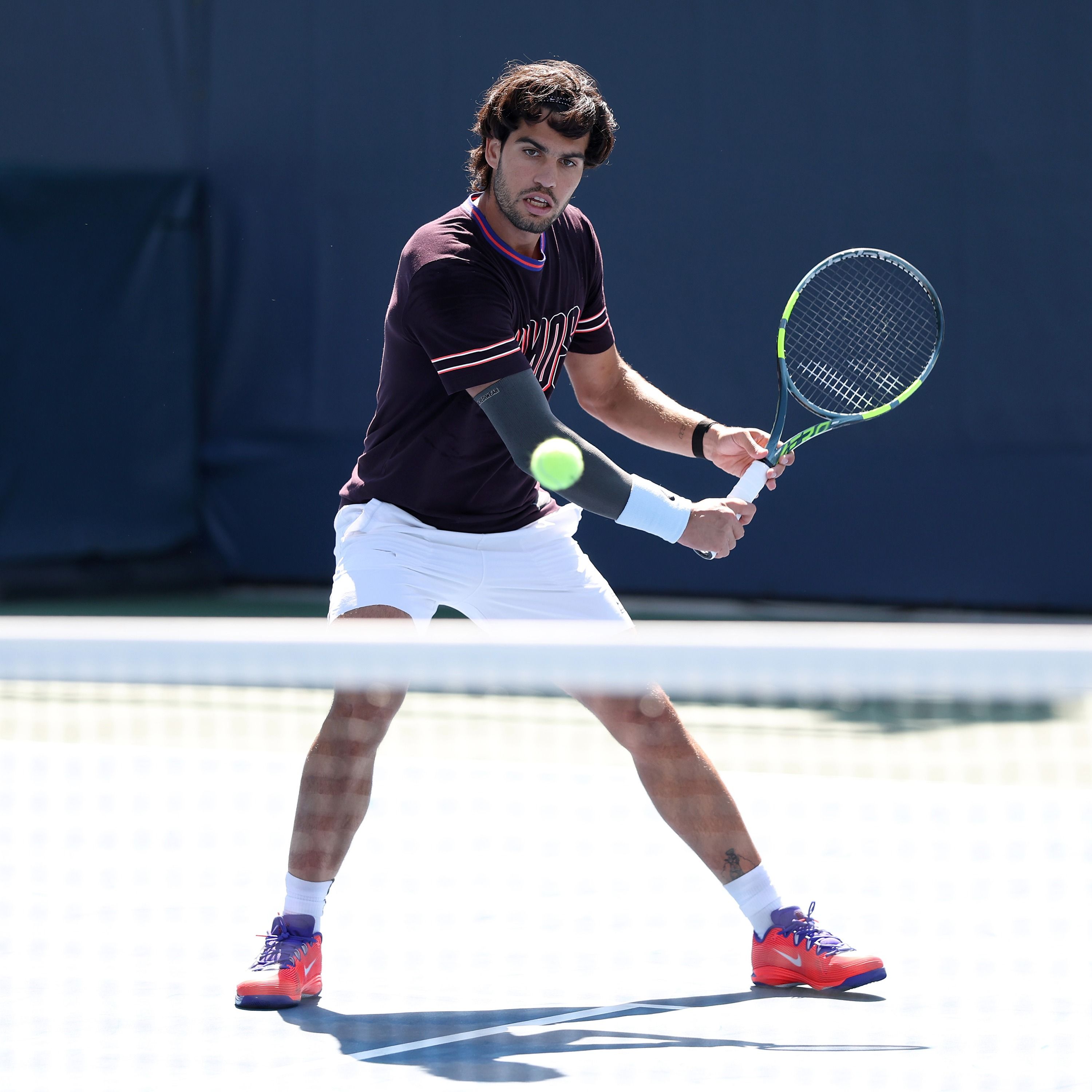
Photo credit: Al Bello/Getty Images.
For more information on today’s episode, visit nytimes.com/thedaily. Transcripts of each episode will be made available by the next workday.
Subscribe today at nytimes.com/podcasts or on Apple Podcasts and Spotify. You can also subscribe via your favorite podcast app here https://www.nytimes.com/activate-access/audio?source=podcatcher. For more podcasts and narrated articles, download The New York Times app at nytimes.com/app.
Hosted by Simplecast, an AdsWizz company. See pcm.adswizz.com for information about our collection and use of personal data for advertising.
Get every episode summarized
Each time The Daily publishes, we email you a written briefing from the transcript — the topics, who appeared, and any specific claims, with the ad reads skipped.
Email me new episodesFree for 3 shows. No card needed.
Hosts & guests


Transcript ready
640 searchable segments. Every word is indexed and playable.
Full transcript
The Daily — Who Will Rule the 2026 U.S. Open?. Machine-transcribed; use the interactive transcript above to jump the player to any line.
I gave my brother a New York Times subscription. We changed articles, and so having read the same article, we can discuss it. Cheap, send New Year long subscription, so I have access to all the games. The New York Times contributes to our quality time together. It enriches our relationship. It was such a cool and thoughtful gift. We're reading the same stuff, we're making the same food, we're on the same page. Learn more about giving a New York Times subscription as a gift at nytimes.com slash gift. From the New York Times, I'm Natalie Kittro-F.
This is the Daily on Sunday. Right now, here in New York City, the greatest tennis players in the world are gearing up for the last and arguably biggest event of the year. The US Open. The tournament is played in Billie Jean King National Team, King National Tennis Center, which is home of the biggest tennis arena on Earth, Arthur Ash Stady. Here goes Arthur Ash, now leading off with the first serve. It's where Pete Sampress ended his career in an epic match with Andre Agassi. We're Venus and Serena Williams first faced off in a major championship final. Venus just chirped in her sister from side to side. John McEnroe and Bjorn Borg, Steffi Graf and Monica Celis, Novak Djokovic and everybody. Another winner and just five footed in the doll.
Some of Tennis' most iconic rivalries played out at the US Open. And that's happening again, but in a new era, with new stars jockeying for their place in history. Carlos Alcaro is winning his first, may it be the Venus apple-a-co? Has not won the US Open. It's the first title of the year for Toto Goss. So on today's show, I'm talking with Matthew Futterman, who covers tennis for the athletic, a sports publication owned by the Times, and is the author of the new book, The Cruelest Game, Chasing Greatness in Professional Tennis. We're going to talk about those new stars, Chasing Greatness, their stories, their struggles, their friendships and rivalries. Everything that makes tennis maybe the most compelling and dramatic one-on-one competition anywhere in the world. It's Sunday, August 30th. Matt, welcome to the Sunday Daily.
Thanks for being here in studio, taking time away from the Grooling US Open schedule. Oh, it's great to be here. Thanks for having me. So I want to start off with a bang. What to you is the greatest rivalry in tennis history. Hands down, Chris Everett and Martina Nevratelova. All she can think about is beating Chris Everett for the second time in three weeks. They played 80 times. We've seen back-to-back defeats for Chris E. there, with 60 of those times that they played were in finals. Wow. Martina trying to defend her title and trying to win the titles of the seven. Chris was playing a double game. They both have great respect for each other. They were such a contrast in styles. Martina made a smart play. Came right in and she's been doing. Chris Everett, Nevratelova, Eastern European. When I won't and when I won't and I didn't get this chance
of war being under the Czech government. Chris Everett, sort of, I will put this in quote that All-American girl next door. Are you getting hit on all the time as well? For men or are you just scared of the pants? Yeah, not that much. I mean, I really don't see a lot of men around the circuit today. The truth. This is a rivalry that had everything, including an incredible personal relationship between the two of them. They were friends. They were incredible friends. They were doubles partners. And then that was too hard for Chris Ever to be doubles partners with her big rival. Because I wasn't the kind of player that really liked to play my friends or my sister or people that I cared about. And she stopped playing doubles with her. And that was like a real personal hurt to Martina. She had just defected to America. She was all alone.
She really felt like her friend had broken up with her. I wanted to be friends with the people that I played against. I preferred that. Also, then Martina started beating Chris like all the time. And that became very hard. Then Chris kind of fought back, but also they both had that cancer together. And gone through treatment together. You know, she was in the trenches with me. And she was comforting me at very important times. We were always there for each other. It was pretty cool. It's not only a completely fascinating sports rivalry. It's a fascinating personal relationship and amazing friendship. Okay. This is precisely what I want to talk about today. The beautiful human drama of tennis. I think a lot of people who love tennis love it because of the characters. I fell in love with watching this sport in the Serena Williams era. The Roger Federer, Rafael Nadal era. Those players were so important to me.
You fall in love with these people. You do. You're up when they're up. You're crushed when they're crushed. But Matt, I have to admit that this time I'm going into the US open being like, who exactly am I supposed to be obsessed with here? I don't totally know. And so that's what I have you here for. I'm hoping you'll tell me, help me. It was a little like music. They say that the music you fall in love with for the rest of your life is the music you hear when you're a teenager. And so... The Backstreet Boys. I think I was a little more fortunate to live with Springsteen being around when I was a teenager. I think it's the same way about tennis. You sort of fall in love with that first era for me. It was, you know, Borg Mac and Rokonners, Vlas. Right. Having said that, I would say you're in a little bit of a moment of transition, although the transition has kind of already happened,
but it hasn't quite sorted itself out yet into what the New World Order is. What do you mean by that? You have these giants of the game that had dominated the sport for the last 20 years. And, you know, Novak Djokovic. Novak Djokovic, what are you doing? Roger Federer. Federer turns it up to a left. Rafael Nadal. This is phenomenal! Drenal Williams. Incredible. Tuts by Serena Williams. To an extent her sister, Venus Williams. Venus Williams is the champion once again for the fifth. So, you know, you have these, you know, lions and lionesses of the sport who are kind of exiting the stage rather slowly. Ticking and screaming. Yeah, a little bit kicking and screaming. But they still loom large. They still suck up a huge amount of oxygen in the tennis conversation. But then you have these whole generation of incredibly talented new players
who have come along. Yannick Sinner, Carlos Algras, Coco Gaf, Arena Sebelanka, Ege Shvion Tech. And so, there's this whole new generation of terrific young players who are not only trying to win tennis matches, but also thrive for 15, 20 years. Because it's incredibly grueling, right? The schedule that these players maintain over the course of a year. It's grueling both mentally and physically. They're playing, what, seven months a year, eight months, how? 11. That is. Yeah, I mean, an NFL player. Yeah, it's a pretty tough sport. They do get six months of vacation. Right. And we should say, though these players are playing most of the year, most viewers tune in to these four big tournaments, what we call the Grand Slam tournaments. Is one of four times when these players get in front of a global audience for the biggest prize in their sport?
Yeah, those are the slams as they're referred to, starts in Australia in January, then French Open, Wimbledon, and then the US Open. It all finishes up. They kind of drag themselves to New York. And a lot of them are pretty banged up by the time they get here, which is one of the reasons it makes it sort of the most unpredictable of the Grand Slam. Yeah, say what's special about this tournament, the US Open. I mean, well, it starts with just the New York of it all. This is where barrier breakers lead drain chasers. It's noisy, it's chaotic. I mean, it is intense. You can feel it when you're there, but I think you can feel it watching it on TV, the atmosphere, it feels different. And you can be there and take in everything that New York has to offer.
And also, and I really highly recommend you don't miss this part of it. There are these people doing what I would argue is just about the hardest sport in the world. A sport that requires the lungs of a marathon or the speed and quickness of a world class sprinter. You know, ridiculous hand-eye coordination. They're sweating, they're out there. It's hot. They're given everything they have with their heart and soul to try and win that last point. In a sport that reveals everything about them. They're personalities and there's just no place to hide in this sport. It is human drama playing out in, you know, the most incredibly compelling form with balls and rackets and a lot of athleticism. All right, so given that what I think we should do today is spend some time diving into those people
that we're going to be doing that amazing thing, the characters that we're going to be following at the US Open. Sound good? That sounds great. Perfect. Hi, I'm Brian Chan. I'm a tech columnist for the New York Times. Instead of just regurgitating the marketing brochures of a tech company, I ask questions like, should I be buying a new phone or should I be replacing my battery? If that's really all you need to do to have a good experience again, I'm going to tell you to replace the battery. I am trying to protect you and prevent you from making a wasteful decision. A lot of companies don't like it when I say things like that. I'll get phone calls from tech companies who want me to change my stories. But because subscribers fund the New York Times, I'm able to be fearless in bringing you this information.
I don't mind having some of these tough conversations. My goal is to serve our subscribers, not the tech companies. That is a huge part of what you get when you subscribe to the New York Times. Okay, Matt, let's start with the women's draw. Who should we be talking about? New faces, new era, I'm ready. Well, not so fast because I think we probably need to talk about a rather familiar name. Serena Williams, you might have heard of her. I love her so much. Rather a good tennis player turns out. One of the biggest tennis tournaments now set to feature defending champion Carlos Alcaraz and the goat. Serena Williams. Serena announced a couple of weeks ago that she was going to come back and she was going to play mixed doubles with Carlos Alcaraz, which is one of the biggest things I would say that has happened in tennis this year. The surprise announcement coming months into Williams comeback campaign, including sort of left reluctantly in 2022
because she wanted to have a second child and really felt like she couldn't do that and also continued to play tennis. It's been the most incredible ride in journey I've ever been on in my life. I just really missed the sport. It's interesting, though, because I've done it literally my entire life. And so when you stop something that you've done since, honestly, I can remember, I don't remember a start date. I think you kind of take it for granted. And so now she has been very open about her use of the GLP one. Drugs that have helped her lose weight post childbirth. It has really changed her life, she said, as she has put it, it has given her her body back. Six times US Open singles champion Serena Williams. She played on Tuesday. The mixed doubles happens before the singles tournament now at the US Open. And it was quite the scene.
I mean, you're witnessing a 44 year old mother of two play in a way that I think nobody really thought was possible. Second point of that match, there's like a floater that comes to her and she rears back to, you know, stuff this overhead. I'm sitting like 20 rows up. And I swear if I had had my eyes closed, I would have been able to say, oh, that's Serena Williams hitting a tennis ball. It's just classic. It makes your skin tingle. You hear the thump of the ball coming off the strings. That sound is different than when it's coming off any other players racket. And it's just an amazing spectacle to watch. They lost their next match, unfortunately. But it was one of those moments where she was just like so back. We are just so lucky that we still get to see Serena Williams play tennis.
I think it is one of life's great joys to watch this person play this sport. And we should all treasure it. And it's not over, right? That wasn't the end of Serena Williams in this thing. No, it wasn't. She is coming back for another go at it. She announced a couple of days ago that she is going to play doubles with her sister, Venus. They've won a lot before. And who knows, we'll see what they can do. Okay. So we still get to do this for a little bit longer, at least. Who else should I be keeping an eye on, Matt? And if you say Martina Nevartulova is coming back or something, I'm going to have to ask you to leave. Nevartulova is not coming back. I kind of think you should probably keep your eye on Coco Goss. Don't get that. That's what Goss can do. The great American hope. I'd say at this point, she's more than a hope. I mean, you know, she's the real thing. She won her first grand slam title at this US Open three years ago.
Get out Coco Goss. You just won the US Open. Last year she won the French Open. Coco has conquered the clay. She's one of these people that is an athlete who could do just about anything. She probably has world class, sprinter speed, just about. You can't hit the ball past her. She's that fast. You know, with the funny thing about tennis, his guy doesn't give anybody everything. She has a very active mind and you know, she can get in her head sometimes. And the last couple of years, she has really struggled with the most important shot in the game, which is her serve. Every other shot you make, someone's hit a ball at you. The serve is yours. It should be in some ways the easiest shot in the game. And in most cases, it's the hardest and the easiest to get in your head about.
And the easiest to get in your head about. She's already had two double faults in this opening game. And it's gotten into her head. It also can be her biggest strength when Coco's serve is firing as it has been the last month. She is probably just about the most dangerous player on the plan. Two fantastic serves from Coco. And so important to watch her toss. She is on top of that the bell of this ball. It's her tournament to win our lose. It sounds like. Well, it's not only her tournament, it's her party. Okay. I mean, you walk around the grounds of the US Open and Coco is everywhere. You know, you walk around this city, you know, over the next few weeks Coco is everywhere. There are billboards. There's posters. She's the most popular player, certainly in tennis in America right now. Okay. Well, I wouldn't want to play her on these courts.
I don't think we want to play Coco on any court. You and I, I think that would be for the best. Fair enough. Yeah. Who is standing in her way? Like, who's her biggest competition? Probably Arena Savile Enka. Again, somebody. I've been playing against one star from Arena Savile Enka. They played each other in the finals. Three years ago, Savile Enka crumbled. I'm really starting to get under the skin of Savile Enka. They played each other in the finals of the French Open last year. Savile Enka crumbled. It was just a fiancee on forced air account because they were accumulating quite a bit from Savile Enka. And there weren't even that many long points. Long rallies there. Arena Savile Enka. World number one. She's wanted this so badly for so long in Arena Savile Enka. Has not won the US Open. From Belarus, superstar, six feet tall, huge power, incredible fire.
Again, greatest strength, also greatest weakness. So is that incredible fire? Sometimes she loses control of it. She's had a rough couple of months. She's lost a lot of close matches. A lot earlier in tournaments than we would have anticipated. And tennis is a sport where you bring everything you have onto a tennis court. You're out there alone. You are your whole self and compartmentalization can be difficult sometimes. Something about Savile Enka that feels resonant for me watching her is that she is seemingly completely open about her emotions. Just want to quit tennis right now, but we'll see. We'll see in a few days hopefully I'll get back on track mentally. I mean, they are all on the court. You watch her crumble when she crumbles and you see her hype herself up when she's hyping herself up.
There's something very accessible about the kind of waves that she rides. I definitely feel that way. I honestly find watching Arena Savile Enka a kind of a painful experience. Oh, why? Well, because of those waves, you know, there are some players where you feel like you're the copilot with them. They kind of strap you in for the ride. And Savile Enka sometimes, you know, she brings you in to the car with her. But sometimes that can be a kind of bumpy and uncomfortable ride. And you don't necessarily want to be in the car with her. Arena Savile Enka when she is losing and she is on the ropes. And you can feel that in a very visceral way. Okay, so lots emotionally at stake with both Coco Gough and Arena Savile Enka. Who else? Who else could contend? Eges Viontech, best player of the last five years. Seven Grand Slam titles.
Incredible talent. And what the four hands cooking. It's so dangerous. She can hit it hard down the line or roll her deep cross-court or short cut. Brittle mentally. A very, very tough opening match for Eges Viontech. And you can see what it's taken out of her. She's visibly emotional. Fills her feelings, self-consciousness and self-awareness. Sometimes you're not great things in sports. Yeah. Better to be the robot, better to be the goldfish. She's not the goldfish. That was scary for Eges Viontech. Mira and Drava, 19 years old. A teenage dream has come true. From Russia, huge new talent. Broke through with her first Grand Slam title at the French Open earlier this year. It's Mira's moment. Andreva. She's a kid though, still. Very young. She's a young woman, 19 years old. But she is a kid.
Her coach the last couple of years. She to Martinez is essentially Obi-Wan Kenobi. She's Luke Skywalker. That's the relationship here. Sometimes it works. Sometimes Mira can hold it together. Sometimes she's a teenager on the court. What a remarkable recovery from this 21-year-old. Linda Naskava, Wimmelden Champion, huge talent. Only going to get better. She is the latest Vanguard of this Czech women's tennis machine. This is a country of 11 million people. They have like nine players in the top 50. What an advert for Czech tennis. What an advert for women's tennis. I mean, there was a number of women in the world. Yeah, kind of an incredible thing. So keep an eye on her. Okay, not that I needed more excitement, but you have persuaded me that the women's side of this tournament is very exciting. Let's take a quick break and we'll come back and talk about the men.
Matt, the men feel a little more clear to me because there's a proven star in the mix. Carlos Alcaraz, who just played mixed doubles with Serena, just tell me about him. Where he's at right now, how he arrived here, and where we encounter him in this moment. Carlos is the golden child of this tennis generation. Carlos Alcaraz wins his first major. And in doing so, becomes the youngest ever. World number one. And for the most part, Carlos is just about the most joyful tennis player. People since he came on the scene five years ago. They love to watch him. Oh, no way. But they love to watch him love how much he loves to play. Still celebrating. You know, he pulls off these shots that it seems like he's just sort of the ultimate jazz musician who's improvising and riffing and doing things that he didn't even know he was capable of.
The ball was behind him. And he still somehow been able to find the winner. It looked as though he completely overrun this ball. You know, one of the fun things about being a sports writer is there are some athletes that you meet when they're pretty young. And you sort of get to see them evolve. And I remember in 2021, I went to one of his early matches, his first match in a singles Grand Slam draw. After that match, I sort of went for a little walk with him around the Australian open and no one has any idea who he is or who he's going to become and who he's going to become. And in many ways, he is still that kid on the tennis court. I mean, he's, yeah, life is going to take its toll on him. It probably already has in terms of he's been suffering from a wrist injury of probably the most serious injury a tennis player can have. But for the most part, he is that kid who is still full of joy.
And I hope for his sake and for all of our sakes, that's who he always says on the tennis court because it's a beautiful thing to watch. Beautiful rainbow from Carlito. You know, so much of the conversation around men's tennis has orbited. It feels like around Carlos Alcarez and his main rival, Yanic Sinner from Italy. But Sinner is not playing at the US Open because of an injury. So my question is, who is Alcarez's big competition here? Well, I think if you're asking about his competitors, the first one you have to talk about is Novak Djokovic, the goat. The tennis is near his first and the superman still around and still hoping that it might all come together and he can find a way to a 25th Grand Slam title. He's back in business. He is 39 years old. He is still right just about at the top of the sport, which is just an astounding thing to consider given that he's 39 years old.
Can you explain it? How is it that we are still seeing him compete at this level when Carlos Alcarez is 23? So a few years ago, I had dinner with Novak Djokovic right before the US Open. And it's two big salmon steaks, two big sweet potatoes, some rice, some gluten-free pasta with vegetables and a fruit cup. There's no sauce on the salmon. There's no butter on the sweet potatoes. The only thing on the pasta is olive oil and he's drinking water. Okay. Well, yeah. So that gives you an idea of how he is living. He gets out of bed every morning and he stretches for 45 minutes. I mean, I'm painting the picture of a monk, but he takes real joy in this lifestyle. He's really into wellness. You know, he treats his body like a Formula One race car. Every little screw, every drop of oil that is in that car is thought about.
He doesn't just accidentally be 39 years old and still be at the top of his game. So he is intent on continuing to compete at this level. And it sounds like he has a real shot at still potentially winning it all. Maybe if his body can hold up, you know, you have to win seven of these matches in order to win the tournament. He's come close. He's won six plus one set. He had Carlos Agra as on the ropes in January at the Australian Open. Djokovic, a couple of sets away from number 25. So it is potentially possible. It's at least intellectually possible. Never count Novak Djokovic out. I've been burned too many times for doing that. I will never do it again. He's still there. He's still doing it in real time. Okay, I have to confess that I really wanted your answer to that question to be an American. Because there are many American men in this tournament. Can we?
And it is the US Open. And it is the US Open. Can we talk about them? Like who? If you're rooting for an American, should you be getting excited about? Well, there's a lot of them to get excited about. The two players, people get most excited about these days who are Americans. They're probably Ben Shelton and Frances Tiafo. Ben Shelton. He takes out his fellow American, Frances Tiafo. Ben Shelton. He's the best athlete I've ever seen on a tennis court. Oh, brilliant. What a full hands. There's this age old question in American tennis because America has so many sports that compete for the best young athletes. Football, baseball, basketball. So we've always wondered what would have happened if Michael Jordan had a tennis racket in his hand when he was eight years old? What about Steph Curry? What about Patrick Mahomes? In Ben Shelton, you kind of have somebody who may have been one of those people.
He was a really good teenage quarterback. I've seen him on this big grass field that Indian Wells throwing 60 yard passes into his fitness trainer. So he could have done that thing. But instead, Ben realized pretty early on that he could miss more school. He didn't really like school very much that he could miss like Mondays and Fridays if he was a good tennis player because he would be able to travel to some tournaments. So he decided when he was 14 years old that he would get serious about tennis and try and play tennis for his father who was the coach of the University of Florida. And so in some sense, Ben Shelton is the opportunity to see the answer to that experiment of when this great athletic specimen ends up with a tennis racket in his hand. Oh no, that is ridiculous. Now, unfortunately, he got that tennis racket in his hand a little late. He's probably about eight years behind Carlos Algras in terms of how much practice he's had.
Carlos Algras got serious at six. I tried to do a rough calculation. It's probably on the order of 10 to 15 million balls. Meaning, Carlos Algras has hit 10 to 15 million more balls than Shelton has. Probably, something like that. Having said that, in addition, Shelton is one of those players where all the emotions are honestly. He comes out of the way that he loves that. The crowds love it too. Lots of noise, very rowdy, very in your face. He just brought that onto the tour, ruffled some feathers early on for doing that. Oh, that's magnificent. But if there's a place that eats that up, it's in New York. He has a great celebration, right? A huge serve. He's really fun to watch. He hits the ball 150 miles an hour. His arm nearly fell out of the shoulder socket last year at the US Open. Fortunately, it wasn't too serious of an injury.
With saying, there's a lot riding on the possibility of an American victory because an American man hasn't won a grand slam. One of those big four tournaments since 2003 when Andy Roddick did it. So, we have been waiting for a while. Right. It looked like it was going to happen in 2022 when Francis Tiafo, another great talent, terrific athlete who's an American, got really close. Francis Tiafo says, it's my time. He's the son of African immigrants. And his father was the maintenance guy at a tennis center. I had no idea. Yeah, and his mother would sometimes work nights. So sometimes he and his brother would sleep at the tennis center. And when they were really little, you know, to busy themselves, they would grab a racket and hit balls against the wall. So the tennis pros noticed that the maintenance guy's kids were pretty good at tennis.
And that's how Francis got his start in the game. Francis Tiafo, puncing every ball down. Fast forward to 2022. The US Open, he beats Nadal in the fourth round. And people are like, wow, an American is really going places. And this draw is pretty open. The times they are a change in. The problem is he faced off against Carlos Alcarez, who was just about two days away from becoming the Carlos Alcarez that we know today. But yeah, I mean, Tiafo is just one of those players that he has, what I would call tennis charisma. Tiafo, putting on a shot. You want to feel like you're the copilot in a tennis match? Go watch Francis Tiafo play. You will be there with him. And, you know, he is there for the show. He is extraordinary. You are fighting from outside the box. Okay. Anybody else that we need to know about that we should be talking about here? It will certainly out of the standards, Vera.
The watch. What will I do? She's got to see. She's got to see. She's got to see. She's got to see. A German player who's been the best Grand Slam player this season, nearly Bidakor as the Australian Open, won the French Open, and then he lost in the final Tianek Center at Wemblebin. He's had some off court problems. Yeah, there were allegations of domestic abuse with former girlfriends. There have been lots of issues around Alexander's ferv. There's also Arthur Fees, who is a French player, absolutely a rising star, won his first big tournament last week in Cincinnati. He's a similar athletic specimen to Ben Shelton, not quite as tall, but seriously powerful. Only issue is he's had this stress fracture and is back the last year or so. And even he doesn't know when it might crop up again.
You know, it seems as though there are ifs hanging over all of them. And I'm wondering, you have studied this sport so closely for so long, Matt. What do you think makes the difference? What determines how you get from that question mark to actually achieving the kind of victory that you need to be an enduring figure in this sport? That's a great question. Of course, if we knew the answer to it, you know, you and I would be Grand Slam champions probably. That's why I'm asking. Look, you never know, right? You never know. So, you know, in talking to these players, especially the great ones, there's a couple of key factors. One of them is understanding that your results are not your identity.
And that you're still lived by. Yeah, right? For all of us. Yeah, for all of us. Like, you are so much more of a person than you are on the tennis court. I mean, that's an incredibly hard thing to do when it's the only thing you've done since you're eight years old and then you wake up and you're 22 and you wonder, wait a minute, I haven't really done anything else. Like, who am I? How did I get here? What do I want to do with the rest of my life? So, yeah, results and identity can't be the same thing. There has to be a great focus on what's coming next. The shot you just hit is over. If you're still thinking about it, you're going to miss the next ball. There's always another ball coming at you. There's always another point to play. There's always another set to play. A match, like another tournament next week. You have to have this incredible focus on what comes next. We talked about Aurena Sebelink, a crumbling like that and her emotion getting the best of her.
What she's gotten really good at in the last couple of years is breathing. And I think that's one thing to watch when you're watching the US Open is watch what these players do in between points. Do they turn around and yell at their box and kick themselves? Or do they close their mouth and breathe quietly through their nose? Because that's the whole key to the sport. In some ways that's the key to all of our lives, the only thing that really should matter is what you do next. Because the thing that just happened, it's gone. You can't change it. You can't change it. And that is never more true than on a tennis court. So, you know, what I really believe in and what I see from the great players and what they tell me, what they've told me that they've tried to do is to commit themselves to intentions, commit themselves to showing up as a certain kind of person on the tennis court
and to understand that you're going to lose half the points or nearly half the points. And you just got to win the right ones and win enough of them to win the match and move on to the next one. Well, I do think there is something in there for all of us in quieting the ifs. I had a tennis coach growing up who always used to say when any of us got in our heads to just smile and remember, tennis is fun. So, I am going to be watching this tennis mat. Thank you so much for coming on the show. Thanks so much for having me. It's really great to be here. Today's episode was produced by Alex Barron with help from Tina Antillini and Lena Richards. It was edited by Wendy Doerr, production assistants in fact checking from Dahlia Hadad
and original music by Dan Powell and Marion Luzano. It was engineered by Rowan Nenisto. That's it for the Sunday Daily. I'm Natalie Kitchola. See you tomorrow. I'm Gilbert Cruz. This week on the Book Review Podcast, how do you feel about ghosts? I love it. I love it. The full book season is here and we are going to talk about a bunch of books that we are excited for. As soon as I read the description of this, I was like, oh, I'm so in. And I don't really read more. I'm interested in this. Get me the second book. Listen to the Book Review, wherever you get your podcasts. Highly recommend it.
More episodes
More from The Daily

The Good, the Bad and the Good-Bad (Movie)
The Daily

Naomi Klein and Astra Taylor Say the End of the World is Now on the Table
The Daily

The Lives That 9/11 Keeps Taking
The Daily

A Couple Breaks Up. Who Gets Custody of Their Embryos?
The Daily