businessAug 20, 20261:28:08pending
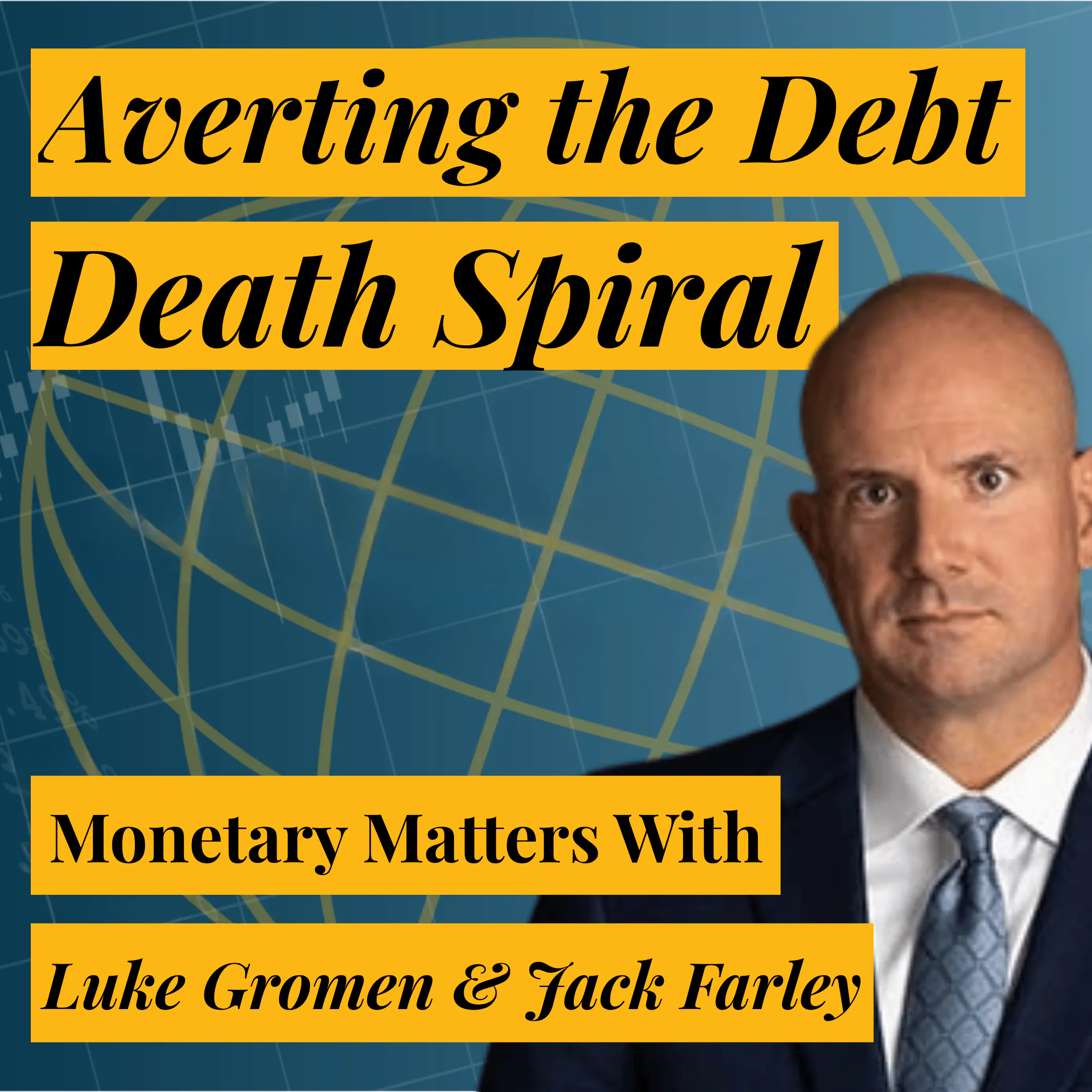
Why Bessent Blinked | Luke Gromen on Doubling of Treasury Buyback Plan to Tame Long-End Yields
About this episode
Sponsor: Teucrium Corn Fund (NYSE Arca: CORN):
https://teucrium.com/corn
Luke Gromen — founder of Forest for the Trees (FFTT) Research — returns to Monetary Matters the same week Treasury Secretary Scott Bessent doubled the size of Treasury buybacks, and Luke argues it's the first real admission that the U.S. has what his firm calls an "emerging market hard currency debt spiral problem."
The math that doesn't work: Luke breaks down why entitlements, interest, and veterans benefits now total 105% of federal receipts — and why that obligation is "hard currency" the government can't inflate away, growing 7.5% a year against receipts growing only 4%.
The gold revaluation scenario: Step by step, Luke lays out how the Treasury could legally revalue U.S. gold reserves from $42/oz to $20,000/oz under existing Federal Reserve accounting rules, mechanically depositing roughly $5 trillion into the TGA — and stages it as the FDR "fireside chat" he'd give the country to explain it.
Grading his own Iran war calls: Luke reviews the predictions he made when the U.S. attacked Iran — three out of four hit (the Treasury market breaking before Iran's economy did, Hormuz staying closed longer than expected) — and owns the one he got wrong: a Chinese oil-demand collapse that never came.
Bessent's yen intervention and the $13-14 trillion carry trade: Luke explains the "stylized Instagram" front-run story behind Bessent's yen intervention, and why the offshore dollar carry trade — $65 trillion gross, $22 trillion net in foreign-owned dollar assets — is the real constraint on U.S. policy.
Why gold, not bonds: Luke makes the case that TLT is down 90-95% against gold since 2014 with "another 90-95% to go," and that the S&P 500 is already down 30-50% against gold since 2022 and 2000 respectively.
Hamiltonian economics and the AI CapEx bubble: From Bessent to Jamieson Greer to JD Vance, Luke argues the administration is quietly building tariff policy around 19th-century "neutral reserve asset" economics — while comparing today's AI buildout to the canal, railroad, and telecom bubbles that all preceded it.
Private credit's Treasury problem: Luke connects insurance companies stuffed with illiquid private credit (instead of long-duration Treasuries) to UAE liquidity stress and the Hormuz shutdown, and explains why that's quietly removing a natural buyer from the bond market.
Teucrium on X https://x.com/TeucriumETFs
Luke Gromen on X https://x.com/LukeGromen
Jack Farley on X https://x.com/JackFarley96
Follow Monetary Matters on:
Apple Podcasts https://rb.gy/s5qfyh
Spotify https://rb.gy/x56dx5
YouTube https://rb.gy/dpwxez
Get every episode summarized
Each time Monetary Matters with Jack Farley publishes, we email you a written briefing from the transcript — the topics, who appeared, and any specific claims, with the ad reads skipped.
Email me new episodesFree for 3 shows. No card needed.
Hosts & guests
No transcript yet
This episode has not been transcribed. Request it and it moves to the front of the queue.
More episodes
More from Monetary Matters with Jack Farley

What Actually Happens When a Life Insurer Fails (It's Worse Than a Bank) | Pranj...
Monetary Matters with Jack Farley
Sep 6, 20261:17:10completed

“I’m Insanely Bullish on Bonds” | Jared Dillian on Copper, Bonds, Semis, and The...
Monetary Matters with Jack Farley
Sep 3, 202632:20completed

The Certainty Premium: What’s Driving the Tech Sector Divergence? | Jeff Keller
Monetary Matters with Jack Farley
Aug 31, 20261:01:36pending

The Commodity Bull Market Is Broadening | Jim Wiederhold on Copper, Grains, and...
Monetary Matters with Jack Farley
Aug 26, 202656:34pending