Why Chicken Sandwiches Don't Cost $1500 | Wendover Productions
About this episode
Get every episode summarized
Each time Wendover Productions publishes, we email you a written briefing from the transcript — the topics, who appeared, and any specific claims, with the ad reads skipped.
Email me new episodesFree for 3 shows. No card needed.
Transcript ready
125 searchable segments. Every word is indexed and playable.
Full transcript
Wendover Productions — Why Chicken Sandwiches Don't Cost $1500 | Wendover Productions. Machine-transcribed; use the interactive transcript above to jump the player to any line.
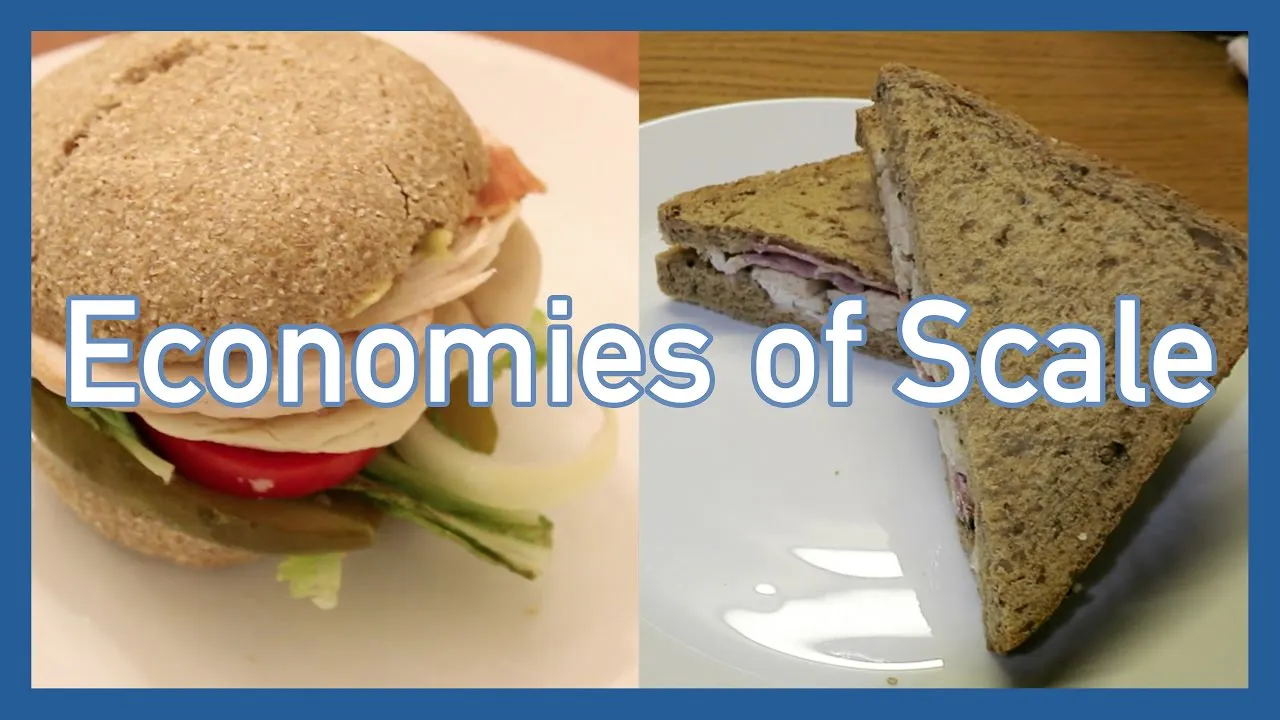
About a year ago, Andy Jord from the channel How to Make Everything released a video called How to Make a $1500 Sandwich in Only 6 Months. I made a chicken sandwich completely from scratch, which cost $1500 in 6 months of my life. The video was hugely successful. It got millions of views. Then, a few weeks ago, Andy came to me with a question. Obviously, I didn't use the most efficient method of making my sandwich. But why is there such a huge gap in price between the sandwich I made for $1500? When you can just buy it a store for much less. My nearest grocery store sells pre-made chicken sandwiches for two pounds, about $2.5 US dollars. That's 600 times cheaper than Andy's sandwich. The economic principle that really makes the modern commercial world go round is economies of scale. You might remember from history glass that an important step in the development of humanity was the beginning of specialization of labor. That was the point when advancements in technology were far enough along that the amount of food one person could produce was higher than the amount one person needed to survive.
Since there was a surplus, some people could go and do other things, like science, research, writing, and even production. This also helps spur the development of the first real cities, since everyone didn't have to live on farms. Specialization of labor was in a way the very beginning of the use of economies of scale, because instead of everyone growing and making everything they needed, different people did what they did best, and exchange goods to get what they needed. Fast forward almost 10,000 years, and the world is almost entirely specialized. Individuals almost never make things for themselves, except for Andy George. Challenge myself to see if I could as an individual make something as basic as a sandwich, entirely by myself. I grew all my own vegetables, harvested and ground my own wheat to make bread, killed and butchered my own chicken, and even flew all the way from Minneapolis to LA, collect ocean water to boil down for salt. The salt is what we're going to focus on. The reason is because Andy's salt production process was almost identical to that of a larger firm.
He had to gather raw materials, process it into a product, then transport it to a final market. Those three steps have been optimized in our modern world to yield insane cost reductions. Over to make my salt, I spent $298.88 on a plane ticket, $57 to rent a boat, and $641 for a 5 gallon jug. All just together the few ounces of salt I needed. He only needed a small amount, but for the same price, he could have gathered more than a pound's worth. For his six ounces of salt, Andy paid $362.40. That's $52 per ounce, more than triple the cost of silver. Each gallon of sea water yields about 4.5 ounces of salt when evaporated, so his 5 gallon jug could have carried enough water to make 22.5 ounces of salt or 1.4 pounds. At that production rate, the cost per ounce is $16, but we can make it even cheaper. We just need more 5 gallon jugs.
If we buy, say, 9 more 5 gallon jugs at $6.41 each, our total cost would be $419.98, but we can make 14 pounds of salt. That brings the cost down to $1.87 per ounce. But we can keep scaling this up to an extent. Andy's method of transport was flying, and at that base rate, his total cargo capacity was only the capacity of his carry-on bag. The largest carry-on bags have a capacity of 45 liters or 11.8 gallons. One gallon of salt weighs 18.1 pounds, so assuming nobody ever checks the bag, Andy could have carried 213.6 pounds of salt. To produce that much, Andy would have needed 153 5 gallon jugs, and the boat he was on could have only carried about 10, so he would have needed to rent 15 more. So if we add together the plane ticket, the 153 gallon jugs, and the 16 boat rentals, we get a total price of $2,191.58.
A lot more, but it's worth it, because at this production rate, the salt only costs $6.4 per ounce, but we can keep scaling. The average rate to hire a Los Angeles-based 40-foot semi-truck is $2 per mile. To drive the $1,912 miles from Los Angeles, California to Minneapolis, Minnesota, it would therefore cost $3,824. The usable capacity for these trucks is 2,395 cubic feet, or 17,916 liquid gallons, or 325,000 pounds worth of salt. Sounds great, but the U.S. only allows a total gross weight of 80,000 pounds on the road, and that has to include the weight of the truck itself, so the actual transport capacity is only about 40,000 pounds. Salt is just so dense that we can't load a truck to its full volume capacity. So, we'll just produce 40,000 pounds of salt, and for that, we need 2,857 boat rentals,
and 28,571 five gallon jugs. For the sake of explanation, we'll pretend that we can't reuse the five gallon jugs. Those boat rentals would total up to $162,849, and the jugs would add up to $183,141. So, including the transport cost by truck, producing 40,000 pounds of salt would cost $349,114. That's now a cost of 54 cents per ounce. As you can see, as you get into higher and higher levels of production, the advantage of producing more grows smaller. It was 25 times cheaper to produce 214 pounds of salt than to produce 1.4 pounds of salt on 152 times increase in production, but increasing the production from 214 pounds to 40,000 pounds, a 314 times increase only decreases the price by 1.19 times. Let's shake up the production process.
Instead of boiling the seawater down to salt in Los Angeles and transporting it to Minneapolis, let's say the Andy transported the seawater to Minneapolis, then boil it down. What would it cost then? Well, seawater weighs about 8.6 pounds per gallon, and once again, we can only carry about 40,000 pounds or 4,651 gallons. This will cost $3,824 for the truck, $5,968 for 931 five gallon jugs, $5,358 for 94 boat rentals, and in the end, we'll only yield 1,308 pounds of salt. To make these 1,308 pounds, we spent 60 cents per ounce. A difference of 6 cents per gallon may not seem like a big deal, but once you get to the scale of producing, say, 100,000 pounds of salt, those 6 cents add up to $96,000 more than the price of a Tesla Model S.
This demonstrates a very important principle in manufacturing. There are essentially two types of products, weight losing and weight gaining. Salt is one of the greatest examples of a weight losing product. You put in a lot of raw materials, in this case seawater, to make a little product. Obviously, it doesn't make sense to ship the raw seawater cross country when you can just boil it down in Los Angeles. This is why processing plants for almost all weight losing products will be located near the source. The other type of product is weight gaining. You take a small amount of raw material and make it into something much heavier or larger. A great example of this is Coca-Cola. They have more than 900 bottling plants worldwide just so they can lower costs. If transport was not a factor at all, they could achieve lower costs by having one single mega factory. But once their soda is made, they still have to get it to the end consumer. The cost of transport is closely linked to weight, so since they just take a small amount of flavors and ingredients and
add it to water, something available almost anywhere, it makes sense to produce their product near the end consumer. Overall, we achieved a 92 fold reduction in cost of salt by using the principles of mass production. Every single ingredient Andy George used to make his $1,500 sandwich could have benefited from the principles of mass production. We also could have gone even further. We could have rented a bigger boat, used bigger containers. There were plenty of ways we could have driven down prices even more. But these type of cost reductions make the difference in our modern world between a $1,500 and a $5 chicken sandwich. I hope you enjoyed this Wendover Productions video. I first need to give a huge thanks to my sponsor, Lumarit. As I'm sure you know for my old Why College So Expensive video, college is expensive. And Lumarit helps you do college for less. Whether you're already in college or want to be, Lumarit Scholar helps you get the same degree from the same college for thousands of dollars less. Lumarit allows you to take up to three years of college from anywhere
in the world on your own schedule for $4,000 a year or less. Once you're ready to enroll in a traditional college, their in-house degree specialist will make sure that all your earned credits transfer. If this sounds interesting to you, head over to go.lumerit.com, slash Wendover, to see how much you could save with Lumarit Scholar. They'll send you an email and then you'll receive a one-on-one consultation to see if Lumarit is right for you. Please be sure to also check out Andy George's channel, How to Make Everything, for all sorts of great videos on making things from scratch. He just released a great video exploring where the money you pay for coffee actually goes. Somewhat similar to my Why Flying Is So Expensive video. So you'll see an appearance from yours truly. I also recently started a Patreon, which you can go to by clicking here. There are a bunch of great rewards like early access to videos, stickers, t-shirts, and best of all, every dollar contributed over there goes right back into the channel. Aside from that, please follow me on Twitter
at WendoverPro. Watch my last video on urban geography. Check out my fan moderated subreddit at www.reddit.com slash r slash Wendover Productions. And most of all, subscribe to this channel. Thanks again for watching and I'll see you in two weeks for another Wendover Productions video.
More episodes
More from Wendover Productions

The Logistics of German Reunification | Wendover Productions
Wendover Productions

The 8 Flights That Show How COVID-19 Reinvented Aviation | Wendover Productions
Wendover Productions

TWL #5: Timekeeping on Mars | Wendover Productions
Wendover Productions

TWL #10: The Day Sweden Switched Driving Directions | Wendover Productions
Wendover Productions