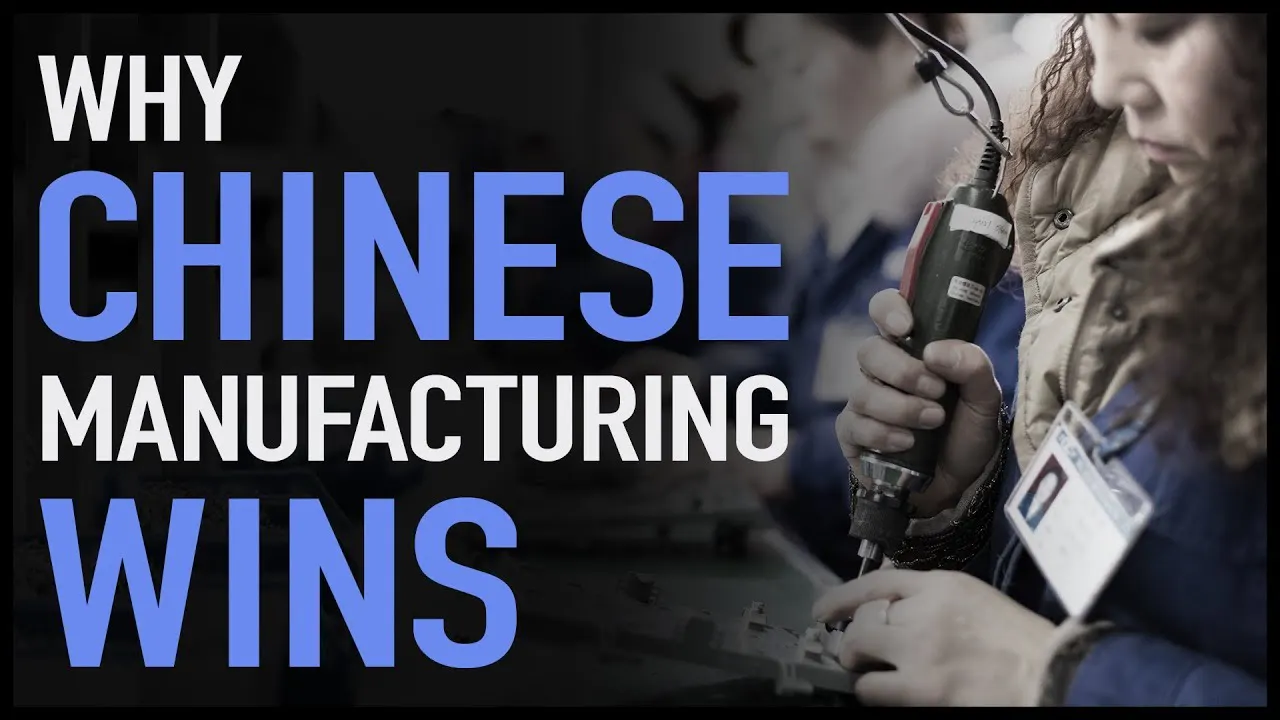
About this episode
Wendover Productions is made possible by:
Get every episode summarized
Each time Wendover Productions publishes, we email you a written briefing from the transcript — the topics, who appeared, and any specific claims, with the ad reads skipped.
Email me new episodesFree for 3 shows. No card needed.
Transcript ready
260 searchable segments. Every word is indexed and playable.
Full transcript
Wendover Productions — Why Chinese Manufacturing Wins | Wendover Productions. Machine-transcribed; use the interactive transcript above to jump the player to any line.
This episode is brought to you by Pal Molliv. Family time isn't just the big moments. It's weeknight dinners, sitting around the table, everyone talking all at once. So when the plates are empty and the sink is full, use Pal Molliv Ultra. Pal Molliv's most powerful formula removes up to 99.9% of grease, leaving your dishes sparkling clean, and the new convenient pump makes cleaning even easier, so you can spend less time tackling dishes and more time together. Shop now at PalMolliv.com. This episode is brought to you by Google Chrome. You think you know a browser, but Gemini and Chrome? That's new. It can help you with practically anything on the web, like restoring a vintage motorcycle from a 50-page restoration block, or finally break down that long article you've had open for weeks. Gemini and Chrome is here for it. Ready to make anything online makes sense? There's no place like Chrome. Check responses set up require compatibility and availability varies 18 plus. Propel Fitness Water with Gatorade Electrolites, Zero Sugar, and Vitamins.
Propel hydrates better than water to help you get the most out of your workout and get back to your best self. What propels you? Propel with Gatorade Electrolites. At the end of the first millennium, around 1080, China was definitely the most powerful country in the world. More than a third of the world live within its borders, its technology was the most advanced in existence and its economy accounted for an astronomical 50% of the world's GDP. The West paled in comparison to China. But eventually, Europe arose from its dark ages, the importance of China diminished, and the West came to rule the world. Today that is still largely the case, but China is rising again. In 1978, China had a GDP of only $200 billion, only about 4% of the world's GDP. Nowadays, that GDP has risen to $11 trillion and accounts for 15% of all economic activity in the world. This economic renaissance of the last 40 years is largely thanks to one industry, manufacturing.
We've come to accept that China is the world's factory, but it wasn't always this way. In the early 20th century, goods were often just produced right where they were sold. America made American goods, Europe made European goods. It wasn't until cheap worldwide shipping became available that the production side of a company could be relocated to the other side of the world. But why did China win? How did this country become the manufacturing giant it is today? In 1978, Deng Xiaoping took power in the People's Republic of China. He quickly visited Bangkok, Singapore, and other flourishing Asian cities, and was convinced that, in order to succeed, China needed to open itself up to the outside world, at least to an extent. He gave people control of their farms, privatized business, and most importantly, allowed for an investment in the country for the first time in decades. He opened up four special economic zones with tax incentives and exemption from the oversight that the rest of the country saw on its investments and trade activity. These four zones were essentially the free market portions of China. But none was more successful than this one, Shen Zhen and the Guangdong Province, so I went
there to see what it was like. Before its designation as a special economic zone in 1980, Shen Zhen was a tiny town with about 30,000 inhabitants. But today, that's grown to nearly 18 million people. That means that its size rivals that of New York and London. It's believed that Shen Zhen might have been the single fastest growing city in human history. Every other special economic zone was an established area before its designation. But Shen Zhen made sense as a spot where China could embrace the West as it lay just north of the border of Hong Kong, what was at the time a British territory. Today, Shen Zhen is the electronics manufacturing capital of the world. So Shen Zhen's city is really known for two things. One is manufacturing capabilities, especially for consumer electronics, products, and second is a gravitation for talents or human resources, especially on the product development and research and development disciplines.
Apple, Samsung, Microsoft, Sony, Canon, they all manufacture products here in Shen Zhen. In fact, 90% of the world's electronics are made at least in part in this city. Everything just costs less in China, so labor costs less too. Where a factory in the United States might pay upwards of 10 to 15 dollars an hour, a Chinese laborer would happily accept $3 or $4 an hour in Shen Zhen. When I was there, I withdrew the equivalent of $80 from an ATM upon arrival and left four days later with cash left over. A 30-minute taxi ride costs about $7 US dollars. A full meal at a local place was about $3. But China isn't cheap entirely naturally. China has artificially depressed the value of their currency. Up until 2005, the Chinese government just said that the exchange rate was $8.271 per dollar, and that was that. They then went a few years allowing it to increase in value within a margin, but in 2008, it's likely pegged its value again to make Chinese exports more attractive during the fall.
This episode is brought to you by Palm Olive. Family time isn't just the big moments. It's weeknight dinners. Sitting around the table, everyone talking all at once. So when the plates are empty and the sink is full, use Palm Olive Ultra. Palm Olive's most powerful formula removes up to 99.9% of grease, leaving your dishes sparkling clean, and the new convenient pump makes cleaning even easier, so you can spend less time tackling dishes and more time together. Shop now at Palm Olive.com. This episode is brought to you by Google Chrome. You think you know a browser, but Gemini and Chrome? That's new. It can help you with practically anything on the web, like restoring a vintage motorcycle from a 50-page restoration block, or finally break down that long article you've had open for weeks. Gemini and Chrome is here for it. Ready to make anything online makes sense? There's no place like Chrome. Check responses set up require compatibility and availability varies 18+. Propel Fitness Water With Gatorade Electrolites, Zero Sugar, and Vitamins, Propel hydrates better than water
to help you get the most out of your workout and get back to your best self. What propels you? Propel with Gatorade Electrolites Financial crisis. Nowadays the government just picks an exchange rate daily and lets the currency fluctuate from it by up to 2%. This just makes it so Western companies can buy more, for less. China also doesn't charge taxes on exports, while the US doesn't charge taxes on imports. The US doesn't even charge customs fees for some products like tablet PCs, so some products can make it all the way from their factory in China to stores in the US completely tax-free. When I was in Chengen, I visited a company called Anchor. They make all sorts of consumer electronics, but chances are if you have something from them, it's one of their portable batteries. I asked their CEO why so many electronic companies are now based in Chengen. So the advantage is that we're close to the supply chain, so everything is faster. So instead of you do a markup and see it like 2 weeks later, here you send them designed
to markup and you receive it like 3 days later. In Chengen, there are markets where you can buy every part imaginable. There are factories ready to build prototypes in a matter of days. There are engineers ready to work at a drop of a hat. Development just happens faster in Chengen. A US company might use the same factories as one based in Chengen, but the geographical distance makes production slower. In addition, word travels fast in Chengen. A few years ago, Anchor was first to market with a technology called Power IQ that allows for faster device charging. The engineers from Anchor told me that a big reason they were able to go to market before the Western companies was because they heard about it first, thanks to the proximity to other engineers and companies. Chengen just produces things better and faster, but a product isn't just a physical item. Honestly, we in Chengen is being in Chengen for this company and the advantage for the supply chain that we can develop very good products with a competitive price, but for the
brand, it's also a kind of a challenge. What Chengen can't build as well is brands. Some companies like Anchor have been able to to an extent thanks to smart PR and marketing, but some other companies just don't bother. Lucrative Western consumers want familiar and approachable feeling brands, but cultural differences and geographic distance often make Chinese based companies just seem different. All across Chengen, I saw these boxes filled with rentable, portable chargers, and as it turns out, it was an anchor product. But the Chinese designed product didn't really succeed in the Western market. So actually talking about anchor box, the product is originally designed for the Western market. However, actually our trial in Seattle wasn't that successful. So we realized, first of all, like, US people actually, when they go to a bar, they actually really go there drinking instead of looking at their phones. Well, if you're going walking to a bar in China, you'll find actually like 20 tables of
people standing around looking at their phone. When the designers are thousands of miles away from the consumer, they might not be as knowledgeable of their wants. Some companies have sprung up in Chengen, whose whole business is to develop and produce products without a brand. They're called white label companies. They might produce earphones, for example, then sell them to a Western audio company who will attach their brand and sell the product at a markup. Despite its enormous role in increasing the GDP of China 30 fold in the last 30 years, manufacturing is not an entirely sustainable industry for the country long term. The problem is that, rather ironically, the economic growth that manufacturing spurred in China has increased labor prices to a point where their manufacturing is less competitive. Before manufacturing came in, China was a country of poor rural farmers. But today, China has a real middle class and cities that are expensive to live in. They used to be that workers like the ones at Anchor's Factory moved to the city for a few years when they were young to make money for their family back home. But nowadays, people are moving to cities permanently and want to be able to sell.
This episode is brought to you by Google Chrome. You think you know a browser, but Gemini and Chrome? That's new. It can help you with practically anything on the web, like restoring a vintage motorcycle from a 50-page restoration block, or finally break down that long article you've had open for weeks. Gemini and Chrome is here for it. Do you need to make anything online make sense? There's no place like Chrome. Check responses set up require compatibility and availability varies 18 plus. This episode is brought to you by Palm Olive. Family time isn't just the big moments. It's weeknight dinners. Sitting around the table, everyone talking all at once. So when the plates are empty and the sink is full, use Palm Olive Ultra. Palm Olive's most powerful formula removes up to 99.9% of grease, leaving your dishes sparkling clean and the new convenient pump makes cleaning even easier so you can spend less time tackling dishes and more time together. Shop now at Palm Olive.com. Propel Fitness Water With Gatorade Electrolites, Zero Sugar, and Vitamins, Propel hydrates better than water
to help you get the most out of your workout and get back to your best self. What propels you? Propel with Gatorade Electrolites What a solid middle-class urban lives. The average cost for real estate in Central Shenzhen is almost $1200 per square foot. That's even higher than San Francisco and New York. Even when workers live outside the city center, higher wages are necessary even just to pay for housing. At the same time, manufacturing is becoming less labor intensive every day as robots and automation are becoming increasingly advanced and inexpensive. In 2015, China launched an initiative spending hundreds of billions of dollars each year to upgrade and automate factories to keep prices low. But this will likely do little to keep companies from packing up shop and moving elsewhere. Manufacturing lines that can be automated are likely to move back to the United States and the rest of the Western market. Robots cost the same whether they're in the United States or China, so manufacturing products in the US helps save on shipping costs and certainly is good for PR.
At the same time, the labor intensive jobs that China prospered on in the past decades are moving to less developed and less expensive countries like Vietnam, Bangladesh and India. Chinese manufacturing firms are responding to this by opening up their own factories all across the world. Everywhere from Africa to the United States itself, the model that might work for China in the future is that of anchor. Chinese-based firms that can take advantage of their proximity to the production lines to cut down on development cost and time. Shenzhen-based startups like anchor, DJI and OnePlus have already succeeded in taking advantage of this proximity, but more are being established each day. If you see a hardware-based Kickstarter campaign, there's a good chance it comes from Shenzhen. Ten years ago, a company would be hard-pressed to succeed in Shenzhen as its own brand, because historically, the retailer has acted as a barrier in between the manufacturer and consumer. But with the rise of Amazon and other e-commerce sites, it's now possible for Eastern companies to sell directly to the Western consumer in a system that rewards for quality
over price. The time really is ripe for Chinese entrepreneurship. While Silicon Valley might be the dominant area for software startups, it's hard to rival Shenzhen as an ecosystem for hardware development and manufacturing. I have to give a huge thanks to anchor for bringing me out to Shenzhen to research and film this video. It truly would not have been possible without them, and they gave me complete creative control over the video. I've actually owned and used an anchor battery for over five years that's never broken down, even when it's been accidentally submerged twice and dropped countless times. But luckily, they upgraded me to one of their newest ones, which I love. The main thing I want to plug for them is their power-it-up contest going on right now. Ten winners will each get $2,000 in cash and a bunch of free anchor products. To enter, you make a video up to one minute long about an unpleasant or awkward situation caused by running out of power, uploaded to YouTube, then shared on their page, and the 10 highest-voted ones at the end of the contest win. The link to enter is in the description, so good luck. Aside from that, please be sure to check out the link in the description. Please be sure to check out my podcast Showmakers and subscribe to this channel to get all my
future videos right when they come out. Thanks again for watching, and I'll see you next week for another Windover Productions video. The right window treatments change everything. You can expect the savings you love and fresh groceries selected just for you. Our associates are committed to getting every detail right, carefully hand picking your
items, checking for quality and freshness and packing your order with care. Because bringing you fresh, quality groceries is what we do best. And right now, enjoy $30 off your first online order of $75 or more. Restrictions apply, seasite for details. Fred Meyer. $1800 contacts. Fall has never looked or tasted this good. Sweet Greens Fall Harvest Menu is back with seasonal favorites dressed to impress and made to be devoured. Warm roasted sweet potatoes, crisp apples, maple glazed brussels, and crave worthy flavors
in the autumn harvest bowl, maple glazed salmon plate, and roasted bacon brussel side. The season's most desirable menu has returned to sweet green. Featuring falls best dressed. Take your move. Order on the sweet green app.
More episodes
More from Wendover Productions

The Logistics of German Reunification | Wendover Productions
Wendover Productions

The 8 Flights That Show How COVID-19 Reinvented Aviation | Wendover Productions
Wendover Productions

TWL #5: Timekeeping on Mars | Wendover Productions
Wendover Productions

TWL #10: The Day Sweden Switched Driving Directions | Wendover Productions
Wendover Productions