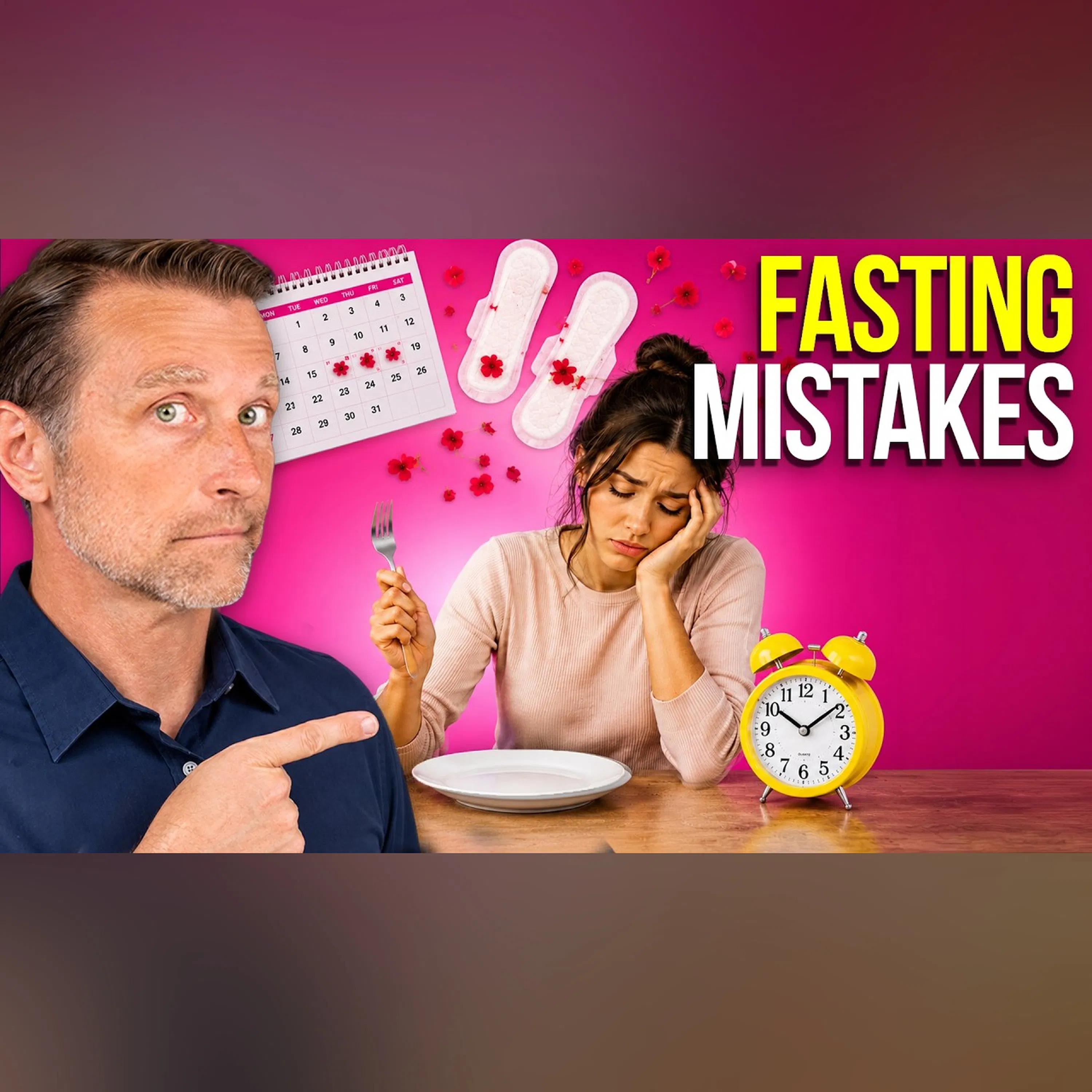
Why Intermittent Fasting Is Different for Women (Most Get It Wrong)
About this episode
Get every episode summarized
Each time Dr. Eric Berg DC publishes, we email you a written briefing from the transcript — the topics, who appeared, and any specific claims, with the ad reads skipped.
Email me new episodesFree for 3 shows. No card needed.
Hosts & guests
Transcript ready
121 searchable segments. Every word is indexed and playable.
Full transcript
Dr. Eric Berg DC — Why Intermittent Fasting Is Different for Women (Most Get It Wrong). Machine-transcribed; use the interactive transcript above to jump the player to any line.
Why intermittent fasting is different for women? There's a large group of women out there that are told by doctors that there's no way you're ever going to be able to have a baby. They're told that even the fertility drugs won't work and then they stumble on this intermittent fasting protocol and all of a sudden they're pregnant. I had my own clinic for 30 years and worked with 40,000 people and I will tell you intermittent fasting is one of the most powerful tools for women and especially if they have hormonal issues which includes infertility. And sometimes I'd have a conversation with a woman about intermittent fasting and their attitude about it was it's dangerous. It's going to wreck my hormones. So I want to show you where that actually came from. It came from a single study involving three month old rats. The rats were biologically equivalent to a nine-year-old human child and their version of intermittent fasting was an extreme starvation that no human would ever want to do.
But somehow that study has become the warning signal about intermittent fasting for women. But the studies that do involve women in intermittent fasting show that it helps their hormones. It does not disrupt their hormones. One of the biggest chronic hormonal problems that women go through is something called PCOS polycystic ovary syndrome. But also you have menopause awake in, you have sluggish thyroid function, you have irregular periods. You're about to find out intermittent fasting is one of the most powerful tools for a female's hormones. But the catches you have to do it correctly and it has to depend on your biology. If you take a 28-year-old female with polycystic ovary syndrome, the protocol for intermittent fasting is going to be much different than a 48-year-old female going in the parimenopause. So let's say for example you get up in the morning and you have your breakfast at 8 a.m. All right. And then your last meal is at 8 p.m. That would be a 12-hour eating window. But it's also a 12-hour fasting window.
To start getting into doing a true intermittent fast, you have to go at least 14 hours without eating. So let's say for example your last meal yesterday was at 8 p.m. That means you have to not eat all night long, wake up the morning, and push your breakfast to 10 a.m. That's like the minimum basic amount to actually start the fasting process. Then we get to 16 hours of fasting. So let's say for example yesterday your last meal was at 8 p.m. at night. Okay. You're going to fast all the way to the next day and your first meal is going to be at 12 noon. All right. That would give you 16 hours of fasting. That's when you start a topology, which is cellular cleanup. Now the question is what is the big thing about fasting? What gives you the benefits? It really has to do with this master switch called insulin. If insulin is too high, you do not get the benefits of fasting. Insulin has to be low. It's going to force your body to start burning your fat reserves.
If insulin is too high, what could happen is their energy can start going higher. And that's why their voice is getting deeper. They get facial hair. They get cystic acne because of this high level of energy, which actually is coming from the high level of insulin. Also this high insulin can put you in a state of estrogen dominance with very low progesterone. Now let's just go through the menstrual cycle. Let's say for example you haven't gone through menopause yet and you still have your menstrual cycle. And you have day one through 14. Day 14 is when you ovulate. This period of time, which is two weeks, is a very safe time to do fasting. So you can easily fast 16 hours and then your eating window will be eight hours or even up it to 18 hours of fasting with a six hour eating window. And you can do that very comfortably the first two weeks of your cycle
without too much of a problem. Now the second part of the month, starting at right around just after ovulation, today 28, which is the beginning of your period, you may find that you have problems with sleep and other symptoms. To be able to reduce those symptoms, you wouldn't necessarily want to do this type of fasting. Maybe you do a 12 and 12, which basically means you're having a breakfast at eight o'clock and then you're having your second meal at 8 p.m. But for women that have menstrual issues that second half, the hormone demand for fuel is very, very high, especially in that last week. Okay. And this is where progesterone is most vulnerable to stress. And so if you're doing extreme fasting, that can throw off progesterone and a lot of women that have very low progesterone cannot sleep. In which case, we don't want to do extreme fasting. So what I'm saying is if you have problems that last two weeks, especially the last week before your period, I would recommend that
you don't do a lot of fasting. You do a 12 and a 12 and you might even benefit by increasing your carbohydrates. But the type of carbohydrates I would recommend would be more berries or even a little bit of starch in the form of yam or red potato because we need to feed the endocrine system, especially progesterone. And you may feel significant benefit and be able to sleep if you do that. But if you don't have a problem with your menstrual cycle, I wouldn't recommend doing this. So a lot of people ask me, what supplements do I recommend? Now, of course, I'm not biased of my own high quality supplement line. But if you go to Amazon and type Dr. Berg supplements, you'll find more information. Now, for women that are menstruating heavily, they're losing blood. It's very important when they eat, they consume food high in iron, which would be red meat, organ meats like liver, that would be even better. But a lot of people don't like liver. So I would recommend increasing more red meat
if you're menstruating to get your iron versus taking some version of iron that's not very compatible with your body. If you have heavy cramping, I also recommend you increase magnesium before you menstruate. Now, let's go back to this other thing I mentioned, polycystic ovary syndrome. This is where you really want to do some hardcore fasting because we need to drive down insulin. So you would want to do 18 hours of fasting, which basically means your first meal is at 12 noon and your last meal is at 6 p.m. And you want to go low carb. Why? Because your high chronic insulin production is causing polycystic ovary syndrome and to undo and unravel that problem, you need to do hardcore low carb and hardcore intermittent fasting. What about fertility problems that are connected to this? I've seen great results with this type of fasting with fertility.
But with some women, when they do this type of fasting for various reasons, let's say they're usually deficient in certain nutrients, their cycle goes away. They become less fertile if they do more hardcore fasting. But what I would recommend as a sweet spot is to do 16 hours of fasting with an eight hour eating window, which basically your first meal is at 10 in the morning and your second meal is at 6 p.m. And then make sure that the meals that you eat are really nutrient dense. And I'm talking about with salmon, eggs, especially the yolk, yogurt, cheese, even shellfish for the tracemen rules. Now, what about parimenta paws? Okay, that's before you are going into menopause. A lot of women start having problems just before they go into menopause, which usually is around age 52. The best intermittent fasting pattern would be 16, eight, 16 hours of fasting. The
first meal would be at 10 in the morning, 10 a.m. and the last meal at six. So it's really two meals, no snacks in between. Now, what can happen parimenta paws and also post menopause is that you may start developing a condition called antigen resistance. Your muscles are not responding to the things that help them grow. So you're finding that your muscles are looking flabby or they're becoming more atrophied. And there's a couple little secrets to overcome this antigen resistance. You can do it with heavy lifting. The heavy lifting opens up the receptors for antigen for about 24 hours. Heavy weight lifting or resistance exercise with quality protein is the key to preserving your muscles. I do want to mention women that have hot flashes. When someone consumes a lot of carbohydrates, they go through these blood sugar swings. This could be corrected by fixing the insulin problem,
using intermittent fasting with a low carb diet. I have a free download that I want to give to you. This free download is my daily routine in the checklist. This is a routine that I use every day to feel like I'm 18 years old, even now I'm 60 years old, and I want to give it to you for free. And so there's a little link down below, click it and definitely download that. Now, we already covered the pattern for post menopause, which is 16 hours of fasting and eight hour eating wind out. And I've already mentioned heavy lifting. You have to work up to it, but weight training is really important paired with animal protein, but I would also add creatine and give you the energy to do the workouts. Now, let's talk about the thyroid. What's more important about the thyroid is making sure that your estrogen is not too high because estrogen can bind with T4 and create problems with the thyroid. In fact, 90% of everyone with a hypothyroid problem, it's an autoimmune condition, in which case
salineum is super important. But I'm going to tell you right now, fasting can help a thyroid condition. I would recommend the 16 hour window of fasting and an eight hour eating wind out. And just by doing this alone will help balance excess estrogen and free up more T3. Let's talk about high stress. If you're going through a lot of stress, cortisol is going to be high. And so we don't want to add a lot more stress of fasting because that's really what intermittent fasting is. It's a mild stress. I would recommend just doing a 12 and 12. Basically, you have breakfast in the morning. And the last meal is at 8 p.m. And I would do long walks, take a good amount of natural vitamin B1, until that stress comes down. So then you can start extending that fast. But typically, you don't want to do any extreme fasting when you're under a lot of stress because your body is already under stress and stress is affecting the blood sugar. So when you're doing the fast, you're not going to feel like
you're really converting into fat burning because you're in stress mode. A really good way to know if you're doing the correct fasting pattern is how you feel because the more stress you have, the longer fast are going to be more difficult. Realize fasting is like a muscle. You want to start off at a certain point and gradually increase it over a period of time to get your body used to it. Now, I will mention a lot of people are on this GLP1. Okay. That takes away hunger. And there's a lot of side effects from this too. So if you are on this, I highly recommend even if you have to set a schedule and even if you're not hungry, consume sufficient animal protein to prevent muscle loss. Why? Because your muscles are the metabolic machine that you need. And as soon as you lose your muscle, it's going to be harder and harder to lose weight, defeating the very purpose that you went on this in the first place is to lose weight and maintain it. Now that you know the differences
with intermittent fasting for females, the next most important thing to know is exactly what you eat when you're not fasting. And for that information, this is the video that you should watch right here. Check it out.
More episodes
More from Dr. Eric Berg DC

The #1 Best Protocol to Reverse Gout (and Prevent It)
Dr. Eric Berg DC

Take ONE Teaspoon of This Spice to Resolve Your Diabetes
Dr. Eric Berg DC

The Top Foods That Have Been Blocking Your Nutrient Absorption (Vitamins & Miner...
Dr. Eric Berg DC

DON'T CONSUME THESE IF YOU'RE OVER 50!!!
Dr. Eric Berg DC