Loading...
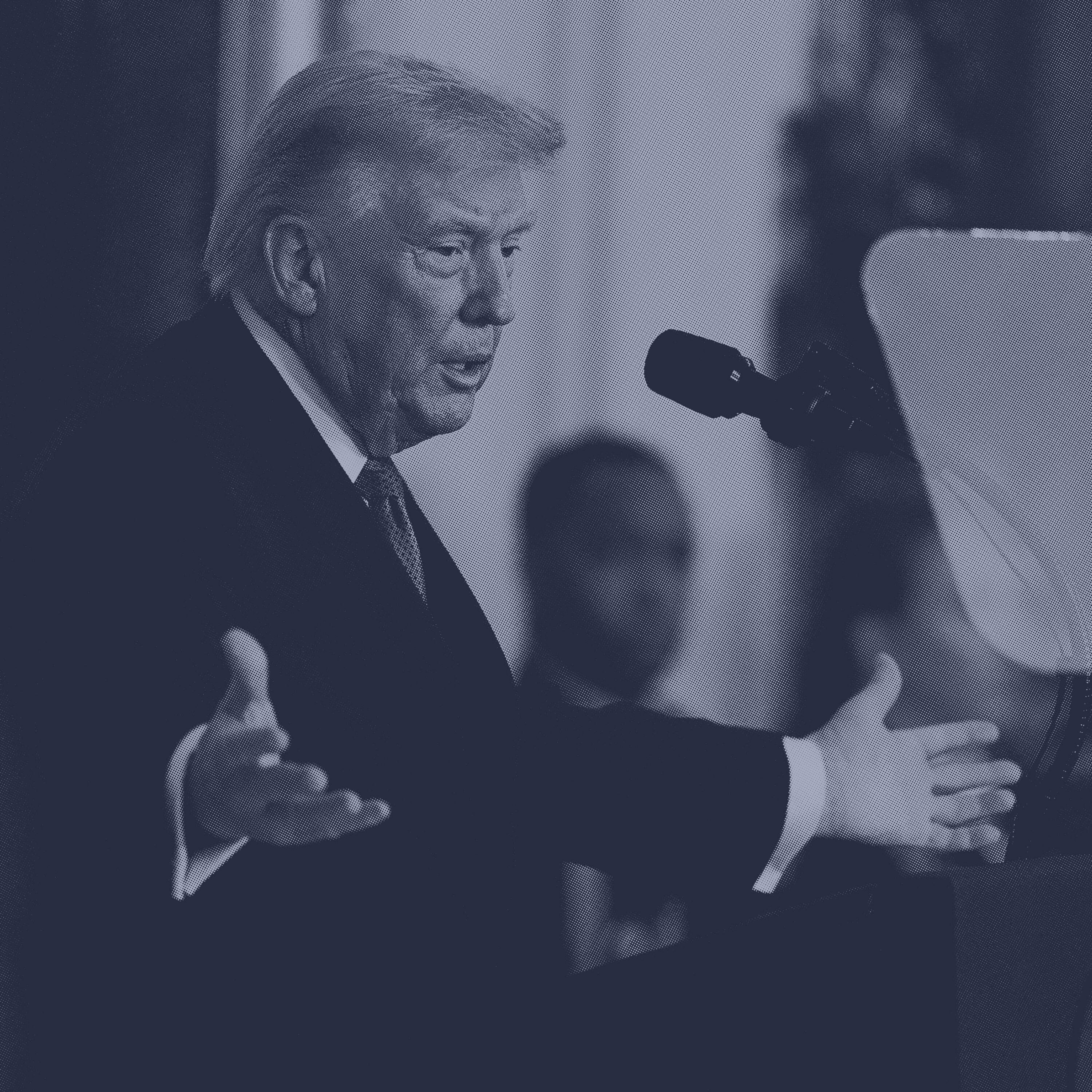
About this Episode
In less than a week, the Trump administration's justifications for the war in Iran have already changed several times, as have the administration's goals for what it wants to accomplish. We discuss both, plus what could come next.
This episode: senior White House correspondent Tamara Keith, national security correspondent Greg Myre, and senior national political correspondent Mara Liasson.
This podcast was produced by Casey Morell and edited by Rachel Baye.
Our executive producer is Muthoni Muturi.
Listen to every episode of the NPR Politics Podcast sponsor-free, unlock access to bonus episodes with more from the NPR Politics team, and support public media when you sign up for The NPR Politics Podcast+ at plus.npr.org/politics.
To manage podcast ad preferences, review the links below:
See pcm.adswizz.com for information about our collection and use of personal data for sponsorship and to manage your podcast sponsorship preferences.
NPR Privacy Policy
This episode: senior White House correspondent Tamara Keith, national security correspondent Greg Myre, and senior national political correspondent Mara Liasson.
This podcast was produced by Casey Morell and edited by Rachel Baye.
Our executive producer is Muthoni Muturi.
Listen to every episode of the NPR Politics Podcast sponsor-free, unlock access to bonus episodes with more from the NPR Politics team, and support public media when you sign up for The NPR Politics Podcast+ at plus.npr.org/politics.
To manage podcast ad preferences, review the links below:
See pcm.adswizz.com for information about our collection and use of personal data for sponsorship and to manage your podcast sponsorship preferences.
NPR Privacy Policy
Hosts & Guests

Transcript
Hey there, it's the NPR Politics podcast.
I'm Tamer Keith.
I cover the White House.
I'm Greg Myri at Cover National Security.
And I'm Mara Liason, Senior National Political Correspondent.
And today on the show, why did the U.S. strike Iran and what happens next?
The Trump administration has given a series of explanations over the last several days
as to why military action was necessary.
Starting with President Trump's State of the Union Address.
After midnight hammer, they were warned to make no future attempts to rebuild their weapons
program in a particular nuclear weapons, yet they continue starting it all over.
We wiped it out and they want to start it all over again.
And at this moment, again, pursuing their sinister ambitions.
And a reminder that midnight hammer was the operation last summer that the president
said completely and totally obliterated Iran's nuclear program.
But then after the U.S. started this mission in Iran, the messaging shifted.
Here is President Trump on Saturday, Sunday, Monday, and Tuesday.
We're going to destroy their missiles and raise their missile industry to the ground.
It will be totally again obliterated.
We're going to annihilate their navy.
We're going to ensure that the region's terrorist proxies can no longer destabilize the region
or the world.
And for almost 50 years, these wicked extremists have been attacking the United States while
chanting the slogan, death to America or death to Israel or both.
They are the world's number one state sponsor of terror.
We are the world's greatest and most powerful nation, so we can do something about what
they do.
These intolerable threats will not continue any longer.
In addition, the regime's conventional ballistic missile program was growing rapidly and dramatically.
And this posed a very clear colossal threat to America and our forces stationed overseas.
You see, we were having negotiations with these lunatics, and it was my opinion that they
were going to attack first.
They were going to attack.
If we didn't do it, they were going to attack first.
I felt strongly about that.
There are a lot of different reasons given there over the course of several days.
And some of them almost seem to conflict with each other.
So, Mara, what do you make of the administration's evolving messaging on this?
I think that the military goals that they expressed were pretty clear.
When you say we want to destroy their missile system or we want to get rid of their navy,
that we understand what that means.
But the political goals have been shifting and going back and forth.
Do they want regime change or not?
If you want to stop Iran from sponsoring terror around the world, well, gee, that sounds
like you're going to need to have a change in the government.
They are not just decapitate their missile program.
So I think that there's been a sense among former administration officials, Europeans,
everywhere that Donald Trump was kind of making this up as he went along.
And that's a very destabilizing, concerning thing when the world's most powerful person
who leads the most powerful country doesn't have a clear idea of what the political goal
is.
We know what the military goal is, but you can't get rid of Iran as a bad actor just with
bombs from the air.
I think everybody always focuses on the military part of it and not on the political part.
The military part with the bombs exploding, the stromatic footage that we see on TV.
And that often is where wars are won or lost, but then there's the political settlement
that comes afterwards.
And that's harder and it's less dramatic and it involves negotiations.
But that often determines in the longer term whether a war went well or went badly for
one country or both or for everybody involved.
Great.
One thing that has really stood out to me in the last week is just how little of a public
case was made for this operation before it happened.
How little of this rationale was explained to the American people.
Instead, we've been getting it afterwards.
Yeah.
Well, it absolutely differs from what we've seen for decades now.
And you just remember, I remember all the way back to George H. W. Bush making a big
case, building an international coalition, going to the United Nations.
So all of these steps, the dealing with the American people, Congress, the international
community, a military coalition, and Trump didn't want to do any of that.
And that's a big difference.
Now, it certainly allowed him to act quickly and more freely and act when he wanted to
act.
But the reason those other things are important is to have legitimacy, to have support.
And then when you sit down at the end of it, work out a political settlement.
And to say to everybody, look, we all agreed, we needed to do this, rather than just say,
we did this alone.
And so I think that's when you get to the end of a conflict, that gives you much more
legitimacy when you want to sit down and work out the final settlement with everybody.
Having had them be there at the beginning and having had input from the beginning, even
if the U.S. was leading an operation.
Mara, there was a moment in yesterday's White House press briefing where press secretary
Caroline Levit talked about how this happened, how this came about.
The president had a feeling, again, based on fact, that Iran was going to strike the United
States, was going to strike our assets in the region, and he made a determination to
launch Operation Epic Fury based on all of those reasons.
Mara, going to war, launching a war based on a feeling is different.
It's the essence of the Trump presidency.
He also said it was my opinion that they would, they were about to attack us.
He didn't say my intelligence community told me this, I got information, nope, it was
his opinion.
So Trump's vision of the presidency is very personalist.
In other words, it's just about one guy, and he doesn't want to be checked.
He has hollowed out all of the incredible resources that the United States used to have to advise
a president, the National Security Council, all sorts of parts of the government which
who would have helped him figure out a strategy are really been diminished.
So this fits perfectly with Trump's idea of an unchecked all-powerful executive.
You don't even need to have a coherent explanation because nobody's going to stop you.
But when you talk about the hollowing, that is by design.
Absolutely.
Absolutely.
They condensed something.
They took the National Security Council and the Secretary of State to big parts of
the decision process.
There is no process.
And they put Marco Rubio in charge of both.
And when I asked the White House, well, what about the process?
They said, well, we want this to be top down.
Greg, I do want to unpack some of the reasons that the administration has articulated for
this war and why it needed to be now and go through it one by one.
Greg, was there any intelligence that Iran was going to attack US interests first, that
there was an imminent attack?
No, not that we're aware of.
We have heard from senators and congressmen who've been in private intelligence briefings
and they said they heard nothing to that effect.
Also let's recall that the US military buildup took place over a month.
They were preparing for this for a long time, which again, it kind of goes against the notion
that there was an imminent threat of attack from Iran.
And what about Iran's missile program?
Did it pose a threat to the US or US interests?
The president in those first remarks was talking about ballistic missiles and needing to take
them out.
And distinction here, to US interests in the region, yes, we've seen Iran fire those missiles
and the battle last summer can hit Israel, it can hit other countries in the region, it
could hit US ships, it could hit US embassies, US military bases.
So yes, in theory, they can and have fired on those US bases.
No, Iran does not have a weapon that could strike the United States itself.
It's the missiles don't go anywhere near that distance.
Secretary of State Marco Rubio suggested earlier this week that the US struck because it
knew that Israel was going to hit Iran first.
We knew that there was going to be an Israeli action.
We knew that that would precipitate an attack against American forces.
And we knew that if we didn't preemptively go after them before they launched those
attacks, we would suffer higher casualties and perhaps even higher those killed.
And then we would all be here answering questions about why we knew that and didn't
act.
It's worth noting that Rubio walked that back somewhat the next day and said the US wasn't
following Israel's lead.
But Greg, what do we know about Israel's plans?
Well, they're one and the same.
They had coordinated this for weeks, if not months.
And it was very carefully crafted.
So it was not like Israel was going to attack and surprise the US.
There's very, very coordinated efforts from the very beginning.
And so when he says that we knew Israel was going to attack, well, yes, he did because
they were sitting at the same table making these plans together.
And this was not a case where either side caught the other by surprise.
Okay, it is time for a quick break.
When we come back, unpacking where things stand now in the war.
And we're back.
Mara, at the top of the pod, you talked about how there are two sets of objectives here
for the war, military objectives and political objectives.
And I'd like to talk about the political ones first.
What is the goal here?
Beats me.
You know, it's pretty confusing because he has said different things at different times.
In an interview with Axios, the president said that he is going to get to pick the new
leader of Iran.
That is regime change pure and simple.
It's the clearest definition of regime change that there could be.
But at other times, he has said, for instance, you know, to the Iranian people, when we're
finished, take over your government.
It'll be years to take.
This will probably be your only chance for generations.
As if he was saying, well, we're going to bomb and walk away.
It's up to you.
And he was going to leave it to them.
So it's unclear what the political objectives are here.
And you know, we're going to have to wait to see if Trump clarifies.
But right now, it seems like regime change is the political objective.
And of course, as Greg can explain, that opens up a whole can of worms because there is
no historical example of doing regime change from the air just by bombing.
Good point.
I had an interesting conversation yesterday with Cory Shockey from the American Enterprise
Institute.
And I asked her, can you give me examples?
When was the last time there was a successful regime change engineered by the U.S. and she
said, well, I can think of three in the past century.
After World War II, when the U.S. defeated Germany and Japan, it went in there and helped
those countries rebuild to prosperous democratic states with an occupation, troops on the ground.
And then Panama in 1989, the U.S. went in, took out the leader there, Manuel Noriega,
and helped rebuild Panama, which has done pretty well for itself since then.
And you could point to a lot more failures, the successes much more rare than the failures.
Yeah, the list of failures is fairly long and painful for the United States.
Oh, absolutely, absolutely.
And often with the U.S. had great plans, you could argue good intentions, others would
argue not, but the U.S. put in time, put in money, it didn't work out.
And for various reasons, and it's just, it's a very hard thing to do.
Well, Trump had some pretty choice words about the lack of planning for a succession.
I don't think that's exactly how he would describe what he said, but what he said was truly remarkable.
This was in the Oval Office on Tuesday.
Well, most of the people we had in mind are dead.
So, you know, we had some in mind from that group that is dead.
And now we have another group, they may be dead also, based on reports.
So I guess you have a third wave coming in.
Pretty soon we're not going to know anybody.
I mean, he's talking about people that he had in mind to be the next government of Iran,
but they kept on getting killed.
He also talked about in the passive voice, in the passive voice.
Yeah, but he also talked about the possibility that there could be somebody just as bad
becoming the leader of Iran as if he had no agency at all.
Well, I think that if you look at the way President Trump has executed foreign policy,
in this second term, he's been fairly agnostic about what happens after the big military action
and the shock and the awe and all that.
He, you know, like he didn't have to bomb and walk away.
That's a simpler way of saying what I was trying to say.
But what's so interesting is if you take him at his word when he said he wants regime change,
well, he can't really walk away.
Right. This is different than what he has done in the past.
It isn't just a couple of bombs.
It isn't a, you know, we'll send a side message and say, we'll keep you leader of Venezuela,
second in charge.
Change the lead singer, but the band plays on.
Right. This is, this is different.
Oh, absolutely.
In this Axio's interview, he gave.
He said, in fact, they were looking for a kind of delsy Rodriguez type figure.
But again, he keeps making that analogy if it was the same thing.
It's much, much more complicated here.
You just have many more centers of power in Iran.
It's a much larger country with 90 million people.
And based on a real ideological principle of clerical rule, it's not just, oh,
we could have this leader who's conservative or this leader who's liberal.
It's theological as well as ideological.
Shiite Islam rule by the clerics.
And the supreme leader was taken out on day one.
And that leaves a vacuum.
Which it may be filled by his son, who's also considered a hardliner very much in the,
in the same mold.
So and Trump has ruled him out.
It Trump is also specifically saying he would not bring, I believe, peace and harmony
to Iran was his Trumps raising.
So there's still a lot of unanswered questions there.
But I think we should move on to the military objectives.
And those two have evolved and changed somewhat.
Greg, what is happening there?
Yeah, I mean, the US and Israel, I think, have carried out a plan probably seemingly along
the lines that they intended.
I would say that in contrast to these confusing messages about why the war started or what
its goals might be, the campaign itself seems to be going pretty well from a US-Israeli
perspective.
We've heard, for example, just in the past day or so, from the Pentagon about the division
of labor here.
So the US has an aircraft carrier south of the water south of Iran and is focused really
on that southern coast and has been firing long range attacks to try to defeat or weaken
the Iranian forces along the coast.
Israel has been going for Western Iran because that's where Iran fires the missiles into
Israel.
So Israel is, that's a supreme concern of Israel.
And Israel has also been bombing in Tehran and hitting the leadership targets and headquarters
in Tehran.
So that's the way they've kind of split up the regions in terms of where they're attacking.
Now the big step that they say they're about to accomplish is completely defeat Iran's
air defenses, which we're pretty weak to begin with, but you don't want to send manned
aircraft into Iran if you don't know exactly what you're going to encounter.
They say those air defenses have almost completely been wiped out, which would allow the
US and Israel to effectively fly manned aircraft over Iran 24-7 in uncontested skies without
having to worry about being shot down.
The supply of bombs that the US has is quite large when it comes to this.
So that would allow just this constant bombing to take place in Iran.
Always unpredictable things could happen, but it does seem like that's the trajectory
we're on.
So interesting about this is the definitions of success, militarily or politically differ,
because this is an asymmetrical conflict.
If the regime just merely survives, they win.
The I think that the criteria for success for the United States is much higher.
They have to get rid of the regime.
They have to show that whoever is leading Iran after this is more cooperative with the US
or has agreed to certain requirements.
But if the regime is still standing, I don't see how Trump can declare victory, even
though he is the best at declaring victory out of almost anything.
He declared victory all the time on all kinds of things, whether he has actually won or
not.
He declares victory.
War is not always predictable, and things happen.
Bad things happen.
In this case, a girl school was hit that NPR reporting indicates was close to a military
target.
There was a friendly fire instant taking down three US fighter jets.
The service members ejected and were recovered safely.
Six US service members were killed in Kuwait.
President Trump has been very critical in the past of US military involvement in the Middle
East in Iraq and in Afghanistan.
Does he risk being responsible for the very thing he has criticized in the past?
So I think we're too early to make that kind of judgment.
I think we're on day six here.
And as an air campaign, the president will have the ability to call it off, pull the plug
pretty much anytime he wants.
That's why it's very different than putting in ground troops.
And that's been a red line for Trump and continues to be.
So I think yes, he could he could end this when he wants.
But we're going to hit a tricky point where even if you're having military success, what
kind of political agreement are you going to get to end the war?
And what if you reach the point where you feel you've done the damage you wanted to
do militarily, but you can't get the political agreement you want?
Do you keep bombing?
Do you keep exercising that kind of pressure on Iran, hoping they will come around?
Or do you just pull out and say whatever happens in Iran is Iran's problem, not ours.
So for me, that's going to be that critical point when Trump may decide, I think we've
accomplished what we wanted militarily, but will he get what he wants politically?
Or will he just still be willing to leave rather than drag it out?
Yeah.
And I think we don't necessarily know the answer to that question.
Oh, absolutely not.
And that's the whole point you never do.
And that's why it's so risky to start a war is you don't know how it's going to end.
There were talks happening in Geneva where the US and Iran were trying to find an off-ramp.
Why didn't that work?
They wanted things that were just very, very different.
Iran was willing to perhaps make some concessions on its nuclear program, but it wasn't going
to surrender.
It wasn't going to give up its missile program.
It's really the only way it can defend itself.
Its navy was not great, and now most of it, or all of it has been sunk.
It has an air force that literally dates back to before the Islamic Revolution, back when
the US was an ally of Iran.
It's one real defense, especially against these air strikes that it's facing, and it's
way to hit out at Israel or US targets, was with missiles.
So Iran was just not going to make those kinds of concessions where the Trump administration
was saying you got to give up your missiles, your nuclear program, and Iran was just not
willing to go that far.
Now you could argue or some have argued that the Trump administration was making demands
it knew Iran couldn't accept, and therefore this was how it would end up.
But they were a little too far apart.
You could have had a agreement similar to the one you had back in 2015 in the Obama administration,
plus a few more things, but you weren't going to get the kind of sweeping deal that the
Trump administration was asking for.
But we should remember Iran still has proxies in the Middle East that could hit US targets.
They've been greatly weakened, whether it's Hezbollah in Lebanon or the Houthis in Yemen.
The Houthis could start shooting missiles again at ships in the Red Sea and further disrupt
the flow of oil.
Individual acts could take place.
So I would say yes, Iran still has the ability to act outside its borders, but not on a large
massive ongoing scale, and we're seeing that capacity shrink by the day.
Well, whatever reason the Houthis have not resumed firing on ships in the Red Sea, Hezbollah
has fired a little bit at Israel, but not in the same way that it did in the past.
So I think that reflects Iran's weakness that's been happening over the past couple years.
Mara, can I ask you about domestic politics?
Because as we talked about earlier in the podcast, the President and the White House didn't
really necessarily make a big sales pitch to the American people.
Now, the American people actually are feeling consequences.
Gas prices rose very quickly.
You've had these service members who were killed.
How much can the American people stomach of this?
Well, that's a good question, and I would say not too much more.
There was no rally around the flag effect at all, which is very unusual, usually when
presidents start a military action at least for a couple of days or a week.
People are willing to give them the benefit of the doubt, and they rally around the President.
That didn't happen.
There was net negative approval for this war, even though Republicans in Congress are still
holding firm.
They're not going to vote for a war power's resolution.
So Americans are against this, and I think the big tripping point for voters is whether oil
prices continue to go up and whether American service members continue to get killed.
Those are usually the two things that make people care about foreign policy in an election
year.
If the President manages to find an off-ramp and oil prices go back down, then I think
it has less of an effect on the midterms.
But right now, the American people don't like this.
All right, we're going to leave it there for now, and please join us tomorrow when we
will discuss President Trump's decision to ditch Homeland Security Secretary Kristi Nome.
I'm Tamara Keith.
I cover the White House.
I'm Greg Myrie.
I cover National Security.
And I'm Mara Liason, Senior National Political Correspondent.
And thank you for listening to the NPR Politics podcast.
This message comes from Kachava.
That wellness goal you set at the start of the year, it's not too late to stick with it
and make your future self proud, especially with the all-in-one nutrition shake from Kachava.
With 25 grams of protein, six grams of fiber, greens, adaptogens, and more, no fillers,
no nonsense, just the highest quality ingredients.
Stick with your wellness goals.
Go to Kachava.com and use code NPR for 15% off.
It's K-A-C-H-A-V-A.com, code NPR.


