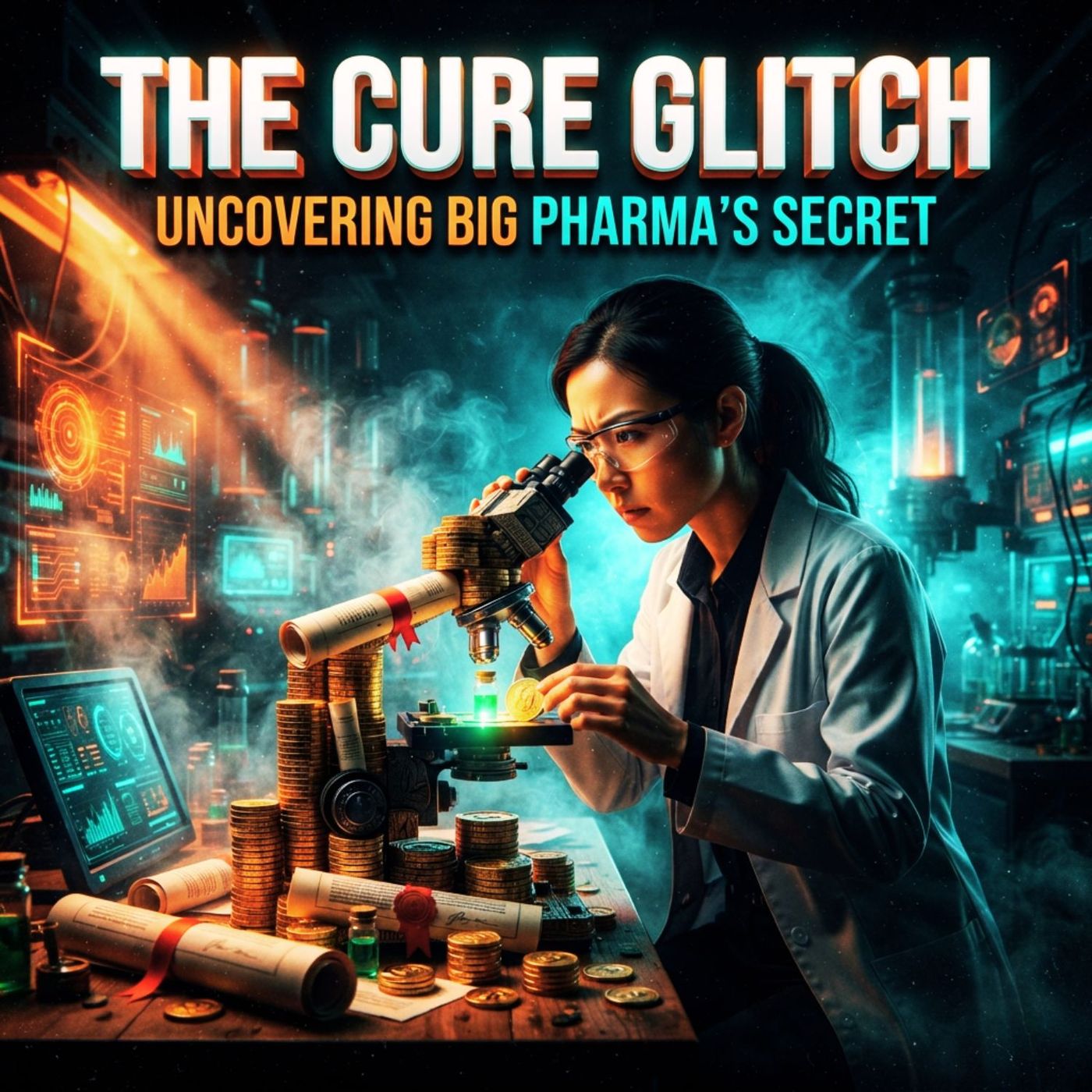
Why Science Found the Cure but Your Doctor Doesn't Have It
About this episode
In this episode, we dive deep into the mind-bending insights of Saloni Dattani from her viral 2026 TED Talk. The truth is more shocking than you think: we aren't waiting for a scientific miracle; we're waiting for a better business model.
The "Economic Glitch" in Global Health
We react to Dattani’s argument that diseases aren’t a fact of life, but a result of broken medical incentives. Why was the malaria vaccine delay decades long? Why is global health innovation stalled for the people who need it most? We break down the revolutionary concept of Advanced Market Commitments (AMC) and how these structural innovations are finally making the impossible, profitable.
Key Insights You’ll Discover:
- The Science is Ready, The System is Not: Why scientific breakthroughs don’t always equal medical cures.
- Advanced Market Commitments (AMC): How "buying the future" can save millions of lives.
- Clinical Trial Reform: Moving past the institutional barriers that slow down progress.
- Collaborative Research Networks: The new blueprints for 21st-century medicine.
The primary barriers are market incentives that don't prioritize the poor and institutional delays that keep scientific knowledge from becoming accessible medicine. By refining the systems that govern innovation, we can treat disease as a solvable technicality rather than an inevitability.
Stop waiting for the future—start building it with us! 🌍✨
Subscribe and join the conversation as we explore how to fix the glitch in our global health OS!
#GlobalHealth #MedicalInnovation #SaloniDattani #FutureOfMedicine
Become a supporter of this podcast: https://www.spreaker.com/podcast/thrilling-threads-conspiracy-theories-strange-phenomena-true-crime-unsolved-mysteries-etc--5995429/support.
ThrillingThreadsPod.com - Unravel the Unknown.Dive deep into the world's greatest conspiracy theories, strange phenomena, true crimes, and unsolved mysteries. Follow the threads.
Get every episode summarized
Each time Thrilling Threads - Conspiracy Theories, Strange Phenomena, Unsolved Mysteries, etc! publishes, we email you a written briefing from the transcript — the topics, who appeared, and any specific claims, with the ad reads skipped.
Email me new episodesFree for 3 shows. No card needed.
Hosts & guests
Transcript ready
389 searchable segments. Every word is indexed and playable.
Full transcript
Thrilling Threads - Conspiracy Theories, Strange Phenomena, Unsolved Mysteries, etc! — Why Science Found the Cure but Your Doctor Doesn't Have It. Machine-transcribed; use the interactive transcript above to jump the player to any line.
If you were alive in the 1950s, your chance of dying from heart disease was roughly four times higher than it is today. Oh wow. Yeah. Right. Just let that sink in for a second. You know, you are just living your life going to work, raising your family and hovering over you is this, this statistical shadow that is literally four times larger, four times heavier than the one you live with right now. It really reframes how we view the past, honestly. I mean, we spend so much time worrying about the health threats of the modern world and rightfully so, but of course, but from a purely statistical standpoint, simply existing in the mid 20th century was, well, it was remarkably more perilous for your cardiovascular system. Yeah. The default state of aging was just significantly more dangerous. And that is exactly where we are starting today. So welcome to Thrillinth Threads. We are taking a massive stack of research, historical data and, you know, foundational presentations, and we're weaving them together to find the insights you actually need to know.
We custom tailor these journeys for you, the listener. So you can walk away, not just informed, but like genuinely understanding the mechanics of how the world operates behind the curtain. Yeah. And today our foundational source is this really fascinating YouTube video of a TED Talk by Saloni Dutani. And it's titled, we've solved many medical mysteries. Where are the cures, which is a phenomenal starting point because that title really captures a paradox. You have likely felt intuitively. Oh, absolutely. I mean, we are constantly inundated with news about massive scientific leaps, right? Mapping the genome, new AI drug discoveries. Both flashy headlines. Right. Yet it feels like people are still getting sick at the exact same rates. The actual physical cures often feel, you know, perpetually out of reach, just stuck in some laboratory limbo somewhere. Exactly. So our mission today is to unpack the hidden reality of medical innovation. Because what the data reveals is that the biggest hurdles to curing diseases aren't actually scientific anymore.
No, they really aren't. They aren't even technological. The real bottlenecks holding back the future of human health are economic. They are systemic. But the good news and what we are going to really tear into today is how ingenious thinkers are figuring out ways to hack those very economic systems to save millions of lives. It really unfolds like a detective story, doesn't it? Yeah, it totally does. We are basically investigating a mystery that moves far beyond biology or test tubes. It is a story about the cold, hard mechanics of global capitalism, you know, the invisible forces that shape public health policies. Right. And why a miraculous cure can exist on a whiteboard, but just completely failed to reach the immune system of the person who desperately needs it. So let's jump right back to that 1950s heart disease statistic. Because how did we get that mortality number down to a quarter of what it used to be? Certainly wasn't magic, right? Definitely not magic. And it wasn't one single pill either. If we look at the landscape of the 1950s, there are no statins to manage cholesterol. Actually, there wasn't even widespread cholesterol testing.
Which is wild to think about. Right. You couldn't just like get blood work done to see if your arteries were quietly clogging up. And that is terrifying when you think about the actual mechanics of heart disease. Plac build up in the arteries is largely asymptomatic for decades. You literally don't feel it. Exactly. Without testing, you are essentially driving down a highway blindfolded, just waiting for the crash, which in this case is a myocardial infarction, you know, a heart attack. Right. And beyond testing, think about the interventions we just take for granted today. There were no implanted pacemakers regulating arrhythmias. There were no massive public anti smoking campaigns. I mean, doctors were actively used to advertise cigarettes back then. Right. Nine out of 10 doctors preferred this brand. That whole thing. Exactly. And there were no municipal or national bands on trans fats in our food supply. Bi-pass surgery was in its absolute infancy. It was incredibly dangerous. Even CPR, you know, cardiopulmonary resuscitation, the most basic life saving technique we are all taught in high school health class. Oh, yeah, the dummy they bring into the gym. Yes, exactly. That wasn't even formally developed and standardized until the 1960s.
When you lay it out sequentially like that, you really realized the victory over heart disease wasn't a single battle. It was, well, it was a war of attrition, one through a compounding effect of dozens of different interventions. Yeah, a lot of little things adding up. Right. Some were biological, like statins interrupting the liver's production of cholesterol. Some were surgical, like the bi-pass. And some were purely behavioral and legislative, like the trans fat bands you mentioned. But here's the thing that really struck me as I was reviewing all this. When was the last time you listening to this saw a breaking news alert celebrating the long term compounding impact of cholesterol testing? Never. Right. Have you ever seen a push notification on your phone that says breaking trans fat bands continue to quietly save 10,000 lives this month? You haven't and you never will. And that is a fundamental quirk of both human psychology and media consumption. Honestly. So well, we are dealing with the myth of the breakthrough. Culturally, we have been conditioned by cinema and sensationalized headlines to believe that medical progress happens in these sporadic, explosive, eureka moments. Oh, right. Like the lone genius. Exactly. We picture this lone genius in a dimly lit lab who accidentally drops a petri dish. Stairs at the mold growing on it and boom, penicillin is born and the world changes overnight. Yes. The classic sheer determination montage where the scientist stays up for three days drinking coffee.
Looks through a microscope and suddenly else I've got it right with dramatic music playing in the background. But the reality is that progress is a continuous relentless stream of incremental innovation. It's slow. Very slow. It happens every single year, quietly, methodically in thousands of different laboratories and policy meetings. But because it happens gradually, it doesn't trigger our evolutionary novelty sensors. It just doesn't make the evening news. It is exactly like watching your hair grow. Oh, that's a good comparison. Yeah, like if you stare in the mirror every single day, you don't notice a single millimeter of difference. It looks exactly the same today as it did yesterday. But then, you know, three months go by, you catch a glimpse of yourself in a photograph and you think, whoa, I desperately need a haircut. Exactly. Progress in the medical field operates on that exact same visual frequency. It is happening invisibly in the background. Pipe it by pipe it. Data point by data point. It is a highly accurate way to visualize it. And this perception gap, this hair growth blindness, so to speak, is actually incredibly dangerous for the future of science.
Wait, really? How so? I mean, just because we don't throw a parade for it doesn't mean the science isn't still happening in the background, right? True, the science happens, but the funding for the science relies entirely on public perception. Right, the money. Exactly when the public doesn't perceive progress cynicism sets in. If you look around and constantly feel like nothing is getting better, if you feel like cancer is just as rampant or Alzheimer's is just as terrifying as it was 20 years ago, you naturally start to question the value of public health initiatives. Yeah, that makes sense. You start to ask your elected officials why your tax dollars are being funneled into billion dollar national health institutes if they aren't yielding results. I see it's like if you are funding a massive public works project, maybe like a new subway line, if all you see is dirt and traffic delays for five years, you just want to cancel a project. Yeah, you forget that tunnels are actually being bored deep underground, where you can't even see them precisely acknowledging these quiet, continuous miracles is a structural requirement for sustaining the momentum of research.
If the public loses faith in the scientific process because they only see the remaining unsolved problems, well, the political will to fund the next wave of research dries up cynicism literally defunds the future. Wow, which is why we really need to look at the actual receipts of what this slow grinding progress has achieved recently when you isolate just the massive wins from the last two years, the pace is actually breathtaking. It really is the volume of human suffering being alleviated right now is historically unprecedented. Let's break down a few of these because they fundamentally alter how we should view the current era take HIV. Just recently we saw the rollout of a new antiviral treatment, which is incredible. Yeah, and this isn't just a marginal improvement. It protects against infections with an efficacy of nearly 100% and the delivery mechanism. It's not a handful of pills every day. It's strict intervals. It is a single dose and injection every six months. We really need to pause and appreciate the mechanics of that for decades.
The standard of care for HIV required highly active antiretroviral therapy or heart, right. This meant taking multiple pills daily. If you missed doses, the virus, which is a retro virus that integrates into your very DNA, could mutate and develop resistance, which is a terrifying thought. Absolutely. It was a massive burden on the patient's daily life, not to mention the psychological weight of it all, moving to a long acting injectable that slowly releases the antiviral over six months, doesn't just improve the biological efficacy. It completely transforms the adherence rate and the patient's quality of life. It effectively neutralizes the virus as a daily concern. That is just amazing. And it doesn't stop with infectious diseases, look at cardiovascular health. We just talked about statins, which were revolutionary on their own. But now we have new classes of drugs like PCSK9 inhibitors and others that are reducing cholesterol levels by an additional 60% beyond what maximum dose statins can achieve. And mechanically, that is fascinating. What do the work? Well, statins work by blocking an enzyme in the liver that produces cholesterol.
But these new drugs work differently. They target a specific protein that normally destroys the receptors on your liver cells. By blocking that protein, your liver can produce more receptors, which then act like a vacuum, just pulling excess LDL, the bad cholesterol straight out of your bloodstream. Yeah, it is a completely different, highly targeted biological pathway. It's like we upgraded from a sponge to an industrial vacuum cleaner for the arteries. Exactly. And then there is oncology. There are new treatments right now that are having the progression of certain lung cancers, brain cancer, and multiple myeloma. Literally having the progression. Sistone. And if we look at preventative medicine, the vaccine development is just staggering. In the last five years alone, we have secured vaccines for four diseases for the very first time in human history. Four distinct diseases. We obviously know about the COVID-19 vaccines, but we also got the first malaria vaccine, the first Chikagunya vaccine, and the first vaccine against RSV, which is the respiratory and situal virus.
When you aggregate those breakthroughs, you are looking at millions of lives saved and hundreds of millions of hospitalizations avoided. So if this is the output, this continuous compounding stream of miracles, what exactly is the input? How are we suddenly able to output this level of biological engineering? That is the big question. Right. And that brings us to the underlying technology. We are currently living in a technological golden age of biological tools. Yes, we are. To understand the speed of modern medicine, we have to look away from the pharmacy and look at the underlying infrastructure of discovery. The numbers here sound completely made up, but they are real. Let's talk about the human genome project. If you're listening to this, you probably remember the headlines when it was completed around 2003. It's a massive deal. Huge. Back then, to sequence one single human genome, to map out the three billion base pairs of DNA that make up a human being, it cost roughly $50 million. And it took half a year to do.
And that 2003 milestone was actually the culmination of a project that started in 1990 and cost billions overall. It was a massive international consortium. Laboratories all over the globe were taking tiny fragments of DNA and running them through what was called sanger sequencing. Let's actually dig into that for a second. What was sanger sequencing? Why was it so slow and expensive? Imagine you have a massive three billion letter book. Right. But it's been shredded into millions of pieces. Oh, like a terrible puzzle. Exactly. Sanger sequencing involved taking those pieces, copying them, and attaching radioactive or fluorescent tags to the very last letter of each fragment. Then you had to run them through this gel in a capillary tube, and a laser would read the tags one by one letter by letter. It required massive rooms full of machines, incredibly expensive regions, and an immense amount of manual labor to stitch the sequences back together. It was literally the biological equivalent of monks copying manuscripts by hand. Wow. Okay. So $50 million in six months for one genome using the monk method.
Fast forward to today, you can get a human genome sequenced in under four hours, four hours, and the cost a few hundred dollars. We went from a $50 million multinational mega project to something that costs less than a decent pair of noise canceling headphones and takes less time than a flight from Chicago to Los Angeles. How did that happen? It is all thanks to next generation sequencing or NGS. NGS. Okay. Yeah. We basically abandoned the capillary tubes. Now we use microscopic flow cells. We take millions of DNA fragments, wash them with enzymes and fluorescent nucleotides, all at the exact same time on a tiny glass slide, and we use high-resolution cameras to wash the DNA rebuild itself in real time. Yes, it is massively parallel processing. Instead of reading one letter at a time, we are reading millions of letters simultaneously. And the implications of that are staggering. It means biology has been completely democratized. You don't need a billion dollar government grant to sequence a pathogen anymore.
A small university lab or a clinic in a developing nation can sequence a virus rapidly. Exactly. It's exactly why when the virus responsible for COVID-19 emerged, scientists were able to sequence its entire genome and publish it to the internet in a matter of days. Precisely. The genetic code of the enemy is no longer a mystery. It is easily downloadable data. But you know, the sequencing revolution is only half of the technological equation here. What's the other half? The other half is purely visual, the evolution of the microscope. Oh, this part is mind-bending. Over the past 200 years, the resolution of our microscopes has increased over 10,000 folds. 10,000 folds. Up until the 1930s, no human being had ever actually seen a virus. They were just these theoretical invisible phantoms. Scientists knew something was passing through their filters and causing diseases, but optical microscopes, which use visible light, physically cannot resolve something as small as a virus. The wavelength of visible light is actually too large to illuminate. It's like trying to measure a grain of sand using a yardstick.
That is a great way to conceptualize the physical limitation of light. To see something smaller than a wavelength of light, you basically have to stop using light altogether. And that is exactly what we did. We moved to electron microscopes and more specifically, something called cryo-electron microscopy. CryoEM. CryoEM is revolutionary. And the result is that today, we can see viruses down to their individual atoms. The source material showed this incredible image of the respiratory sensitual virus RSV. It wasn't just a blurry blob, it was an atomic map. To appreciate how profound cryoEM is, you have to understand the mechanics of how it tricks nature. Trick nature, how? Well, if you just put a virus under a powerful electron beam, the energy of the electrons would instantly incinerate it. No, right. Furthermore, proteins exist in water. And if you freeze water normally, ice crystals form, which act like tiny knives that shred the biological structure you are trying to look at. So how do you freeze it without crystals? You flash freeze the samples so incredibly fast, usually using liquid ethane at temperatures around minus 190 degrees Celsius, that the water molecules literally don't have time to arrange themselves into a crystalline lattice.
Whoa! It forms a vitrious glass-like ice. The virus is perfectly preserved in its native state, just suspended in time. Then, you shoot electrons through it, ticking thousands of two-dimensional shabby pictures from different angles. Okay, follow it. Finally, you use massive computational algorithms to stitch those thousands of 2D shadows into a perfect three-dimensional atomic map. And once you have that 3D atomic map of the virus, everything changes. It is the ultimate form of knowing your enemy. If you can see the exact physical shape of a viral protein down to the atom, you can engage in structure-based drug design. Exactly. You can literally use computer modeling to design a chemical molecule that fits perfectly into the nooks and crannies of that specific viral protein, locking it up and neutralizing it. You aren't just blindly testing thousands of chemicals in a petri dish hoping one works anymore. You are a locksmith, looking at the internal pins of a lock and 3D printing the exact chemical key required to jam it.
Okay, but if you are listening to this right now, I know exactly what you were thinking. Because I am looking at these same facts, and the obvious question is just screaming at me. The big Y, right. Right. If I can get my genome sequence for the price of a fancy dinner, if scientists are literally taking atomic level 3D portraits of viruses and custom designing chemical keys to destroy them, why isn't everything cured? It is the most natural logical place your mind should go. If the technology is this impossibly good, what is the hold-up? Why do we still have cancer ward? Why did someone I love still get sick last year? It feels like there is a massive disconnect between the tools in the lab and the reality in the hospital. And addressing that disconnect is where this conversation pivots from a triumphant science documentary into something much more complex, deeply sobering and, frankly, structural. Okay, lay on me. The hard truth is that for many of our most devastating diseases, the foundational understanding of the biology is largely solved. The bottleneck holding back the cures is no longer the microscope, and it is no longer the sequencer.
So what is it? The bottleneck is the infrastructure. It is the institutions. And most crucially, it is the fundamental economic incentives that drive global drug development. Okay, let's really unpack this economic bottleneck. To fully understand what you mean by broken incentives, we have to look at a specific case study, and that is the tragedy of the malaria vaccine. When I was reviewing this section of the source material, it absolutely stopped me in my tracks. It is infuriating. It is perhaps the most perfect, heartbreaking illustration of how scientific brilliance can be completely neutralized by market economics. Let's start with the biology malaria, just to establish how hard this was to solve in the first place. Malaria is not a virus like COVID, and it's not a standard bacterium-like strep throat. It is a parasite, specifically the plasmodium parasite. And this thing is an absolute nightmare for the immune system because it is a shapeshifter. The biological life cycle of the malaria parasite is staggeringly complex compared to a virus. It requires an incredible amount of evolutionary deception to survive.
Break that down for us. Why is it so hard to target? Well, when an infected mosquito bites you, it injects the parasite in a specific form called a sparsoid. These travel rapidly through your bloodstream and hide inside your liver cells. Very. There, they multiply and change their biological form entirely into something called a marizzoid. Then, they burst out of the liver and infect your red blood cells where they multiply again, causing the red blood cells to rupture. And that is what causes the devastating cycles of fever and chills in a malaria patient. So it's basically changing outfits at every stage of the robbery. That is exactly it. But it's even worse than that. Once inside the red blood cell, the parasite constantly changes the proteins it displays on the surface of the infected cell. Wait, really? Yes. Your immune system generates antibodies to attack protein A. But by the time the antibodies arrive, the parasite has swapped its surface to display protein B. It is a game of biological whack-a-mole where the parasite is constantly evading the immune response. That sounds impossible to fight.
It is a monumental scientific challenge. Designing a vaccine to teach the immune system to recognize a target that is constantly changing its disguise is just incredibly difficult. Right. It requires immense innovation. But the incredible thing is, scientists actually did it. They figured out a way to create a vaccine. We mentioned earlier that a new malaria vaccine was introduced just a few years ago. But here is the absolute gut punch. That vaccine was actually first developed in the 1990s. Decades ago. Decades. The fundamental science, the cure, or at least a highly effective preventative tool existed in a laboratory before we even crossed into the new millennium. And this is where the economic bottleneck chokes the life out of scientific innovation. Why did it take nearly 30 years to go from a successful discovery in a laboratory to actually putting that vaccine into the arms of the children who needed it? Because of money. Or more specifically the lack of a commercial market. The researchers who developed the vaccine struggled at every single stage of the process to find the funding necessary to run the clinical trials.
And the reason they couldn't get funding is the infuriating part. Who does malaria affect? It predominantly affects people living in extreme poverty and developing nations, primarily in sub-Saharan Africa. It's exactly. So pharmaceutical companies looked at this miraculous biological breakthrough, ran the financial projections, and saw a market of patients who physically could not afford to pay for the drug. There was zero commercial incentive. We have to look at this objectively as uncomfortable as it is to discuss the monetization of human health. The reality of pharmaceutical research and development is mathematically brutal. Walk us through the math. Why couldn't they just test it and release it? Like what does it actually cost? Because taking a drug from a lab bench to a globally distributed product is arguably the most highly regulated expensive process on earth. You have phase one trials, testing basic safety on a few dozen healthy volunteers. Right. That costs millions. Then phase two, testing efficacy on a few hundred patients. That costs tens of millions.
Then phase three, double-blind, randomized controlled trials on thousands or tens of thousands of people across multiple geographic locations to prove absolute safety and efficacy. And if it fails at any of those stages, the money is just gone. Entirely gone. It is a sunk cost. Factoring in the failures, developing a single new drug and bringing it to market, costs an average of one to two billion dollars. Now billion dollars, wow. That is massive financial risk. Now, put yourself in the shoes of a pharmaceutical CEO who has a fiduciary duty to their shareholders. Under the rules of a free market system, you have to invest that billion dollars of capital where you can guarantee a return on investment. Which usually means developing treatments for chronic diseases like cholesterol or diabetes in wealthy western nations where insurance companies can pay high prices. Exactly. The free market is an incredibly efficient engine for solving problems for people with disposable income. But it fundamentally structurally fails diseases of poverty. A billion dollar R&D cost cannot be recouped by selling a vaccine to a population living on two dollars a day.
The fuel and cost of that economic equation is just staggering. Malaria kills over half a million children every single year. So for the nearly 30 years that this vaccine was sitting in developmental purgatory, waiting for researchers to scrape together enough philanthropic grants and foreign aid just to run the next phase of trials, millions of children die. That's tragic. When the author of our source material realized this timeline, she noted that she felt no desire to celebrate the eventual release of the vaccine. It just felt like a profound failure. It is entirely understandable to feel a deep visceral outrage at that timeline. It represents a profound moral failure of our global priorities. I have to say looking at it, it really feels like a systemic failure of humanity. We have the sheer brain power to outsmart a shapeshifting parasite, but we let it cure a sick dormant because it is held hostage by a spreadsheet. It is infuriating, but it is vital that we channel that frustration into understanding the mechanics of the failure rather than just getting angry at the actors.
If we reduce this to a simplistic narrative about evil, greedy corporations twirling their mustaches while children suffer, we actually strip ourselves of the ability to fix the problem. Because the corporations are just playing by the rules of the board game. Precisely. The system is operating exactly as it was mathematically designed to operate, maximizing shareholder value while minimizing risk. The inherent problem is that saving the lives of impoverished children does not maximize shareholder value. Therefore, we don't need to just yell at the system, we need a systemic fix, we need to restructure the incentives of the game itself. It brings us to the heroes of the next chapter of this conversation. And surprisingly, they aren't biologists for doctors, they are economists. Who would have thought? Right. If the root problem is that saving poor children isn't profitable, the logical question is, how do you make it profitable? How do you hack the capitalist machinery so that its immense power is directed toward humanitarian work? This is where we introduce one of the most brilliant, elegant policy innovations of the last few decades,
the advanced market commitment or AMC. Okay, I want to make sure I fully grasp the mechanics of this because it seems like a cheat code for global health. Let me reason through this. Go for it. If the problem is that the pharmaceutical company is terrified of spending a billion dollars on R&D, because they know the end users in poor countries have no money to buy the finished vaccine, why wouldn't wealthy governments or giant charities just step in and say, hey, we will buy it for them? That is exactly the right intuition, but the timing of that promise is everything. If you just wait for a company to hopefully invent a drug and then offer to buy it, the company still bears all the initial risk. An advanced market commitment moves that promise to the very beginning of the process. So it's a legally binding pre-order? It is essentially a massive guaranteed purchase order for a product that does not fully exist yet. Okay, give me an example. Think of it like this. Imagine a city desperately needs to solve traffic congestion, and they decide the only solution is flying cars.
But no aerospace company wants to spend 10 billion dollars inventing a flying car because they aren't sure the city will actually approve them or pay a fair price once they are built. The risk is too high. Right, they might invent it, and then the city says, actually, we only want to pay five bucks car and the company goes bankrupt. Exactly. So to solve this, the city creates an advanced market commitment. They sign a legally binding contract that says, if any company out there successfully invents a flying car that passes all our safety tests, we mathematically guarantee that we will purchase 50,000 units at one million dollars each. So the aerospace company looks at that contract, takes it to their investors and says, look, the market is guaranteed, the risk is gone. If we build it, the payout is locked in. Precisely. In the medical world, donors, like sovereign nations, the World Bank or the Gates Foundation, they pool their money and make a legally binding promise. They say to the pharmaceutical industry, if you develop a vaccine for this specific disease of poverty and you prove it is safe and effective through all regulatory hurdles, we commit to buying a massive predetermined volume of doses at a guaranteed price.
That is brilliant. It entirely de-risks the R&D investment. The company looks at the AMC and the math completely flips. The market for the drug in poor countries is no longer zero dollars. It is a guaranteed billion dollar payout funded by wealthy donors provided the science succeeds. Well, thanks, Lee. It suddenly provides a massive, capitalist incentive not just to research the vaccine, but to figure out how to manufacture it at an incredible global scale. And there is a vital secondary component to the AMC contract. In exchange for this guaranteed payout that covers the company's R&D costs and provides a reasonable profit, the pharmaceutical company must agree to a long-term price cap. Oh, that's smart. Right. Once the initial donor-funded contract is fulfilled, they have to commit to selling the vaccine to those poorer countries at an affordable, near-cost price for the foreseeable future. So everyone wins. The pharma company makes a profit and keeps their shareholders happy. The donors get maximum leverage for their philanthropic dollars and the developing nations get a steady, affordable supply of life-saving vaccines.
It just perfectly bridges the gap between capitalist incentives and humanitarian needs. It is a perfect mechanism. It harnesses the sheer unmatched efficiency of corporate infrastructure, but places a moral steering wheel on it. And we know this isn't just an ivory tower economic theory because it was deployed beautifully in 2009. The source material highlights the story of pneumococcal disease. For those who aren't familiar, this is a deadly bacterial infection that primarily attacks the lungs, causing severe pneumonia. Now vaccines for pneumococcal disease already existed in 2009, but there was a massive flaw. Right. The existing vaccines were highly effective against the specific strains of the bacteria that were prevalent in North America and Europe. Because, again, that is where the market incentive was. Exactly. But the strains of the bacteria that were ravaging children in sub-Saharan Africa and South Asia were genetically different. The Western vaccine didn't provide adequate protection against the global South strains. And because the country's affected couldn't afford premium drug prices, the pharmaceutical companies weren't investing the resources to formulate a new version of the vaccine tailored to those specific strains.
And the market responded exactly as the theory predicted. It was almost instantaneous on a pharmaceutical timeline. Several major companies immediately jumped in, redirected their resources and developed the tailored vaccines. And they reached the children so much faster than the historical norm for vaccines. The results are just breathtaking. It is estimated that those specific AMC funded vaccines has saved over 700,000 children's lives since they were introduced. 700,000 lives saved, not by a new microscope, but by a legally binding economic contract. It is a triumph of policy engineering. It proves that you can bend the free market toward justice if you apply the right financial goals. I am truly amazed by this. But I would push back on one foundational assumption here. On behalf of anyone listening who might be skeptical of Big Pharma.
Sure. If these governments and philanthropists have $1.5 billion sitting in a pool to create an AMC, why involve the profit-driven corporations at all? That's a fair question. Right. Like why don't the donors just take that $1.5 billion, walk into the infectious disease department of a major university like Oxford or Harvard, hand the money directly to the academic scientists and say, make the vaccine and distribute it. Why pay a premium to a middleman just so their shareholders can take a cut? It is a very common and highly logical critique. And the answer comes down to understanding the vast, almost incomprehensible gulf between the phase of discovery and the phase of delivery. Okay, let's break that down. What can a university do and what can it do? Well, a university laboratory is an incredible engine for discovery. Academic scientists are unparalleled at mapping genomes, identifying protein targets, and synthesizing smoke. But a university is not a global manufacturing and logistics can lomerate.
So they can invent the recipe but they can't run a global restaurant chain. Exactly. Once you have the recipe, you have to manufacture 50 million sterile, perfectly regulated, standardized doses of that vaccine. A university does not have the factory infrastructure to source millions of medical grade glass vials. Furthermore, they do not possess the global supply chain logistics required to maintain what is known as the cold chain. Oh, right. The temperature requirements. We've learned a lot about that during the COVID rollout. Exactly. Many modern vaccines require continuous refrigeration, sometimes at extreme sub-zero temperatures, from the moment they leave the factory line to the moment they are injected, maintaining that unbroken cold chain from a manufacturing hub in Belgium onto a cargo plane, onto a refrigerated truck in Kenya, and finally into a cooler on a motorbike heading to a rural clinic requires a logistical empire. And universities definitely don't own refrigerated cargo fleets. No, they don't. Nor do they have armies of specialized regulatory lawyers who know how to navigate the distinct health ministries and clinical approval processes of 40 different sovereign nations simultaneously.
Pharmaceutical companies possess a globally optimized infrastructure for delivery and scaling that takes decades and billions of dollars of capital to build. You cannot rapidly replicate that infrastructure in a university setting, no matter how much grant money you hand them. Ah, I see. So the brilliance of the AMC isn't just about money. It's about leveraging existing infrastructure. It doesn't try to reinvent the incredibly expensive wheel of global manufacturing and logistics. It simply uses the profit motive as a steering wheel, pointing that massive corporate engine in a new humanitarian direction. Precisely. Discovery is the spark, but delivery is the engine. If you want to move fast enough to stop an epidemic or save hundreds of thousands of lives in a few years, you need the massive corporate engines. That makes total sense when you break it down like that. But economics and manufacturing aren't the only bottlenecks holding back cures, right? The source material moves on to highlight that sometimes the roadblock is in the lack of money, but a lack of patience. Or more accurately, the logistical nightmare of trying to test a drug when the physical circumstances of the disease are working against you.
Yes, we are moving from economic innovation to what we might call operational or logistical creativity, because having billions of dollars and a brilliant chemical compound still isn't enough if you physically cannot run the clinical trial required to prove the drug works. The talk gives two incredible examples of this logistical hacking. Let's look at the first one, which is childhood leukemia. This story is fascinating because it highlights how something mathematically rare can stall science entirely. It is a cool paradox of medicine. We obviously want devastating diseases to be rare, but that rarity is a curse for the scientific method. Because of statistics, right? She explains that back in the day, it was incredibly difficult to test new chemotherapy protocols for childhood leukemia because individual hospitals just didn't see enough cases. Right. To prove that a new drug is safe and effective, to prove that it is actually better than the existing standard of care, you need a large sample size. You need statistical power to eliminate the variable of random chance or what statisticians call noise.
So if a single children hospital only has three patients with a specific type of leukemia in a given year, and they give a new experimental drug to all three and two of them go into remission, what does that tell you? Statistically, it tells you almost nothing. Did the drug work? Or did those two children just happen to have a slightly less aggressive mutation of the cancer? Was it a fluke? You simply cannot extract a reliable signal from that much noise. You need hundreds or preferably thousands of patients to prove a medical protocol works. If you are isolated in one hospital, the science stalls out. You are flying blind. So what did the medical community do if you can't magically create more patients in one hospital? How do you get the sample size? You build a network. You change the architecture of how hospitals interact. And this is exactly what happened. Researchers built massive collaborative data and treatment networks across the United States, which eventually expanded into Europe and Canada. They fundamentally changed the rules of engagement. Instead of every hospital operating as an independent silo, hoarding its own data, they pooled their patients.
Which logistically is a monumental achievement. Try getting disparate hospital systems, different sovereign countries, and competing regulatory bodies to standardize their treatment protocols, share proprietary data, and collaborate seamlessly. It is an administrative nightmare. But the payoff for navigating that nightmare was historic. Once this multinational network was established, if a researcher had a promising new treatment, they didn't just test it on the three kids in their local ward. They could instantly recruit hundreds of patients from across the entire network into one massive, unified clinical trial. They could test, fail, iterate, and learn at lightning speed. They manufactured the statistical power they needed out of thin air through sheer organization. And the result of that organization is visible on this graph she showed. It might be the most beautiful graph you could ever look at. Before the 1970s, before these networks existed, only around 15% of children diagnosed with leukemia survived to past five years. 15%. It was essentially death sentence. But because of this massive collaborative network, because doctors figured out how to talk to each other and pool their data,
today, that survival rate is 85%. It is a complete inversion of the mortality curve. The vast majority of children in richer countries today survive and are effectively cured. I'm 15% to 85%. And it wasn't achieved by a single miracle chemical. It was achieved by a better filing system by a superior organizational chart. I love how you phrase that the network itself was the cure. It perfectly illustrates that medical innovation is not always a new molecule synthesized in a test tube. Sometimes innovation is a logistical restructuring of how human beings cooperate. And her second example of this logistical hacking is even wilder because it deals with an even harder problem. What do you do when a disease isn't just rare but entirely unpredictable? You can't build a patient network for a fire that hasn't started yet. And that was the nightmare facing the researchers trying to develop a vaccine for Ebola. Ebola presents a fascinating and terrifying epidemiological challenge. How do you run a clinical trial for an outbreak you cannot predict?
Right. With Ebola, you have the economic bottleneck. The commercial incentives were terribly low because it affects developing nations, just like malaria. But even if you had a billionaire hand, you know, unlimited funding, the traditional clinical trial method was physically impossible. Exactly. Walk through the standard protocol for testing a vaccine. Usually for something like COVID or the flu, you take 10,000 people, you give half of them the real vaccine and you give the other half a placebo. Then you send them back out into the world and wait to see who naturally gets sick over the next year or two. If the placebo group gets highly infected and the vaccine group stays healthy, boom, you have your data. But you can only do that if there's a steady, predictable background rate of the virus circulating in the population. Right. You need a constant low-level fire burning in the forest to test your fire retardant suit. But Ebola doesn't work like that. It doesn't constantly circulate at low levels. It lies dormant and animal reservoirs, usually deep in the jungle. And then sporadically, it jumps to a human. The outbreak pops up out of nowhere, burns through a community with terrifying speed and lethality,
and then vanishes back into the jungle. So you can't just vaccinate 10,000 people in a random town in West Africa and wait five years hoping an outbreak happens to strike that exact town. It defies the standard epidemiological toolkit. So the scientists had to invent a completely new way to test a vaccine on the fly. They had to rewrite the rules of clinical testing in the middle of a hot zone. The utilized a strategy called ring vaccination. It is an incredibly aggressive, dynamic concept borrowed from the eradication of smallpox, but deployed here with modern rapidity. Let's explain how this works because it's brilliant. Instead of vaccinating a random population beforehand, they literally wait for an individual case of Ebola to appear in the wild, a confirmed active infection. As soon as that happens, the trial begins. The medical team's Russian to the hot zone, locate the infected patient and quickly trace every single person that patient has been in contact with. Their family members, their friends, the healthcare workers treating them.
They map out the social and physical network of the virus. Exactly. And then they immediately vaccinate everyone in that immediate circle. They form a literal ring of immunity around the infected person. The idea is that if the vaccine works, the virus hits that wall of immunized people and stops dead in his tracks. It can't spread any further. And they compare the transmission rates in those vaccinated rings against rings where they delayed vaccination to prove efficacy. It is clinical testing deployed with military precision. It requires a mensageality. You are moving into the heart of an active outbreak of one of the deadliest pathogens on earth, setting up a localized trial and tracking data in real time while surrounded by chaos. And it worked. Using this ring vaccination strategy, they were finally able to prove that the Ebola vaccine they had developed was highly effective. But hearing about this process brings up a personal story that the speaker shared in her presentation. And it really hit me. It highlights the human element beneath all this logistics and economics.
The story about her university lecturer. She talked about being a university sitting in the back of an infectious disease lecture, just a normal Tuesday. And one day a substitute lecturer walked in. The sub told the class that their primary professor wouldn't be teaching for a while because he had packed up his things and flown to West Africa to do field research and helped develop that very Ebola vaccine. He just dropped everything left the safety of a university campus and willingly walked into the epicenter of a lethal epidemic. And it hadn't even occurred to her that a person could just do that. That you could just pack up your life and choose to go face down a deadly virus. And it made me realize something profound. We talk a lot about these massive abstract concepts, advanced market commitments, cross-border data networks, massive parallel sequencing. But behind every single one of these systemic hacks, there is immense stubborn human willpower. That is the essential ingredient. Progress is not an autonomous machine that runs on its own. It requires human beings to look at a fundamentally broken, impossible system and refuse to accept it.
Right. You have to have people willing to choose to persist. Whether you are an economist, fighting in a sterile boardroom to convince sovereign nations to pledge a billion dollars for an AMC or a hospital administrator fighting through endless red tape to connect the leukemia database or a scientist stepping off a plane in West Africa and a hazmat suit. Someone has to decide to push the boulder up the hill. Progress requires individuals saying, I am going to find a way around this bottleneck even if I have to risk my own life to do it. Synthesizing all these examples, it really highlights a shift in perspective. For so long, we've viewed disease as purely a biological mystery. What this exploration reveals is that once the biological mystery is solved, it becomes an operational puzzle. And human beings are uniquely equipped to solve operational puzzles when they have the willpower to do so. It is an incredibly empowering thought. But as we start to pull all these threads together to land the plane on this episode, there is a distinct shadow side to this empowerment. The author admits that while she finds this continuous stream of innovation incredible, investigating it also deeply frustrates her.
Because of the counterfactuals, when you look closely at how the sausage is made, you realize how much meat is being left on the floor. Exactly. The counterfactuals are haunting. When you realize how much progress we have managed to make, despite the system being so inefficient, despite funding constantly drying up, despite the commercial market ignoring poor countries, despite the logistical nightmares of clinical trials, it is terrifying to think how much more we could have achieved if the systems were actually optimized from the start. It forces you to ask dark questions about our history. How many miraculous cures were actually discovered in a Petri dish in 1985? But the young researcher couldn't get the grant money to do a Phase I trial, so that formula is currently just sitting in a dusty binder in a university basement somewhere completely forgotten. How many breakthroughs almost didn't happen? How many millions of people died? Simply because an economist hadn't yet invented the concept of an advanced market commitment. It underscores a critical vulnerability in our current trajectory, and it leads directly into the urgent warning that closes her presentation.
Yes, the warning about funding. Because right now globally, we're facing significant political pressure to cut back on science funding, to shrink global health initiatives and to slash for an aid. The financial engine that fuel both the foundational discovery in the academic labs and the AMCs that guarantee global delivery are constantly under threat of austerity. If those financial engines stall out the entire pipeline collapses, the brilliant scientists can't map the proteins and the massive manufacturing plants won't produce the vials. Which means if the raw money shrinks, we have absolutely no choice but to rely on these systemic hacks. We have to make the remaining resources go exponentially further. We have to be smarter about how we incentivize the free market and how we aggressively organize our clinical data networks. We can't afford inefficiency anymore. Because progress is not an inevitable law of physics. We suffer from a cultural bias where we assume the arrow of history always naturally points upward. That tomorrow will effortlessly be healthier, richer, and more advanced than today. But the arrow only points upward because specific individuals are putting their shoulders against it and pushing it up the incline.
If we stop funding those individuals, we stop innovating our economic systems. Gravity takes over. The progress stops. The stream of quiet miracles dries up. But if we keep pushing, we actually optimize the system. The ultimate takeaway from this deep look at her research is one of the most hopeful paradigm shifting things I have heard. She concludes with a very simple statement, diseases are not a fact of life. There are problems that we can solve. It is a profound shift in human consciousness. For the vast majority of our history, a plague sweeping through a city, a cancer taking a loved one, a failing heart in your fifties, these were viewed as the unavoidable will of the gods. They were inevitable tragedies to be mourned and accepted. They were just the cost of being alive. Exactly. But what this research and this entire technological era shows us is that diseases are merely complex puzzles. Some are biological puzzles, some are logistical puzzles, some are economic puzzles. But they are solvable. We hold the keys right now. We have the genomic sequencing. We have the atomic level microscopes. We have the network structures. We even have the economic models like the AMC to hack capitalism and ensure delivery.
The science is there, the tools are there, the only remaining variable is our collective will to deploy them. We literally hold the blueprints to a disease-free future in our hands. It just requires the courage to restructure the game board to make it happen. It is entirely within our grasp. So to you, listening to this right now. We want to leave you with something substantial to chew on. Think about everything we just uncovered today. Think about how an advanced market commitment effectively hack the rules of global capitalism to curinomococcal disease and save 700,000 children's lives. If we can mathematically restructure the market to conquer a deadly bacteria, what other global crises could we solve if we simply change the economic incentives? That is the million dollar question. Right. Could we use an AMC to hack the market and solve climate change by guaranteeing a massive payout for carbon capture technology? Could we restructure the financial incentives to solve global housing shortages? What about food scarcity? Where else in our society are we currently accepting mass suffering as just a tragic fact of life when in reality is just a math problem waiting for a new formula?
Think back to that 1950s statistical shadow of heart disease. The machinery of progress isn't broken. We just have to make sure it stays plugged in and that we are pointing it in the right direction. We would love to hear your thoughts on this. Where would you deploy an advanced market commitment if you have the power? Let us know what your sand is in the comments. Thank you so much for exploring with us and thanks for listening to Trilling Threads.
More episodes
More from Thrilling Threads - Conspiracy Theories, Strange Phenomena, Unsolved Mysteries, etc!
The Day The World Stopped: Why These Crimes Changed Everything
Thrilling Threads - Conspiracy Theories, Strange Phenomena, Unsolved Mysteries, etc!

Molecular Resurrection: Was Ancient Mummification Actually ALIEN Cryo-Technology...
Thrilling Threads - Conspiracy Theories, Strange Phenomena, Unsolved Mysteries, etc!

The CIA, MKUltra, and the Arcade Game that Never Existed
Thrilling Threads - Conspiracy Theories, Strange Phenomena, Unsolved Mysteries, etc!

The Ghost Quake: Why Global Tech Failed to Stop Nepal’s Killer Flood
Thrilling Threads - Conspiracy Theories, Strange Phenomena, Unsolved Mysteries, etc!