Loading...
newspoliticsgovernment
Why The U.S.-Iran History Just Hit A Violent New Chapter
About this Episode
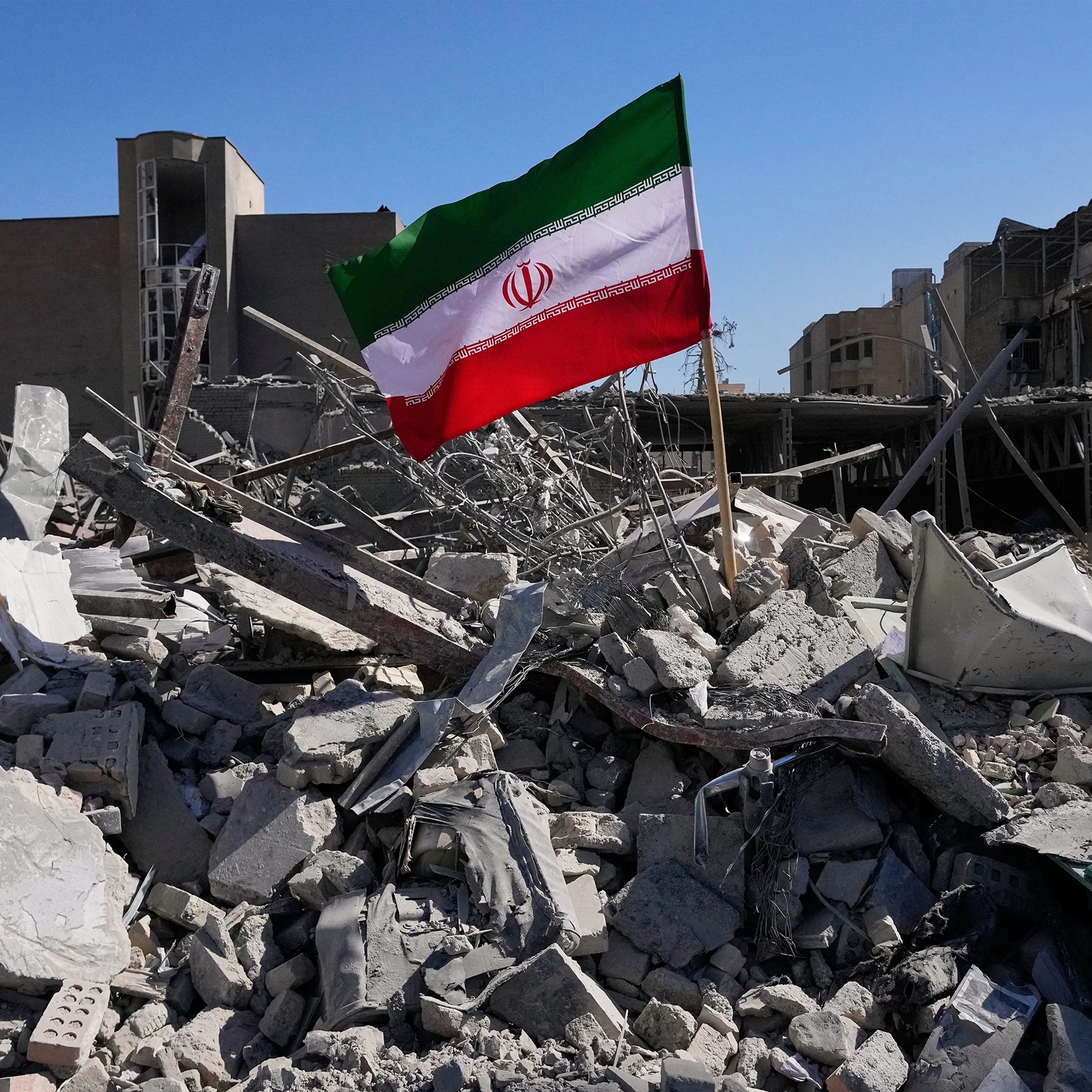
Reaction from around the world pours in as the U.S. and Israel strike targets in Iran. Thousands of flights have been canceled across the Middle East and beyond as rattled markets react to higher oil prices. On Tuesday, President Trump and German Chancellor Friedrich Merz signaled a unified front against the regime during a meeting in the Oval Office. Amid reports that the strikes were a preemptive move to neutralize a rapidly advancing Iranian nuclear program, the President acknowledged the risk of future instability while expressing hope for a domestic military stand-down. Alex Gray, former Chief of Staff to the National Security Council, breaks down what he believes led up to this weekend’s strike, the "downstream effects" of this escalation, and what it means for other global flashpoints like Ukraine and the South China Sea.Multiple direct military strikes by the U.S. and Israel have killed Iran’s top leadership, escalating decades of proxy tensions into a high-stakes, open confrontation. Senior fellow at the Ronald Reagan Institute Tevi Troy joins to discuss how the relationship devolved from a century-old alliance and celebratory parades into a modern struggle against a radical regime.
Plus, commentary by Ruthless podcast co-host Michael Duncan.
AP Photo Credit: Vahid Salemi
Learn more about your ad choices. Visit podcastchoices.com/adchoices
Hosts & Guests

Transcript
That's pure automotive joy.
I'm Peter, the owner of Muscle Car Junior.
It started as a hobby, then I started posting about it.
Before I knew it, I built a business for storing muscle cars on Facebook Marketplace, and
the community of car lovers on Instagram.
Today, new customers send me what's that message is from all over.
Not bad for a hobby.
And how meta helps over 35 million American businesses, like Peter's Grow, at meta.com-slash-community.
In 2024, a truck crashed into Canaw in Mar rescue, where I work.
146 of our dogs needed homes fast.
We asked for help on Facebook.
Our story spread through WhatsApp messages and Instagram reposts.
Immediately, people stepped up, and just six hours later, every dog was fostered.
I'll never forget how our community showed up for us.
Learn how over 3.5 billion people connect to what matters with meta, at meta.com-slash-community.
I'm Stuart Vonney.
I'm Martha McCallum.
I'm Jason Chafetz, and this is The Fox News rundown.
Wednesday, March 4th, 2026, I'm Jessica Grozenthal.
Reaction from around the world pours in as the U.S. and Israel strike targets in Iran.
What questions remain about the downstream effects of this war on other hot spots around the world?
You're going to see the president define conventional wisdom and resetting the global chess board
in a profoundly impactful way.
I'm Dave Anthony.
As the war rages in the Middle East, did you know, before the U.S. and Iran were foes,
we were friends.
My greatest hope is that we could develop a situation again where the U.S. and Iran
are allies, but again, was the real history of U.S. and Iran until this unfortunate detour
that the terrorist enhancing mullahs have been taking us on for 47 years.
And I'm Michael Duncan.
I've got the final word on The Fox News rundown.
Thousands of flights have been canceled across the Middle East and beyond as rattled
markets react to higher oil prices.
And we have a little high oil prices for a little while.
But as soon as this ends, those prices are going to drop, I believe lower than even before.
President Trump knocked back reports from Secretary of State Marco Rubio that the U.S.
attacked Iran because Israel was going to attack anyway, and they wanted to strike first
to keep Iran from going after U.S. bases in the region.
So if anything, I might have forced Israel's hand, but Israel was ready and we were ready
and we've had a very, very powerful impact.
He said he believed Iran would strike first.
U.S. envoy Steve Wittkov, who conducted negotiations with Iran ahead of the strikes,
told Foxes Sean Hannity, the Iranians bracked him.
They had enough uranium to begin creating 11 bombs.
The president was asked Tuesday, what is the worst case scenario?
I guess the worst case would be we do this and then somebody takes over who's as bad as
the previous person, right? That could happen.
But the president also said he hoped Iranian military and police would lay down their guns
and ask for immunity. The president reflected on lessons learned from the recent past,
like in Venezuela, but also in Iraq, making all of these statements in the Oval Office
dexter German Chancellor Friedrich Merz.
We are on the same page in terms of getting this terrible regime in Tehran away.
Merz said he wanted to talk about Ukraine and Russia, as Iran strikes neighboring
Gulf nations, insisting that hits to Qatar, the UAE, Saudi Arabia, and Kuwait,
are attacks on U.S. assets and not the host countries.
Questions remain about the downstream effects of the war on other regions,
including Russia and China, as some reflect on exactly how we got to this point.
I think it really started with the strike on Kossum Soleimani.
Alex Gray was chief of staff to the National Security Council during President Trump's first term.
When I had really the privilege of being with the president during that strike and watching
his leadership and what at the time was a pretty historic strike at Iran's
air-sponsoring regime and someone who had really been the mastermind of the murder and the
maiming of thousands of American soldiers in Iraq. The president at the time made a very strategic
calculation that contrary to the conventional wisdom in Washington, striking Kossum Soleimani,
the head of the Kud's force of the Iranian Revolutionary Guard Corps would actually be stabilizing
for the Middle East. It would not be destabilizing. It would actually send the right message to Iran
and deter future bad behavior. That was obviously something, even people within his own
administration argued vehemently against. The president really chose to take the decision that
that was the right thing for the country and it worked out. It was a very important move
for reestablishing deterrence in the region. Now fast forward to today, the president's essentially
doing that, but on steroids. The president is saying that we're going after the entire apparatus
of terror that the Iranian regime has propagated for 45 plus years. I think the same effect is going
to apply as what we saw with the Soleimani strike in 2019, where you're going to see the president
find conventional wisdom and resetting the global chess board in a profoundly impactful way.
Before this operation, the president said about negotiations that Iran just wouldn't utter the
words, we will not develop a nuclear weapon. I know some of the democratic side of the aisle say,
well, Iran did say those words when they signed that nuclear deal under President Obama,
right? The JCPOA. What do you say to that? I would say that the JCPOA was a deal that was basically
designed to look the other way when Iran ultimately violated that agreement. I mean, the JCPOA,
if you have to understand and go back to 2014-2015, what was the strategic thinking by the Obama
administration? The strategic thinking was that Iran getting a nuclear weapon eventually really
wasn't that big of a deal. That's why they paid them these pallets of cash. That's why the
verification mechanisms were so loose. That's why they were able to have civil nuclear programs that
could very easily turn into militarized nuclear programs. Essentially, they were making a strategic
gamble that a nuclear Iran actually wouldn't be that destabilizing for the region. Otherwise,
the JCPOA would have been done in such a way as to be much tougher and more difficult on Iran.
I would say to anyone who argues that the JCPOA was containing Iran's nuclear ambitions,
they obviously never looked at the same intelligence that President Trump and his team looked at
in the first term when we made the decision to get out of that agreement. There's just no, in my view,
there's no arguing that that that JCPOA did anything to restrain Iran's march toward a nuclear
weapon. Now, some of the commentary here, and I know you're seeing it, is this is about China.
The China relies on Iran for oil, and so this undercuts them as we, you know, in this race for AI,
was this about China or is the impact to China secondary?
Well, as someone who spent my whole career arguing that China is the paramount threat to the United
States, it pains me to say, you know, I do think this is probably secondarily about China.
At the same time, I think that ultimately what the President's doing here, which is based on Iran
as a threat in its own right, is going to allow us to divert our attention to the paramount
threat of China in the long run, by changing the strategic chessboard and taking the Iranian
theocracy off the table. I mean, this is the thing I think we have to remember. Hillary Clinton
in 2010, Secretary of State, said we're pivoting to Asia. And 16 years later, we still have not
moved the preponderance of America's focus to Asia. Why? I would argue because of Iran. Iran,
in various forms, through its proxies, through its missile program, through its nuclear program,
has managed to ensnare us in the Middle East in various forms for 15-plus years.
And now that the President is rewriting this strategic makeup in the Middle East,
we will finally, if this plays out the way I hope it does and the President hopes it does,
we will finally have the bandwidth and the ability to move away from the Middle East
and to focus on the threat from China. Alex, what if it doesn't go the way you hope? What if
the Iranian people, it's up to them, as the President says, what if this doesn't go the way
the administration hopes? Well, look, that's always the risk. And the President
was given the best military advice about the risk and reward. And he chose, I think, very
courageously, to take the gamble. The good news here is the President, I would call it now the
Venezuela model. The President is not trying to be a nation-built. He's not trying to do a rock
2.0. He's not trying to go around and do the rock thing where you hold up your purple finger to
show that you voted. It's very admirable that we should want ultimately the Iranians get a
liberal democracy. But the reality is, that's not the interest of the United States.
The interest of the United States is to get rid of the theocracy that was spreading terror
and killing Americans and destabilizing the region and whatever, as in Venezuela, whatever
follows. Assuming that it's not the clerics, the red lines that we have about the type of people
that would follow the clerics, as long as that's not crossed, I think the President's relatively
agnostic about what type of regime comes next. And this is what the President is doing that I think
is so remarkable. He's redefining the use of American military power. He's not, you know, all the
people who said he's an isolationist. Donald Trump's the farthest thing from an isolationist.
But what he's doing is he's fixing the mistakes of the Iraq war where we overextended ourselves.
We were focused on this very aggressive and ambitious agenda for democracy. Instead,
he's focused very narrowly on what are the core national interests of the United States.
No nooks, no missiles, no proxies. And as long as he keeps that very narrow focus,
I think this will work out the way the President's hoping.
I asked you about China. Let's go to Russia. Vladimir Putin has praised the Iatola now to cease
to Iatola Hominay as being a personal force in improving Iranian-Russian relations.
What does this situation mean for Russia's abilities in Ukraine, especially their drone capabilities
if anything? Well, that's only a slightly less faunting tribute than the New York Times
gave them. But you know, look, I think that there's obviously a number of, you know, the Russians,
the Chinese, the Iranians, the North Koreans have made common cause for a long time. And
the Iranians were certainly enabling Russia's war against the Ukrainians. They've been enabling
North Korea's pursuit of nuclear weapon. There's been a tremendous, you know, the axis of authoritarianism,
I think is a good term. Having the destruction of the theocracy benefits stability globally.
It benefits all who want peace and freedom. And I think that, you know, Russia is finding itself
increasingly isolated. And the collapse of the Iranian theocracy is just another example of that.
When the President says, and he said it Monday, everyone was behind us. They just didn't have the
courage to say so. Given your role in international affairs and your your interest in geopolitics and
the contacts you've made, what did you make of that comment? What what sort of reaction do you think
he may be getting privately? Well, it's often the case that when the United States does things,
whether it's against ISIS, whether it's against the Iranian theocracy, whether it's against the
Houthis, you will get broad support, whether it's in Western Europe, whether it's in East Asia,
whether it's in the Gulf Arab states, privately, I can tell you from my personal experience in
government, you will privately have senior officials from those types of countries calling and
congratulating their American counterparts on a job well done. The reality is most of the people
who operate at the elite level of foreign policy in these countries share a similar worldview to
the United States. They want stability. They don't want this type of bad actors like Iran,
like North Korea. And so, you know, whatever they may need to say in public for their domestic
consumption, privately, they're very much in most ways aligned with the United States.
And finally, France's President says they're increasing nuclear warheads, their stockpile. This
was apparently decided before the operation in Iran, but he also announced this week that he will
allow temporary deployment of nuclear armed aircraft to allied countries. What is the
impact of all of this on Europe? I know that's a big question, but it's just I'm asking especially
in light of the President saying that Iran already has long range missiles that can reach Europe.
Look, I think that Europe is very conflicted on this. And you look at Spain, which denied America
the right to use the bases that that we've jointly operated on Spanish soil to conduct this
operation. You look at Britain, which has been all over the map on this. You look at France,
again, which has been all over the map. Western Europe is in an identity crisis domestically,
and they are in a strategic abyss. They don't know where their loyalties lie. They don't know where
their future is headed. They have extraordinary domestic and social problems. The reality is Donald
Trump and his national security strategy explained our relationship with Europe exactly right.
Europe is in many ways Western Europe, particularly not Central Europe, not Hungary,
not Poland, but Western Europe is in many ways in significant cultural, political, and economic
decline. And while we have great historic relations with those countries, they are increasingly
moving in a direction that is not an alignment with American interests. And I hope that changes.
I hope they all get governments that are more aligned with US interests and the US way of thinking
about the world. But right now we need to accept the fact that the current governments at least in
countries like Spain, like France, like Germany, like the United Kingdom are in so many ways. They
just don't look at the world and see what we see. Alex Gray, former National Security Council Chief
of Staff, thank you so much for joining us. Thanks for having me.
Here's something most founders don't think about until it's too late, their business address.
When you register your company, that address shows up everywhere,
filings, public records, customer documents. Stable gives you a real business address you can
use everywhere. So your company looks professional and your personal address stays private.
And stable digitizes the mail that comes to that address. Sign up at use stable.com slash pod and
get 50% off your first three months of a grow or scale plan. Every weekday, it's your go-to source
for staying informed and entertained. The Fox News Primetime highlights podcast, The Ingram
Angle, Chessie Waters Primetime, Hannity and Gutfeld. Listen and follow now at FoxNewsPotcasts.com.
This is Michael Duncan with your Fox News commentary coming up.
This US conflict with Iran is just the latest chapter in a long saga. A decade ago,
President Obama took a much different approach. America must lead not just with our might,
but with our principles. It shows we are stronger, not when we are alone, but when we bring
the world together. He hailed a joint comprehensive agreement between the US and our allies,
and Iran aimed at curbing Iran's nuclear program, but President Trump called it a terrible deal
and he ended it in his first term. The Iran, as we know it, dates back to 1979. When I had
total come any, led a revolution and Americans were kidnapped at the US Embassy in Tehran.
President Carter called that terrorism in a unifying moment for the US.
We stand today as one people. We are dedicated to the principles and the honor of our nation.
But the Iran hostage crisis kept going and going, and Carter lost the 1980 election to
Ronald Reagan. Hours after being sworn in, January 20, 1981, the new president announced that
at an inaugural ball, the plans have landed now, cheers, announcing that 52 hostages Reagan called
prisoners of war had been set free. You can imagine their happiness. They're preparing to
board the American planes for the last leg of the trip. But the first US clash with Iran
took place way before that. 102 years ago, Franklin Delano Roosevelt is the first US president to
visit what is now called Iran. Tevi Troy is a presidential historian who worked for a president.
As a senior White House aide, the George W Bush, he's also a senior fellow at the Ronald Reagan
Institute. He went not necessarily for Iran itself, but for a meeting with the so-called Big
Three of World War Two, Roosevelt Winston Churchill, Joseph Stalin, the Allied powers.
And Roosevelt was very gracious. He met with the now the young Shah, the son of Reza Shah,
and he thanked him for his hospitality. There's even a letter in the archives of very gracious note
that he sent him. And there was a sense that the US and Iran were friendly nations. And so that
was a good thing. And Truman followed up, met with him as well, even hosted Reza Shah Pilevi,
so the young Shah in Washington, the first president to host an Iranian later in Washington.
And then Eisenhower, he had up and down relationship with Iran?
Well, Eisenhower, I would say, has positive relations with Iran, but there was a coup
where a guy named Muhammad Musadah was the anti-Western prime minister. And he tried to nationalize
the oil industry, which really angered the British. The British wanted to take military action
against this. Eisenhower was against the idea, but Musadah didn't play his hand very well.
They were large anti-Musad demonstrations. And he might have fallen anyway, but there is a sense,
and there's some historical dispute over this that the CIA gave him a push. And he was out and
still to this day, people who don't like America grumble about America's role in that 1953 coup.
But it's not clear that it was all the US's fault or that the US actually made it happen.
Then Eisenhower does still have good relations with the Shah, who returns to Iran after those
troubles of 1953. And he visits Iran in 1959 and highlights the friendly relationship we have with him.
All right, President Kennedy, he didn't go to Iran, did he?
He didn't, but the Shah's best years, I think, were the 1960s. He was seen as a close American ally,
and he visited America five times during the Kennedy and Johnson years. And he went to see the US
space program at Cape Canaveral. He got a ticker tape parade in New York City. He had a
steak dinner and a ticker tape parade. A ticker tape parade for the leader of Iran.
He didn't do that anymore. Yeah, that was a thought.
Right. So Mueller certainly haven't gotten a ticker tape parade in New York City.
Nor will they anytime soon. No. And then we get into the 70s. President Nixon, he was a,
he was a big Shah backer, wasn't he?
Oh, huge Shah backer. In fact, dating back to the 1950s when he was vice president under Eisenhower.
So he's very positive about the Shah, his famous national security advisor and his later secretary
state Henry Kissinger. He calls the Shah an unconditional ally. And he really sees the Shah
as the linchpin for US efforts in the Middle East. So what happens? You get into the Jimmy Carter
years. Then you have a rising up of the Islamic radicals in Iran. Where does the US
Iran relationship and with the Shah go from there? Carter visits Tehran on New Year's Eve
right before the revolution. And he calls Iran an island of stability in one of the more troubled
areas of the world. Those words did not hold up well. The Carter administration just wasn't aware
of all the problems that were happening. There's this guy, Ayatollah Khomeini, who's exiled to France.
And he has some enablers who are falsely telling the world that he's going to be friendly to the West.
He's not going to be a problem. All not true. The Carter administration, the CIA had tapes of
this guy, Khomeini, and all the radical things he was saying. They were in Farsi and the CIA put
the tapes in a drawer and they never opened the drawer or translated the tapes. So they didn't know
how bad Khomeini was, even though they could have had they just opened that drawer and looked at
the tapes. Did they welcome Khomeini? Did they think he was going to be good somehow?
The Carter administration, I guess, thought he was going to be okay. Obviously not as close
a relationship with the Shah, but they thought they could work with him. And they were just wrong.
And obviously just a few months into this Khomeini takeover, they take over the U.S. Embassy and
U.S. diplomats are held there for 444 days. And that's really the thing more than anything else
that destroyed the Carter presidency. So either way, when Reagan takes over, the hostages are released,
but that does not necessarily improve U.S. relations with Iran.
When do the terror tentacles spread for the Iranians? I mean, getting into Hezbollah and then of
course Hamas and Gaza and all that? How does that happen? Yeah, it's really important to highlight
this that Iran is the sponsor, the supporter, the advisor of organizations that hate America,
try to destroy America like Hezbollah and Hamas. And this really starts in 1983 in the Beirut bombing
when Hezbollah, which is again an Iranian supported organization, murders 241 U.S. service
members in a terrible truck bombing. But that wasn't the only thing that they were doing. They
hijacked a commercial plane where they murdered a U.S. Navy diver. They took multiple Americans hostage
in Iran. And that was actually what set in motion the Iran-Katra affair, which was the biggest
scandal of Ronald Reagan's presidency. So from the minute they get into power, they have this idea
that they want to destabilize things using proxies. And the advantage of proxies, like Hezbollah and
later Hamas, is that Iranians don't suffer when the Hezbollah people are killed or when the
Hamas terrorists are killed. The Iranians have this level of insulation. And right now what's going
on with the attack against Iran is after 47 years of this strategy that's attacking the U.S.
through proxies. Finally, the U.S. is saying, you know what, we're going to hit you back directly
not just through the proxies. Now a lot of focus after that was put on Iraq
with the first President Bush in the Gulf War. And then after the Clinton presidency came the 9-11
terror attacks. In his 2002 state of the Union address, President George W. Bush famously
singled out Iran, Iraq, and North Korea. States like these and their terrorist allies constitute
an axis of evil, arming to threaten the peace of the world by seeking weapons of mass destruction.
These regimes pose a grave and growing danger. That was a few months into the U.S. war on terror.
Well, first of all, it called it what it was. I mean, Iran was a very problematic nation.
Still is, hopefully, where things are going to change more positively. He tried to get the
Iranians to the nuclear negotiating table in his second term. But the real problem was that
the Iranians were fomenting trouble against U.S. troops in Iraq. 600 Americans died because of
roadside bombs that the Iranians had provided for Iraqi terror networks. Through Kasim Soleimani,
who Trump took out the Iranian al-Quds force was a constant irritant to the American efforts in
Iraq. But the Bush administration had other things on its mind. It was bogged down by the
words in Iraq and Afghanistan. And it did little to address the Iranian problem because they just
didn't have the bandwidth for it. President Obama did enter into a nuclear agreement with Iran in
his presidency. It was undone by President Trump in his first term, but Democrats have said
that's a mistake. I think the mistake was the Obama approach, which was this kind of balance of
power approach, where you kind of prop up the Iranians as one axis against the Sunni states and
Israel on the other side. The truth is, if you have allies, you should support your allies,
and that is not what Obama was doing. He was trying to work with the Iranians, even called
the Iranian President Hassan Rouhani, which was the first contact between an American president
and any Iranian head of state. It didn't do much good. They had this so-called nuclear
agreement that didn't really stop them from developing nuclear weapons. Certainly didn't stop
their missile program and did not stop their use of proxies. So it was really an ineffectual deal
that President Trump pulled out of. But the problem is you pull out of the deal and you still don't
have a way to stop them from developing nuclear weapons. So it was a bad deal, but we still needed
to do something else to stop them from getting nuclear weapons and attaching them to ballistic
missiles. We already see that their ballistic missiles can wreak havoc across the entire region.
As we go through this conflict now, nobody knows how it's going to end. The exiled crown prince,
Reza Polavi, he wants to go back and lead a democracy push in Iran. Can there be leadership like the
Shah again in that country? I don't think you can have leadership exactly like the Shah. The
Shah was the head of state and actually kind of ran the mechanism of government. I don't think
Polavi could do that. He hasn't been in the country in almost 50 years. He really doesn't have
the kind of leadership experience. But to see him as a ceremonial head while some other government
takes place, hopefully a democracy, that is potentially workable and it's one of the options
that I heard is on the table. But we're still not there yet and there's a long way to go between
now where the head of the snake has been cut off. What's going to happen next? We can't know that.
But I do hope, my greatest hope is that we could develop a situation again where the U.S. and
Iran are allies, which again was the real history of U.S. and Iran until this unfortunate detour
that the terrorist enhancing mullahs have been taking us on for 47 years. It is hard to believe for
a lot of people listening to this. Iran has been an adversary led by Islamic radicals for decades
to think that we had such good relations with a Middle Eastern country like that.
Yeah, and it's a shame when you see a really problematic tyranny take over. We saw this in the
Soviet Union. We have no beef against the Russian people, but the Soviet leadership really
fomented trouble against the U.S. for a long time. Something similar has happened here with
the Iranians, but again, my fondest hope is that we can get back to a situation where the
great alliance between the U.S. and the Iranian people can return to what it once was.
You think it's possible that Donald Trump could be the next president to visit Iran?
I think that would be spectacular to see a U.S. president visit Iran in the near future
in a safe and welcoming environment because that would signal that things have gone right.
Tevi Troy is a presidential historian. The author of five books on the presidency,
former senior White House aide in the George W. Bush presidency senior fellow with the
Ronald Reagan Institute. Great to have you on the show. Thanks so much for being here.
Thanks for having me.
Starting a business can seem like a daunting task unless you have a partner like Shopify.
They have the tools you need to start and grow your business. From designing a website,
to marketing, to selling, and beyond, Shopify can help with everything you need.
There's a reason millions of companies like Mattel, Hines, and Allbirds continue to trust and
use them. With Shopify on your site, turn your big business idea into...
Sign up for your $1 per month trial at Shopify.com slash special offer.
It is time to take the quiz.
It's five questions in less than five minutes. We ask people on the streets of New York City to play
along. Let's see how you do. Take the quiz every day at the quiz dot Fox. Then come back here to
see how you did. Thank you for taking the quiz. Read and review the Fox News run down on Apple podcasts
or wherever you listen. It's time for your Fox News commentary. Michael Duncan.
What's on your mind? The war with Iran has prompted the liberal media to declare another war.
A magascism on Donald Trump's foreign policy. And it's not without its merits. Trump rose to
power in 2016 opposing the Iraq war and the failures of nation building. The world is ripping us off
and it's time to put America first. But the libertarians within the Republican coalition
took this opening, jumping to the front of Trump's parade, and declaring themselves as the ones who
started it. The problem? It's at odds with President Trump's own record. He eliminated
Kassam Soleimani. He made NATO pay for their defense. He broker the Abraham Accords. He didn't do
this by withdrawing from the world. He did it by leveraging our leadership in it. He didn't do it
by nation building. He did it by negotiating. President Trump's foreign policy is a sober,
rational doctrine that eliminates foreign threats and strengthens America. It's more sophisticated
in the false choice of isolation or forever war. But too many influencers and pundits have
exploited the specter of Iraq to cast any foreign policy action as neo-conservative meddling.
It's a convenient way to impose their view on the movement. But I would suggest it's less about
America first and more about me first. This is Michael Duncan.
You've been listening to the Fox News rundown, and now stay up to date by subscribing to this
podcast at FoxNewsPodcasts.com. Listen to AdFree on Fox News Podcasts Plus on Apple Podcasts,
and Prime Members can listen to the show AdFree on Amazon Music. And for up to the minute news,
go to FoxNews.com.


