Loading...
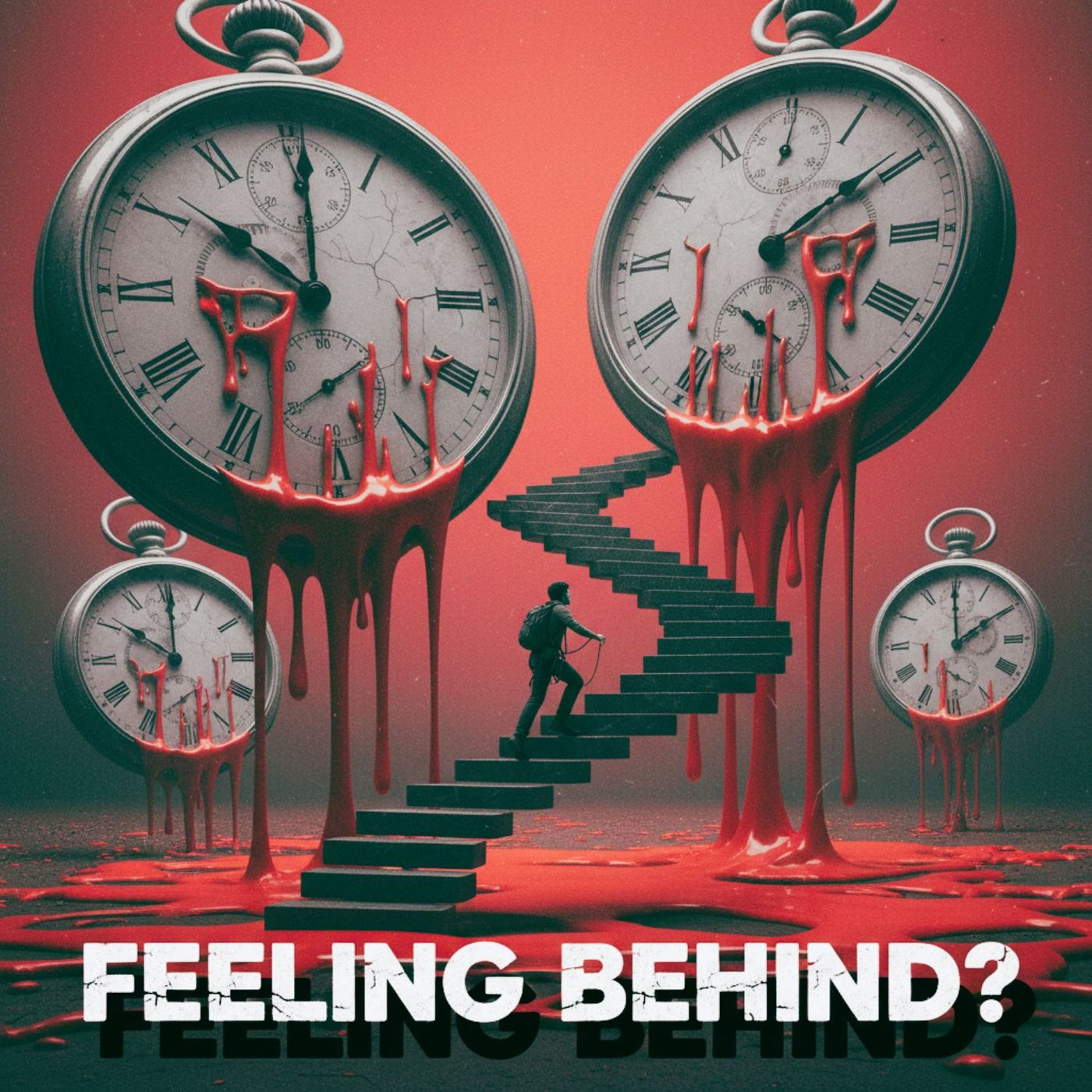
educationself improvementhealth
Why You Feel Behind in Life (And Why It’s a Lie): Overcoming Timeline Anxiety
About this Episode
Feeling Behind? The Truth About Timeline Anxiety and the Comparison Trap.
Ever feel like you missed the memo on how to 'adult' while everyone else is sprinting ahead? 🏃♂️ If you are constantly scrolling through a curated highlight reel of 30-under-30 winners while navigating a career pivot at 35 or a quarter-life crisis, this episode is your survival guide.
Why do I feel behind in life? 🧐 The answer isn't that you're failing; it's that you're playing a rigged game. We are deconstructing the social clock pressure and the toxic productivity standards that keep us paralyzed. This is the permission slip you’ve been waiting for to abandon the traditional success blueprint and embrace your own nonlinear growth.
What we explore in this episode:
✨ READY TO REWRITE YOUR STORY? ✨
Don't let an artificial timeline dictate your worth. Subscribe now to join a community of high-achievers who are defining success by their own metrics. Share this with a friend who needs to hear that they are exactly where they need to be. 🎧✨
Become a supporter of this podcast: https://www.spreaker.com/podcast/life-hacks-diy-more-transform-your-everyday-with-simple-tricks-and-diy-magic--5995484/support.
You May also Like my other FREE web apps:
SkyNearMe.com – Your all-in-one "Sky Super-App." Track real-time weather, sunset and air quality, stargazing conditions, 5G signal mapping, drone flight zones, solar potential, track satellites, rocket launches, UFO sightings in your local airspace and even get your Sky Horoscope and more!
MyDisasterPrepKit.com – Gamified survival training. Generate custom survival plans and simulate scenarios ranging from hurricanes to zombie outbreaks.
🤖Nudgrr.com (🗣'nudger") - Your AI Sidekick for Getting Sh*t Done
Nudgrr breaks down your biggest goals into tiny, doable steps — then nudges you to actually do them.
Ever feel like you missed the memo on how to 'adult' while everyone else is sprinting ahead? 🏃♂️ If you are constantly scrolling through a curated highlight reel of 30-under-30 winners while navigating a career pivot at 35 or a quarter-life crisis, this episode is your survival guide.
Why do I feel behind in life? 🧐 The answer isn't that you're failing; it's that you're playing a rigged game. We are deconstructing the social clock pressure and the toxic productivity standards that keep us paralyzed. This is the permission slip you’ve been waiting for to abandon the traditional success blueprint and embrace your own nonlinear growth.
What we explore in this episode:
- Reframing failure as data: Why your 'mistakes' are actually high-level R&D for your soul. 🧪
- The Stagnation Myth: Why feeling 'stuck' is often just an internal software update that hasn't finished loading yet. ⏳
- Evidence of Caring: Why your anxiety about progress is actually proof of your deep ambition and quiet courage. 💪
- Late Bloomer Success: How to leverage your invisible resume to win on your own terms.
✨ READY TO REWRITE YOUR STORY? ✨
Don't let an artificial timeline dictate your worth. Subscribe now to join a community of high-achievers who are defining success by their own metrics. Share this with a friend who needs to hear that they are exactly where they need to be. 🎧✨
Become a supporter of this podcast: https://www.spreaker.com/podcast/life-hacks-diy-more-transform-your-everyday-with-simple-tricks-and-diy-magic--5995484/support.
You May also Like my other FREE web apps:
SkyNearMe.com – Your all-in-one "Sky Super-App." Track real-time weather, sunset and air quality, stargazing conditions, 5G signal mapping, drone flight zones, solar potential, track satellites, rocket launches, UFO sightings in your local airspace and even get your Sky Horoscope and more!
MyDisasterPrepKit.com – Gamified survival training. Generate custom survival plans and simulate scenarios ranging from hurricanes to zombie outbreaks.
🤖Nudgrr.com (🗣'nudger") - Your AI Sidekick for Getting Sh*t Done
Nudgrr breaks down your biggest goals into tiny, doable steps — then nudges you to actually do them.
Hosts & Guests
Transcript
Before you begin your road trip, ask yourself, do you really need five full suitcases?
With a 2026 Kia Sportage X-Pro's class-leading cargo space, you'll have room for what you
need.
Find out more at your local Kia dealer today.
Keep the adventure going.
Kia, movement that inspires.
Call 800-333-4K for details.
Always drive safely and obey all traffic laws, comparisons based on second-row legroom
and cargo space behind second-row seats in the subcompact SUV class according to Kia
segmentation as of October 2025.
Picture this.
It is 7.0PM on a Sunday.
Oh, the absolute worst time of the week.
Right.
One is just starting to go down and you've got those long, slightly melancholic shadows
creeping across your living room floor.
The weekend is still happening.
Technically.
You could still watch a movie or read a chapter of a book or go for a walk, but let's
be totally honest.
Emotionally.
Oh, emotionally, the weekend is long gone.
Exactly.
It is packed its bags, called a cab, and it left the building.
So you are lying on the couch or maybe you're just standing in the kitchen, staring blankly
into the open refrigerator.
Just hoping a new snack has magically appeared.
Right.
And suddenly this heavy, completely suffocating wave of anxiety just walks right through
your front door without knocking because Monday is coming.
Yeah.
And with Monday comes the math.
The math.
Yes.
It is this unavoidable brutal calculation.
It's the math of the life you actually have right now, staring directly into the face
of the life you firmly believed you would have by now.
Which is a terrifying mirror to look into.
It really is.
You think that Sunday night dread means you are fundamentally failing.
Like at life.
That's the thing you're not.
Right.
Because the stack of research, the sociological history, the cognitive psychology we are
diving into today suggests the exact opposite.
Completely the opposite.
So the thesis of today's deep dive is this.
That specific anxiety is actually the strongest proof that you are built for success.
I love that we are tackling this because it is a pervasive, almost universal dread.
Yeah.
And what makes it so insidious is that it rarely announces itself with a trumpet, you know.
It doesn't happen when you're actively failing at a task.
No, you're usually just eating cereal.
Exactly.
It seeps in during the passive moments.
It happens when you're in the middle of doing absolutely nothing.
Because that gives your brain the silent space it needs to boot up this comparative algorithm.
And the core mission of our discussion today is taking that exact feeling, that crushing
visceral illusion that you are somehow permanently, like quote unquote, behind in life and completely
dismantling it.
Taring it down to the studs.
Because we are going to look at the exact, deeply flawed math that our brains use to torture
us.
We're going to examine the neurological and the sociological mechanisms behind it.
It's a lot of ground to cover.
It is.
Okay.
Because to tell someone, hey, that deep-seated feeling of failure you have is actually actively
lying to you.
I mean, that is a massive claim.
It is a bold claim, yeah.
But the source material we are working through today, I mean, we're talking studies on
the default mode network, the history of post-war economic timelines.
It proves that the evidence of your progress is right in front of you.
It has just been obscured by a rigged equation.
Right.
What's fascinating here is that the sources we're analyzing completely flip the script
on how we view our own psychological friction.
We usually treat this feeling of being behind as a symptom of a disease.
Like an alarm bell.
Yeah, an alarm bell warning us that we are losing the game of life.
But when you synthesize the cognitive science and all this behavioral data, it becomes clear
that this anxiety isn't a symptom of failure at all.
Wait, so what is it then?
It is a deeply misunderstood sign of a highly functional mechanism.
We have just mislabeled the sensation of internal growth as the sensation of external failure.
Wow.
Okay, let's start by defining the invisible track we supposedly fell off of.
The famous track.
The track.
Because this feeling doesn't just happen in a vacuum, right?
It arrives in waves triggered by really specific environmental cues.
Sunday evenings are obviously one.
Birthday mornings are another classic trigger.
Oh, man, birthdays.
Those moments before you eat the cake, before the text messages start rolling in from your
friends.
You're just standing there in the bathroom, brushing your teeth, looking in the mirror,
and your brain just accidentally runs the calculation.
The subconscious equation our minds run in those quiet moments is actually quite specific.
Walk us through the math.
It essentially goes like this.
You take your current chronological age, minus your highly visible, socially validated
accomplishments.
So like job titles, houses, that kind of thing.
Exactly.
And then you divide that number by an abstract standard of where you quote unquote should
be.
And because of the way the brain weighs negative information against this totally abstract
standard, the result of that math equation every single time you run it comes back as insufficient.
Always insufficient.
I have never once, student, in front of the mirror on my birthday, run the mental math
and concluded, wow, I am precisely where the universe requires me to be.
I am right on schedule.
Yeah.
Nobody does.
Nobody.
It is a totally rigged calculator.
In the denominator in that equation, this imaginary standard, that is what we call the
track.
We all walk around assuming there is this one shared, completely objective timeline, a
track that everyone else is on, moving in the exact same direction at roughly the exact
same speed.
And we are totally convinced that we are the sole outlier failing to keep pace.
Yeah, like everyone else got the memo, but us.
And this assumption is so deeply embedded in our psychology that it doesn't even feel
like a societal construct anymore.
It feels like gravity.
It feels like a law of nature.
But if we look at the sociological data from the mid 20th century, we can actually see where
this track was invented.
Wait, it was invented.
Oh, absolutely.
It was assembled from completely disconnected, highly specific historical ingredients.
Okay.
Give me an example.
Well, for example, the expectation that you should have your career, your house, and your
family fully locked in by your late 20s or early 30s, that isn't some biological imperative.
Right.
It is a massive sociological hangover from the post-World War II economic boom in the
West.
Wait, really?
So you're telling me my Sunday night anxiety is partially the fault of the 1950s economy.
Entirely.
I mean, think about the GI bill and the unprecedented economic expansion of that specific
era.
Right.
The booming factories, the suburbs, for a brief, highly anomalous window in human history,
a single income could buy a house, support a family, and guarantee a pension by age 25.
Which is literally impossible now.
Completely impossible for most.
But that created a new developmental timeline.
Yeah.
Sociologists at the time codified these life stages, and that exact timeline became the
blueprint for our parents and our grandparents.
And they passed it down to us.
Exactly.
Then, the Bratter culture added its own ingredients.
The media amplifies this by utilizing compressed narrative arcs.
Oh, like in movies.
Right.
Absorb movie tropes, where the protagonist has their entire meaning and perfect romance
figured out by 30, because you have to wrap up a movie in two hours.
Yeah.
And we read these breathless business articles about tech founders who made their first
billion at 23, which is statistically basically a lottery ticket.
Right.
And then your immediate peer group finalizes the track.
This is the real kicker.
It is.
Because whoever among your friends got to a specific milestone, like whoever got the
first big salary or bought the first house.
They unknowingly become the benchmark for the entire group without even trying to.
Yeah.
Suddenly, everyone else is just a variation of behind.
So somewhere in the middle of all that noise, without anyone ever asking for a consent,
this track was constructed in our minds.
Precisely.
So you are measuring your intrinsic human worth against the schedule you did not write.
Right.
Based on a postwar economic anomaly, heavily filtered through Hollywood screenwriting structures.
That sounds so absurd when you lay it all out like that.
It is.
Yeah.
You are calling the gap between where you are and that imaginary finish line, a massive personal
failing.
Okay.
I hear the sociological breakdown.
And intellectually, I mean, it makes total sense.
But I have to play devil's advocate and push back hard on this.
Go for it.
Because if I am 40 years old and I do not have a stable career, or if I haven't started
saving for retirement, compounding interest does not care if my track is a sociological
hangover.
Right.
The bank doesn't care.
The bank does not care about the post-WWII economic anomaly.
If I am broke at 40, I genuinely am behind the curve.
There are actual penalties for coming in last.
So how does the source material reconcile tangible economic realities with this idea that
our feeling of being behind is just a hallucination?
That is the exact friction point we need to address because it is where almost everyone
gets stuck.
It's where I get stuck.
The sources do not dismiss economic reality.
Compounding interest is very real.
Biological clocks for starting a family are real.
But here is the critical distinction.
The anxiety we are talking about that suffocating 7.0 pm Sunday Dread is rarely just a practical
assessment of resource management.
Oh, it's definitely not practical.
It is an existential judgment about your identity.
It is a profound sense of inadequacy regarding your worth as a human being.
So it's the difference between saying, I need to aggressively adjust my financial strategy
versus saying, I am a fundamental failure and my life is a total weight.
Exactly.
Recognizing the imaginary track isn't about ignoring your bills or pretending time doesn't
exist, it is about untangling yourself worth from a timeline that was never designed for
the modern world.
That is a huge relief to hear, honestly.
Right.
The economic realities might require action, but the shame you feel about your specific
pacing, that shame is inherited.
And shame is just a terrible motivator for complex problem solving.
It's the worst.
When you are operating out of shame, your prefrontal cortex, the part of your brain responsible
for long-term planning and logical reasoning, it literally downregulates.
It just shuts up.
It goes offline.
So by putting the imaginary equation down, you aren't giving up.
You are actually restoring your brain's capacity to navigate those very real economic challenges.
That makes a lot of sense.
The shame is the hallucination.
But if we can intellectually understand that grading ourselves against this arbitrary timeline
is counterproductive, why is it so hard to shake?
Because it's everywhere.
Right.
Why does it feel so overwhelmingly real every single day?
Because an imaginary track would eventually fade from your mind if you weren't constantly
being fed data that seemingly proves it exists.
It is Ryan C. Crest here.
There was a recent social media trend, which consisted of flying on a plane with no music,
no movies, no entertainment.
But a better trend would be going to chumbacacino.com.
It's like having a mini social casino in your pocket.
Chumbacacino has over 100 online casino-style games, all absolutely free.
It's the most fun you can have online and on a plane.
So grab your free welcome bonus now at chumbacacino.com, sponsored by Chumbacacino.
And that brings us to the psychological meat grinder that is the comparison machine.
The 11.0 PM doom scroll.
We really have.
You told yourself you're going to read a book, you're going to go to sleep early.
Instead, you are lying in bed, the room is pitch black, and you are holding a glowing
rectangle two inches from your face.
Because burning your retinas.
Burning them.
And what does the rectangle tell you?
It tells you that someone you went to high school with, someone who I don't know, used
to eat paste, just bought a beautifully restored mid-century modern home.
With a wraparound porch.
Or you open LinkedIn and you see that a former coworker just got promoted to, like senior
executive vice president of synergistic dynamics, which isn't even a real job.
I don't even know what that means.
But the UI of the app makes it look like they just want a no ball prize.
We have to look at the actual mechanism of how those platforms deliver that information
because it is not accidental.
The sources go into the design deeply.
The research on social media user interface design shows that platforms like LinkedIn
or Instagram utilize variable ratio schedules.
Wait, what does that mean in normal terms?
It's the exact same psychological mechanism used in slot machines.
Wow.
But instead of delivering financial payouts, they deliver social hierarchy data.
Oh, that is so manipulative.
They have features specifically designed to push notifications to you when someone in
your peripheral network achieves a milestone.
Nobody woke up and said, please routinely interrupt my Tuesday to inform me of the professional
triumphs of my acquaintances so I can question my own life choices.
Nobody asks for that.
I have legitimately sat on my bed staring at that glowing rectangle, looking at a beautifully
filtered photo of someone's appetizer from a vacation in a mall fee.
There's a piece of bread with tomatoes.
Exactly.
And I use that single piece of bruschetta to build an entire courtroom in my head.
A bruschetta courtroom.
A courtroom where the prosecutor is my own anxiety, the judge is society, and I am losing
the case spectacularly over a piece of bread.
The courtroom analogy is perfect, actually, because in a trial, the verdict is determined
by the admissibility of the evidence.
Right.
And the fundamental structural error we make in this comparison machine is the evidence
we allow into the room.
We mean what's the error?
You are comparing two entirely different mediums of existence.
You're comparing the full, unedited raw footage of your own life to someone else's highly
produced highlight reel.
The unedited footage, the deleted scenes, the 3.am doubts when you wake up in a cold sweat
because you remembered something deeply embarrassing you said at a party in 2014.
We all have that memory.
Or the Tuesday night where you are so absolutely exhausted from the sheer cognitive load of
just existing that you eat a bowl of dry cereal over the sink for dinner.
The sink cereal is a universal human experience.
It really is.
You know every single gritty, unglamorous detail of your own life.
And you're comparing that sink cereal reality to a version of someone else's life that
was deliberately curated, carefully edited.
The comparison is scientifically invalid from the first second because it lacks symmetric
data.
So it's a rig trial.
To make an actual valid comparison, you would need their missing context.
You see the fancy job title.
You see the vacation photos.
But you don't see their crushing credit card debt.
Right.
You don't see the panic attacks.
You don't see the deep quiet goal they abandoned three years ago that still haunts them
at night.
But why is the brain so willing to accept this rigged comparison?
Like if I know logically that Instagram is fake, why does my heart rate still spike
when I see the vacation photo?
Because the evolutionary mechanics of confirmation bias.
Okay.
Lace and neuroscience on me.
This is driven by a network in the brain called the reticular activating system or RAS.
RAS.
Yes.
RAS acts as a filter between your conscious and subconscious mind.
When you are stressed, when you feel that Sunday night dread, you're amygdala signals
that you are in a state of social vulnerability.
Because we're pack animals basically.
Exactly.
In evolutionary terms, losing social status meant getting kicked out of the tribe and
dying of exposure in the winter.
Oh, wow.
So the stakes feel literally like life or death.
To your brain, yes.
So your brain runs a highly targeted search query for threats.
It actively looks for proof that you are failing so it can prepare you for the worst.
So wait, when I am stressed, my brain is literally running a survival algorithm that misinterprets
a LinkedIn update as a mortal threat to my tribal status.
Exactly that.
It thinks you're about to be kicked out of a cave.
And because the world is infinitely complex, if your RAS is programmed to look for proof
of your own failure, it will easily find it.
It's just scanning for negatives.
Right.
A cluttered apartment isn't just a sign that you had a busy week.
Through the lens of confirmation bias, it becomes a damning verdict on your entire life
trajectory.
Oh, man.
An unanswered email is incontrovertible proof that you are fundamentally incapable of keeping
up with adult responsibilities.
And while the brain is zooming in on the dusty baseboards, it is actively filtering out
every single piece of evidence that contradicts the verdict.
It ignores the good stuff.
It completely ignores the difficult conversation you navigated perfectly yesterday.
It ignores the boundary you set with a toxic friend.
It ignores the fact that you showed up and did your work even though you were exhausted.
The behind feeling is essentially a pair of glasses that only lets in the frequencies
of light that confirm you are failing.
Which brings us to a massive psychological crossroad in the source material.
If the track is imaginary and the comparison machine is rigged by confirmation bias, what
do we actually do with the things in our lives that genuinely are failures?
This is a huge point.
Because the source material is very careful to avoid toxic positivity here.
We can't just wave away a bankruptcy or a divorce and say, oh, it's just my reticular
activating system acting up.
No, absolutely not.
That would be delusional.
Right.
I pretend my failed business was an illusion.
Some failures cost years of life.
They drain your savings and they shatter your confidence.
They are brutal.
They hurt.
If someone tells you that a devastating failure was actually a purely wonderful event, they
are either trying to sell you an expensive life coaching program or they have never actually
failed at something that deeply mattered to them.
The pain is undeniably real.
The pain is real.
Yeah.
When we process that pain, dictates our future trajectory.
The critical distinction the research draws here is the immense psychological difference
between a verdict and data.
A verdict versus data?
Yes.
Almost all of us are walking around treating a raw data as if it were a final verdict.
Because a verdict is final, like the judge bangs the gavel and the trial is over, it permanently
defines your identity.
Exactly.
If you treat a failed relationship as a verdict, the verdict is, I am unlovable, I am terrible
at intimacy and I will be alone forever, case closed.
Which leaves you nowhere to go.
But data is entirely different.
Data is ethically neutral.
It's just numbers on a spreadsheet.
Right.
Data simply tells you what happened and then you get to decide how to use it.
In cognitive psychology, this aligns really closely with Carol Dewey's research on the
growth line set, but it goes even deeper into cognitive restructuring.
How so?
Like with a job interview?
Yeah.
Let's take that job interview that went horribly sideways.
If it's a verdict, it means you are unemployable, but if you run it through a cognitive restructure
and treat it as data, it becomes highly specific, actionable information.
Like what kind of information?
It tells you that you freeze up when asked about your long term five year plan or it tells
you that you didn't actually research the company culture deeply enough before you walked
in.
Or maybe it tells you that your subconscious was actively sabotaging you because you didn't
actually want the job in the first place.
Oh, I've done that.
Creating failure as a verdict just makes you feel small and miserable, treating it as
data teaches you how to operate your own machinery.
Gakily, you become an engineer of your own life.
But this raises a really interesting question.
I've read the sections on reframing failure, but what about the people who seemingly never
fail?
The golden children.
The golden children.
The people who get it right on the very first try.
The ones who graduate, walk straight into a lucrative career, marry their high school sweetheart,
and just glide down the track.
They look so easy from the outside.
From the outside, they look like the ultimate winners.
They skipped all the painful data collection.
Well, they did skip the pain.
But the research suggests they also skip the acquisition of a vital psychological tool.
There is a hidden deficit to early, frictionless success, a complete lack of internal navigation
skills.
Navigation skills.
Break that down for me.
Think about the person who failed massively in their 20s.
They got completely lost.
They had to sit in the rubble of their plans, painstakingly examine the data, and figure
out how to rebuild their sense of self.
Which takes years sometimes.
Yes.
But that person developed the ability to find their way back when the map burns up.
Oh, wow.
They know what it feels like to be completely disoriented.
And more importantly, they have empirical proof that they can survive it.
Because they already did.
Exactly.
But the person who got lucky and succeeded early, they only know how to follow a
pristine map.
So when something finally goes wrong.
The second they encounter a macroeconomic storm, or an unexpected personal crisis later
in life, which, let's be honest, is statistically inevitable.
They completely collapse.
Because they lack the internal navigation system to correct their course.
Exactly.
We culturally celebrate the lucky ones.
But the truly resilient ones are the ones who are forced to gather the hardest data.
So the failure wasn't you falling behind.
It was you paying the tuition for an elite school of navigation.
That's a great way to frame it.
That is a massive paradigm shift.
But if gathering data from failure actually builds this internal navigation system, what
happens to the periods of time we spend entirely off the map?
The lost years.
The lost years.
The years we look back on and mourn as complete waste of time.
What is the brain actually doing when we are wandering in the woods on a detour?
This is where we have to look at how we measure progress.
We tend to view any deviation from our plan timeline as a failure.
But if you look at the macro maps of highly fulfilled people, if you trace the biographies
of innovators or deeply content individuals, detours have a shockingly high success rate.
Give me an example of how a detour actually functions mechanically.
Because usually a detour just feels like I'm stuck in traffic while everyone else is
on the highway.
Let's use the concept of an algorithmic search.
In computer science, if an artificial intelligence is trying to find the highest peak in a mountain
range, it will sometimes get stuck on a small hill, because it thinks it's the top.
Every step in any direction goes down, so the algorithm assumes it is one.
This is called a local maximum.
But there's a bigger mountain right next to it.
Exactly.
But the AI can't see it.
The only way for the AI to find the true, massive mountain peak is to introduce a function
called random noise.
Random noise.
Essentially a forced detour that kicks it off the small hill, so it has to explore the
wider map.
Oh, that is wild.
So in human lives, the job you got fired from, or the city you had to move away from, those
often act as the random noise that kicks you off a local maximum.
It forced you to explore a wider map.
So the detour was the only mathematical way to find the higher peak.
You wouldn't have looked for the big mountain if you were comfortable on the small hill.
But what about the peri is during the detour where you aren't exploring at all, where
you just feel completely utterly paralyzed?
The sources draw a very specific distinction between feeling stuck and being stuck.
It is a vital distinction.
Being stuck is a genuine objective standstill.
It means zero internal or external movement, but feeling stuck is entirely different.
Feeling stuck is often what deep, profound, neurological, and psychological movement feels
like from the inside, before you can see the results on the outside.
Instead of the old cliche about the caterpillar and the chrysalis, let's talk about what's
actually happening in the brain during these periods of paralysis.
Drew McIntyre here from WWE, wielding the claymore can be a life of chaos.
When I'm not dominating in the ring, Chumbac Casino is how this warrior takes a wee break.
With hundreds of online social games and new weekly releases, there's always something
fresh to try.
And those daily busts, next level, even my free time feels like foul howl.
So when life feels like a battle, kick up your feet, have some fun, and let's Chumbac.
No purchase necessary.
VGW Group, Boyd, we're prohibited by law, CTs and Cs, 21 plus sponsored by Chumbac Casino.
I found the research on the default mode network and the source material, absolutely fascinating.
Yes.
Let's look at the neuroscience of it.
When you feel stuck, when you're lying on the couch, staring at the ceiling, feeling
like you are wasting your life.
Basically, the Sunday night feeling.
Yes.
During that time, your brain's default mode network, or DMN, is actually highly active.
What does the DMN do?
The DMN is the neurological system responsible for self-reflection, autobiographical memory,
and projecting into the future.
When you are hyper-focused on an external task, like grinding away to job you hate, the
DMN is suppressed.
Because you're just answering emails and surviving.
Right.
But when you are forced into a period of stillness, the DMN activates.
And it begins heavily processing unresolved emotional data and realigning your core values.
So it's like background processing on a computer.
Exactly like that.
If your computer suddenly slows down and the fan starts worrying really loudly, you might
think the computer is broken.
It feels stuck.
But in reality, it's defragmenting the hard drive.
It is reorganizing millions of pieces of data so that it can run more efficiently in the
future.
So the absence of visible external progress is simply the texture of change when you are
experiencing it from within.
It feels like you're broken, but you're actually healing.
When you are in the middle of a foundational life change-like recovering from burnout
or healing from a trauma or quietly dismantling a belief system that no longer serves you,
it feels like you are spinning your wheels.
But your DMN is running the most computationally heavy program of your life.
Okay.
I love the defragmentation analogy, but let me play devil's advocate again.
I'm ready.
If I am sitting on my couch on Sunday night, how do I know if my default mode network is
actively reorganizing my values, or if I have genuinely just given up and am wasting
my life?
Because they look the same from the outside.
Exactly.
From the outside, both just look like a guy eating Doritos in the dark.
That is the million dollar question.
And in the immediate moment, it can be incredibly difficult to tell.
But the key indicator of the psychological literature points to is the presence of agitation.
Agitation, like feeling antsy.
If you are wrestling with these questions, if you are actively bothered by the gap between
where you are and where you want to be, you are defragmenting.
Oh, I see.
But the people who are genuinely at a dead standstill who have truly given up aren't agonizing
over their lack of progress.
They have numb to themselves to the gap entirely.
So the fact that it hurts means it's working.
The friction you feel is the heat of the process or working.
The friction is the heat of the process, so I need to write that down.
That is incredible.
So we feel stuck because we can't see the massive internal reorganization happening.
But we compound that suffering by looking backward.
We look backward and we ruthlessly judge our past decisions, assuming that we should have
known better.
We are incredibly cool to our past selves.
The cognitive psychology term for this is hindsight bias, specifically the research pioneered
by Baruch Fischoff.
Hindsight bias?
Yes.
We fundamentally misremember the state of our own minds when we made big decisions.
Let's test that theory.
So think of a major terrifying decision you made in the past.
Like you quit a stable job without a backup plan or you moved across the country for a relationship
or you invested in a wildly risky project.
We always remember that moment through the incredibly distorting, fun house mirror of
everything that happened afterwards.
Because we know the ending now.
Because of hindsight bias, your brain retroactively edits your memory to make the outcome seem
inevitable.
If the risk worked out perfectly, you look back at your past self and say, well, that was
an obvious choice.
I was a visionary.
Of course, they took that job.
We're all geniuses in hindsight.
But if the risk failed spectacularly, if the startup went bankrupt or the relationship
ended in a fiery wreck, you look back and call your past self an absolute idiot.
You say, I was so naive, I should have known that was going to blow up in my face.
The red flags were everywhere.
But here's where it gets really interesting.
In both of those scenarios, whether we crown our past self a genius or condemn them as
an idiot, we strip them of the one defining characteristic of that actual moment in time.
Which is what?
They acted without knowing the outcome.
They did not have the answers.
Wow.
Every single meaningful choice you have ever made in your entire life was made completely
blind.
You moved with incomplete information and absolutely zero guarantees.
We possessed the luxury of hindsight in the present and we used that luxury as a weapon
against ourselves.
The illusion of explanatory depth tricks us into believing we understand the complex mechanics
of our past failures.
And therefore, we quote unquote, should have known.
But you couldn't have known about a sudden market crash or a global supply chain issue
or the hidden psychological trauma of the person you trusted.
You just couldn't.
It is so easy to sit in the climate controlled broadcast booth after the game is over
and critique the quarterback's decision to throw the ball.
Oh, armchair quarterbacks are everywhere.
Right.
But your past self was on the field in the mud with a 300 pound defensive line when running
directly at their head and they had to throw the ball anyway based on a split second
read.
It requires a kind of quiet, unphotogenic courage that we rarely give ourselves credit
for.
It is the courage of moving through profound uncertainty.
The fact that you kept going that you stepped into the void over and over again when the
map was utterly useless is actual tangible evidence of your strength.
You didn't just freeze forever, you made a choice.
The outcome provided data, but the choice itself is immutable proof of courage.
So let's say a listener is tracking with all of this.
We forgive our past selves for throwing the ball in the mud.
We realize our failures are just data points for our navigation system.
We understand that our periods of paralysis are just background defragmentation.
What happens when we finally do cross one of those imaginary finish lines?
You mean when we actually hit the milestone?
Yeah.
Yeah.
What happens when we get the promotion or we buy the house and we finally achieve the
thing we were absolutely certain would cure this anxiety and make us feel ahead.
This is the ultimate trap of the timeline hallucination.
You think achieving the goal will finally make the math equation balance in your favor.
But it doesn't.
It doesn't because the math automatically recalibrates.
The psychological framework here is known as hedonic adaptation or the hedonic treadmill,
which was heavily researched by Brickman and Campbell.
The treadmill of success.
Exactly.
Let's look at the person who finally gets the massive promotion they've been agonizing
over for years.
For about 48 hours, their brain floods with dopamine.
They feel amazing.
They buy champagne.
They feel like they're finally ahead of the curve.
But almost immediately, the variables in the subconscious equation shift.
How so?
Now, they are no longer comparing themselves to their peers who didn't get promoted.
Their particular activating system locks on to a new target.
Now they are comparing themselves to the other executives who got promoted, but who also
just gave a TED talk.
Or who also run a successful philanthropic foundation on the weekends.
The finish line physically moves while you are running toward it.
Catching up never fixes the feeling, because the feeling isn't actually tied to the external
accomplishments.
Right.
The equation is designed at a structural neurological level to produce insufficiency regardless
of the inputs.
If you put a billion dollars into an equation designed to spit out a negative number, it
will just find a more expensive way to make the answer negative.
The game itself is the problem, not your current position on the board.
So if the big flashy achievements don't actually cure the feeling of being behind and the timeline
is completely rigged, what is the true metric of change?
How do we actually measure progress?
Yeah.
How do we measure progress without triggering the comparison machine?
The source material points us toward a concept I find incredibly grounding, which they
call the compound proof.
I love this concept.
I read this section on the compound proof a few times and I'm still trying to fully
wrap my head around it.
If this proof is largely invisible and unglamorous, how do I actually measure it without falling
back into the trap of looking for external validation?
You measure it by tracking behavioral increments, not narrative milestones.
Okay.
What does that look like?
Real, deep foundational life change rarely looks like a viral announcement on social media.
It rarely looks like a dramatic cinematic montage.
Real change looks like a Tuesday morning.
A Tuesday morning?
Yes.
The compound proof is the quiet, invisible accumulation of tiny behavioral shifts.
Give me an example of a Tuesday morning shift.
It is the Tuesday morning you woke up, felt the overwhelming weight of your anxiety and
chose to log into work and show up anyway.
It is the tiny, almost imperceptible boundary you held with a highly demanding family member
during a phone call.
That's huge.
It is deciding to spend 20 minutes cooking a real meal with actual vegetables when you're
exhausted instead of ordering takeout for the fourth night in a row.
It is sitting on the edge of your bed, typing out a highly reactive, emotionally volatile
text message, and then choosing to delete it and go to sleep instead.
I used to think of change like water shaping a rock, but honestly that metaphor feels way
too passive.
They're the more active than that.
The compound proof feels more like building the invisible foundation of a skyscraper.
I like that.
If you walk past a massive construction site in a city for the first six months, it looks
like nothing is happening.
In fact, it looks like they're moving backward because they're just digging a massive ugly
hole on the ground.
Just dirt and noise.
You don't see any tower, but what they're actually doing is drilling down to the bedrock
and pouring thousands of tons of concrete and rebar.
Without that invisible underground structure, the shiny glass tower would collapse in the
first strong wind.
That is a much more accurate structural analogy.
The tragedy of the behind feeling is that the comparison machine has absolutely no metric
for rebar.
It doesn't care about the foundation.
It only knows how to measure the shiny glass windows.
It doesn't count the days you simply held it together when holding it together required
maximum cognitive load.
But those are the days that compound.
Those are the days that build the structural integrity of who you are becoming.
Which brings us ultimately to the grand reframe.
We have dismantled the post-war track.
We have exposed the UI design of the comparison machine.
We have redefined failure as navigational data.
We've done a lot of demolition.
We really have.
But if we know all of this, why do we cling to this rigged math in the first place?
If it actively makes us miserable, why don't we just instantly drop it the moment we
realize it's fake?
Because there's a secondary gain.
We finally arrive at the core psychological barrier.
We secretly think we need the guilt.
We think the guilt is the only thing keeping us moving forward.
We deeply resist giving ourselves permission to just feel okay with where we are right now.
Because there's a very loud, culturally reinforced voice in our heads that says, if you accept
where you are, you're just making excuses.
You're getting soft.
If you stop whipping yourself, you will just lie on the couch forever and accomplish absolutely
nothing.
We also believe that the constant, low-grade misery of feeling like we are falling short
is the only reliable fuel source for ambition.
We treat our anxiety like it's high octane gasoline.
But let's look at the data on motivation.
Has guilt ever actually been a sustainable fuel source for human achievement?
I mean, not for me.
The research on self-determination theory is unequivocal on this.
Never.
Now, once in human history has lasting, positive, highly creative change been sustained
purely by extrinsic pressure, self-hatred, or guilt.
This might give you a quick burst of frantic cortisol-driven energy to pull an all-nighter
or meet a deadline out of sheer terror.
But it inevitably mathematically leads to biological burnout and deep resentment.
The people who make real, enduring changes in their lives, the ones who build the skyscrapers,
do it from a place of intrinsic clarity, not extrinsic guilt.
And this leads us to the ultimate reframe.
The piece of evidence that turns this entire investigation completely upside down.
The grand finale.
The feeling of being behind that 7.0pm Sunday Dread is actually evidence that you care.
If we connect this to the bigger picture, this is the most crucial insight to take away
from all the sources.
That anxiety isn't a sign that you are a failure.
It means you want something deeply.
It means you are paying incredibly close attention to the gap between where you currently are
and where you passionately want to be.
Let's really think about that.
If you were truly a failure, if you had truly given up on the project of your own life,
you wouldn't feel the ache of the gap.
You wouldn't care.
You would just numb out completely and passively accept whatever happened to you.
The very fact that you are engaging with this material right now, the fact that you chose
to spend this time diving into a dense introspective topic rather than mindlessly scrolling or distracting
yourself with shallow entertainment.
That choice itself is the literal behavior of someone who is actively paying attention
to their own life.
You are popping the hood and examining the engine.
Preparing is the absolute biological and psychological prerequisite for all achievement.
Every single accomplishment you have ever admired in someone else, whether it's an artistic
masterpiece, a brilliant business pivot, or a deeply loving marriage.
It started with the exact same internal restlessness you are feeling right now.
The profound sense that things could be better, that they should be better, and that the current
state is merely temporary.
You have been treating that restlessness as a symptom of a terminal disease.
And in reality, it is the raw engine of your future success.
You were never behind.
You were just building the foundation in the dark without a clear blueprint and experiencing
the completely natural friction of heavy construction.
We have covered a massive amount of ground today.
We traced the imaginary track back to its mid-century origins and threw it out.
We broke down how the UI of social media and our own reticular activating system rigged
the comparison machine.
We learned to treat our brutal failures not as final defining verdicts, but as vital
data points that forge elite navigation skills.
We looked at how our brains diffragment in the dark forgave our past selves for throwing
the ball blind, and recognized that our relentless anxiety is, in fact, just our ambition and
our care, wearing a very heavy disguise.
And as we wrap up the analysis of this material, only to everyone with one final echoing thought
to mull over.
We spend so much of our cognitive energy envying the people who never seem to feel behind.
The ones who seem perfectly content, perfectly placid, gliding along the surface of life
without any friction.
But consider this through the lens of everything we've discussed.
Are they actually at peace or have they simply made peace with their own stagnation?
The ache of the gap means the gap still matters to you.
And things that still matter to you are things that will inevitably change.
The pain of feeling behind is the ultimate proof that you are still alive, still reaching,
and still entirely capable of transformation.
The friction is the heat of the processor.
The ache means you are still in motion.
So we turn it over to you.
Where do you stand after looking at the actual mechanics of this feeling?
Look closely at your own life, ignoring the big, shiny milestones and the social media
updates.
Look at your own compound proof, those quiet Tuesday mornings, the invisible rebar you've
been pouring, the small choices you've made while completely terrified of the outcome.
What is one specific piece of evidence in your life right now that proves you are building
something real, even in the dark?
Drop a comment, share your thoughts, and let us know.
We want to hear about your quiet courage.
Keep paying attention to the gap, keep asking the big questions, and we will see you in the
next deep dive.
Tell a reddit here from 2311 Racing, game nights fun, until someone spends five minutes
lining up one shot.
Chalk, breathe, reach shock, still aiming.
While they figure it out, I fire up Chamba Casino.
I can spin anywhere, anytime, and there's always a new social casino game every week.
Spins happen way faster than that shot.
Play now at chambacasino.com.
Let's chamba.
Sponsored by Chamba Casino, no purchase necessary.
BGW Group Fortware prohibited by law, 21 plus terms and conditions apply.
More from Life Hacks DIY & More - Transform Your Everyday With Simple Tricks and DIY Magic!
View all episodes →
How to Build a Life You Don’t Need to Escape From
Life Hacks DIY & More - Transform Your Everyday With Simple Tricks and DIY Magic!
Apr 17, 2026·38:25·failed

Your Brain is Gaslighting You: The Secret Logic of Your Worst Decisions
Life Hacks DIY & More - Transform Your Everyday With Simple Tricks and DIY Magic!
Apr 16, 2026·50:13·failed

