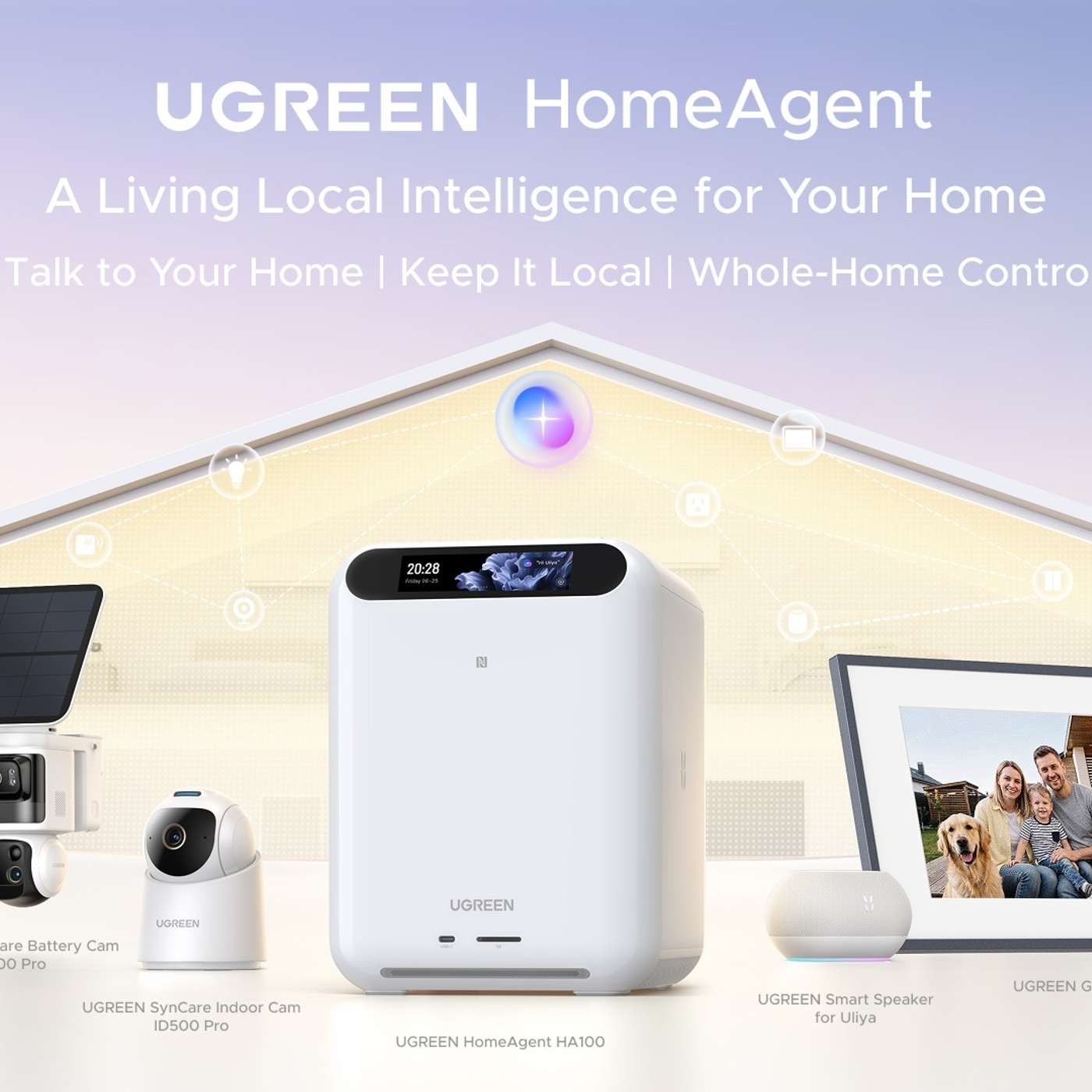
Your Smart Home Has Plenty of Devices. What It Lacks Is a Brain
About this episode
This story was originally published on HackerNoon at: https://hackernoon.com/your-smart-home-has-plenty-of-devices-what-it-lacks-is-a-brain.
UGREEN HomeAgent combines local AI, storage, security, voice control, and smart-home automation into a unified intelligence layer for connected homes.
Check more stories related to undefined at: https://hackernoon.com/c/undefined.
You can also check exclusive content about #ugreen-homeagent-aiot, #local-ai-smart-home-hub, #ai-powered-home, #ugreen-homeagent-series, #uliya-ai-voice-assistant, #aiot-local-computing, #ugreen-masteragent, #good-company, and more.
This story was written by: @ugreen. Learn more about this writer by checking @ugreen's about page,
and for more stories, please visit hackernoon.com.
Smart homes have plenty of intelligent devices, but their data and controls often remain trapped across separate apps and cloud services. UGREEN HomeAgent takes a different approach, combining local storage, AI computing, security, voice interaction, and device control through its UGOS Pro platform. With Uliya, SynCare cameras, Matter and ONVIF support, and the NVIDIA Jetson Thor-powered MasterAgent MA100, UGREEN is betting that the next smart-home breakthrough is a shared local intelligence layer.
Get every episode summarized
Each time The Good Tech Companies publishes, we email you a written briefing from the transcript — the topics, who appeared, and any specific claims, with the ad reads skipped.
Email me new episodesFree for 3 shows. No card needed.
Hosts & guests
Transcript ready
82 searchable segments. Every word is indexed and playable.
Full transcript
The Good Tech Companies — Your Smart Home Has Plenty of Devices. What It Lacks Is a Brain. Machine-transcribed; use the interactive transcript above to jump the player to any line.
This audio is presented by Hacker Noon, where anyone can learn anything about any technology. Your smart home has plenty of devices. What it lacks is a brain, by U-Green. Smart homes have become very good at adding intelligence one device at a time. Cameras can recognize people, lights can follow schedules, speakers can take voice commands. Storage systems can hold years of family photos in video, yet the home as a whole often remains fragmented. Security footage lives in one app, family files in another, automation somewhere else, and much of the intelligence still depends on separate cloud services. The problem is no lingerer lack of smart devices. It is that data, computing, and control inside the home still operate in silos. That is the problem U-Green is trying to address with home agent. At its smart living launch event on September 1 at Gillette Stadium in Foxboro, Massachusetts, U-Green officially entered the IOT space with the home agent series, alongside the new mag flow series, while naming New England Patriots Cornerback Christian Gonzalez its global brand ambassador.
Rather than positioning home agent as another standalone smart home hub, U-GREE Knees building it as a local intelligence layer for the home, bringing storage, AI computing, security, voice interaction, and device control into one system. The missing layer between your data and your devices, at the center of home agent is the all new U-GREE's pro, U-Green's in-house operating system built on a Linux architecture. U-GREE's pro offers professional storage management, robust data security, easy backup and sync, and extensive expandability. Home agent builds on that NAS grade foundation by adding integrated home security, smart home capabilities, and voice interaction. That distinction matters. A NAS stores data, a smart home hub controls devices, a security system watches the home, a voice assistant provides an interface. Home agent is trying to make it those layers work together. Files, photos, and surveillance footage can be stored locally alongside the I-VAT analyzes them. Security events can become information users retrieved through natural language. The same system
managing household data can also coordinate compatible devices across the home. That common foundation brings together five core capabilities. Natural language interaction through U-LIA, local AI and storage, proactive smart home security, AI highlights for family memories, and whole home control. From recording the home to understanding it, one of the clearest examples is security. With supported U-GREE's SIM care cameras, local AI can recognize people, vehicles, pets, and packages. Detect events such as a baby crying or an unfamiliar person, generate alerts, summarize recorded events, and help users locate footage through keyword search. Instead of treating cameras simply as recording devices, home agent turns footage into searchable, actionable information. That same local vision and storage foundation can also serve a very different purpose. With AI highlights, home agent and SIM care cameras can identify meaningful moments from long-term family footage and photo libraries, automatically create highlight videos, and display them on U-GREE
gallery smart frames. A birthday dinner, time with a child, a music practice session, or an interaction with a pet may be meaningless to a conventional security system. To a locally intelligent home, those moments can become memories worth preserving. This illustrates the larger idea behind home agent. The same household data can create different kinds of value when storage and intelligence operate within the same architecture. When the home becomes something you can talk to, home agent also changes how users interact with that information. Through U-LIA, users can use natural spoken language to control supported devices, check live camera status or event history, and retrieve household information without navigating multiple apps or menus. The bigger shift is from controlling devices individually to interacting with the home as a whole. Rather than opening one app after another and issuing separate commands, users can simply express what they want, while home agent works in the background to understand the request and coordinate the relevant supported devices. With support for standards such as matter and onvif,
home agent can also bring compatible third-party devices across different brands and categories into the same local ecosystem. Users can create home modes and coordinated actions, allowing multiple supported devices to respond together. The goal is not simply to make individual devices easier to control, but to make the home behave more like one system. What happens when the home needs more computing power? U-Green is pushing that idea further with the master agent MA-100. Powered by Nvidia Jetson 4T5000, MA-100 delivers up to 2007-FP4 teraflops of local AI computing performance, enabling larger models and more demanding workloads to run locally. The logic is straightforward. If future homes are expected to understand more context, process more data, and coordinate more devices, they will also need substantially more local computing power. If home agent represents UGR-EEN's attempt to give the smart home a brain, master agent represents the higher performance version of that vision.
The bigger bed is local intelligence. None of home agent's individual ingredients are entirely new. NaS systems already exist. Smart home hubs exist. Security camera is exist. Voice assistance exist. Local AI exists. What makes UGR-EEN's approach more interesting is the attempt to bring those previously separate layers into one local architecture. The company is effectively bedding that the next phase of the smart home will not be defined by adding more connected devices, but by giving those devices a shared intelligence layer that can store, understand, and act on household data closer to where it is created. If that model works, the next smart home competition may not be about who makes the smartest camera, speaker, or light. It may be about who builds the intelligence layer that makes all of them feel like one home. Also announced at the event, UGR-EEN also introduced the smart speaker for ULIA and UGR-EEN gallery, extending voice interaction and family content experiences across the home. The company separately unveiled its new Mag flow
series, including the UGR-EEN Magflow Pro Magnetic Power Bank 10,000 mAh 25W. The Magflow Pro 3 in one Magnetic Wireless Charging Stand 25W, and the Magflow 2 in one foldable Magnetic Wireless Charger 25W. Price and availability, pre-orders for the UGR-EEN home agent HA100, HA100 Pro and UGR-EEN master agent MA100 are now open through the UGR-EEN IOT official store. The official Kickstarter crowdfunding campaign will launch on October 27, 2026. Other announced IOT accessories will be introduced as part of the Kickstarter campaign beginning on October 27. During the pre-order period, customers can placia deposit starting from $50 on any of the three hubs to secure the super-early bird price at 50% off. All three Magflow products are now available. UGR-EEN Magflow Pro Magnetic Power Bank 10,000 mAh 25W is priced at $149. 99 through the UGR-EEN official store and Amazon. UGR-EEN Magflow Pro 3 in one Magnetic
Wireless Charging Stand 25W is priced at $159. 99 through the UGR-EEN official store and Amazon. And UGR-EEN Magflow 2 in one foldable Magnetic Wireless Charger 25W is priced at $59. 99 through the UGR-EEN official store and Amazon. Thank you for listening to this Hackernoon story, read by artificial intelligence. Visit Hackernoon.com to read, write, learn and publish.
More episodes
More from The Good Tech Companies

Protection Funds, Insurance and FDIC/SIPC: What Actually Covers What
The Good Tech Companies

Credible Captain Launches Independent Consumer Review Platform Focused on Transp...
The Good Tech Companies
4 Ways to Win a Hackathon (None of Them Is Writing Code)
The Good Tech Companies

Tokenized Stocks vs Real Stocks vs Stock Futures: Wall Street Without Walls and...
The Good Tech Companies