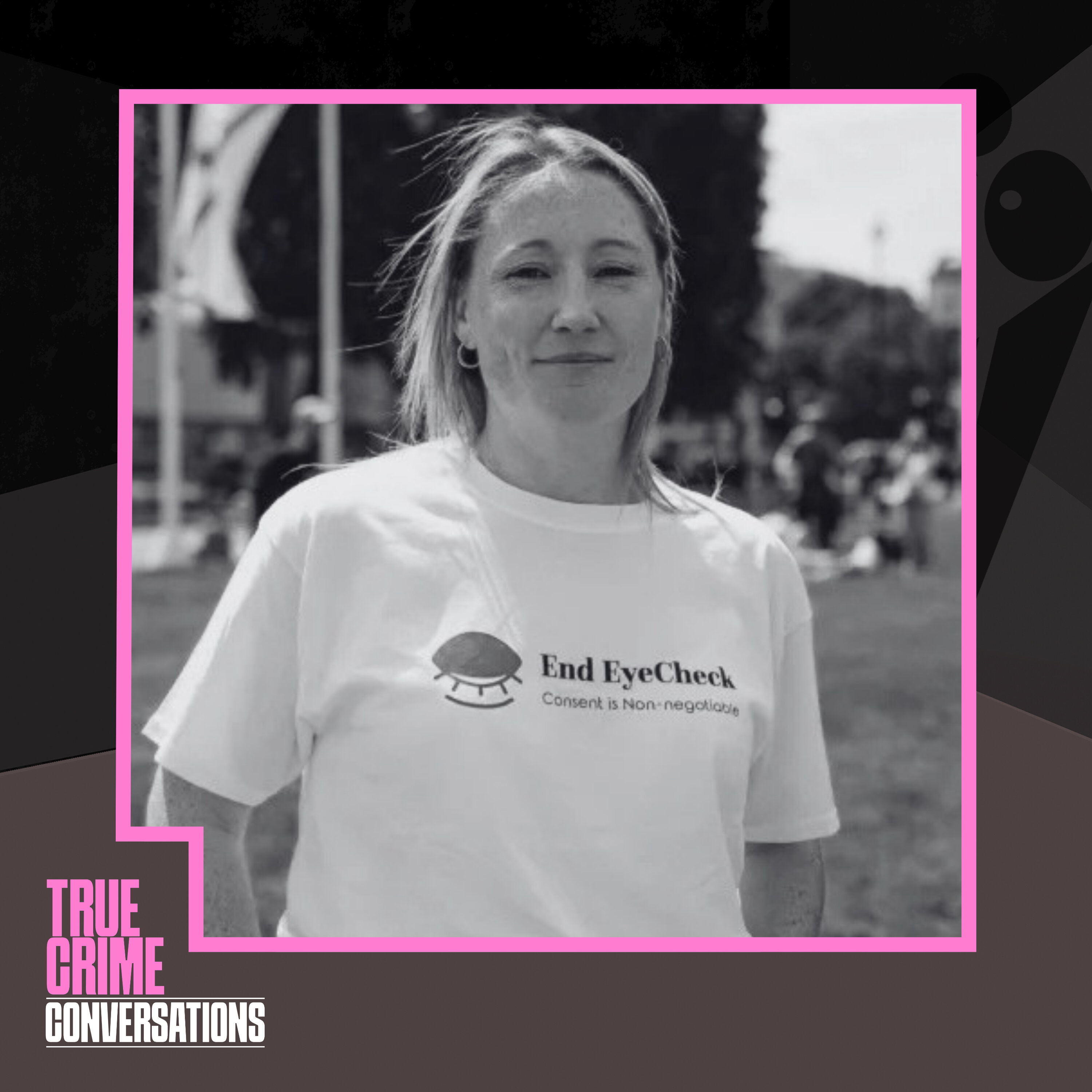
Zoe’s Husband Drugged Her Evening Tea. For Years He Assaulted Her While She Slept
About this episode
In 2018 Zoe Watts' family believed her 16-year marriage was ending due to an affair. Struggling with debilitating panic attacks, sleeplessness, and nervous breakdowns, she finally confided in her sister, revealing a far more horrifying reality. Her husband hadn't just splintered their family with infidelity; he confessed to secretly drugging her with their son's sleeping medication and sexually abusing her while she was unconscious.
Years before the world learned the name Gisèle Pelicot, Zoe was forced to navigate the shadowed, rarely discussed reality of spousal drug-facilitated rape. After seeing her husband sentenced to 11 years in prison, Zoe waived her legal anonymity to share her story as part of a global CNN investigation exposing online "rape academies"—hidden communities where thousands of men swap tips for drugging their partners. In this episode of True Crime Conversations, Gemma Bath speaks with Zoe Watts about surviving unimaginable betrayal, standing up against secret online networks, and her crusade to reform the laws that allow this crime to fester in the dark.
Listen to 'Inside The Hidden Network Of Men Drugging And Raping Their Wives' here.
LINKS
We want to hear from you! Take our quick 3-minute survey for your chance to win a $1,000 gift card.
If any of the contents in this episode have caused distress, know that there is help available via Lifeline on 13 11 14 or Beyond Blue on 1300 22 4636.
Contact Full Stop Australia on 1800 385 578, 7 days, 24 hours.
GET IN TOUCH
Follow us on Instagram and TikTok @truecrimeconversations
Want us to cover a case on the podcast? Email us at [email protected] or send us a voice note.
MAMAMIA OFFERS:
- Get access to Very Peri, Mamamia's exclusive perimenopause series, for just $59. 25 world-leading experts, over 20 on-demand sessions, available now. We’ve sorted through the noise so you don't have to. Go to veryperi.com.au today. You hot? Same.
Make sure to leave us a rating and review on Apple & Spotify to let us know how you're liking the episodes.
CREDITS
Host & Executive Producer: Gemma Bath
Guest: Zoe Watts
Senior Producer: Tahli Blackman
Producer: Ella Maitland
Video Editor: Julian Rosario
Audio Design: Tegan Sadler
Mamamia acknowledges the traditional owners of the land on which we have recorded this podcast.
Become a Mamamia subscriber: https://www.mamamia.com.au/subscribe
See omnystudio.com/listener for privacy information.
Get every episode summarized
Each time True Crime Conversations publishes, we email you a written briefing from the transcript — the topics, who appeared, and any specific claims, with the ad reads skipped.
Email me new episodesFree for 3 shows. No card needed.
Hosts & guests

Transcript ready
1,356 searchable segments. Every word is indexed and playable.
Full transcript
True Crime Conversations — Zoe’s Husband Drugged Her Evening Tea. For Years He Assaulted Her While She Slept. Machine-transcribed; use the interactive transcript above to jump the player to any line.
This is Ashley Akinetti from the Almost Hymnest Podcast. You ever notice you and your spouse keep saying, we need to get away, but you never actually plan anything. That was us until we did something fun and spontaneous. We went to resortpass.com. There are hundreds of hotel resorts, pools and spots and private beaches that you can enjoy. You can spend the day at a luxury resort, pool, spa, massage, without booking an overnight stay. And listen, I may have only been like 15 minutes from home, but it felt like it was a whole different world. And I'm thinking, this is exactly what I needed. So just go to resortpass.com, choose your resort, choose your day, luxury, resort, day passes, start at just $1,500. Once you post your daycation, people are gonna ask where you are. Go to resortpass.com, slash almost famous, and use the promo code almost famous to get $20 off when you spend $100. That's code almost famous at resortpass.com slash almost famous.
It's 2018 in Devon, England. And Zoe Watts family think she's mourning the end of her 16 year marriage because of an affair. That's what she told them a few months ago. Ever since, she's been struggling to function. Nervous breakdowns, panic attacks, unable to sleep or eat. She can feel it starting to impact her four children. So she sits a sister down and it all comes tumbling out. Her husband didn't just splinter their life with the admission of infidelity. He told her he's been drugging her with their son's sleeping medication and having sex with her unconscious body. For Zoe, the last few months have felt like white noise. With no memories of the abuse, she's struggling to wrap her head around the years of rape she's endured at the hands of someone she loves. But her sister has no doubt. This is a crime.
Once their mum is told, she doesn't hesitate. They immediately call police. I'm Gemma Bath, and you're listening to true crime conversations, a podcast exploring the world's most notorious crimes by speaking to the people who know the most about them. And just a warning, this episode contains just dressing descriptions of drug-induced assault. In 2024, we let the name Jiselle Pellico and the crime of drug-induced rape was thrust into the international spotlight. The Pellico case was particularly harrowing as Jiselle's husband hadn't just drugged and raped her himself. He'd invited 50 other men into their home to do so too. The case shocked the world. But for Zoe Watts, this crime wasn't new. She'd been to trial two years prior
with her husband sentenced to 11 years in prison for doing the same thing to her. When her case was going through the courts, she had no other examples to pull from because this crime has laid in the shadows for decades. Jiselle's bravery inspired Zoe's. And in 2026, she shared her story publicly with CNN for the first time as part of their investigation unveiling the online rape academy and the true extent of this horrific offending. We spoke to the journalist behind that investigation in a previous episode, which will link in our show notes. That report revealed group chats started through porn websites in which thousands of men swap tips and tricks for drugging and raping their partners. Every time one of these websites is shut down, another pops up in its place. Zoe has now joined the fight to take these men down,
starting a campaign to build awareness, community, education, and most importantly, change laws that allow this crime to fester. This is her story. Zoe, thank you for joining us on True Crime Conversations. I wanted to start by saying, I'm so sorry this happened to you. And I'm also so sorry about all of the abuse and criticism and victim shaming you have received after telling your story, which is something I never thought that I would say. I'm in shock that that's even happened to you. Yeah, I was thinking about that last night. Just, you know, how is it that when you finally, you know, get the strength to speak about your experience, there's a whole fresh new lot of silencing. Now, find that very difficult to, you know, I find it very difficult to process
because you don't, you don't know where it's coming from. You know, you know, the attack, you know, where that source is, what you, you've understood that that's where the initial violence happened. But the victim shaming, it comes out of nowhere. I've experienced it in very strange places without, without the children. So it really just destabilized you once again. Let's take listeners back to the start. When you met this man who is now your ex-husband, you were quite young, weren't you? 17, yes. Yeah. Do you remember what it felt like to meet him? Was it, you know, love at first sight? What was that early relationship like? Yeah, I'd say it probably was love at first sight. I look back now and I know that none of it was love. But I can even speak to what I was feeling at the time and I was wholeheartedly swept off my feet by this man who seemed, you know, I always say, you know, if a Tinder, you know, used to write, you know,
he had, you know, good connected with his family, good friends, good education, good job. There wasn't anything that you kind of had to think, oh, well, you know, maybe if you just stopped gaming too much, you would be okay. You just seemed perfect. And the age gap, because there was like a 10 year age gap between the two of you, that wasn't a concern? And not at the time, no, it's only been a concern realistically, I think, as society moved on because back then, you say back then, I feel old. Um, yeah. Yeah. Yeah, back then, the age wasn't really an issue. I, you know, became 18. And by that point, he was sort of 28, 29. So sometimes there was an 11 year gap. And I don't think it was an issue, but now in hindsight, and I know I've mentioned this before, my eldest son has said, my, my, just think you were green. She said, I think you were green at the time.
And I think, I haven't already broken that down, but I know that if my daughter's or my son's a boy in the door with somebody 10 to 11 years older, I'd be turning around and marching them back. Also, when you were 17, when I was 17, we didn't really know about grooming. How cool that your son knows what that is. Yeah, yeah, I'm proud. I'm very proud of all my children. I'm proud of the way that they have managed this situation. But yeah, I think it does speak to, you know, the changes that we can make by speaking out. I describe drug-acilitated rape as a silent crime. And it's as silent as domestic violence was 20 to 30 years ago. You know, it's happening in a home near you that people don't believe it. Well, before it happened to you, had you heard about it? No. Just the, you know, I'd heard of spiking. And me and my friends would all make sure that we would get back safe. If we were out to lunch or having a drink or something,
somebody's birthday, and I'd heard or, you know, that making sure you get home don't walk on your own anywhere. That was about as much my education stretch to growing up in school and colleges. I was the same. I don't think I had properly heard about it until the Pellico case in 2024. That's when it kind of got catapulted across the world. But I think a lot of us have been living in the dark about this crime. Yeah, I think society on the whole has. But doing what I do now, I now realise that, you know, there's some people that are engaged in the campaign that are in their 70s, that has experienced it. You've got to think they would have been born in the 50s, you know, 60s. And I think medication back then, it wasn't a stringent so you even had like fentanyl derivatives in cough syrup and things, didn't you back then. So some women have come forward and said that that's what being counted within their relationship.
And obviously divorce was very much found upon around about that time too. Yeah. Let's get back to your relationship family life. You had four children together, you know, raising kids is a lot parenting alongside each other. You were with each other for, you know, nearly two decades. What was that like? What was raising a family together like for you? Well, it had its ups and downs. I mean, the ups was, he maintained a level of social adoration. So his outward projection of what he was like as a father and as a husband was fantastic. So there were times that it looked great and you would rely on those big gestures to think, okay, things are going back to normal now. It will be fine. And I can just speak to the dynamics that he had arranged a blessing day. So for a guy and I don't want to be gender stereotype
but he went out of his way to arrange a blessing day. So he contacted the minister of the church which we got married, saved up about 500 pounds in an envelope, booked in a hair appointment for me. Because I think arranged to look after the children with him and I think my mum while I went shopping and he arranged a meal in the hotel that we had on a wedding reception. So I woke up one morning and he had to be the envelope and he told me what was going to happen on Saturday and he'd invited everybody. And I thought, wow, this guy must really love me. So one of the says and 40 people is turning up for the renewing of our wedding bells. When it turned out that he was feeling guilty, that he's sleeping with my best friend at the time and I was pregnant. So that lends to the double narrative that you don't quite feel safe but there's something brilliant going on
and you just want more of that. But then there were times when it was very difficult. He was never not poorly. He was always poorly and that probably started about three weeks into the relationship. And initially it was put down to the death of his dad that he wasn't coping and he was going to get help. And I found very quickly that there was always something that he wasn't coping with and this was the excuse of his poor behaviour. So it was managing him and his illness as well as running a family. When you say that led to bad behaviour, was it abusive? Were you living in a DV relationship? Did you realise that at the time? Oh no, I didn't realise that. I remember the first time it was really big. He grabbed hold of me and was basking me down this alleyway. And I still don't know why. And I remember reaching out to some family members
on his side and reaching out to his friends saying, I don't understand this. I was 17 and I hadn't come across that before. You know, a good circle of friends. It's just nothing I'd ever encountered. You know, my upbringing wasn't anything similar. And his family sort of suggested and friends suggested did he drink Jack Daniels? And I thought, well, yeah, he had Jack Daniels in code. And this, well, yeah, that doesn't agree with him. He drinks Jack Daniels in code. You know, he really can't code because he gets aggressive. So as long as he avoids that, then he'll be okay. And that level of excusing set the course of the relationship that something would happen, there would always be excuse. So did that physical violence increase then over the years? Yeah, yeah, it definitely did. To whether it was outward threats. And I can just explain that, you know, the atmosphere in the room would change first. You know, I'm very atmosphere, atmospheric sensitive, really.
I remember some driving in a car one time, well, he was driving, actually. And I remember just feeling the atmosphere changed. And I looked at him and I thought he's going to punch me in the face. And I remember when he called the car over and he got to some friends house. I was really scared that they could see and then they asked what was going on. And I said from across the room, you were going to punch me in the face. It said, it's a clever thing on my body not to. And so I could feel it with feeling. And as time progressed, he would suffocate me in my sleep. He stalked me. Yeah, I mean, all sorts of really, when I look back, but it was a mixture of an emotional abuse, your emotions are being abused. There was a psychological aspect where I was constantly doubting my reality and who this person was, but of course, he loved me because we were making plans as a family, as well as the physical abuse and then the sexual. Obviously, we're going to talk about the drug facilitated rape.
But before that, before you became aware of that, was there any sexual violence that you were aware of when you were awake? No, no. There wasn't any that I remember when I was awake. And I think that, that again makes this difficult, but because, I mean, I guess that would give me an answer, wouldn't it? The only thing I can say is that there were times from 2009 that I did wake up. I would say as he'd finished, so whether the sedation had worn off or not, I'm not sure. But he was very clever. He wasn't sitting there saying, it didn't happen. I don't know what you're talking about, Zoe, you must be crazy. What happened was one of the times that I woke up, this man was sort of sat on the end of the bed, you know, head in hands, broken, crying, saying,
oh, I don't know what just happened to me. I don't feel right, something's not right. I'm so sorry, you know, what's happened? And then I'd be thinking, well, what? And then he went to the doctor, he started going to the doctor and saying, I have woken up to find myself having sex with him. I don't want to, can you help me? So it seemed like this poor man, this was just another phase of his mental illness that was being considered by the medical professionals and therefore the abuse continued. Were you planning to leave him or did you see a future with this man? No, I think I'm not going to stay with him because it wasn't right. Those words weren't even, I mean, his doctor was contacting the consultant at a hospital to see, you know, just what was going on, you know.
So they were not at all concerned about my wellbeing. They weren't concerned about what was happening. It was as if he was going in with an ingrown toenail really destabilizing. So I just thought this was just something, you know, that I was, you know, experienced with a weaver experiencing together, you know, I was just on the receiving end of it almost, you know. It only got to, it got to about 2015, 2016 and things really got bad with a mixed, well, got bad all round really with a domestic violence. So, you know, the emotional psychological, and then I was thinking, I think I'm going to have to have a break. I couldn't, I couldn't cope with being his pair up as well as being a mum and running a business. So I think we had around about a six-week break and then he got well. And then he got back together. Before he made his confession of the much more sinister things
he was doing, were there any symptoms that you now look back on in hindsight and think, oh, that was a sign that I wasn't aware of? As in physical ones for me. Yeah. Yeah, so I'd experienced for years, Thrush, and I never knew why. I couldn't, sometimes as a woman, you can track it down to the cycle you can track it back to the sexual experience and you think, okay, maybe I should've gone to the toilet afterwards or something, but I was struggling with that and I was struggling with, you know, like idiopathic, non-specific urine infections. And it was a police that had explained to me that they found, you know, those things in my medical records that, you know, kind of tests the times that I also contacted the GP. There was a correlation and I wasn't really sure. I also thought at one point in time, I thought I had a brain tumor because I was so, I'd have bouts of just feeling sick and migrainy.
My body, my body wasn't well. I can't explain it and I thought, I'm gonna have an apple brain tumor and I'm going to die. My migraines were so bad that I had an MRI, which didn't reveal anything, which is great. And then things just get put down to stress, you know, hormones, you go through a lot right now. So yeah, I think I put down the anusia and the exhaustion and the migraines and the thrush and, you know, to just being run down and I think the GP's did as well. After the break, Zoe tells me about the day her ex-husband confessed what he'd been doing to her in her sleep. Shop vans and Albertsons for fresh savings every time you shop. This week at vans and Albertsons get fresh, boneless, skinless chicken breasts for $199 per pound, limit 10 pounds and locally grown grape-ery cotton candy grapes are $299 per pound with digital coupon. Plus 24 packs of Canada dry or 7-up 12 ounce cans
are $499 limit one with digital coupon. Enjoy fresh and delicious savings for every meal. Hurry in, these deals won't last. Visit vans or Albertsons.com for more deals and ways to save. This is Ashley Akinati from the Almost Amos podcast. You ever notice you and your spouse keep saying, we need to get away, but you never actually plan anything. That was us until we did something fun and spontaneous. We went to resortpass.com. There are hundreds of hotel resorts, pools and spots and private beaches that you can enjoy. You can spend the day at a luxury resort, pool, spa, massage, without booking an overnight stay. And listen, I may have only been like 15 minutes from home, but it felt like it was a whole different world. And I'm thinking, this is exactly what I needed. So just go to resortpass.com, choose your resort, choose your day, luxury resort day passes, start at just $1,5. Once you post your daycation, people are gonna ask where you are.
Go to resortpass.com slash almost famous and use the promo code almost famous to get $20 off when you spend $100. That's code almost famous at resortpass.com slash almost famous. Take me to 2018, which is when he made his confession. What did your life look like at that point? So you had all this stuff going on with the health. How old were your kids? What kind of situation were you in in life? I'm just trying to think. I think my elders is probably about 1415. And so my other one, my other son, would have been about 11, 12. And then my daughter would have been about nine, 10. And my other one would have been about five and six. So quite young. I think still in the midst of parenting. Yeah, I know, I know, but they saved my life. But I think at the time,
we were really heavily involved in a church and we were running courses. So now Bear Grills does the Alpha Course, which is just an exploration of your relationship with God. So we were running that. We were running ironically, J. John, just 10, which is a 10 commandments. So, you know, they're not steel. They're not committed adultery. They're not commit murder. But within those educational packages, we broke down what adultery looks like and how it stems from lust. And we broke down national commit murder. And that stems from anger. And I always remember to this day, those two separate weeks that we ran out of the commandments, he refused to come and was really poorly and somebody else had to do it. And I looked back now and I think, yeah, well, you know. Guilty conscience gotcha. Absolutely, dude, didn't stop him, they did it. No. But yeah, so we were really involved in that.
We were involved in, you know, there was an outreach program that people were calm or we were getting into the food and stuff. So, you know, again, there was this different persona of who this guy was, you know, on the face of it. But I think, yeah, we were attending church every Sunday, doing things one to two evenings a week. And, and it, you know, there seemed to be some fulfillment from that. We would always have a family day, the weekend with the children as well. They had their barriers, different clubs. On a side note to that, he had decided to go into a fellowship program from around about 2015, 2016 when things have got out of hand. It was an anonymous fellowship program as somebody was trying to help because they'd known this guy for 11 years and they knew that he was on a desperate quest to get well and to get better and to cope. So, you know, they suggested like,
if you've ever had a problem with drink or drinks or you've ever had a problem with sex, whatever it is, whatever the addiction is, you might find this place helpful. So, he joined this fellowship program, synonymous 12-step recovery. But why that's so important was because within the church section, some of these guys came. So, I was engaging with them regularly weekly and one of them was his sponsor. So, every day he would speak to his sponsor. Every week they would meet and they would run through the step work program. I don't know if you're familiar with it. No. The sort of step one is you have to admit you've got a problem. So, if you're an alcoholic, you will admit that you're an addict. Step two is you've got to seek something outside of yourself. So, one and two were done very easily. Step three was something like, you write a character defects list of all the things you struggle with. So, that might be pride, self-indulgence or lust. Whatever it is, it's driving you to act out.
You know, step four, you write a list of people that you've harmed. So, it might be, well, I was 15, I stole money from my aunt to go and get my alcohol. Then something like step five is you tell that person and you put it right, should it cause them harm. So, I remember when he went into the program, he used the program as well as religion as another excuse for poor behaviour. So, it would be, I've had a really bad day working my step work today, I really can't cope. Or he would say, I'm just speaking to my sponsor, it's not gone well. Or step four is really difficult. Have you ever tried to look at all the things that you've done wrong? So, he used, you know, mental health, the step work and religion as tools to systematically abuse me. So, between 2015 to 2018, he must have gone through his step work because you repeat them. You go through one to 12 and you repeat them. Or one to four, you act out and then you go back to step one.
So, it's a constant cycle. At this point in 2018, we had realised when he gave it a confession that this group of men in the fellowship knew what he was doing. So, they had known since 2015, 16 of the various different types of abuse that I was encountering. And I was standing up there on a Sunday or on a Wednesday night talking them through. And there was this guy chatting away at how not to assist it about the love of God and how you should treat people. And in the audience, there's a group of guys thinking, well, I'm going to go home and rape it tonight and drop it up. I just can't get the hell around that at all. And that's why the fact that it's not just your husband, it's all these other men that were complicit. Yeah, and they knew for years and they also met the children. So, you know, we'd exchanged phone numbers. There was an outside relationship. I wasn't and I'm not saying
that if I was J. B. Roxane Street, they shouldn't have helped. But there was a relationship with these people where we had developed a kinship, a friendship, a supportive network. So, when 2018 occurred, as time progressed, I started to realize the extent of what had happened to me, but it took me time. I'm flabbergasted that all these men knew before you. So, he admitted to you what he'd been doing on a random Sunday. Do you think it was these 10 steps like a guilty conscience? Why did he eventually come clean? I don't think it was. I think, I mean, it would be easy, right? Oh, gosh, he feels so bad. He's told me guilty conscience. But if that was the case, and he was really genuine in his confession, confession, and changing his behavior 180 degrees, you know,
he wouldn't have done what he did for the remaining four years and he would have guilty. There was no remorse. No. What I think was as this man had got me in such a vulnerable, emotionally and physically, an vulnerable state, that when you're in that dynamic of a domestic, or some sort of an abusive relationship, you know, the person that's abusing you, you, the kushul's so unaware that that's what's happening, you end up turning to them for comfort. I personally believe that these sorts of people are very inadequate individuals. They can't sustain and fulfill their needs through, you know, loving themselves and receiving genuine love from other people. That they seek to fill the void of inadequacy through power. And I believe that he'd already got me in a position where I knew I was being suffocated
and the GPs knew that I was being suffocated and that wasn't an issue. They knew that he tried to drive me into a life-based station wall at 60 miles an hour and they just told me to take away his keys. What? Yeah, I know, yeah. So I think that he was deriving more and more satisfaction and power from me, almost being aware of it, got to the point that I was sat in a room with a counselor saying, because he was like he's parading me round. He said, I said, I don't understand what's happened. He's admitted to having an affair. He's admitted to drugging me. Well, I didn't say drugging me. I said put in my son's sleeping medication in my drink to sedate me, to have sex with me, to tie me down, take photographs of me. And she just shushed me and said, can you see him and he's like this? He's not coping.
So when you've seen looking like this, you need to stop talking. You need to give him time and space. So I think it was almost like, I mean, I knew everything and he was still getting away with it and the abuse was still continuing, I think. And the physical abuse was continuing for sure, the suffocations and we derived from the suffocations had then gone onto the outward strangling. So I think that he was getting that fix, that you know, they had to run in and up in the ante. And I think my death would have been next. So I guess he vets my question in that he admits it, confesses and you guys kind of try and stay together for a period and try and kind of work through what he'd just told you. Yeah, my family knew about the affair and friends knew about the affair. He had admitted to struggling with sex
to certain members of the congregation and to certain people outwardly in front of me and said, look, I'm really struggling with this. I'm struggling with online content and can you do anything that can help? It's quite different because a lot of the time you get an abuser that shies away from the abuse, but he just took enough, not responsibility, but on the outward image of him, he was saying, hey, look, I'm human, I've got faults, I need help, will you help me? So from the outside, people are like, God, this man. I mean, he's really trying. He's, oh, he's really, let's pray for you. Let's, let's meet tonight and we'll do some more step work, you know? Go out, relax, it's been a hard week. Yeah, you don't often get that within the abuser, that is how confident he had become. It feels like a dystopia that people thought that this was acceptable. He admitted to restraining you,
photographing and videoing you as well as the rape. Did he tell you what he was doing with those videos and photos? I don't know. I don't know. And again, I didn't pick up on this till a couple of weeks ago. I've got some clippings from the court and I've got the criminal journal reporter that was in during the sessions and it's even printed that he was standing in the dark saying, why took arti photographs of her? I took arti videos of her. Why wasn't he charged? He's standing in the ground court, admitting to doing it, but was never questioned on it and was never charged with it. It's crazy. And I've only just realized that now. So he wasn't charged for that portion of it, for the photography and the videoing. No. Surely, surely that's a crime as well. Well, it is. Yeah. It is. But his excuse was she wanted me to, when he told me he says,
I've taken the videos and images of you, but it's for your benefit, Zoe. You don't want me looking online at other women. I've already had an affair. So if I'm looking at the content that I'm making of you, then if I could be so crude, he said, well, I'm not masturbating to anybody else. So you don't want me to do that, do you? So it's for my benefit, he said. Wow, the manipulation. We'll see an end's investigation this year, revealed that men, thousands of men, are using porn sites and then entering chat groups and basically swapping tips on doing this very thing, drug-facilitated rape. Do you think he might have, do we have any proof that he was in these groups, that he was sharing these photos of you there, or at least talking to these men there? Oh, yeah. So when he admitted to certain people, that he was struggling with looking at porn sites and adult material, we went up to his work and,
mean another guy, went through the computers and put loads of blocks on to make sure it was safe at work and at home. The police only ever took his phone. I asked him to take his computers, but they didn't think it was necessary. But on that, we found loads of different profiles on websites that I just couldn't even tell you. I just knew that they were adult content. It's not something at the time that I wanted to be. I mean, I wasn't aware that I needed to go down the rabbit hole, but it's not something that I wanted to be doing, but I thought, well, I don't want this stuff on our work computers. And it was before the police, the security was put on them, and you can get like a Wi-Fi that blocks certain things. But once the police were involved, I said to them, do you want to take the computers? Because he would be going up to work at night and then coming home and saying that he was working late.
And they said, no. So when you go on mainstream porn websites, it feels like most of the content on there is quite violent. And then you've got this extra sub kind of area that is this sleep content that's extra sinister. How do we change this? How do we help our young boys to not be sucked into these horrible world pools? Yeah, I think it's really disturbing. I remember being on a bus within the last six months and hearing sort of 13, 14-year-old boys talking about CNC pool. And I was thinking, what? What? Like, my worry is that these young lads are going online on these sites. And if you don't click far, you click on it, and there is something disgusting as in, you know, a daddy waits daughter or a, you know, a strangle to the point of eyes rolling.
And I think that I'm really worried that we are desensitising our children and that these girls think it's acceptable to be treated that way and that boys think it's acceptable to treat a young girl that way. And I think if you've got 13, 14-year-olds that are being shown by adults that this is something that is thrilling and acceptable and all is one click away, then it's not a fast stretch to think how they end up going down the wrong rabbit hole. Obviously it's different to actually acting it out, but I mean past, previous, future in that respect. They are in their hundreds of thousands. So I am really concerned and think there needs to be a re-education of what is, and is unacceptable. And again, tackling the porn industry for making the content to begin with. Did he tell you how long he'd been doing this to you? No, but I know it started in,
easily 2009, possibly the end of 2008, because that's when I first went to the doctor to say, I woke up to find him, you know, am I okay? You know, I think I was checking if I needed a contraception or, you know, so I know that it would have happened around about 2008, 2009, this is start of it. So forgive my very bad maths, but you would have had been pregnant or had young, like, just postpartum in some of these rapes? Yeah, so I know for, I know, my last child, I had a mastitis, you familiar with what that is? Yeah, well, yeah, painful, right? And stitches, and I was infected, like, top and bottom. And you walk around all day, padded up. And so at night time, I went to bed,
on a towel, we're not wearing anything on to just air off and try and let the infections heal when I was on antibiotics. And this was four weeks after birth, and then I woke up my first sexual encounter, was with him, raping me. And I had to go back to the GP to say, I'm breastfeeding, I'm not on any contraception, you need to go to your GP, this has happened again, you need to tell your GP what he's doing, isn't working, you need more treatment. And again, he was just sat on the bed, said, I just, I don't know what happened. I mean, you're all right? What's going on? At the time, again, it was, I was looking after him. It was very cold. That's also incredibly dangerous to even be having sex for weeks postpartum. There's just so, it's just so wrong on so many levels when you unpack it. I want to talk about, because this was like the big revelation, you obviously knew something was happening,
but in the confession, he said, I've been crushing our son's sleep medication. So he admitted that he'd been drugging you. Was it a prescription medication? Does this mean your son wasn't getting medication? What was happening there? Yeah, exactly that. And there were times that we go to the GP to increase the medication because it wasn't working. And also at the time, what was happening in my life? And my migraines getting worse. I was on medication as well, so I was having various different drugs to try and help with my medication that also had a sedative effect. So I mean, one of the drugs I remember was amateuritoline. And that can be used as an antidepressant and a relatively low dose, but the high dose, it can be used to treat pain, say migraines, it's a nerve blocker, and can also be used to treat symptoms like urticaria. And then those days, those days, I sort of 50 to 60 milligrams up, while I was on like 150 milligrams.
And so there were all sorts of different migraine medications that I would be taking as a preemptive to stop a preventative, if you like, that I was taking nightly on top. So I wonder if he, you know, just almost increased my dose of sedative by using the sleeping medication. And what sort of a father does? It's not a father. I'm just guessing what sort of a father does that. That is not what a father does. So I don't know. Yeah. Because your son is prescribed sleeping medication for a reason, and he's taking that away from a child. Yeah. The routine that you had of an evening was a nightly tea, right? That's what he used to do for you. You know, a kind act. Yes. When you found out that he'd been using that kind of nice evening routine to basically facilitate this assault on you,
what was that like? Because I can imagine that's like another extra level of betrayal when you find out that, you know, that the kindness that he was showing was actually not kind. Yeah. I haven't really thought about that. That's a really good question. As I said, every day is a school day for me. I'm learning something new about what happened to me as well. I think, yeah, the usual routine was that he would be making me a cup of tea and I'd be running around sort of in the house. I went, if the next morning, you know, love to see, then what not? You know, I think it's, you know, relationships were growing, you always form roles of who just what? I can't figure out how it got to that point of him making my tea and looking down and thinking, I know what I'm going to do. I know what I could do tomorrow night. I don't know how it started. I mean, yeah, it is a, I mean, the whole thing is a violation of trust, isn't it? And you trust your intimate partner, probably more so than anybody, you know?
Definitely equal or even more so than your parents, because you are now a team, you share your every thought with this person. But yeah, that is just, I can't even imagine her. My brain can't go there. Do you think in this process, your brain has protected you a lot? Can you just not think about certain things because it's too hard? Yeah. So once it had happened, and oh, I see, was it happened once the police were involved? Because you broke in that night as well. And that was a horrific evening. He was arrested within about four days. I ended up hospitalized with a kidney stone. I think I was in hospital for about six days. I needed an operation. It wasn't passing. And then I remember coming home and laying on the sofa just thinking, I didn't, I don't want to die. But I also didn't want to carry on. There were no active thoughts of suicide, but I just,
my life was gone. My life was gone. I didn't know what was real in my past. My whole future had been taken away from me. I was slowly breaking down with the police that they were saying that you are being raped. You have been being raped for all these years. And I remember my mum saying, right, this is going to make you a baby. My mum's fantastic. I love to be seen. And it was a really strong chat. She said, look, you are all your kids have got now. So this will make you a baby. And she was right. And I thought, oh my god, yeah, my future is gone. Well, what about theirs? I'm not going to let you know this affect them any more than what it has to. Obviously they had to adjust to him not being there. And they found out very quickly what he had done. But I threw myself into making memories and rebuilding our new family unit.
So there was a little bit of a problem. I was a new family unit. So there was a level of disassociation that I just this thing. It was over here. I can reel off the list of things that this man has done to me as if it's a newspaper article or if that's somebody else. I struggle to engage and connect with my emotions. And I'm working through that now with a new ero psychotherapist who is absolutely fantastic. But I do not allow myself as a protective mechanism to get emotionally connected to it. So I'm hoping in time because that also is I was diagnosed with a function who knew a logical disorder a few years ago. Because I lost the ability to talk properly and I had left hand side weakness. And I was sort of almost like jerking. I was having involuntary body movement and they said it was a neurological disorder brought on by trauma.
So I'm having to work through what has happened to me very slowly in a secure environment. So not to exasperate my symptoms. I had about a year and a half worth of speech and language therapy to get to where I am today. So you are the third victim survivor who has told me about having a chronic autoimmune condition after something they've suffered that that is it is such a mind blowing thing that I think is so understudied the fact that your body reacts like that. So surely we need people looking into this and my goodness. Yeah, I think all right. I've come across a few survivors that have had that. But I mean, when I was in the hospital, they were saying to me, look, I didn't think it was trauma. But the hospital was saying we know the women that have experienced or people that have experienced trauma can go on to develop a neurological condition called function, neurological disorder.
So I'm hoping that as time is progressing and people are becoming more vocal that they are correlating the two and doing the necessary work. But let's stop people experiencing trauma. How was your experience with the police? Were you believed with a supportive? They were. The police were brilliant. I look back and I think were there things that they could have done differently as in collecting the computers with that open of a whole new thing. But I think some of that also is down to the CPS. I think they weren't very separately, although you think that they work very together. They're not. You know, the police will investigate all day long can have all the evidence that you need, which my officer did. And he was fantastic. And then so they had to apply to the courts for the medical records. And I gave my medical records and my son's medical records over, you know, without a hitch. Whereas he refused because he knew that all of his conversions were in there.
So they then had to go to court to force the medical records. And then when the CPS had all that information. After 18 months of the investigation. They contacted me and said, we're not going to prosecute. And my officer, he was fantastic, came out to the house. He could have just pinged it over and he, well, they sent me an email anyway. So, but he was so engaged in this and was so aware of what this man, who he really was and what this man had done. I can't fault that and my idva and isver. My isvils are absolutely fantastic. And I went to the CPS and I had to champion myself through the victim liaison and be my own advocate. I remember writing to them, you know, every couple of days, you know, he has confessed in his medical records. What do you need my body? You know, do you need a dead body? Are you actually going to do something? And then it took over a year for them to say, yeah, okay, we've made a mistake.
Thank you for bringing this where I tension. We will prosecute him. So it could be that the CPS. Because they didn't charge him. There's a separate offense. If you have sex, if or if you rape somebody in front of a minor. And it doesn't matter what age the minor is, but they didn't charge him with the sexual assault. Of when I woke up and my daughter was in the Moses basket. They didn't charge for the online content. They didn't charge any of the domestic violence. But for me, I want that. I want that charge for that and I want that charge for that. And I want that recognition and the punishment to him. But the police were good. But I think the CPS are struggling. Up next, Zoe recounts what the court process was like. And the four year weight between charges and the trial. This is Ashley Akinati from the almost famous podcast. You ever notice you and your spouse keep saying, we need to get away.
But you never actually plan anything. That was us until we did something fun and spontaneous. We went to resort pass.com. There are hundreds of hotel resorts, pools and spots and private beaches that you can enjoy. You can spend the day at a luxury resort, pool, spa, massage without booking an overnight stay. And listen, I may have only been like 15 minutes from home, but it felt like it was a whole different world. And I'm thinking this is exactly what I needed. So just go to resort pass.com, choose your resort, choose your day, luxury resort day passes start at just $1,5. Once you post your day, Kaychen, people are going to ask where you are. Go to resort pass.com slash almost famous and use the promo code almost famous to get $20 off when you spend $100. That's code almost famous at resort pass.com slash almost famous. Well, he was only charged with four charges in the end. You waited four years to go to trial.
What was that experience like for you? Because he could have saved you a lot of pain, but he pled not guilty. Yes, and I'll never forget that. He caught for me was awful. I think there's a separate element to a drug facilitative rate than intimate partner that you have. I had 18 years worth of my sex life. I'm strutiny. I remember being asked, did I ever use handcuffs? I thought, yeah, I was 17. I was like, how can we prove that you weren't up for it now then? It's very degrading. It was almost, if I use handcuffs another 17, I was asking for it and I was 25. I mean, it's like you were asleep. Yeah. Well, I guess what they're saying is that the courts can use it as a valid defense, right? It's crazy. Absolutely crazy to have that line of questioning even allowed.
Because for me, consent is renewed with every new intimate transaction. It's not, well, I did celebrate with love 17, so I was asking for it 10 years later. Are we saying as a judicial system that we don't have to give consent with each sexual interaction? Because that's certainly how it felt. Never mind the fact that I was sedated. But I think that he became undone during the court proceedings. And he annoyed the judge and the barristers. I almost feel like his veil has slipped. It's taken years to get me in that position to make me as vulnerable as I was, to make me as accepting of my environment. And I think he thought he could do that to 12 of his peers, a judge and some barristers in the space or five, six days. And he couldn't do it.
He lost. Yeah. But he blamed me. You know, that allowed to be his defense. She was asking for it. She wanted me to. Well, he got 11 years. Was that justice for you? Was that a surprise for you? It was a surprise. I don't know if it was justice because my coping mechanism was that I assigned myself to the fact that he was going to be let off. And therefore, as a mum, I had action, various things to make sure me and the children were safe. So I was quite proactive in that regard. Right. He's talking us. We need a normalization order. If this man's walking around, what will we do to protect ourselves? And then when they said that they were going to charge him in my mind, I thought, well, he's going to be let off. And then I thought, OK, but at least he's gone through this. At least he's gone through this. And there'll be a court record of everything that he says. So I can walk away just knowing that. And then when he got found guilty, I thought 18 months community sentence.
That's what he's going to get away with. And the coping mechanism, just a self, self-preserve, you know, that I feel function afterwards. And then they said, no, it'll be between nine and 14 years. There was bad representation in regards to the barrister of his character. So his barrister said how wonderful it was. And he was actually, for the four years, enabled by this group of men working in a recovery centre, for vulnerable men and women as a living carer. And he was caring for them. And I just thought, OK, here we go again. They are facilitating this man working with vulnerable women who are, you know, trying to step out of addiction, which is incredibly difficult. And they are allowing him to do so. So, you know, his barrister was saying, what a wonderful guy he was. And then they also said that he was squeaky clean for four years.
And I tried to speak and say, that's not true. And I was actually getting on one station order. He has stalked us, harassed us, gone to the children's school, you know, been outside the house for four years. And I wasn't allowed my voice in court. They wouldn't let me say that. So he got 11 out of the maximum 14 years. And then I remember the judge saying, we will never know how many times you've raped her. He's your 11 years. But I thought, well, you know, 2008 to 2018 is 10 years. Therefore, he's been given one year for raping me once every year, where he probably would have hundreds and hundreds. So in that regard, I don't think there's justice. And I think that the sentence thing is not reflective on a judge for a drug facilitated rape. A woman had experienced rape with one time, one time, rape, Danane, which is horrendous, by the way.
The guy should never be let out. But in the scale of sentencing, he got 18 years. So I think, well, if you've raped somebody 150 times, 500 times, your sentence needs should reflect that. But it doesn't. It's strange. Yeah, well, when you put it like that, it's quite glaring. When Jacelle Pellaco's story broke in 2024, and this is like two years after all your proceedings have ended, and I don't know what that like for you, seeing something that was quite familiar to you play out on an international stage, and suddenly everyone's talking about drug induced rape. I mean, firstly, Jacelle Pellaco, incredible for coming forward, waving her anonymity. She's absolutely right to do so. But I think it's slightly different, and I'm definitely feeling that with a lot of the women that come here to campaign, because I think the world stopped for Jacelle. Right, so, because it wasn't just a husband, it was 50 other men. And I think that's very different from women that have had it with just their husband. And I'm not saying just something just their husband.
Yes, because they're feeling like it's not bad enough that maybe they could have done something different. Maybe they shouldn't have sent that joke five years ago, or my case, well, I went to bed naked, so maybe it was my fault. It's almost like there's what I've experienced is, well, you've already had sex with him. You should have been more keenkey within your relationship, and you might have done it. Or maybe you would do keenkey and let him on. You should have put out more. So I think there's society has a base level of an expectation. And I think even some women are like, oh, God, I've thought about it. I've thought about it for the month. He's had it now. I don't need to do it again. It's almost like it could be a due to your tool. And so I think there was a basic level of my old acceptance, you know, that the man's needs need to be met. So I think women are really struggling to come forward and say, no,
my husband raped me. I think it's just a little pellicote. It was a dance I easier to get on board with that narrative, because how are you going to explain if you men that there's poor women have never met? And I'm trying to create a space for women to say, no, just your husband, one woman, one time, is one to humanity. That's it. Is that why you decided to share your story? Because you only shared recently just this year you waived your right to anonymity. You shared for the first time with CNN, with your face and your name, to your story. Is that why? Because you wanted other women to see an example? Yes. I tried it one way. I tried it being anonymous, and I spoke with the family about it as well. It wasn't a decision I took lightly. And then my kids were said, well, mum, if something had happened to, you know, you're able to stilse her. Would you be telling her to run away and hide? No, you wouldn't.
You'd be standing next to her saying, it's not her fault. And this person needs to go to prison. And you know, when my children say that to me, I think, yeah, you are right. And I think, which is our pelico, there have been more of an acceptance for somebody that has my story to come forward and create a space for women where it was just a husband. Firstly, tell me about Amanda, because she's your partner in crime as you kind of fight this epidemic, it seems to be, of drug facilitated rape. You met Amanda through, kind of, that CNN story. She's also a victim. Yeah, she is. We wanted to exchange numbers, so Saskia, from CNN, to facilitated that for us, bless her. And we started off with, you know, the old message, you know, you've got nothing in common, no common ground with this person except traumatic experience. And we were learning as Ty went on how close our experiences were.
And so it was after the campaign, after the airing of the CNN interview, that we touched base a bit more. We touched base for the first sort of thing. I think we recorded, and then there was a two to three month gap. We touched base for the first month. Then it went quiet for around about a month, the audio, okay message. And then it aired. And then I was, bless, honestly, Saskia, I was on her all the time. You know, I said, I woke up. It was like, no, I'm doing something about this. But what can I do about it? Is my voice going to be enough? I think Amanda was doing the same. And then I set up, and I checked. I was on my driveway, and I was so frustrated. I have one of these moments where I thought I'm doing it. I'm doing it now. I was already logging my story online. And Saskia would put me in touch with other people to share it with,
to make a change, sort of professionally speaking. But then I developed, then I came up with it, you know, did it all. And then after a couple of weeks of doing this and engaging with Saskia, Saskia said, ask Amanda. See if Amanda wants to do this with you. And at first she went away to think about it. And do you know, that's what's great because having another voice, it lends to making sure we're not catering, but reaching a wide net of women that people can relate to. So for me, I named it and I checked because I thought we are going to end the I check. Tell my listeners what an end I check means for those that don't know. So the I check is the act that is performed by this degenerate. When they have sedated the woman, they lift up the eyelid and check to see whether she is sedated
and quote often they recalled it. So these men on these online platforms were doing hashtag I check. And then they were performing the rape. And that again, I learned something in that moment. I thought, oh my god, what did he do to make sure I was sedated? Like what did he do to poke me in the wrist? Did he do the I check? So I thought, no, I'm not having this. Every time these men are going to sign in I check, and I check is going to come up. And I was designing a website and doing everything just in my bedroom. And that's where after a good couple of weeks I contacted Amanda. And then Amanda said, I'm not sure if I can join. Because the I check, the word I check for me is really triggering. I thought, yeah, you're right, it probably is. And that's what I mean. We're meeting survivors on so many different levels. It's good to have that person to say she joins the campaign. And she's she's doing fantastic. But we're learning through talking that we've had the same crazy thought.
Or that I'll say, oh, this happened to me. And she's so my god, I didn't realize that happened to you too. Did that happen to you? And that's a survivor network that we're building up. Or women that have experienced a sedated rate. Well, we can find common ground. Because I can't look back on light. So, Pelike can a wonderful marriage. I just look back and lies. It's just lies for me. And therefore we'll meet women that can look back. And they're wonderful marriage and have that memory. And that's great. And then I'll be able to relate to the women that look back and think, my god, I've been lighter. This isn't love. It's good to have someone. So what are the goals? What are you trying to do with the end check campaign? With the end I check campaign, there's lots of things. One of them is, oh, firstly, we're trying to track statistics of job facilitated rape. So if you go into your doctor and you record a rape,
or you go to the police and you record rape, it gets put as rape, or maybe familial rape. So it would be class in the same bracket as if you were sexually assaulted by your father or your uncle or your brother. I am requesting that all agencies record drug facilitated rape as a separate statistic. So let's say I get this pushed through, because this is my new thing. Let's say I get this pushed through. In 2007, we are going to start collecting data of women recorded that they experienced drug facilitated rape. So in five years time, we can look at the growth. Right now, we can't look at the growth, because no one, there's no source of statistics. So the campaign is building a statistic database, and now working with agencies are saying they are happening, they're going to happily start recording this as a separate violation. Want to implement cracking down on online platforms and have, you know, well, I believe that sleep content
and CNC content, strangulation content, it just should be banned. It should be banned from being made. It should be banned from being uploaded. Some wally tomato that upload sleep content, their IP address, even if it's blocked or whatever it is, gets sent straight to the police. Rather than the victims, how from trying to find themselves years later, that's something. I'm looking at an education program for women, so that we know that this is something that we can encounter. Bit like Ask Angela on the back of a toilet door, you know, drug facilitated rape is something that I never even knew that I need to consider as a possibility. And also the education program reaching mandatory reporters, when we have women coming in with various different symptoms, or in my case, actually saying, this is what has happened, they put the adequate safeguarding and mandatory reporting in, because it's currently that this is being done. And then to reach out to men, like how are they going down this rabbit hole? I mean, I don't like calling them men, because these people are men.
That is not what a man is, they are a degenerate, but how do we get from back to this? It's just quite a few things that plug in way out with the campaign at the moment, but it's good. Good. And building the network. So far, in a number of months, there is 55 different countries worth of engagement. And 22 separate countries of survivors. So this is why I say, you know, it's like the clip of the movie is happening in a town near you. It literally is. And I think as a society, we have to wake up. We don't want to and know it's sad to cliche. We've got to wake up. We have to open our eyes that this is something that is happening. We check how our friends get home, but we don't check how our friends slept that night. And the sad thing is is that she probably doesn't know either. So when I think, I don't know if right now I could list 22 countries off the top of my head, just random. There is that many 22 different countries of survivors.
So I'm asking them to continue to reach out. We're working diligently for them, but that sets the tone of how prevalent this crime is. And I think we're just scratching the iceberg. Have you heard from many from Australia? Yeah. The end eye check campaign is opening up in Australia soon. And fortunately or unfortunately. So Canada, Australia, Mexico. And America. I think Canada is already pretty much up and running, but the prevalence in Australia is very high. Yeah, well, that's devastating. It is, but you know, I think while we keep thinking this is a crime that happens to somebody else, we're not going to fix it. While we keep thinking that this crime discriminates, it doesn't discriminate in both ways. It doesn't discriminate by the perpetrator. We think that somebody like this, you know, is somebody that, you know, is not of good standing. This crime by the perpetrator, we've got perpetrators that are highly educated.
Various different social networks, various different ages, various different ethnicities. It does not discriminate. So we're not looking for it. And it certainly doesn't discriminate by the victim. If you think that you've got a good job and living a good area, it's not going to happen to you. You're wrong. It does not discriminate. We have got victims of different ages, different ethnicities, different parts of the world, different social standards. I think we just have to accept that while there is a body, and there is a not-kind, this is a possibility. And that is it. At least we're actually talking about it nowadays. Yeah, absolutely. I can feel your passion is creating this community of incredible survivors. Is it helping you? Is it healing you? Is it giving you people to bounce off? I mean, it's a double-edged sword. Every new woman that I speak with is just, is heartbreaking. But then on the plus side, if I get up every day and I think if I can just help one more, if I can just help one more.
There are women that have stripped their social media page and dedicated it to End Eye Check. They are now End Eye Check Scotland. End Eye Check Wales. I think, wow, like that is brilliant. And I'm pleased to be able to help facilitate a platform for these women to heal. There is a level of healing, but I think first comes understanding, and I'm still understanding what happened to me daily. I just interviewed yesterday, and I suddenly realised something else about myself and my experience. I either haven't processed or I haven't allowed myself to process. So I think if other women, you know, anonymously or otherwise as they press it away, they're anonymity, have a space to be able to do that. Whether you know, judgment-free, then that's great. Campaigning aside, what does the future look like for you and your family? Do you see love in the future, happiness in the future? What are you looking forward to?
I think I don't rule anything out. I'm not going to let this person make me feel bitter and rob me of my future. He robbed me of my perception of the past. So I'm of the mindset of grabbing joy whenever I can. My dad was an incredible, incredible man, and we recently lost him. In fact, he passed away four days after CNN aired, which was just awful. But I think that he was an example, a shining example of what a man is. And I know that there are men out there that I like that. And we need them, right? We need them to stand up, come alongside the campaign, change the narrative, educate their children. You know, we need that. So I don't think that me sitting here thinking all men are like it. I'm never, you know, doing anything is going to help me because he's keeping me in prison still.
He's controlling me from prison if I stop finding joy, if I stop making memories. So my coping mechanism of healing is to go out and live my life and make memories with my family. That's the biggest thing that has got me through. So I find joy, whether it's in a cup of coffee, in the garden, or a walk with my mom, whatever it is, I think that's one thing that I can do that you can't. You're incredible, Zoe. Thank you so much for joining us. And thank you for sharing your story. Oh, thank you for having me. I really appreciate that. And please let me know if I can help with anything in the future. Or if you have any women that come forward after watching this, these, you know, send them my information being more than happy to help. Thank you to Zoe for sharing her story with us. You can find a link to support the hashtag end iCheck campaign in our show notes. If you enjoyed this episode, please leave us a rating or review on Apple podcasts and Spotify.
It really helps others find the show. Thanks so much for listening. I'll be back next week with another true crime conversation. This is Ashley Akinati from the Almost Amos podcast. You ever notice you and your spouse keep saying we need to get away, but you never actually plan anything. That was us until we did something fun and spontaneous. We went to resort pass.com. There are hundreds of hotel resorts, pools and spots and private beaches that you can enjoy. You can spend the day at a luxury resort, pool, spa, massage without booking an overnight stay. And listen, I may have only been like 15 minutes from home, but it felt like it was a whole different world. And I'm thinking this is exactly what I needed. So just go to resort pass.com, choose your resort, choose your day, luxury, resort, day passes start at just $25. Once you post your daycation, people are going to ask where you are.
Go to resort pass.com slash almost famous and use the promo code almost famous to get $20 off when you spend $100. That's code almost famous at resort pass.com slash almost famous.
More episodes
More from True Crime Conversations

The Lindsay Clancy Trial Mini Series: The Verdict
True Crime Conversations

The Lindsay Clancy Trial Mini Series: The Defence's Case
True Crime Conversations

The Lindsay Clancy Mini Series: A World Obsessed
True Crime Conversations

The Lindsay Clancy Trial Mini Series: The Prosecution’s Argument
True Crime Conversations