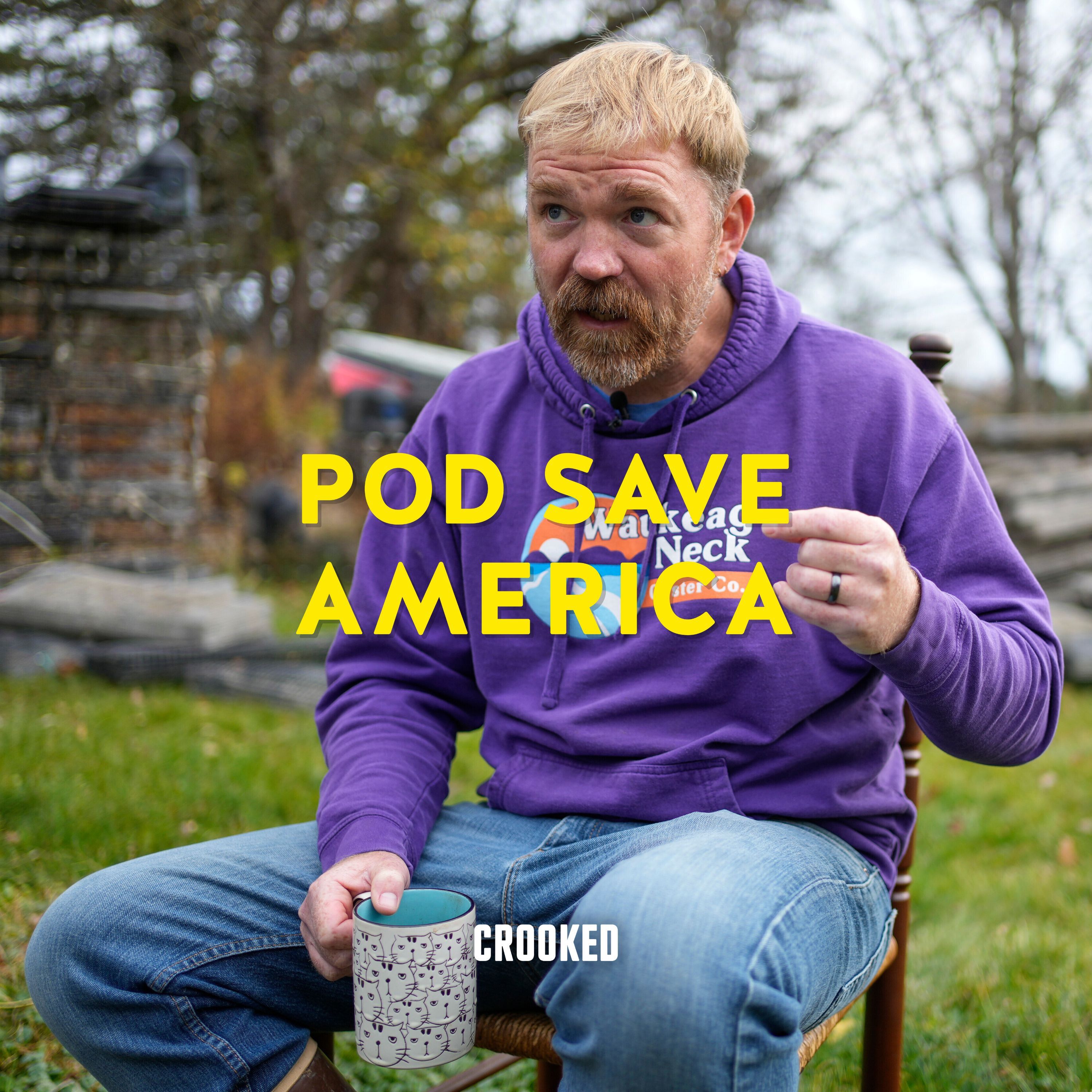
About this episode
Graham Platner, a Democratic candidate running for Senate in Maine, stops by the studio to talk with Jon about Trump’s impending conflict with Iran, the future of Medicare for All, and what community organizing in rural Maine taught him about building political power in our polarized era. The two discuss new polls showing Platner leading Janet Mills in the Democratic Senate primary, how his tattoo controversy has resonated with Maine voters, and what he wants to change about the Democratic Party to rebuild a winning, working-class coalition.
For a closed-captioned version of this episode, click here. For a transcript of this episode, please email [email protected] and include the name of the podcast.
Get every episode summarized
Each time Pod Save America publishes, we email you a written briefing from the transcript — the topics, who appeared, and any specific claims, with the ad reads skipped.
Email me new episodesFree for 3 shows. No card needed.
Hosts & guests

Transcript ready
1,750 searchable segments. Every word is indexed and playable.
Full transcript
Pod Save America — Graham Platner Isn't Backing Down. Machine-transcribed; use the interactive transcript above to jump the player to any line.
Pots of America is brought to you by Act Blue. Here on Pots of America, we're all about cutting through the noise to get clear on what's really happening and what we can do about it. Act Blue provides Democrats up and down the ballot with the tools they need to run effective campaigns and win. Fundrais organized, build campaign websites and donate with solutions that are easy to use. Act Blue has been there through our country's biggest moments. And our partners at Votes of America create digital fundraising pages on the Act Blue platform for initiatives like the anxiety relief program and you flip the house fund. It's so easy to create the donation pages and you can add features like goal tracking monitors and design custom branding and the funds are processed quickly and safely. Act Blue never sells your data or your personal information. They focus on securities. You can focus on what matters most, like winning. So whether you're running for office or want to make an impact, Act Blue has the tools you need to make it happen. Because the right time to get involved is right now. Donate, organize, and raise money for candidates and causes you believe in at actblue.com slash crooked. Welcome to Pots of America.
I'm John Favreau. Our guest this Sunday is Graham Platner, who's running for Senate in Maine. He's currently in a Democratic primary race against Maine Governor Janet Mills that will be decided in June. And the winner will try to finally defeat Susan Collins in November. Graham has been on the show before. You might remember that his interview with Tommy in October is where he revealed that he got a scullin' crossbones tattoo as a young Marine that he says he later learned was a Nazi symbol. And right after his PSA appearance, he got the tattoo covered up. I of course asked about that, but I mainly wanted to learn more about what Graham Platner actually believes about politics, what life experiences shaped his beliefs, what his theory of changes, what kind of a person he is, and what kind of a senator he'd be. All important questions because, despite the early controversies over the tattoo and his long trail of Reddit posts, Platner didn't just decide to stay in the race, he's now the front runner, at least according to the polling averages and fundraising totals.
At the very least, judging by the crowds he's getting and the organization he's building, he will be a formidable challenger to Mills, and this will be a very competitive and much-disgust primary in the months ahead. With that said, I really enjoyed the conversation, and I hope you do too. Here's Graham Platner. [♪ OUTRO MUSIC PLAYING [♪ Graham Platner, good to see ya. Thanks a lot, it's good to be here. Welcome back, it's good to have you here in person. No, it's an absolute pleasure, man. You've been running for Senate for six months, right? Yeah, we launched the campaign on August 19th. Okay. So yeah, whatever that is, around that. You've gone from completely unknown challenger to rising star, to scandal plagued candidate, who face calls to drop out, to fundraising leader, and maybe, if you believe the latest polls, front runner. Yeah, it's been quite the whirlwind. How is your thinking about politics and campaigns being in public life changed since you started running?
Like, what have you taken away so far from this journey? One I've taken away, I mean, I was already pretty cynical about money in politics, and that cynicism has just been supercharged. I mean, it is like, and the problem is, you clearly need to raise money to compete for this stuff, but there is just a whole apparatus that seems to exist just to suck up money. Yeah. Like, and that has been really eye-opening. I mean, the political industrial complex, so the campaign industrial complex, what do you want to call it? And it is this kind of like, it's a wild thing to actually interact with personally. I mean, we're lucky because our fundraising has been so much small dollar stuff, and because, frankly, the establishment of even my party wants nothing to do with me, it kind of keeps all of that at arm's length, like automatically. So I'm not that mad, but you're just interacting with it. It's like, man, there's a whole industry around this stuff. Is it the time stock? That's really. It's the time, totally. And it's, I'm not gonna say I understand why people go
the kind of corporate pack dark money route, because I mean, just ideologically, I can never really grasp that, but from a practical perspective, there is an element where I can see someone who might not have the same, I like just sort of political foundation that I have, being, I mean, if somebody comes along and says, hey, you never have to make a phone call again, and you don't have to go beg anybody for money, I can see someone being like, oh, well, that would mean that I could do more other stuff. Right. Although, I mean, it's, I mean, that's not in any way should reform remotely worth it. But it's, and then there's just the, there's just kind of interacting with the whole media landscape and political world, as a pretty normal guy up until August. And so like, that's a whole wild experience. I'm like, open my phone and see my name, and I'm like, I don't, nope, no, no, no, I don't wanna see that. Like, it's just this very, and it's not always good, not mostly good. No, it's such a, yeah, it's a very like,
it's just very surreal. Yeah. And I also very much understand why, I guess the biggest lesson I've learned is structurally, it's borderline impossible for regular people to pull this off. Like, if you're a regular human being, with not a lot of money, and having lived a pretty normal life, who doesn't wanna like just get your entire existence ripped to pieces, I can see why people don't wanna do this. I think about that often, because especially with people, our age, and younger, like, and everyone younger, because we've, and if you look, if you've never spoken about politics or posted about politics your whole life and have lived a perfect life maybe, but you've obviously found out. Yeah. You've said quite a bit about politics. Yeah, I mean, at the time, and everyone knows now. And everybody knows, I mean, like, and for me, like it's a, when I got into this thing, I'm an elder millennial. I've spent most of my life on the internet. I was well aware, when the moment I said yes to this whole experience that somebody was gonna come along
with a bunch of resources, and dig up every single thing I ever did on the internet and try to use it. Like, I knew that was coming. And when it came, I was happy to talk about it, because quite frankly, I think it's a pretty standard story of people that aren't trying to get into politics, or just regular human beings in general. You go through phases in life. Yeah. You believe things when you're younger, you say things, you do things, and then you learn new things, and then you change, and then you become a different version of yourself, which I mean, in my experience, it's pretty much just like what most people go through. So it was actually very kind of ironic that that whole thing blew up as if it was this huge scandal. And in reality, I think it actually really strengthened the campaign, because a lot of people could like directly engage with that feeling of like, yeah, I have not, most of us have not always been who we are today. And we also have to very much understand that if we're gonna build a better future,
we need to keep in opening for a lot of people to change. Because if we're all stuck right now on some ossified political thought and nobody's capable of changing, and then what's the point of doing any of this? Yeah. No, and look, we appreciate you coming out here and know you talked to Tommy in an interview, which became part of the story, because he asked you about a lot of the old posts. He also asked you, and then you talked about the tattoo. You've since had the tattoo covered up. You actually had a cover of like two days after that. I remember. Well, I remember a few weeks after that, I had a main voter who I know say to me, I like Platner, I'm leaning Platner. I don't think he's a secret Nazi, but then they said, you know, my concern is, I saw that a few people left his campaign. One of them said Platner knew the tattoo was a Nazi symbol when he started running. Someone else told CNN the same thing. I'm just wondering if I can trust him. Now, if you win the primary, because I'm sure you've probably been able to meet a lot of primary voters just campaigning around Maine.
It's been a matter of that. In general voters, in general voters. Maine's not very big. Right. If you win, of course, super PACs will run millions of dollars of ads to this effect. Can we trust him? Is he telling the truth? What about all these positions? To reach voters who aren't politically engaged or aren't as politically engaged or aware as maybe some of the voters who've come to your events. What will your response be? And what is your strategy to push back? So this response is going to be exactly what it was, which is like, I'm happy to talk about all this stuff. I, I, when that whole thing started, it like never crossed any of our minds to like run away from it. It was just kind of like, no, I mean, this is just part of my life. And in many ways, it's kind of part of my political journey. And so I'm happy to, happy to discuss it. One, what we're doing in Maine is we are truly trying to build a real on-the-ground, organized, broad coalition
of frankly working class power. And in the doing of that, in a state that's as small as Maine is, by the time we get to the general, I'm going to have either directly connected with a substantial portion of the electorate, or a bunch of people who are just going to tell their friends. And the way Maine tends to work is that people trust their friends and their neighbors more than they trust TV ads from political groups. And part of our strategy, quite frankly, is just to cut through all of it by engaging as many people as possible and personally interacting with this mountain. I do three to six public events a day. I mean, I do not sleep much. And that's fine. You might meet everyone in Maine then. We very well might meet everyone in Maine. And we go everywhere. I mean, this is not like, we're not doing some kind of weird math about like, oh, we've got our win number and we're only going to focus on that. Like for me, we truly need to change politics.
And to do that, we have to engage with everybody, even people who we might not agree with, even people who might initially be very either resistant or hesitant or even oppositional to the message, although we've found that when we do engage with those folks, we have a lot of common ground. If you had conversations with people who are skeptical about all the tattoo stuff or any of the old Reddit posts or any of that. Oh, yeah. I mean, I'll give this a go. They go great. I mean, it's because I explain it. And frankly, most people are like, that all sounds eminently reasonable. And it's, and I think in Maine folks, I mean, I'm just like, I don't know how to say this, but when people meet me, they tend to be like, okay, so he seems exactly like a normal human being. So it's helpful. It's helpful. So there's that. And then I mean, honestly, we're also just going to push back on TV primarily with messaging, but it's positive. I mean, I really, I'm, I know that once we get through the primary that, you know, the whole thing's going to,
I mean, there's so much money. It's going to get spent on this race, which drives me insane. Because if I had my way, we would just take that money and like, write everybody and make a check. Frankly, we'd be better off. Every cycle when you hear how much is being spent on the biggest Senate races. It's not just like, oh, what the fuck is that? Although I will say for us, the way that we kind of fight back against that is we're like, we're building it on the ground, organizing apparatus. So a lot of like, we hire manors and we're going to, we're going to have manors learn how to be organizers in their communities and like have them on staff. Like we want the money that we spend to primarily be spent in Maine, not just give it to some DC consulting firm that makes another stupid ad that we've all seen a thousand times, just changes little things. But we all know exactly what they are. So by building that and by sticking to a very like cogent, constructive message of the kind of future we want to build, the kind of policies that are going to get us there.
And a theory of power building that is also going to be necessary to get us there. I think that's how we push through all this stuff. And in my experience, like negative TV ads, I don't think they actually moved the needle much in Maine. In 2020, Sarah Gideon race outspent the Collins race, almost three to one. Yeah, it's a money left over. It's a money left over. In a men's amount of money was spent on negative ads about Susan Collins, it didn't do anything. And honestly living in the part of man I live in, which is rural Eastern Maine, a lot of the negative ads about Sarah Gideon also didn't change anything. It was really more about like a feeling on the ground. People couldn't really connect with the Democratic candidate. Primarily because I think DC came in and ran the race like an old school DC race, which is not going to win against Susan Collins. And Collins was a known entity. And at that point, people could still sort of frame her
as this sort of moderate. Ro would not have been overturned, which is really important to remember. And I think that that to me just shows that it's not really about the ads or even the money spent. There's another, there's an X factor in there about connecting with people. And about really being able to make people think that you are, we're not think, but letting people engage with you directly to show that you are like authentic. And which is why I, I mean, we hold, we've held 40 town halls. And we're going to hold 20 more before the primary. And we're going to hold a bunch more after that. Like making myself accessible in a way that isn't controlled. Like we don't screen questions at these things. People just come and I literally pick on folks who raise their hands, drives the comms team insane. They are terrified. But I think that's how you make yourself accessible. And we need politics to be accessible again to regular folks. So you're running against Janet Mills.
She is a, you know, a popular governor, who, you know, who's accomplished quite a bit in comparison to other governors, even other Democratic governors, big healthcare expansion for community college, more school funding. What governing decisions has Janet Mills made that you disagree with? So if, if anything, I am very much a labor candidate. I believe in the need to strengthen unions. I believe in the power of organized labor within our society to advocate, not just for like their union members, but kind of for the working class in general. The governor has effectively vetoed every single pro-labor bit of legislation that's come across her desk. She's been an opponent of labor. I mean, right now I have, forget how many, but a bunch of union endorsements. By the time I get to the primary, we're probably gonna have the vast majority of unions in Maine because they have a not great relationship with the governor. And you know, to me, like we need to pass the pro-lect.
We need to expand the NLRB or have the, we need to expand labor courts and have an NLRB that actually acts as a good faith intermediary and like unfair labor practice disputes, which right now, I mean, it doesn't even have a quorum right now, so it's all not functioning. And like someone who's vetoed pro-labor legislation over and over and over again, to me is not someone that's like gonna go to the mattresses to fight for it in DC. I also think that Maine has a very fraught relationship with the Wabben Occinations. We have a specific law from 1980, which does not extend to the main tribes. The same protections that all other 570 nationally federally recognized tribes get. So it means that the main tribes have to spend a bunch of money on lobbyists in Washington, DC because for legislation to impact them, they need to be named specifically. So they have to have people in Washington
to make sure that malice, Penobscot, Pasamiquati, that that gets added as words into bills. There have been multiple attempts to fix this and the governor has opposed all of them. Both as Attorney General and as governor. So like to me, that is also a pretty fundamental difference around, I don't like a foundation of political philosophy. I do not see expanding tribal sovereignty in Maine as a bad thing at all. I think it's good. And I also think it's morally the correct thing to do since we have been not good faith actors in our relationships with the tribes. And so there are, and then last but not least, rather big one I think is I think we have to tax the rich. And the governor's vetoed multiple bipartisan bills, some written by Republicans that were trying to raise taxes on the wealthy in Maine, creating three new tax brackets was completely reasonable and the governor vetoed that. And again, that just doesn't show a commitment to going after where the money is,
which I think as we move into this next phase in American history, I think that's gonna have to be like a pretty foundational element of our politics going forward. Pots of America is brought to you by fast growing trees. Did you know fast growing trees is America's largest and most trusted online industry with thousands of trees and plants and over two million happy customers? They have all the plants your yard or home needs, including fruit trees, privacy trees, flowering trees, shrubs, and houseplants, all grown with care and guaranteed to arrive healthy. It's like your local nursery, but anywhere you live with more plants and you'll find anywhere else, whatever you're looking for, fast growing trees helps you find options that actually work for your climate, space, and lifestyle. Fast growing trees makes it easy to get your dream yard, just click order, grow, and get healthy, thriving plants delivered to your door. They're alive and thrive, guarantee promises that your plants arrive happy and healthy, no green thumb required, just quality plants you can count on, plus get ongoing support from trained plant experts who can help you plan your landscape, choose the right plants and learn how to care for them
every step of the way. We're huge fans of fast growing trees. Great way to get really nice plants and shrubs for your yard. It's hard to figure out what to do because there's so many plants out there these days. A lot of plants, hard to figure out what to choose. Need some help. You don't need a big yard or a lot of space. You can grow lemon, avocado, olive, or fig trees indoors along with a wide variety of houseplants, all grown with care and hand selected to thrive in your home. The experts of fast growing trees have curated thousands of plants for every climate and growing zone. So customers can find options that truly work for their yard. Right now they're having a great deal on spring planting essentials up to half off on select plants and listeners to our show get 20% off their first purchase when they use the code Cricut to check out. That's an additional 20% off better plants and better growing at fastgrowingtrees.com using the code Cricut to check out. Fastgrowingtrees.com, code Cricut. Now's the perfect time to plant. Let's grow together. Use code Cricut to save today, offer valid for a limited time, terms and conditions may apply. Pots of America brought you by Blinds.com. If you ever thought about upgrading your window treatments but didn't want the hassle Blinds.com is here to change the game to the only company
that lets you shop custom blinds and shades online and backs it up with professional in-home measure and installation services. At Blinds.com, you can skip the stress and get expert design advice through their convenient virtual consultations on your schedule, whether you know exactly what you want or need a little help deciding, do it yourself or sit back and let Blinds.com handle everything from measure to install. Either way, you've access to experts every step of the way. They're on a mission to make custom window treatments easy and affordable for everyone. Get the same quality and service you would at other high-end stores, but at a fraction of the price get samples sent directly to your door, fast and free, compare colors, textures and materials right from the comfort of home to help you make the perfect selection. All Blinds.com orders are backed by their 100% satisfaction guarantee. If you're not happy, they'll make it right. They're breaking the mold, but they're not new to the game. Blinds.com has been around for 29 years and is covered over 25 million windows, making them the number one retailer of custom window treatments. Right now, Blinds.com is giving our listeners an exclusive $50 off when you spend $500 or more, just use code Cricut at checkout, limited time offer, rules and restrictions apply, see Blinds.com for details. I want to sit back and ask about how you came to believe
what you believe about politics. Like when did you start paying attention to politics and what was your worldview like back then and sort of how has it evolved? I mean, I've always been, I was a big history buff when I was a kid, which in many ways kind of makes you sort of politically aware just because you're doing that. In high school, I was introduced to more critical thought, like Howard Zinn and Chomsky, you know, at that point. But I remember reading those things and like being like, yes, some of this makes sense, but I also still was very much like a bit of a patriotic young man. So, and I always wanted to join the military. So I had this kind of like weird like militaristic vent that I really can't explain, but since I was two, I wanted to be a soldier. It was really after my military service that I began to think much more deeply about it, primarily because I mean, I had four tours in the infantry
and I fought in Iraq and Afghanistan. And I really came to believe that what we were doing was not what we were claiming to do. I could not figure out what the immense amount of violence I partook in, what that did for the town of Sullivan-Man. And like, into the state, no one's ever been able to explain to me. I do know that some people made a lot of money off the worse that I fought in and it wasn't the young men and women who did the fighting and it certainly wasn't the civilians that we inflicted, it just wild amounts of violence upon. I, it's defense contractors and it's folks in political power. Like it really is, and that began to, so I became, it became very critical of American foreign policy, which as I then that kind of just sent me on a road of being, well, if I'm critical of foreign policy, why is our foreign policy like this?
So I became more critical of our political structures. And once you start being critical of the political structure, you're like, well, why is our political structure like this? And that takes you into like an economic critique and you start to realize that, oh, I like this whole system in many ways does seem to be built by people in power with wealth to maintain or expand their wealth in power, generally to the, to the emissoration or diminishment of regular working folks. And, and I think, you know, the reason my, this campaign has sort of blown up the way it has is, I think a lot of people are getting wise to this. I think a lot of folks are like, wait a second, like this stuff that we all thought for years, we are getting a totally different outcome from what we claim we're trying to do. So are we actually trying to do the thing that we claim or is all of this doing something else? And when you reframe the question of like, does all of this exist just to like screw working people and make somebody else rich?
Suddenly, a lot of decisions we make begins to become a lot more clear. I'm like, man, and so that's kind of where I've, it's been a long journey. I mean, it's, it's definitely not been, I didn't like have a day where I'm like, oh, it's, I figured it out, but. Well, and obviously, so obviously you're like, shaped by your experiences in Iraq, you come home, all the, everything you just said, you know, you could, you could have found out by just being on the internet, right? And reading about politics and reading the news. But you decided before you, long before you ran for senate to like get involved in community organizing, which I find really interesting. What got you into that like, did, what did you want to change in your community, specifically, and like, and what did you find about the work, what was challenging, what was fulfilling? And number, I forget what year this was, but I read a book called No Shortcuts by Jane McLevy. And she's a pretty storied labor organizer who sadly passed just a few years ago, which is a shame because we could use her now. In it, the book really talks about the difference
between organizing and mobilizing, developing a deeper theory of power in which power really is accessible for people who are willing to organize and to take it in many ways, in that we, in our society, even in like liberal circles, still kind of have this vision that there is an elite who's like worthy of wielding power and the rest of us kind of have to like, you know, let them do it. And her argument is like, that's simply not true. That really power is, power is for everybody. But it requires organizing to bring it around. It requires trust building and relationship building. And I read that and it kind of changed my life actually because I began to think that, like I spent a lot of time, especially coming back, my last trip to Afghanistan was in 2018. And it was just, to call it disillusioning would be an understatement. I was there for six months, hadn't been there in seven years. And I was like, okay, well, nobody has any new ideas.
This is insane. And I came back and I was really kind of just at my, at a loss of what to do. And I decided to kind of opt out. And I moved back to my hometown, became an oyster farmer, started working on the ocean and really wanted to just check out. But while I did that, I also began to connect to my community. And I mean, I live in a town of a thousand people. So town I was born and raised in. I wound up on the planning board. I wound up being the harbor master and in doing all that, I began to see like really the value of building trust and relationships and just organizing on the ground. And I also began to realize that organizing is actually not that complicated. It's just really hard. And that there is no graduate version of it. It's all 101 stuff. And it's hard because it is difficult to get people to participate, to care, to break down barriers. And because you have to put a lot of time, unpaid labor. You have to believe.
And you have to go out into your community and you have to tell people what you believe, which is also hard. And it requires you to kind of open yourself up to a lot of people who are like people who I know, who you have to kind of say like, this is what I believe. And sometimes people are like, I'm not into that. You're my neighbor, that runs me out. But you have to do it. And we had a number of issues in Eastern Maine. For instance, there was a school board race. And out of, frankly, an out of state pack came in with a bunch of money and backed a very anti-trans candidate. And somebody had been on the board for 13 years, who was well-respecting the community, who everybody liked, lost a seat. And a month later, the school district pulled back protections for LGBTQ kids that had been there for six years. For no reason.
Just because. Outside packaging involved in a local school board race. School board race. School board race. Yeah, technically in Franklin. But yeah, we have an RSEO, so a regional school unit. And it was this moment for myself and a few other people where we watched this happen. And it only happened because it was no organizing versus a little bit of organizing. They had people in nock doors. And this guy had himself. It was a small town school board race. And there was no apparatus to support him. There was no way of like getting people in nock doors for him. He was calling around almost like frantic, understanding what was happening, like with a week until the election. And there really wasn't anything that existed. And so a number of us, we'd already formed like kind of a small community organizing group, but we use this as kind of an example of, we understood that if we don't have people who can make signs and put them up, if we don't have people who can knock doors, who can make phone calls in their communities,
talking to their neighbors, people that they trust, or people who would trust them. If we don't build that, then we're gonna lose this kind of fight. And so we just started to build it. And we reached out to folks and we got a number of the other larger statewide groups. We reached out to local democratic committee. We reached out to Frank. There's a lot of individuals who we knew kind of had who were worked up about this because like a ton of people are angry. But again, there was no mechanism. And we kind of realized that, especially right now after Trump's re-election, people want to do something. They want to fight. They want to get involved. The problem is, in a lot of places, there is no, there's no room to go into. There's no place. And we figured we just have to build the room. And once you build the room, people come into it. And they start talking to each other and they start building relationships. And I mean, the way we did it was pretty non-hierarchical. So essentially like folks who get together and be like, this is the thing I care about.
And it was like, I care about that too, or like go forth and make that a campaign. And it worked. Like we actually wound up like winning the next school board race. And like we're still kind of, now we're trying to get candidates to run for county commissioners, stuff like that. So there is a, to me that was a direct, it was a moment where I realized, oh man, this kind of power building is very real. Yeah. It just requires people to really get out of their comfort zone and start building relationships again. And for me, it's kind of, it was the foundation of when the campaign started. One of the reasons I agreed to do this was purely to use it as a statewide organizing vehicle. With the visibility and the resources that we're gonna get, we can take that kind of strategy, those kind of tactics, that kind of, on the ground, trust building that we do. And we can supercharge it.
And we can get the labor unions involved. And we can get all the other community organizations around the state involved. And then we can bring in all these people who engage with politics via electoral campaigns. And we can train them. How to be organizers and activists in their community. And I think that's, that's how you build the apparatus to knock it enough doors, talk to enough people and build enough trust. Where I mean, I'm pretty convinced we're not just gonna beat Susan Collins in November. I think we're gonna trounce Susan Collins. And if the worst thing happens and we have an election that is contested or called into question, well, we still have an apparatus to turn people out to actually have people mobilize. And if we have to resist fascism in the streets with a mass movement, which is really the only way you can. And we're trying to build the apparatus to do both. And when we're done, we want it to stay. I don't want any of this to die because one single Senate seat's not gonna get
as universal healthcare. So we're gonna need to have the power of people still on our side in order to like get the wins we're gonna need down the road. I'm a nerd, so I looked up the election results in Sullivan for the last decade, quite a bellweather. Barely goes for Trump in 2016 by like less than 1%, although you said it's like 1,000 people. Jared Golden Barely wins in 18. Barely flips to Biden in 20. Trump squeaks out a win in 2024. I'm sure you know most of the people there. What are their politics like? What do people believe there? It's a, I mean everybody works really hard. Eastern Maine is economically depressed. We have, it's commercial fishing. It is a lot of construction mostly because we have some pretty substantial summer communities nearby, which brings money in. And then across the bay from us, we have a Katie and National Park. So there's a lot of folks that work in industries that are related to tourism. So it's a very, it's a very working class area,
which I frankly as I think why it is this kind of weird back and forth between like Trumpism and not Trumpism because I mean Trump, I have a lot of friends who voted for Donald Trump three times. And they hate billionaires. They think corporate tech folks are like manipulating all of us. They think that corporate owned agriculture and food systems are exploiting all of us and essentially poising us. They think that hedge funds and private equity are like destroying working people's lives. I agree with all of this. One of the reasons they voted for Trump is because Trump came along and he told them the one thing that they knew was true was true, which is that they live in a system that is not built for them. And somebody somewhere is robbing them blind. And once he said that, they were willing to kind of forgive all the other stuff because that was, that's the core thing that people understand
that we live in a political and economic system that does not have their best interests at heart. When you tell people that something they know in their bones is real, they're willing to kind of go along with a lot more I think afterwards. And what the biggest problems we as Democrats have had is that we didn't have a counter to that. We told folks that we had to protect the status quo. We told folks that, no, the economic system's actually doing great. Did you guys not see that Wall Street's doing fine. GDP looks great. Unemployment is record low. Yeah, but everybody works three jobs and they hate them. So it doesn't matter if unemployment's low. Working people are working themselves to the bone. I think that that's why I'm utterly convinced that economic populism is going after the oligarchy. That is how we kind of rebuild trust with working people. And I mean, I say this, this is not like a radical idea. It's, I mean, honestly, it seems pretty obvious.
But the Democratic Party, at least elements of it, certainly in D.C., have really walked away from that. And I think working people walked away from them because of it. Pots of America is brought to you by Stamps.com. It is shocking. It's at this very day. Many small business owners are still making post office runs or stuck with expensive postage meter leases. It's 2026, not 1926. That's right. Nail and ship, when you want, how you want with Stamps.com. With Stamps.com, you can send from your computer or phone 24-7. No long line, no low supplies, open any time. Print postage on demand and get up to 90% off carrier rates like FedEx, UPS, and USPS. Schedule carrier pickups right from your door and get carrier compliant labels every time. No errors, no rejected mail, no wasted trips. It's perfect for your business. Send certified mail, get document tracking, and confirm delivery and analytics to make sure you know exactly what you sent and spent.
From almost 30 years, millions of customers have relied on Stamps.com to make mailing and shipping faster and so simple. Look, we use Stamps.com all the time here at Crooked. We have since the very beginning, it will save you a ton of time. It will save you money. It is just one of those tools that makes sense. You save time, you save money. You don't have to leave your home or office. I just can't believe that anyone is doing it any other way. Right now, you can try Stamps.com risk-free for 60 days. Go to Stamps.com and use code PSA to get 60 days risk-free. 60 days gives you plenty of time to see exactly how much time and money you're saving on every shipment. That's Stamps.com, code PSA. That's Stamps.com, code PSA. So, I want to talk about that a little more. Like, what do you think happened? Because Hancock County, where Sullivan is, went for Obama by 17 points, 2012. And, you know, obviously, I've heard you say, and I get it that the Democratic Party has become too tied to corporate interests. Like, where specifically has the party gone wrong
in the last decade in terms of policies, decisions, positions, are there things you can point to where you're like, that's what I mean. Yeah, I mean, I absolutely, too, the financial crisis. Bailing out the banks, bailing out the big industries, letting people walk away with gold or jump away with golden parachutes, while those banks still turn around at four closed on people's homes. Well, the average working person saw there, frankly, their retirement savings just disappear. And then we watched the political apparatus back up the people that broke the thing in the first place. I think that was huge, that broke a lot of trust. And then, further on, you know, like the... So, I was in, I was there, I was in the White House. We sort of knew that this was gonna happen. We walk into the White House, bush had already done the bailout. Yep. And we can't really undo it at that point
because we can't let the banks fail because the whole system goes under. And we make sure that the banks pay all the money back with interest. Right. The fucking executives get away with the golden parachutes and I remember trying to, I remember talking to Larry Summers about it. And I was like, he's like, we, it's contract law. We can't claw back the bonuses. Like, it's illegal. We're not, we're gonna get fought. And I'm like, okay. We can talk about contract law, but there's like people with pitchforks outside the White House. Right. So like, you know, we're, it's the same thing with like, why didn't anyone go to jail? Well, the laws aren't there. The DOJ won't prosecute because the laws aren't there. And obviously, we can't direct the DOJ to do anything anyway. Obamac is an area where he calls these people fat cats. He gets in trouble for calling them fat cats. Right. Let alone all the policies. Yeah. I think looking back, there's plenty of criticism over our housing policy. So even then, at the time, I remember that being like, well, we'd love to bail out people who like lost their homes in this. But what about we don't want to bail out the people who bought second and third homes that they knew they couldn't afford because then we're rewarding people
who acted irresponsibly. So there was all this. We passed the Recovery Act. We passed the Affordable Care Act. We spent a whole bunch of money that then we lose the midterms over. But not much money. And I only bring this up not to, not to defend any of it because I often look back on it and think like, we're going to have another crisis and another crisis. And you get Republicans who are like, we'll let the whole fucking thing fail and we don't care. And then we'll just blame the immigrants. That's right. And then you get the Democrats being like, okay, we're going to try our best to solve the problem. And then it's not going to be good enough. And then everyone's going to hate us and say that we are tied to corporate interests. Yeah. You know, it's like, it's a hard... It totally, but I also think that that's why I was just being entirely upfront. I mean, I think that's why we need to kind of change the political will of the Democratic Party to go a little bit further, to actually go after. I mean, people should have gone to prison. I mean, Iceland put people in prison. And I understand that, I mean,
but Trump administration's happy to abuse the Justice Department and send them after folks. They send them after like, comey because he hurt Trump's feelings. I honestly don't think the American people would be angry if the Justice Department went after folks like, destroyed their retirement savings or kicked their neighbors out of their homes. It's a, and that's the problem. I think before that, like, I mean, I assume, yeah, maybe they would be upset. I assume we want to make sure the Justice Department only goes after people who actually brought up. Oh, who actually brought up the law? Of course. But then the question is like, but also we need to pass the fucking laws. Well, that's the other thing. So that means that that's the other thing. Like, we need people in the Senate and the House who want to pass these laws. And also, frankly, put enforcement mechanisms in place. That's one of our biggest problems right now. Got lots of laws. But then they get broken. I mean, the Trump administration breaks the law every day. And then a lot of people just stand around like, well, what do we do? Like, what's the mechanism to actually enforce this stuff?
And again, like, I'm not, I don't think that the criticism is always correct, but the criticism is absolutely there. And it's driven like the kind of narrative. For sure. And that's why I think that the only way to regain the trust of the American people as Democrats is to be radically different than what we've had to really become like, there should be no such thing as a labor Democrat. That should just be being in the Democratic Party. There, we do need to cut ties with the, I would say, the larger the donor world that comes from the financial system, the donor world that comes from Silicon Valley like that wants to use AI to either put us all out of work or I guess maybe kill us all as a, as a couple of years. It's very insane. We need to cut ties with that. And I think we need to do it in a very clear public manner. Until we do, I think a lot of folks are still gonna see Democrats
as beholden to the same corporate apparatus that the Republicans are. The problem is that the Republicans have the, have the weapon of just blaming marginalized communities, blaming immigrants. We need to blame the oligarchy. We need to blame the corporate power that resulted in the deregulation of the banking system. I mean, that's a big one. We used to have laws in place. There's a reason 2008 happened in 2008 and not 1994. I mean, we changed rules. And frankly, a lot of Democrats supported that stuff. And until we become a party that doesn't do that, until we become the party that uses the tax code to go after the money that might have been in has actually been stolen from working people in this country over the past four decades, until we use, frankly, like the anti-monopoly laws we already have on the books. We just have to stop having Robert Bork's wild reading of what a monopoly is.
Until we do that, I think people aren't going to trust us. I guess a big question I've had for much of the last decade is can Democrats win over people who have more culturally conservative beliefs with economic populism alone? Because I very much want to believe that the answer is yes. I have not seen the evidence that it can and I realize the sample size is small, but Bernie Sanders runs in 2016. Bernie Sanders runs in 2020, gets a hell of a lot of votes, still getting big crowds, did not win either race, obviously. Friend Shared Brown, who there's a perfect example of an economically populist Democrat who still holds liberal views on other issues, has not sort of tacked to the middle on any cultural views, held out in Ohio for a while and then just lost his last race. And hopefully he wins again this year as well. Oh, fingers crossed. But what do you think about that? I think that when I think the landscape has changed now,
I do fundamentally think that a lot of people, even who hold culturally conservative views, are realizing that they are in fact getting taken for a ride on the economic side. I think it's more clear now that it has been. Also, this can be a little, but the Epstein files also are showing people of all political stripes that there is in fact a class of people who lives above accountability and lives above and kind of sees the rest of us as like a, like this sort of amorphous blob to either just extract wealth out of so they can go live depraved lifestyles. I think that's actually really helpful one because it's, you know, people are realizing that it's true. But in my experience in Maine thus far, I have a lot of people come up to me at events and in public, who identifies Republicans, identifies conservatives, tell me straight up that they do not agree with some of the things I say, but that they think the fact that I'm fighting back against the establishment in the system,
that that's more important and that's why they're gonna vote for me. And it's anecdotal, but it also pans out in the polling. I mean, we do really well with independence. For a long time, the whole story was, is that independence are this like magic moderate middle and that if you have any kind of sort of, you know, populist or progressive as we define it, views, that you'll never appeal to those folks. Well, it turns out when you just go out there and talk about the fact that billionaires are robbing you, a lot of folks are like, yeah, that's what I'm here for. That's the, and so it's, so I think the landscape has somewhat changed, but like you know, with Sherrod Brown, Sherrod was a victim of the larger failure of the Democratic Party. He was not a victim of his own politics, I think. You know, Ohio went from being a blue stronghold of unions to becoming this red stronghold of disenfranchised, angry working class people who 30 years ago were Democrats, because they were all in labor unions. And then, I mean, it's not like in the 1990s,
it's not like the Clinton administration really stood up for labor. You know, it's, we, the Democratic Party has a lot of a role to play in the diminishment of labor power in the free trade projects like NAFTA, that really did. In the end, screw a lot of working Americans. You know, I think that that, when you put into the greater context, I think that's what's happened. And in this moment, frankly, just because of the material reality that people are living in, it is becoming very clear to a lot of folks, whether they're conservative or liberal, or whatever you want it, or just in the middle and don't even care about politics, there's becoming a very clear awareness that they are, in fact, being taken for a ride by people with immense amounts of power, and that those who are willing to stand up to that power, those are the people they're gonna look to and support. And I think they're willing to sort of not care, actually, about a lot of the culture war stuff,
which, in my opinion, and I say this often, I think was all invented to keep us all from having the conversation about taxing billionaire wealth and breaking up corporate monopolies. I think that's why we have to argue about all these culture war issues that, in reality, I mean, it keeps us all divided, but it doesn't reopen the hospital, and it doesn't change the fact that your rent continues to go up, or that the wages that you've been earning continue to stagnate while the prices of goods and services continue to rise. All the culture war stuff is nothing for that, and we need to be very clear, and cogent, and blunt about how we're gonna change it. And I think if we do that, I do think that there is an opening to do this. Do you think the Democrats have, I don't wanna say taking the bait, but engage too much in some of these culture wars? Totally. And I think they have taken the bait. And I'll be entirely honest, I think some of them,
don't even take the bait, some of them rise to it on purpose because they don't wanna have the other conversation. I mean, there is an element, I see this all the time, of more kind of establishment folks who are like, look, I don't wanna talk about this, but they make me talk about it, and now I'm gonna talk about how I don't wanna talk about it for the next four hours, and I'll never talk about raising taxes on billionaires. And I think there's an element within the party that actually likes this stuff, because it gives them this ability to pretend they hate this, but it sucks up all the oxygen. So then you never have to get around to the structural or systemic reforms that we have to make. Sometimes I wonder if it's because the coalition of the Democratic Party is now more college educated and upper income than it's ever been, that like what gets people angry, and what gets people like eager to participate in politics are some of these issues, which you know, I also like, I'm sure people feel strongly, I feel strongly, but a lot of. Same for very much, and I'm cultural issues,
and I do not back away from things. I think all the wins we've made for justice and equality, we take no steps back from any of this stuff. But I'm also very aware as someone who now has money, that you're like, oh, when your life is comfortable, then you can say that yes, it's important that people care about raising taxes and keep care about health care, but also are you gonna be as angry about it as everyone else? And I think that like, I am because I am very politically engaged, but I think for a lot of people who just show up at elections, who are like more suburban, upper incomes, stuff like that, who've been voting Democrat for a long time, I wonder if it's like the driving force for that. It might be, but we're not winning with that. Right. I mean, there's that great Chuck Schumer line, where you know it's, and we did everyone we lose, for every working class person we lose, like out in the country side, we're gonna gain two voters in the suburbs, yeah. And it didn't happen, Donald Trump won,
and then he won again, and we lost a lot of seats around the country. Like, so clearly that math did not pan out. I truly think that the only way forward for us as a party is to really become the real party of working people again. And when you do that, it doesn't mean you're also not, I mean, look, when I talk about working people, I literally mean anybody that just makes money from wages, which is everybody. I mean, I've had a bunch of folks but like, well, what about the middle class? I'm like, yeah, man, in this American, the middle class is the working class. But frankly, somebody that started a business and has just worked their asses off every day ever since, and might now have a bunch of money, but still works, they're way closer to someone working three jobs in poverty than they are to a billionaire. Like we're all kind of down here. And when we talk about policies about clawing a lot of that wealth back, we're not talking about going after small business owners.
We're not talking about going after big business owners. We're talking about going after the people who used their wealth and power to change policies in the political system to then consolidate more wealth and power. They cheated. And we need to use political power to claw that stuff back. So I think that by becoming the party of representing working folks, we really would be becoming the party of like really representing the vast majority of Americans. And as people begin to realize that this right-wing populism, it's not making things cheaper, right? And it's not reopening hospitals and it's not making your health insurance company any less awful to deal with. Yeah. That realization will kick in, and we won't get everybody. But I think we will start getting folks back. But we need to be there with open arms. And we need to be there with policies that are very understandable. I mean, I think that's a big one. I think that's a big one.
Pots of America brought you by Mint Mobile. I don't know about you, but I like keeping my money where I can see it. Unfortunately, traditional big wireless carriers also seem to like keeping your money, too. If you're fed up with crazy high wireless bills, bogus fees, and free perks that actually cost more in the long run, you need to switch to Mint Mobile. Stop overpaying for wireless just because that's how it's always been. Mint exists purely to fix that. Mint Mobile is here to rescue you with premium wireless plans starting at $15 a month. All plans come with high-speed data and unlimited talk and text delivered on the nation's largest 5G network. Bring your own phone and number, activate with eSIM in minutes and start saving immediately. No long-term contracts, no hassle, ditch over price wireless, and get three months of premium wireless service with Mint Mobile for $15 a month. Cricket's own NINA was fed up with her over-priced wireless bill with one of the big wireless carriers, so she made the switch to Mint Mobile. She no longer has to worry about bogus fees or hidden costs on her monthly bill, saving her big bucks. If you like your money, Mint Mobile is for you. Shop plans at mintmobile.com slash cricket. That's mintmobile.com slash cricket. Up front payment of $45 for three month, five gigabyte plan required equivalent to $15 per month.
New customer offer for the first three months, only then full price plan options available. Taxes and fees extra C-Mint Mobile for details. Well, I want to talk about Medicare for all. Yeah, because I know that's like central to your campaign. And I now feel like I have talked about healthcare for most of my life in politics and went through this in the 2020 campaign. Obviously, it had been there for ACA as well. So I dealt with a lot of healthcare politics. I think insurance companies are horrible. I think that the for-profit system is insane. And I think it is a no-brainer that if we were starting from scratch that we would have a single payer system or some version of a single payer system. I think that the figuring out how to win the political support to transition from what we have now to a single payer system Medicare for all or something like it is a political challenge that is made more difficult in large part by all the money that the insurance companies and everyone else has. But there are also some like real trade-offs
and transitions that I think average people who very much dislike their insurance companies are still concerned about. And like they tried, they put it on the ballot in Colorado in 2016 as a ballot initiative. Medicare for all fails, Oregon fails, California fails. They pass it in Vermont, the only state that's tried. And then they failed at implementation, right? Well, one is because it needs to be a national policy. Yes. Especially small rural states. We don't have the money. I mean, it's in many ways we're talking about building a national risk pool. And the more people you have in a risk pool, the more effective your insurance is, which is really is what we're talking about here. I'll just use my own experience. So I essentially get universal healthcare. I'm a disabled combat vet. And because of that, I simply get free point of service care. It allowed me to start a small business. It allowed me to take some time to figure out
what kind of life I wanted to live after my combat service. Without it, I would not have been able to be an oyster farmer because I would have had to work another job to have healthcare. It gave me a real material freedom that allowed me to build something that today is a successful small business that employs people in Eastern Maine. Never would have existed without my healthcare. That basic element of foundational support just around healthcare is what allowed me to become a successful small business owner. Not only do I think that providing that is going to unleash a lot of productivity in the real world because this is important. We have a system and we have a lot of metrics that we use to judge our productivity that frankly mostly seems to be fantastical in the financialized system. But in the real world where people actually build things and exchange them with each other for money, that in that world, I honestly do think
that giving people just this simple foundational support is gonna unleash a lot more productivity. People have the freedom to start small businesses or to engage in art, to engage in things that I think actually elevate all of us as a society. Also, we would take healthcare off the plate of small business owners, which it's a nightmare. If you're like a lot of small business, medium-sized business owners, they wanna provide healthcare to their employees. But I mean, I've spoken to folks in many who like, if you have a company 50 employees and up, one of those employees job is to just deal with the health insurance stuff, pay in the premiums, dealing with the companies. It's a frig. You take that off their plates, well now they can just focus on what their business is, not also having to be this intermediary around healthcare. I know that we can do it because the VA doesn't. Right, that's the program exists. The VA only has problems when Republicans cut its budget. When we fund it and we resource it,
it does a spectacular job. In Maine, the VA is awesome. And it's awesome because we have a small population and the resources and employees, the ratio for the population that's serving, it's a good ratio. So it works. I've lived in other parts of the country where the VA system is really hard to deal with because they don't get the funding and therefore the outcome. It's almost as though you get what you pay for whoever would have guessed. When I think about moments in American history where we had to address systemic problems, big ones, there are always going to be times of experimentation and frankly growing pains. And the only way it ever works is when you have people in positions of power who have the political will to try to drive it forward. I mean, this is what the new deal was. The new deal was FDR having built a broad coalition,
having political power and then really just ramming things through, making them happen. Some of them failed and then they changed. They allowed to be a, they were imaginative. They experimented. Things worked. Things didn't work. I mean, the NRA worked for a little while and then it kind of didn't. And so they got rid of it. And like in there is a, when we electrified all of rural America, it was done within a ray of options, whether it was public ownership or public private partnerships and sometimes just straight up private companies. But we used to use our imaginations to fix problems. And I think our biggest problem recently has been we have a political class that has sort of forgotten how to dream big. Everything's a tax credit. Everything's a block grant. Everything's like something weird and we try to explain it to people like you lose them in like five seconds because everyone's like, I don't even, what is this weird wonky language you're using? Which I mean, it's one of my biggest, biggest criticisms of the Biden administration
where they did a lot of amazing things and then just never told anybody about them. And then we all sit around and you're like, they're like, why did nobody like that we did this? I'm like, dude, nobody knew. And when you did explain it, it was always in this kind of very complicated legal language then nobody engages with that. When it comes to healthcare, I mean, I'll be honest, I think we have to do a lot of big things. We're gonna need federal money to reopen hospitals. Yeah, I think we need to start thinking about mental healthcare as being as much a part of healthcare as everything else and incorporating that into a larger system. I mean, in real Maine, healthcare is collapsing now. Not next year, not down the road, it's already happened. I know it's gonna say, like one of the big problems, or one of the big challenges with Medicare for All is that hospitals get a, are open right now because they get reimbursed through. And if you suddenly have every hospital go to the Medicare reimbursement rate, suddenly hospitals are closing
all over the place. I mean, I think this is why Bernie and his plan has like a transition period. So four-year transition? Four-year transition period. Yeah, and also, I mean, to be fair, like I've read Bernie's full bill and it's essentially universal healthcare with the name Medicare for All, right? Like as you really kind of get through, I mean, it covers dental, it covers vision. Medicare doesn't cover those things. Like it's an expanded program that really is just a single-payer universal healthcare system that is based around basic things. Like you can still get insurance for higher level procedures that it doesn't cover. But it does cover all the stuff like if you get sick or if you get injured and you just don't have to like, think about it. And I gotta say, having traveled a lot and been to a lot of other countries, I just have this element of me where I'm like, dude, everybody else does it differently. They all figured it out. And yeah, of course it's never perfect. These systems will always help. I mean, we're talking about large bureaucratic systems.
They're gonna have some problems. They have a lot more problems when you get neoliberal policies in place that start taking money away from them. But everybody else has a better version of this and it's cheaper. And the care in many ways is better for most people. You know, a lot of folks are always put along in America, you know, like the rich come here to get great procedures. I'm like, that does no good for somebody with no money. Right. Or who can't afford, who can't even afford ACA coverage now because premiums have got up by like triple fold. And I mean, these are people I know. These are my neighbors. I mean, my relative of mine had to drop her health insurance because her premium doubled because of the loss of the ACA extensions. And even if we keep expanding the subsidies and the credits for the ACA, you're just like they're raising prices. That's right. And we're all just subsidizing the higher rates. Like at some point, you have to figure out how to contain the cost of the health care system.
Yeah. And I'll just be entirely up front. As long as there is a substantial profit motive with a substantial middleman, we're just gonna, like, unless we address that part of the problem, subsidies won't be enough because somebody's gonna figure out how to pull more money out of the thing. Cost will go up. So I think it's, I do not pretend that it will not be a transition period. I mean, it would be one of the largest projects we've really ever undertaken as a nation to transition from the health care system we have to a single-payer universal health care system. But we also have to do it because what we're doing now is insanely expensive and it's terrible. It's in many places in rural America, it's totally unsustainable. It's absolutely falling apart. I want to ask you about this because it's in the news and by the time people hear this, a Trump could have already launched a war with Iran. I do want to get your response to what a White House source told Politico about selling the war.
Quote, there's thinking in the administration that the politics are a lot better if the Israelis go first and alone in the Iranians retaliate against us and give us more reason to take action. Thoughts? I hate everything so much. I mean, one, I think it's disgusting that we've got people in the White House who are literally sitting around thinking about how do we sell a war? I mean, I went, we went through the run-up to the war in Iraq. At least then the Bush administration had the decency to really try to trick us. Yeah. At least they like, they really went out of their way. They made Colin Powell's sully his entire reputation at the UN. They put the work in. And it's insulting to have these folks who are just like, oh, we're going to figure out a war in a week.
We're just, oh man, this Epstein stuff's getting out of control, Iran. We're going to invade Iran now. The Venezuela thing, we did that. We're still screwing around down there. We need to start another one. Let's just go to war with Iran. And I mean, that's what they're doing. All this is, is posturing. And as somebody who fought a war, too, it's disgusting. And it also is, I think for me, I mean, one of the reasons I want to go to the Senate specifically is we need a Senate who's really going to take their power back when it comes to war making. I mean, the Constitution's pretty clear. Yeah, I saw that the war, that the Democrats think that the war power's resolution will now get a vote in the House. Yep. I don't know if it'll pass, because I think there's a few Democrats who, I mean, this is, this is, I mean, this is, and by the way, you want to talk about like one of those reasons why working people or regular people don't try. It's also because of this stuff,
because there is this connection like, we just should be the anti-war party. I mean, the fact that there is an element of the right that this kind of isolationist version of it that actually gets to almost take on the mantle of being, that only works when we have elements of the Democratic party that are like willing to go along with this stuff. We shouldn't be fighting wars. I'm sorry. We should not be sending young American men and women off to kill a bunch of people in foreign countries. I mean, for essentially any reason, I'm, it is hard for me to see any intervention post-World War II that in the long run really worked out well. Korea, maybe you could make the argument. Everything else though. And it is a, I'm not a pacifist, but at this point, I've become essentially anti-war when it comes to like the nation writ large and how we use our power internationally.
Because every time we do this, when you go back and look at it in hindsight, it's pretty much always a bad idea. But more importantly, for me, like, there's a human cost to this stuff. They've seen. Yeah, they felt. Like, I know what it looks like when American made high explosive interacts with children. Like, I've touched it. It's a horrifying thing. You know, I know what it feels like to have friends die and to have a lot of other friends of mine in myself included, have to deal with the trauma of that for years afterwards. We need more people in positions of power, frankly, who either understand it because they've experienced it, or who are just kind of ideologically opposed and don't want us to do this kind of stuff. And it's not just about the moral component. It's about the fact that this stuff, it doesn't make us safer.
It doesn't make the world safer. It tends to quote a famous marine who came long before me, war is a racket. And there are people that make an immense amount of money off of it. And when you go look at a lot of the wars we fought, frankly, certainly in my lifetime. At the end of the day, that's usually what happens. And I do not see a war with Iran falling into a different category. In fact, it seems to be almost like, I mean, I said this about Venezuela as well. It's like a rack but dumber. But we need people in places of political power who are really willing to call it exactly for what it is and to stand up against it. I mean, this can't happen. Yeah. Last question, hopefully a lighter note. You recently took a campaign hiatus to travel to Norway with your wife to try IVF. Speaking of healthcare. In the hope, yeah, exactly. In the hopes of having your first child. Can you talk to me about that decision and why Norway? Yeah, so we've been, Amy and I have been dealing
with infertility for about two and a half years now. And went through all the previous steps. Eventually got to the point where I'm like, all right, IVF is the last thing. And because of, I mean, the VA doesn't cover it. If it's not like clearly my problem and Amy's not a vet so it doesn't cover her kind of weird, which needs to be changed, by the way, because to have children, you do need both people. But whenever it's a whole other thing, I'm gonna work on that when I get to the center. We, her insurance didn't cover it. The VA stuff didn't cover it. And so we started to look into doing it in the United States. And the cost is astronomical. And in New England, there's only one clinic. So we, and their only clinic is in Portland, Maine, which is three hours away from where we live. So we'd have to be traveling anyways. We started to look into it. We saw how expensive it was, but we really weren't sure what else to do.
And then a friend of Amy's had either a relative or someone who had gone to Norway. They're like, you know, Norway, it's really cheap. And everybody's really nice. And it's a wonderful personal experience. And so Amy reached out to a clinic in Norway, like on a Monday, and we had like an hour-long intake exam with the surgeon on Thursday. And the moment I knew we were gonna go is at the end of an hour-long intake exam. I was like, okay, how much do we owe you guys? And they were like, why would you give us money? Like nothing has happened. And I'm like, yeah, we're going, we're going, Norway. I mean, this is like, it was amazing. And it was amazing. And it was a, and in the end, even with the travel, staying in an Airbnb for two weeks, the plane tickets, it was one quarter, the cost of just the baseline of doing it here in the United States, it's insane. And you get treated like a human being.
Like the clinic is small. Everybody's really nice to you. They don't look at you as like just something to pull more money out of. They like treat you like a human being, which as you're going through infertility, yeah, that's cool. It's very helpful because it's an emotional experience. And you know, we developed like a really nice relationship with those folks. And so it, yeah, it was a very, we were still in it. We're still kind of going through the process. But it's been, we actually, I mean, I talk about this, we joke about it, that even if it cost the same, we still would have done the Norwegian version. Because like, it's just, it's so much more present. It's pleasant. And I mean, you go to like Norwegian hospitals, where literally no one is sitting there worried about how much this costs. They've really figured out in those Nordic countries. Yeah, I think they, they, they, they shouldn't. They've made Denmark. They're pretty nice. We should not invade Denmark. No war with Greenland. Yes, that's good. On top of, on top of all the other ones. Yeah, no war. I feel like that one might be the most. We can get that done. We shouldn't definitely, we should definitely not do that one. Well, good luck on, on your journey there. And also good luck in the campaign. And thank you for coming by.
Oh, thanks for having me. I really appreciate it. If you want to listen to Podsave America, add free and get access to exclusive podcasts. Go to cricket.com slash friends to subscribe on supercast, substack, YouTube, or Apple podcasts. Also, please consider leaving us a review. That helps boost this episode and everything we do here at cricket. Podsave America is a cricket media production. Our producer is Saul Rubin. Our associate producer is Farah Safari. Austin Fisher is our senior producer. Reed Churland is our executive editor. Adrian Hill is our head of news and politics. The show is mixed and edited by Andrew Chadwick. Jordan Cantor is our sound engineer with audio support from Kyle Seglon and Charlotte Landis. Matt DeGroat is our head of production. Naomi Sengel is our executive assistant. Thanks to our digital team, Elijah Cohn, Haley Jones, Ben Heffkoat, Mia Kelman, Carol Pelavive, David Tools, and Ryan Young. Our production staff is proudly unionized with the writer's Guild of America, East.
More episodes
More from Pod Save America
On the Ground in Michigan with Abdul El-Sayed
Pod Save America

Dallas Bribers Club
Pod Save America

Will Trump's Postal Service Seize This Mail Bag?
Pod Save America

Poll Me Twice, Shame On Me
Pod Save America