About this episode
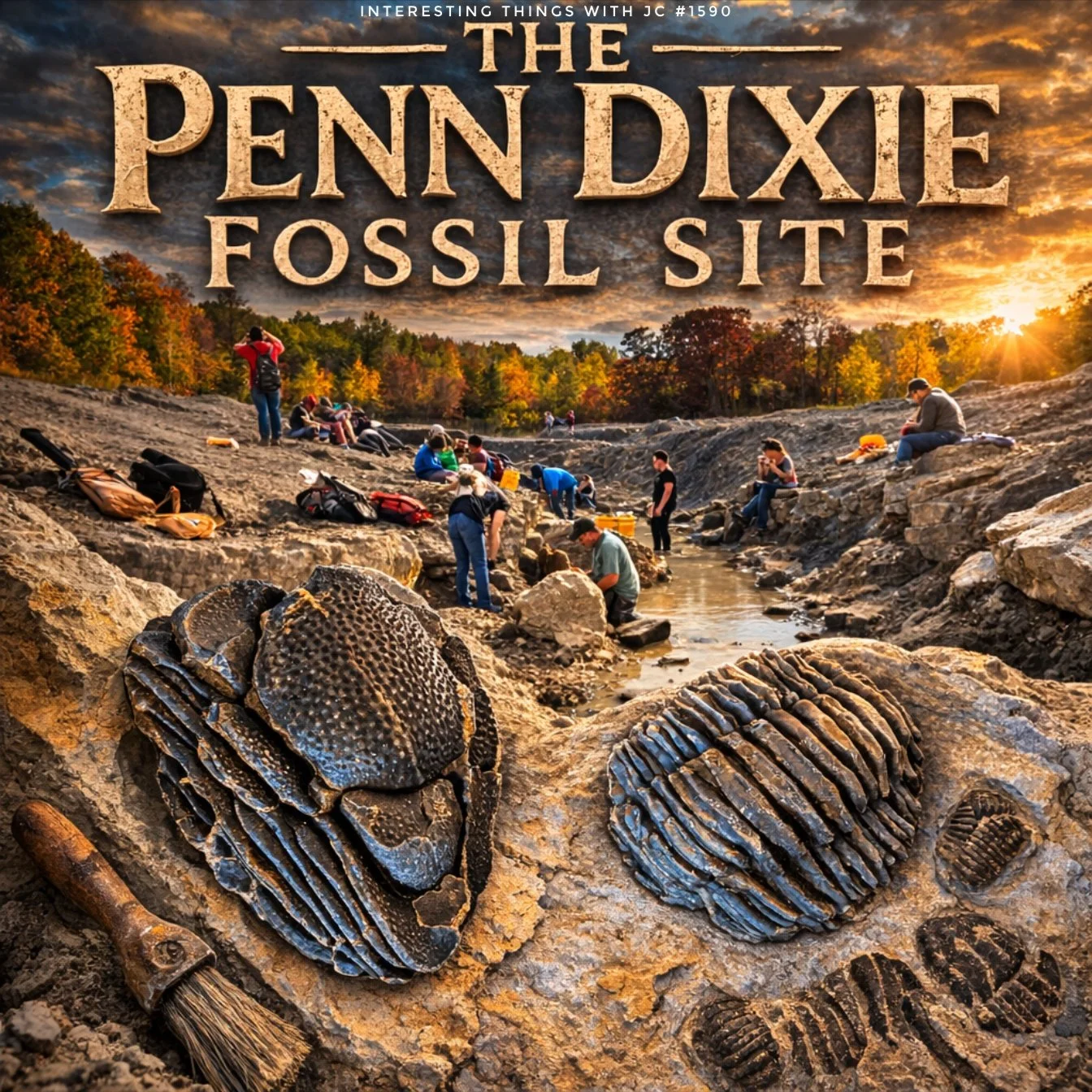
Interesting Things with JC #1590: "The Penn Dixie Fossil Site" – In western New York, families split open shale and touch a vanished sea nearly 380 million years old. Beneath an old quarry floor, the Devonian still waits...silent, buried, and full of creatures that never saw the world to come.
Get every episode summarized
Each time Interesting Things with JC publishes, we email you a written briefing from the transcript — the topics, who appeared, and any specific claims, with the ad reads skipped.
Email me new episodesFree for 3 shows. No card needed.
Hosts & guests
Transcript ready
35 searchable segments. Every word is indexed and playable.
Full transcript
Interesting Things with JC — 1590: "The Penn Dixie Fossil Site". Machine-transcribed; use the interactive transcript above to jump the player to any line.
Penn Dixie, Fossil Park, it sits in Hamburg, New York, about 12 miles or 19 kilometers, south of Buffalo near Lake Geary. Today, it's a public fossil site covering about 54 acres, roughly 2.3 million square feet, or 22 hectares. Families come here with small hammers to split open pieces of shale, and sometimes those rocks they reveal creatures that lived 380 million years ago. Fossils from the middle Devonian period, about 380 million years old lie inside those rocks, long before Lake Geary or the Ice Age, lakes like Lake Warren existed. At the time, Western New York, labenitha shallow inland sea, that filled the Appalachian Basin. Marine animals lived all across the sea floor, where towns and highways now stand. Trilobites such as El Dredjops, Raina, they crawled along the bottom.
Rockupods opened and closed their shells in the currents. Crenoids and corals, they grew along parts of the seabed. This marine ecosystem thrived shortly before one of Earth's major extinction events. By the end of the Devonian period, roughly 75% of marine species would disappear during what scientists call the late Devonian extinction. When those animals died, their shells settled into mud on the seafloor. More sediment buried those layers over millions of years, slowly hardening the mud into shale, and preserving the shapes of those animals inside. Many trilobites here are found remarkably intact, because fine seafloor mud buried them very quickly, sealing them away from oxygen and scavengers. Those rock layers eventually became part of the bedrock of western New York. Hundreds of millions of years later, people began cutting into those rocks. The land operated
as the Bayview Quarry later owned by the Pendixi cement corporation, from the early 20th century until mining stopped in the late 1960s. Workers blasted and removed rock, and they used it in cement and steel production. As the quarry deepened, the digging cut directly into the ancient seabed and exposed one of the richest Devonian fossil beds in all of North America. Mining stopped in the late 1960s leaving the fossil layers exposed. In the early 1970s, fossil collectors and paleontologists began visiting the abandoned quarry. One of the people who helped spread word about the site was fossil enthusiast Dan Cooper. By 1990 local residents and scientists, they realized the site could easily disappear to development, so the community stepped in. In 1993, the Hamburg Natural History Society formed to protect the quarry. In 1995, the town of Hamburg purchased the property,
and in 1996, about 32.5 acres, roughly 131,500 square meters, were transferred to the society. The protected area has since expanded to about 54 acres. A mission is quite modest, typically in the midteens for adults with discounts for seniors, military members, students and children. The park generally operates easily from spring through fall. Today, anyone can walk onto the old quarry floor, split open the shale, and see marine life from a sea that covered western New York nearly 400 million years ago. These are interesting things with J.C.
More episodes
More from Interesting Things with JC

1775: "The Signal Einstein Thought We Might Never Hear"
Interesting Things with JC

1774: "Uncle Sam Day"
Interesting Things with JC

1773: "The Clock Behind Instant Replay"
Interesting Things with JC

1772: "Staten Island Remembers"
Interesting Things with JC