About this episode
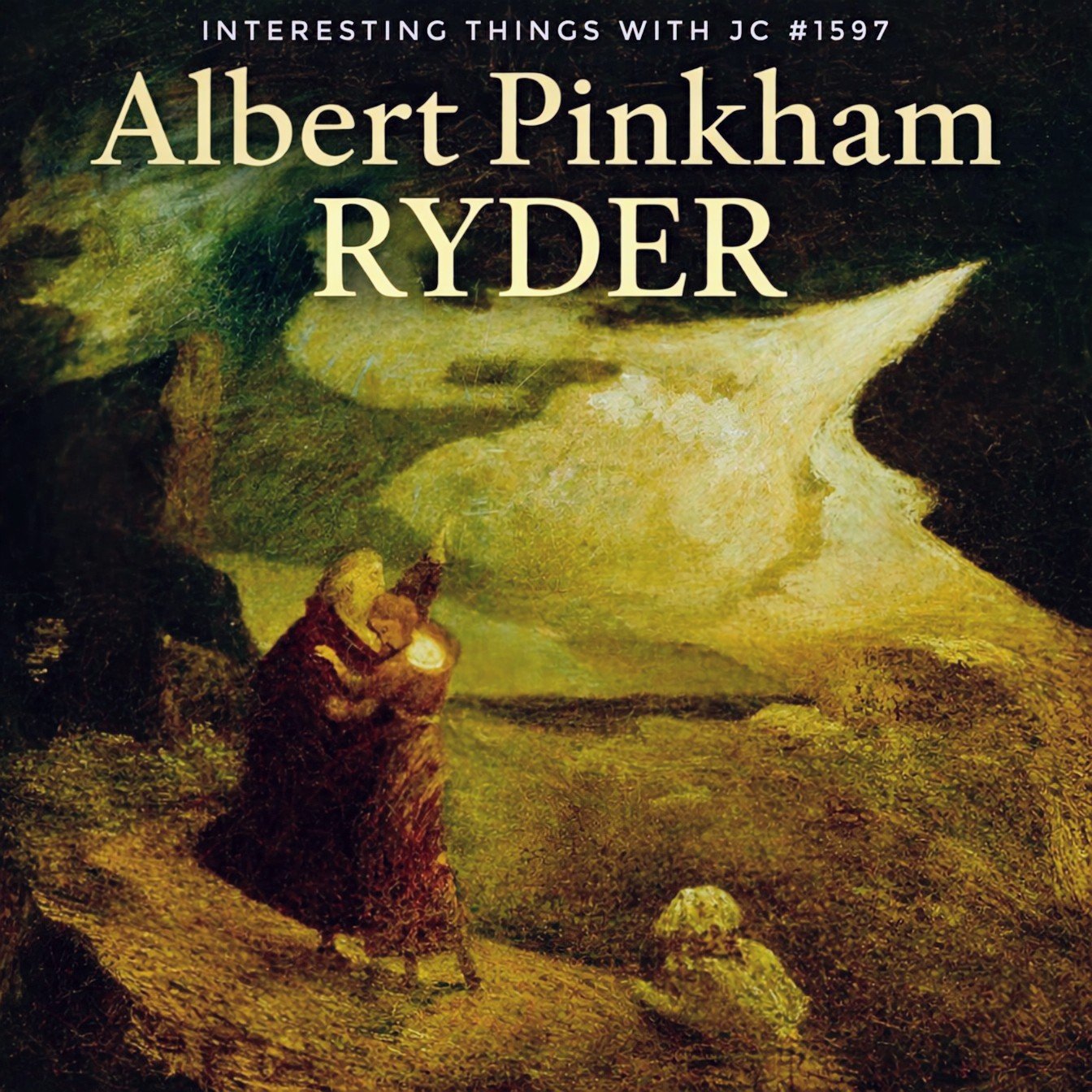
Interesting Things with JC #1597: "Albert Pinkham Ryder" – He spent more than twenty years on a single painting, building it up until it started to crack under its own weight. While others aimed for clean and finished, Ryder let the surface carry the struggle.
Get every episode summarized
Each time Interesting Things with JC publishes, we email you a written briefing from the transcript — the topics, who appeared, and any specific claims, with the ad reads skipped.
Email me new episodesFree for 3 shows. No card needed.
Hosts & guests

Transcript ready
53 searchable segments. Every word is indexed and playable.
Full transcript
Interesting Things with JC — 1597: "Albert Pinkham Ryder". Machine-transcribed; use the interactive transcript above to jump the player to any line.
A man spends decades on a single painting, not something huge, not something meant to grab you from across the room. A canvas about 27 and 3 quarters by 35 inches, around 70.5 by 88.9 centimeters, small enough so that you have to step in close, almost within arm's reach, to really see and feel what's going on in the surface. Albert Pinkham Rider, who was born in 1847 in New Bevver, Massachusetts, by the 1800s, he was in New York, and people knew that he worked different. Most painters worked fast, finished the piece, sell it, move on, but a rider worked at his own pace. If something did not feel right, he kept going back to it, days, months, years.
One of those paintings was the Tempest. It pulls from Shakespeare, mainly act one, scene two. You've got Prospero Miranda out on a rocky shore, a storm breaking around them. In Rider's version, they're small against it, a lantern, a gesture upward, and everything else's sky and water coming apart. He started the painting in 1892 and kept working it through the 1910s, reworking it heavily between 1896 and 1918. More than 20 years on the same canvas, he built in layers. Oil paint went down first, and then he waited, sometimes weeks, sometimes longer. And then back in again, he added varnish, resin, wax. The surface got thicker. In some areas, the paint rises up in the ridges that you could see from the side.
And in others, it sank and pulled apart. He scraped parts down and repainted them, and at one point he took a hot poker and dragged it through the thickest part of the sky to get the texture that he wanted. The whole thing kept shifting. The paintings started to break while he was still working on it. Cracks spread across the surface, some fine-like airlines, others wider, cutting through layers that never fully set. Most of it darkened more than he likely expected, and that kind of breakdown. It shows up across a lot of his work. It came from how he built his paintings, wet layers, heavy mixtures, pushing the material past what it was meant to do. By normal standards, that means something went wrong. He kept going anyway. He wasn't trying to make something clean.
He was trying to make something feel right. And he was willing to accept the damage if it got him closer to that. Today the Tempest hangs in the Detroit Institute of Arts. You can see it all, the uneven surface, the raised ridges, the cracked sections that catch light differently, depending on where you stand. It doesn't look preserved. It looks like it's been through something. And that's what brings it back to that small canvas that you had to step in close to sea. Most things done fast, they look good for a while, smooth, clean, easy. The work that stays with you usually takes longer than you planned. And it rarely ever comes out perfect. You can often see the time put into it if you look close enough.
Rider, he understood that trade off. And he stayed with it until the painting carried that story on its own. These are interesting things. With JC.
More episodes
More from Interesting Things with JC

1770: "When a Parasite Rewires Behavior to Spread Itself"
Interesting Things with JC

1769: "Football Brain Injury Cover Up"
Interesting Things with JC

1768: "The Science of Jealousy"
Interesting Things with JC

1767: "The Spider-Man of Paris"
Interesting Things with JC