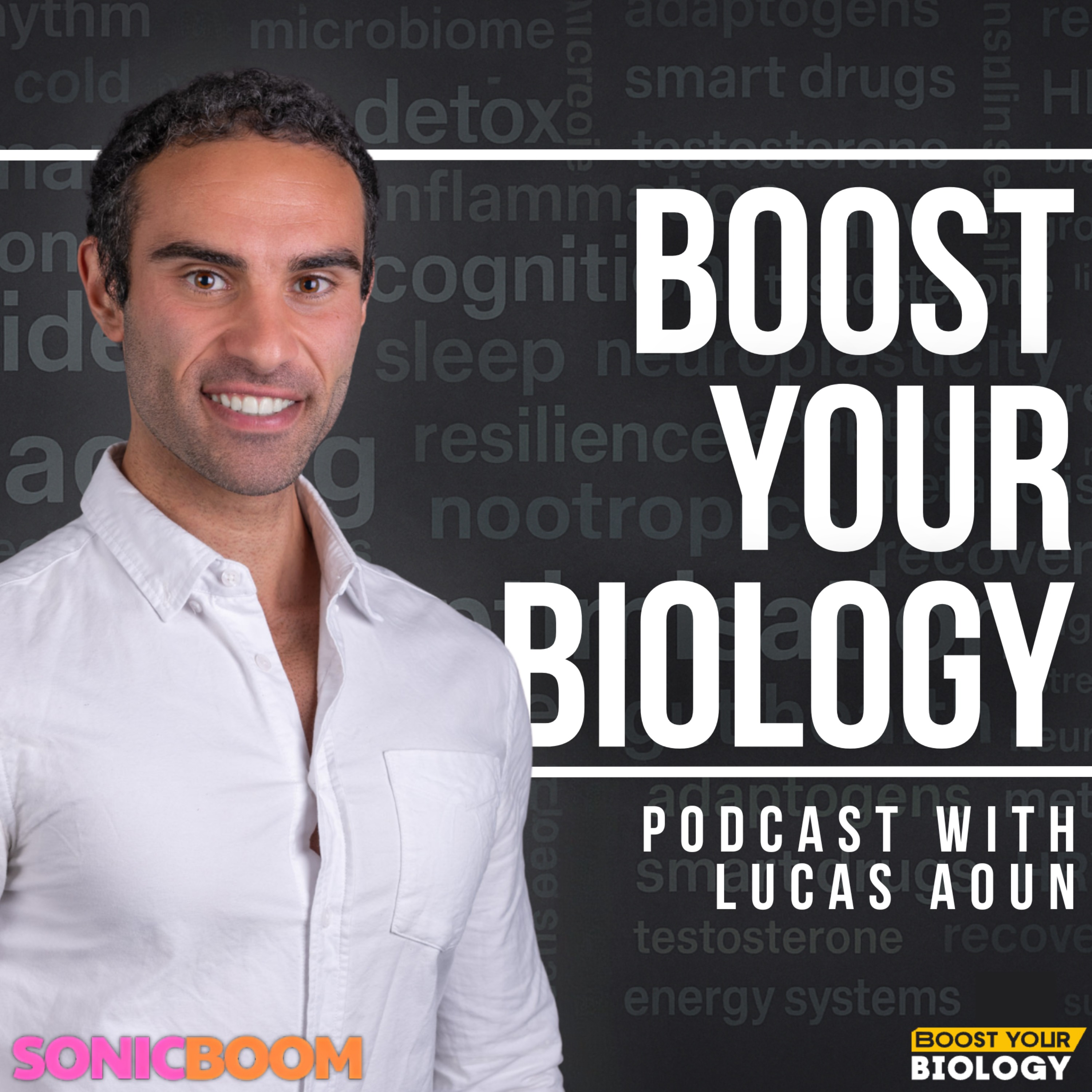
368. DHT, Testosterone & What Makes Men MASCULINE
About this episode
In this episode, Dr. Dave Lee shares his expert insights on optimizing thyroid health, the role of DHT and testosterone, and the impact of lifestyle factors on hormonal balance. Perfect for men seeking to understand and improve their hormonal health naturally and through targeted therapies
The information provided in this podcast episode is for entertainment purposes and is NOT MEDICAL ADVICE. The products presented and discussed in this podcast are explicitly only relevant to those who reside in the US. The statements and discussions held within this episode, are NOT approved by the TGA. If you have any questions about your health, contact a medical professional. This content is strictly the opinions of Lucas Aoun and is for informational and entertainment purposes only. It is not intended to provide medical advice or to take the place of medical advice or treatment from a personal physician. All viewers of this content are advised to consult with their doctors or qualified health professionals regarding specific health questions. Neither Lucas Aoun nor the publisher of this content takes responsibility for possible health consequences of any person or persons reading or following the information in this content. All consumers of this content especially taking prescription or over-the-counter medications should consult their physician before beginning any nutritional, supplement or lifestyle program.
Hosted on Acast. See acast.com/privacy for more information.
Get every episode summarized
Each time Boost Your Biology with Lucas Aoun publishes, we email you a written briefing from the transcript — the topics, who appeared, and any specific claims, with the ad reads skipped.
Email me new episodesFree for 3 shows. No card needed.
Hosts & guests
Transcript ready
621 searchable segments. Every word is indexed and playable.
Full transcript
Boost Your Biology with Lucas Aoun — 368. DHT, Testosterone & What Makes Men MASCULINE. Machine-transcribed; use the interactive transcript above to jump the player to any line.
Most women have been there. Something feels off. You don't feel like yourself. Yet your doctor says everything looks fine. Spoiler, it's your hormones. Midi is a virtual care platform built for women by women and offers specialized hormone care from trained clinicians. Plus, it's covered by most major insurances. Getting started is easy. You can book your first visit with a clinician right away. It's not you. It's your hormones. Visit joinmiddi.com to book your first visit. That's join midi.com. Insurance coverage varies. Check with your plan for coverage. Whatever bike you're looking for from mountains to road, either pedal powered or electric, we've got what you want ready for super fast delivery. Quality gear at prices you won't find in your average bike shop. Bikes on line.com. Ride more for less. The information provided in this podcast episode is for entertainment purposes and is not medical advice. If you have any questions about your health, contact a medical professional. This content is strictly the opinions of Lucas Owen and is for informational and entertainment
purposes only. The references, claims and scientific information linked to any products are only applicable to those listeners who are based in the US. If you are outside the US, this information does not apply to you. It is not intended to provide medical advice or to take the place of medical advice or treatment from a personal physician. All viewers of this content are advised to consult with their doctors or qualified health professionals regarding specific health questions. Thank you for listening to the Boost Your Biology podcast. My name is Lucas Owen. I uncover the most cutting-edge health information on the planet, ranging from hormones, nutrition, supplementation, fat loss, fire hacking, longevity, wellness and a whole lot more. Welcome to the Boost Your Biology podcast. What is up ladies and gentlemen and welcome back to the Boost Your Biology podcast.
I'm your host Lucas Owen and today we have a special guest in the studio who's actually on for round three. We have Dave Lee. Dave, welcome to the podcast man. Thank you for having me back once again. I think it's been a while since number two. Well man, you're a wealth of knowledge and I'm constantly getting messages from even my own clients telling me how awesome your perspective is on health and what you have to share. So I really do, I really respect what you're what you're preaching. But for my, for the new listeners, I've obviously built up the podcast quite a lot since we last spoke. Just share with him a little bit about your, I guess your perspective on health these days and what you try and prioritize and your main mission. Yeah, that's a good question. Hey, I think we have one of the reasons why we've always probably had a bit of alignment with our philosophies is
that I think that we are both based in what we would call the bio energetic approach as a foundation of looking at health. I think that can be interpreted in a lot of different directions. But what I've found personally is that it, that tends to be the kind of the point that everyone converges to when you work with people for a long time and you're in the field for a long time and you see what works and what doesn't. A lot of it comes down to that approach of essentially that the human body is a interconnected series of systems that is also a sentient being that has willpower, which makes it way more complicated than a robot. So I look at it like human engineering and I think it's very important that everything is seen in an interconnected fashion and ultimately we are wanting to optimize the body to be able to be more efficient and effective at burning energy. I think that's what creates optimal health. And I guess my niche or my area of interest and focus is primarily how the endocrine system acts as a marionette kind of like a puppet master
for a lot of the systems that we are trying to modulate to get the outcome that we want to achieve. So I'm a little bit more rooted in the hormone side of things, but as a result of getting people the outcomes that they're hoping to achieve, it's expanded out into a lot of areas that are adjacent to that. But holistic health without the stigma attached to the word holistic is probably what I would be focusing on. Yeah, yeah. I know you and I see eye to eye on so many different aspects around health optimization. Let's sort of dive into, you mentioned some of the aspects around ensuring the body is efficient and effective at actually burning energy and utilizing energy. So let's maybe talk about some of those prerequisites. I know you focus heavily on test austro animal. We'll get to that shortly, but I actually would love to start with thyroid, because you've created some really important content around the importance of thyroid. And every second day I'm having conversations with guys telling them your thyroid is actually
what's determining your energy, not your testosterone. So do you want to sort of elaborate on that? Yeah, thyroid and liver are the two things that I never really had that much intention on getting into when I was first getting into like near the TRT sphere. But they ended up both being integral because they were the things that were bottlenecking progress or were driving symptoms and side effects. And especially moving over to Europe and living in a country now that's basically Game of Thrones north of the wall for half of the year and working with a lot of people from cold at darker countries, I saw a lot more thyroid dysfunction, which was interesting. I do think that being vitamin D deficient during development or even maternally deficient in vitamin D does play a role in the development of hashi motors as well. But I've really spent a lot of time and effort recently educating on thyroid because when I was putting together my thyroid masterclass, I really only did it because I was like, this information is not available. I don't have a resource that I can send to patients and clients that will allow them to kind of wrap their
head around what's going on. And when I was recording it and writing the slides, I'm like, this is so much more complicated than TRT because I guess the advantage of thyroid therapy is that you're not suppressing natural production, you're adding on top of it. Like if we could do that with TRT, that would be wonderful. But you're now giving a static exogenous dose on top of a volatile, fluctuating, and dodging a system wanting to optimize it. So it's like dealing with a very broken thermostat in a lot of aspects. The thing that I've found that's been mind-blowing is how many people have, I picked up, undiagnosed low-grade hashi motors in. And this has been a lot of the time the reason why they're getting the side effects on TRT, but also just the reason why they have what I would call like minor depressive disorder or issues with anxiety, issues with focus and attention, but issues with sleep, thermal dysregulation, not just being cold, but sweating inappropriately, all of these things. And I'd be very happy to run your listeners through how I've
been picking this up because I believe, and I'm sure you'd agree when I go through it, that it's very methodical and objective and makes sense, but it allows people to actually do their own investigations so that they can have the information to go to someone to get treatment, rather than expecting someone else to pick up something that they might not even know how to do. Well, that's what I'd love to dive into that Dave, because some of the metrics and I guess proxies that I'll use to assess thyroid function is oftentimes I am focusing heavy on blood work, but I know there are other means of actually assessing thyroid function, but like how much attention and how much emphasis are you placing on making sure TSHT4, T3, reverse T3, how much emphasis are you placing on making sure they are absolutely optimal? Tons, assuming that the the client or patient doesn't have a pituitary like defect, because if you have a defect in the pituitary gland, which is
relatively rare in the scheme of things, but it does come up, that means that the TSHT3 feedback loop is not going to function properly, so that kind of puts that out the window. And if someone's had a thyroid ectomy as well, then obviously that system's not going to work well, but in most cases, like people say, oh, TSHT3, not that important, it's about symptoms, and I'd be saying, well, if you actually know how to read the plug work properly, it's actually extremely important, because assuming that feedback loop is working, we can actually get feedback from the body to actually say, is the body demanding more thyroid at the receptor level, or have we overshot it and gone past the ceiling? You can't do that with TRT, there's a very broad range that people can be optimized in, and it's very difficult to pinpoint where that is, but with thyroid, you get a lot more feedback, and if you can also work in the old school approach of using waking temperatures, waking temperatures can be very useful, because other things can cause waking temperatures to be low, but nothing other than optimal thyroid function can cause waking
temperatures to be optimal, so it can be a really nice adjunct to the plug work, but I'd still look at it as like an objective biometric. I think that TSHT3 become more important when we're dialing in exogenous thyroid therapy, because if you get like five TSHT3T4 panels in a row each day, they're going to fluctuate quite a bit, but the thing that I think gets overlooked and doesn't get put in the scheme of things, like I've seen a ton of Hashimoto's that has required a decent amount of exogenous thyroid hormone, when the baseline TSH is like 1.5, 1.6, 3T3 is in the top quarter of the range, and if you're only running those markers, they, that looks like it would be good, but the problem that we have, and this is the big macro kind of point, is that the reference ranges for anti-thyroid globulon and anti-thyroid peroxidase, sometimes you'll get a reference range based on a diagnostic, sometimes you'll get a reference range based on the average people with Hashimoto's. So sometimes you can have a number that would be four times the top of the range in one
lab test, and in the bottom quarter of the range in the other test, and if people don't know the meaning of what they're looking at, you can have Hashimoto's be tested for identified on paper and completely disregard it, and I bring ultrasounds into that as well. I do a lot of thyroid ultrasounding to confirm this. Interesting. I would love to understand your perspective on how much of an influence do you think nutrition has on actually altering some of these thyroid numbers? For example, guys that are on a generally very low carbohydrate diet, are you actually seeing that impact their thyroid numbers in particular? So this is the part that if humans with robots, things would be way easier. Because yeah, you know that very well. The problem that we have is that if someone's hypothyroid, I'm not talking about eating a burger and fries or a pizza that will make anyone feel a bit fatigued, but let's say if we're looking at beef mince and rice or a chicken
and rice or like a lean protein and carbs or a meal, if your hypothyroid, because the thyroid is primarily the governing engine for glucose metabolism, that's still going to make you lethargic and sleepy. So as a way of self-medicating this, you're probably more going to be aligned towards a low carbohydrate structured diet, because you're going to go, oh, well carbs make me feel shit, so I'm going to avoid them. And you think that the low carb or keto or fasting approach is giving you more energy, but it's actually up regulating a journal in production, which is a good short term mechanism for getting stuff done. But in the long term, it's actually becoming a vicious cycle. And there's a lot of vicious cycles people get into. So yeah, I do see that when this is prolonged, we do get further down regulation of thyroid production, more up regulation of reverse T3, and this is when you can get these patterns on the labs where you get high TSH, high T3, which is also suggesting some receptor resistance as well. And it's very difficult to optimize the end
outcome of thyroid therapy if people don't become comfortable with reintroducing carbohydrates, especially if they're athletic, optimizing things like magnesium, environment D. But it's nice, because when you fix the thyroid, all of a sudden you eat carbohydrates and you actually get energy from them, you don't just feel like taking it out. I want to use my dad as a bit of a case study. He's actually been a bit of a tricky one to really optimize with his thyroid. So he's had very low TSH all these years, like I think 0.7 to 0.7 to 1. So it's reasonably low. His T3 levels have always been medium, like average, just, you know, like I think it's 4.8 with our reference range here. But then his T4 is always really high, like 25, 30. In that case, like what would you, how would you approach that? That's definitely an A to B1, because that high of a T4 is interesting,
right? And that would suggest to me that the thyroid's doing a pretty good job at making T4, which it primarily makes. It's interesting that if there's like one thing that can be going on, which I do think can get pathologized when it's not a pathology, is that some people just have really good thyroid receptor genes. So they don't need a huge amount of T3 to be able to efficiently activate the receptor and then give feedback to TSH to basically say, it's kind of like the glass being full and you're just kind of keeping it topped up to keep it full. It's like, okay, that's working really well. And you know, potentially he may have some inefficient conversion of T4 to T3 that he's still getting away with. So in those cases, if I wanted to look into that, like I'm I'm a big fan of just doing all the testing required at once so that we can get a picture of what's going on. So if we look at thyroid problems, when we ultrasound the thyroid, we can, and also running antibodies as well, that can show us if there's a primary issue with the thyroid. If we
MRI the pituitary, we can see if there is an issue signaling the thyroid. And if we ultrasound the liver, we can see if there's an issue with the primary location of T4 to T3 conversion. And if there's no issues with any of those plus antibodies, I'd be saying, well, it is a bit older, maybe the T4 to T3 conversion isn't as efficient as it was, but you might not have an issue. And that's where I like bring the waking temperatures in because if he's waking up at like, you know, close to 97.8 or above Fahrenheit, that to me is suggesting that it's likely a non-issue. But that's definitely an A to pick a one, but I just like to look at all those metrics and diagnostics. And I think it's also very difficult to treat family objectively because you're emotionally attached. It kind of gives you a hundred percent. A hundred percent. That's a really, I'm glad you brought that up because that's a, I hear it time and time again. It's like, it's like there's a gene encoded in our DNA where it's like if family members give feedback or advice around health is like this, it sort of doesn't, it's kind of like actually, I'm going to
share this publicly with my supplement brand, you know, in before I've got peak T released and I've got Tudkur and Katwaba. That's been built by my brother and I and numerous times we've budded heads, you know, we've clashed in terms of opinions on things. Generally speaking, I'm a really fast mover and I move quickly with things. My brother's the opposite. Like he's very perfectionist and meticulous. And it's like when he gives me feedback about what to do in the business, versus if you were to tell me the same thing, it's for some reason I'm accepting what you say to a different level to what James is saying to me. And I think there's definitely a, he's an older brother situation. It's like older brother, younger brother. There's definitely something to that. You know? Yeah, it's a big one. It's also one of the reasons I weren't, I don't really treat my wife or all my parents. I bring your colleagues into, I mean,
I sit in the consults and weigh in, but I let them take the lead because it's, there's absolutely things as well in terms of like, you know, you get triggered by things very easily when it's coming from family versus when it's coming from people that you don't have an emotional connection to, but it's also very difficult to be objective when there's an emotional connection to anything. And I think that objectivity in this field is extremely important. And yeah, it's one of the, one of the many challenges that the people that we care about the most, we have the most trouble helping and also receiving help from as well. It's quite interesting. Yeah. Let's go a little bit deeper on the interventions that you'll sort of deploy. And some of your favorite sort of suggestions and strategies to really keep thyroid hormones optimized for the average guy. Let's say he doesn't, doesn't need to go down the route of actual thyroid replacement therapy. Like what are you advising or suggesting to really keep thyroid hormones like optimal? Yeah. So the first thing I would, I would recommend for people is to look at your antibodies and
to do an ultrasound if there's any presence of antibodies whatsoever. The reason for that is that if you do have a degree of Hashimoto's and tissue damage to the thyroid, it is not going to be possible for you to be able to optimize it naturally. And I think that that's a, it's very good to rule out the pathology before you go down the natural optimization route. Otherwise, you're just wasting your time. And the thing that's very useful is if you have any presence of ATPO or ATG antibodies that are above undetectable because they should be zero, maybe one or two for like a clip on the radar. The question is being like, well, are those antibodies actually consequential against the thyroid? Like have they actually damaged the tissue or are they just too low and we don't need to worry about it? You could ultrasound the thyroid to see if there's been tissue damage. So if there's swelling or if there's coarseness of the tissue in the thyroid or if there are nodules present on the thyroid, it suggests that that has been consequential
and therefore there has been some tissue damage. So I think it's the first step of optimizing naturally is making sure that you can optimize it naturally. The typical like paratid conventional supplementation advice is like selenium iodine and like maybe tyrosine is number three. And I've said this before publicly for a number of years and I've also spoken to a lot of people who've been looking at these supplements. I've never seen this solve anything because if you're deficient in them, they will absolutely be a bottleneck for sure. But if we push these up past a certain point, they're not acting as like linear induces of optimal thyroid function. Like if you're building me a house and you're a bricky and you're building it at a certain speed, if I drop off more bricks at the house, it's not going to make you build it faster because that's not the bottleneck. So I haven't seen those help but a good quality multivitamin as a foundation
that includes those is going to be the best place to start because micronutrient deficiencies the foundation of a lot of issues because if your body doesn't have the nutrients and cofactors it needs, it will pull them from your own stores. That's going to be a stress-driven process which isn't good for the thyroid. So a good quality multivitamin foundation is the king for this. I've always recommended the thorn basic nutrients. I've just seen they've been acquired and maybe the quality might not stand up. We'll see but I've also seen our mutual friend Memo at Mara Kelt has put together a wicked multivitamin. So I think that's probably going to take the crown spot there. But the nutrients that I see make the most difference supplement wise vitamin D and magnesium. And the lifestyle factors that I think are the most important, I think sunlight's the king and the healthy circadian rhythm. So I grew up in a punk rock band and loving rebelling against authority. So it really hurts me to tell people go to bed and get up at the same
time every day. I feel like it's such a fucking sell out. But that's a real big one. Getting outdoor sun exposure and just having what we would just consider healthy lifestyle practices because it's if we're not living in alignment with the outcomes that we're hoping to achieve from just a holistic human perspective, the system's not going to work optimally. It might have when you were younger and you got away with it. But I really believe that a lot of the things that are holding people are back are generally things that they know they need to fix and they aren't realizing the connection between the two. So general good lifestyle practices, sleep hydration, good nutrition, getting sunlight, and then making sure you've got enough vitamin D and magnesium. And then managing cortisol and stress. That's the biggest impact for having issues with T3 receptor sensitivity as well as messing up the conversion of T4 to T3. And if you've got anything,
objectively wrong with your liver, like fatty liver disease or if you've got problems with insulin resistance, it's such a vicious cycle man because once you become overweight and you become insulin resistant, it makes your thyroid function worse, which makes your weight gain problem worse. And it's kind of like the further you are off track, the further you fall off track in the process. And the further you are off track, the harder it is to get back on track. It's quite tricky. So just maintaining good healthy principles long-jome is really going to be the key factor there. And what's ironic with a lot of those principles like to achieve that optimal state of health at the same time, for let's say a guy that's trying to actually become more fertile, let's say he's trying to really optimize fertility, I'd imagine you'd be just rephrasing like repeating the same strategies and health suggestions, right? Because like a lot of guys when they come to meta, obviously looking at, they want to boost up their sperm count, motility and all that sort of stuff.
What I say to them is like, it's in order to become more fertile, yeah, we can bring in the co-enzyme Q10, we can supercharge your mitochondria, say your sperm cells are super vibrant. But it's ultimately getting in shape, being healthy, just ticking off the boring shit. So all the boring stuff getting to bed early, eating clean, avoiding microplastics. But I want to go back to what you mentioned about vitamin D because I'm not sure if you've sort of looked into, there is a group of individuals in the medical field that are really like pro vitamin D and I'm a big fan of high dose vitamin D myself. Have you seen clients clinically presenting with issues from over doing the vitamin D supplements? Never, never seen it. When I was at Silverback last year, one of my favorite things for this conference that my friend Ali Gilbert puts on is I get to hang out with Dr. Eric Serrano, who was one of the... He's a mania. He is one of the funniest people to be
around and also amazing. I gave a clinical workshop on like Nuon's T3 protocols and proper correction of prolactinomas and treating metabolic disease on TRT. And I'm giving this seminar to a room for the doctors and Eric's just sitting in the room just looking straight at me. And I'm like, this is the most intimidating thing to be presenting to doctors on. And I'm presenting to like the fucking guru, but getting feedback from him positively is absolutely been probably one of the biggest honors in my career. But when we were on stage talking about vitamin D on a panel, you know, when I referred to like 10 to 20,000 as high dose, he just scoffed and he was like 50 to 100,000 is high dose. And I hadn't looked into like... I'm probably pronouncing a wrong that coinbra protocol or I'm not sure how to pronounce it. But there is a protocol for auto-immunity, which is based on, yeah, mega-dosing vitamin D, 50 to 100,000 units. And you know, I asked him,
I was like, you know, what outcomes do you see from that that are negative and problematic? And he said, none, you know, autoimmune disease goes into remission. He's like, if that's a negative. But yeah, I, you know, being over here as well and you know, the interesting thing about Australia, and I'm sure you've seen this as well is people would think that Australians are the last people to have a vitamin D deficiency. But it's very difficult to get enough vitamin D from the Australian sun unless you're on indigenous Aboriginal because the sun is so harsh. Whereas over here, like so where peak summer and Lithuania at the moment, I can go out in the sun for hours and not burn because it's gentle and it's soft. And because we're in the dark for six months of the year, you know, it makes sense why all the the old Baltic religions and like the pagan gods were based around the sun because they would worship the sun in the summer because they knew how important it was to get all this sunlight. So I've seen vitamin D deficiencies be rampant in sunny countries, dark countries. It's the worst in the UK because I think they have an indoor culture and a lot of
darkness. But I think that like, and I've been saying this for a while and people might push back, but I think the RDA was a miscalculation and it's been recalculated in the recent years that they needed to add a zero. But I don't think 5,000 units of vitamin D requires a blood test. I would say that that should just be baseline. And for most people to correct a deficiency and get a good outcome, 10,000 daily long term tends to be good. 20,000 can be front loaded a bit if people really need to bring it out of the gutter. But I've I've never seen a problem with it. What I do see is people get a much better response to TRT. And if people have vitamin D deficient and they're taking exogenous thyroid supplement like like you're now to desiccated thyroid T3T4, whatever they don't get a good outcome or they don't get the results quickly in terms of rectifying their hypothyroidism unless they correct the vitamin D deficiency at the same time. Super fascinating because I've spoken to like I've had a look at a lot of blood test results over the years and I did see a guy come back and
his vitamin D was I think 200 and I was 185. So it was like it was a little bit elevated. I think ours goes up to 150. And so he was a little bit elevated but he had no he was he was really concerned and I'm like you don't need to be too concerned. You don't really present you're not presenting with many symptoms or of vitamin D toxicity which which might be calcium related to dysfunction handling maybe muscle twitches, muscle spasms, maybe few issues with sleep or you know that sort of stuff but really fascinating what you said about responsiveness to hormones, exogenous hormones. Why do you think that vitamin D can unlock the benefits of something like TRT for example? Because it positively modulates the anagen receptor. And I think this gets this is a like a really good kind of segue kind of peripheral point to a lot of the problems that we have with Zenoestrogens
are that they are very strong potent agonist that the alpha estrogen receptor but they also cause it to multiply. And as a downstream effect in some tissues they can then upregulate aromitase as well. So we're having a situation where and the other thing that these Zenoestrogens especially BPA is that they come into the anagen receptor and they they have this very interesting function where they essentially bind with the pocket of the receptor meaning that they don't cause the effect of being an agonist to the anagen receptor. They basically block other things from coming in and agonizing it. So in inverse agonist I think that's what they call it. Essentially. Yeah. And it's a very it's very potent because it out competes DHT the fuckers. So it's very interesting what we're dealing with especially like this gets this problem gets worse the younger people get in society because we're looking at more multi generational you know impacts of these Zenoestrogens.
But you know I relate the hormone system a lot of the time to like an old school pinball machine in an arcade. You can have as many balls flying around that table as you want but you don't get any points unless they hit the bumpers. So hormones don't do anything until they activate the receptors. So if we're putting in a bunch of the hormone that we want to do stuff you know if we're putting in T3 it's going to be mediated based on the sensitivity of the T3 receptor. And if we're putting in a bunch of antigens it's going to be mediated by the sensitivity and the presence of the average of receptors. And what I've found in the research which is why like because I used to teach I used to teach drums in primary school and you're teaching a musical instrument to younger kids like you have to find a way to explain it to them in a way that it makes sense that they're going to action and do. And I don't see adults optimizing their health as you know four-year-olds but I also think it's important to say we're like what's what's action will what's going to be actionable here in terms of like you know positive modulation
of receptors in the body. And what I found mechanistically in terms of what upregulates these receptors or supports this process working is if you are going to take thyroid hormone or testosterone and this is why I love your works so much is you have to do all the stuff that would optimize your natural production if you weren't using these hormones because if you're living in a way that you would be making those levels if you could your body is going to be primed from a hormone metabolism and receptor sensitivity standpoint actually utilize these things. But if you put a bunch of testosterone a bunch of thyroid in someone whose body is naturally suppressing these levels if your body is a car your pump the body is pumping the brakes and you're coming in and going I'm smarter than you I'm going to pump the accelerator that's not going to give you a smooth ride you're going to get some benefit but some side effects as well. So this whole kind of approach I think is is really important to look at and the thing that's nice for people to wrap their head
around is being like okay I just need to get get lean be have good cardiovascular fitness eat well sleep well look after myself and then taking the hormones isn't a shortcut to not do that it's kind of locking you into this commitment to actually do it otherwise you're going to get side effects not benefits and I think if people understood that better before they pull the trigger they would look into the natural optimization pathways a bit more first because you're going to have to fucking do it anyways so that's where I think that's why I think there's such a synergy with your work and mind because the the principles that you talk about for optimizing these things naturally whether it's thyroid or testosterone you've got to do it anyway if you come to my side of the fence spot on man it's there's a there's a quote to my cousin uses and he speaks about it because he's actually a drummer by the way he's a he's a he's a full-time drummer and he's a drumming teacher and he he says either do the work in preparation or you do it in repair it applies it applies with hormones like either get your body primed before jumping in or you have to do it later on down the
track when you know that's why I mean the ultimate goal with any sort of therapies to like you want to maximize the effectiveness and the efficiency of whatever you're introducing to your body right I want to go back to the pinball analogy is really awesome I love that is do you have an analogy for my audience because when it relates to the differences between testosterone and DHT okay because I know you and I share a very similar viewpoint on the importance of DHT in men and I'm extremely against hair loss drugs you know very much against that do you have some sort of analogy that you can sort of explain the difference between testosterone and DHT for the guys listening yeah I'm fortunate enough for people watching the video that I've never experienced hair loss so I mean I can't comment on the hair loss drug side of them um no I actually was I was receding and thinning from like 16-17 both my grandfathers were bald but I was in a I was in an emo band and I was a singer at the time so I couldn't not have a fringe so I
used Monoxidil from like 17-24 typically and I don't think that messed me up but I don't know that it didn't um it's definitely the lesser evil though but yeah it's look DHT is um and I've got to really for people who want to hear the other side of this discussion I've got a debate I wouldn't call it a debate it was a friendly discussion but a friendly debate with the college of let yeah yeah um and I really enjoyed that conversation because he brought up a couple of nuances that like in the literature I was like fuck you know it kind of I definitely blew past me and he made a few good points but you know if people want to hear the other side I think he he's got a good perspective on it but he's one of my favorite people because we respectfully disagree on so much stuff but agree on on all the kind of foundational principles and um but look DHT is like DHT is super testosterone in terms of it is a much more powerful agonist of the receptor
so it's kind of like if testosterone's a pin I a ball and and the DHT is the pinball if both of those hit the receptor you get like 10 times more points from the DHT it's much stronger and when we look at hormone receptors you if you activate the hormone receptor with let's say testosterone DHT DHEA um maybe like NANDRALONE or like let's like tremble on you all these different compounds you're still going to get the effect of activating that receptor but the what's called the DNA transcription effects which is the downstream effects of that are going to be different they're going to cause a different outcome um you know an example is that you know LSD and serotonin both activate the same receptors in the brain very different outcome you know take acid or take zooloft you'll have a different day um so DHT DHT's DNA transcriptional effects are much more angriogenic now DHT still has some anabolic effects and testosterone still has some
angriogenic effects but when we you know when they talk about anabolic angriogenic steroids AES anabolic means to build tissue angriogenic means to masculinize so when we're the thing that's interesting when when guys are I've given a few speeches on this in the states when guys are wanting to go on TRT they're not just wanting to have a higher lab test for testosterone they're not or whether they want to optimize it naturally they're not just wanting to have more testosterone floating around typically they're wanting to be more masculine like that's that's kind of what they're looking for and then it's like well what does that mean and I think that masculinity is leadership that's kind of what I put it down to or the capacity for leadership which is resiliency distress and general overall resiliency bravery courage competence all of those things and the thing that's very interesting about DHT and Ian from Marick Health I can't pronounce Ian's last name otherwise I would um he just did a fantastic research article which had the hypothesis
which I think is very accurate about how when we look at the metabolites of DHT the alpha and beta metabolites they have extremely important neuro steroidal function and my favorite analogy for DHT is that it's like a healthy yagobon so back back when I was um you know doing music and you know 19 to 20 20 25 and partying everyone loved yagobons because it would be you're the drink you'd have at the bar that would lower your social inhibition but it would also give you a buzz and you need to make you want a party um not that DHT gives you a buzz and makes you want a party but it's something that is basically increasing the accelerator like the sugar and the caffeine and increasing the brakes like alcohol at the same time we've got something that is modulating the effects of cortisol we've got something that is positively modulating the garba a receptor so creating this resiliency distress but we've also got something that is modulating the dopamine and nor epinephrine
pathways as well and to me this basically gives the because my background was neuropsychiatry it kind of gives you this neurochemical push that is drive but also not inherent stoicism but the capacity for stoicism so being able to be driven being able to be competent being able to be cool calm and collected on distress but also wanting to push into those scenarios and I think that the inverse of that like lacking that or taking something to delete that is probably not going to be conducive to the outcomes that a lot of guys are wanting to achieve with their lives. Man I really I really like a sort of broke that down Dave um the way that I also like to to look at it is um because I've had a few guys who'd message me over the years you know trying to get me to justify the research behind how DHT is positively affecting mood because I've made a lot of
I have made a quite a few big claims in some of my content around you know the importance of DHT in helping a man with his mood state um but you mentioned something before around the fact that it's possibly some of them metabolites of DHT which I haven't really sort of I didn't even know there were um you're not referring to aloe pragnanolone in particular you're talking about other things right I'll I'll ask Ian to send you I would send it to myself but Ian hasn't had a peer reviewed yet so I'll ask him to send it to you himself but yeah I can't I can never pronounce them in terms of the the alpha and beta metabolites but yeah so aloe pragnanolone is the five alpha reduced for people who want to wear five alpha reduced metabolite of pragnanolone there's actually the metabolites of DHT that are primarily responsible for the neuro stereroidal effects of DHT and because I dropped out of neuropsychiatry masters because I was like hang on these drugs that we're
prescribing aren't conducive with how we want to modulate neurochemistry for depression if you look at if if if if you look up like Wikipedia and you look at these two DHT metabolites look at their pharmacological mechanisms of action in the brain you'd be like this is what every man needs to fix his mental health this is the pathway we want it's like the ultimate biohack utropic for the brain so yeah it's a DHT is so important for the foundational development of your character and I think a lot of mental health stuff comes from people may be being internally guilty or ashamed that they're not who they could be or that they feel like they're behind the eight ball or they're not reaching their potential and I think actually correcting the capacity to achieve those things is going to be better than just tricking the brain into thinking that you're doing better than you are one thing that I remember researching in the early days Dave was around how DHT can potentially offset elevations in estrogen do you have any sort of because I heard
there's some DHT related steroids that can actually not act as an aromatase inhibitor but do something like displacing estrogen from the receptors yeah what's the go there so I'm not sure if you've experimented with DHT L that you choose if you want to chime in on that if you have or haven't but I have like actual bioidentical DHT and the thing that's a shame and a lot of people have said the same thing is that it doesn't do what you'd think it would do like it it doesn't achieve the effect is this the the gel or injectable this was what would typically be in the gel but we get it made in like a 20% compounded cream so it's just more you know more more concentrated and what Kyle and I spoke about in that lecture is that it seems that because DHT like estradiol is predominantly made in the cell so it seems as though and this is you know again the importance of the work that you do people are like oh well I can just take DHT
know you actually need to upregulate your own production of DHT in the cell because that from just anecdotal experience as well that makes a hell of a difference in how you feel like topical testosterone cream which five alpha reduces into DHT has more of that subjective DHT style effect than taking exogenous DHT interestingly and that sorry just on that just on that for the guys with the topical testosterone cream if that's applied to the gonads from what I understand that's a more rapid way to to drum up DHT production so if you compare injectable versus topical testosterone you will get more exposure to the five alpha reductase enzyme anywhere on the body and the skin but you get way more on the scrotum because there is a higher expression of the five alpha reductase enzyme in that skin and the skin is also thinner so you get more into the blood stream at the same time you just have to make sure you're using a cream that's made to go on the scrotum
because a gel will burn and you will work it out very quickly that it's not a good idea so and this is one of the points I was talking about in that lecture I gave when Eric was in the room DHT has a very important regulatory and modulating effect on not just the estrogen receptor expression but also the expression of the arumate enzyme and vice versa as well they have balancing effects and when we look at all the problems that lead to excessive aromatization in men which is typically obesity alcohol consumption these also have a suppressive effect on five alpha reductase so you get this double whammy problem and this is these vicious cycles in the body are always present so a lot of the time guys are you know fixated on being like oh I'm over aromatizing it's like that's part of the problem but the other problem is you're under five alpha reducing and then the lack of the DHT is then making that problem even worse because now you
have more up regulation of the estrogen alpha receptors and then when we've also got a bunch of xenoestrogens coming in and acting on that receptor too we really need a robust amount of DHT in the male body in this day and age to still retain the masculine effects that we're looking for to combat all these environmental estrogens and the metabolic issues people are having as well hmm well let's sort of because from my experience day I mean every time whenever I'm doing blood work on myself I'm obviously I'm trying to keep my natural testosterone above 900 for me that's when I feel my best so 900 or 950 nanograms per desolate and I'm always checking obviously my DHT in my estrogen what's pretty ironic is that my both my DHT and estradiol are always running relatively high as well so but I've only recently have I noticed that my DHT is at an all-time
all-time high I don't have any plausible theories as to why that might be the case apart from training legs twice a week like hitting legs twice a week which male may not have a positive effect on DHT production there's been a slight increase in caffeine intake compared to other years and I'm pretty sure not sure if George you didn't go have spoke about caffeine having a positive effect on father of reductase I don't know if you've looked into that but for like the average guy like what would you and then also T3 as well because I know you mentioned that T3 helps with that upregulation of the whole steroidogenic cascade have I missed anything in particular you think it's important for men to really optimize the DHT so I think I think those are the key and as well as just not having micronutrient deficiencies and things like zinc as well is really important I always try to give um George you think of as much
credit where credit is due because his breakdowns of literature in a world where people just throw abstracts around is so refreshing and and so well done um so I think he's an amazing contributor to the scientific community and he's really outlined how those things are especially helpful it it seems as though when I look at it from a kind of top down perspective is that having an optimized and efficient energy metabolism to therefore make it so that the body can efficiently and effectively just be a human you know if your body is struggling to burn energy just to be alive and walk around and get up and downstairs the stress cascade which is consistently upregulated is very antagonistic towards by-bath reductase and it seems as though the human body really focuses on survival and like prioritizes reproduction a lot less when the body is in a stress state which which makes sense so those are are really going to be the the key ones in terms
of making sure that you have optimal thyroid function which I think is really dictated assuming you don't have an autoimmune condition by diet and lifestyle and then that insulin sensitivity and efficient process of stabilizing blood glucose and having optimal mitochondrial function seems to then allow the body to have the optimal resources and capacity to produce the the proper amount of five alpha reductase which can then produce the correct amount of DHT to have that hormone stabilizing effect I just think it is so easy in this day and age to fall off that path and stay off that path because when humans feel crappy we tend to do things that make us feel better in the short term because we're going to feel crappy in the long term anyway. Hmm, really good point actually. What about in terms of so with the DHT pathway the guys that
you're prescribing or the guy for the guys that you're advocating like for TRT how much of their symptom resolution do you think is coming from the actual bump in DHT versus the actual you know the number on testosterone for example. That's a good question. I think when we're looking at the subjective psychological effects which I would argue is what most people are focusing on which I think is very very understandable and that's very normal. I would say it's doing the lion's share of it. DHT is people can argue whether it's psychoactive or psychotropic meaning whether it's directly psychoactive or indirectly psychoactive but it definitely has a psychological impact and I would say that it is a massive, massive contributing factor if not the primary contributing factor for the psychological or subjective outcomes that people are trying to achieve on TRT and this is
why you know and during that lecture I gave if if anyone wants if you're not in my TRT academy if you send me an email us and you will link to the lecture if you want to watch it but the thing I talk about in that lecture is that one of the challenges that we have describing and treating men for hypogronatism is that you know if you have I'll use my friend Jay Campbell as an example of someone who doesn't fall into this category healthy athletic guy and he's published this story a lot I'm not divulging anything personal. Took a basketball to the testicles and needed TRT to replace the function that he previously had that is a very easy TRT treatment to do that's like if a sports car comes into the mechanic and the engine's not working and you put a new sports car engine in it and it drives out like it used to happy days. The problem is that most guys coming in for TRT are guys who've never had optimal testosterone levels before they've always had suppressed function and as a result they're not metabolically healthy they've got all the metabolic problems that you'd see in geriatric men and when you come in and put the testosterone in
it's not metabolizing into estrogen and DHT the way that it typically would in a healthy man and one of the ways around this without using pharmaceutical medications is to use the topical trans-scrottle testosterone cream because if you do this in someone with metabolic disease or liver problems like let's say you have someone who's obese, prediabetic when you put this testosterone in via the scrottle skin when you get more conversion to DHT and therefore antagonism of estrogen in the body you actually now replicate the hormonal ratio of a healthy man rather than an unhealthy man and what's interesting is that these guys will come back in after like three months or four months and I'll say you know how's everything going and they're like man I'm really sick of having to shave my balls to put this cream on and I'm going that's the only problem that you have is that you're sick of shaving your balls no, dino, no water retention, no emotional problems, no fatigue
like that's your only issue they're like yeah I want to swap to injections because I'm just sick of sick of shaving my balls I'm like no we've just performed fucking miracle work here this is incredible so that's it really goes to show that there is a very big difference in how these hormones metabolize and when even healthy men are wanting to get more of that subjective androgenic masculineizing effect of testosterone they will assuming they respond to the cream and they have a good cream that's compounded properly and it's a good concentration they tend to get more of that response with an equatable total testosterone level versus injections. Hmm Transitioning a little bit Dave I want to finish off with a little discussion around estrogen there's still an enormous amount of confusion around estridile estrogen but from your clinical experience I mean you've looked at literally probably thousands of
blood test results from numerous guys all across the world you've been doing that for many many years a few more likely to see guys have issues with estrogen being too high or estrogen being too low I have never seen a problem with estrogen being too low even when like some older guys when you put the Monte IT will have you know undetectable estrogen and you don't know if it's one point below the cutoff or if it's at zero right but below that kind of cutoff on the range which on peak or more per liter which we use in Australia reference ranges typically like 50 to 150 you know it will come back in you know less than 50 I have never seen problems here and when guys say that they're having low e2 side effects with these levels it's often coming from deficiencies in pregnant alone or DHEA and it's very common to have age related decline of DHEA DHEA is a weak estrogen agonist so I've and especially knowing that we have so much estrogenic stuff in the
environment or in our bodies I don't think lack of estrogen receptor activation in man is ever a problem unless you pharmaceuticaly inhibited and crush it the the high estrogen discussion is I think it's more nuanced than people would like it to be and I think it's become a little bit tribal and I I really see both sides of it because I really do agree that using aromatics inhibitors isn't the solution or at least shouldn't be the solution but I also see a whole bunch of guys coming in with really big problems that are clearly mediated via the estrogen receptor pathway but my belief is that and this is what I've found in practice as well is that a lot of the time there is sub-plinical hypothyroidism which people say that they have checked the thyroid properly but they have an ulcer sounded that they haven't picked up low-grade hashi motors and low and behold you put
in like two grains of NDT or you put in like 25 to 50 micrograms of slow release T3 and their TSH goes from like a 1.5 to a 0.8 like it barely even moves like they needed so much more T3 because their receptors weren't working that's a big factor in modulating the estrogen receptor, androgen receptor, five alpha reductase, aromatics all in the directions that we wanted to go or we're also seeing a lot of guys who who really have trouble swallowing the pill but you need to be under 15% body fat to be healthy as a man and if you're above that and you're taking the levels of a fit lean young guy it's not going to work out properly. So you know that they're big driving factors but at the same time it can't be ignored that there are younger men especially who were doing everything right they've got everything working for them and they have still got these feminine traits that seem to have a biological root but to me that seems to be coming very
strongly from the presence of these senile estrogens in the environment and I think we should be more focused on getting them out of the body rather than inhibiting the aromatics enzyme which may disproportionately lower it in the in the philium leading to you know cardiovascular issues. The problem though and this is where I'm always very open to hearing people advocate for aromatics inhibitors in low doses used responsibly is that I don't have the perfect answer for how to fix that problem and no one does. So I don't think aromatics inhibitors are a perfect or good solution but at the same time you know there's people like Ryan at Cortex Labs who will talk about you know these case studies that he has from people using aromatics inhibitors and getting good outcomes and I sit there going I want to hear about that like I don't want to say I don't want to say that's incorrect that's wrong you're doing I'm like I want to I want to know about that like how like show me the blood show me the cases like let's see it because at the end of the day we've
got so many young men who are dealing with these problems and side effects and I think it's great for us to say this isn't the solution but we have to be able to offer them something better and I think that that discussion is still something that needs a lot more research and understanding in terms of finding a path forward and it's my kind of main area of research at the moment. Yeah I'm going to do I'm going to do the listeners a bit of a favor here Dave in I'm just going to point them all towards your your YouTube channel it's a Dave Lee TRT if you guys want to look that at I'm Dave Lee I'm going to make sure to leave that link to the podcast show notes because you've got a few videos there I saw whatever them around I was about like you know how much attention should you pay to blood work and this is a conversation that I've had with numerous guys kind of like they'll ask me Lucas look I need my estrogen antistosterone ratio fully optimized and I'm telling them okay well let me tell you this there isn't actually a definitive
absolute answer to this question because I don't I can't say for sure that if we get your estrogen to this number and your testosterone to this number whether or not that will lead to symptom resolution because ultimately it's not just about those two hormones you and I know that it's about thyroid it's about correcting vitamin D keeping dopamine high which a lot of guys don't know how to do which is all part of the bigger picture and like you said it's I think when it comes to hormone optimization it really is a big symphony a big orchestra like you need to look at each thing understand that the ratios do matter for certain things but like thyroid influences estrogen metabolism thyroid prolactin influences you know so many different sort of systems but for everyone sort of listening in definitely check out Dave's content I mean he's been educating for for a number of years Dave where can people where do you recommend they find
you online as well yeah I got on YouTube about six months ago after kind of resisting it but thought that I kind of had to do it at the end of the day I will throw on the joke that I now have more followers than you do on YouTube which with a milestone I never thought I'd reach I didn't reach it the way I would say I would jump back I would jump back on if I was allowed Dave I just thought if you jumped back on you would blow past me in a couple of months I have nodes out so I have a small window that I can revel in this now it's so I'm on YouTube and I'm all over YouTube so if you search me on YouTube I'm probably more so across other people's channels than my own and I'm on Instagram at I'm Dave Lee and for the people who've made it to the end of the podcast I have three e-books on my website that I wrote for people who were wanting to understand these topics a bit more and if anyone would like a copy but kind of for it for whatever reason just send me an email I don't need to know why but just send me an email and I'll send you a copy of
whichever one you'd like for free. Amazing man well for those who've listened in today please do leave this podcast a five star review I'm really trying to drum up more downloads for the podcast side of the my content and if you did find this information useful and helpful please do also share it around to your friends and families even to to guys that are either on TRT or not on TRT any guys is looking to optimize they really should be listening to this sort of content but Dave it's always a pleasure having you on the podcast man wicked we're probably gonna have to do around four and I'll probably listen to some of the feedback from the guys who've listened to this one so we can maybe use the questions that they have from today and actually bring it up in the next podcast but yeah man thanks so much for jumping on. Yeah thank you again for having me and I hope you have a speedy recovery to the internet because yeah I know how hard you worked on getting to where you are and I'm sure that that's gonna pay dividends when you come back because I think
you've become enough of a household name that you'll be able to recover pretty quick so yeah anyone this thing for this help Lucas get out his his following back and and help him out because he's been putting out information for how long have you been doing this way longer than me yeah six six years I think yeah yeah yeah quite a while quite a while I appreciate that appreciate that Dave yeah thank you so much having me once again and yeah we'll do it again soon sounds good McDonald's is putting value back on the menu whether you're craving a big Mac McNuggets or sausage egg and cheese McGrittle's make it a meal and save your favorite is now your wallet's favorite too extra value meals are back get a big something extra with a big Mac or 10 piece McNuggets fries and a medium coke all for just nine dollars limited time only promotion pricing may be lower than meal pricing meet the Red Bull Dragonberry Emergizer it's one of the
many new drinks out now who knew ice cold drinks could be so fire try the more only at McDonald's
More episodes
More from Boost Your Biology with Lucas Aoun

370. Nicotine Alternative Nootropic Pouch & The Future of Medicine
Boost Your Biology with Lucas Aoun
369. The World’s Best Glutathione Supplement? A Discussion With Steven Scott
Boost Your Biology with Lucas Aoun
367. The Best Biohack of 2026 Is Co2 Therapy: An Expert Discussion With Ross Fro...
Boost Your Biology with Lucas Aoun
366. Natural Hormone Optimisation Through an MD Lens - Christian Poulos
Boost Your Biology with Lucas Aoun