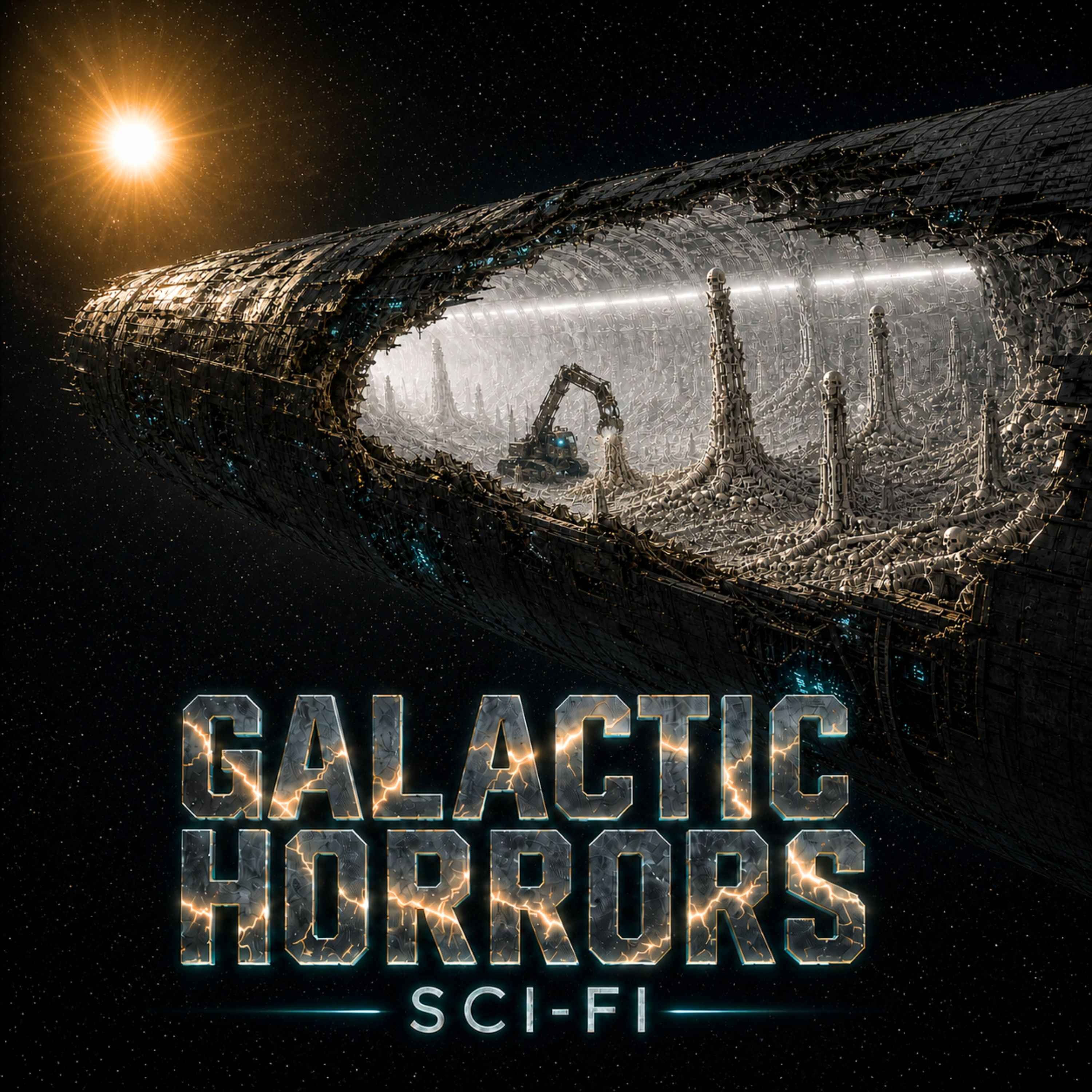
A 3-Million-Year-Old Vessel Drifted Into The Solar System. It Hides A TERRIFYING Secret
About this episode
Galactic Horrors is made possible by:
A generation ship built three million years in humanity’s future has come home, and its interior is made from the dead.
Paul Weaver has spent fifteen years recovering bodies from collapsed mines, ruptured stations, and industrial disasters. Nothing prepares him for the forty-kilometer vessel drifting near Jupiter. Its soil is compressed human bone. Its towering structures are cast from human remains. Across the landscape, immense autonomous machines grind, rebuild, and engrave the dead in an endless cycle whose original purpose has been almost erased.
As Weaver and a small survey team descend through the ship’s strata, they uncover generations of human change written directly into the terrain. The deeper they investigate, the clearer it becomes that this is not simply a derelict vessel or a failed machine system. Something deliberate survived here long after the last human life disappeared. Then the machines begin changing course toward them.
With another expedition preparing to enter, Weaver must determine what this place actually is before curiosity, procedure, or fear turns humanity’s strangest grave into one more site to be dismantled.
🔗 Official Links:
The only place to get daily and bonus Galactic Horrors stories with no ads or interruptions is Patreon:
📡 Join Patreon: https://patreon.com/GalacticHorrors
Galactic Horrors stories are also available as eBooks on Amazon, with new releases every week:
📚 eBooks: https://www.amazon.com/stores/author/B0H2F5M2B3/allbooks
📖 Written by Galactic Horrors
⚠️ Content Ownership Notice
All stories, artwork, thumbnails, and animations featured on this channel are original creations of Galactic Horrors. I do not accept or feature submissions from other creators. Unauthorized reproduction, redistribution, or re-uploading of any content from this channel, in any form, is strictly prohibited and constitutes a violation of copyright. Legal action may be taken against any parties found infringing these rights.
📜 Fictional Work Disclaimer
This story is a work of fiction created for entertainment purposes only. The events, characters, and organizations portrayed are entirely fictional, and any references to governmental bodies, entities, or individuals are not intended to represent reality. Any resemblance to actual persons, living or dead, or real-life events or organizations is purely coincidental.
#scifi #scifihorror #creepypasta
Disclosure: This episode includes AI-generated elements.
Hosted on Acast. See acast.com/privacy for more information.
Get every episode summarized
Each time Galactic Horrors publishes, we email you a written briefing from the transcript — the topics, who appeared, and any specific claims, with the ad reads skipped.
Email me new episodesFree for 3 shows. No card needed.
Hosts & guests
Transcript ready
803 searchable segments. Every word is indexed and playable.
Full transcript
Galactic Horrors — A 3-Million-Year-Old Vessel Drifted Into The Solar System. It Hides A TERRIFYING Secret. Machine-transcribed; use the interactive transcript above to jump the player to any line.
This episode is sponsored by Ari. If you know me, you know that my philosophy is all about looking good and feeling good every single day. And that honestly comes down to the first layer. I'm talking about bras. If your bra is digging into your shoulder or maybe it's riding up in the back or you are dying to take it off at the end of the day, then that bra is not the right fit. And what I love about Ari is that they have 59 different sizes in really soft fabrics and really good fits. Because at the end of the day, your bra should hold you in and not hold you back. Visit ari.com to find the right bra and your perfect fit. Quick question. When was the last time a display ad changed your mind? Now think about the last time a friend told you about something they loved. Different feeling, right? That's how podcast advertising works. A host who's built a real trust with their audience talks about your brand and their own words and their own voice. It doesn't interrupt the experience. It's part of it. With A Cast, you can access the world's largest podcast marketplace. Choose the right shows, the right audiences, the right format.
Then watch the data tell you it worked. You're not buying impressions. You're buying influence. Learn more by visiting acast.com slash advertise. Before we begin, Galactic Horrors is now on Patreon. Get daily stories in one place with no ads and no interruptions. Link is in the description or search Galactic Horrors on Patreon. Now let's begin the transmission. The two miners on series were still in the rubble. That bothered me more than the assignment. I was sitting in a transfer shuttle watching the belt shrink to nothing while Bobby Carver and Mitch Forrester stayed buried under 40 meters of collapsed lithium drift. Three days into the recovery when the reassignment came through. Agency priority. Effective. Immediately. Someone else would finish the dig and bag the remains. They'd fill out the transport forms. Someone else would do it wrong.
I've been in mortuary recovery for 15 years. Four in the service. Eleven contracting for the Bureau of Deep Space Incident Response. The Bureau is the federal agency nobody's heard of until they need a body brought home from somewhere expensive to reach. Most of my work is mining accidents. Cavins and pressure breaches usually involving equipment that should have been replaced two cycles ago. The dead are usually in pieces. The companies are usually in a hurry to clear the site. My job is to slow them down long enough to do the work right. Recovery is detail work. You catalog what you find where you find it and photograph the position before anything moves. Every fragment gets a grid reference. Six months later, some families attorney may want to know exactly where his clients' husbands left hand was relative to the equipment that killed him. The work is procedural and ugly. The kind of thing that kills conversation at dinner. But the dead are owed their names and records.
Their owed proper handling. That's the principle. And I don't dress it up. The series job was routine. Four dead. With two already recovered. Carver and Forrester were still under rock. The grid was mapped and the equipment staged. Carver was probably 18 hours away. Then my supervisor forwarded the reassignment with a one-line note. Don't fight this one. So I pack my kit and court the shuttle to the transit hub at Vesta. I spent three days in a birth reading a briefing packet that made no sense. A generation ship. Selindrical, roughly 40 kilometers long. It had entered the solar system six weeks before on a trajectory that matched neither a known launch nor any cataloged object. No modelled rubble path accounted for it. Robotic probes confirmed the hull was human origin alloy. The metallurgy was terrestrial, but the isotope ratios didn't match anything in the industrial record.
The dating analysis, which I read twice because I assumed I was misunderstanding the notation, placed the ship's construction approximately three million years in the future. I skipped the 40-page theoretical framework. Temporal displacement and causal isolation, among other things. Words I can pronounce but have no business having opinions about. I went straight to the two-page assessment from the preliminary robotic survey. The interior of the ship contained extensive biological remains of human origin. That was my department. Mark Howzer ran the four-person survey team. He was a mid-50s naval commander reassigned to the Bureau. Before we'd even boarded, he had the survey divided into sectors and the report deadline fixed against the larger military science expeditions arrival. That gave us about 40 hours aboard. Wes Colvin was our systems engineer. 28 years old, assigned to interface with the ship's onboard data.
He talked while he worked, narrating connector types and signal quality as he went. Colvin was also the youngest person aboard by 12 years, a fact he compensated for by carrying twice the equipment he needed. Gary Nezbit flew the shuttle. He'd stayed docked at the entry point providing overhead imaging. Me, I was there for the dead. The ship filled the viewport as Nezbit brought us in on approach. It resembled a culvert someone had dropped in Jupiter orbit. Enormous and featureless, it's grey hull rotating. We entered through a hull breach near one end, a section of plating peeled back by some ancient rupture. An emergency pressure field spanned the opening, invisible until static crawled over the viewport as our nose crossed it. The probes had confirmed that the field held the cylinder's atmosphere while admitting solid craft. Nezbit threaded us through muttering his corrections to himself the whole way. The interior opened up around us. I've worked bad places. Decompressed
stations where the pressure doors froze open. The fuel depot fire on Callisto where carbon scoring ran 300 meters around the site. Those spaces had edges you could see, points where the disaster ended. Here, the damage continued beyond sight. The terrain rose around us climbing the walls of the cylinder until it became the ceiling. The far side hung overhead as a grey white band hazed by distance. A luminescent strip ran along the central axis. The ships failed son degraded to a weak glow that washed the landscape in a colourless shade. The flat illumination erased shadows and flattened depth. It felt like permanent overcast pressed into a tube 40 kilometers long. Below us was terrain, low ridges and level stretches. Beyond them, distant shapes resembled a city skyline under the same grey white cast. Nezbit set us down on a level section near the breach.
The landing skids crunched into the surface beneath us. I knew that sound. I'd heard a similar sound once before at a collapsed crematory in Reno, walking on spilled remains that had mixed with concrete dust. The pitch didn't match mineral soil. It was too light and dry. With a yielding quality, I'd never been able to describe to anyone who hadn't walked on processed calcium themselves. I suited up. The pressure field at the breach had kept the cylinder's atmosphere in, while ancient recycling systems had kept some of it breathable. The composition was marginal, but breathable through a filter mask. I stepped off the ramp. The gravity was close to standard, but lighter. With a lateral drift I felt in my knees when I shifted weight. Coriolis from the rotation. My inner ear kept disagreeing with my feet about which direction was truly down. I crouched.
15 years of handling remains have given me a catalogue of textures. I picked up a fragment from underfoot. It was rough and granular. Heat from the ship's internal systems had warmed it. The color didn't match rock. It weighed too little. The fracture pattern along the edge showed laminar structure. Dense layers compressed with oxidized metal. I scraped it with my thumbnail. The pale streak it left was familiar. Bone. Human bone. Fused with iron. I stood up. The surface under my boots ran toward a ridge 50 meters to my left. Beyond it the open expanse reached the skyline. All of it. Weaver. What have you got? Houses voice came over the radio. He was in the shuttle running the mission clock. I had my hand full of someone's grandmother, but the scale of it hadn't arrived yet. The understanding was traveling from my fingers to somewhere deeper,
and 15 years of professional experience had nowhere to put it. Give me a minute, I said. I walked 30 paces from the shuttle. The surface crunched with every step. I brushed away the loose rubble, then dug my fingers into the compacted layer beneath. I found an adult molar fused to a sliver of corroded iron. A fragment of parietal bone lay pressed flush into calcium powder and metal shavings. The substrate was biological. Compressed and fused with metal over a span of time I had no framework for. The continent I was standing on was made of human remains. I've stood on mass graves. I've excavated sites where bodies were stacked four deep. The work at those sites was always the same. You took the remains out of the environment. Separated them from dirt and rubble from whatever wreckage had trapped them. Here the dead were the environment. They made up the dirt itself,
along with the wreckage mixed through it. Digging deeper would never reach a natural substrate. This went down as far as the construction cycle had laid it. The interior terrain is biological remains, I said, into the radio. It's everywhere. How's it didn't respond for a few seconds? Then define how much of it. The horizon curved with the terrain as it rose into the walls. Far overhead the interior curved into the ceiling. All of it, I said. Everything you can see. That's when Colvin came down the ramp, carrying his data rig in a bag over one shoulder, with a sensor array slung over the other. He was already talking about the ship's communication frequency bands, how the probes had found intermittent signal responses from subsurface conduits. He walked six or seven steps onto the surface before I told him what he was walking on. He stopped. His gaze dropped to his boots before returning to me. How old were they? The people down there.
No way to tell. The processing is too thorough. Colvin glanced down again and nodded. Then he adjusted his stride, placing his feet more carefully than he had on the ramp. The care changed nothing. There was nowhere to place a foot without remains. He did it anyway. We oriented ourselves. How's a came out and spent several minutes surveying the area from the top of the ramp with field glasses. Then he assigned the sectors. Before we moved out, Nesbit launched a survey drone to keep a high track over our route. 40 hours. How's Er wanted a grid assessment of the surface composition from me. A systems interface from Colvin, overhead mapping from Nesbit. A preliminary report drafted by our 32 so we could file it during the transit back. Everything went into sectors and deadlines. How's a check the mission clock as he assigned them. In the distance, something moved. A shape on the
horizon moved slowly enough to look almost stationary despite being visible from several kilometers away. Nesbit, what am I looking at bearing 270? How's Er said? The drone feed came through on our suit screens, magnified from above. Large vehicles, dozens of them moved across the plane in long overlapping paths, each one the size of a municipal building. Heavy treads carved ruts while articulated arms worked behind them on booms. Far the back, trailing assemblies appeared to be raising structures from the churned mass. They're everywhere, Nesbit said. I count 38 on this hemisphere with probably similar coverage on the other side. The vehicles were demolishing structures and building new ones. The city skyline I'd seen from the air, those windowless towers that gray architecture was temporary. Structures were demolished and rebuilt from recycled remains in a cycle whose
duration I had no way to measure. We moved toward the nearest cluster of buildings. How's a set of fast pace and checked the mission clock as we moved. Colvin trailed behind with a hand-held sensor trained on the ground. His readings continued over the radio to nobody in particular. I walked behind them both, watching the footing change under my boots. The granular cover gave way in patches where machine treads had compacted it into hard pan almost like concrete. Then the footing loosened again. Then a stretch where intact skeletal fragments surfaced through the matrix. A length of femur cracked but recognizable, lying flush with the hard pan like rebar showing through old pavement. Three million years in the future was the number from the briefing. I didn't know what to do with it. I work in weeks. A standard recovery runs two to six weeks depending on the complexity of the site. The longest job I'd ever worked was the Callisto depot.
Eleven months. Eleven months felt like endurance. A construction date that far beyond us belonged to a scale I had no professional use for. It had no business being attached to human remains in front of me, but they were here. Under my feet, extending to the curved horizon in all directions, layered deep into the structure of a ship that had traveled so long its passengers evolved into something else entirely. I kept walking as the skyline grew closer. A detail at foundation level caught my eye. Its proportions were anatomical rather than architectural. The trench stopped us. It cut across our path to the building cluster. A deep gash in the terrain maybe six meters down, running perpendicular to our route beyond sight in either direction. Machine carved. The edges were clean. The walls vertical. A harvester had scooped this section out on its last pass and carried the rubble off to build elsewhere. What it left behind was a cross
section. I've read excavation profiles at mining disasters. Cave in patterns where the collapse reveals the geological layers the tunnels were driven through. You study the exposure and read the history of the rock. What was deposited and how long it rested there? Changes before the next deposit tell you the rest. The trench walls here showed a comparable structure built from a different substrate. I climbed down. The bottom strutum, the deepest exposure about five and a half meters below the surface, showed recognizable remains. Long bones and shoulder blades were fused into a dense matrix with crude iron, standard anatomy. I could have pulled any of those bones from the cut and held them beside a reference chart. The anatomy would have matched. Adult, unremarkable skeletal variation. The iron binding them was corroded but uniform as if the bodies had been mixed with whatever scrap metal was available at the time. Whole plating, machine parts, and packed into building material.
These were among the earliest passengers, people from near the beginning of the voyage before the later adaptations accumulated. I moved up the profile. The middle layers changed slowly, with longer bone shafts and thicker cortical walls. The skulls I could identify showed altered proportions. Smaller facial structures larger cranial vaults. Spinal columns showed increasing integration with carbon composite tubing. Dark threads laced through the vertebrae like wire through beads. Each strutum was a generation or a hundred generations. Each step through the profile was a step further from baseline. This was evolution recorded in skeletal anatomy and preserved in geological strata. A six meter cut exposed it the way a road cut exposes a hundred thousand years of limestone deposition. Here the sediment was families. Whole populations lived through generations of adaptation before their bodies were folded into the world their descendants
walked on. The ship's biological history was its physical terrain. I was reading it the way I'd read any excavation profile except every strutum was people. The upper strata stopped me. Near the top of the trench wall within arm's reach of the upper edge, the anatomy left my professional vocabulary behind. Thicks spines were laced with dark tubing that had fused completely with the skeleton. Some skulls had no eye sockets, only smooth bone where the orbits should have been. Limb structures I couldn't pass without guessing. Whatever had occupied the upper epochs of this ship descended from the baseline anatomy at the bottom of the trench. The continuity was visible through the deposits allowing me to follow the transition. Without that visible record I would not have identified the upper forms as human at all. Paul give me an assessment. How's a stood at the edge of the trench above me? You want a number?
I want something I can put in the report. Successive strata of bodies formed a geological record of adaptation across deep time. The number runs into the millions I said. The lower layers preserved baseline anatomy, recognizable human remains. The upper layers are extensively adapted, evolved far beyond the people at the bottom of the cut. The entire deposit is biological in origin and human derived. Can any of it be identified? Nothing individually. Can any of it be recovered? The episode is sponsored by Aerie. If you know me you know that my philosophy is all about looking good and feeling good every single day. And that honestly comes down to the first layer. I'm talking about bras. If your bra is digging into your shoulder or maybe it's writing up in the back or you are dying to take it off at the end of the day, then that bra is not the right fit. And what I love about Aerie is that they have 59 different sizes in really soft fabrics and really good fits.
Because at the end of the day, your bra should hold you in and not hold you back. Visit Aerie.com to find the right bra and your perfect fit. You've got social dialed in. Search is doing its thing. So why do your marketing results look the same as six months ago? That's because you're fishing in the same pond as everyone else. Podcast listeners are a different audience entirely. More engaged, harder to reach through traditional channels and ready to act when someone they trust makes a recommendation. We're Acast and we put them right in front of you. Browse thousands of the world's leading podcasts, book host reads or run your own ads, and track every conversion in real time. Same skills you already have, brand new results. Acast. Acast.com slash Advertise. I ran my hand along the trench wall. They formed that wall and continued into the landscape above. Recovery implies separation. You remove a body from the environment therein. Here, the deposit was
the environment. Not as individual remains, I said. They're fused into the terrain. How's a glance at the mission clock? Then at the exposed cut. What's your recommendation? I don't have one. We have 36 hours. Then ask me in 35. A collapsed section of the trench wall had slumped into a ramp, giving us a route back toward the buildings. Colvin had been scanning the trench walls with his scanner while I examined the strata, talking the whole time about subsurface conductive channels running through the matrix like capillaries through tissue. He'd found a junction point in the trench floor where several channels converged. He wanted to go back to it. How's it told him to stay with us until we'd reached the structures? Then he could return to the trench on his own. The nearest building rose from the terrain like a residential tower. 40 stories, maybe 50. Its exterior was continuous without windows or doors. A massive rectangular column of bone composite
warmed to the touch, rising straight from the plain into the weak light. I pulled a utility blade from my kit, scraped the exterior. The shavings curled off pale, showing the laminar structure I'd found in the fragments I'd taken from underfoot. I pressed one between my fingers until it crumbled. Powdered femur had been melted with titanium and cast into solid blocks. The exposed cross section showed two meters of composite at the base, opened by some ancient stress event. I pressed my suits field scanner to the opening. The density return stayed solid across the footprint, with no cavity deeper in. A vertical sweep gave the same return to the roof line. The whole footprint is solid, I said, mostly to myself. What did you find? How'sa had been circling the other side of the building. It's solid through the whole footprint. The scanner shows composite from the outer edge to the center, floor to roof. How'sa came around the corner and studied the crack. Then the cross section it revealed.
Two meters of dense composite, unbroken. The building had the footprint and proportions of residential construction. But it was cast full, leaving no interior space anyone could inhabit. Then what is it? How'sa asked. I didn't have an answer. A monument maybe. A residential form cast solid never meant to be occupied. The machines had rebuilt forms like these through cycle after cycle. Each one was a solid composite block. It had the shape of a home, but the closure of a tomb. I walked the perimeter. Recovery work gives you habits with foundations. You learn to read how a structure meets the ground because its load path tells you what's underneath. These buildings sat on an unusual foundation. At each corner the composition changed where the base met the terrain. The connection flexed around a separate component rather than forming a rigid joint.
I knelt at the nearest corner, brushed away loose dust from the contact point until the joint underneath came clear. A ball and socket joint. The anatomy was unmistakably human, intact and integrated into the foundation supports. The femoral head was scaled up and reinforced with metallic deposits. It sat in an acetabulum engineered into the foundation's base plate. I put my hand against the joint. It was warm under my palm and moved when the tower shifted. I stood and put my palm against the facade. After a few seconds I felt a very slow sway, almost imperceptible unless you were listening for it through your hand. The whole structure rocked on joints that let it flex by fractions of a degree instead of passing routine tremors through the tower. The immense mass of processed bodies swayed on enlarged hip joints. Houser had followed me around the perimeter. He took
my place at the joint and tipped his head towards the building above it. How many people? He asked. The camera hung unused at Houser's side while he kept one hand on the joint and looked up at 40 stories of processed bodies balanced on an enlarged femoral joint. In this building I couldn't even guess. The density alone. I mean the whole ship. How many people does this represent? I looked down. Beyond the building, a skyline of identical structures stretched across the pale plain to the walls. Those walls curved overhead and eventually became landscape again on the far side of the cylinder. 40 kilometers of this. 40 kilometers of compressed remains deep enough to form a continent, supporting a city of solid monuments built from them. More than I can count, I said. More than anyone can count. After another moment at the joint, Houser stood with the camera and photographed the foundation from four angles. By the time he'd finished the fourth shot,
the question about how many people was gone. He was already checking the mission clock on his wrist. We moved on. Colvin had already left for his junction point in the trench, eager to get back to his equipment. I could hear him on the radio narrating the interface process and signal quality as he descended. He'd been doing it since we met at the Vesta Hub, talking through the shuttles docking procedure while Nesbit was running pre-flight. Nesbit had told him to shut up. Colvin had shut up for about 90 seconds. Watching the drone feed, Nesbit reported that the nearest harvester had altered its course slightly, continuing in our general direction now about two kilometers out. If we wanted to observe it, we could position ourselves on the ridge north of the building cluster. Its trajectory would bring it within 500 meters of that position inside the hour. How's it agreed? Documenting the active vehicles was part of the survey. We moved toward the
ridge. The machine was enormous. I've seen mining equipment on series that could shift 100,000 tons of rock in a single shift. Those machines were built around human operators with cabins and control panels sized to the men who ran them. Its exterior served machinery rather than a crew. It was built for itself. A self-contained processing plant on treads segmented like a freight train and moving across the bone plane at walking pace along a path worn into shallow ruts. We positioned ourselves on the ridge 10 meters above the surrounding terrain. How's it had the survey optics? I took the first look. The treads were each the size of a cargo container. Eight meters across may be more. They pressed down with a weight that left ruts half a meter deep. As it passed, the treads crushed the upper slag layer into fine powder. A grey plume rose behind it, drifting in the Coriolis shifted air before settling 60 meters behind it.
Behind the treads, the manipulator arms. I adjusted the optics. The arms extended from the machine's midsection on articulated booms sweeping the freshly crushed strip the way a mason might run a trowel across wet mortar. Each arm terminated in a focused emitter head. As it moved, the heads cut deliberate rows of characters into the slag. Dates. I studied them through the optics. Numerical groups were etched clean into the fresh bone surface by the trailing arms, each entry following the same numerical pattern. The separators and repetition made the format look calendrical, but I couldn't tell how the fields were ordered or what event each entry marked. Each numerical entry aligned with a separate inscription. Behind the date engraving arms, a second set cut character strings into the slag. At first I thought the optics were blurred. I refocused once, but the characters were already sharp enough to distinguish individually.
Their sequences were the problem. The strings repeated symbols in patterns that broke apart before they resolved into anything readable. Each entry received the same meticulous engraving as its paired date. Miles of characters covered everything the assemblers raised. Whatever part of the personal record the system was reproducing, its source data had degraded into noise. I lowered the optics. It continued its pass half a kilometer away, the trailing assembler section already raising a new structure from recycled remains. I watched bone and titanium slurry pour into a mold. The mold pulled away before the mixture had fully set, and the laser arms began engraving the pillars face. A memorial column, 20 meters tall when finished, based on the ones I'd seen near the buildings. The memory banks are corrupted, I said. That much is obvious, how's a said. He kept the camera on the pillar. The database is degraded. That isn't what I mean.
I handed him the optics. Look at the engraving. The dates retain a consistent structure. The identifier portion doesn't. How's a kept the optics raised? The machines are cutting memorial inscriptions, I said. A date entry and an identifier for each person they process. The protocol continues to run even though the identity records are damaged. How's a lowered the optics? That changes the assessment. It did. Paired dates and personal record fields made this a specific protocol rather than random processing. The output was corrupted past the point of meaningful identification, but its structure remained intact. The system recorded each person before construction began and continued that work with information that no longer functioned. I'd spent my career inside systems like this. Mortuary affairs is a protocol. You recover the remains, you identify them, you record the identification, you file the paperwork, you transfer to the designated party. Every step has a form. Every form has a purpose.
When the system works, the dead get their names back. When the system breaks, you keep running the protocol anyway. Identification can fail or records can disappear. The forms have to show what happened. You file what you can and mark what you can't. The steps continue even when they stop producing a result because doing nothing means the dead don't matter. The system kept doing the steps after its records began to fail, working on bodies so thoroughly reworked that the original anatomy had been ground away dozens of times over. People were identified and memorialised before the structures were demolished and fed back into another cycle. The process continued long after anyone remained to correct it. We walked to a completed pillar from a previous cycle. It stood 15 metres from the ridge, a composite column rising straight up from the surface. I put my hand on the dense column. Its smooth exterior was warm under my fingers. The engraving started at the base and ran to the top, eight or nine metres of character strings.
Each line had uniform height and depth. The spacing never varied. Hundreds of entries, thousands. Each one occupied the position of a personal record whose identifying data had broken down into noise. This episode is sponsored by ARI. If you know me, you know that my philosophy is all about looking good and feeling good every single day. And that honestly comes down to the first layer. I'm talking about bras. If your bra is digging into your shoulder or maybe it's riding up in the back or you are dying to take it off at the end of the day, then that bra is not the right fit. And what I love about ARI is that they have 59 different sizes in really soft fabrics and really good fits. Because at the end of the day, your bra should hold you in and not hold you back. Visit ARI.com to find the right bra and your perfect fit. It's fall in Jeep country and during the drive-in-to-fall sales event, get a great deal on four-by-fours that refuse to be contained, like Jeep Wrangler. Confidence built into every drive with the most
awarded SUV ever, Jeep Grand Cherokee, and freedom that can't be denied with the open-air freedom in Jeep Gladiator. After 85 years, it's no surprise that Jeep became America's SUV brand. Get a great deal during the Jeep drive-in-to-fall sales event. Jeep is one more awards over its lifetime than any other SUV brand, Jeep and the Jeep Grill or Registered Trademarks of FCAUS LLC. Whatever information had vanished from the record's execution remained exact. Every character was cut to a uniform depth. Every line was level. The pillar was engineered to last built to survive. It had survived with flawless engraving, even though the inscriptions themselves were wrong. I stood there with my hand on the column. Below the characters, I could feel skeletal fragments within the melted alloy. The composite had been cast into a building element. Their identities were carved into their own remains and raised as monuments. The project was also a recycling program, a grave stone repeatedly rebuilt from the grave. Colvin rejoined us from his trench
with both hands on the rigs' carry frame. He set it down and paused before brushing a film of bone dust off the display with his sleeve. He studied the fine residue on his sleeve, the color of old chalk before wiping it against his thigh. Then he opened the display and got back to work. They were building something, he said. He scrolled through recovered text on the screen. Multiple references to a construction project, including resource allocation logs. Personnel assignments are in here too. The timestamp spanner range I can't fully decode yet. The date format doesn't match anything in historical databases, but the content is clear enough. They were designing machines. Maintenance equipment, houses are asked. Their fragmented design specifications for new construction, not maintenance records. Colvin tapped the screen. But I need better data. The conduits at this depth are too degraded. There's a boundary in the strata. Paul noticed it in the trench. Below that boundary,
the shielding is better preserved. If I can find a junction point at that depth, the archive should be more complete. How's it check the time? We can discuss that on the return trip. Right now, we're heading back. The trench reading suggests the deeper conduits. I heard you will schedule it for the next cycle, so start back. Nesbit came over the radio. He'd been monitoring the drone feed in silence for 20 minutes. Commander heads up. The vehicle you were observing has completed its outbound pass. It's turning. Which direction? Coming back roughly the way it went. The return route has shifted, though. It's going to cross the path you used to reach the ridge. Howzer turned west. It was turning in a slow, wide arc. The mass of it carving through the plane in a curve that would take minutes to complete. Its new trajectory would carry it directly across our route to the shuttle. Alternate route? Howzer asked? Go north around the building cluster. The extra kilometer will clear its path with room to spare. We started moving. Howzer set the pace
again faster now. The footing crunched under our boots in a rhythm I'd stopped noticing until the pace changed. I fell in behind Colvin, who had slung the rig but kept checking its status display as he walked. On my suitscreen I watched the drone feed. The returning machine's route adjustment was one change, but two other vehicles further out on the plane had also shifted their paths in the last hour. Small adjustments of a few degrees each. One vehicle was to the south, the other to the northeast. All three adjustments converged on the area where we'd spent the most time. That convergence might mean nothing. The vehicles varied their routes across terrain they constantly rebuilt themselves. But convergence has a specific look on an overhead display. You see it in search patterns and rescue operations. Any system allocating resources to a point of interest makes that geometry. Howzer checked the wider route plot, I said. He pulled the feed onto his wrist
display. What am I checking? The vehicle south and northeast both changed bearing after we worked their sectors. This one did the same thing. Nesbit zoomed the overhead image out. He's right. Three route corrections, all toward occupied survey areas. Are they tracking us? Howzer asked? I can't say that. I said. Heat, vibration, transmitter traffic or disturbed terrain could be affecting the routes. Three points are enough to flag, not enough to call it tracking. Howzer watched the vectors for another few seconds. Put it in hazards. Nesbit, flag every course change within five kilometers of personnel. Already doing it. That was how you handled an inaccurate entry on a manifest. You didn't decide what it meant because you disliked uncertainty. You marked it so the next decision had to account for it. We reached the shuttle. Nesbit had the ramp down. Howzer went aboard first to log the mission files. Colvin followed, already pulling up his
communication fragments on a secondary display before he'd sat down. I stood at the base of the ramp. Across the bone continent, the vehicle was completing its return sweep. Behind it, the trailing assemblers raised a new row of pillars. The laser arms were cutting dates into fresh slag and adding damaged identifier strings beside them. The inscriptions belonged to people who had died long before. Their bones turned into building material and later demolished so the machines could feed them through the grinders again. The machines were still trying. That was the part I couldn't fit into the report. A malfunction I could write up. Equipment degradation or protocol failure belongs in a familiar paragraph, even when automated systems have outlived their designed lifespan. I've written that paragraph before in different contexts. Equipment fails and systems degrade. The standard recommendation is to shut them down. They were performing the memorial protocol exactly as their surviving instructions allowed, but with damaged records.
The corruption was in the information. Structured date fields and attempted identification revealed the original intent, which had survived after the people who defined it were gone. That intent was the only thing aboard this ship that had. I turned around and walked up the ramp. Hauser entered the coordinates at the console while Colvin hunched over his display. From the pilot's seat, Nesbitt ran the atmospheric recycler, which made a sound like an old refrigerator working too hard. 34 hours to go. We spent five hours in the shuttle. Colvin slept for one of them, sitting upright in his seat with the rig balanced on his knees. Sleep took him the moment he stopped moving, without any transition I noticed. I'd seen combat medics sleep like that. You learn it when the available rest comes in unpredictable windows and you either take it immediately or lose it. Hauser organized the mission files into his report before checking in with the transit ship holding orbit outside the cylinder.
The incoming expedition wanted a sight classification before it started loading its first lander. Biological hazard, archaeological preserve, industrial derelict, active vessel. Hauser marked it pending. Their staging software apparently had no box for continent of human remains maintained by autonomous mortuary machinery. I sat at the aft console with my report template open on a tablet, the cursor at the top of a blank page. Preliminary assessment, surface composition. Of the first three sentences I typed only one survived, the cursor waited until I tried again. The professional language I'd used on every prior job phrases like remains consistent with and evidence of post-mortem processing followed by another recommendation for analysis felt inadequate on the screen. Those phrases were built for sites where victims numbered in the dozens or hundreds, where bodies could be distinguished from the environment around them. They assumed a disaster with the beginning. What I'd seen on the surface was a condition rather
than an event, a state of being that had run so long it had become the geography of the ship. I didn't know how to write that up. The form wanted categories. The categories didn't fit. I tried human remains site. That phrase at least had procedural force. Under bureau procedure it imposed custody rules on anything taken off site. Removal had to be controlled with destructive sampling deferred until identification assessment. Personnel movement had to be logged. The regulation had been written for crash fields and mine collapses, places with perimeters and bodies inside them. Here the perimeter was the hull. I left the classification line blank, but I didn't delete the phrase. Colvin woke from his nap and started talking before he'd fully opened his eyes. The communication fragments he'd pulled from the trench junction were resolving into structure. He'd run a pattern matching algorithm on the damaged blocks during his sleep, and the results showed strong similarities between the fragments and known engineering specification
formats. The crew hadn't just been discussing construction. They'd been writing build documents. I need the deeper conduits, he said. The boundary pole found, the shielding below that depth is significantly better. The data above it is noise. Below it, the archive might still be readable. Howzer checked the mission clock, 29 hours remaining. How far from the shuttle? The canyon we crossed runs deeper to the southeast, two kilometers, maybe two and a half. The strata should be exposed at the right depth. That's a four kilometer round trip through active vehicle routes. The vehicles walk. We can see them from a kilometer out. Nesbit came over the cabin speaker. On the route changes from the first excursion. I ran the playback. Two of the three vehicles crossed areas we had occupied after we cleared them. None diverted toward the shuttle. Patterns real enough to keep flagged. I still can't tell what they're reacting to. Current traffic? Howzer asked. Nearest harvester to the southeast canyon is 4.6 kilometers
and moving away. I can keep you on a clean corridor. If anything changes bearing, you'll know before it gets within two kilometers. Howzer turned to me. Is there a reason to go back? He was asking me because my assessment was the one the expedition would review first. If I said the boundary was relevant to the recovery evaluation it became part of the survey mandate. If I said it wasn't, Colvin's request was a side project the larger team could handle. There's a transition in the strata. I said. Below the boundary the inscriptions retain a consistent written structure. Above it the output degrades into the character strings we saw on the surface. Something changed at that boundary, either in the protocol or in the population running it. Understanding that transition is relevant to my assessment. True. Also the professional justification for a choice I wanted to make for reasons that wouldn't fit on a form. The boundary nagged me. In the trench the shift from functional identification to degraded
output appeared abrupt. The inscriptions below the line were coherent. The later output above it was not. I wanted to know why. Howzer gave us two hours. We'd proceed to the deeper section. Colvin would pull what he could. I'd examine the boundary strata and we'd return to the shuttle by Mission Hour 13. Nesbit would maintain overhead imaging, routers around any active traffic. We walked out across the bone plane for the second time. The degraded strip overhead held the landscape in the same flat, colourless glow. Without the mission clock I wouldn't have been able to tell whether we'd been aboard for six hours or 60. The canyon system Colvin had identified was deeper than the trench we'd crossed earlier. The walls dropped 15 metres or more, carved by machine passes that had cut through the upper strata into older deposits. We followed the rim until we found a traversable descent, where fallen rubble had formed a steep grade and picked our way down. The strata here were older. The lowest exposed layers showed bones I
could identify by touch, baseline skeletal anatomy. The iron binding corroded to a dark orange brown that crumbled when I pressed it. This was among the earliest material, probably from first-generation passengers who had boarded knowing what the ship was. The boundary was visible in the canyon wall about eight metres above the floor. A distinct band, darker than the layers around it, roughly a metre thick. From below it appeared as a stripe of dense composite running the entire length of the exposed wall. I climbed to it. The wall was rough enough to offer holds, fragments of bone and metal protruded throughout the matrix. I reached the boundary and stopped. The band held bodies more densely than any other strata might examine, their skeletons compressed until the outlines overlapped. These were the most heavily adapted forms I'd seen. Spines fused with tubing ran through the band, and some skulls had no eye sockets. The final generation. The final population had been deposited within a much shorter interval than
the generations below. In normal strata bodies were distributed across depth as they accumulated over time. Here the remaining population was concentrated into one narrow band. Below the boundary, I scraped the wall with my blade and found engraved surfaces mixed through the older material. The characters formed a consistent written system I couldn't decipher but could recognize as language. Each inscription was paired with the same numerical pattern the engravers used. These pieces had been reworked by the memorial engines while living operators maintained the archive, then laid down among older remains before the final population died. Above the boundary, the engraving changed within centimetres. The written patterns broke apart into longer strings, as individual symbols began repeating without structure. Within half a metre, the inscriptions had become the same noise that covered the surface pillars. The dense band marked the final population. Material deposited above it belonged to the autonomous
period after their deaths, when the engines kept recycling the terrain without anyone left to maintain the identity archive. Paul, I've got clean data. Colvin was at the canyon bottom. His equipment connected to a subsurface conduit he'd found exposed at the base of the canyon. I climbed down. Colvin was crouched over his display, scrolling through recovered text blocks without looking up. Long passages were readable, less fragmented than anything he'd pulled before. Communication logs, he said, their late period, from the final generation at the boundary. The sequence markers line up with the transition even though I can't convert the calendar. He scrolled. They knew they were dying out. The population had collapsed. Reproductive failure was compounded by accumulated genetic damage. The recycled atmosphere had also become toxic. They had only a few hundred people remaining, perhaps fewer. He paused on a section and tapped it. This is a project authorization,
signed by some kind of governing body. I can't decode the title structure. The authorization is for construction of automated memorial engines. They commissioned the first units while this final population was alive. Purpose, identify each person who lived aboard the vessel and preserve the record from initial departure to final generation. The schema includes each person's name and date of birth. My translator can map those entries now. The rig tags its handshake with my operator record. The engines would construct permanent memorial structures from available biological material and maintain them indefinitely. He raised his head toward me. They built the harvesters. I said, on purpose, it was their final project built to commemorate everyone who had lived here. He scrolled further. There's an navigation directive attached to the ship's guidance system, aim for the origin star and return to the home system. He sat back on his heels. They wanted to send the whole thing home back to where they came from. I sat on hardpan
made from compacted bodies of people who had died long before the final descendants who designed these machines evolved. The protocol was functioning as designed. It used surviving identity records to engrave the dead, then recycled the processed mass into structures it was meant to maintain indefinitely. The archive had degraded after its operators died. One instruction survived the decay, continue the memorial work. It was the final task their creators had given them and the machines had held onto it. They built their own grave markers, Colvin said. He kept reading. They ground up everyone who came before them, named every piece. The early engine work below the boundary preserved structured names with recorded birth dates, I said. Once nobody was left to maintain the archive the entries began to degrade. The machines kept going with whatever fragments they could reconstruct. How's a stood at the base of the canyon wall? He asked the question I'd been circling. Does this change the recommendation? It changed the recommendation completely.
The harvesters were the last cultural artifact of a human species that no longer existed, surviving evidence that generations of human civilization had lived and vanished inside the cylinder. The machines continued carrying out their creators final wish long after the creators themselves were gone, shutting them down would end a vigil while the system continued performing its intended work. Because at the end of the day your bra should hold you in and not hold you back. Visit ari.com to find the right bra and your perfect fit.
It changes the recommendation I said. I just don't know how yet. Nesbit broke in on the radio. Commander, a harvester is approaching your position from the northwest. It changed bearing 12 minutes ago. Current trajectory brings it through your section in roughly 20 minutes. Was it headed here before we entered? How's a rast? It was running east along the upper plain before we entered. Nesbit paused. The turn starts three minutes after Colvin brought the deep conduit online. That's correlation not cause. I can't tell whether it registered the signal or the power draw. We may also have disturbed something getting down there.
Colvin glanced at the interface cable running into the substrate. Howzer checked the time. Pack up we're moving. Colvin remained connected. I need five more minutes. The data density here is the best we've now. Colvin disconnect the rig. Colvin looked at his display and started packing, but slowly. He saved files with one hand on the interface cable, squeezing one last extraction out of the connection before disconnecting. The rig continued pulling a transfer while he packed around it, slowing every step. Howzer was already moving toward the ramp we'd used to enter the canyon. Weaver get him moving. Colvin closed it up. 30 seconds. He pulled the interface cable free then packed it into the carry case. The rig remained powered. Above us at the canyon rim I could feel the vibration. The harvester was close enough that the compacted crust transmitted its approach through the walls. A low rhythmic compression traveling through the soles of my boots and up through my palms where they touched the canyon wall. Colvin moved now. He killed the transfer and snapped the
case shut before slinging the rig over his shoulder. We moved. Canyon floor varied in density. I'd noticed patches on the way in where a thin compacted layer gave slightly underfoot. Repeated harvesting had removed older deposits from beneath the floor and left voids that were never completely refilled. Most were small. A boot might break through the crust into a pocket of loose fill and inch or two deep. In consequential. Colvin was behind me. Howzer was ahead already 20 meters toward the ramp. The vibration was stronger. The harvester was close now, maybe five minutes from the canyon mouth. At walking pace that gave us time to reach the ramp and climb to safety. The floor shifted under Colvin. I heard it. A dry crack like a plate of thick ice giving way under a point load. I turned. He dropped through the thin crust to mid thigh and caught himself on the intact edge ahead. The data rig's carry case had caught on the lip of the hole, wedging itself
across the gap. Colvin hung from the shoulder strap at an angle. His legs dangling in the void below. I'm stuck, he said. One knee was jammed against a solid obstruction beneath the broken layer, a fused fragment of old bone matrix that had shifted when the floor gave out. The shoulder strap held him at an angle that prevented him from pulling himself up, letting the case fall would send him deeper into the void. Don't move. I said. I started back toward him. The floor between us had just collapsed. Hairline fractures radiated from the hole, mapping the edges of the void beneath. More stable surface laid closer to the wall on my left. I stepped that direction, testing each footfall before committing my weight. Howzer came back past me. How deep. Can't tell, Colvin said. He was bracing on his forearms, trying to take weight off the strap. My feet aren't touching anything below me. The case is holding me at this level.
The vibration increased. I looked toward the canyon mouth. The harvester filled the cut like a moving wall of dark metal. It's treads grinding along the canyon floor. Walking pace. The phrase sounded slow until a machine 80 meters wide occupied the whole cut. At that speed, 50 meters disappeared quickly. The treads were already compressing the floor behind Colvin. Howzer measured the narrowing gap between Colvin and the machine, then studied the fractured center of the floor. Can you get the strap off? If I shift my weight to free my right arm, I drop. The case is the only thing holding me here. Howzer tried the direct route first. He put one boot onto the cracked center strip and the floor dipped under him with a dry series of pops. A fracture opened between his feet and Colvin's hole. He backed off before his weight finished breaking through. Wallside, I said. He moved right. I moved left. The void ran farther beneath us
than either of us could see. Howzer's side narrowed where earlier passes had cut the canyon wall almost vertical. Mine had a shelf of older fused matrix a boot width above the bottom. I moved along it where the material was denser near the solid base of the canyon. It held. I could reach Colvin from the side rather than crossing the compromised center. The harvester was 40 meters behind him. The manipulator arms trailing the treads were already extended, emitter heads sweeping in their standard pattern. I reached a point on the wall directly opposite Colvin. Four meters of open floor separated us. The same fracture pattern crossed it, showing that the void extended under most of the center. I couldn't cross it. Can you reach your suit toe ring? Colvin looked down. Chest rings below the broken layer. Rear loops under me. The shoulder strap was the only accessible load path within reach. I'm tossing you a line. Clip it to the rig's frame and
I'll pull from here. The rig weighs 30 kilos. If it shifts toward me, I go through. Then hold on. I pulled the toe cable from my recovery kit. 15 meters, rated for heavy loads. I'd used it to clear rubble off a body on Calisto. I took a wrap around a bone protrusion on the canyon wall to give myself a redirect and a break. Keeping the working end in my hands, I threw the free end to Colvin. He caught it with his right hand and the weight shift tilted him enough for the shoulder strap to slide. He grabbed it back with his left hand holding himself in place, the cable in his right. Clip it to the carry handle, I said. I need both hands for that. 20 meters. The harvester was 20 meters behind him. The treads were pulverizing the floor, turning bone matrix into powder. At that distance, the individual tread plates resolved clearly, each one driving the surface half a meter down. Colvin looked over his shoulder at the machine.
Then at the cable, he stared into the gap beneath him. He let go of the shoulder strap with his left hand. His body dropped as the strap slid off his shoulder. Six inches, maybe eight. He gripped the carry handle with his left hand while feeding the cable through the loop with his right. He narrated the procedure while his hands worked. Cable through the loop, half hitch, then pull it to seat. It's clipped, he said. Pull me up. I pulled. The cable snapped tort. I planted both boots against the wall and leaned back until the harness on my suit cut across my ribs. The case shifted in the hole, dragging against the lip. Bone composite flaked away under one corner. Colvin rose an inch, then stopped. The shoulder strap had twisted around his left arm and cinched above the elbow. He tried to turn his wrist through it. The angle made the rig roll instead. More of the broken surface gave way beneath his chest and fell into the void without
making a sound I could hear. Pull again, he said. I reset my grip and pulled. Houser was working toward us from the other side, but the shelf beside him ended six meters short. He had nowhere to put his weight without crossing the fractured center. Ten meters. Colvin's breathing had gone loud on the radio. He was no longer narrating everything, only the parts his hands needed. The straps caught on my left arm. I'm working it free. The texture of the tread plates was clear now, down to the bolts holding them to the drive chain. Each bolt was the size of my forearm. Colvin, leave it. Let go. The straps around my the treads reached him. The cable came hard enough through my gloves to burn my palms. For half a second the rig lifted against the lip and Colvin's trapped knee came up with it. Then the leading tread caught the carry case. The load went past anything the cable or my improvised redirect could take. The bone spur behind me cracked loose with a sharp report. The line snapped
sideways across my forearm and the far end disappeared under the tread. Colvin's unfinished sentence vanished under the drive chain. The harvester maintained its speed and heading. It passed over the strip where Colvin was caught with the grinding continuity it applied to the rest of its route. The tread crushed the broken surface and collapsed the void beneath it, taking the rig and Colvin into the dense substrate the machine left behind. The severed end of the toe line whipped back and struck the canyon wall beside my helmet. I caught it by reflex, then dropped it when pain went through my left hand. The outer glove was intact. Under it my forearm was already tightening where the line had hit. I was against the canyon wall. The bulk passed close enough that I could have reached out and put my hand on the tread assembly. The metal was warm. The drive chain moved at the speed of a man walking, a speed that seemed impossible for a machine that size and was true regardless. I pressed myself tight against the
bone surface as the harvester's body went past. Segment after segment passed. The treads gave way to the midsection with its booms. The rear assembly followed. Each section blocked the overhead light and restored it as it passed. So the shadow rolled over me like the shadow of a slow freight car crossing an intersection. The patch where Colvin had been was smooth, compacted into the gray white hard pan the harvester's maintained. His body was under it with the rig and cable. All of them crushed into the substrate. Indistinguishable from the bone plane that surrounded it. Houser was ahead of me on the same wall, pressed into a shallow erosion in the strata. He hadn't spoken since the machine entered the canyon. His palm was braced on the strata to steady himself against the vibration of its passage. As the trailing section passed, its manipulator arms lowered the emitter heads over the freshly churned strip. I watched them work. The heads swept the
area where Colvin had been then held over one point in the fresh slag. After a brief sensor lock, the emitter's began cutting. A date appeared first, etched in the ship's calendar format. I couldn't translate the numbers, but Colvin's recovered skimmer had established what that entry represented. Date of birth. His rig had stayed powered after the interface session. Colvin's translation layer had mapped his operator record into the ship's personnel schema, and the handshake beacon was still active. The memorial system had something it could read. Then came the name. The emitter heads cut a string of characters into the fresh slag. Its symbols repeated in the same damaged patterns that covered pillars across the plane. The protocol had taken Colvin's mapped identity fields from the rig and passed them through its damaged archive. I knew the entry was his because I had watched the system created over the place where he died. Reading it was impossible. His body was in the hard pan beneath the inscription,
present, but unrecoverable. The machine moved on down the canyon. Behind it, the assembler arms mixed fresh slurry from the surrounding remains for the next structure. Colvin's corrupted entry stayed cut into the hard pan above him, alongside everyone else's. The machine had done to him in less than a minute what its memorial cycle did to the dead it processed. Houser and I climbed down from the wall into the quiet left by the harvester. We need to go. Houser said. We went. The walk back to the shuttle took 40 minutes, Nesbit guided us around two active harvester routes, neither of us spoke. My left hand kept losing strength from the cable strike. Twice I had to catch the recovery kit with my right when the grip slipped. The bone surface crunched under our boots as it had all day. I imagined that sound under every generation that had walked there before the last one stopped. In the distance, the assembler sections of other harvester's raised new structures. Pillars went up as walls were
poured. The city kept rebuilding itself the way it always had. Colvin's equipment and primary files were gone. The communication logs and project authorizations were in the rig's memory when the machine took it. So was the navigation directive. We had fragments from his earlier extractions stored on the shuttle's secondary systems, plus what he'd told us. My memory of what he'd recited from the screen would have to cover the rest. It would have to be enough. The conduit he'd found was under a meter of fresh bone slag, and the machine was already on its return pass. His bit didn't ask about Colvin when we boarded. He'd watched the vehicle enter the canyon on the drone feed. Only two figures had come out. He got us away from the interior without a word. The shuttle lifted through the pressure field at the whole breach and into open space. Beneath us, the cylinder rotated under the pale glow of its luminescent strip. I watched the interior landscape shrink through the viewport. The harvester's kept moving,
small from this altitude as they crawled across the plain. Trails of churned rubble marked their paths. I sat at the aft console with the report template open on my tablet. Houser was in the co-pilot's seat, recording the mission summary into the flight log. His entry for Colvin was two sentences. Systems engineer Wesley Colvin killed during survey operations in sub-surface canyon, Mission Hour 13, cause compression by automated surface vehicle remains unrecoverable. He typed it, reviewed it, saved it, moved onto the next section. Two sentences. Colvin's whole career, his equipment, his habit of narrating the procedures he touched, even his 90 seconds of silence after Nesbit told him to stop talking. All of it reduced to two sentences. The flight log would be archived on a server somewhere and probably never opened again. I opened my own death report. Before entering the coordinates or equipment loss,
I pulled Colvin's personnel manifest. Name of deceased, Wesley Colvin. I checked his birth date digit by digit against the crew record, then entered the grid coordinates an estimated time. The automated system there had made its own entry. Mine would be the one that went home. I'd used the standard clinical format I'd used for every prior death in my career routed through familiar checkboxes. Were remains recovered? No. Were remains identifiable yes by witness incident and personnel record. Location of remains incorporated into site material by automated processing equipment. The form had a box for that. Incorporated into site material. I'd used it twice before. One case involved a welder who fell into a smelting vat at a processing station in the belt. The other was a technician pulled into a rock crusher during a mining operation on Vesta. Both times what was left of the person became part of the industrial output. Both times I filed the report with the box checked and the circumstances noted.
The families received notifications and the cases were closed. I checked Colvin's name once more before I moved to the site assessment. The incident form asked what operation he had been performing when he died. I entered systems data recovery and support of mortuary boundary assessment. The next field asked for the basis of the activity authorization. I entered recovery assessment requirement. Mine. The answer was accurate so I left it there. My left forearm had swollen where the cable struck it. Flexing my hand pulled against the bruise under the suit liner. I typed around it. I filled out the death report. Then the site assessment. Surface composition. Human biological remains fused with metallic elements accumulated across successive generations and repeatedly reprocessed with automated cycling continuing after the final population died. Depth of deposit, variable, estimated 2 to 15 meters in surveyed areas.
Individual identification. Impossible. Recovery. Impossible. The remains constitute the physical terrain of the ship's interior. I described the evolutionary strata and the daulest buildings solid through their footprints. Their weight passed through enlarged human hip joints. The report covered the active machines and their memorial protocol including the intact birth date entries and corrupted names. I summarized what Colvin had found in the deep conduits, communication logs and project authorizations showing that the final generation commissioned the engines before their extinction to commemorate everyone who had lived aboard. Colvin's primary data had been lost with the rig but earlier fragments stored on the shuttle remained available for analysis. The language came easily. I'd been writing reports like this for 15 years. The professional vocabulary exists specifically to make the unbearable fit on a form. Checkboxes reduce it to summaries short enough for the work to continue after the part nobody
has useful words for. I filled in section after section. In the hazard section, I entered the route changes. Automated vehicles altered course toward occupied or recently occupied survey areas on four observed occasions. Trigger unknown. Personnel proximity should be treated as a possible rooting input until disproven. Each section had its format. I typed and the words came from the part of my brain that had written them often enough to keep working without asking permission. Then I reached the last section. Recommendation. The form gave me a text field. 200 words maximum. Options. Preservation. For further study. Remediation. Control. Shutdown. Of automated systems. Demolition. Transfer to designated authority. Other. Preservation meant accepting the cycle as it was. Commemorative structures built from the people they represented. Identities decaying while the machinery carrying them continued. Control. Shutdown meant deciding the last generations instruction
had expired because we had arrived while demolition would destroy the deposit and the only surviving work of the people who had arranged to send them home. Every option was a form of desecration. The cursor blinked in the empty text field. Outside the viewport, the cylinder was a gray bar against the black shrinking as Nesbit flew the transit heading. The light strip was visible from out here. A thin bright line running the length of the hull. The ship's failed sun burning after every living thing aboard was gone. On series, Bobby Carver was still under 40 meters of rubble. Someone else was digging him out. They would photograph the positions and label what they found before anybody with a production schedule could clear the drift. I didn't know whether the right disposition for this ship was preservation or shutdown. A 40-hour survey window couldn't give me that authority. It had given me enough to know the next team wasn't ready to start cutting pieces off it. My recommendation carried limited authority. But as the recovery specialist of record,
a human remains classification would force the incoming expedition to clear the hold before anybody sampled a pillar or shut down a harvester. It would also block anyone from deciding the whole interior was merely equipment without review. Somebody could override me. They would have to put a name under that decision. I selected other. I wrote, Treat Interior as an active human remains site pending joint mortuary, legal, archaeological and systems review. No demolition, shutdown, sampling, extraction or disturbance of memorial structures or automated systems until site status and operational response are established. Suspended non-essential crude entry, automated vehicles have repeatedly altered routes toward occupied or recently occupied survey areas, causal trigger unknown, preserve recovered data and continue remote observation. Do not classify memorial machinery as derelict equipment pending review. Howzer turned from the copilot seat when the recommendation flag
appeared on his console. You selected other. That's why they put it there. He read the text. This puts an access hold on the expedition. That's the point. They're staged to enter as soon as we dock. Then they can unstage. Howzer read the recommendation again. You're not recommending preservation. I'm recommending a hold, not preservation. You're not recommending shutdown either. Shutdown can wait for the review. How long do you expect this review to take? I thought about Carver under 40 meters of series rock, 18 hours from reaching him when someone with more authority moved me off the site. Long enough to do it right. Howzer read the recommendation once more, then returned to his report. He didn't argue. I filed the recommendation. Howzer transmitted the report package. The transit console acknowledged it a few seconds later. The expedition's entry status changed from staged to hold pending review.
A second message followed from mission control requesting the incident record, route plots and legal basis for the remains designation. That meant somebody had already tried to move the hold and discovered it had paperwork attached. Nesbit in the pilot seat was running the pre-transit checklist. Fuel cells, navigation lock, comms handshake with the transit ship. The steps came in their familiar order. Behind him, my tablet showed Wesley Colvin at the top of the personnel incident report and other at the bottom of the site assessment. Two entries I could stand behind. Through the viewport, the cylinder was a gray line now, barely distinguishable from the dark behind it. Somewhere below the assemblers were pouring a new pillar. Elsewhere on the same interior, the systems version of Colvin's name remained cut into the hard pan above him, alongside entries already damaged beyond recovery. The shuttle cleared the cylinder's shadow. Sol lit the viewport,
the real sun, the star the last generation had aimed their ship toward when they decided to send their dead home. Nesbit made a correction to the heading and the cylinder disappeared behind us.
More episodes
More from Galactic Horrors

A Dead Gas Giant Has A Horrifying Secret Hiding In Its Lower Atmosphere
Galactic Horrors

Deep-Core Miners On A Frozen Planet Accidentally Awakened A Subglacial Bio-Engin...
Galactic Horrors

A Deep Space Prison Uses Crushing Gravity To Restrain Inmates. Tonight, They Bre...
Galactic Horrors

60 Astronauts Entered The Singularity Engine. Only One Body Came Back
Galactic Horrors