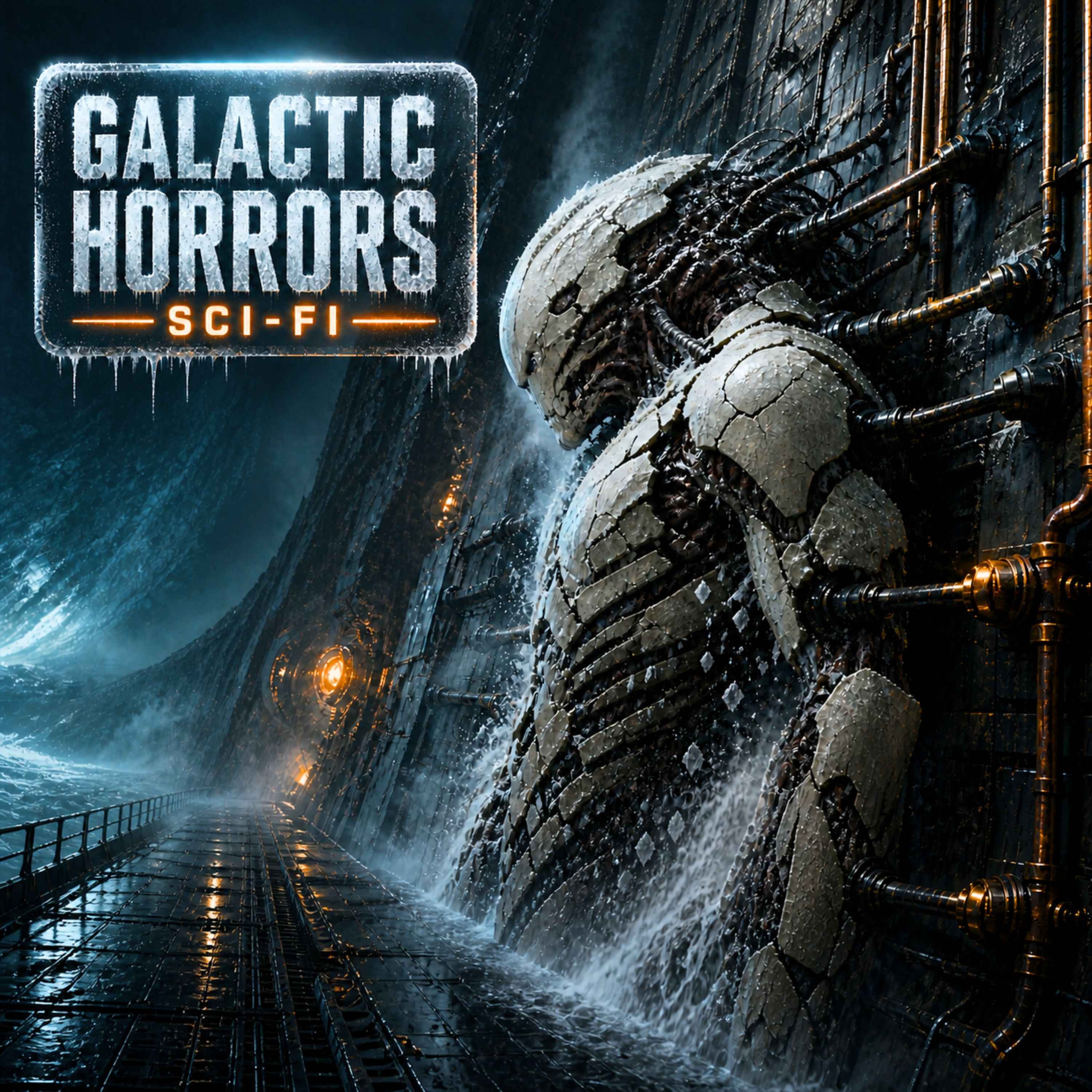
Deep-Core Miners On A Frozen Planet Accidentally Awakened A Subglacial Bio-Engine
About this episode
Ray Dunford knows the Kelvin-3 drill has one dangerous flaw: its sensors understand Nevada geology, not an alien world. Procurement says the software update can wait eleven weeks. Buried beneath Outpost Zero, something has already waited much longer.
When Ray and three crewmates cut into a miles-long metallic structure under the glacier, they find corridors lined with impossible bodies, precise industrial hardware, and a power network wired through the walls. Then the mining software makes the worst possible mistake. The buried system begins to wake.
Heat tears through the frozen structure. The hull repairs itself. The glacier above starts to fail. With an injured crew, a storm closing in, and rescue more than twenty hours away, Ray has to do what he has always done: read the machinery faster than it can kill him.
But this machine was built for a purpose, and the thing it is powering lies deeper inside.
🔗 Official Links:
The only place to get daily and bonus Galactic Horrors stories with no ads or interruptions is Patreon:
📡 Join Patreon: https://patreon.com/GalacticHorrors
Galactic Horrors stories are also available as eBooks on Amazon, with new releases every week:
📚 eBooks: https://www.amazon.com/stores/author/B0H2F5M2B3/allbooks
📖 Written by Galactic Horrors
⚠️ Content Ownership Notice
All stories, artwork, thumbnails, and animations featured on this channel are original creations of Galactic Horrors. I do not accept or feature submissions from other creators. Unauthorized reproduction, redistribution, or re-uploading of any content from this channel, in any form, is strictly prohibited and constitutes a violation of copyright. Legal action may be taken against any parties found infringing these rights.
📜 Fictional Work Disclaimer
This story is a work of fiction created for entertainment purposes only. The events, characters, and organizations portrayed are entirely fictional, and any references to governmental bodies, entities, or individuals are not intended to represent reality. Any resemblance to actual persons, living or dead, or real-life events or organizations is purely coincidental.
#scifi #scifihorror #creepypasta
Disclosure: This episode includes AI-generated elements.
Hosted on Acast. See acast.com/privacy for more information.
Get every episode summarized
Each time Galactic Horrors publishes, we email you a written briefing from the transcript — the topics, who appeared, and any specific claims, with the ad reads skipped.
Email me new episodesFree for 3 shows. No card needed.
Hosts & guests
Transcript ready
1,127 searchable segments. Every word is indexed and playable.
Full transcript
Galactic Horrors — Deep-Core Miners On A Frozen Planet Accidentally Awakened A Subglacial Bio-Engine. Machine-transcribed; use the interactive transcript above to jump the player to any line.
The Kelvin-3 drill ran version 4.6 of the Harman mining suite, a software package built for open-pits sandstone operations in northern Nevada. Somebody in procurement had loaded it onto our rig before we left Earth, which meant the system's acoustic sensors carried only terrestrial geology. Alien materials had no profiles or classification models in its database. The sensors would try to identify everything they touched against Earth Rock, because that was all they'd ever been trained to do. I'd filed three formal equipment concerns about this over the past six weeks. The first was noted by the logistics office on Cursey Station, 14 light hours away, which was where all our supply requests went to age. The second was acknowledged. The third came back from a clerk named Weddle, who explained that software updates for the Kelvin-3 platform operated on a quarterly procurement cycle. The next window was in 11 weeks.
He included a link to the procurement schedule, a nice touch, as if I might pin it to my wall for comfort. I let it go. The acoustic sensors didn't control the cutting head. The drill could cut without knowing what it cut. I told myself the classification readout was cosmetic. A display nobody needed, running behind glass nobody checked. The system would misidentify alien metals as limestone or nice. We'd laugh about it. It didn't matter. The work platform sat on a glacier shelf at the bottom of a 40 metre excavation shaft, directly above the hull of the object we'd been sent to open. A four person personnel cage rode a steel guide rail down one wall, cable driven from a winchhouse at the rim. 35 seconds from surface to platform when the rail was straight and nobody had overloaded the cage. From the rim, the outpost was visible. Six prefabricated habitat modules bolted to the ice shelf in a rough crescent, half buried
by three months of windblown pack. The communications mast stuck up from the centre module at an angle that had bothered me since week one. The tilt never quite justified a report, but I noticed it every time I walked past. Beyond the outpost, the planet was flat white ice running to a low grey horizon in every direction. The slight depression around our excavation shaft was the only break in it. Four of us at outpost zero. My third exoplanet contract. The work was simple in theory. Maintain the equipment the scientist needed to do whatever it was they came to do. The drill running and the generators fed. Keep four people from freezing in their sleep. In practice, I spent most of my time waiting for things to break in a place where nothing moved fast enough to break interestingly. I'd maintained offshore rigs in the Gulf of Mexico. I'd overhauled pump assemblies at a copper mine in Arizona, where the ground temperature
hit 140 degrees at depth. This planet's cold made those jobs feel like different professions, but the boredom belonged to the same family. My skills went soft from disuse until I started finding problems just to have something to solve. I was here because of Gary. My younger brother, 39, who'd caught his left arm in a stamping press at the Delphi plant in Kettering four years ago. The arm survived. Most of the nerve function below the elbow didn't. The settlement covered the initial surgeries but not the ongoing rehab. The specialized prosthetic interface, the physical therapy three times a week that kept the remaining nerve pathways from degrading further. Hazard pay contracts. Three years on, completion bonus, early termination penalty, were the only numbers that worked. I told Gary the job was equipment calibration for geological surveys. That was technically accurate. He didn't need to know I was calibrating equipment on a planet where the surface temperature
could freeze exposed skin solid in under two minutes. Eighteen months in. Eighteen to go. We'd found the cylinder two weeks earlier. Orbital imaging had flagged a metallic anomaly too regular to be geological. A miles long shape buried under the glacier, running east to west at a slight downward angle. The excavation team spent a week cutting a shaft through the ice to reach the hull. The metal was dark and dense with heavy corrosion in places, but the shell remained intact. Polk, our lead researcher, had described it as the most significant discovery in the history of the exoplanet survey program. He said this while standing at the rim of the shaft in a full pressure suit at minus ninety degrees, his visor fogged, holding a tablet he couldn't operate with his gloves on. I liked Polk. He asked me questions about drill capacity that revealed he didn't understand the answers. Then thanked me as if I'd given him something useful.
The morning we breached the hull, the drill fought the metal for six hours. The Kelvin 3 was built to chew through basalt. Whatever this hull was made of gave the cutting head trouble. A dense resistance that felt more like stubbornness than hardness, as if the material didn't want to come apart at the molecular level. Jimmy Lot ran the drill console. Jimmy was twenty-six on his first exoplanet contract and had read the equipment manual cover to cover before he touched a switch. Every procedure took about twenty percent longer than it needed to. I respected the result. At fourteen thirty local time the drill punched through. Cold gas exhaled through the breach and frosted the drill housing. Condensation gathered on the platform rails. We widened the opening over the next hour until a man in a full suit could drop through. Interior readings came back on Jimmy's console. Nitrogen heavy atmosphere, low oxygen concentration, temperature matching the surrounding glacier.
Dark inside. The portable sensors showed grated metal decking about seven feet below the breach, with a corridor extending in both directions beyond sensor range. Dark wanted to enter immediately. I told him we should wait. Let the interior atmosphere stabilize overnight. Run a full gas analysis. Come back tomorrow with better data on what we were walking into. Storm window, Paulk said. He pulled up the weather forecast on his tablet, holding it at arm's length so I could read through the condensation on both our visors. Three days before a surface storm system shut down all exterior operations for up to two weeks. If the storm damaged the platform or collapsed part of the shaft, we could lose the opening entirely. He wanted one entry before the weather locked us out. We could document what we found and establish a baseline survey. The entry authorization on his tablet had two signature boxes at the bottom. Research lead and equipment lead.
His was already filled. He was right about the timing. He was wrong about rushing. Whose facts could coexist, but Paulk treated the forecast as permission to do what he already wanted. I could have pushed harder. I could have raised the acoustic sensors and the unknown atmosphere again. Entering a sealed alien structure on the day we opened it, violated every habit I'd learned on industrial sites. I didn't push. On a hazard contract, pushing too hard could get me written up or sent home. Every termination would leave me owing money. I had 18 months of pay left on the table. I had Gary's next two years of rehab riding on my ability to remain agreeable. So I put my name in the second box. Four of us went in. Me, Paulk, Jimmy, Neil Gallagher. Gallagher was our field documentarian, 41 ex-Army. He carried a ruggedized camera rig strapped to his chest plate. It looked heavy, but he moved easily under it.
He framed shots with his hands before he took them. Index fingers touching thumbs, sizing up a composition as I sized up a torque specification. We got along. Full pressure suits, supplemental oxygen, four hour tanks, portable lights, magnesium flares for backup, toolkits, sample containers. We dropped through the breach onto the grated decking, one at a time, lowering ourselves by the arms because there was nothing to anchor a rope to on the corridor ceiling above. The corridor was 15 feet wide. The ceiling was higher than our helmet lights could reach. The walls and grated deck were made from the same dark dense alloy as the outer shell. Overhead, more metal vanished into darkness. Gaps between the deck panels exposed support framing below. Recessed panels lined both walls at chest height, some slightly ajar and opening onto dark cavities. The temperature was vicious, same as the glacier. Our suits were doing their job.
The chemical warmers in the lining kept the interior above 60 degrees Fahrenheit, which let me focus on the corridor instead of whether my fingers still worked. We found the first one about 200 meters in. It was pinned to the left side of the corridor, roughly 5 feet off the deck. The body was large, 7 feet curled, probably longer at full length. Overlapping off white plates covered most of its exterior, thick material with the texture of fired clay. Fibres tubes ran along its back, each about the diameter of my forearm. The whole thing was encased in a dense crust of glassy ice with a grey tint and milky opacity. The creature, whatever it was, had been pressed flat there by a tungsten rod driven through its midsection. The rod was a heavy industrial bolt, seated into a recessed bracket behind the panel. The hardware was precise. Its head sat flush with the creature's exterior.
Its shaft disappeared into the cavity and terminated in a heavy mounting collar. I didn't say anything at first. I stood there studying the bolt and its bracket, especially the mounting collar. The installation was clean. Whoever had done this had used tooling. There are more of them. Polk was already 10 meters ahead. His light swung back toward me. There were more. Every 20 to 30 feet, another body and another bolt, both walls. The configuration stayed the same. A rod seated in a wall bracket passed through the midsection, pinning each creature beneath the same frozen crust. They varied in size. Some were smaller, maybe four feet curled. Others were massive. One farther down filled the wall space from the deck to beyond our lights. Its bolt was the diameter of a fence post. Jimmy counted 12 between the first body and the chamber entrance.
Gallagher photographed each one, framing compositions with his hands before the camera's shutter cycled. Polk moved fast, talking about tissue samples and classification protocols before he had a sample in hand. I stopped at the third body on the right wall. One of the recessed panels near it hung open, exposing the cavity behind it. I shined my helmet light inside. A thick copper bus bar ran horizontally along the interior. Maybe two inches wide, bolted to a support beam. It met a junction block directly behind the creature's mounting bolt. The copper continued in both directions, disappearing toward the next mounting point. Copper. Bear conductor routed like a power feed. I pulled another panel open three meters to the right. The same layout continued. A copper bus bar met a junction block at the bolt mount. Beyond it, the conductor merged with a thicker trunk conductor running deeper into the ship. And what I assumed was the stern.
Polk, this wiring connects to the mounting bolts, I said. It's part of whatever these bolts are doing, not environmental control. Polk was already 30 meters ahead, crouching near a body with his sample kit open. He said something I couldn't hear through the suit. He didn't come back to look. The deeper we went, the more of them we found. A passage opened from the main corridor into a large interior chamber. The ceiling rose beyond our lights, and the same dark alloy continued across a space maybe 60 feet wide. Pinned creatures lined every wall from deck level up into the darkness overhead, arranged in vertical rows, hundreds visible in this one room. Some were enormous, 15 feet, 20. The tungsten bolts scaled with the body size. Polk's spectrometer had finally produced a useful name for the coating. An ammonia-rich, frozen condensate, layered and uneven over the bodies, as if it had accumulated
for a very long time. I spent 20 minutes pulling wall panels in the chamber, mapping the copper network in my head. Every bus bar terminated at a bolt junction. Each junction fed the same trunk line running afterward. Their cross sections increased as the lines converged, standard practice when a distribution grid has to carry increase in current. Other energy this system collected at the mounting points was being gathered into progressively larger channels and sent deeper into the ship. I'd wired plenty of industrial equipment in my life to recognize a power distribution layout when I was standing inside one. The creatures and their mounting bolts formed the input side of a circuit. Gallagher finished photographing a set of mounting configurations on the far wall, then crossed the chamber and stopped beside my open panel. He studied the copper for a while. Then he examined the nearest mounting bolt, the one holding a mid-sized creature about
chest height. The bolts go through the soft tissue, he said. The plates on the outside, the hard parts, they're intact. Everyone I've seen the rod enters between the plates through the body underneath. The rod in front of me entered the creature's body at a gap between two of the large ceramic plates, passing through what appeared to be dense muscle tissue. It avoided the plates entirely. It also cleared the thick dorsal tubes and everything else that seemed vital to support or circulation. The bolt was placed to penetrate the deepest mass of soft tissue it could reach without killing the body it passed through. The placement was surgical. I didn't have the data to say what it meant. I told Gallagher the copper was carrying something toward the back of the ship. He nodded once. We both understood that the precision bothered us, even if neither of us had a framework for why. Paul could give an up on the tissue samples. The ammonia-rich crust was too dense for his field tools.
He was talking about bringing the drill down into the ship, recalibrating the cutting head for fine work. I told him the Kelvin 3 was a tunnel bore. It could take a shallower bite, but delicacy wasn't part of the design. Speaking it to do fine work was asking a jackhammer to do dentistry. Jimmy was across the chamber, monitoring the drill console through his handheld relay unit. A ruggedized tablet linked to the main console on the platform above the breach. The drill was in standby mode, but its acoustic sensors ran continuously as a passive monitoring function. From inside the hull, the sensors were picking up material signatures through the metal walls. The console processed those readings against its terrestrial mining database, including the coal seams it had been built to find. Come look at this. Jimmy waved me over, grinning behind his visor. He held the handheld toward me. A classification alert filled the screen, green text on a dark background.
The system had identified a large subsurface deposit. The software had scanned through the hull with its acoustic sensors and found the thousands of dense organic bodies pinned to the walls. He compared the return profiles with its terrestrial database and produced a 90-something percent match to buy tumourous carbon deposits. The attenuation pattern pushed the classification toward anthracite. Then the software assigned a commercial grade and rough tonnage before recommending extraction. Jimmy thought it was funny. 18 months of keeping this equipment alive had cured me of that. Shut the drill down, I said. Jimmy stopped grinning. It's in standby.
The head's not spinning. The acoustic sensors are active. When the system identifies a deposit, it sends a marker pulse through the drill assembly, standard practice in terrestrial mining. You pulse the strike so the extraction team can find it later. Jimmy's eyes dropped to the handheld. His thumb went straight to the sensor isolation menu. He cut the array without another argument. The drill head is still seated in the hull, I said. The pulse transmits through any material the heads in contact with. He hits sensor cut off. The green classification vanished. For half a second the screen showed sensor array offline. Then another message replaced it. Marker pulse complete. Survey buffer processing. The relay app had already mirrored the survey buffer onto Jimmy's handheld so he could carry a bore map away from the console. During the sensors killed the next pulse. It didn't erase the copy already in his hand. Jimmy looked up at me. It already sent.
The deck shuddered. The shudder came up through the grated flooring into my boots, then settled deep in the bones of my feet. Something had shifted far below us, or far behind us. In a part of the ship we hadn't reached. Our helmet lights stuttered as an electromagnetic burst passed through the corridor. It was a rough but strong enough to interfere with the helmet electronics. Then the temperature moved. The change barely registered on my skin. My forearm display made it measurable. Ambient temperature had risen from minus 62 to minus 58 in a single reading cycle. Four degrees. I crossed to the nearest wall and pulled the panel open. The copper bus bar behind it was warm through two layers of insulated rubber. The junction block was hotter, so was the section of bus running toward the stern. The creature mounted above the panel had developed a fine web of hairline fractures across its ammonia-rich crust.
One fracture opened along the edge of a plate. A strip of dark tissue showed underneath, glossy and compressed around the tungsten rod. It tightened as it drew away from the rod, then clamped around it and shifted the plate beside it. The junction under my glove jumped hotter a heartbeat later. The tissue loosened and the heat at the junction eased with it. A moment later the tissue contracted again. Whatever was under that crust was responding to the heat. The temperature climbed faster than I'd calculated it could. Six minutes after the initial shift, the ambient reading on my forearm display had jumped from minus 58 to plus 12 fahrenheit. The rate was accelerating. It poured from the walls and deck while the creatures radiated more into the corridor. Behind the panels the copper buses were heating under load as they carried power toward the stern. Our pressure suits were rated for sustained surface exposure at minus 90.
The vulcanized rubber was three-quarters of an inch thick at the chest, layered with chemical warmers designed to trap every calorie of body heat against the skin. At minus 90 the suit was life support. At 12 degrees above zero it was an oven with the door welded shut. By minute eight the interior was above 40 degrees fahrenheit. The chemical warmers in my suit lining had activated on schedule when we entered the glacier shaft hours earlier. They couldn't be shut off. They were exothermic packs stitched into the insulation designed to burn for 12 hours. The suit was now trapping my own body heat, the warmers output and the rising ambient temperature inside three-quarters of an inch of rubber that had been engineered specifically to prevent thermal exchange with the outside environment. I was cooking. Strip the suits. I wiped condensation off the inside of my visor with my glove.
Get the torso shells off. Keep the boots. Pork looked at me. His visor was fogged from the inside. I could barely see his face. The atmosphere. Low oxygen. Not toxic. The masks and tank harnesses are separate. Keep those on. I was already cracking the chest seal on my suit. The locking mechanism was designed for removal at base camp, not in the field. It took me 30 seconds of fighting with the release catches. The heavy rubber shell split down the center seam. I dragged it off one shoulder and arm at a time, leaving the oxygen harness tight across the thermal underlayer. The fabric underneath was soaked through with sweat. The ship's air hit my chest warm and wet, already above 40 degrees. I could function. Below the vapor layer was a different problem. The ammonia-rich coating on the creatures had started breaking down as the temperature rose. Dense grey vapor lifted from every pinned body, carrying cold condensate and suspended
material that kept it low in the corridor. It rolled along the grated floor in a slow grey tide, filling the gaps between deck plates. Everything below midshin disappeared under it. Maintenance gaps and access hatches broke up the grated sections, with drop-offs to lower levels beneath them. We'd noted those hazards on the way in and stepped over them. Now the vapor hid them. Glacier meltwater was flooding through the deck. The glacier above the ship was melting from the thermal output. Water poured through the breach and every seam around the drill point. It ran down the interior walls into the low points of the grated flooring. The water was glacier-cold, close to freezing. It pooled underneath the ammonia vapor, hidden, mixing with whatever was draining off the interior surfaces. We kept our suit boots on. The boots were rated for direct ice contact. Without them, frostbite on the feet would start inside of four minutes, standing in that
runoff. Jimmy was having trouble breathing. His supplemental oxygen flow was calibrated for normal respiration rates. He was breathing so fast the regulator couldn't keep up, forcing him to pull nitrogen-heavy ship atmosphere between delivered breaths. I grabbed his regulator valve and twisted it to notch his past the recommended maximum. The flow rate jumped, his breathing slowed. He nodded at me, which was the only thanks I needed, and more than I expected from a man whose face was the color of a boiled egg. Gallagher had stripped his suit torso cleanly, faster than the rest of us. He worked the release catches in sequence without wasting motion, then set the upper shell aside. By the time I turned, he was helping pulp with a chest seal that had jammed halfway. Then the sound started. I'd noticed the creature's bodies changing as the temperature rose. The overlapping plates on their exteriors, hard ceramic material forming segmented armor,
had started shifting. Internal heat expanded the tissue underneath. The rigid plates separated at their seams and pressed outward against the restraining bolts. The bolts held. The noise came from ceramic plates dragging across tungsten bolt shafts under thousands of pounds of biological pressure. It sounded like concrete blocks being dragged across dry asphalt. Hundreds of bodies along the visible walls were swelling at once. The sound filled the corridor so completely that I had to shout to reach Jimmy from six feet away. The first chemical fire caught me by surprise. A bright white flash at deck level, ten meters behind us, then another, closer. The magnesium flares we'd used for supplemental lighting on the way in. We'd dropped them on the decking when their burn time ran out. The spent casings still held unburned metal, oxidizer, and whatever binders the manufacturer
used. The ammonia-rich runoff reached the residue and found a combination it liked. Patches of white fire bloomed across the waterlogged deck, intense and brief, hidden by the vapor until they ignited. The vapor hid each flare until it was already burning. Back the way we came, I said, stay on the wallside, touch the panels and keep a hand on something solid. We moved. The main corridor held more creatures per meter than the chamber, and the vapor lay thicker over the deck. I navigated by memory with one hand on the wall panels above the vapor line, counting recessed sections as I passed them. Each panel was roughly two meters wide. I'd counted 19 from the chamber entrance to the first creature, which put the breach roughly 240 meters away. The temperature passed 90 degrees Fahrenheit at the 11 minute mark. My thermal underlayer was a second skin of hot wet fabric.
The air tasted like warm metal, and vapor rolled below my knees until I couldn't see my own feet. With about 70 meters left to the breach, Gallagher went through a floor gap. One second he was behind me. The next, the vapor swallowed his lower half. He caught himself on the grating edge with both arms, legs dangling into the space below. I heard Glacier runoff splash against his suit boots. Jimmy grabbed one arm while I took the other, and we hauled him back onto solid grating. From mid-thigh down his legs were drenched. The boots had kept his feet dry, but his thighs were already stiffening from the cold water. He could walk, only slower. Forty meters from the breach. Ambient light from the shaft filtered down through the drill opening, cutting through the vapor like a column of pale dust. Paul stopped walking. My recorder, he said. He was looking back the way we'd come.
I left it in the chamber. The spectral maps, surface scans, all the sample site telemetry. Three hours. Gallagher's camera doesn't have any of it. It's gone, I said. My career is on that recorder with the survey data from this discovery. You can have a career or you can have a body, pick one. He didn't move. The grinding from the walls was so loud I could feel it in my body. A chemical fire popped five meters behind him and burned white for two seconds. Another ignited where Gallagher had fallen through, lighting the vapor from below in a camera flash glare. I called his name. He turned around and started walking. Shoulders still high and locked. He didn't say anything else about the recorder. We reached the shaft of daylight. The hole in the hull was seven feet above the deck. We dropped through it hours earlier, lowering ourselves by our arms. Getting back up would require boosting each other from below.
The hole was smaller. I stood under it. The rough cut hull had thickened and smoothed around the hull, shrinking its diameter by maybe two feet. I touched the rounded rim with my bare hand. It felt like a pipe carrying hot water, warm from something moving through the material on the other side. The hull was healing. The creatures were feeding the junctions and one awakened system had begun repairing the cut. How fast Gallagher asked. He was studying the same hole I was, doing the same calculation. I didn't know. The hull had narrowed by two feet in roughly fifteen minutes. If the rate held, we had another thirty minutes before it closed entirely. If it accelerated with the temperature, we had less. «Jimmy first», I said. «He's the smallest». «Jimmy went up. I boosted him by the boot and he caught the rim to pull himself through. The hull scraped the lower half of his suit before his legs disappeared above me.
A second later his voice came down thin through the excavation shaft. The drill platform was still forty metres below the surface, but planetary air poured down and turned his breath ragged. He folded himself behind the drill housing, out of the meltwater running down beside him. Gallagher went next. His stiff legs made the squeeze harder. Polk crouched and laced his fingers together for a stirrup. Gallagher stepped into it. I grabbed his belt from behind while Polk straightened, pushing him upward. Gallagher got his upper body through. The hull was tighter than it had been thirty seconds earlier for Jimmy, so he twisted sideways to force his hips past the hull before pulling himself onto the platform. The hull was visibly smaller now. Its rim contracted in real time, tightening like a wound on a body that refused to stay open. «Get through», I told Polk. He went. I boosted him as I had Gallagher.
He was wider through the shoulders but lighter overall. He got his arms through and found a grip above. The hull gripped his midsection as he pulled. The upper chest section he'd been unable to fully remove, caught on the rim and tore before he forced himself through. My turn. The hull was eighteen inches across at its widest point, maybe less, and the rim was blood warm. Beyond it were the drill platform and forty meters above that a narrow rectangle of gray sky at the shaft mouth. I reached up and grabbed the rim, pulling myself off the deck. My shoulders entered the hull. The hull pressed against both sides of my chest, warm and dense with a slight give that metal should not have had. I pushed with my legs. My torso slid through an inch, then another. The pressure increased as the hull closed around me. I got my elbows above the hull and pressed down.
Something in my right shoulder separated, connective tissue giving up under the load. I kept pushing until my hips cleared the rim. I fell forward onto the drill platform gasping while shaft air poured over my sweating skin, painfully cold but sheltered from the wind above. Behind me, the hull sealed itself. Within two minutes the dark alloy was smooth and continuous, erasing every trace of the cut. The drill head still embedded in the hull from above groaned against its housing as the metal absorbed it. The shaft sank a quarter inch, then kept going. The ship was swallowing the bit. I sat there in my soaked underlayer. My right arm hung wrong at the joint. The alien hull had erased six hours of drilling as casually as a man wiping chalk off a board. The ship was warming directly beneath us. I felt it in the metal cross beams under my hands and in the melt water beginning to tick
from the shaft walls onto the platform. Jimmy stayed curled there, shivering, while Gallagher sat against the rail with his legs straight and worked blood back into the muscles. At the platform edge, Polk stared down at the smooth hull where we'd entered. His torn suit hanging off one shoulder. Nobody said anything for a while. Water tapped against the decking in an irregular spread. Droplets becoming thin streams as the walls gave up heat. We'd gone from 90 plus degrees inside the ship to an excavation shaft that immediately started pulling that heat out of us. The real surface was 40 meters overhead. Below us, the grinding continued through 40 meters of ice and into the platform steel. I could feel it under my hands. The creatures kept swelling. Their output still fed whatever waited at the stern. Everything I'd warned about. Everything I'd put in writing but let us supply Clark talk me out of pursuing.
It was all running now. A mining program from Nevada had pinged the hull and woken the ship by telling it there was coal inside. Housing groaned again. The steel cross beams under the platform shifted as the ice beneath them softened. I watched the drill shaft sink another half inch into the hull. The metal closing around the bit as water closes around a stone. Then I stopped watching because a machine eating a piece of equipment I'd maintained for 18 months was making me feel something I didn't have time for. My right arm was useless at the shoulder, though the fingers moved and the elbow still bent. The rotation at the joint sent a current of pain down to the wrist. I held the arm against my ribs with my left hand pressing the forearm flat to keep the joint still. A field splint would have helped. The first aid kit was in the outpost, 15 minutes across flat ice, in conditions that would have been difficult to walk through fully able-bodied.
Jimmy's handheld tablet sat on the platform deck where he'd set it down after climbing through the breach. The screen was still active, still linked to the main console above us. The green classification text had updated. I read its sideways from where I sat. The estimated deposit had been revised to 11 million metric tons. Below the tonnage, a new line, deposit qualifies for expedited commercial survey. Contact regional extraction authority for permit application. The software had found its coal mine. It was filling out the paperwork. Something about that screen. The calm green text cycling through its recommendations while the platform sank beneath us forced me toward a conclusion I'd been avoiding since the copper buses went warm under my gloves. I'd been inside the ship for roughly three hours, including 20 minutes opening wall panels and tracing junctions into the larger network. I'd seen how the network moved energy. What I hadn't let myself think about was why.
A thermal harvesting system had one job. Turn heat into usable power and deliver it to a load. At every mounting point, the conversion node took input from the creature around the bolt and fed the current into an aft running bus. Gallagher had already shown me the placement. Every bolt passed through dense muscle between the exterior plates, clear of the dorsal structures most likely to be vital. Each one held a large mass of living tissue against the interface without destroying the source. I sat on that sinking platform with ice crystals cutting across my bare arms. Every deep breath ground my shoulder inside its socket while I ran the arrangement in my head as I'd run a pump schematic or wiring diagram. The design was deliberate. Their metabolism was a blank to me, along with their nerves and whatever passed for a stress response. What I had watched at the junction was concrete. Tissue pulled hard against the tungsten as the converter heated under load.
When the tissue eased, the load fell with it. A moment later the response started again. The hardware kept each organism alive and in contact with its interface while those repeated contractions fed the same aft running system. Whatever their biology called the state that made them fight the bolts, the ship had been built to harvest it. The hardware created the condition and collected the extra heat that came with the response. Pain was my word for it. The machine cared only about the output. The grinding through the platform was the sound of the system working exactly as intended. I could sketch the part I'd seen from each junction through the buses toward a load somewhere aft. Understanding it changed nothing. The machine would run the same whether I understood its purpose or nobody ever did. We need to move. Gallagher had pulled himself upright against the platform rail. The platform had dropped two inches since I'd fallen through the breach.
The excavation shaft around us was widening. The glacier walls retreating as the hull's thermal output melted them from the inside. Water was running down the shaft walls in thin sheets, pooling on the platform decking. The crossbeams were wet. Another ten minutes and the platform anchors would lose their grip in the softening ice. I collected Jimmy's hand held from the deck, slid it into the cargo pocket on my field pants. The lower shell was still intact. I'd only stripped the torso shell. I got to my feet using my left arm, keeping the right pinned against my ribs. Get to the cage now, I said. The person L cage waited against the shaft wall where we'd left it. An open steel box on two guide shoes with a waist high rail and a dead man control. Four person rating. The weight wasn't the problem. The rating assumed straight guide rails anchored in frozen ice and ours were warming from the bottom up.
Jimmy uncurled beside the drill housing. His lips were blue grey. He'd been in a wet undershirt in shaft air for close to ten minutes and the shivering had gone from his hands into all of him. Gallagher got upright with Polk under one arm. I took his other side with my left. My right shoulder shifted when his weight came across me and I nearly put all three of us down. We got Gallagher into the cage first. Jimmy folded into the back corner. Polk squeezed beside him. I stepped in last and reached across my body for the control lever with my left hand. The lever had been installed on the right rail because nobody designing the Kelvin 3 excavation package had planned around a separated shoulder. I held the dead man down until the winch engaged and the cage started upward. At ten metres the first guide bracket tore out of the shaft wall below us. I heard the steel let go then the bracket hit the platform with a dropped wrench clang. The cage swung away from the rail.
Gallagher's bad legs folded and he went to one knee. Polk caught his harness before his face reached the grate. Keep it moving, Gallagher said. That was already the plan. Water streamed past us down the wall. The farther we climbed the colder it got, but the guide rail was warming from below. At twenty-five metres a second bracket pulled half free. The rail bowed outward under the cage. The guide shoes screamed against it. The winch load light on the control box flashed amber. I kept the lever down. The safety logic tried to stop us. Load alignment fault blinked on the little display. Release control to reset. Reset meant descend. Receit the guide shoes and try again. Under normal conditions I would have done exactly that. Under normal conditions the bottom of the shaft wasn't turning into a warm hole around an alien ship. I held the lever. The motor current climbed. The cage crawled past the bent section of foot at a time.
Somewhere below something heavy failed. The platform dropped out of level with a long metallic crash. Jimmy looked down once and then stopped looking. The top lip came within reach. Polk climbed out first and dragged Gallagher over the rim by his harness. Jimmy followed. I released the dead man only after they were clear. The cage stopped with its floor six inches below grade. I got my left forearm over the rim and rolled onto the ice. My shoulder shifted inside the socket and the sky went white for a second. Then the surface hit us. Full exposure at minus 90. A 12 knot wind drove ice crystals west to east at chest height. I'd worked on this planet for 18 months. I'd never been outside a pressure suit on the surface. It was worse than I expected. The cold arrived fully formed, pressing against every exposed area at once and pulling heat out of the skin faster than my body could replace it. My soaked thermal underlayer froze stiff at the shoulders within 30 seconds.
The wet fabric became a rigid shell of ice that cracked when I moved my left arm. Moisture on my back crystallized against my spine where the sweat hadn't evaporated. Polk kicked open the emergency locker at the shaft rim and pulled out four insulated evacuation over parkers. Short duration gear with hoods and mitten gauntlets. No pressure seals but enough insulation for 45 minutes at surface temperature. We dragged them over our wet upper layers before moving away from the shaft. Gallagher was the worst off for walking. His legs were functional but stiff from the thigh deep ice water immersion. He moved like a man on stilts. Each step a controlled fall forward. Polk took one side. I took the other. My left arm under Gallagher's armpit. My right arm clamped against my ribs. We moved as a unit. Gallagher's weight shifting between us. His suit boots crunching through the top crust of the ice shelf with every step. The outpost was visible ahead.
Its hub modules huddled around the communications mast. The supply shed sat at the eastern end. 15 minutes in good conditions. 25 in these. And as the drill shaft was collapsing. I could hear a low grown as the ice walls folded inward and filled the excavation. The platform went with it. The Kelvin 3 represented 18 months of maintenance. I'd put 60 hours into cutting head calibration alone and the shaft had taken a week to excavate. All of it was sinking into a hole swallowing itself. From where we walked the opening was already half its original diameter. Its edges crumbled inward while the drill housing tilted as the supports gave way. The ice was wrong under our feet. I'd crossed the ground around outpost zero for 18 months, learning where the wind packed it hard and where softer drifts gathered in shallow depressions. During the last two weeks the route between the outpost and the new drill site had become
routine. The glacier shelf here was old, built from thousands of years of accumulated freeze. Its top crust normally supported a tracked vehicle. Now, it was fracturing. Dark lines ran through the surface in irregular patterns. Some of them hairline, others opening onto visible depth. A few were leaking. Thin wisps of vapor rising from the cracks visible against the white surface for a second before the wind shredded them. The glacier was venting heat. The ship's thermal output was reaching the surface through the fracture network, carried by melt water and vapor forced upward from around the warming hull instead of by conduction through 40 meters of solid ice. At the surface it emerged as warmth that had no business being there. I could feel the difference in the souls of my boots. The ice was warmer than it should have been, still far below a thaw but perhaps a degree or two above normal. On a planet where the surface temperature hadn't varied by more than five degrees in recorded
history, two degrees was seismic. What is it, Paul Cast? We were two hundred meters from the outpost. He was carrying most of Gallagher's weight on his side. His torn suit flapped in the wind. What's what? The ship. What is it? Thermal engine, I said. The wind took the words so I repeated them louder. The bolt junctions convert their heat into power. The network sends it aft. They're alive. I watched tissue pull off the rod and clamp back down. The junction got hotter when it did. Pork walked six or seven steps with that. What does the aft line power? Didn't get that far. Can you stop the transfer from outside, not without getting back to the conductors? Does it stop on its own? I glanced back toward the vanished shaft. Ask me when it does. He hiked Gallagher's arm higher on his shoulder. We kept walking. He was ten meters ahead, moving on his own with his arms wrapped around his torso.
His stride was uneven but continuous. The shivering had gotten worse. His body was burning whatever reserves it could find to generate heat which meant the calories were running out. He needed warm shelter and dry clothes. He also needed calories. All of it was in the outpost. The outpost was three minutes away when I saw the fracture. It ran through the Glacier roughly 30 meters from the main Hab module, a dark crack, two inches wide, extending east-west beyond sight in both directions. The two sides had shifted. The Habside ground sat maybe half an inch lower than where we stood. The shelf was settling. The outpost modules had become a problem as the ice beneath them lost density. The communications mast was tilted. The slight angle that had bothered me since week one had steepened into a list toward the northeast, with one of its four guy-wire anchors pulled free. The mast remained upright and the comms dish still pointed at the relay satellite.
The remaining three anchor points were carrying load they had never been designed to take. The Hab module was warm inside, which was the wrong thing to be grateful for but I was grateful for it anyway. Jimmy went straight to the heating unit in the main room and stripped off his frozen undershirt. He pressed himself against the radiant panel. Gallagher sat on the bench by the door, working his stiff legs with both hands, trying to need blood flow back into muscles that had been cold-shocked for 20 minutes. I went to the comms console. The system was active. The mast was damaged but the dish was still aligned, still linked to the Cursey station relay. 14 light hours. I typed the emergency signal with my left hand, one key at a time. Standard distress format. Location. Crew count. Injuries. Situation summary. I kept the summary short. Equipment malfunction resulting in thermal activation of subsurface alien structure. Glacier destabilization in progress.
Immediate extraction required. I sent it. The signal would reach Cursey station in 14 hours. This authorization would take another two, maybe three. A shuttle from the nearest crewed station would need six to ten hours of flight time. Total. 22 to 27 hours minimum before anyone arrived. The floor of the Hab module was tilted. Less than a degree, barely perceptible. But I'd lived in this room for 18 months. I knew the floor. The eastern end was lower than the western end. The module was settling with the ice. Pork came in behind me. He looked at the comms' console at the transmission confirmation blinking on the screen. How long, he said? 22 hours. Best case. He walked to the window on the southern wall, a narrow pain of triple layered thermal glass. From there the drill site was visible, or where it had been. The shaft was gone.
In its place, a depression sat four feet below the surrounding shelf and was visibly sinking. The edges were wet. Liquid water lay exposed here where it had no business existing. The ice isn't going to hold for 22 hours, Pork said. Hearing it from him only confirmed what I already knew. The recorder was gone, and Pork had moved on to the next practical problem. The survey marker is 12 miles inland past the shelf edge, I said. It's on bedrock. In this? The forecast still gives us more than 40 hours before the storm shuts down exterior work. We have a window. Jimmy can barely walk. Jimmy can walk. He just can't walk fast. Pork returned to the window. The depression at the drill site had deepened while we'd been talking. Six feet below grade now. The ice around it was dark with moisture. I opened the emergency supply locker in the main module.
Rations for four people, four days. Water purification tabs. Two backup oxygen cylinders. 50 meters of static rescue line and four ice screws in a canvas roll. The medical kit, useless for my shoulder, but it had compression bandages for Gallagher's legs. On emergency pressure suit, compact model rated for 12 hours of surface exposure. It would fit Gallagher or Jimmy, not both. The regular field suits were modular. Three replacement torso shells hung on the maintenance rack for seal failures. Exactly the pieces we'd lost. Gallagher and I locked two into our surviving hip seals. Pork cut away his torn up a shell and took the third. He fed my right arm through its sleeve because the shoulder wouldn't rotate. We activated the fresh warmers. The complete emergency suit went to Jimmy, who was furthest into hypothermia. Pork sealed him in while I opened rations and made him chew. Gallagher worked his thighs between bites.
I managed half a bar one-handed. The surface air was thin but breathable. The suit masks warmed and humidified it and gave us pressure margin. We didn't need continuous bottled oxygen as we had inside the ship. We kept the backup cylinders for Jimmy and Gallagher if either started losing ground. I loaded the remaining rations, rescue line and ice screws into a pack. I shrugged it on one armed, then shifted the strap to the opposite side when it pulled across my bad shoulder. Pork took the oxygen cylinders. Gallagher carried nothing. He'd need both arms free for balance. Before we left I went back to the comms console once more. The transmission light was still blinking. Signal sent, awaiting relay confirmation. In 14 hours someone on Cursey Station would read that message. In 22 hours, best case, a shuttle would enter the atmosphere and scan for life signs around the outpost coordinates.
The outpost wouldn't be here. The contract had an early termination penalty. I had spent 18 months treating that clause as if it were gravity because Gary's rehab invoices arrived every month, no matter how cold the work got or how scared I was of being sent home. The job itself was gone now, with the drill lost and the outpost failing. The numbers had changed without asking either of us. I pulled the handheld tablet from my cargo pocket. The drill software had updated again, and the green text now estimated the deposit as exceeding all known terrestrial anthracite reserves. A new recommendation line. Deposit may qualify for autonomous extraction rights under Terran Mining Compact, section 7.12. Initiate corporate notification sequence. The software called 11 million metric tons of alien suffering high-grade coal. The paragraph 7 of a trade agreement written for West Virginia, it qualified for strip
mining. I turned the tablet off. Then I turned it back on because the battery was full and the GPS still worked. A 12-mile walk to the marker, 8 miles of it across a breaking ice shelf in worsening weather was exactly when a working navigation device mattered. We left the outpost through the main airlock. The wind was stronger, 15 knots now, gusting to 20, carrying a fine haze of ice crystals that reduced visibility to about 400 meters. The fracture line to the south had widened since we'd crossed it 20 minutes ago, three inches now. The vapor rising from it was thicker, more sustained. I took a bearing on the survey marker. East North East, 12 miles. The first eight would be on ice, the last four crossed frozen ground beyond the escarpment, if the shelf held. We walked. Ray Dunford, Rig Mechanic, 43 from Dayton, Ohio, walking across a breaking glacier with
a separated shoulder, a pack of emergency rations, a handheld full of mining permits, and three other men in various states of damage. Walk on my left, carrying the oxygen. Jimmy ahead, Gallagher behind, stiff-legged, his suit boots punching through the softening crust with every step. A hundred meters from the modules I glanced back, the communications mast went down as I watched. The Northeast anchor had already failed. Two more gave way with sharp cracks before the assembly began leaning across the roof of the center module. The final anchor let go. The dish bounced off the roof panel before sliding down the far side. The mast came to rest across the module like a broken antenna on a rolled car. Behind the outpost in the direction of the drill site, the ice was dark with moisture, visibly sinking. The depression had spread, 40 meters across now, a shallow bowl forming in the surface as the glacier softened from below.
The glacier stood in the lowest point, a thing that shouldn't have been possible on this planet, a flat pool of liquid reflecting the sky. Past the drill site and collapsed shaft, the ice was glowing. A low amber light rose through 40 meters of glacier from somewhere around the hull. The ship was running. Whatever the bolt network collected, the ship had started spending it. We were the match, struck against the side of the box until it woke. The box no longer needed us. I turned away from the glow. I adjusted the pack strap on my side. Ahead of us, the ice stretched east toward the escarpment, white under grey sky. The fracture lines running through it like veins in old marble. Twelve miles. The wind was picking up. For the first two miles we could step over the cracks. We didn't make good time. The guss tried shortened as the cold worked deeper into his thighs. Jimmy's emergency suit kept the wind off him, but he had to stop twice to work his hands
against his chest until the fingers moved properly again. The injured joint settled into a steady mechanical throb. Every time the pack shifted, the joint answered. At the second stop, Paul put one backup cylinder on Jimmy at low flow for five minutes. While I made him finish the ration bar he'd carried out of the hab. The oxygen gave him room to breathe and the calories gave his body fuel. Neither fixed him. Both bought us time which justified spending them. We rotated who supported Gallagher, though Paulc did most of it. Jimmy tried once. After three minutes his knees started shaking, so I told him to stop. I took one side whenever the ground forced us close together using my left arm and letting Gallagher lean against my hip instead of my shoulder. Nobody argued about pace. The storm erased that luxury. At four miles, visibility dropped below 200 meters.
The outpost disappeared behind us. The only fixed thing in the world was the bearing arrow on Jimmy's hand held, because I had finally given it to him after deciding one handed navigation was a stupid place to prove independence. At five and a half miles we met a fracture we couldn't step over. It ran north, south across our bearing, five feet wide where we reached it and visibly widening. The two sides were no longer level. Our side had sagged almost a foot. Down inside the crack blue black ice fell farther than the light could reach. Warm vapor came up in pulses. Each pulse softened the edges a little more. He followed it north for 300 meters before finding a place narrowed by a wedge of ice that had broken loose and jammed between the walls. The wedge made a platform about two feet below grade, three feet across. It was the only crossing visible through the blowing ice.
I took the rescue line out of the pack. Pork drove one ice screw into the colder shelf on the far side after making the crossing alone. The first screw went in too easily. He pulled it back out and moved another 20 feet before he found ice that fought the threads all the way down. That was the one we trusted. Jimmy crossed next with the line clipped to his harness. He stepped onto the wedged slab. It dropped half an inch under his weight. He shifted forward and climbed the far lip without looking down. Gallagher studied it and said, my left leg won't make that step. Then don't make it, I said. Let us. We put the line around his harness. Pork and Jimmy took tension from the far side. I stayed behind him, left hand locked through the back strap. Gallagher lowered himself onto the wedge with both legs stiff, boots landing together. The slab shifted again, a crack shot across its surface between his feet. Get him up, Pork said.
Gallagher tried. His left knee folded. The line snapped tight, dropping Jimmy to one knee while Pork leaned back against the anchor. I pulled Gallagher by the harness with my left arm. The twist through my torso loaded the bad shoulder and weakened my grip. But the joint held. Gallagher got one forearm over the far lip. Pork caught his wrist while Jimmy grabbed the harness and together they hauled him onto solid ice as the wedge split underneath him. One half dropped into the fracture and disappeared. The other stayed jammed, rocking in the gap. I was still on the wrong side. The crack had opened another six inches, pork through the line back. I clipped in and backed up four steps facing the gap. With two good arms I would have jumped it without thinking. Now getting across was only half the problem because a bad landing could demand the right arm I no longer had. Jimmy called my name through the wind. I jumped. My left boot hit the far edge and my knee folded, throwing me sideways.
Pork and Jimmy kept the line taught so I never reached the crack. But the harness caught under my bad shoulder and drove the joint upward. Something clicked. I lay on the ice until the white cleared out of my vision. Then I got up because the fracture was still widening and lying there had no technical advantage. We left one ice screw behind. The line came with us. After that the shelf got worse faster. The fracture network stopped looking random. Long cracks began opening parallel to one another, all running roughly east-west along the same axis as the buried cylinder. Amber light showed far below through some of them. The glow had sharpened into organized bands that brightened and dimmed in sequence beneath the glacier, one after another toward the west. Pork saw it too. It's moving after, he said. I checked our bearing. The cylinder ran east-west. The conductor trunks inside had all thickened toward the stern.
The light under the ice was moving the same direction. Whatever waited at the end of those trunks was taking load now. We reached the shelf edge seven hours after leaving the outpost. The glacier ended against a lower scarlement of black bedrock that rose 15 feet above the ice. The last 30 meters were uphill. Gallagher made them with pork under one arm and Jimmy under the other. I followed with the pack because there was nothing useful my right side could contribute anymore. The moment my boots left glacier ice and hit rock, I knew the difference. Bedrock held firm under my soles, free of the warmth or faint movement I'd felt through the shelf. Stable ground didn't fix any of us, but it removed one entire category of ways to die. The survey marker was still four miles east. Those four miles took us almost three hours. Frozen ground was easier than the shelf. By then Gallagher's legs had stopped loosening between rests.
Jimmy had gone quiet inside the emergency suit, while pork carried one oxygen cylinder under each arm because the sling straps had frozen stiff and started soaring at his shoulder seams. I kept the bearing and counted distance in single mile jobs. Each completed mile was useful. The marker appeared through the blowing ice as an orange composite pole bolted into a rise of black rock, half its reflective tape scoured off by weather. I had seen photographs of it in maintenance files and never expected to be grateful to an orange pole. We put the rock rise between us and the wind. Jimmy sat down first and Gallagher more or less stopped being upright. Pork checked the marker's emergency beacon housing and found the status light alive. Short range only meant to guide a shuttle once it entered local airspace. It couldn't make Cursey hear us 14 light hours sooner. It could make sure whoever eventually came didn't have to guess which piece of frozen
ground we were dying on. I took the handheld back from Jimmy. The battery was at 61%. The harm and mining suite had continued processing its cached survey the whole way. A new notification waited on the screen. Autonomous extraction notification queued. Transmit when network link available. Below it, the estimated deposit tonnage was still climbing. I glanced back across the shelf. From bedrock the amber bands were easier to see, long submerged lines moving beneath the stormed arc surface toward the west, each one fading as the next brightened. The ice between us, an outpost zero, had begun to settle in broad sections. Somewhere under all of it, the ship was routing power into a system we had never reached. I turned the handheld face down on the rock, but I left it on. We still needed its battery and its map. The corporate notification could wait in its queue with everything else.
We had bedrock under us now and the glacier behind. A head waited the storm and eventually, whatever curses station decided once our message reached them.
More episodes
More from Galactic Horrors

A Dead Gas Giant Has A Horrifying Secret Hiding In Its Lower Atmosphere
Galactic Horrors

A Deep Space Prison Uses Crushing Gravity To Restrain Inmates. Tonight, They Bre...
Galactic Horrors

A 3-Million-Year-Old Vessel Drifted Into The Solar System. It Hides A TERRIFYING...
Galactic Horrors

60 Astronauts Entered The Singularity Engine. Only One Body Came Back
Galactic Horrors