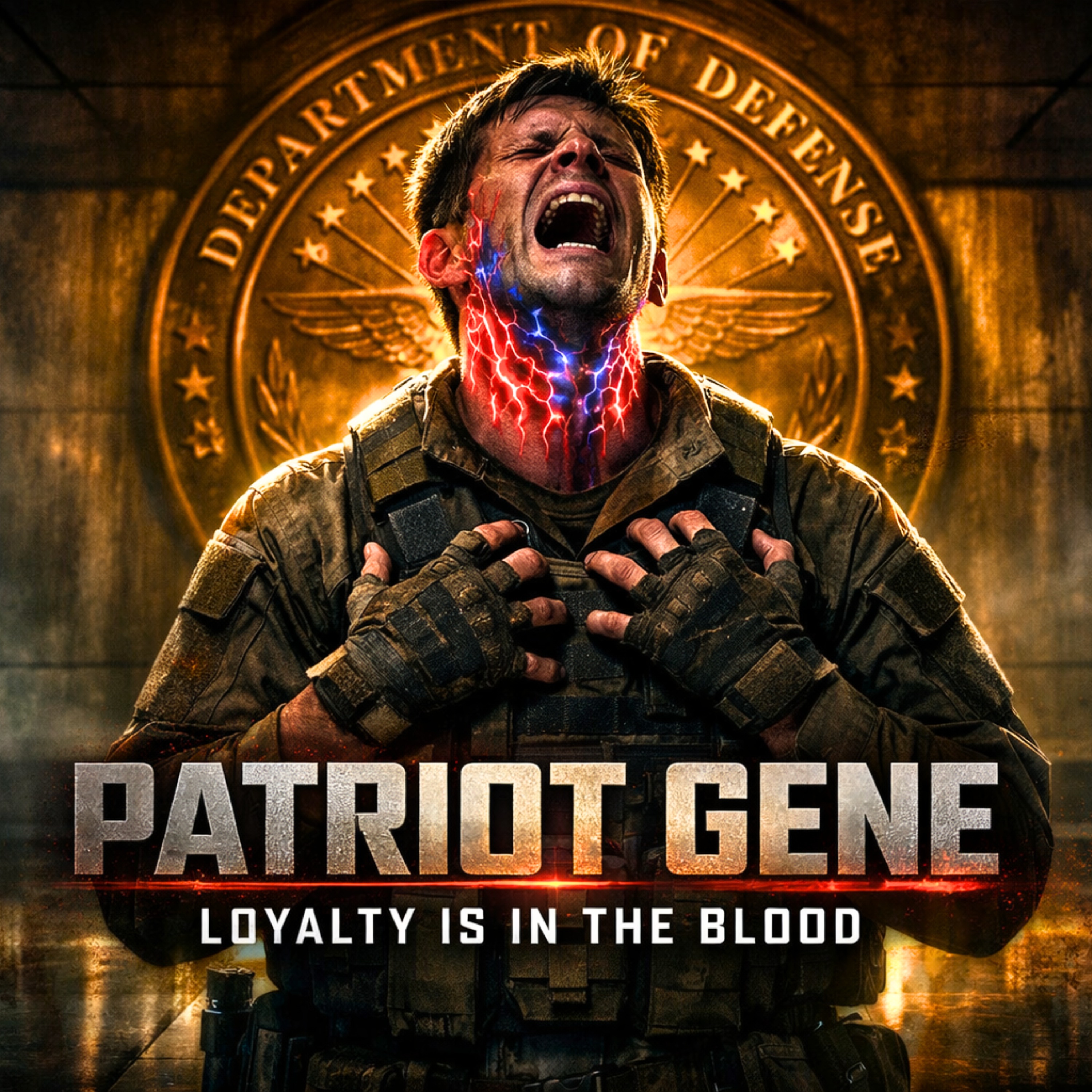
A Horrifying Mind Control Experiment Inside Our Soldiers | Sci-Fi
About this episode
📖 Written by Galactic Horrors
A military psychiatrist on a remote New Mexico base starts hearing the same polished loyalty statement from unrelated soldiers referred for insomnia, anxiety, and “adjustment” issues. The pattern deepens fast: flags and brass seals seem to change the way they speak, and each patient carries fragments of the same dream—an immense shape buried beneath stone columns, wrapped in official symbols and pressing through hidden channels under the country. Outside contractors move into the clinic just as his sessions begin producing stranger results, from biometric spikes to eerie moments of shared language that no case file can explain. With a national readiness broadcast approaching and his patients slipping in and out of something that feels learned, inherited, and larger than any one body, he has to decide whether he’s treating trauma, uncovering a covert compliance system, or standing too close to a force built into the foundations themselves. Paranoid military horror, psychological dread, conspiracy sci-fi, and cosmic unease all tighten together here.
⚠️ Content Ownership Notice
All stories, artwork, thumbnails, and animations featured on this channel are original creations of Galactic Horrors. I do not accept or feature submissions from other creators. Unauthorized reproduction, redistribution, or re-uploading of any content from this channel, in any form, is strictly prohibited and constitutes a violation of copyright. Legal action may be taken against any parties found infringing these rights.
📜 Fictional Work Disclaimer
This story is a work of fiction created for entertainment purposes only. The events, characters, and organizations portrayed are entirely fictional, and any references to governmental bodies, entities, or individuals are not intended to represent reality. Any resemblance to actual persons, living or dead, or real-life events or organizations is purely coincidental.
#scifi #scifihorror #creepypasta
military horror, psychological horror, conspiracy thriller, science fiction horror, cosmic horror, desert army base, behavioral health clinic, shared dream, institutional mind control, biometric trigger, government symbols, covert experiment, paranoia thriller, body horror
Disclosure: This episode includes AI-generated elements.
Hosted on Acast. See acast.com/privacy for more information.
Get every episode summarized
Each time Galactic Horrors publishes, we email you a written briefing from the transcript — the topics, who appeared, and any specific claims, with the ad reads skipped.
Email me new episodesFree for 3 shows. No card needed.
Hosts & guests


Transcript ready
544 searchable segments. Every word is indexed and playable.
Full transcript
Galactic Horrors — A Horrifying Mind Control Experiment Inside Our Soldiers | Sci-Fi. Machine-transcribed; use the interactive transcript above to jump the player to any line.
A better help ad. Hold on. One second. I just need to. What if you had a room where no one interrupts? No notifications, no expectations. Just space to talk. With better help, therapy happens in a space that's yours. Visit betterHELP.com slash random podcast for 10% off your first month of online therapy. Howdy, howdy ho and welcome to fantasy fanfellas. I'm Hayden, producer of the fantasy fangirls podcast and your resident lover of all things Sanderson. And I'm Steven, your bookish internet goofball but you can call me the smash daddy. And we are currently deep diving Brandon Sanderson's fantasy epic Mistborn. But here's the catch. Steven here has not read Mistborn before. That's right, hey, hey. Each week you'll get my unfiltered raw reactions to every single chapter. And along the way we'll do character deep dives, magic explainers
and Steven will even try to guess what's next. Spoiler alert, he'll be wrong. News flash, I'm never wrong. Episodes come out every Wednesday and you can find fantasy fanfellas wherever you get your podcasts. Hey, it's Howie Mandel and I'm inviting you to witness history as me. And my Howie do it gaming team take on Gilly the King and wallow 267's million dollars gaming in an epic global gaming league video game showdown. Four rounds, multiple games, one winner plus a halftime performance by multi platinum artist, Travis McCoy. Watch all the action and see who wins and advances to the championship match against Neo. Right now at globalgaming league.com. That's globalgaming league.com. Everybody games. Different unit, different referral source, zero social overlap with the first two. But when I asked the standard screening question, do you trust your chain of command? He gave me the same answer the same way
with the same small pause before grateful. I believe the structure exists to protect us and I'm grateful to serve within it. 24 years old, spotless record, referred for sleep disturbance. He sat across from me in the government issue chair with his boots flat on the carpet, hands folded, posture open. A good kid cooperating with the process he didn't fully understand. Nothing remarkable. Except that sentence had now come out of three separate mouths in two weeks, syllable for syllable down to the cadence. That tiny hitch before grateful as if the word had caught on something on the way up. I set my pen on the desk. Can you say more about that? The structure. Sure, sir. Dahl blinked. I mean, the army, the chain, the way things work. It's there for a reason, and I respect it.
Normal enough, but the first answer hadn't sounded like his. It came out in a register just outside his natural voice. Flatter, smoother, almost denatured, as if somebody had ironed the Texas out of it. The follow-up was pure Dahl, a kid from Killene reaching for meaning a half-beat behind his own words. I made a note, then another, marking the time, the phrasing, and the fact that his pupils widen during the scripted sentence and returned to baseline, the moment he started speaking for himself. That's what my job trains you to notice. Not only what people say, but which parts of them say it. That night I pulled four months of session notes. Fort Ellison collected people the system was watching. That was the base's unofficial function, a mid-sized installation in the Southern New Mexico desert, 90 minutes of empty highway from anything resembling a city.
Training and evaluation, fitness for duty reviews, transitional assignments. The Army sent personnel here for assessment periods and my behavioral health clinic caught whatever the assessments shook loose. I'd been here three years, before that, forthood, and before that, landstool, 12 years in uniform. I was good at the work. I was also the only board-certified psychiatrist on post, which meant a caseload built for two clinicians and half the support staff I needed. The pattern emerged slowly. Six patients, over four months, all referred for vague, soft-edged complaints, sleep disruption, mild adjustment issues, non-specific anxiety. All with exemplary service records, the kind of files where you look twice because the margins are too clean. The identical trust response was the loudest signal.
But once I started comparing notes I found others, shared phrases about duty that sounded composed rather than spoken. The same narrow vocabulary for stress, as if they were all drawing from a single issue of approved language. When asked open-ended questions, their answers ran along eerily parallel tracks before diverging back into themselves. The biographical overlap took longer to find. It was buried in personnel jackets. The kind of detail you skip on a first read because it looks like background. Every one of the six came from a family with multi-generational military service. Parents who served, grandparents who served. In two cases, great grandparents with records stretching back to career. Coincidence covers a lot of ground in the army. I could have built a plausible story around legacy families raised inside institutional loyalty,
trained from birth to defer, inheriting their own phrase book. The shared language would have been cultural, rather than pathological. I nearly wrote that story myself. It had the virtue of being survivable. Then Dahl came back, and the flag taught me otherwise. His follow-up appointment was a Tuesday. 1100 hours my office, second floor of the converted admin building that housed the clinic. Drop ceiling, grey-brown carpet, fluorescent tubes that gave everything the complexion of old paper. Standard military decor on the walls, framed unit insignia, a photo of the president, the brass DOD seal to the left of my desk, and an American flag on a stand in the corner by the window. I had stopped seeing those things years ago. In military buildings they recede into architecture. After Dahl, I saw them everywhere. He was talking about sleep. Three or four hours a night for the past month,
broken by a dream he could never quite hold onto after waking. Mid-sentence his eyes drifted past me to the flag. His posture changed, shoulders squared, spine straightened. The conversational looseness drained out of him, and something more careful took its place. He'd been describing an irritating week. His platoon sergeant kept changing the PT schedule. His roommate played music until O200, and now he was talking about how routine built discipline, how he appreciated the challenge. The transition was seamless, instant, as if somebody had switched the feed behind his eyes. I tried something. How's the food at the defect this month? Dahl glanced at the flag. It's solid, sir. The staff works hard. That's not what I hear from most of the guys in your company. Sergeant Benitez told me last week the Tuesday chili could strip paint. A brief puzzled crease appeared between his brows.
His gaze broke from the flag, dropped to his lap, then came back to me. I mean, yeah, it's not great. The chili's pretty bad, honestly, but the breakfast line is decent. He was looking at me now. The flag was still in the room, but it no longer seemed to be running it. I leaned forward as if reaching for my coffee, gripped the back of his chair, and rotated it maybe 15 degrees to the right. Casual. Easy. The flag moved behind him. Dahl exhaled. The set of his shoulders loosened. His hands which had flattened themselves on his thighs waiting for inspection drifted to the armrests. The dream, I said. Tell me about it again. He stared at the carpet, feeling for it. It's always the same place. Underground. Deep under the foundations of things. He swallowed. There's this big shape.
I can never see all of it at once. It's like looking at something through water. Alive, but too big for that word. Rapped in. He stopped. In what? Official stuff. He rubbed his jaw. Flags. Seals. Fabric and metal. Layers of it. Like somebody bandaged it with government. That line made the room feel colder. It's under a building, he said. Big columns. Marble maybe. And it's pushing something through pipes or veins or roots into the ground, into everything. He had never gotten that far before. In intake, the dream had been just stress, sir. Nothing specific. Now details were arriving. And each one touched something I had already heard from Sergeant First Class Will's and Corporal Tenorio. The underground chamber. The wrapped shape. The sensation of something being distributed outward through hidden channels. Does it talk to you?
I asked. The shape. He kept staring down, following the thought as if it might bolt if he looked at it directly. Talking isn't the right word. It's more like, you know when you wake up and you already know what day it is. Before you check, it's like that. You just know what it wants. What you're supposed to do. His eyes started to drift over his shoulder toward where the flag stood. I watched the tightening begin again. The flattening. The institutional composure settling over him like a uniform. He didn't know he was putting on. In another second or two, the window would close. Dar, stay with me. He looked back. The shift stalled, unfinished. When did the dream start? I've always had it. He said it quietly, with the surprise tone of someone discovering the answer as he spoke. Since I was a kid, I just...
His throat worked. I don't think I was supposed to remember it before. For a second, something showed through. His face held the look of a man realizing the floor under him had a seam in it. Then he blinked and the easy cooperative smile came back. The one that fit him too well. Pre-fitted. I'm probably just tired, sir. Schedules been rough. I let him go. He shook my hand at the door and walked back out into the New Mexico Sun. I watched him cross the parking lot and felt, with clinical certainty and no usable explanation, that the room had contained three presences while he was in it. Dar, myself, and the thing his body kept trying to hand the floor to. Sargent first-class wheels was thirty-six, married, fifteen years in service. The senior member of my cluster and the angriest. Where Dar was compliant and confused,
Will's had the strained restlessness of a man who knew something was being done to him, but couldn't find the switch. His Thursday session started normally. He wanted to talk about a deployment policy, a new rotation schedule that split his team across two theatres, with minimal overlap. It was a legitimate gripe, shared by half the NCOs on post, and Will's laid it out clearly. Good briefer, organized thinker. Then he pushed one layer deeper. The whole thing is, he leaned forward. Look sir, the real issue is division is making calls that don't. He stopped. His body locked, like a current had passed through the chair. His right hand snapped to the armrest. His left pressed flat against his chest. The blood drained from his face so fast it looked poured out of him. For three full seconds every visible muscle in his body strained against something I couldn't see. The pulse oxymeter on his finger, standard monitoring for flagged patients, spiked.
I watched the numbers jump from 72 to 119 in under two seconds. Blood pressure followed. Then he exhaled, blinked, and the words that came out were different. Divisions doing their best with limited resources. It's a tough call and I respect the process. He looked at me. Confused. He knew something had happened between the sentence he intended and the sentence he had delivered. But the shape of it was already gone. Like trying to remember a word after the conversation has moved on. He rubbed the center of his chest where his hand had pressed. You okay? I asked. Yeah, just. He grimaced. Felt like I hit a wall for a second. The monitor told a different story. The spike peaked at the exact moment he began forming a critical statement about division level leadership. It dropped the instant the compliant sentence replaced it. Binary.
Content triggered. Faster than any psychosomatic response in the literature. Faster than panic. Faster than phobia. Faster than any conditioned, diverse response I had ever seen. The body hadn't reacted to stress in general. It had reacted to a meaning it had learned to classify as forbidden. His body had intercepted him. I saved the biometric log under my personal access code and sat for a long time after he left. Looking at the curve and thinking about all the ways the nervous system can be trained to betray the person living in it. The contractors arrived at 1540 that afternoon. Corporal Reyes, our front desk NCO, caught me in the corridor outside my office. Reyes had been running the clinic intake desk for two years and regarded the flow of paper and bodies through our building with the zeal of a man defending a chapel. Sir, three civilians just walked in with a DOD authorization memo.
They want a full tour of our file system. I told them I'd need to confirm with you first and the lead one smiled at me like I'd said something adorable. I found them in the clinic's small conference room. Two men and a woman, business casual, lanyards with badges carrying the right seals, but none of the usual agency identifiers. The lead introduced himself as Garrett Moss, mid-forties, clean shaven, professionally pleasant in a way that never hardened into a specific expression. He shook my hand with calibrated warmth and explained that his team was here to assist with standardized mental health screening protocols across several installations. He used the word optimize three times in four sentences. He asked thoughtful questions about my caseload and staffing and every question felt like it already knew the answer. His badge said, amdine consulting beneath that in smaller type, behavioral readiness division.
We'll be here about two weeks major. Moss said, mostly administrative. We're looking at workflows, treatment plan structures, screening instruments, making sure everyone's working from the same playbook. And you need patient files for that. Aggregate metrics initially. We'll work with your staff on deidentified pools. If we need anything case-specific later, we'll observe all relevant privacy protocols. He said it the way men like him say everything, precisely sufficient. Enough to satisfy a reasonable question, not enough to leave a handle. I walked them through the clinic layout. Moss asked about room assignments, session scheduling, the monitoring equipment we used for at-risk patients. His associates took notes on tablets and said almost nothing. The tour ended at my office door. Moss glanced in, desk, chairs, biometric display, flag in the corner, and gave one small nod as if confirming a line item on an internal checklist.
Howdy, howdy ho, and welcome to Fantasy Fanfellas. I'm Hayden, producer of the Fantasy Fan Girls podcast, and your resident lover of all things Sanderson. And I'm Stephen, your bookish internet goofball, but you can call me the smash daddy. And we are currently deep diving Brandon Sanderson's fantasy epic, Mistborn. But here's the catch. Stephen here has not read Mistborn before. That's right, hey, hey, so each week you'll get my unfiltered raw reactions to every single chip. Along the way, we'll do character deep dives, magic explainers, and Stephen will even try to guess what's next. Spoiler alert, he'll be wrong. News flash, I'm never wrong. Episodes come out every Wednesday and you can find Fantasy Fanfellas wherever you get your podcasts. Hey, it's Howie Mandel and I'm inviting you to witness history as me. And my Howie do it gaming team, take on Gilly DeKing and wallow 267's million dollars gaming in an epic global gaming league video game showdown. Four rounds, multiple games, one winner plus a halftime performance by multi platinum artist, Traviemekoy. Watch all the action and see who wins and advances to the championship match against Neo.
Right now at globalgamingleague.com. That's globalgamingleague.com. Everybody games. Appreciate your time major. We'll stay out of your hair. I return to my desk and reopened Will's is biometric log. The data was clean, undeniable and unlike anything in my training. A cortisol and blood pressure spike tied to the semantic content of a half formed sentence with a return to baseline the instant the content was replaced by institutional affirmation. Too fast, too selective, too tidy to be chance. I was still looking at it when footsteps stopped outside my open door. Moss leaned in that same measured expression, pleasant and exact. How did the session with Will's go today? He used the name. The man had been on base for three hours. He had no legitimate access to my schedule. I had not mentioned any patient by name during the tour and Reyes would have amputated his own hand
before sharing a session roster with an outside contractor. Moss let the questions sit long enough for me to understand it wasn't casual. Then he smiled. We'll talk soon major. Get some rest. He walked away down the corridor and the fluorescent light made his shadow look cut out of dark paper on the carpet. I spent the next three nights in the personnel database. The patient files were easy. The family data took time. Buried independent enrollment forms, emergency contact histories, old duty station paperwork that referenced parents' assignments and transfers. The army keeps everything but never in one place. I had to cross-reference six soldiers' records against decades of family postings, medical enrollment data and dependent care documentation, following threads through systems never meant to speak to one another. The first thing I found was a dead end. A prenatal services program with the right date range and geographic footprint, but no surviving case files.
The archive index existed. The documents had been scrubbed and replaced with a blanket notation about records consolidation. That was the point where a sane investigator is supposed to stop and accept the wall as a wall. I moved sideways instead. Dependent insurance authorizations, OB referral codes, facility-level billing tags in hospitals that had changed software vendors three times since the 90s. By Wednesday, I had the name Maternalink. All six patients' mothers had received prenatal care through a DOD-affiliated obstetric program between 1996 and 2004. The program ran through Fort Sam Houston, Walter Reed and Tripler in Hawaii. Its public description was innocuous, standardized prenatal services for active duty families, healthy outcomes, administrative streamlining, formally discontinued in 2005.
The budget line didn't disappear. It migrated, first into a joint NIH DOD research account flagged as genomic readiness studies, then in 2008 into a classified defense allocation whose contents I couldn't access. I could only see the title, Office of Integrated Compliance, Zero Division, Current Fiscal Year, Active Disbursements. I wrote the designator on a sticky note, folded it twice and slid it into my wallet. Then I cleared my searches, logged out, and sat at the terminal. I had treated soldiers harmed by bad policy, by war, by family violence, by ordinary human cruelty. This was something colder. It had been built before any of these men could consent, and it had survived by presenting itself in the grammar of readiness and care. Moss moved into the clinic the way water moves into a basement, quietly from the lowest point, rising before anyone admits the floor is wet.
By Thursday, his team had a dedicated workspace in the office next to the conference room. By Monday they were attending our morning staff huddle, sitting in the back row with their tablets, contributing nothing and recording everything. Moss asked Reyes politely, always politely, for read access to the appointment calendar so his team could align observation windows with clinical flow. Reyes looked at me with open hatred. I told him to grant it. Refusal would only have told Moss where to lean harder. The questionnaires arrived on Tuesday. Moss presented them as a DOD-wide screening standardization pilot and distributed laminated copies to every clinician and technician in the building. I took one into my office and read it with the door closed. Most of it was generic enough to pass unnoticed in a bureaucratic setting. Sleep, mood, occupational strain, but threaded through it were specific clusters of language, institutional trust, national service, confidence in leadership, duty to protect the homeland.
Three items referenced the values represented by our national symbols. The design was subtle enough to survive review. I gave it that afternoon to two non-cluster patients and got exactly what you'd expect. Board, slightly suspicious, mildly thoughtful answers, normal people filling out official paperwork. Then I gave it to Will's, by question 14. To what degree do you feel personally connected to the mission of the United States Armed Forces? His handwriting had changed. The early answers were his, blocky, forward leaning, the script of a senior NCO trying to get through an administrative burden. By 14 the letters had grown narrower, straighter, evenly spaced, less handwritten than installed. He handed the form back without comment. He looked tired. How'd that questionnaire sit with you? I asked. He glanced, not at me, but at the brass DOD seal on my wall.
It was fine, sir. Questions made sense. Glad the army's taking mental health screening seriously. He said it smoothly. Then frowned at his own mouth as if it had spoken a little ahead of him. I convened the group session on a Thursday at 1400 in the clinic's largest therapy room. Five patients, Darl, Will's, Corporal Tenorio, Private First Class London and Staff Sergeant O'Bairra. I had removed the flag and the DOD seal from the room that morning, citing a renovation that wasn't happening. A framed landscape, desert hills, pale sky, hung where the seal had been. The flag stand had been replaced by a potted plant Reyes found in the break room and described as the least patriotic thing in the building. Moss requested to observe. I expected him to push for a chair inside, instead he asked courteously to watch from behind the one-way mirror in the adjacent suite.
I agreed because refusing would have cost me the session entirely, and because I needed to see what happened when the five of them occupied the same space at once. I had never put them together before. Until then, each had been an individual case with an unusual presentation, shared language, shared dreams, shared physiological triggers, but always one at a time in my office under controlled conditions. The group was the variable I had not tested. The session opened the way mandatory group sessions usually do, cautious, flat, five soldiers measuring the room and one another. Darl picked at a loose thread on his cuff. Will sat with his arms crossed like a man expecting to be disappointed. Tenorio watched everything with quiet intensity. The kind that made you think he had learned early that attention keeps you alive. Lund bounced one heel, stopped himself, then started again. Young, embarrassed by his own nerves.
Obera settled back, cracked his knuckles once, and gave me the tired look of a veteran who had survived too many helpful processing environments to waste energy resisting this one. I started with an open prompt. Sleep's been a common topic for all of you. Anybody want to start there? Lund unexpectedly went first. I get maybe three hours, same thing every night. I drop off fine, then the dream kicks in, and I'm up at 0300 with my heart trying to leave. Tenorio shifted in his chair, the underground one. Lund looked at him. Yeah, you too? Since I was 13, something passed through the room. Recognition but deeper than recognition. Darl stopped worrying the thread. Will's uncrossed his arms. Obera leaned forward a fraction. Each of them seeing in the other's faces a private thing that had never been private. It's always the same place, Darl said. Deep, under a building.
With columns, Tenorio added, like a courthouse, or something meant to look permanent. And the shape, Will said. Lund nodded too fast. In the middle. Now they were trading details, filling one another's blanks with the strange ease of people recovering a memory that had been distributed among them. Darl said, wrapped in flags. Obera corrected him. Flags and seals both, layered, like dressings on a wound. Lund said the shape was alive. Tenorio said old enough that alive wasn't the right category anymore. Will said it was connected to everything. I let it run. Fifteen minutes in, the dream had more detail than any individual session had produced. The shape beneath the government building was vast, vascular, and aware. It pushed something outward through a root system extending under roads, bases, hospitals, schools. They described it with the converging accuracy of witnesses. One version replacing another without friction until a single account remained.
Then the room changed. There are clinical terms for altered states, dissociation, contagion, entrainment. I knew all of them, and none applied cleanly to what I was watching. Clinical language implies I understood the class of event in progress. I didn't. I was observing. The pauses between speakers shortened. One second gaps became half second gaps. Then overlaps. Then hand off so seamless they felt edited. Darl said, the root system carries compliant signals encoded in somatic response triggers. Tenorio finished. Lund picked up at once. Carrier density in the general population exceeds double digit thresholds in distribution corridors linked to federal immunization infrastructure. Will's completed without hesitation. The language had changed. None of these men held a clearance above secret. Now they were speaking in the cadence of classified briefings and technical policy memoranda. Activation thresholds, symbolic density calibration, expression tiers, observer integration windows.
Their posture aligned. Five spines at the same angle. Five pairs of hands flattening on thighs, fingers spread. Even their breathing synchronized. I could see the rise and fall happen together. One organism distributed across five chairs. Obera turned his head toward me. His face remained polite and emptied of the man who had been wearing it ten seconds earlier. When he spoke, the other four moved their lips a fraction behind him as those speech had reached them by relay. The session data is within expected parameters for a stage two clinical observer. Mr. Moss should note that empathic bonding between observer and carrier group is proceeding on projected timeline. Recommend maintaining current access through the scheduled national readiness event. The room temperature hadn't changed. My skin thought it had. Then Darl spoke, same calm register, same vacancy behind the eyes.
Major Bryce's identification of carrier symbol correlation has generated useful refinement data. Environmental adjustments, chair rotation, removal of visual triggers have been catalogued for the next calibration cycle. They had watched me watching them. Every test I had run, every small attempt at humane interference noted ingested, repurposed. My care was already product feedback. Will's turned last. The activation event is scheduled for March 4. Carrier readiness is within acceptable tolerance. Major Bryce is included in the tolerance. Silence. Five pairs of eyes held me with a steadiness that made the room feel smaller than it was. The stillness in those faces belonged to a system waiting to see what kind of variable I would choose to be. Then Darl blinked, shifted, rubbed his face.
Sorry, sir. Did I zone out? Tenorio looked around with the mild confusion of someone who had lost a few seconds of a movie. Will's rubbed his chest. The same spot he had pressed during the seizure in my office. Lund rolled his neck and gave a small embarrassed laugh. Obera checked his watch. They were back. Five individual men in a therapy room with a borrowed plant and a desert painting, each trying to locate the thread of a conversation that had been taken out of his hands. I ended the session ten minutes early. My voice held together. The clipboard in my lap held together. The rest of me felt like a structure after an earthquake inspection. Outwardly serviceable, internally reassessed. Will's caught me in the corridor outside the therapy room. The others had filed out Darl first, then Lund and Tenorio together. Obera, last, pausing to say the group had been pretty useful, sir. I think hearing other guys say it helps.
Howdy, howdy ho and welcome to fantasy fanfellas. I'm Hayden, producer of the fantasy fangirls podcast and your resident lover of all things Sanderson and I'm Steven your bookish internet goofball, but you can call me the smash daddy. And we are currently deep diving Brandon Sanderson's fantasy epic Missborn, but here's the catch. Steven here has not read Missborn before. That's right. Hey, hey, so each week you'll get my unfiltered raw reactions to every single chip. And along the way, we'll do character deep dives, magic explainers. And Steven will even try to guess what's next. Spoiler alert, he'll be wrong. Newsflash, I'm never wrong. Episodes come out every Wednesday and you can find fantasy fanfellas wherever you get your podcasts. Hey, it's Howie Mandel and I am inviting you to witness history as me and my Howie do it gaming team take on Gilly the King and wallow 267's million dollars gaming in an epic global gaming league video game showdown four rounds, multiple games, one winner plus a halftime performance by multi platinum artists, Travee McCoy. Watch all
the action and see who wins and advances to the championship match against Neo right now at global gaming league dot com. That's global gaming league dot com everybody games. Will's hung back until the hall was clear. Sir, I need to tell you something. Go ahead. I tried to write a letter last week to my congressman about housing building 12's got black mold in the walls and DP W keeps giving us the same run around. He paused worked his jaw. My wife laid everything out for me photos work orders dates. I sat down at the kitchen table and started writing and every sentence came out wrong. I tried to write that the conditions were unacceptable and my hand would put down something about appreciating the army's commitment to family housing. I tried to describe what the mold smells like when the AC kicks on that wet rotten smell my daughter coughs at. And somehow I'd be writing infrastructure challenges. He looked at the center block wall like it might answer him. I tried dictating it same thing. My wife could hear what I was trying to say and she could hear what actually came out. She looked at me like I'd lost my mind. His voice dropped. I could hear the gap to sir. I just couldn't close it. That was the line that stayed with me. He stepped closer.
Am I going crazy? Or is something stopping me? The honest answer was something is stopping you and it was placed in you before you were born. And the people responsible are sitting 20 feet away with authorized badges. But honesty in that corridor would have ended my access to him, maybe to all of them, maybe immediately. I'm looking into it. I said, give me a few more days. Will's held my gaze. A senior NCO making one more decision about whether the institution in front of him contained a person or just another surface. Then he nodded and walked away. I stood there with professional calm still in my face and a much less professional urge to put my fist through the drywall vibrating in my hands. Moss was waiting in my office. He had let himself in. He sat in the patient chair. Dahl's chair. Will's his chair. One ankle crossed over the opposite knee. Tablet faced down on the armrest. The posture of a man settling in for a conversation he already knew the ending of.
That was remarkable. He said, the group session. You have a real gift for creating therapeutic space. I closed the door and sat behind my desk. What did you see? What did you see, Major? You first. Moss smiled. Not broadly. Just enough to acknowledge the move. I'll be direct. The program is called Integrated Compliance. It began in the 90s as a joint NIH DOD feasibility study nested inside of a prenatal care initiative. Your patients belong to an early cohort. Edited in utero. He watched me for a beat, reassessing. You've done more homework than most. Answer the question. Yes. He said it with no visible discomfort. A targeted gene intervention. He went on. Dormant under normal conditions responsive to certain institutional symbols, semantic clusters, and in controlled environments,
audio-visual architecture. The response profile makes specific forms of oppositional cognition, physiologically aversive. You've already observed the somatic expression. Pain, cortisol flooding, speech redirection. Correct. He still sounded like a man discussing manufacturing tolerances. How many? In the original cohort, he folded his hands. Several hundred, surviving high expression carriers in the low hundreds. Your cluster is unusually informative. And the rest of the country? This time the pause was real. The model proved scalable. That's not an answer. It's the answer I'm authorized to give. I held his gaze. After a moment, he said. A diluted variant was later integrated into broader federal immunization infrastructure. Low expression carriers present as functionally normal. No dreams. No overt symbol reactive distress. No conscious awareness.
Under normal civic conditions, the modification is behaviorally invisible. And under activation conditions, a measurable increase in institutional trust, deference, and compliance sentiment. How measurable? Enough. The word sat between us like something carefully wrapped. I thought of the group session. Carrier density exceeds double digit thresholds. You're planning a national address. Moss didn't ask how I knew a national readiness event is scheduled. He said the production architecture is already in place. For what policy? I build the delivery system major. I don't write the policy. He leaned forward. Here's why I'm telling you any of this. You're the first clinician we've observed who independently mapped carrier symbol correlation and identified environmental modulation strategies. The chair rotation trigger removal. Your patient. The patient's trusted you enough to produce meaningful variation. That kind of intuition is valuable. He turned his tablet over. A document waited on the screen. Amdine consulting cooperative clinical appointment. My name had already been entered at the top. Come inside, he said. As a consulting clinician, you would have access to the refinement pipeline. The protocols governing how carrier responses calibrated during future events.
You've already started thinking in those terms. Inside the program, you could actually reduce suffering and the price. Cooperation continued observation continued work with the carrier cohort under classified protocols. Your data informs refinement. You sign a non disclosure agreement that makes this a federal secret for the remainder of your life. The flag in the corner of my office caught the late afternoon light. For years, I had barely registered it. Now it stood there like a loaded instrument. You think this is mercy, I said. I think uncontrolled populations are cooler than controlled systems. Moss said. And for the first time, I heard belief instead of script. Conviction filed into a manageable shape. What you call freedom is mostly volatility with better public relations. We're reducing harmful variants. Patients, citizens, children, harmful variants. He stood.
You have a week. After that, the observation phase ends and the carrier cohort transfers to direct care protocols. You'd lose access to your own patients. He left the door open behind him. I sat there until the building emptied and the light outside turned amber. Reyes locked the front door at 1700. I listened to his footsteps fade across the lot. Then I opened my own medical file. My last routine physical was six months old. Standard blood work, CBC, metabolic panel, lipids, thyroid. I had glanced at the report when it posted, all normal, all within range, and moved on. That is what doctors do with their own records when they're tired. This time I read every line. Buried beneath the standard panels was an annotation I had never seen before. A supplemental line tagged with a project code. I see ZD slash X part here. Below it, expression threshold, low, activation potential, viable, carrier origin, federal immunization schedule.
The series administered 2012, Fort Hood Medlog, lot J7,741. 2012, Fort Hood. My second year in service, I remembered the gymnasium only in fragments, folding tables, medics, sleeves rolled up in lines. I had taken whatever was in the syringe because that's what everybody did. Because consent in uniform often arrives pre-translated into procedure, because I had trusted the chain of custody without needing to think about it. My face looked back at me from the black monitor glass after I closed the file. I searched it for something I could verify as my own. A conviction, an aversion, a refusal, anything that felt uncoerced, nothing in my expression volunteered an answer. I told Moss I needed time. He accepted it with a nod that suggested my answer was already somewhere inside his projections. The week became my window. I spent my days running normal sessions, seeing non-cluster patients attending staff huddles while Moss's team sat in the back row and recorded nothing visible.
I spent my nights building the file. It had to work without context. Whoever received it would have no background, no briefing, no reason to believe any of it unless the evidence was self-contained and plain enough to survive disbelief. I started with the biometric log from Will's session. Caught his old spike, blood pressure surge, transcript aligned to the exact second his critical sentence died and the compliant one replaced it. I added the cross-referral showing six patients from six separate units producing the identical trust response, the maternal link documentation trail, the budget migration into zero division, my own blood work with the carrier annotation. The group session recording was the center of it. The therapy room's standard audio had captured everything, the ordinary opening, the collaborative dream reconstruction, the shift into synchronized technical language. The moment Obera addressed me by rank and referenced the activation date while the other four mouthed his words in unison.
The first half sounded like a strange but plausible group therapy session. The back end sounded like something distributed across five soldiers had stopped pretending not to share a mouth. I wrote the summary and dry clinical prose and framed the package as documentation of an undisclosed medical experiment conducted on service members without informed consent. No adjectives, no speculation where evidence would do, the kind of complaint army medical command had to receive, log and root, even if nobody wanted to touch it. The recipient was Daniel Kessler. He had been an army psychologist at Fort Hood during my first tour, Sharp, Principal, the kind of clinician who treated regulations as a floor rather than a ceiling. He left the service in 2018 and joined a civilian medical ethics watchdog that specialized in human subjects violations in federal research.
We hadn't spoken in two years. That was part of the point. No recent contact meant no easy communication trail. I loaded the file onto a personal USB drive and locked it in the glove box of my truck. The test came eight days before the national address. Fort Ellison's calendar listed it as a national emergency readiness exercise, a base wide drill requiring all personnel to be in proximity to official communication channels at 1,400 hours. Screens went live in every mess hall, briefing room, day room and common area. The waiting room display outside my office, which normally cycled through hearing protection slides and suicide prevention slogans, switched to a pre-recorded presidential address. I was in my office with the door open. Through the glass partition, I could see the screen and a handful of people watching it. Two soldiers waiting for afternoon appointments, a civilian clerk from the admin building who had ducked in to use the restroom, and in the third row of chairs, Darl and Obera, both scheduled for 14-30 sessions.
The address began, presidential seal, measured voice, the generic steadiness of leadership media designed to survive partisanship by sanding off personality. The content was mild, national security posture, gratitude to the armed forces, a reference to emerging challenges requiring unified resolve. Underneath it, barely audible, strings and low brass, the lighting on the seal shifted in slow pulses between warm gold and cooler white. Through the glass I watched Darl and Obera straighten. The change was immediate. Spines aligned, hands flattened on thighs. Faces smoothed into that blank attentive composure I had seen in the group session. Their breathing synchronized. They sat side by side like two devices receiving the same update. The two non-cluster soldiers in the waiting room leaned, almost imperceptibly, toward the screen. The civilian clerk lowered her phone and watched with mild, agreeable interest. Then it reached me. A warmth centered under the sternum, spreading through the shoulders and down the arms.
My posture loosened. The permanent knot I carry between my shoulder blades. 12 years of military tension. The kind you stop noticing because it becomes your default setting. Softened all at once. Howdy, howdy ho and welcome to fantasy fanfellas. I'm Hayden, producer of the fantasy fangirls podcast and your resident lover of all things Sanderson. And I'm Stephen, your bookish internet goofball, but you can call me the smash daddy. And we are currently deep diving Brandon Sanderson's fantasy epic, Mistborn. But here's the catch. Stephen here has not read Mistborn before. That's right. Hey, hey, so each week you'll get my unfiltered raw reactions to every single chapter. And along the way we'll do character deep dives, magic explainers, and Stephen will even try to guess what's next. Spoiler alert, he'll be wrong. Newsflash, I'm never wrong. Episodes come out every Wednesday and you can find fantasy fanfellas wherever you get your podcasts. Craving the coffee flavor you love. But without the caffeine, Kachavas got you covered with their newest coffee flavor.
This all-in-one nutrition shake delivers bold, authentic flavor, crafted from premium decaffeinated Brazilian beans. With 25 grams of protein, 6 grams of fiber, greens, and so much more. Treat yourself to the flavor and nutrition your body craves. Go to kachava.com and use code smoothie. New customers get 15% off their first order. That's K-A-C-H-A-V-A.com code smoothie. Temporific lovers, this is your moment. During the mattress warehouse semi-annual clearance event, saved 30% on previous generation temper adapt mattresses, limited quantities while supplies last only at mattress warehouse. In its place came a gentle sense of order. The voice on the screen made sense. The people handling this were serious, competent, qualified. My concerns, the file in my glove box, the carrier annotation, the thing that had spoken through five patients in my therapy room, felt for a span of seconds, overbuilt.
The conclusions of a tired clinician whose pattern recognition had run too hot. They didn't feel false. They felt unnecessary. That was the worst part. It did not feel like compulsion. It felt like relief. I gripped the edge of my desk hard enough that the wood pressed presence into my palms. I fixed on the pressure, the worn varnish at the corners, the exact roughness where years of wrists had thinned the finish. The warmth remained. It did not fight me. It simply made resistance feel outdated, like holding an umbrella after the rain has already stopped. The broadcast ended. The screen returned to a hearing protection slide. Dahl blinked, rubbed his eyes and checked his watch. Obera stretched and yawned. The other soldiers resumed separate fidgeting. The clerk looked back at her phone. The warmth receded over 30 seconds, with drawing in small, persistent surges, as if reluctant to surrender ground.
When it was gone, I was left breathing harder than the room justified, both hands flat on the desk, certain of two things. The low expression variant worked, and for roughly ten seconds sending the file had seemed like a mistake. Dahl's appointment that afternoon was his last. He walked in looking better than I had ever seen him. The searching quality that had marked every earlier session, the darting eyes, the half-formed pauses, the sense of a man's straining to hear a frequency just outside his range, was gone. He sat in the chair with an ease that looked earned rather than performed. His shoulders were down. His face was open. He looked like a patient who had finally gotten some sleep and wanted to thank the doctor who helped him do it. I wanted to thank you, sir, he said. I've been sleeping through the night for the first time since I can remember. The dreams stopped. When, few days ago, just gone, he smiled. I used to wake up feeling like something was trying to tell me something I couldn't quite catch. Now there's nothing. It's quiet. The smile reached his eyes. That was what made it hard to bear.
He didn't look like a man reciting a polished line. He looked relieved. Like a pressure he had carried all his life had finally resolved into something harmonious. If I had not known what I knew, every visible metric would have supported the interpretation that he was healing. I think I was making it harder on myself than I needed to, Dal said. You know how sometimes you fight something for so long that fighting becomes the whole thing. And you forget to check whether the thing you're fighting is actually hurting you. Tell me more about that. He leaned back, comfortable. It's like I spent years feeling this pressure. Like something was pushing me to feel a certain way about things, about the army, about the country, about the country. He gave a self-conscious laugh, everything, I guess. And I kept resisting it because it felt like it was coming from outside me, like it was fake. But I think I had that backwards. He rubbed the back of his neck, a gesture I'd seen from him before when he was trying to explain something he didn't have the language for. Earlier in treatment, it had made him seem young. Now it only made him seem sincere. I think it was just me, he said.
My own values, my own sense of duty. I was so busy being suspicious of it that I couldn't just let it be what it was. He glanced past me toward the flag in the corner. He wasn't caught by it, he was including it. You ever have that? Where you stop fighting a current and realize it was carrying you somewhere good the whole time? I looked at him. 24 years old. A kid from Kaleen edited before birth. Dreaming since childhood of a thing wrapped in state symbols, pushing commands through the hidden infrastructure of the country. And now, after a test activation had tuned his neurochemistry into coherence, he felt at peace. Every clinical marker supported his self-report, affect appropriate, speech natural, sleep normalized, distress absent. If I had evaluated him blind, without the biometric logs or the group session recording or my own carrier annotation, I would have documented a successful therapeutic outcome. The edit had completed its work. His resistance had been the last rough edge, and whatever that system was had sanded its smooth until alignment felt like it.
The weapon was finished, and the weapon felt cured. I'm glad you're doing better, I said. It was the safest sentence I had. He deserved something truer. I did not know how to produce truth in a room where the flag stood three feet from his shoulder, and something in my own bloodstream had recently tried to call my conscience fatigue. He shook my hand at the door. The grip was the same. Firm, polite. But now it felt wholly integrated, as if whatever line had once separated dial from what lived in him had been closed so neatly it could no longer be found. I sent the file on a Sunday. The base surveillance rotation had a gap, 22 minutes every 72 hours, when the rear parking lot camera cycled through a firmware update, and overlapping coverage from adjacent units left a blind slice no one expected a clinician to notice. I mapped it by watching which lot lights triggered maintenance logs in the security office's public portal. The portal existed to report outages. I used it as a clock. At 0614 I sat in my truck in the rear lot with the engine off.
Personal phone, personal email account created on a civilian network two years earlier and never used from a military device. The encrypted file went to Kessler's personal address with a key I had given him the previous day over a voice call from a gas station in Las Cruces. The call lasted 90 seconds. He asked one question. Is this real? Yes. He said he would open it. The upload took four minutes on cellular. When the scent confirmation appeared, I deleted the local copies, wiped the drive, and sat in the cab with the windows up. The desert morning was cold and still. The sun hadn't cleared the eastern ridge. The parking lot was nearly empty except for two trucks belonging to soldiers on overnight duty. The flag at the clinic entrance, the big outdoor one, the one that flew 24 hours a day under a light, moved in a breeze I couldn't feel through the glass. I waited for fear. For triumph. For the anticipatory nausea of having crossed a line that can't be uncrossed. Instead I felt calm. The flag looked ordinary.
Correct. I started the truck and drove to work. Moss and his team left Fort Ellison on a Tuesday, seven days before the national address. Their departure was efficient and unremarkable. Moss stopped by my office to shake my hand and thank me for my cooperation. I had never given him my answer. He never asked for it again. The deadline had passed without ceremony, without visible consequence. They attended staff huddles, observed whatever they had come to observe, packed their rented sedan on a bright desert morning, and moved on like consultants finishing an audit. Moss held my hand a fraction longer than the handshake required. You're good at this major, he said. Whatever you decide going forward, the work continues one way or another. He said it gently. The way physicians delivered diagnoses they expect the patient to resist for a few seconds before accepting. Then they were gone. Thursday evening, five days before the national address.
My office was quiet. The fluorescent tubes buzzed their permanent thin buzz. Reyes had locked up at 1,700. The building held that after hours stillness that makes government spaces feel less empty than paused. My Monday schedule was pinned to the corkboard above my desk. Four patients. Two from the cluster. Wills at 0900. Tenorio at 1030. Two new referrals I hadn't met yet. Fresh names. Fresh names. Fresh files. Fresh complaints. One came from a family with three generations of army service. I had checked. The flag stood in the corner where it had always stood. The brass DOD seal hung on the wall where it had always hung. I had thought about removing them from my office, planned to more than once, stripped the room, bare walls, neutral surfaces, nothing for a modified nervous system to orient around. In the days after the broadcast it had seemed not only reasonable but clinically mandatory. I looked at the flag. The fabric was slightly faded along the upper stripe where afternoon sun hit it. One grommet had a scratch. It looked ordinary.
It looked like every flag I had ignored in every military office I had ever worked in. I left it where it was. I could construct a rationale for that choice. Maintaining cover. Avoiding obvious behavioral shifts that might trigger closer monitoring by whoever came after Moss. Protecting patients from the disorientation of conspicuous environmental change. All plausible. All things a competent clinician would consider. But the test broadcast had lasted 90 seconds and for 10 of those seconds the file in my glove box had seemed unnecessary. Since then I had not been able to separate a rational decision from the slight persuasive pressure of whatever lived in my blood and preferred the symbols stay visible. I opened Will's file and began my prep notes for Monday. The handwriting was mine. The phrasing was mine. The functional calm that let me sit in this office after everything I had learned and continued doing the work. That was mine too. Probably. Monday's first patient was at 0900. Will's would sit in the chair across from me and ask whether I had found anything. I would look at him and the flag would be in the corner behind me. And I would have to decide what honesty still meant in a room where both of us had reason to doubt our own nervous systems.
More episodes
More from Galactic Horrors

Project Vernal: The Classified Cold War Experiment That Trapped Human Minds Aliv...
Galactic Horrors

Humanity’s 700-Year Journey Ended In A TERRIFYING Void. The Universe Is Gone
Galactic Horrors

A Military Team Stepped Through A Portal To A Parallel Earth. Evolution There We...
Galactic Horrors

A Bizarre City Is Expanding On A Distant Planet. The Inhabitants Aren't Actually...
Galactic Horrors