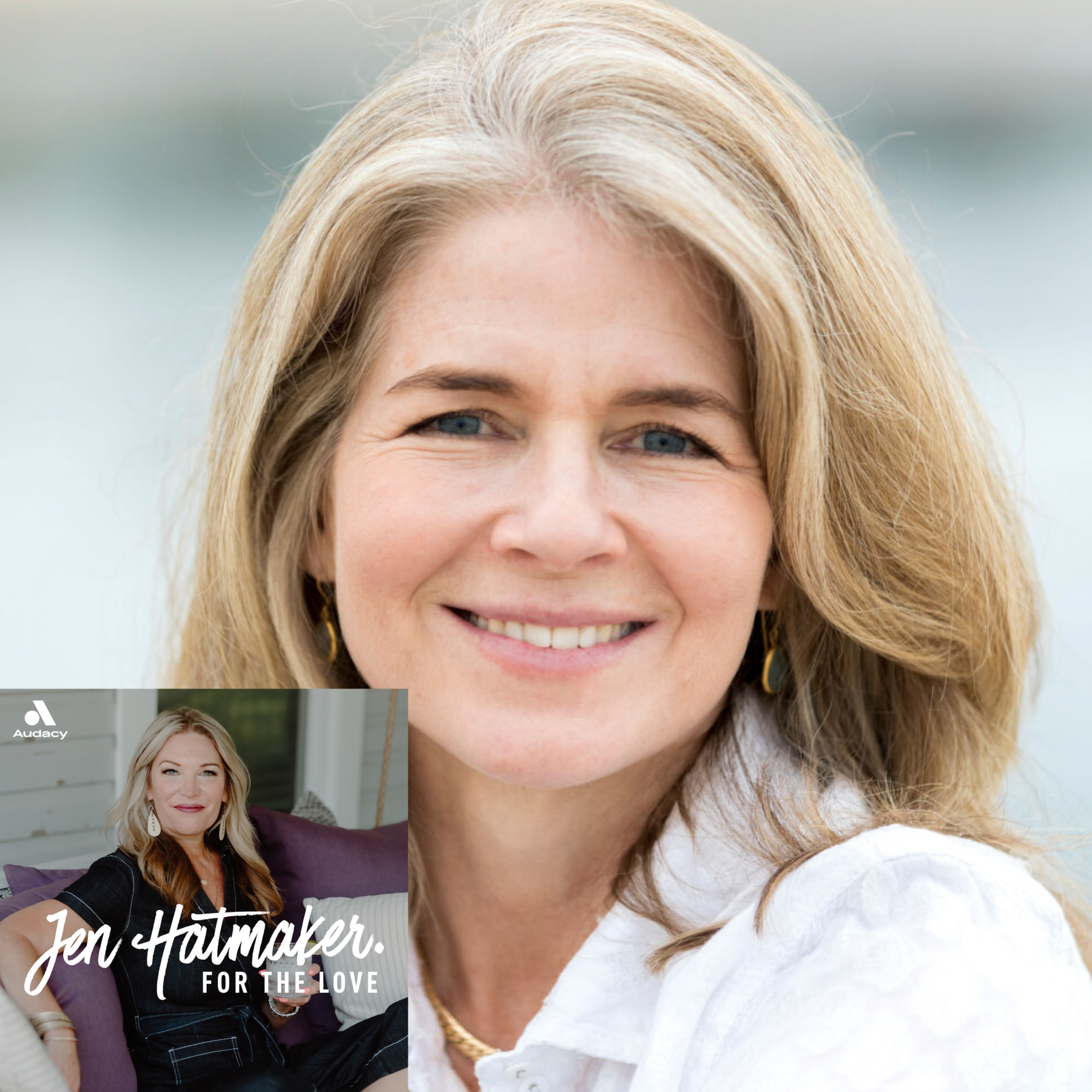
Adrienne Brodeur on Family Myths, Wounded People, and Honest Fiction
About this episode
Description:
Some families run on rules nobody ever wrote down. Here is your role. Here is what we talk about. Here is who gets forgiven and who gets blamed. We accept those terms as children, and then one day we look up and wonder who exactly signed us up for the job.
August’s Jen Hatmaker Book Club pick is Little Monsters, and Adrienne Brodeur came with the whole story behind it. She spent thirty years on the other side of the pen, co-founding Zoetrope: All-Story with Francis Ford Coppola, editing at HMH Books, judging the National Book Award, and now running Aspen Words. She published one novel of her own in 2005, then waited fourteen years for the next book, a memoir that broke a silence she had kept since she was fourteen.
Adrienne and Jen get into the unspoken rules every family runs on, why estrangement takes love rather than indifference, and what Cain and Abel taught her about the gifts we give our parents. Adrienne explains why fiction can feel more honest than memoir, makes an unpopular case for Ken, and talks about writing mania with compassion rather than spectacle. Plus the stack of books a stepmother handed her that redirected her whole life, the screenplay she is writing, and the book club’s standing offer to cast the movie.
***
Thought-provoking Quotes:
- He’s wounded, and wounded people wound. – Adrienne Brodeur
- Understanding someone isn’t quite the same as absolving them. – Adrienne Brodeur
- Fiction can sometimes feel more honest than memoir. I don’t mean factual honesty. I mean emotionally unguarded. – Adrienne Brodeur
- Who the hell decided that peacemaker was my job, or golden child, or secret keeper, or difficult one? – Adrienne Brodeur
- Turns out dead mothers still have an excellent work ethic. – Adrienne Brodeur
- Everyone wanted a flat version of themselves. – Jen Hatmaker
- We have family stories that we’re telling too, even believing, that we’re trying to believe. – Jen Hatmaker
- Some of our characters landed on their feet, but they landed on their feet in a different zip code. – Jen Hatmaker
Resources Mentioned in This Episode:
- Little Monsters by Adrienne Brodeur - https://www.simonandschuster.com/books/Little-Monsters/Adrienne-Brodeur/9781982198114
- Little Monsters book club discussion questions - https://www.readinggroupguides.com/reviews/little-monsters-by-adrienne-brodeur/guide
- Wild Game: My Mother, Her Lover, and Me by Adrienne Brodeur - https://www.barnesandnoble.com/w/wild-game-adrienne-brodeur/1130010789
- Man Camp by Adrienne Brodeur - https://www.amazon.com/stores/author/B001HN38FI
- Aspen Words at the Aspen Institute - https://www.aspeninstitute.org/people/adrienne-brodeur/
- Zoetrope: All-Story, co-founded with Francis Ford Coppola
Guest’s Links:
Adrienne’s Instagram - https://www.instagram.com/adriennebrodeur/
Get every episode summarized
Each time For The Love With Jen Hatmaker Podcast publishes, we email you a written briefing from the transcript — the topics, who appeared, and any specific claims, with the ad reads skipped.
Email me new episodesFree for 3 shows. No card needed.
Hosts & guests

Transcript ready
428 searchable segments. Every word is indexed and playable.
Full transcript
For The Love With Jen Hatmaker Podcast — Adrienne Brodeur on Family Myths, Wounded People, and Honest Fiction. Machine-transcribed; use the interactive transcript above to jump the player to any line.
Hey everybody, welcome to the For the Love Podcast. This is the Jan Hatmaker Book Club edition, which we love so much. I have such a fabulous novelist today calling all readers. You're going to love this conversation and you are absolutely going to love this book. I've got Adrian Broder today. Adrian has spent 30 years in the book world. Most of it on the other side of the desk, deciding which stories got told. She co-founded a literary magazine with Frances Ford Coppola, no big deal. She was an acquiring editor for years. She judged the National Book Award and she currently runs Aspen Words, which is the literary arm of the Aspen Institute, which puts on this incredible writers conference every summer and gives a yearly prize
to fiction that refuses to look away from the world. So she is out there finding the best scripts. Her whole career, mostly, has included her hands on other people's manuscripts. She did write one novel of her own back in 2005 and then 14 years went by before her next book, which was a memoir about her own family and it broke a silence she had been keeping since she was 14 years old. And for those of you who have read it, you will understand the bridge to the book that we're speaking about today, which is her novel, Little Monsters, an outstanding book that was the J.H.B.C. selection for August and absolutely one of the best books I've read this year. So without any further ado, Adrian, welcome to For The Love.
Okay, before I ask you anything about the book, before we get to the book. Okay. I would, I'm curious if you would tell me a little bit about the bridge. You say that you have like a physical, like a chemical reaction when you drive over it. Can you talk about that a little bit? I assume we're talking about the Sag More Bridge, which for us Cape Cotters, you know, it connects the all of Massachusetts to the Cape. But yes, I have a completely Pavlovian response. And as soon as I get that first burst of briny air, I feel like my blood pressure drops and my shoulders unclench and some, you know, just deep animal part of me says, womb. So it's less like arriving somewhere than almost just returning to myself, but it's really, it is physical. And I love it. And I haven't actually gone off the Cape this whole month. So I hope to, I hope to really settle into clamming and beach walks and just the smells of the tides.
And, you know, the stilness here, it's really, I mean, I know Cape Cot, it's very touristy and everything else. But if you're just in your own little bubble, you can find a lot of peace. Can you just say a little bit more about your relationship to the Cape? I have such a deep sense of location. And of course, obviously, we've, we're gonna, we've the book is set there. And so, this is a place that any, any like half-baked reader can read your stuff and go, oh, she knows this place. I do feel like I know the Cape and I know it in all these different ways. And on the one hand, I feel like it's very important as a non-local to identify yourself as a non-local because it is a really different experience to live here, read year-round. But I have been coming here for at least, I'd say, a third of the year, my entire life since I was an infant. And I've seen all different parts of it because my mother lived in one area. My father lived, you know, way an outer Cape,
which is much more like the sand bar. And he was a fisherman and a gardener. And, you know, so I, I just, I also feel like I have, you know, a near poetic appreciation for it. I mean, I love Mary Oliver, who is our, you know, we feel like our Cape Cot poet here. But just the way in which you can stare at the same view. And every tide is different, every, every movement of the sun is different. And some years, our little bay is covered in horseshoe crabs in another year. You know, it'll be muscles. And then the starfish will eat the muscles. And it just, it's just constantly changing and evolving. And it is so beautiful and transient. And yes, I could just wax on forever. I, it's in my bones. I feel very like Scarlet O'Hara and Tara like, this is my place. I love that so much. And that is really evident in your writing because it's almost like the Cape
is a, as a character. Like it's so vivid and so important. And the story is so specifically located. And that absolutely comes through. I want to go back with you a little bit to your younger years. I really loved reading kind of about your evolution, if you will, as a reader. And then, of course, ultimately, as a writer. But you've said, you know, you weren't necessarily like the, uh, for example, when I was in elementary school, um, I think maybe in fourth grade, my teacher called my mom and said, I'm worried about Jennifer. She doesn't play with anybody. And at recess, she just sits under a tree with a book every day. I was that kid. I was 100% that kid. And you say that wasn't necessarily your childhood, but that the right book was placed in your hands
at the right time. I just, can you talk a little bit about that? Sure. Um, and I wasn't that kid. I mean, I read, but I sort of read in your standard way, a kid might sometimes got into it, mostly didn't. Mostly would be a prefer to be outplaying. And I think part of it was I had, you know, kind of cookie writer parents. And I sort of like, you know, that is not going to be me. Um, but my, uh, my, both my parents also married quite a bit. And it turned out that my second would agree sentence, both my parents married quite a bit quite a bit. Quite a bit. Quite a bit. Each were married three times. And my second step mother, uh, owned an independent bookstore in California and weirdly, both my father and I fell in love with people from California and moved out at around the same time to San Diego. And I was, you know, just getting out of college at the time and Malayne, who is, her name is Margo in my memoir Wild Game, but she just, um, she was one of those fairy dusted, um, independent book owner types. You know,
these people, they read everything and they also read people deeply. And she, I just remember one of our first meal, she kind of handed me this little stack of books. And it wasn't a single book. It was, um, I remember there being Dalva by Jim Harrison, uh, the bean tree by Barbara King solver. And there was an Alice Hoffman book and maybe one or two others that I'm just not remembering right now, but they all, they all had to do with sort of young women figuring out their which clearly she could see I needed to do. And it just hooked me on reading in a very different way, not as sort of escape, but as information. And they kind of showed me lives that I didn't know that I could imagine for myself. I just, it, it just changed my relationship to reading. It also changed your trajectory. Oh, I mean, what did you think you were going to do with your
life at that point? What were your plans? I, I had a degree in public policy. I was, you know, well into a career as, you know, I worked for a local politician in San Diego. I was getting a big sort of what I thought was my dream job, which I suddenly realized would make me sort of a, a bureaucrat. And all this. And I also at the same time, notice like the literary journals on my bedside going up all the policy and public policy journals were going down. And so really, it changed everything. I just realized I wanted to be in that world. So I left my political job. I left California. I left the guy I was with. And I moved to New York to try to break in, you know, living above a curry and a hurry in a studio apartment in Murray Hill. And honestly, it was the best decision I ever made. And, you know, sure, it's not always the most, you know, a world in,
in editing. And so on is not necessarily the most lucrative career. But I am fully someone who believes you sort of follow your dreams and good things happen. That sounds a little sappy. But I remember my father giving me some career advice, which was mostly, I mean, in essence, don't be bored. Like we're all going to work a very long time and, you know, do something that you love. So I've had ups and downs in my literary career. But I have enjoyed pretty much every day of talking to writers, working with writers, spreading the word about books. I mean, it's, there's not much better. It's very romantic. I mean, the curry and a hurry. It's like a scene out of every good movie where they lead is breaking into New York publishing. Yes. Scrappy female. Those are just email. I just hear for it. And so let's, I'd love to hear you discuss a little bit.
The early part of your, well, I mean, I say early part of your career, you spent 30 years, essentially, as a person who, who's deciding you were a book decider. You were making big decisions about authors and stories and publishing. And before you sort of steered into your name on the cover. And so I mean, it's, it's like almost a banal question to say that one obviously served the other. But what were, what were the parts of, of being an editor and a curator really is what you were of other people's work, that number one like affected you the most. And number two ultimately played some role in you going, I'm going to put pen to page now. Yeah. I mean, it's a wonderful
question. And it, you know, it wasn't really like this completely binary one moment. I was doing that and one moment I was doing this because I'm actually still, although I'm not an editor anymore, I'm still, you know, involved in curating in some ways. And I run a literary nonprofit. But I mean, I think I'd been trying to tell my own story for years almost so like if my personal story, which I tell in Wild Game, not Little Monsters, but if, you know, as I was trying to figure out how to, to tell that story. And you know something about writing memoir, you know, it wasn't, um, it took a lot of forms for me. I mean, I think in my 20s, I was sort of writing, I've always been writing a bit, but writing sort of overly earnest literary short stories about it. And then, you know, when you're trying to process something painful, I mean, part of it was done with humor, it was my hilarious cocktail party pattern like, whoa, you know, and my exosmin is my stepbrother,
you get, you can, and I, you know, I wrote a pretty, I think what was a truly terrible rom-com about my life. And eventually I wrote a modern love essay. But what really sort of the moment that I realized how to write Wild Game, which isn't quite answering your editor to writing question, but the moment that I finally had my aha, this is how to write this story, was actually when my daughter was born, because in essence, Wild Game is a mother daughter book. And I thought I had processed everything I needed to process about my own mother and mothering. I'd therapy, you know, you name it. But when literally the day of her birth, as I'm, I had a C section and I was going up on the elevator and the doors open, and there's my formidable mother, Malibar, and I am so excited to introduce her to her first grandchild. And then it was like an elephant head sat on my chest, and I couldn't get words out, I couldn't breathe. I was like, and finally this very
officious and efficient nurse kind of whisked her into one room and me into another. And I was like, whoa, you know, that anesthesia, and she's like, that was an anesthesia, you were having a panic attack. I was like, and it just then really dawned on me that I needed to tell my story in my own voice and tell it in a straightforward memoir. It wasn't a hilarious rom-com, it wasn't these other things. In terms of the editing aspect, I mean, I think that was like my education the way some people's education is an MFA. I mean, I just informally read so much, intuitive what about structure is working, what isn't, and just, you know, just I do think for anyone who wants to be a writer, reading is absolutely the most important thing, and reading broadly, and trying to understand what you love about the books you love. And it's not, it just informs,
it informs you. This is such an impossible question for you to answer, I'm sure, but do you have a, did you have a favorite book that you worked on that has just that stuck with you in a special way that if you have, if you were forced to go, okay, that that project was definitive for me. This is an absolutely terrible question to ask. No, it is. I will tell you one of the one of the most wonderful things that I worked on simply because it was just a magical publishing story, and it was, before I was a book editor, but when I was a story editor and I ran a literary magazine, which I started called Zoetro Ball Story, and we commissioned stories. So in each issue, we would sort of assign someone a story, and I assigned, and we all focused only on really unknown writers at the time, and I assigned Melissa Bank, essentially the story that became the girl's guide to hunting and fishing. And we also simultaneously fell in love and became just best best friends. We lived in
the same building, you know, we just became part of each other's life, but watching, watching a story come from essentially an idea that wasn't even my idea, it was Francis Coppola, who was the patron of the magazine's idea, into this story that that struck such a chord that like the next, the day it got published, all these editors called and agents, and you know, then she went on this big trajectory and had, you know, a meteoric rise as a writer, and it was just, it was so fun to watch and to experience, and she was such, she died a few years ago, she was just such an incredible person and writer, and that was probably the most dazzling experience that way in my editorial career, but I had lots of books that I've loved. That's such a great answer. I cannot imagine how it must have felt to have sort of been such a key player at the origin story of an arc like that.
That's rare. That's rare and special. It is rare and special, but I will also just to, you know, diminish it just, I mean, I don't mean to diminish it. What I'm saying is, um, 30 years ago, I published so many wonderful authors first stories, and that was what was so fun about Zoetrop, as it was really, you were putting air and people's sales, but now of course, I, you know, I run this other organization, and people are always like, how did you get so and so, and I'm like, oh, I published their first story 30 years ago. Oh my gosh. You played the long game. Yeah. I mean, not intentionally, but it's certainly been wonderful. I mean, there are literally, um, dozens of authors whose first story was published in Zoetrop who've gone on to win Pulitzer's and other things and big prizes. So it's just, it's very fun. That's amazing. It really is a, a bit of a small community. It never seems like it, you probably, you must feel the same way as I do because it's like all my friends or authors.
Yeah. So to me, it just feels like everyone's an author. Everybody writes a book of your human, your job is being a writer. Like, that's what we all do. Yeah. One of the other jobs, I have no idea. But in fact, it is a really kind of small community of people who find their way into publishing, and on both sides of the pin, as writers and then of course, as editors and publishers and, and I just find it a wonderful life. It's a great, wonderful life. I don't, I can't think of another one. A couple of nights ago, I was having dinner with a whole group of friends. And the question at the table was, something along the lines of, what's the one job that you just used to do? You would rather be homeless than have to do that job. So essentially, what do you, what would you hate to do? And it was so interesting to hear everybody go around. And, and mine was just like, I,
I could not think of anything outside of a creative life that would bring me any joy. I'm like, and so my answer was, if I had to, yeah, I'm like, if I had to do a job that was just heavily located around logistics and operations, I would just perish. I think I would just shrivel up and, and that'd be the end of me. And so this is the life as messy and, you know, and we love to, we love to complain about our deadlines and our editors, but we don't mean it. We don't read it. We absolutely don't, but I agree. Anything that's just, yeah, like accounting, but I mean, when you first said it, I, I, I, immediately went to repulsive jobs. I was like, proctologist, never. I don't know what else, but I think anything like that just totally. Hey there. I'm Kendra Adachi. And my show The Lazy Genius Podcast helps you be a genius about the things that matter and lazy about the things that don't, and you get to decide what matters. I'm not here to tell you what to do. I'm here to give you a new
way to see episodes of the lazy genius podcast are full of compassionate time management tips and permission slips to do what makes sense for you. New episodes drop every Monday. Follow and listen to the lazy genius podcast on the free Odyssey app or wherever you get your podcasts. I want to go back to the, um, the bridge between wild game and little monsters. Um, it's interesting because you wrote a complicated memoir that was not like shrug, shrug, wink, wink, like you initially thought you might do, um, with the light touch. Yeah. You know, you, you wrote it true and straight. Um, and that's a hard thing to do. I, I was just, you know, we've just said, I'm a memoir writer too. And boy, that's tricky. It's tricky writing, uh, because people are alive and families are real. However complicated the dynamic is. And once that book is done, you still have to live with these people or
see them or whatever. So you had this complicated writing, um, task with wild game. And then you move over to little monsters, which is fiction. And I just cannot imagine that you did not feel a sense of liberation. I'm curious how that felt as a writer. Well, I will woo you into fiction now. I mean, the truth is it's, it sounds slightly counterintuitive, but I feel like fiction can sometimes feel more honest than memoir. And by that, I don't mean factual honesty. I mean, emotionally unguarded because in memoir, as you just said, these are real people. They are standing immediately offstage and you are always trying to balance the truth with the responsibility. And obviously not hurting anyone. You don't, you know, you just don't want to hurt anyone. And in a novel, you are not protecting anyone's literal life. So you feel much, you can let it rip. Like you can
go, you can push characters further, you can make the behave terribly, you can follow the story into the darkest, weirdest, most uncomfortable place. And I feel like in some ways, freedom, fiction gave me freedom to get at emotional truths that I might have approached a little more cautiously. That said, yes, liberating, very liberating. And also though, I mean, terrifying that at least with memoir, you kind of know the protagonist, you know the point of view, you know the basic facts of the world you're trying to tackle. And still it's craft. I mean, you, it's art, you have to figure it all out. But with fiction, the whole idea that anything can happen on any page. And oh, Abby can be pregnant. You didn't know that going in. And oh, so, you know, like it's just, it's for a little Libra like me who has tough time making big decisions. I'm just like, oh,
oh, it's as soon as you can find some structure and some narrowing, it's very helpful because it is such a wide world with fiction. I'd love to hear more about that. Can you talk about? It's always interesting. I get to talk to so many novelists. And I am absolutely fascinated with the mind of a novelist. And in the process, and of course, one thing I've definitely learned across the genre is there's just no one way in. There's not one set of, this is the way you process. And this is the every writer has such a different way of finding their story. I'm curious, I'd love to hear yours. Did you start with a character? Did you start with the plot point? Did you start with an ending? And I'd also love to know, did you have a real sense of where it was going and how it was going to end all along? It seems like you did. But I have no idea because hell, it may have
presented itself to you halfway through. And you wait for that. That's where we're going. It's interesting. I feel like my process tends to be noticing what I notice, which sounds so abstract. But the things that you start thinking about, just the silent conversations you have with yourself when you're walking your dog or doing the dishes or whatever you are. And I was quite fixated on siblings and how other friends of mine who had complicated sibling relationships and what makes two people from the same womb and same DNA experience the world so differently. So I'd been, I'd just been finding myself thinking a lot about siblings and estranged siblings and what was the cause of that. I mean, not the cause so much, but what would make siblings become estranged? And part of what I realized as I was just, you know, on my walks and
thinking about it, and I wasn't even really thinking about a book at the time, it made me realize it could only be, you know, great love that makes you need to respond. Like if you're indifferent to someone, you're not going to push them out of your life. And so that was the, that was sort of the starting place for me was thinking about, was thinking about siblings and I really didn't know where I was going to go. I knew I wanted to set the book on Cape Cod. I knew I wanted to set it in 2016 because I just, I found that such a, you know, powerful moment in history. And then the summer before the election, I just felt like, I don't remember the details of a lot of summers, but I remember every detail of that one. I just felt like everyone was on high alert. We knew the ground was shifting. We didn't know how. So I wanted these characters to exist then and then in that way, the readers would know much more about what happens in the world than the characters themselves, which was sort of interesting. But that was, that was kind of the starting place.
And, and then you start doing research. You asked me if I knew the ending and I, I didn't. And part of my story was when I was looking into sort of famous sibling stories, you know, I turned to Cain and Abel sort of, you know, the obvious one. And I thought like, whoa, I'm going to find out so much about character and plot and so on. And then, you know, I read it in 16 different versions. And it's like this, the most rudimentary Cain did this, Abel did that. Someone got killed, boom, like nothing. And I was like, what the absolute, that was not satisfying, but it actually provided the structure for the book. So that moment when I realized like, oh, it's in giving gifts to the father, giving, you know, the gifts almost always show more about the giver than the receiver. And these two siblings in the book, Abby and Ken are, they both give frankly like somewhat disturbing and inappropriate. Absolutely.
They're father, but they spend a lot of time thinking about it and caring about it. And I just, I found that really fascinating. So once I knew there was going to be a party and that these gifts and then like, you know, the horses were off and it was really fun. It was really fun to write. How long did it take you to write it? You know, I think about two years, like it was four years, it came out four years after a wild game came out. And I think that that sort of, you know, you, you, a book publishes, you spend a year thinking maybe a year writing, then a year revising and then it takes a year to publish. I mean, this is mine. Some people take 10 years and some people take a few months, but that sort of my, my pattern at this moment. I read that you, when you turned the book in, you had, you know, you'd made a deliberate choice with, with Abby's mom, you know, we just, we never, and you were like pleased with yourself. And
um, then you got a some response from your editor. Can you talk a little bit about that? Done your homework. So yes, after wild game, I thought mother, daughter, relationship, and my process done with that. I've moved on to siblings and a father daughter. And I was fully entering new territory. And my proof was that I killed the mother off in the very beginning of the book. So yes, I was also proud. And I announced such to my wonderful editor like, oh, you will see, I am over my mother's ear. And she of course read the book. And you know, she calls me and she's like, you do know, Adrian, that the mother haunts everyone, every character in that book for the whole book. And I was like, oh, yes, she's right. Apparently, um, yeah, turns out, uh, dead mothers still have an excellent work ethic. It was a nice try. It was a nice try. I appreciate your effort.
I'd love to talk a little bit. You wrote, you wrote some real memorable characters. Um, in every way, every one of them is unforgettable for different reasons. Um, I'd love to talk a little bit about Ken. Oh, Ken. I just want to hear you talk about Ken because Ken is the character that people like the least, um, for obvious reasons. And, um, but you like him. And I'd like, I'd like to hear the evolution of Ken in your mind and your understanding of Ken, even. Yeah. And I do love Ken. Although, well, love might be overstating it, but I feel for Ken. Ken, poor Ken, he is this dude that cannot get out of his own way. And I feel like we all know people like Ken. I've dated a couple people like Ken. Um, but he carries enormous wounds of abandonment.
I mean, his mother died. His stepmothers have left. Um, he adored his sister Abby, who kind of pushed him away when she, as she grew up and hit adolescent. So, you know, the big thing about Ken is he's wounded and wounded people wound. And, um, I have, you know, I'm not saying everyone needs to love him. I have compassion for him because I usually think, I, I think people who act like jerks generally, there's some pain underneath it, not always. And it doesn't excuse the bad behavior. He's still responsible for the damages he caused. But, um, understanding someone isn't quite the same as absolving them. And I, I want it readers to see the hurt child in this very difficult man. Yeah, you did that. You did that. And by the end, it, it, if everyone started a little
flat on the page as they wanted to be presented, everyone wanted a flat version of themselves. This is the perfect family. This is the simple artist. Um, the quirky artist, you know, if it started flat by the end, I mean, it was topsy turvy, you know, you had really surprised me as a reader. I was really surprised, um, by the store, in a good way, by the story arc. And then the slowly emerging history that you save for that like shock and awe at the end. I mean, you just kind of went scorched earth. And, um, so it was such like a satisfying, such a satisfying story. And I think that was one of my favorite things about the book and something that is deeply in conversation in our book club, obviously, which is just this idea that that is a very common idea, frankly, that we are born into a family. And then we, we craft a story
around the family. This is who we were. This is what we did. This, and it's almost always a little polished and a little shined up. And, um, these were the terms of our family. And we accepted these terms. Yeah. Um, and so getting to watch a family kind of unravel under the weight of the truth um, inside this novel, it's, it's prickly. It's prickly because it makes your reader go, we have family stories that we're telling too. Even believing like that we're trying to believe, I, I wonder how, um, if that surprised you at all to sort of watch that unfurl in that particular way. And how resonant has that been with your readers? I mean, I think
surprising and not surprising like it's a surprise, you know, we all come from families and all families have these unspoken rules, you know, here is your role in the family. Here's what we do talk about. Here's what we don't talk about. Here who get who gets forgiven and gets blamed and you know, keeps the peace, right? We all, and as kids, we kind of accept these rules. And, and we just accept them as the truth. We don't question like, well, this is weird because it's you only have one family and we grow up in it. Um, but then at some point, you know, I think there's this disconnect between, you know, accepting what we've grown up and mistaking the arrangement for truth. And someday we're kind of like, wait, who the hell decided that peacemaker was my job or golden child or secret keeper or difficult one or whatever it is? And, and then there's a moment to renegotiate that. And which is never easy, obviously. And I think, I mean, I think it's a natural stage in growing up. I mean, I certainly remember my own version of this in my family, which was,
yeah, this is not my growing up version, but as much as my later in life version, I just remember at one point feeling like I had to decide like, do I want to feel resentful or do I want to feel guilty? Like I'll feel guilty if I don't do this thing that they all want me to do. But then I'm just going to resent the hell out of it. And so I decided that I wanted to feel, you know, I'd let myself feel guilty from time to time and not do everything that's expected. I feel like I'm sort of drifting away from the question. That's good. The great answer. That's the thing that I think about. And I think in any, in any novel about a family, um, you know, there is sort of, there is that breaking of what is expected. And you know, it's true in probably marriages and just time. I mean, we all change, right? It's so true. And in that way, it just felt even though the circumstances of the family's life that you invented are so specific to them. And
there were other elements that just felt super universal, super relatable. When I think I'm curious about Adam and your decision to assign a bipolar disorder to him. And I've got that that experience in my life, um, well enough to know what's the, what that mania is like. And it felt true enough that I thought she's going to have this somewhere in her life. Um, no, I have much mental illness in my family. But my father, my father was a very high functioning bipolar person. And I think, you know, I mean, he, he was very high functioning. And he was a New Yorker writer. But I think in some ways, those periods of mania, you know, and paranoia probably made him the brilliant investigative journalist. He was. Um, and, and, you know, so I didn't, you know, Adam has some similarities. He is not
Paul Broder, my father at all. Um, you know, he's a marine biologist and a satologist and all these other things. But these, I think the thing that sort of went across characters, but most specifically with Adam was this moment that I think all people experience, which is a little bit about relevance. And Adam in the book is turning 70, but I feel like you can have this at any point in your life, which is really like, oh, is, is this, is this what it is? Like is this what, you know, because we all have such big dreams as kids. And at some point, you know, we reckon with what we've accomplished or not accomplished or what we still want to do. And I think, I think, um, Adam was really at this moment where he's having that reckoning as a 70 year old and, you know, on the precipice of this big discovery and also at the same time, you know, opting to go off his meds in order to,
you know, experience the rush of the grandiosity and the mania and trying to capture this, this feeling. You wrote it really well. All of us in our little crew who have some personal experience with, with bipolarism, some in our families or in our circles, or I'll just like, oh boy, that feels true and honest. And I thought you also wrote that compassionately. Well, I mean, I sort of feel like it must be so hard to stay on those meds when you know you can feel this good, this brilliant, this everything. And I, you know, my, my father, as I said, was, you know, I think everything's a spectrum. And I think he was fairly mild and a slow cyclore and all that. Whereas I, I do know other people and I was, I didn't, as I said, base it on him alone by any means. I read a lot of personal experiences with bipolar disorder. But, um, yeah, I think, I
mean, I don't, I mean, I think we all have highs and lows and I don't, but, you know, if you could keep your, like, oh, I got it. I mean, you know, you know, this from writing a book some days, you're like, this is brilliant. And other days, you think, oh, this is terrible. And, um, yeah. So I also don't want to confuse it with people who are very, very ill with that disorder, um, because this was, you know, a more mild and manageable situation. Um, all the characters stick with the reader, you know, I just found myself thinking about them. And, and you, you left it with plenty of story left potentially to tell, um, with Abby's rebuilding her family in a new direction. And there's a reckoning in Ken's family with Jenny and, and what's going to happen with Adam. And I'm just, I'm curious if you have any impulse, um, to write the second, the second iteration of
their, the next installment. It's, you're like one of the only people that have asked me this. And I love all of them. And I think about that a lot. Like I think about what's Jenny up to. What's, I, I, I feel like any one of them could, could warrant more. I mean, particularly, for some reason, I'm particularly, I love Jenny. Um, she was just such a white hot mess in the best way. Um, and, you know, she started so polished and print and kind of, um, you know, whether she was, yeah, she just, she was letting go. Um, so yeah, I think about it. Is it on my current horizon? No. But I'm, I'm actually right now. Um, I recently handed in, um, my, my, the, the draft new novel. And so one of the things that I'm doing right now is I'm writing the script for Little Monsters, um,
which I wasn't expecting to do. And has been such an interesting exercise. And the first thing, you know, first you have to condense, I don't know, 400 pages or 375 into a 90 page script with is, you know, you know, I like describing KitKud. Well, there's none of that. It's just I logged. And, you know, it's so distilled and condensed. But what I realized is I also have to pick someone's story. It can't be Steph's Adam Ken's Abby Jen. So, you know, whose story is it? And then which do you really let go? And, um, you know, I'm only at the beginning of it, but it is a completely different writing exercise. I'm finding it very challenging, but kind of, you know, liberating and interesting. So we'll see. I love that creative puzzle. Yeah. And it's fun to have to exercise a brand new muscle around characters you know deeply, but in a completely different direction. That seems like a really exciting challenge. Yeah. I mentioned it. I'm sorry. I was going to say, think about
how different the movie would be if it was Jen Jennings movie or yeah, or Ken's movie or Adams. I mean, my agent said, oh, you know, it's Adam's movie. And I was like, I don't know about that. But I just feel like everyone bonds with a different character in that way. I mean, it's made for film. It's just made for every bit of it. The the tension, the setting, the characters are so vivid. Like, I have an idea what they all look like. But I just would love to see this come to life. You and me both. We'll see. Yeah. That's really exciting. Before I let you go, you mentioned that you just handed in your next project. Is it too soon for us to know anything about that? It kind of is too soon to know because I feel like I have been so in the deep thick mess of it that I have no idea how to talk about it yet. So
yeah, so I don't know how to talk about the novel yet. I will figure that out. Yeah. So yeah, dodging that one. Yeah, you're like in next. That's exciting. Other ratings. So like, the script is one I'm also about to launch a substack, which I feel like I have been kind of avoiding doing mostly because I just didn't want to have. You know, I feel like so many author substacks are kind of similar. Like, oh, what I'm reading. And here's my artfully placed coffee cup next to my book. And I just was like, I don't want to put another author newsletter in the world. But I've been thinking about, I'm calling it stray observations, but thinking about, and you will be able to relate to this, all the magical, unexpected people that have come into my life through books. And I'm not talking about, oh, the other famous authors, you know, you meet in the world. But more the, you know, the person you
have not seen since you were seven who shows up at a reading of yours in San Francisco. And then you do this connection. And I mean, I have had so many of those and that have really profoundly changed my life or added new people to it. So I'm kind of interested in doing little mini bios of them or, you know, the people, the things, just something like that. So I love that idea. That's original and interesting. I write it on substack too. And it's a great community. It's a great place to write. Yeah. The internet is so bananas. And like putting our writing just out on the big wide world web, it can be just such an invitation for misery. But substack is like this little harbor of readers and it feels a little safer and more. That's not good. No, less flashy. Yeah. And also,
I don't know about everybody else's, but I don't have mine is not the curated cut by the, it is, you don't have to do any of that. That is not what my experience of substack community is looking for. They're not looking for that razzle dazzle. They can get that on Instagram. Yeah. They're looking for substance. And you've got so much of that to write about. And I look forward to that. You'll have to give me the link for your substack when you launch it. So I can make sure that my community knows to subscribe. I will do that. Thank you. Yeah. Yeah. Absolutely. Okay. This is so great to talk to you. I was really, really looking forward to meeting you. And I really, really loved your book. I love your writing style. I really appreciate that you gave us complexity, that it wasn't tidy, that you didn't give us sort of any saccharine ending. You didn't. It's not to say that some of our characters did not like land on their feet, but they landed
on their feet in a different zip code. And I just, I appreciate that. And the fact that I'm still thinking about them. And I read it a year ago. And so I can't wait to find out about your next novel. And I know exactly what you mean when you don't have the language for it yet. It's just like a word salad, like just a word vomit. You would have thought. Completely. I remember when I was just starting the very front edge of interviews for a wake, which is my last, uh, Nymar. And I, I'd maybe laid down one interview and I had to kind of work with my, my publisher. And they were like, let's, let's work on getting this tightened up. I'm like, I know. I don't, I can't, I got to pull it in tight. I'm so sorry. I'm, I'm unpracticed. Um, anyway, this is marvelous. So thank you so much for your time today. And our book club loves it. Of course. Um, everybody comes from hard families. A comprehensive families. So it feels, um, comforting.
To read about a fictional family. Go, okay, we're kind of all in this thing. Trying to row our little boats to shore. Um, can you just before we sign off, where's the best place for my community to find you and to follow you and obviously, Substack is on its way. But where else? Well, everything is pretty much my name. So Instagram, Facebook, Adrian Broder, Substack is going to be Adrian Broder writing. And I think that's going to really come out in the next day or two. I will say, oh, yeah. I'm one of the people who has been hacked and my domain name got stolen from my website. So now instead of Adrian Broder, I'm Adrian W Broder. And I have just, I'm so proud of myself, just rebuilt that puppy from scratch by myself, just because I wanted to finally figure it out. So I wouldn't be as beholden to other people totally with it. Um, but yeah, so pretty much Adrian Broder will get you to the pieces where you can find me. Okay. We'll
ground those up for everybody for sure. Okay, we'll we're pulling for you. Um, we can't wait to watch Little Monsters, um, the movies. So, um, also me and my book club, we have casting ideas. So if you need some excellent, the judge, please. Yes, yes, come back to us. We're very good at casting our authors books. Um, and we do it like pathologically. So, um, anyway, great to meet you. Great to meet you too. Thank you again.
More episodes
More from For The Love With Jen Hatmaker Podcast
Encore: Barbara Brown Taylor on Being the Saint of Small Things
For The Love With Jen Hatmaker Podcast

Priya Parker on Fighting Well, and Why Conflict Is Not Sin
For The Love With Jen Hatmaker Podcast
Your Life Is the Assignment: Jen Hatmaker Solo Episode
For The Love With Jen Hatmaker Podcast
Jodi Picoult on Banned Books, Buried Truths, and the Story Behind Hollow Bones
For The Love With Jen Hatmaker Podcast