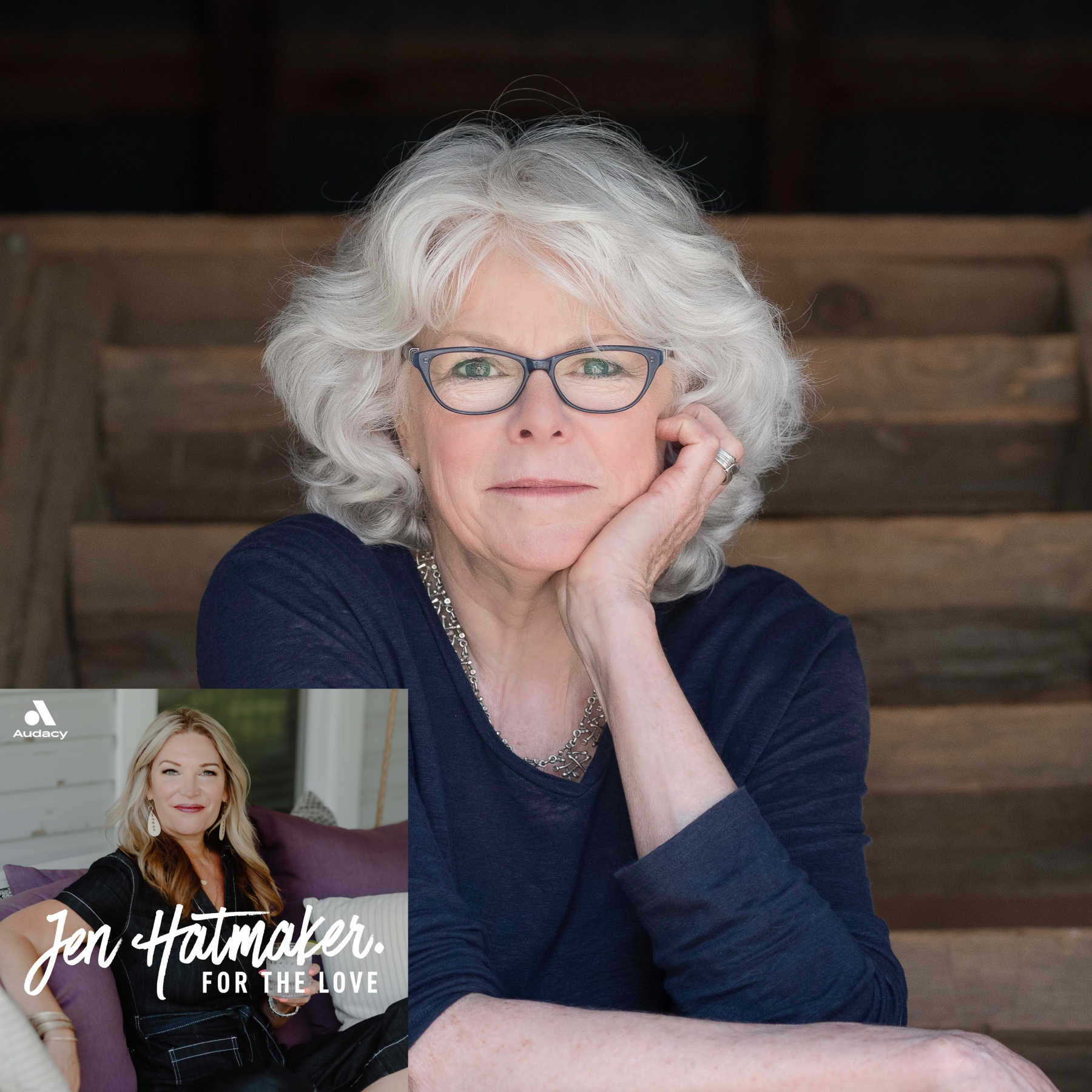
Encore: Barbara Brown Taylor on Being the Saint of Small Things
About this episode
Description:
Barbara Brown Taylor gave us the question that ends every episode of this show, so it feels right to hand the Sacred Work series over to her. In this encore, the New York Times bestselling author, teacher, and Episcopal priest talks with Jen about the year she spent doing almost nothing impressive: the county fair with a couple of six-year-olds, an old racehorse nobody wanted, blueberry pies for friends going through hard things, and shifts at the public library. She calls herself the saint of small things, and she is honest about how hard that is to say out loud when people want to know what big thing you are working on. They also get into why she is wary of hope that functions as an escape hatch, how she keeps her heart from going wooden in a world of terrible headlines, and why friendship is worth protecting even though nobody rewards you for it. Stay to the end for the benediction Barbara wrote for this community.
Thought-provoking Quotes:
- I’ll be the saint of small things today.
- Headlines give me omniscience but no omnipotence.
- I’ve got to attend to the sustainability of a supple heart.
- I’m real wary of hope unless it functions right here, right now.
- The years are short but the days are long, and that’s a blessing not a curse.
Resources Mentioned in This Episode:
- A Rhythm of Prayer by Sarah Bessey, which includes Barbara’s contribution
- This Here Flesh by Cole Arthur Riley, who has also been a guest on For the Love
- When God Is Silent by Barbara Brown Taylor
- Leaving Church by Barbara Brown Taylor
- Learning to Walk in the Dark by Barbara Brown Taylor
- An Altar in the World by Barbara Brown Taylor
Guest’s Links:
Website - https://barbarabrowntaylor.com
Facebook - https://www.facebook.com/authorBarbaraBrownTaylor
Connect with Jen!
Jen’s Website - https://jenhatmaker.com/
Jen’s Instagram - https://instagram.com/jenhatmaker
Jen’s Twitter - https://twitter.com/jenHatmaker/
Jen’s Facebook - https://facebook.com/jenhatmaker
Jen’s YouTube - https://www.youtube.com/user/JenHatmaker
The For the Love Podcast is presented by Audacy.
Get every episode summarized
Each time For The Love With Jen Hatmaker Podcast publishes, we email you a written briefing from the transcript — the topics, who appeared, and any specific claims, with the ad reads skipped.
Email me new episodesFree for 3 shows. No card needed.
Hosts & guests

Transcript ready
171 searchable segments. Every word is indexed and playable.
Full transcript
For The Love With Jen Hatmaker Podcast — Encore: Barbara Brown Taylor on Being the Saint of Small Things. Machine-transcribed; use the interactive transcript above to jump the player to any line.
Hey everybody, Jim Hatmaker here. You're very grateful host of the For the Love podcast. Welcome to the show. All right. We are in the middle of our sacred work series. And today, as promised, I am bringing you back to a conversation that I have thought about more times than I can count. And we actually probably haven't in 10 years of podcasting had a previous episode fit so perfectly into a thing as this month. We've got Barbara Brown Taylor back. So she, if you don't know BBT, she is one of who I would consider my most important spiritual mentors, which is a very short list for me.
And it's primarily populated by people who are older than me because their lives have borne a credible witness to their message. You know what I mean? They're not like shiny young snappy like gifted orators with weird skeletons in the closet. These are people whose lives have been marked by consistent, beautiful faithfulness. And Barbara is certainly one of those. She's a New York Times bestselling author. She's a teacher. She's an episcopal priest. And one of her books among many is Leading Church. And the other one is an alter in the world. Learning to walk in the dark. These were my sermons in a decade when I needed them desperately. She's also the reason I used to end every episode of this show with the question, what is saving your life right now? That was her question. And I borrowed it from her years and years ago.
I'm here, especially belongs in this series. I bet a lot of us came in assuming quote sacred work meant the big thing, capital B, like the calling, the platform, the career, the huge project with your name on it that you were searching for, right? Like located in your future, if somewhere out there, you were going to find it and it was just going to be massive. Barbara certainly talks about sacred work, but she locates it in other places like the county fair with a couple of six year olds. These are her stories. An old racehorse nobody wanted. Blueberry pies for friends going through it shifts at the public library. Barbara calls herself the saint of small things.
So perfect for this conversation. We recorded this at the end of 2022 as a benediction to the year. Stick around to the end because she wrote something special just for this community and I cried through the entire thing. So here she is, the wonderful, wonderful Barbara brown Taylor. All right, Barbara, I'm so delighted to see you every time I ever get to be with you in any way, virtual or in person, I feel so lucky. So thank you for thanks for being here today. My deep pleasure. Thank you, Jen. So you've been on the show before and I filled in our listeners with a little bit about who you are for those of them who are need you, but I wonder if you could just start here on this particular episode by sharing just a little bit about kind of where you are in the world right now.
And maybe even what's been capturing your attention lately. I'll do that because I think it's important. All you can see is a library. I'd be outdoors if my broadband would go that far, but it won't. So I live on a farm in rural North Georgia, which means I spend a lot more time with birds and dogs and cats and horses and chickens than I do with people. So everybody listening should be cute. I am not a city person. I'm a rural person. And I'm also a person who just celebrated a birthday with a big zero in it. So I'm a good end of the year guest on your show. I'm a person, a woman of a certain age and it has a lot to do with with what we'll talk about as well. I can't reflect on a year without thinking about probably how few I have left. So this is my gratitude exponentially. I appreciate that so much. I am coming up on a birthday with a zero net. It's a new it's a new zero for me to. And just realizing that it's becoming clear like this really does it really does go like this. It life really does go like this. It kind of goes fast and just like that. I'm probably past the halfway mark.
And I appreciate I look forward to hearing what you have to say about that. As you know, because I've told you many times your voice and your work have been a real guide or comfort to me. You've been a real leader and mentor to me through many, many, many seasons of life as it turns out. But let's first talk about 2022 for you. Maybe you just sort of touched on it just now sort of from a high level. But I wonder if you could talk a little bit about what was good, what was hard, what where did you grow? What did you learn? Maybe a little bit of a highlight reel of BBT's walk through 2022. I resisted picking up my calendar and giving you a literal answer to that. So I think the most important thing to say is it's been an odd liminal transition space between two heavy pandemic years and then seeing what comes next with really no assurance about what comes next, which I think for people of faith is a great walk, a great kind of trust walk.
So my 2022 has been a lot about deciding how much normal I want to go back to and and what kind of a tempo I want to live because at this point, everything's picking up again. And I have found myself rushing and busy and distracted. And I remember that too well. And there are not enough years left to live like that. So 2022 has been for me a hinge year. It's been a year for coming to terms with age, both the fear of what that means and the invitation that it brings. Perhaps especially for a woman, I'm not sure about that. But the fear is about the stereotypes. It's just amazing how many well meeting people condescending people who gray hair. Come up behind me when I'm riding a bike and say, you're doing a great job. I want to say, thank you. But I've decided to use the sideline as a kind of way to get away with things like I can dress like I want now. And if my makeup's all over my face, nobody's really going to look close enough to notice. And I've even experimented with being a little bodyer, rowdier. And you know, why not make use of the stereotype of the eccentricity of age.
So 2022, I've been doing that, but I've also been pulling back from public life and living a lot more locally. So when I look at the calendar, it's things like going to the county fair with two, six year old girls and her twins or adopting an old broken down race horse or bacon blueberry pie for friends going through hard times and volunteering at the public library. And all kinds of things that are hard to say to people who say, what are you working on now? Because they're looking for something big and productive. And I'm tending to relationships with people and creatures. And it has been bliss. It's been bliss. Though I have been, of course, like everyone fixed to terrifying headlines, spending good year, but nonproductive in a major way or an impressive way. So I'll be the saying to small things today. I love that. That sounds comforting. That sounds like a relief. What I also love and very interested in seeing a bodyer Barbara. This is really exciting. So you can, you can bet that I'll be paying attention to that version of you. That is real thrilling. Okay.
Okay. So I want to talk for a minute about rhythm of prayer. This was a really beautiful collaboration that came out recently between you and quite a few very beloved authors. Helmed by Sarah Bessie, who's one of my dearest investments. I was hoping that you might be able to talk about what rhythm of prayer means to you. What, what does that mean? How can this idea, maybe this practice, if you will, bring us comfort or sense of presence, even healing during tumultuous times, which is always. Let's tag that that can be our headline. That's right. Here's what's comforting to me is that a rhythm of prayer is both settling into what is, in other words, the rhythm of a day that early morning praying is different from late night praying.
That there's a breath that comes several times every minute. And there's a rhythm of prayer that can be linked to that. But there's also a way in which for me, at least a rhythm of prayer is a breaking of the pattern of the day. It's literally putting on of the breaks. And stopping whatever I'm doing in order to attend like a lady in waiting to what's happening around me. So there's that. And then seasons of prayer really matters to me. I prayed much differently in my 20s than I did in my 30s or 40s or now. And to be patient with the changing seasons and not insisting that spring be like fall or that winter be like summer. But to be patient with the rhythms and to trust, to trust the change in them. So so both of those that there's a rhythm that is settling into a pattern. And then there's a point at which the rhythm means breaking the pattern to insert a slower rhythm, a more attentive rhythm and it changes through the seasons.
So you're saying that feel like a lot of some of the parts of faith that I was handed earlier when I was younger, carried with it this message that was both overt and covert, which was that change is suspect that there should be a very fixed way that faith. So practice your faith that that that the consistency says something about your faithfulness and change says something about your faithfulness that you. And that hasn't been true for me at all. And I appreciate hearing from someone like you that that is not just normal and expected, but even good good. And it's good that our prayers change through the decades and that our faith even shifts. And we pray and how we even think about prayer, how I thought how I think about prayer has changed drastically over the last 20 or 30 years. And so I think you for always leading us gently.
Like that out of the confines of sort of more rigid dogmatic faith and into something a little bit more tender. A little bit. I don't know fluid is the right word, but a little bit more malleable. And as we grow our faith grows. I hope so. Otherwise it's an antique. I mean, the way you talk about it never changing that's like in order to pray faithfully, we must ignore everything that is happening around us and in us. That's right. That's all become plasticized. Yeah. And that's a plasticized prayer. I'm not either that trade off feels too hard. You mentioned this just now very briefly, but in rhythm of prayer, your portion explores the idea of God or of being with God, obviously in nature, but also in breath, which you just touched on. You you assert to us that perhaps we don't always need grandiose or formal preamble to come in with God that he's already on the mountain with us, so to speak.
You have you've written about this and taught this and led this four years. I feel like some of my earliest glimpses of this were from you well before I kind of understood it experience what you meant. Can you share a little bit about you, your personal story and how you've arrived there and this sense that God is already with us and we are already communing and we are already communicating and some of it is a little bit more mysterious and in the soft tissue of the thing, not just the bones. I love the soft tissue, which doesn't survive right all archaeology is about the hard things the guns, the bones, the buildings, but where did the soft things go. So the business about being God with us, I mean, I've struggled with that I read a little book call when God is silent. It's a part of realizing God is with us is giving up illusions that means that God is very chatty and always available.
I mean, I'm an introvert, so I recognize when I see one and and sometimes God with us means God's silent and withdrawn and that that does not mean God's gone. But I also noticed how many religious authorities and gurus make a fortune over the idea that God is far away and that there's some magic that we have to perform, you know, or buy a bottle or follow a routine and really if you dig very far into that it's about how to control God, how to get God to respond better or how to feel better about my own prayer life. So I've also gotten suspicious about that and to decide that to trust that God is with us, even when God's quiet or not easy to talk to is a rebellion against those who would control access or tell us we're not good enough or not. Not ready. That's comforting for all of us who have expected a non-stop barrage of messaging in the divine way and discover that in truth there's there's quiet, there's stillness, sometimes there's silence and that's just as godly and just as connected even that really takes some discipline and practice to discover.
A lot of your ideas and rhythm of prayer but also just in your work in general, it seems like it draws from some other religious traditions from around the world, some Buddhist leaning, some other, there's so many other faiths in the world that have a lot to say. And I wonder if you think that's true and if your time as a world religion professor influenced your ability to learn and to listen from other traditions at the same time that those tenets deepen your own Christian faith. Sure. Sure. And the good thing about my understanding of my Christian faith is it's the religion of the neighbor and it's the religion, you know, whose prime teacher said if you've got to choose between your religion and your neighbor choose your neighbor because I never told you to love your religion.
So that's a great help and a liberation right away. So I have soaked up the others and I've got holy envy of almost all of them. But as you say what they've done. When I get really India's turn me back to my own tradition to dig deeper because in 2000 years almost everything's in there somewhere, you know, either in scripture or in the traditions that have grown out of it that can give me back lost treasure. So, you know, we may end up talking about love of creation, which is I think a lost treasure for Christians who've been taught that God is above and outside of creation and any love of creation is pagan or druid or new age or or something. So I find that not true. There's a strain of Christianity called creation spirituality. You can hear people talking about Celtic Christianity. And what I think they mean is a trust in the we don't live in a soul less creation. You know, we live in this remarkable world where all breath comes from the divine and the divine inspires all that live. So how could the divine not be in this as well like a trademark or thumbprint. So so I have found that in Christianity will not let it go.
I that is as sort of faith tenet that has been new for me, probably in the last 15 years just certainly did not wasn't raised to cherish creation and to see it as sacred. And even as an extension of faithfulness, our stewardship of the earth and our even our enjoyment of it. I might my faith on my childhood did not teach me that God had any interest in our pleasure. That was just not in fact that the opposite was more true. Like the harder something was probably the godlier it was or the more I denied myself something that felt beautiful or wonderful that probably meant I was being obedient. And so this idea that isn't that that God made this world to just be so enjoyed and to heal us into our shirt, nurture us and that feels so crystal clear true to me now that I'm shocked that it wasn't always.
But yeah, some other faith traditions are really good at that and have raised that up to like I think a lot of our attention and I'm grateful for that as well this year's been in some ways beautiful like all years and in some ways got wrenching like all years. I think you know I'm down here in Texas and we have seen such kind of just unfathomable like gun violence and loss this year in you've all the and of course all around the United States. It's not unique. It just was close to home this time and and just so so many losses. It's been a hard year and collectively we've suffered in the pandemic has created so much pain and continued suffering. We're still in it. And so from I'd like to hear from you because I know that you've learned this over the years because life is hard. That is just true.
We're faith is in an inoculation against life or pain. And so what if you learned along the way about grief and how to hold your grief how to manage your grief what to do with your grief. In a way that both allows you to move through it and heal but also is healing for the world. This is going to be hard to say because headlines are how the larger world is delivered to me. But it's also full of stereotypes because it has to move fast move fast give you the news move on to the next news. I just got a letter from a man in Australia who said he found my work and he was so pleased to find it because he thought all southerners were stupid backward people you know who walked around with Marlboro's rolled up in their t and I just like good grief do you know so so I read the headlines twice a day and in between I don't because headlines give me omniscience but no omnipotence.
In other words they show me all the grief going on everywhere but they give me nothing to do that be broken by it. In other words they give me a God's I view with no God like ability to take it all in. So in order to prevent a ke halist heart or when it just deadens and scrolls through the headlines. I limit my exposure and I read my local newspaper which only comes out twice a week I read every page you know with the recipes that are combined with Bible passages and the celebrations of the 50th anniversary is in the little kids making green cards for the folks at the convales and I keep the local in there with the global that's good but I also attend to the griefs right in front of me locally there's plenty going on in my little county that is grievous and if I break my heart over what's happening everywhere else I won't be attentive to what's happening here I'm reading a book called this here flesh by Cole Arthur Riley I don't know if you've on your own.
She's been on the show I read every word of that book every word of it. I'm so profound. It's amazing and she just ran me through the 23rd song again about how rest is a kind of sad to anxiety and grief. Hey there I'm Kendra Adachi and my show The Lazy Genius Podcast helps you be a genius about the things that matter and lazy about the things that don't and you get to decide what matters. I'm not here to tell you what to do I'm here to give you a new way to see episodes of the lazy genius podcast are full of compassionate time management tips and permission slips to do what makes sense for you new episodes drop every Monday. Follow and listen to the lazy genius podcast on the free Odyssey app or wherever you get your podcasts. But the same song that talks about walking through the shadow of death is the song that talks about being led to green pastures and besides still waters. So I'm my final answer your question is I've got to attend to the sustainability of a supple heart and all of that means you know as we've been talking about kind of changing closer for the back local global just finding a way to remain present.
All the things you just named and more without becoming wooden or completely fatigued beyond any usefulness and that's a work in progress. Yeah me too. On the other side on the other side of the equation what was your if you have one your favorite thing of 2022 your favorite memory or experience or whatever that kind of rises to the top for you. I would like to tell you it was lunch with the Dalai Lama maybe you know or you know when I received the medal of something ready. I just cycled out of my zero bursting into it burst a with a one in it yeah and and it was just a week ago and I spent it in the North Carolina Arbor item with my beloved of 40 years. Walk in trails and watching people run with their dogs and eating a sandwich by a creek and taking pictures of leaves with our snapshot things so we could figure out what the heck that was and it was just bliss it was a little kiss of eternal life you know on a birthday so.
So I would rather think about something that happened last week then go rummaging around for January or February. It seems to me it'll always be terrific if I can find somewhere you know a favorite memory that happened a week ago. That is so good what a wonderful answer. I just sent my brain spending like yeah favorite thing from this week what's my favorite thing from last week there's always something. There's always something they're lovely things to celebrate and to cherish. What about this Barbara what are you most hopeful for about 2023 I as we look ahead knowing of course as always we will there will be painful things that will be suffering but there will also be beauty there will be joy there will be love there will be new babies. Life keeps going in a beautiful way to so I wonder what you're personally looking forward to.
Let me deal with hope from in it because this is something I have gotten from teaching other traditions is the way which hope can be doesn't have to be but can be an escape hatch. You can become a way of not being in the present a way of refusing what is happening right now and a kind of. Insistence on a better thing coming you know and so I'm real wary of hope unless it functions right here right now and and so hope becomes really a wish to be more faithful to the reality I'm planted in when it's horrible and when it's lovely and to keep my responsiveness as a limber as I can. To keep my responsiveness you know if if my job in life now is to attend to what's happening every day and then part two to respond as best I'm able you know through a bow through a gift of time or money through a blueberry pie but the attending and responding my hope for 2023 is that I can keep that up and that I can continue to let other people's lives interrupt mine.
That the trouble the world is in both human and climate you know just to stay tender I want to stay tender my hope for 2023 is I can stay tender and then very selfishly that I can expand expand a circle of friends you know to people. I haven't had time for because friendship is not productive you know in the way that the car and and events on speaking calendars and things though my my hope is I can become even more embedded in my community and useful and responsive there what did I leave out there surely I have something more noble than that sure no that's noble okay now I love that I particularly love. The anticipation of making new room fresh room for friends for friendship friendship to me is one of the anchors of my life I am many many things that I do could fall away and I would still have a really rich and beautiful life and friendship is not one of them that is that is a through line for me year after year after year and I bang that drum all the time and so.
I actually love to hear you say that because it can get crowded out for sure of course it can it doesn't you're not rewarded for how much you invest in your friendships like you are for how much you invest in a book exactly. And if you said earlier this is the age when all the cliches come true you know life short and and grief is the price we pay for love and all flesh is grass and guess what love you know intimacy closeness friendship that's what that's what counts that's what lasts it is what last I was listening to a podcast yesterday a clip of one. And she was a scientist and she worked in in biology but she just said the greatest predictor of a longer life than by a by a mile way more than anything you might think is. And the number and quality of connected relationships that's it more than what we eat more than how much we move our bodies it supersedes if we drink or smoke that connectedness is de factor in our longevity and and ultimately are happiness and so I when you you don't need a more noble answer than the one that you gave.
Have one more question for you. Since this is our benediction episode I wondered if if you would be willing to kind of speak over us help us close out this year together a prayer or a blessing or a reading or anything anything that you would just like to sort of speak over this community as we close the door. Gently on 2022 and we look ahead to a new year and but love your leadership in that. I'm going to do that and I was warned you're going to ask me that this one was so important I'm a writer I wrote it down. But first my benediction is is to you for doing this for being pastor to this community and for ending the year in this way because I think in the questions you've asked me everybody listening can answer those questions right. And that's where the beauty of this arises is not in what either of us said but what our conversation brings up in other people that's right.
So with a whole lot of other people I could quote I'll give you a benediction I wrote down for this episode. Thank you so I'll do it my eyes open the years are short but the days are long and that's a blessing not occurs there is so much for us to notice every single day. So many ways we can respond so my farewell prayer to 2022 and my blessing over all of you who listen is to find a moment today to put on the brakes stop just stop what you're doing and take a deep breath. Realizing that the air moving through you has moved through the lungs of all creation there's the steam of lava in you there's the breath of dinosaurs in you of babies first cries of dying people's last breath of rainforest and whale spouts and everything that lives. But there by the genius of the one who created you and placed you in this luminous web of being that will be as true.
On the first day of next year as it is on the last day of this year so rejoice with those who rejoice and lament with those who lament in all the big and little ways you can invent because God knows that the world needs you to do that this day and the next day and all the days to come on men. Thank you. That was lovely. Thank you. Goodness. Thank you so much for that that was so beautiful. Just right. You know I can't let you go because this is the very last thing as you know your question is my final question for every episode the amount of times I have said your name on this show is so many I'm like this is the question for one of my favorite teachers Barbara brown Taylor I have said that phrase a billion times.
So first of all thank you for this thoughtful question that you put out into the world so many years ago, but I'll ask you like I ask everybody like you originally asked us what saving your life right now. I looked out today and I saw my two broken down all race horses playing like six year old boys they were doing this. I put tail pulling nose bumping thing and the life that is all around me and the certainty of change. This is the most important thing you started out with it the certainty of change is saving my life because when things are horrible they're going to change and when they're wonderful they're going to change. The community is in that the community of all of us who cannot prevent the changes that occur and who know that loves the price we pay you know when when we're. We're saddled with loss so so what saving my life now is consenting to being part of the cycle of of life and seasons and ozone and and playing horses and and people still morning their lost loved ones from this year.
Thank you for the opportunity to answer that question every day on my life. Well you are a treasure among us and thank you for leading us so faithfully for a really long time and that's just by you being you and and living your life but doing it in a way that we could see it learn from it and it's meant so much to me. So all all the love I can send you from down here in Texas to you and the the broken down horses and the blueberry pies and all the magic of life. Thank you. Okay, I mean I told you let me tell you two things that I carry out of that episode every time. First, the saint of small things isn't that so lovely.
She said out loud that it's hard to tell people what you did with your year when what you did was small and local and unimpressive small as Barbara has taught us is not less. Small is usually the whole point second headlines give her omniscience but not omnipotence right all the grief everywhere all the time and nothing to do but be broken by it. So she reads them twice a day closes them and then tends to the grief in her own county where she can actually put her hands on it. She called that the sustainability of a supple heart which is perfect and there is the job description darlings for sacred work right there attend then respond. Notice what's in front of you then answer it with your time or your money or with a blueberry pie and it will not make a headline but do it anyway.
So go find a moment today to put on the brakes that is your assignment we'd love to hear your story what is your small thing what were you the saint of some small wonderful thing tell us go to ginhatmaker.com under the podcast tab and leave a message where it says send voicemail tell us or when somebody else was a saint of something small that meant something precious to you when we're you the recipient. Either way we'd love to hear it and maybe play it on the podcast hey thanks for joining us today you guys follow us wherever you get your podcast make sure that you have subscribed and give us a review and we'll see you next week.
More episodes
More from For The Love With Jen Hatmaker Podcast

Priya Parker on Fighting Well, and Why Conflict Is Not Sin
For The Love With Jen Hatmaker Podcast

Adrienne Brodeur on Family Myths, Wounded People, and Honest Fiction
For The Love With Jen Hatmaker Podcast

Your Life Is the Assignment: Jen Hatmaker Solo Episode
For The Love With Jen Hatmaker Podcast
Jodi Picoult on Banned Books, Buried Truths, and the Story Behind Hollow Bones
For The Love With Jen Hatmaker Podcast