After 9/11, Two New Yorkers Told WNYC How They Felt. We Found Them 25 Years Later.
About this episode
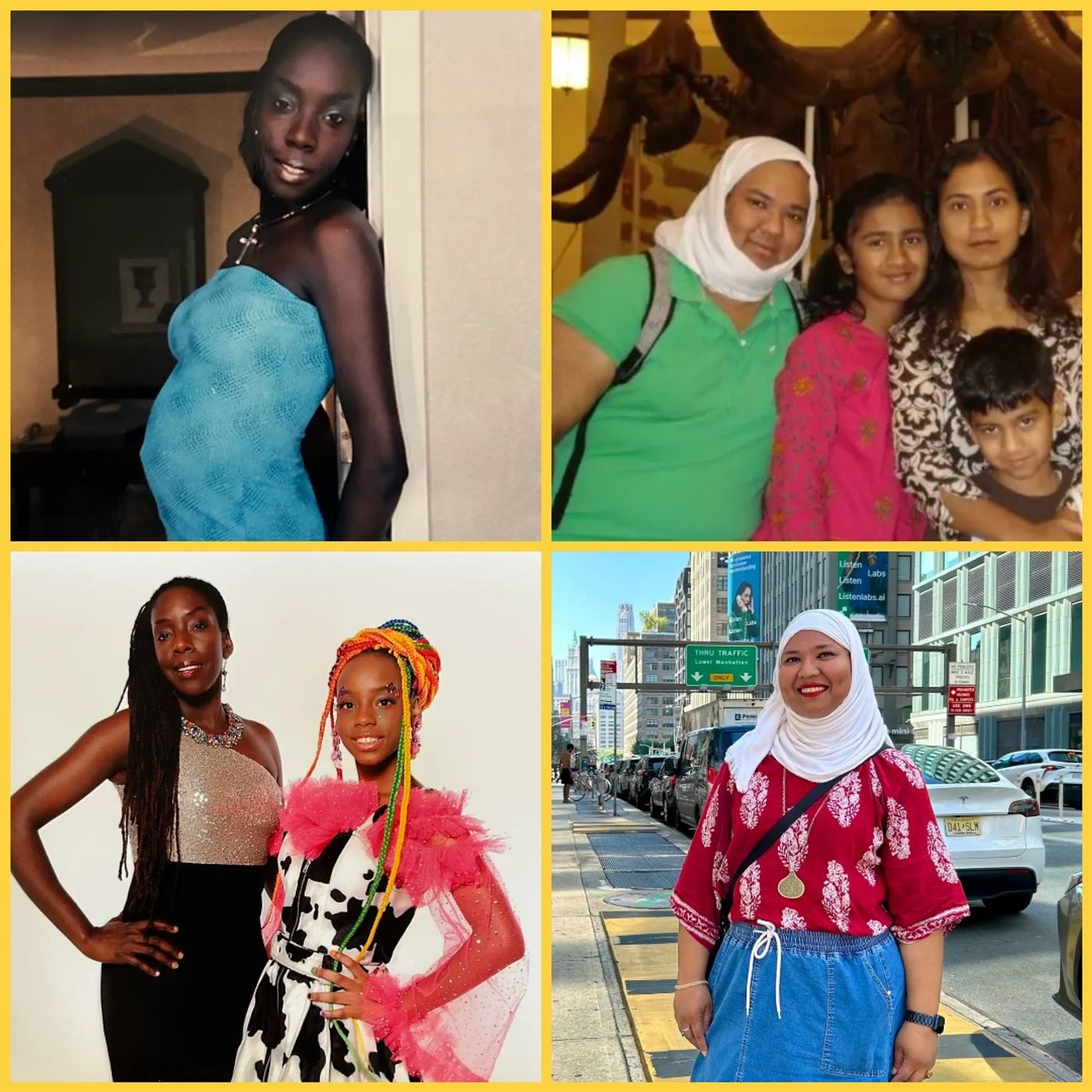
Twenty five years ago, WNYC reporters fanned out across the city recording New Yorkers in the hours and days after the attacks on the World Trade Center. Today, we revisit two of those New Yorkers: a scared, pregnant 21 year old wondering if her baby would grow up to enjoy the city she loves, and a 15 year old Muslim girl bracing for the Islamophobia that followed. WNYC's Samantha Max found both women 25 years later to find out what became of those fears and joins us to discuss what both of their lives look like now.
Photo: Courtesy Janelle Lewis and Nahima Ahmed
Notes:
- Families gather at ground zero to remember 9/11 — 25 years later
- South Bronx Legionnaires’ cluster kills 1, sickens 5, NYC says
- Autonomous Tesla Cybercabs hit the streets of New York City
Got any questions, comments or story ideas? Send us a message at [email protected].
Hosted by Simplecast, an AdsWizz company. See pcm.adswizz.com for information about our collection and use of personal data for advertising.
Get every episode summarized
Each time NYC NOW publishes, we email you a written briefing from the transcript — the topics, who appeared, and any specific claims, with the ad reads skipped.
Email me new episodesFree for 3 shows. No card needed.
Hosts & guests
Transcript ready
346 searchable segments. Every word is indexed and playable.
Full transcript
NYC NOW — After 9/11, Two New Yorkers Told WNYC How They Felt. We Found Them 25 Years Later.. Machine-transcribed; use the interactive transcript above to jump the player to any line.
From W and YC, this is NYC now. I'm Janepi Air. Living through a tragedy like 9-11 puts life into perspective. You don't know what today or tomorrow will bring. 25 years after the September 11th attacks, some survivors are reflecting on how that day shaped their lives. On today's show, we sift through the archives and track down a couple New Yorkers who talked with W and YC back in the aftermath of the attacks and hear their reflections. But first, a moment of silence for the nearly 3,000 people who were lost in the tragedy. Morners gathered Friday at the site of the World Trade Center to commemorate those who died
in the worst terrorist attack in U.S. history. Family members read aloud the names of those who were killed. Mayor Zoram Omdani was at the memorial alongside all living former U.S. presidents and former New York City Mayor Rudy Giuliani and Bill de Blasio. In other news, the city is investigating a cluster of Legionnaires' disease in the South Bronx. Most officials say one person has died and four others have been diagnosed. Legionnaires has also recently been an issue on the upper east side and at the Haven Plaza Complex in the East Village. Could cybercaps be coming to New York City? The city's transportation department says Tesla is testing out a supervised self-driving system that's in accordance with New York State law. The cybercaps has officially launched in major cities in Florida and Texas. It gives riders a driverless taxi experience and apparently there's not even a steering wheel in the car. I'm curious, what are your thoughts on self-driving cars?
Do you trust it or do you have some reservations about it? Let us know. Send an email or a voice note to NYCNow at wnyc.org. We make sure your comments in a future episode. It's time now to get on with the show but before we do, a quick warning. Police content contains audio of the aftermath of the September 11th attacks. On this day 25 years ago, at 8.46 a.m., a hijacked plane crashed into the north tower of the World Trade Center near the southern tip of Manhattan. Less than 20 minutes later, another tore through the south tower. First responders descended downtown that tried to evacuate the skyscrapers, while 911 dispatchers struggled to reassure the office workers still inside.
Then the unimaginable happened. The building is falling right now. People are running through the street. Smoke is everywhere. Then after the next, the towers collapsed. People are filling lower Broadway. Former WNYC reporter Beth Fertig was just blocks away and recorded herself and New Yorkers as they watched the skyline fall. Tell me what you just saw. It's like a war zone. People injured everywhere. It's like every time they lift up a new pile of debris, dust goes everywhere. I saw the building right ahead of me and I saw it on fire. We live right down there so we sort of plan to come around and circle right into it. The next thing I walked and then the second one exploded and I felt the ground shaking. The top half collapsed and we were just caught in the smoke like this.
I don't think I'll realize that I was going to make it. Those were the voices of Michael Smith, Jin Kong, Grace Liang, Amory Imbronani, and Thomas Williams. Just a few of the countless New Yorkers WNYC spoke to in the days, weeks, and months following the attacks. The WNYC reporter Samantha Maxx listened to hours of archival tape. She followed up with two New Yorkers who shared their feelings back in 2001. My parents are afraid that someone might try to attack me and that they won't be able to do anything about it. Nehima Akman, a Muslim teenager. When my baby gets to enjoy the city that I've loved so much, I'm absolutely terrified. And Janelle Lewis, a young mother to be. Both were worried about the lives ahead of them after 9-11. Twenty-five years later, Sam tracked them down to find out what became of those fears and how the attacks shaped their lives that followed.
Sam, welcome to the show. Hi. Before you walk us through the conversations that you have with these two young New Yorkers, how old were you during 9-11? I was in kindergarten. Man, I was in middle school and it seems like I don't know was something out of a movie or something. How were you? So I was in the Baltimore suburbs in my elementary school and honestly, I have no memory of that day which is weird because I have a lot of memories from my early childhood. That must be because my parents did a good job of shielding me from what was going on. So thank you to my parents. Yeah, great parents. After all, I was not shielded. I remember my middle school teacher rolling a television into the classroom that I was sitting in at St. Simon Peter in New Orleans East and we watched the entire thing and it was so traumatizing. Yeah, I could imagine. I know you don't remember it but could you feel that something had changed? Yeah, I mean, the thing is even though I don't remember the day itself 9-11 was just like
this cloud looming over my entire childhood. You know, I had a friend whose dad had died in the towers and it was growing up like in the shadow of the wars in Afghanistan and Iraq. I don't remember a time that I went to the airport and I didn't have to go through security. So there were all these things that were in the atmosphere at the time growing up because of the 9-11 attacks. But it was really different once I started listening through this archival tape. There's something just so visceral about hearing our reporter being just blocks away watching the tower fall, hearing from people who had been outside or who had been in the area and how they escaped. So it really just brought me into that moment in this direct way that I had never really felt before. Yeah. Can we talk about some of those memories? Tell us about Janelle and Nahima. Yeah, let's start with Janelle. Hi, I'm Radio Rookie Janelle Lewis and I'm 21 years old.
On 9-11, she was 21, a few months pregnant and living in East Flatbush. She had actually been part of WNYC's earliest youth radio program radio rookies at the very beginning. So when the attacks happened, she picked up her reporter and did what we audio folks always do is, you know, she talked into the reporter about what she was feeling. Subtamory 11 brought out the chicken in me. They say you have nothing to fear but fear itself, but my behind is scared of everything. That was my Manhattan hood, where I worked, shop, ate and enjoyed life. Now I'm scared of even coming into the city or riding the subway. I've managed to do it a couple times, but when I see the tall buildings and imagine something twice or even four times as tall, being brought down with one blow, I want
to turn back and go back home to Brooklyn. I see the faces of the city, regular day-to-day business people. I look at them and imagine them in panic, dirty, running and jumping. The people my God jumping. Until now, my only fears were miscarriage and labor. Now it's life itself. Before I was afraid of bringing up my child in my neighborhood, but now I'm afraid of bringing up my child in this world. Will I give birth in a hospital after enjoying a beautiful baby shower? Will I be on the ground in a fallout shelter, delivering my own child? Will my baby get to enjoy the city that I've loved so much? I'm absolutely terrified. In a way, afraid of the unknown. Then there's Nehima Ahmed that someone that we interviewed on the street.
She was born and raised on the Lower East Side. Her parents came here from Bangladesh in the 80s. And since she was a kid, she's been wearing a hijab. And that alone made her a target the moment that Islamophobia just really started spreading through the city after 9-11. When I was coming home the other day from school, I've heard people say, why don't you go back to your country, stop doing all these horrible things to people. But I understand what they're coming from. Tell me more, what do you understand? Everyone has a way of dealing with anger. Sorry, I was crying. And everyone has a way of dealing with stuff. And this is how they want to let them mix their lives a little easier with them. So it's okay, everybody's been crying all the time, so don't feel bad. Nehima was 15 when our reporter talked her at the time. When I brought her into the studio a few weeks ago, she choked back tears as she thought
about what she would say to her 15-year-old self. That girl sounds a little bit hopeful and defeated. That girl stole me. Like in so many ways, I recognize myself as wanting to connect with the why of people. And I think understanding the anger is what really struck me when I really listened to that interview. She said that girl deserved to be protected, to feel like she had value and was contributing goodness to the world. All right, Sam, I'm curious. How did you actually track the two of them down? Yeah, it was definitely a bit of a process. I was digging through archives and doing some detective work. Janelle came through a WNYC connection. I actually spoke with the reporter who talked to her 25 years ago. And she was in touch with the radio rookies mentor who was still in touch with Janelle. And then Nehima I found through modern technology. I was searching around for her name on Google and I found her LinkedIn.
I saw that she's an epidemiologist now and actually used to work at Science Friday, which is a radio show. She was working there on the more kind of science end of things. But I reached out to one of her former colleagues and she put us in touch. And thankfully, Nehima agreed to speak with us too. And do they both still live in New York? Yeah, they're both still here. Really both still in the neighborhoods where they grew up. Wow. When you said down with them, did they remember talking to WNYC back then? Bigly. Janelle remembered a little bit that she had done this radio rookies project after 9-11, but she really had no idea what she had said. Well, my baby gets to enjoy the city that I've loved so much. I'm absolutely terrified. Whoa. How did that feel to hear that? Well, literally, I didn't remember any of that. And wow. Oh, my God. Oh, and strange because I didn't think I was afraid of anything, but just hearing me talk
about the things I was afraid of before and then how afraid I am at that time, which is my now. That's rough. But I was hard to listen to. Do you want to take a minute, drink or anything? Ah, let me just sip with my tea. Please. And then Nehima told me that she had basically forgotten that this interview even existed until I got in touch with her. So Sam, you kind of alluded to this earlier. We know that 9-11 resulted in some pretty significant Islamophobia from Muslim New Yorkers. Can you talk a bit about how that impacted Nehima? Yeah, Nehima told me about how Islamophobic attacks started shaping the way that she moved through the city after 9-11. She said when she went back to school after the attacks, she realized that adults were looking at her differently. So now I'm representing a whole group of people and I'm 15, right? I'm a child. She told me about this one incident where she was on the escalator at the Delansey Street
subway station. And she noticed this guy had been looking back at her and next thing she knows metro cards are flying at her head. And I just thought, wow, you are a grown man and you are picking on a child, right? This is just after that point I stopped caring so much. And I think that's probably why you hear me being a little... I don't want to say apathetic, but a little... I guess determined just a sold-run in the interview. Ahmed is now a researcher. She works for a company that tries to change how minorities, including Muslims, are perceived through pop culture. And she told me that 9-11 really helped to push her toward that career path. I asked her if she ever thought about stopping to wear her hijab to avoid people's scrutiny. And she said her family members, friends, even her ex-husband had also asked her that same question at times. But she said her answer has always been no. I said no, because I don't give in to bullies.
I'm not going to let somebody else... Somebody else's bigotry, somebody else's stupidity... Take how I live my life. I stand my ground. I'm a tree and I'm planted. And if you have a problem, you can walk around me. That's Nahima Ahmed, now an epidemiologist, talking about the bigotry she faced growing up Muslim in New York City after 9-11. Growing up, Sam catches up with the other voice from our archive, Janelle Lewis. During 9-11, she was a scared pregnant 21-year-old who wondered if her baby would even grow up in this city. Well, my baby gets to enjoy this city that I've loved so much. I'm absolutely terrified. Stick around. WNYC Studios is supported by Odo. When you buy business software from lots of vendors, the cost's at up and it gets complicated and confusing. Odo solves this. It's a single company that sells a suite of enterprise apps that handles everything from
accounting to inventory to sales. Odo is all connected on a single platform in a simple and affordable way. You can save money without missing out on the features you need. Check out Odo at odo.com. That's odo.com. This week on the New Yorker Radio Hour, quote about Colin Kaepernick on the cost of protest in the NFL. I had one player that came back and was like, my owner told me that I can't protest. My owner. And that was an unfathomable sentence to me. Colin Kaepernick joins me on the New Yorker Radio Hour from WNYC. Listen, wherever you get your podcasts. Welcome back to NWIC now. Before the break we heard, Nahima Ahmed reflect on facing Islamophobia as a teenager after 9-11.
Now we hear from Janelle Lewis. She was pregnant during the 9-11 attack and says she was terrified for her unborn child's future. How has her life changed? Well, Janelle now has actually two kids. And 25 years? Has it really been 25 years? Yeah. I cannot believe that. You're saying it and then hearing it, I was a different person. Me then and me now, two different people, in a sense. Her initial reaction after listening, you know, at first she was kind of like talking through it and then all of a sudden she got very slow and just like started sobbing. Like it just kind of washed over her like realizing how afraid her young self had been and how much she had to overcome in that moment to be brave for herself and her baby. Exactly. Her daughter, who she was pregnant with at the time, Dora was born a few months later. And Janelle says motherhood became her focus after 9-11.
Not to say that 9-11 was dismissed, it wasn't, but I think we just adapted. I think this little baby in learning how to care for her, I think that became the priority and that was the main thought. Dora is now 24 years old and Janelle says that 9-11 honestly hasn't been a huge part of her consciousness. And recently after I had reached out to Janelle, they had had this conversation about 9-11 and you know, Janelle had mentioned to her daughter that she had done this piece for WNYC and Janelle asked her daughter, she was like, did you know I was pregnant with you at the time? And her daughter was like, yeah, okay, I guess I knew that. And when Janelle is asking her, you know, do you know anything about it? She was just kind of like, I mean, I heard about it, but I don't know anything about that. Do you want to ask her if she wants to come down for a minute? Dora? Dora actually joined us for part of our interview and I got to ask her directly, you know, how she feels about 9-11. Is it something that you feel like you think about at all?
No, not really. There's just so many other things that are happening in the world that are currently impacting our generation. So I guess like 9-11 just doesn't seem as significant and I feel like Verka uses it to take advantage of a lot of stuff. Her answer was not exactly what I had expected. She feels almost like America is using it to its advantage in certain ways. I wonder how true that is for the generation that didn't actually experience 9-11 or the generation that was inborn yet? Yeah, I mean, I think there's something really specific about living through a trauma. And if you haven't lived through it yourself, it's different. And she also has all these other things that she is hearing about and seeing that are worrying her that, you know, that's really her focus right now.
So she told me that it's really sad that innocent people lost their lives on September 11, especially over a conflict that they had nothing to do with. But she said she's more focused on conflicts that are playing out right now, like immigration in the US and wars around the world. I thought like about the people who are in Palestine right now and how they're experiencing the same thing, except that they've been experiencing this stuff for years and years. And that there's never a name. And you would think that because we experience just a hint of that tragedy that people would be more open minded or more have more empathy for people who are suffering in Palestine and other places where currently being bombed, that they would like care more because the same thing kind of happened to them just a little bit. But no, they don't really care.
She said it's just hard for her to kind of square those two realities. I can understand that. Yeah, and then I was asking Janelle for her reaction to all of this. And she said that she agrees with a lot of her daughter's thoughts. She is also overwhelmed by the current state of the world. She said she doesn't listen to the news. She tries not to pay attention to a lot of the things that are going on because she doesn't want to be in panic mode all the time. And she knows what it's like to be in panic mode. Living through a tragedy like 9-11 puts life into perspective. You don't know what today or tomorrow will bring. You don't know of today or tomorrow's your last day. You really don't know. I am a person that really likes to enjoy my life and join myself. I'm very much open to my children being the same way. I believe in making life feel good. She says she tries to protect her daughter and her son from the worry she felt back then. She was able to move forward from it.
And she says that's a blessing. So Sam, for some New Yorkers 9-11, never forget. But for others, it seems like they're just concerned about the world they're living in today. Yeah, and you know, that's why we have places like the 9-11 Memorial. That's why it was so important for me to go through these archives. But also, there's this whole generation behind us and more to come that won't have that same experience. So I think it's really a question of how will they relate to this tragedy in the future? Yeah, that's WNYC's Samantha Maxx. Sam, thanks so much for your reporting. I know that this wasn't an easy one to cover. No, but it was important. I think so. WNYC's journalism and storytelling is heard by millions of passionate listeners, sponsors of our programming gain our listeners' attention and their respect.
Learn about how your organization can support WNYC and WNYC Studios at sponsorship.wnyc.org.
More episodes
More from NYC NOW

Why More City Dwellers Are Raising Chickens
NYC NOW

Why New York City Is Restricting Artificial Intelligence in Public Schools
NYC NOW

How Classical Music Has Changed Over the Past 30 Years of WQXR Host Jeff Spurgeo...
NYC NOW

Ahead of Labor Day, Haitian Businesses in New York City Feel the Impact of TPS E...
NYC NOW