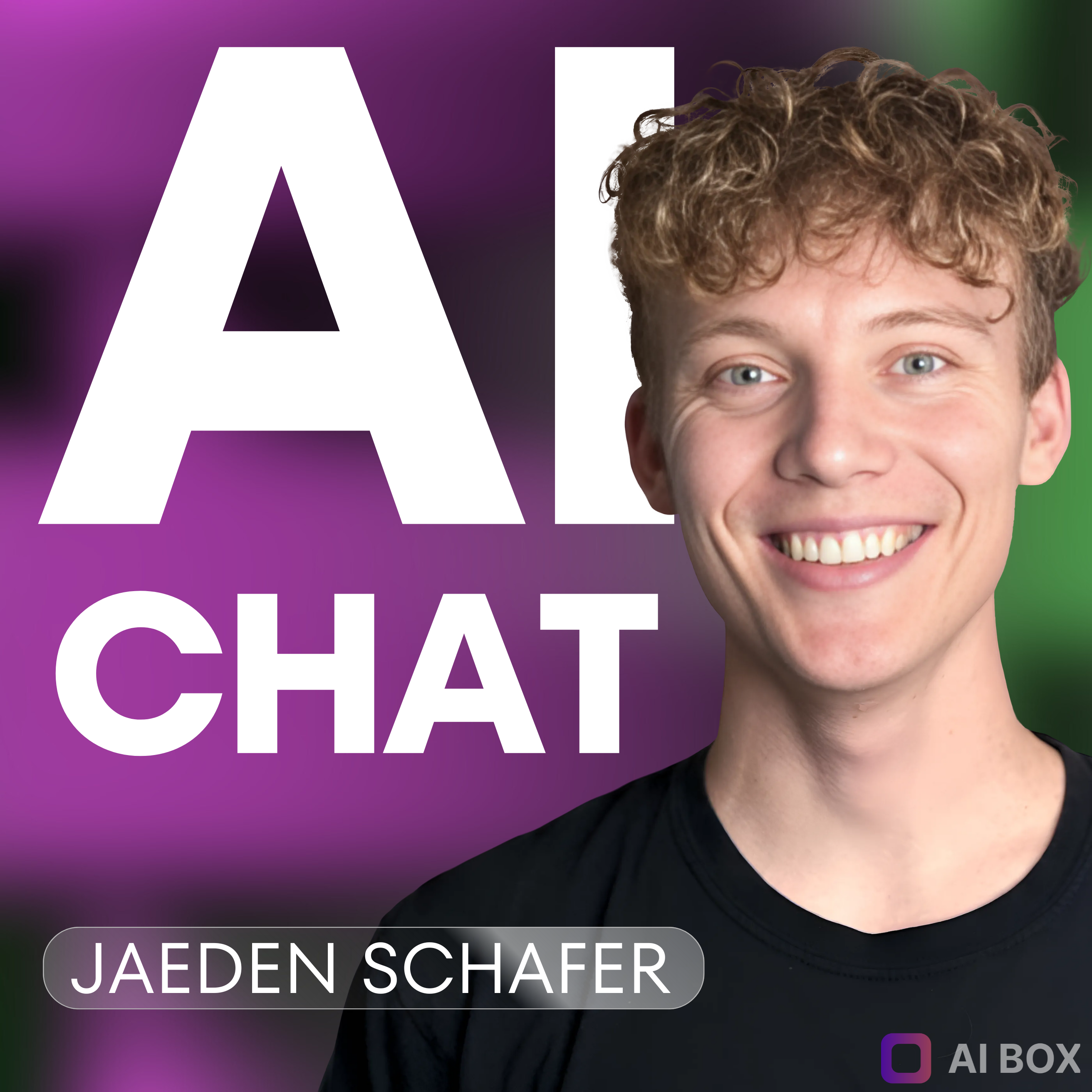
AI App Crisis, OpenAI Does Math, Big Nvidia Deal
About this episode
In this episode, we explore the challenges AI-powered apps face with long-term user retention, analyze ChatGPT's new interactive visual explanations for math and science, and discuss Thinking Machine Labs' massive computing deal with Nvidia.
Chapters
00:00 Introduction & Birthday Shoutout
01:36 AI App Retention Struggles
12:04 ChatGPT's Interactive Visuals
14:21 Thinking Machine Labs x Nvidia Deal
16:49 Industry Trends and Future
Links
Get every episode summarized
Each time AI Chat: ChatGPT, AI News, Artificial Intelligence, OpenAI, Machine Learning publishes, we email you a written briefing from the transcript — the topics, who appeared, and any specific claims, with the ad reads skipped.
Email me new episodesFree for 3 shows. No card needed.
Hosts & guests
Transcript ready
522 searchable segments. Every word is indexed and playable.
Full transcript
AI Chat: ChatGPT, AI News, Artificial Intelligence, OpenAI, Machine Learning — AI App Crisis, OpenAI Does Math, Big Nvidia Deal. Machine-transcribed; use the interactive transcript above to jump the player to any line.
My name's Mackenzie, and I started to go fund me for the adoptive mother of a nonverbal, autistic child. The mother had lost her job because she wasn't able to find adequate care for this autistic child. So she really needed some help with living expenses, paying some back bills. So I launched a GoFundMe to help support them during this crisis. And we raised about $10,000 within just a couple of months. I think that the surprising thing was by telling a clear story and just like really being very clear about what we needed, we have some really generous donations from people who are really moved by the situation that this family was struggling with. GoFundMe is the world's number one fundraising platform trusted by over 200 million people. Start your GoFundMe today at GoFundMe.com. That's GoFundMe.com. GoFundMe.com. This podcast is supported by GoFundMe.
Warning, the following Zippercruder radio spot you are about to hear is going to be filled with F words. When you're hiring, we at Zippercruder know you can feel frustrated for Lauren even. Like your efforts are futile. And you can spend a fortune trying to find fabulous people only to get flooded with candidates who are just fine. F***. Fortunately, Zippercruder figured out how to fix all that. And right now, you can try Zippercruder for free at zippercruder.com slash zip. With Zippercruder, you can forget your frustrations because we find the right people for your roles fast, which is our absolute favorite F word. In fact, four out of five employers who post on Zippercruder get a quality candidate within the first day. Fantastic. So whether you need to hire four, 40, or 400 people, get ready to meet first rate talent. Just go to zippercruder.com slash zip to try Zippercruder for free. Don't forget, that's zippercruder.com slash zip. Finally, that zippercruder.com slash zip.
Welcome to the podcast. I'm your host, Jaden Schaefer. Guys, today is my 30th birthday, but I had to record a podcast because there was some crazy stuff happening. Number one, there's a bunch of research and data coming that is showing AI-powered apps are really struggling with long-term retention. Also, chat to BT can now create interactive visuals that are going to help you understand math and science, which Google was kind of doing something similar. It's going to be really cool to see chat to BT do this. And third, thinking machine labs has just created a massive compute deal within video, which is pretty exciting for a company that has such a legendary background and has raised so much money. So we're going to get all of these stories today, but before we do, I have to say a huge shout out in the last couple of days. I've asked people for my birthday. If you could leave a rating and review, if you haven't already, I want to read the most recent review that someone dropped. This is from EatingCrab yesterday, he said, just wanted to say thank you for the podcast. I don't have very much time in my day being a full-time student and working full-time, but I have a huge passion for AI
being able to keep up with your podcast, helps me keep in the loop. I appreciate it, keep it up, and a happy birthday. A huge shout out to EatingCrab. Thank you so much for the review. Guys, today is my birthday. I'm turning 30 before I go through a midlife crisis. If you guys could do me a massive favor for today and please leave a rating review if you haven't already. It would be the greatest birthday present of all time. I will be eternally grateful over on Apple or Spotify or wherever you get your podcasts. I know it's usually annoying, but today's my birthday. So if you've ever appreciated that podcast in the past or today, it would be greatly appreciated to drop a review. All right, let's get into the episode today. So the thing that I think is really interesting is kind of this idea right now that all of the AI-powered apps are really struggling to keep long-term, people engaged long-term retention on the apps. And I think there's a couple of problems with this as someone that has built AI-powered apps in the past and as someone that is actively working in AI startup and AI startup AI box and a company. I can understand where a lot of this challenge is. And that is, I think with AI coming out
and the power of AI being so incredible, I think we definitely had a really big wave, especially in the last couple of years where there was a lot of concepts of what AI could do and would be able to do. And a lot of people I think overhyped or oversold their apps. And I think that's going to be the primary driver of lower tension. In addition, I do think that right now, I try probably 10 times as much software as I have over the last five, 10 years working in the industry. And so I think right now, we just try so much more and then we kind of settle on what works best. I think if you're a developer and you're creating a tool with AI in it, you have one shot really for someone to go try your tool and for it to wow them and for them to be impressed and be like, okay, I will keep this as part of my long-term toolbell of the tools I use. If they try it and it flops, there's a bunch of tools from big companies that I've tried in the past. They flopped and I haven't gone back. I think one of those examples would be something like Runway for Video. This is a platform that I tried a lot in the early days.
It wasn't that great. And I mean, you have to give them a huge kudo for being first, but I never really got back to that platform. And then Soono came out and a lot of these other video generations, he had Higgs Field which had a whole bunch of models on there. And I tend to just use more of those types of tools today than going back to some of the OG video tools. I think this is kind of a trend you'll see with a lot of, I know it's kind of like a random story from my experience, but I think you're going to see that a lot. So there was a recent report that came out of Revenue Cat and they showed that the subscription infrastructure for more than 75,000 different developers. And they kind of analyze it because they power all that subscriptions. And by the way, these are kind of my favorite reports. Mercury, a SaaS kind of bank, SaaS-focused bank is an awesome one. They do kind of a state of AI every year where they show the top AI companies that people are actually using and actually have subscriptions to. So it's kind of cool to see Revenue Cat do something similar. What they found though, these are just awesome reliable places because you know exactly where money is actually being spent. But in any case, they found that while AI apps monetize
really quickly, they really struggle to keep users around. And I'll even say for my own startup, AIbox.ai, when we first launched, there was a lot more bugs at the beginning. I mean, with anything and a lot of different features that we didn't have. And I think our churn was pretty high. When we first launched, I'm pretty proud of being able to pull that churn right down and get people to stick around a lot longer. But it was a lot of work for us to achieve that and to be able to bring that down. I think a lot of other people struggle with that too. According to their 2026 State of Subscription Apps report, AI apps experienced significantly higher churn compared to traditional apps. So this is interesting, right? Like it's not just like, oh, people try more software than they use less today. Well, people actually still keep a lot of their OG apps that they have and OG subscriptions. But it's the new AI ones that they're just trying out this new buzz thing. I'll look and do this crazy cool thing and make an image of me looking like XYZ, you go try it and then you kind of dump it. So according to the report, they analyze more than one billion in app subscription transactions. And that was about $11 billion in annual developer revenue.
I mean, based off of their scale and their ecosystem, I think this is a pretty good indicator. They have like iOS, Android, and web apps. And what's interesting to me is that, you know, despite like, I think a lot of the hype around AI, most subscription apps are not built around it. Only 27% of apps analyzed, according to their report were categorized as AI powered. About 72% of those are just non-AI apps. So a majority of apps. And this is interesting because I think we see a lot of the bigger players like immediately injecting AI in. I think a lot of the smaller apps and companies are like, well, if we don't need it, maybe there's not a reason to just, you know, bolt something on that's not necessary. And that's making up, you know, almost 73% of all apps. I think what is obviously pretty clear is how fast AI adoption is accelerating. About one in four apps now marketing themselves, are marketing themselves as AI driven. So a lot of those are not necessarily going to be, you know, chats you to your Gemini, but they might just be, you know, an app that has some AI features in their product experience. Which I think a lot of people should be and could be experimenting with.
And there's a lot of things that AI can do just inside of all traditional SaaS. I do think this is a smart idea for most any apps. I think definitely the categories that are adopting AI faster than others would be things like photo and video apps. Those are kind of the top according to what they're seeing in their analytics. They say 61% of photo and video apps are incorporating AI features. They say gaming is on the complete opposite extreme. Only 6.2% of gaming apps are using AI in their code offering. There's a bunch of other like pretty low adoption categories including travel, which is only 12.3%, which is hilarious because I swear every single demo we see from chat, you can be in Gemini. It's like, charcoal the new advancements we made. Like it's going to make planning your travel itinerary like a thousand times faster. Like just say you want to go to Greece and it's going to give you like a 15 day itinerary with everything you need to do every hour. Now, I don't know how often people are planning the travel itinerary. I don't know why this is the one demo we get stuck on with everyone and I apologize for my voice
on the demo voice there. But it is just one of the things that drives me crazy. And it's so wild to see that only 12% of the travel apps are actually using this. Well, every single AI company is like basically using this category as the main demo of a use case. And it just doesn't turn out to be that useful or I guess the demand isn't there. Business also has a 19.1% rate of having AI inside of the apps that the business category. I think where things get a lot more surprising is customer retention. So across both monthly and annual subscription plans AI powered apps consistently were underperforming just regular non AI apps. After 12 months AI apps had about a 21% retention rate for their subscriber. So if 100 people subscribe on day one, 12 months later, only 21 of those will still be subscribed compared to over 30%, 30.7% for non AI apps. So 10% higher if you don't have AI embedded in there. Now, I think there's going to be some things that obviously skew that, which is that a lot of these AI apps
are kind of a new interesting use case and people are going to be trying them out for the first time. I also think that there's a lot of hype and if the AI can't do exactly what you want perfectly, you're going to move on. And I think those capabilities will come back in the future. So people may retry those same apps in the future and they'll stop being called just like an AI app. There's not going to be a buzzword. It's just going to be like an app that does XYZ does use AI, but you know, people don't really care. It just does it correctly. And I think then you'll see the retention rates higher. On a monthly basis, I think there's also a pretty big gap between these two categories. AI apps have a 6.1% retention. Non AI apps have a 9.5% retention rate just month to month. I think one of the other areas where AI apps are performing a little bit better is in weekly subscriptions. Retention is at 2.5% compared to 1.7%. I mean, really, that's just showing you that I think a lot of people are trying these apps. Weekly subscriptions is not a very common thing. And I have actually seen this with a bunch of AI apps. I saw I see weekly subscriptions with people that have a tool that you don't really need it
for a super long period of time. So they try to hit you multiple times in a week. It's basically my least favorite subscription amount of time to re-subscribe. And it's when people are like, look, it's only $2 a week. It's like just say $10 a month or something. Like so annoying. In any case, part of the churn that we're seeing right now, I think is gonna be obviously just how fast AI is going. All of the experimentation happening in the industry, I think you're gonna see metrics like AI apps have 20% higher refund rates than non AI apps. The median refund of 4.2% is, you know, you can compare that to 5.3%. At the high end, I think the difference is even more pronounced with AI apps seen refund rates is high as 15.6% compared to 12.5% for non AI apps. And according to what revenue cat is saying, basically volatility is coming from some big issues about value product experience, long-term utility. And I really just think a lot of this comes down to over-promising and under-delivering what the AI is capable of doing. And I see this in so many areas
because I'm in marketing and I'm in AI. So clearly this is a problem. I think we see in the industry, I think we should probably normalize, you know, being able to under-hype your app, but it being super useful and people just use it without, you know, having to oversell all of this capabilities. I think AI apps right now also monetize downloads significantly more effective overall. Median download monetization is at about 2.4% for AI apps versus 2% for non AI apps. So that is interesting. And I think AI apps also generate higher realized lifetime value. So here we are, you know, talking about oh look regular apps versus AI apps, AI apps are able to keep people subscribed as long. But they're getting a lot more money out of people, right? On a monthly basis, AI apps produce a median real lifetime value of $18 per user compared to $13 for non AI apps. It's actually closer to $19 and like $13.50 for non-A apps. So I mean, that's a pretty big step up. People are paying more for AI apps. Obviously the costs of those are higher
on an annual basis though. I think it gets even bigger. So for annual AI apps are reaching $30 versus $20 of real lifetime value for their users. I think if you look at all of this together, basically the data, like the pattern that I see in this is that AI features are going to help apps monetize really quickly. But sustaining that long term is going to be the challenge and making sure your product is actually useful. Delivers on all the promises is harder. It's totally possible. But I think there's also a lot of competition. And even for an app like, you know, chat GPT for example, that was like the bell of the ball for forever for years. Number one, and then all of a sudden Gemini comes out and Claude comes out and they have kind of some new capabilities and move reasons why you'd want them. So I think that we're just going to see a lot of competition and it's going to be an interesting space. It's no one's, you know, it's not like anyone has this completely cornered. Okay, switching gears for a second. I want to talk specifically speaking of chat GPT, a new feature that is going to support inside of chat GPT and inside of the app. Obviously we can see that we got to try to make these things more useful for users.
And some of this is the latest thing that chat GPT is doing obviously to try to keep their churn down. So this week chat GPT has just introduced dynamic visual explanations inside of chat GP. This is basically a feature that is going to let you have make mathematical and scientific concepts a lot more interactive. So rather than just, you know, getting like some sort of text explanation or maybe like a static diagram, this new feature is going to let you manipulate variables directly. And then you can watch equations update in real time inside of chat GPT. This is very cool. So an example of this is like if you were exploring, you know, the Pythagorean theorem or something, users could basically, you could go and adjust the sides of a triangle. And then immediately you'll see how the hypotenuse is changing. The feature rate now is supported in more than 70 different math and science concepts. It includes compound interest, exponential decay, linear equations, columns law, ohms law, kinetic energy, hooks law. It's, honestly, it's pretty cool if I'm not, if I'm telling the truth, I think that right now if you're able to kind of turn an explanation to this sort of like interactive module,
the feature is going to shift from maybe just the tool giving you these really simple answers to actually helping users. And I mean, hopefully students and others explore how the concept actually works and get kind of a deeper insight and understanding of the problem. So honestly, you know, I remember when AI came out and never said it's going to make everybody dumber and we're going to just, you know, outsource our brains to AI. But I actually think it's an incredible tool for education that's going to make us smarter and we're going to be able to learn more. Open AI says that more than 140 million people already use chat GPT every single week for math and science help. I think it's over 900 million people weekly just for general use. But, you know, 140 million just for math and science is a huge chunk of that. And so I think this is obviously a something that's been very tricky for a lot of people. It's hard to get access to good tutors and this is an awesome opportunity. I think for a lot of people, other companies are definitely experimenting with some similar approaches in 2025, kind of at the end of last year, Gemini introduced some interactive diagrams within their own AI system as part of kind of an effort to get more into education.
I think I think I did a podcast on it back at the time. I think the race right now to build the next generation of AI infrastructure is going to be interesting. We have all these new features, but all of these new features have to be powered by infrastructure. They've got to be powered by more compute as these tools just get more and more intense. And on that note, Miriam Maraudi startup thinking machine labs has just announced a multi-year strategic partnership with Nvidia to deploy large scale computing systems. And this is actually going to start in 2027. So not this year, it's interesting. I mean, it's kind of crazy, Miriam Maraudi, and then we have, you know, super safe intelligence as well. Kind of these spin-offs from some of the top brass over open AI when they came out and they raised like a billion dollars, their startups didn't launch something immediately although I do believe that Miriam Maraudi thinking machine labs does have tinker, I think is their product. They do have a product out there. But I think they got a lot more on the pipe and they're building all of these kind of compute partnerships that are starting, you know, not this like they got out maybe last
year. They didn't really put out a ton last year. Then they have all of this year. They're still working. And these compute deals aren't rolling out till next year. So you can expect that whenever their products are scaling is going to be in the future. This agreement in particular includes deploying at least one gigawatt of Nvidia's Vera Ruben AI systems. I mean, honestly, even just going to sign in a gigawatt deal, it's a lot of confidence that their product is going to be incredibly useful. I think this is one of the company's newest architectures and Nvidia is also making a strategic investment in thinking machine labs, which has already raised more than two billion dollars since it was founded last year. It's valued at over $12 billion, thinking machine labs is focused on building AI models that are designed to produce more replicable and reliable outputs. And they released their first API product tinker last year. So right now this partnership is showing, I think, basically a bigger trend in the industry AI companies are really having to be very aggressive in how they compete for access to this computing power, Jensen Lang, CEO of Nvidia. He predicted that the industry would spend $3 trillion to $4 trillion on AI infrastructure
by the end of the decade. So so much money is getting put into this industry. I think the exact value of thinking machine labs and their deal that they're doing with Nvidia here, that wasn't all disclosed, but I think the massive compute agreements are just becoming more and more common for some of these big companies. Last year, for example, open AI struck a $300 billion compute partnership with Oracle. And so yeah, obviously this is something that's not slowing down. If you look at all of these together, I think the industry right now is experimenting rapidly. They're just trying to put out tons of different products and we see that from kind of the state of AI apps I was talking about earlier, but I also think the AI is starting to reshape how apps monetize, how people learn, how infrastructure is built, how long-term winners are likely going to be people that are moving beyond just the novelty and they're actually delivering a really durable value to the users, right? And I think it's important when even a company like thinking machine labs and a lot of these others has to think like when you build a product in open AI with their latest kind of math and science feature, like when you build a tool, when you build a product, make
sure it works really good on launch and then you're going to be able to keep your turn up and then all of these long-term infrastructure deals you have are not going to be wasted because you're going to be able to keep all of your users using the product. So this is an interesting time in the industry. A lot is going on. I'll definitely keep you up to date on all of it. If you want to try all of the AI models I talked about on the show, make sure to go check out AIbox.ai. You get access to over 40 of the top AI models all in one place. You can chat with them. We have some exciting new features dropping soon. You can check it out. Link is in the description to AIbox.ai and everyone, remember, today is my birthday. I turn 30 today, the number one present and thing in the entire world I would ask for my birthday is if you could leave a rating review on the podcast, it would mean the world to me. I would be so thrilled. So if you haven't already, leave a review and I will be eternally grateful on my birthday. All right. Hope you guys all have a fantastic rest of your day. Finding great candidates to hire can be like, well, trying to find a needle in a haystack. Sure, you can post your job to some job board. But then all you can do is hope the right person comes along.
Which is why you should try Zippercrooter for free. At zippercrooter.com slash zipp. Zippercrooter doesn't depend on candidates finding you. It finds them for you. It's powerful technology identifies people with the right experience and actively invites them to apply to your job. You get qualified candidates fast. So while other companies might deliver a lot of hay, Zippercrooter finds you what you're looking for. The needle in the haystack. See why four out of five employers who post a job on Zippercrooter get a quality candidate within the first day. Zippercrooter, the smartest way to hire. And right now, you can try Zippercrooter for free. That's right. Free. At zippercrooter.com slash zipp. That zippercrooter.com slash zipp. Zippercrooter.com slash zipp. Warning. The following Zippercrooter radio spot you are about to hear is going to be filled with efforts. When you're hiring, we at Zippercrooter know you can feel frustrated for Lauren even. Like your efforts are futile and you can spend a fortune trying to find fabulous people
only to get flooded with candidates who are just fine. Fortunately, Zippercrooter figured out how to fix all that. And right now, you can try Zippercrooter for free at zippercrooter.com slash zipp. With Zippercrooter, you can forget your frustrations. Because we find the right people for your roles fast, which is our absolute favorite F word. In fact, four out of five employers who post on Zippercrooter get a quality candidate within the first day. Fantastic. So whether you need to hire four, 40 or 400 people, get ready to meet first rate talent. Just go to zippercrooter.com slash zipp to try Zippercrooter for free. Don't forget that zippercrooter.com slash zipp. Finally, that zippercrooter.com slash zipp.
More episodes
More from AI Chat: ChatGPT, AI News, Artificial Intelligence, OpenAI, Machine Learning
ChatGPT Work vs. Claude Cowork
AI Chat: ChatGPT, AI News, Artificial Intelligence, OpenAI, Machine Learning

Anthropic Fixes Memory, Apple's New Mac, Stability Raises $76M
AI Chat: ChatGPT, AI News, Artificial Intelligence, OpenAI, Machine Learning

ChatGPT Can Access iMessage and Meta Glasses Detectors
AI Chat: ChatGPT, AI News, Artificial Intelligence, OpenAI, Machine Learning

Anthropic's Watermarking Got Cracked in 4 Hours
AI Chat: ChatGPT, AI News, Artificial Intelligence, OpenAI, Machine Learning