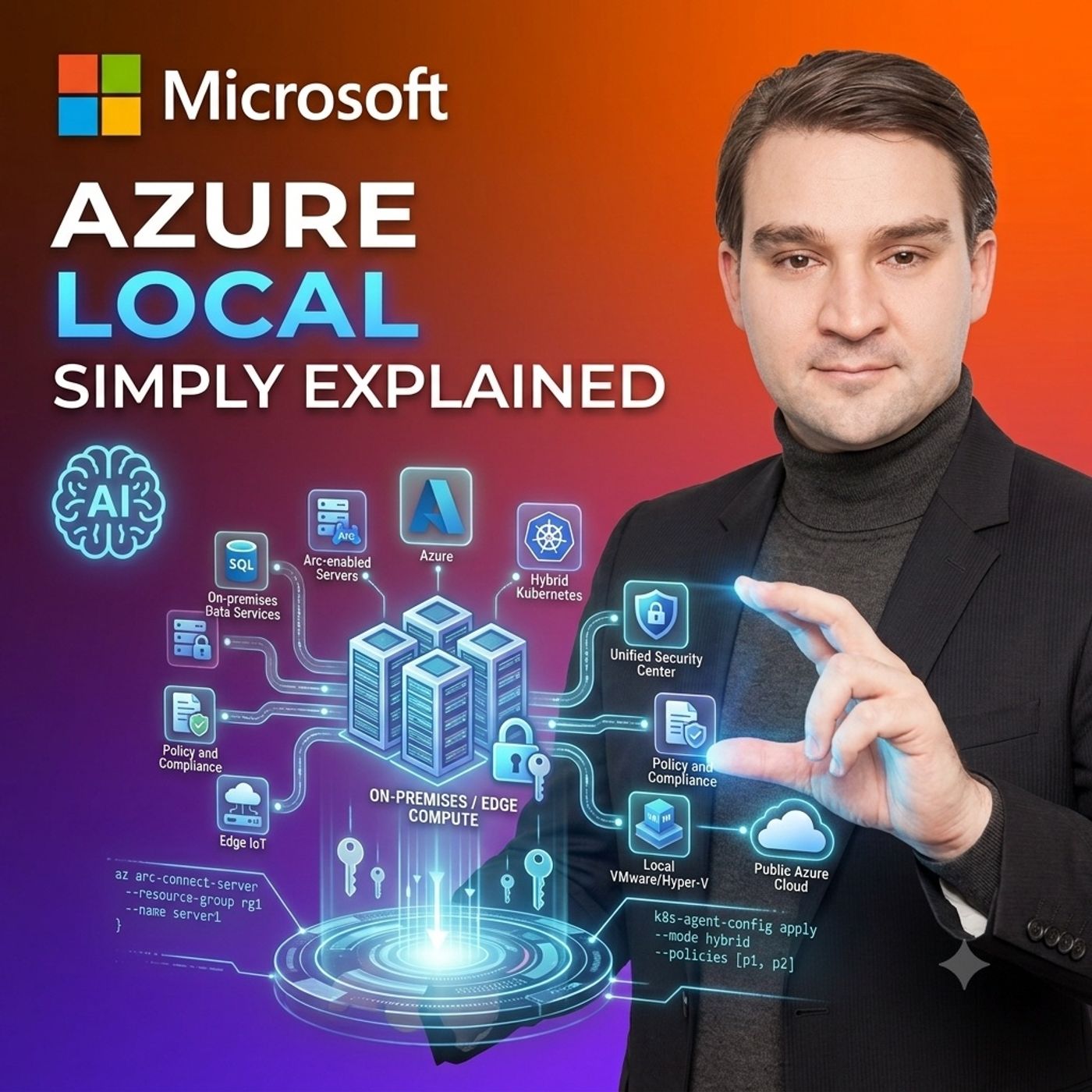
Azure Local - Simply Explained
Get every episode summarized
Each time M365.FM - Modern work, security, and productivity with Microsoft 365 publishes, we email you a written briefing from the transcript — the topics, who appeared, and any specific claims, with the ad reads skipped.
Email me new episodesFree for 3 shows. No card needed.
About this episode
UNDERSTANDING MICROSOFT AI GATEWAY AND AZURE API MANAGEMENT
Microsoft AI Gateway extends Azure API Management by introducing centralized control over AI traffic, model endpoints, intelligent agents, Model Context Protocol (MCP) tools, Agent-to-Agent (A2A) communication, and existing business APIs. Rather than allowing every application to communicate directly with different AI providers, organizations create a single managed entry point where authentication, authorization, routing, rate limiting, logging, and security policies are consistently enforced. This separation allows development teams to focus on building intelligent business applications while platform teams maintain governance, compliance, and operational standards across the entire AI landscape.
ROUTING AI REQUESTS ACROSS MULTIPLE MODELS AND PROVIDERS
One of the greatest advantages of Microsoft AI Gateway is the ability to separate applications from individual AI model deployments. Instead of hardcoding connections to specific providers, applications communicate with a stable endpoint while the gateway intelligently routes requests to Azure OpenAI, Microsoft Foundry, Anthropic, Google Gemini, Amazon Bedrock, or other approved model providers. Organizations can balance workloads across multiple regions, optimize performance, reduce operational risk, implement failover strategies, and migrate between models without requiring application developers to rewrite existing integrations. This flexible architecture enables enterprises to adapt quickly as AI technology continues evolving.
GOVERNING AGENTS, TOOLS, AND BUSINESS APIS
Modern AI extends far beyond simple chatbots. Intelligent agents increasingly interact with HR systems, finance applications, customer records, enterprise databases, and internal APIs. Microsoft AI Gateway provides centralized governance for Model Context Protocol (MCP) servers, Agent-to-Agent communication, and business APIs by enforcing identity, authorization, content safety, and Zero Trust principles. Combined with Microsoft Entra ID managed identities, organizations can ensure every AI agent receives only the minimum permissions required to perform its assigned task. This dramatically reduces the risk of unauthorized data access while creating complete visibility into every AI-driven action.
MANAGING TOKEN COSTS, PERFORMANCE, AND AI OBSERVABILITY
Unlike traditional software licensing, generative AI introduces variable consumption costs based on token usage. Microsoft AI Gateway helps organizations control these expenses through request throttling, quotas, token budgets, semantic caching, traffic prioritization, and detailed monitoring. Every AI request can be logged with information about the calling application, selected model, token consumption, response status, latency, and tool execution. This observability enables platform teams to identify inefficient prompts, detect abnormal consumption patterns, optimize model selection, and allocate AI costs across departments while ensuring mission-critical business workloads always receive sufficient capacity.
BUILDING A SECURE FOUNDATION FOR SCALABLE ENTERPRISE AI
Microsoft AI Gateway is not another AI model or agent builder. Instead, it provides the governance layer that allows organizations to safely scale enterprise AI initiatives. By combining Azure API Management, Microsoft Entra ID, Azure AI Foundry, MCP, A2A communication, API Center, content safety, centralized policies, and comprehensive monitoring, businesses gain a unified architecture capable of supporting future AI innovation without sacrificing security or compliance. Organizations beginning their AI journey should start with a single managed workload, establish governance from the beginning, and gradually expand toward a standardized enterprise AI platform that remains secure, observable, and cost-efficient.
Become a supporter of this podcast: https://www.spreaker.com/podcast/m365-fm-a-microsoft-mvp-podcast-by-mirko-peters--6704921/support.
Get every episode summarized
Each time M365.FM - Modern work, security, and productivity with Microsoft 365 publishes, we email you a written briefing from the transcript — the topics, who appeared, and any specific claims, with the ad reads skipped.
Email me new episodesFree for 3 shows. No card needed.
Hosts & guests
No transcript yet
This episode has not been transcribed. Request it and it moves to the front of the queue.
More episodes
More from M365.FM - Modern work, security, and productivity with Microsoft 365

Constraint-Based Scheduling: The Architecture That Makes Production Plans Real
M365.FM - Modern work, security, and productivity with Microsoft 365

A Machine Goes Down. How Should Your Production Plan React?
M365.FM - Modern work, security, and productivity with Microsoft 365

Can Value Stream Mapping Become a Live Data Model?
M365.FM - Modern work, security, and productivity with Microsoft 365

How Finite Capacity Scheduling Actually Works in Manufacturing
M365.FM - Modern work, security, and productivity with Microsoft 365