About this episode
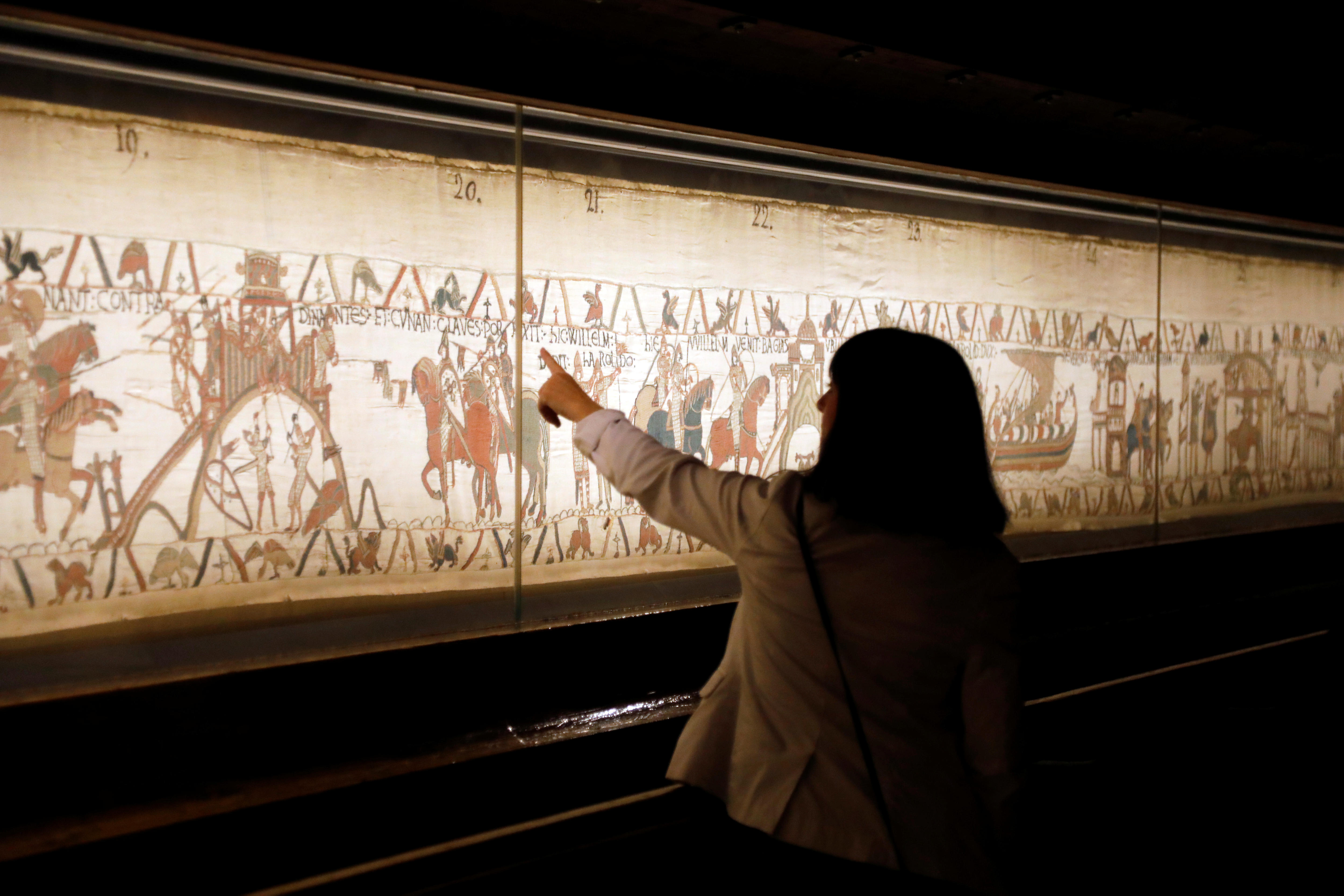
The 68-metre embroidery - loaned from France - depicts the 1066 Battle of Hastings and the start of the Norman Conquest of England.
Get every episode summarized
Each time Radio National Breakfast publishes, we email you a written briefing from the transcript — the topics, who appeared, and any specific claims, with the ad reads skipped.
Email me new episodesFree for 3 shows. No card needed.
Hosts & guests
Transcript ready
128 searchable segments. Every word is indexed and playable.
Full transcript
Radio National Breakfast — Bayeaux Tapestry will be on public display from tomorrow. Machine-transcribed; use the interactive transcript above to jump the player to any line.
Well, for the British Museum, it's almost like the night before Christmas. From tomorrow, the Bayer Tapestry will be on public display marking the biggest ticket sale on record for the museum. The 68-metre embroidery loaned from France depicts the 1066 Battle of Hastings and the start of the Norman Conquest of England. Michael Lewis is the curator of the Bayer Tapestry exhibition. He joined me a short time ago. Michael, welcome to breakfast. What's it like tonight for you? It's almost the night before Christmas as this all gets underway. Yeah, it's really exciting. Tomorrow, the exhibition opens and the Bayer Tapestry will be available to everyone to see. So, it'd be great. What's the public reaction been like in terms of ticket sales to be able to go and see this on English soil? It's been absolutely amazing. I mean, the first 100,000 tickets sold out in 24 hours, it's like a pop concert or something
like that. The British Museum's never seen anything like this before with such public appetite for this object. Tell me about the first time that you saw the tapestry. What was that like to see this incredible story of 1066 unfolding before you in in Thread and Cloth? The first time I saw the tapestry was in Bayer many years ago. I've been studying the Bayer Tapestry for over 30 years now. So it was a long time ago that I saw it. But yeah, I think the first thing you are surprised about is the length of this object. It's 70 metres long. But also the extent to which its illustrations, embroidered threads are so colourful as well. I mean, they have faded over time, of course, but they are still very vibrant. Why do you think this tapestry has captured public imagination for so long in France and also in Britain? It's because it depicts the events of 1066, essentially one of the most important events in British history or English history, probably the last time England was successfully conquered.
But more than that, it's because it is an illustrated narrative. I think anyone can relate to it. It's cartoon-like figures really jump out at people. So I think that's what's really called the imagination. But it's actually a lot more famous in England than it is in France, ironically. Why do you think that is? Well, it's famous in Normandy, but outside Normandy, French people don't really learn about the dukes of Normandy. They learn about the kings of France. And William the Conqueror wasn't a king of France. He was a king of England. So it's kind of odd in a way. I think a lot of my French colleagues are surprised about how much interest there is in England. And also, the French people are now wondering what the English are so excited about. They want to see it as well. Getting this to Britain has been a huge logistical exercise. How many years has it taken from the idea coming to fruition some kind of agreement from French officials and actually making this happen? Well, it was in 2013 that I joined the Bayer Tabestry Scientific Committee,
which was about renovating Bayer Museum. And then we knew there was an opportunity for the Tabestry to be loaned. But it wasn't really until President Macron's announcement in 2018 that this got kind of political traction, if you like. And then it sort of abated for a while. And it wasn't really until the beginning of last year that there was kind of more formal negotiations about the object actually coming to the British Museum, which has actually left us a very small amount of time actually to put this exhibition on in relative terms. How long will the exhibition continue for? So the exhibition goes on until July next year, so it's 10 months in all, which actually is a long time for a British Museum exhibition, normally there about three to four months. But I mean, there's such a public interest. I mean, it's going to be tricky to make it available for everyone who wants to see it. How was it transported from France? It was first transported to Bayer into storage, and the same mechanism is the same that it was essentially brought to England, which was, it was folded up in a, what the French called a paravan.
It's like a concertina type frame, which has got padding and such like. And then it's created up, put in a lorry, and then brought to England through the channel tunnel. And that's obviously the route that it will go back as well. So it's quite easy now. We've got the channel tunnel actually for it to be transported. The main issue was about vibrations and lots of studies were done to make sure that was okay. And insurance? Yes, so it's insured under government indemnity for a lot of money, about 800,000, sorry, 800 million euros. So it's an expensive insurance object. But obviously, hopefully nothing happens and there won't be any public payout on that. What's the mix of art and politics here? What does the tapestry are coming to the British Museum? What does that mean for the bilateral relationship between Britain and France? It's a really significant cultural loan. This object means obviously a lot to the British. It's an object that has been in France, essentially, for 950 years.
It's a sort of coming home for this object. So yeah, I mean, it's a really remarkable gift, if you like, that the tapestry is being loaned to the United Kingdom. It shows trust between the two nations. And I think that's obviously why it's happened, really, to ensure that that dialogue between Britain and France continues in a positive way. Michael, where does the matter of trust sit for museums in modern times now? For the British Museum, it's holding artifacts of cultural significance from other countries, like the Elgan Marbles. They've been controversies over a number of items. How does this transfer and the issue of trust sit in that bigger picture? Well, I think this demonstrates that if countries want to work together, then things are possible. Obviously, I don't want to go into specific cases, but it has been a demonstration of trust between Britain and France for this to happen. And of course, we've got reciprocal loans going back to France as well.
The Saturn who treasures, which are famous Anglo-Saxon treasures, and also the Lewis Chessmen, these medieval chess pieces. Yeah, so these kind of links can be formed where countries and institutions, of course, have dialogue with each other. Of all of this 70 metres or so, what is your favourite part of the tapestry? Well, my favourite scene is the scene where Edward the Confessor passes away, and that's because it brings together some of the key English people in the tapestry. You've got Edward the Confessor touching hands with Harold, who obviously becomes king after Edward. And at the bottom of the bed, you see Queen Edith, who is also the sister of Harold, and then Archbishop Stigand, the Archbishop of Canterbury at the time, kind of hovering over about to give the kind of last rights. And I like this scene particularly because Edith has wrote a book herself at the same time, which talks about this scene, in which he says that Edward passed over the throne essentially at that moment.
He kind of promised, he asked Harold to look after Edith, and also after the kingdom. And you can see that Harold saw that as the opportunity to seize the throne for himself. Markov, it's been very generous of you to speak to us the night before. I hope you get some sleep as the crowds gather for this. Thank you very much for talking to Radio National Breakfast. No problem, I'd love you to speak to you.
More episodes
More from Radio National Breakfast

Breakfast Wrap: The world remembers how September 11 changed the world forever
Radio National Breakfast

Poet Ender Başkan wins PM's Literary Award
Radio National Breakfast
A historic first NFL game lands at Melbourne's MCG
Radio National Breakfast
The Friday Political Panel
Radio National Breakfast