About this episode
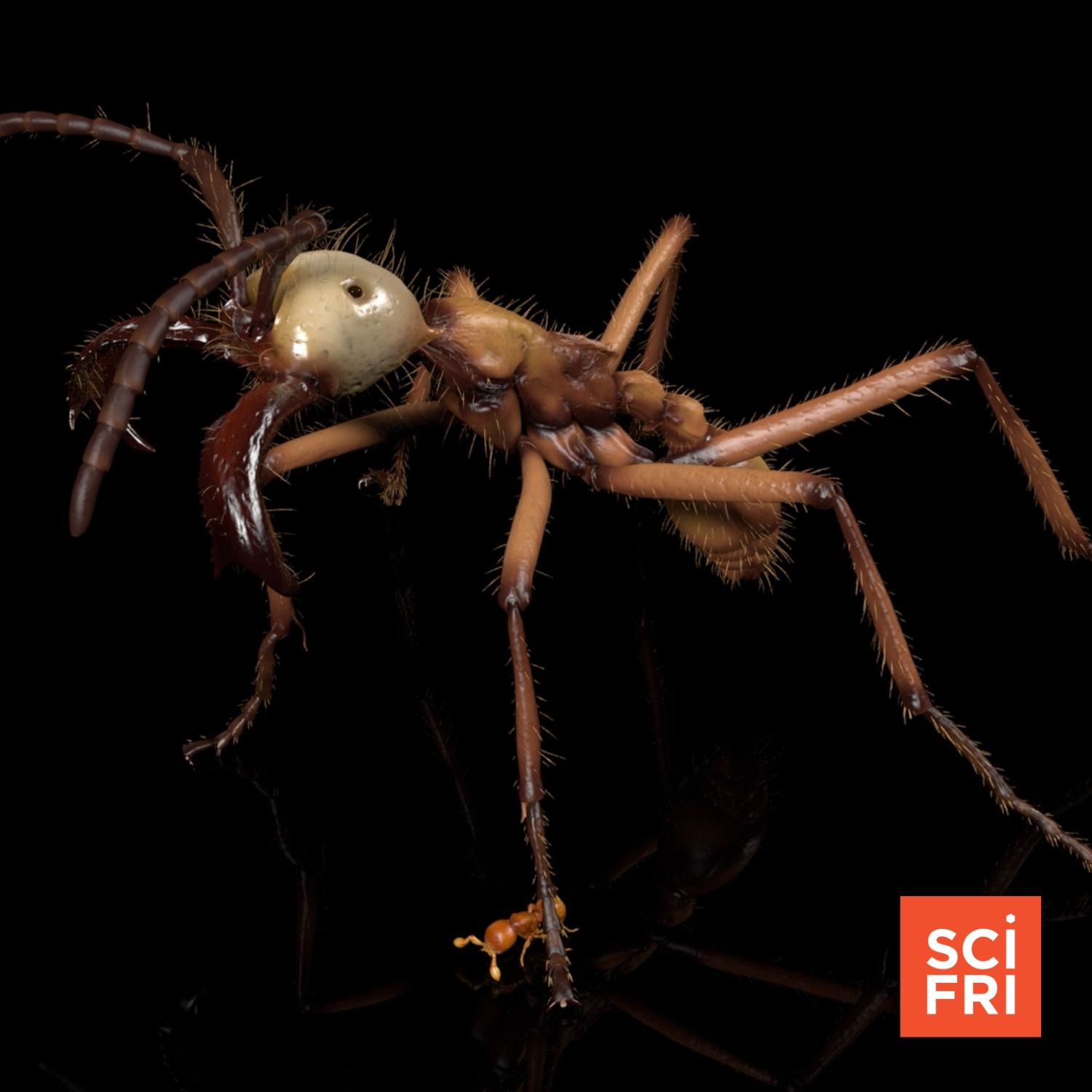
A project called Antscan has generated high resolution images of thousands of ants, representing over 700 species. To make it happen, researchers brought preserved ants from collections around the world to a particle accelerator in Germany. There, a powerful synchrotron X-ray source combined with a vial-swapping robot allowed the researchers to build a collection of 3D ant images, inside and out. Each voxel (like a 3D pixel) has a resolution of 1.22 micrometers—enough to see the tiny hairs on ant bodies, and distinguish individual muscle fibers.
Antscan researcher Julian Katzke joins us to describe the background of the project, and how the images could be used for science and art.
Check out Antscan images at our website.
Guest:
Dr. Julian Katzke is a postdoc at the Smithsonian National Museum of Natural History. He worked on the AntScan project while a PhD student at the Okinawa Institute of Science and Technology.
Transcripts for each episode are available within 1-3 days at sciencefriday.com.
Subscribe to this podcast. Follow our show on Instagram, TikTok, Facebook, and Bluesky @scifri and sign up for our newsletters. Got a science question that’s keeping you up at night? Call us: 877-472-4374
Hosted by Simplecast, an AdsWizz company. See pcm.adswizz.com for information about our collection and use of personal data for advertising.
Get every episode summarized
Each time Science Friday publishes, we email you a written briefing from the transcript — the topics, who appeared, and any specific claims, with the ad reads skipped.
Email me new episodesFree for 3 shows. No card needed.
Hosts & guests

Transcript ready
143 searchable segments. Every word is indexed and playable.
Full transcript
Science Friday — Building a digital ant gallery, from the ground up. Machine-transcribed; use the interactive transcript above to jump the player to any line.
Science Friday is supported by MathWorks, creator of MATLAB and Simulink software for technical computing and model-based design, MathWorks, accelerating the pace of discovery in engineering and science. Learn more at mathworks.com. Science Friday is brought to you by Progressive Insurance. Do you ever find yourself playing the budgeting game? Well, with the name your price tool from Progressive, you can find options that fit your budget and potentially lower your bills. Try it at Progressive.com. Progressive casualty insurance company and affiliates, price and coverage match limited by state law, not available in all states. WNYC Studios is supported by the New York Community Trust. Every neighborhood needs heroes. By giving through the New York Community Trust, you can be that hero. Help those in need. Create opportunity, improve health, nurture the arts, educate young people and protect the environment.
Direct your funding or let the trust team of experts connect you with nonprofits making a lasting difference. Turn stocks, retirement funds, even a house into a force for good. Be a local hero with the New York Community Trust. Visit give2.nyc. That's giveto.nyc. Hi, I'm Flora Lichtman and you're listening to Science Friday. In this seminal insect film, a bug's life, we're given a bug's eye view of the world. Oh, not since this is nothing compared to the twig of 93. We come face to mandible with ants. They're antennae, they're spindly legs, everything. And they're delightful, but perhaps the accuracy left a little something to be desired.
Enter the Ant Scan project, which has generated high-resolution x-ray images of over 2,000 real ants from over 700 species. And I got to say, the results really are stunning. This is ants in all of their beautiful and frightening glory. Joining me now to dig into this mound of ant data is Dr. Julian Katzka. He worked on this project while a PhD student at the Okinawa Institute of Science and Technology. Hi, Julian. Hi, Flora. Thanks for having me. Thanks for being here. Okay, so you came into this work comparing the mouth parts of dozens of ants species. Why mouth parts? So if you're a human and you live anywhere in the world, there's a pretty high chance that ants are all around you. And there's this now pretty well-known fact that the biomass of all ants equals or surpasses that of like all humans. And the total
diversity of ants species is enormous. And that also extends into their forms and shapes, particularly in the mouth parts because they are sort of the first tool that ants use in their daily lives. So like a mascot model is this South American army ant. They have small ant workers, but they're also large soldiers. And these large soldiers have these fish hook like mandibles that you could even use to like staple a wound. They're by the so fierce that they would never let go. And I think the theory here is that these mandibles are really just there to hurt something that is as big as a human. And so really like learning more about the evolution of these different mouth parts was motivating my PhD research. Describe for people who can't see it. And we'll put some on our website at scienceready.com slash ants. What do the images look like? So the images they are like derived from x-ray images,
right? So if you've ever taken like an x-ray image at a hospital, you have this c-through x-ray image. And then if you would like turn yourself around while taking these x-ray images like enough times, you could mathematically reconstruct the 3D volume. So that is like the technology behind computer tomography. And that's exactly what we did with the ants scan. The data that we end up with are like slices of images that are like gray scale. And so they contain the anatomy of the ants. And then you put them together and you can color them and make them beautiful too. Yes. So the tomography data is like the raw data and there's like plenty of methods that you can use to generate something out of it. So like in the first instance, it might just be like a measurement, like body size or whatever. But you can also use them in a way like Hollywood 3D animators would. Yeah. I mean, that's what that's what caught my eye. They were just amazing. They're sort of like 3D, but in this extreme detail. And they look like
aliens. I mean, the ants only look like aliens because they look alien to us, right? They are a bit strange because they're so small and like our eyes are just not good enough to really take it all in at once. And that's I think it's like one of the basic aspects why digital library of animal shapes and forms can be very important is because so much of like the world out there is just so tiny. And for us to to engage with it more, we need them at like the same scale or even that like larger scales than ourselves. Tell me about the tool that you used. I mean, is this something that that you could do in your local lab or like with a CT scanner in a hospital or do you need something special? So definitely not with a CT scanner in a hospital because the resolution is like usually much lower. But what we use here was a synchrotron light source. So a certain type of like particle accelerator that generates really high energy synchrotron x-ray radiation and we
harness that to do a micro CT scan very, very fast. But that's not the end of it, right? Because like a lot of x-ray radiation in a room would make it very dangerous. So another key part of the technology here that we have a robot that exchanges samples for us. And then the last thing is that we need a high-speed camera to like cope with all that speed. When you say it's really fast, how fast are we talking? For one ant. So for one ant, the imaging itself would be just about 30 seconds. And then at the time when we recorded just another 30 seconds just to transfer the data. Oh wow. So very fast. Very fast like especially compared to like what we do in laboratory micro CTs for insects. So there we talk about like more like 8 to 12 hours for one ant. Wow. Okay. So you can do a lot in a short amount of time. I mean, and can you load up your robot with like 2000 ants and just press play? At that time it was a little bit more limited. So we did
50 at a time and we still had to like jump through a few night shifts to make it work within a week. What resolution can you get to? So just in terms of numbers, the absolute resolution of like a voxel, which is a 3d pixel, is 1.22 micrometers. That's the highest resolution that we have. But in terms of like outer shape anatomy, you can resolve the delicate hairs that you find on like ant bodies. And then on the internal side, you can resolve up to like individual muscle fibers. So you're getting like all the squishy stuff inside the ants, not just the shell. Yeah. And it's really important, like especially for scientific application, that we have a technology where we can not only look at like the the outer appearance of the ants, right? There's so much inside that's going on and that used to be really very difficult to study and that like is the brain or the guts and the musculature of the ants, right? So like ants are really well known for
their insane strength and that must come from somewhere. But it's very challenging to study that. Having 3d data to look inside of them, that makes it a lot easier. You made the data freely accessible. How do you want people to use it? The way it's developing right now, I would always like see this in like two different ways. So there's the scientific aspect of using the data for like large scale projects on like ant evolution and biodiversity. But we also starting to see this kind of like more engagement with people that are not coming from the science world that might just be happy with like learning a little bit more about ants and like ant shapes and stuff. That's us by the way. That's your use case for that. Yeah. Nice. I think the number of like people working with like 3d data, like video games are getting ever more popular. That would be the other side of it. So that's like people that want to engage with like 3d data of things that they don't like normally see in their daily 3d lives.
These images are arresting. Would you describe them as beautiful? I think yes. I would say it's beautiful and it's an acquired taste. I think like the aspects of like symmetry and asymmetry and sculpture and like forms, extreme forms, they are something that like the more you look at it, the more you understand it, the more you come to appreciate it. Is there a world where you're going to try to train AI on this data so that we can learn more about anthropology or ant evolution using those tools? Yes, for sure. I think as soon as we're done here, I would have to sit down and do a bunch of annotations to train these models. No one's going on Instagram and it's like posting a picture of an ant and they're like, oh, this particularly is like the left hind leg of the ant and then we would have to do this like a million times over to really be able to generate a model like that. So we need to all start from scratch here and
make use the data that we're given now. I mean, how would you use an ant AI model? Why would that be useful? So for science, I would just use an AI model that might be able to like distinguish in the 3D data what is the access skeleton of the ant and what is the muscles of the ant and what is like all the nervous tissue of the ant and then I could do this for all two thousands of them and then bring in a phylogenetic tree and then I can really say something about the evolution of these traits. And then on the society aspect, like when I have a AI model that can tell me that like this part of the ant is its head, then we would have a much easier workflow to like getting like better and more accurate animations. Yeah, for a bug's life, you know, two or three. Yeah, it's like a bug's life too and boogaloo. Are you hoping to do this with other creatures? Yeah, so that's really like why we're calling it a pilot study is that really like by
using this like key technology that breaks the bottleneck of like scanning time and then arranging around it the like the collaboration effort but then also the processing efforts. We're really trying to show that it's that is possible to scale this up even further and like I mean I'm still I still have a vested interest in doing more of this for ants but there should be nothing that like excludes other small invertible groups or like other insect groups to be scanned like this. Was there anything that made you as you know as an ant person? Just go what? That's so really, let me just think I that that is a question like that that has never come up. No, I think I think as an ant person right I speak a lot about like the diversity of ants and sometimes it just becomes like an automatic response right that I say like that ants are so diverse
but with this data set like every time I open one of those scans and there's like two thousands of them right so there are still a lot of scans that I've never opened before that just makes me realize again and again how different these ants actually are. So even to me as like a researcher I sometimes like rush over the fact that they are so diverse and so different and like I don't really fully and compassionate but when I open one of these guys that really hits me immediately. Right and it's easy to overlook as you say because we can't resolve those details with our eyes so to really appreciate that diversity you need a tool like this. Exactly. Dr. Julian Katzka a postdoc at the Smithsonian Museum of Natural History he worked on this project while he was a PhD student at the Okinawa Institute of Science and Technology. Thank you Julian. Thank you. And you can see some of this ant glim on our website science Friday.com slash ants. Seriously it is worth a look I promise you will not regret it. This episode was produced
by Charles Berquist and if this podcast helps you get a different view of the world please recommend it to a friend, insect or otherwise or leave even just like a teeny tiny little review wherever you get your podcasts. Thank you for listening. I'm Flora Lichtman. WNYC Studios is supported by Atio. The AICRM for modern teams. Atio is the CRM that actually knows what's going on. Every customer email and call becomes context. Atio can act on instantly. Need to prep for a meeting? Done. Stuck on what to write in that follow up already drafted. Want to know how to win this deal? Just ask Atio. Powered by Universal Context. Atio's intelligence layer you can search, update and create with AI across your entire customer ecosystem.
Ask more from your CRM. Ask Atio. Try Atio for free by going to Atio.com slash WNYC. That's atio.com slash WNYC. WNYC Studios is supported by Odoo. When you buy business software from lots of vendors the costs add up and it gets complicated and confusing. Odoo solves this. It's a single company that sells a suite of enterprise apps that handles everything from accounting to inventory to sales. Odoo is all connected on a single platform in a simple and affordable way. You can save money without missing out on the features you need. Check out Odoo at odo.com. That's odo.com.
More episodes
More from Science Friday

Did scientists just find a dark matter particle? Maybe
Science Friday

Why physics and philosophy need each other
Science Friday

Recall rodeo: A food safety update + Why cars are catching fire
Science Friday

Is there science behind the ‘nervous system reset’?
Science Friday